
Finding a monitor that makes your games look real and feel instant is a tall order. You need a screen big enough to fill your peripheral vision, with a fast enough refresh rate so you never miss a split-second dodge, and colors so rich the world pulls you in. This guide breaks down exactly which 32-inch monitors deliver that first-person perspective immersion without wasting your money on specs that don’t matter.
I’m Min — the co-founder and writer behind Gadgets Feed. This guide is built by comparing the manufacturers’ published specifications and the patterns across verified customer reviews, so you get each pick’s real strengths and trade-offs instead of marketing spin.
Whether you are a competitive esports player or a single-player campaign explorer, the right 32 inch first person perspective monitor will turn every scene into a near-tactile experience and every reaction into a victory.
How To Choose The Best 32 Inch First Person Perspective Monitor
First-person games demand three things from a monitor: instant response to your mouse or controller, a high refresh rate so motion stays smooth, and great contrast so you can spot enemies hiding in dark corners. Here are the key specs to focus on.
Response Time & Refresh Rate
Response time (measured in milliseconds or ms) is how fast a pixel changes color. For first-person shooters, anything above 5ms can look blurry during fast movements. Aim for 1ms or lower. Refresh rate (measured in Hz) is how many times the screen updates per second — 144Hz is good, but 180Hz or 240Hz feels even smoother, making your aim feel more connected to your hand.
Panel Type: OLED vs Fast IPS
OLED panels produce perfect blacks by turning off individual pixels, which gives an incredible contrast ratio (often over 1,000,000:1). This makes dark game scenes look deep and realistic. Fast IPS panels are very good too, but their contrast ratio is usually around 1000:1, meaning blacks look more like dark gray. OLED also responds faster (0.03ms), but it costs more.
Resolution and Your Graphics Card
4K (3840 x 2160) gives you the sharpest image, but requires a powerful graphics card to run smoothly at high refresh rates. QHD (2560 x 1440) is a great middle ground — much sharper than 1080p, but easier on your GPU. If your card is a few years old, QHD will give you a better frame-rate experience than 4K.
Quick Comparison
On smaller screens, swipe sideways to see the full table.
| Model | Category | Best For | Key Spec | Amazon |
|---|---|---|---|---|
| ASUS ROG Swift PG32UCDM | Premium OLED | No-compromise gaming | 240Hz / 0.03ms QD-OLED | Amazon |
| MSI MPG 321URX | Premium OLED | Stunning HDR value | 240Hz / 0.03ms QD-OLED | Amazon |
| LG 32GX850A-B UltraGear | Premium OLED | Glossy screen clarity | 165Hz / 0.03ms WOLED | Amazon |
| ASUS ROG Strix XG32UCG | Mid-Range | Best dual-mode value | 4K 160Hz / FHD 320Hz | Amazon |
| Samsung Odyssey G50D | Mid-Range | High FPS at QHD | 180Hz / 1ms Fast IPS | Amazon |
| KTC H32P22P | Budget | 4K on a budget | 165Hz / 1ms Fast IPS | Amazon |
In‑Depth Reviews
1. ASUS ROG Swift PG32UCDM

The 0.03ms GtG response time and 240Hz refresh rate make the ASUS ROG Swift PG32UCDM the top pick for competitive first-person shooter players who demand near-zero motion blur. Its QD-OLED panel ensures you see a muzzle flash and react before the pixel finishes changing.
The 4K resolution (3840 x 2160) at 240Hz is exceptionally rare, and the 1,500,000:1 contrast ratio delivers perfect blacks — so you spot enemies in dark corners without washed-out shadows. Buyers report the glossy screen enhances clarity and immersion, making reflections minimal in practice. A custom heatsink and graphene film reduce the risk of burn-in (image retention from static elements like a HUD), which is a common concern with OLED panels.
The PG32UCDM leaves little to want for the highest-end experience in first-person shooters or RPGs. Its brightness reaches 1000 cd/m², and the 3-year warranty includes burn-in coverage for peace of mind. This is the full package, but buyers who prefer a matte screen to avoid any reflections should look elsewhere.
Why it’s great
- 240Hz combined with 0.03ms response time for instant motion clarity
- Infinite contrast with QD-OLED makes dark scenes pop
- 3-year warranty with burn-in coverage
Good to know
- Glossy screen reflects bright room lights (best in a controlled-light setup)
- High price point compared to IPS alternatives
2. MSI MPG 321URX QD-OLED

The MSI MPG 321URX matches the ASUS ROG Swift on speed — both deliver a 0.03ms response time at 240Hz — but costs noticeably less, making it a smarter buy if you want OLED performance without the absolute highest premium. Its QD-OLED (quantum dot OLED) panel also produces a 1.5M:1 contrast ratio, so black levels are nearly identical to the top pick for first-person immersion.
Where the MSI pulls ahead is sheer value for the money — it packs the same 4K 240Hz specs with VESA DisplayHDR True Black 400 (a certification meaning it meets strict standards for deep black and bright highlight performance). Owners mention the HDR colors are vibrant and stunning, and the built-in OLED Care 2.0 helps prevent burn-in. It also includes a 90W USB-C port, letting you charge a laptop directly from the monitor.
If you want the incredible contrast and speed of QD-OLED but prefer to spend on a GPU upgrade instead of the absolute most expensive screen, the MPG 321URX is the smarter pick. For most buyers, this is the best balance of performance and cost. Buyers who need a stand with extra height range should note the stand is limited.
Where it shines
- Same 240Hz and 0.03ms as the top pick at a lower cost
- 90W USB-C charging for laptops
- DisplayHDR True Black 400 certification
Worth noting
- Stand lacks a wide adjustment range
- Some users note purple tint reflections, though customers note it is unnoticeable in practice
3. LG 32GX850A-B UltraGear
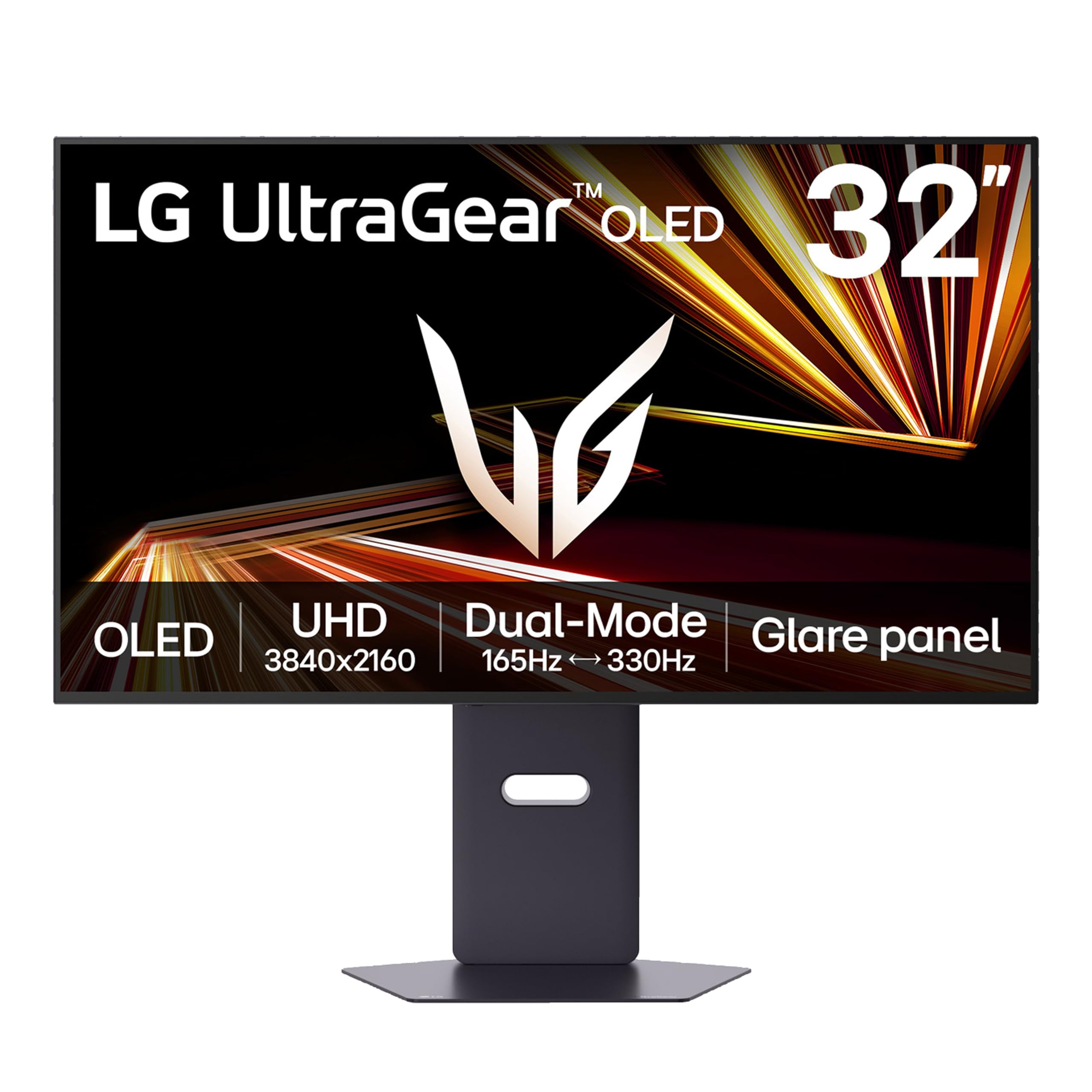
If you play in a room with controlled lighting and want the clearest, most vivid image possible, the LG 32GX850A-B UltraGear is a strong alternative. Its glossy WOLED (white OLED using a color filter) display eliminates the unnatural black glow of IPS panels and delivers 1.5M:1 contrast, making dark scenes in games like *Alan Wake 2* or *Dead Space* look genuinely deep.
While it runs at 165Hz (versus the 240Hz of the MSI and ASUS OLEDs), its 0.03ms response time is just as fast, so motion blur is non-existent. A neat trick is its dual-mode: you can run 4K at 165Hz for story games, or switch to Full HD at 330Hz for ultra-competitive shooters. Reviewers point out upgrading from a 1440p IPS to this OLED was a “crazy difference” thanks to true blacks and sharp text. It also has three UL certifications for anti-glare, flicker-free, and low-blue-light comfort.
The catch is brightness — at 275 cd/m² typical, it is less punchy for HDR highlights than the ASUS ROG Swift PG32UCDM (1000 cd/m² peak). But if you value a glossy coating that enhances clarity over a matte finish, this is your best OLED pick. If you need high brightness for HDR gaming, stick with the ASUS or MSI QD-OLED options.
What stands out
- Glossy OLED delivers best-in-class clarity and deep blacks
- Dual-mode: 4K 165Hz or FHD 330Hz via hotkey
- Three UL certifications for eye comfort during long sessions
The trade-offs
- Lower peak brightness (275 cd/m²) than QD-OLED rivals
- Glossy finish can be reflective in bright rooms
4. ASUS ROG Strix XG32UCG
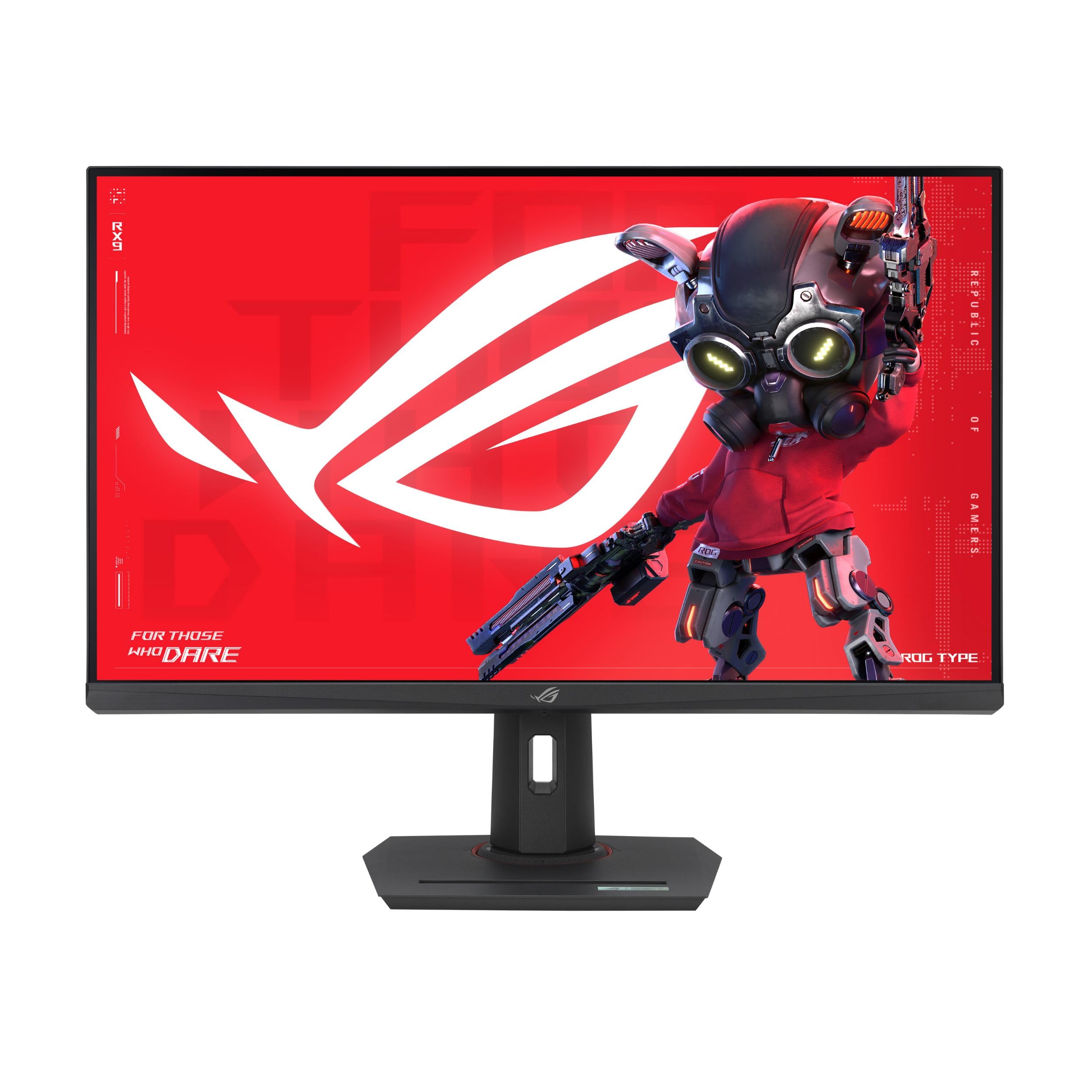
The single number that matters most in this category is refresh rate, and the ASUS ROG Strix XG32UCG scores a dual-mode 160Hz at 4K or 320Hz at Full HD, letting you switch between detailed single-player worlds and competitive first-person shooters where every millisecond matters. In FHD mode, the faster refresh rate gives you an edge in reaction-speed games like Counter-Strike or Valorant — sharper than the Samsung Odyssey G50D at 180Hz in clarity, though both are fast.
Despite being a Fast IPS panel (not OLED), its 0.3ms response time is remarkably low, nearly matching OLED territory while costing significantly less. The 95% DCI-P3 color gamut ensures vibrant colors, and ASUS Extreme Low Motion Blur Sync (ELMB SYNC) eliminates ghosting even when the refresh rate varies. Shoppers say the semi-gloss screen and vivid colors make this a great all-around monitor for both work and gaming.
If you want the sharpness of 4K for everyday use but also crave an ultra-high refresh rate for competitive FPS games without buying two monitors, the XG32UCG is the best all-in-one option, making the 0.3ms response time gap versus the 0.03ms OLEDs negligible for most players — a strong price-to-value read for those who prioritize versatility over perfect black levels.
The upsides
- Dual-mode: 4K 160Hz or FHD 320Hz for different game types
- 0.3ms response time — nearly OLED-fast
- Excellent color coverage (95% DCI-P3)
Keep in mind
- Contrast ratio is 1000:1, so blacks are not as deep as OLED
- Requires a powerful GPU to drive 4K 160Hz
5. Samsung Odyssey G50D

At this lower price you get a fast QHD 32-inch screen that lets a mid-range GPU push high frame rates without the strain of 4K. The 2560 x 1440 resolution delivers 1.7x the pixel density of standard 1080p for sharp images, while the 180Hz refresh rate and 1ms GtG response time keep motion smooth and clear.
The 180Hz refresh rate beats the ASUS ROG Strix XG32UCG (160Hz) by about 12% for smoother motion. The Fast IPS panel supports VESA DisplayHDR 400 for brighter highlights in dark scenes, and buyers report G-Sync works flawlessly to eliminate screen tearing in fast-paced FPS games. The stand swivels, tilts, and adjusts in height — more adjustable than the MSI MPG 321URX’s stand — making it easy to find a comfortable viewing angle.
If your graphics card is a few years old or you simply prefer high frame rates over maximum pixel count, the G50D gives you a fast, responsive 32-inch screen that does not force you to upgrade your entire PC. It is the perfect budget buyer for the competitive player who wants smooth motion and sharp QHD detail without the cost of a 4K panel or a new GPU.
Why we’d pick it
- 180Hz refresh rate — faster than many similarly priced rivals
- QHD resolution balances sharpness with GPU demands
- Full ergonomic stand: height, swivel, tilt adjustability
A few caveats
- Contrast ratio is 1000:1, typical for IPS (blacks look gray in dark rooms)
- Some users report poor default color calibration requiring adjustment
6. KTC H32P22P
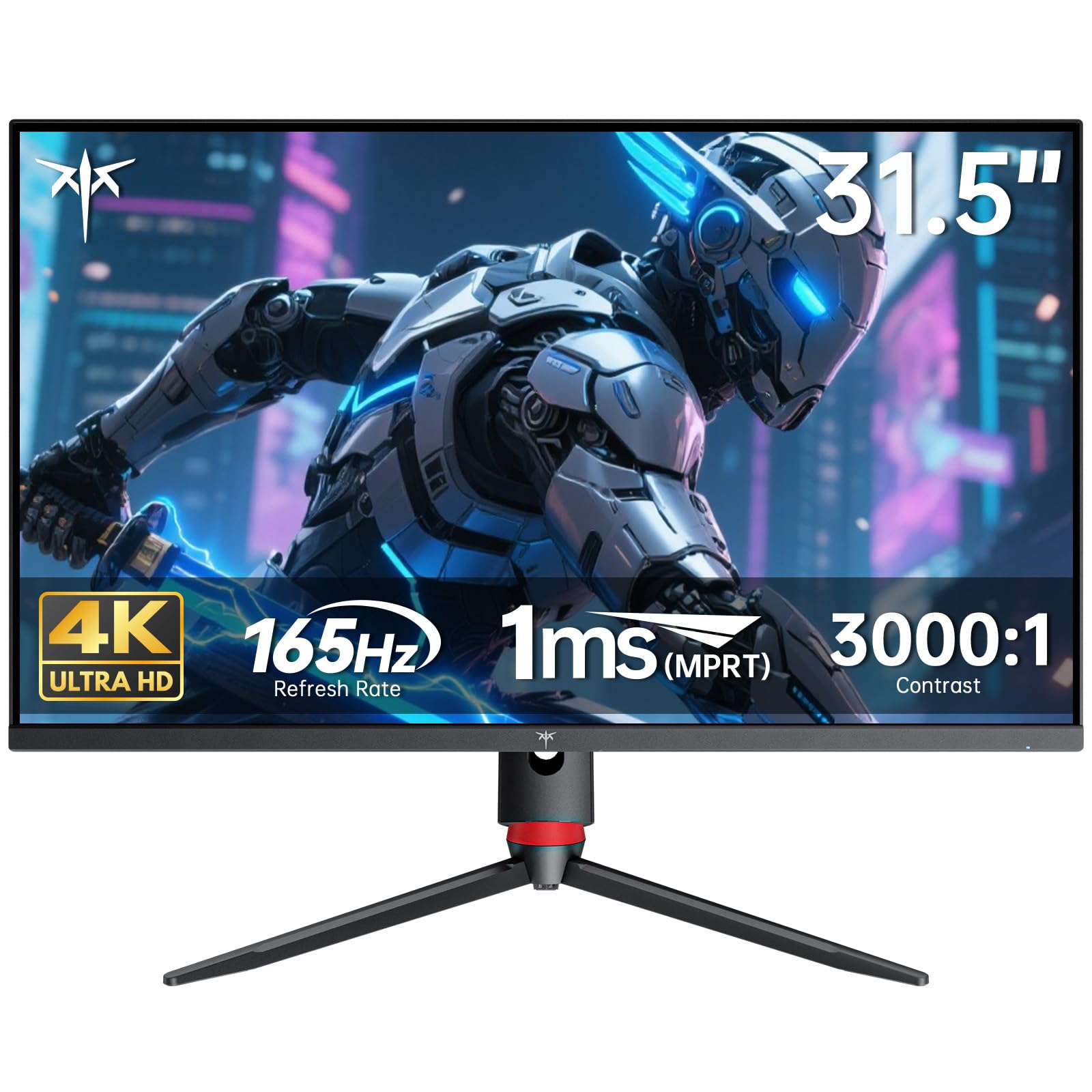
The KTC H32P22P is perfect for the budget-conscious gamer who wants 4K resolution and a high refresh rate in a 32-inch screen without paying OLED prices. It delivers a 3840 x 2160 resolution and 165Hz refresh rate via a Fast IPS panel with HDMI 2.1 and DisplayPort 1.4, making it suitable for both PC and next-gen consoles like the PS5.
Its standout spec is the 3000:1 contrast ratio — that is 3x higher than the Samsung Odyssey G50D’s 1000:1, meaning blacks look noticeably deeper for an IPS panel, which helps you spot enemies in shadows. The 1ms response time keeps motion clear. Owners mention the colors are gorgeous (121% sRGB) and the price-to-performance is “awesome.” However, some note the monitor has a minor non-active display area (a small black border around the active screen).
If your budget is tight but you still want a 4K 32-inch screen for first-person games and productivity, the KTC H32P22P is a legitimate contender. You sacrifice absolute color accuracy and HDR punch versus the MSI MPG 321URX, but you keep the high resolution and a very playable refresh rate. Just be aware that its minor non-active display border may be a slight distraction for those who prefer a seamless edge-to-edge screen.
Strong points
- 4K resolution at an entry-level price point
- 3000:1 contrast ratio — 3x higher than typical IPS monitors
- HDMI 2.1 for PS5 and Xbox Series X at full 4K 120Hz
Before you buy
- Brightness is 300 cd/m², which is modest for HDR content
- Some users mention a small inactive border around the screen
Understanding the Specs
Response Time (GtG)
This is how fast a single pixel can change from gray to gray, measured in milliseconds (ms). A lower number means less blur when you spin your view in a first-person game. For competitive play, 1ms is good, but high-end OLEDs achieve 0.03ms — so fast the human eye cannot perceive any motion blur.
Contrast Ratio
Contrast ratio compares the brightest white to the darkest black the monitor can display. A 1000:1 ratio (common on IPS panels) means blacks look dark gray in a dim room. A 1,500,000:1 ratio (OLED) means blacks are truly black because the pixels turn off completely. In FPS games, higher contrast helps you see enemies in shadowed corners.
Refresh Rate (Hz)
Refresh rate tells you how many times per second your monitor draws a new image. 60Hz feels sluggish for gaming; 144Hz is smooth; 180Hz and 240Hz make motion feel so fluid that your aim feels directly connected to your hand. Your graphics card needs to output enough frames per second (FPS) to match the refresh rate to see the benefit.
Adaptive Sync (G-Sync / FreeSync)
Adaptive sync matches your monitor’s refresh rate to your graphics card’s frame output, preventing screen tearing (where two different frames appear on screen at once during a fast turn). G-Sync works with NVIDIA cards, while FreeSync is for AMD cards. Many modern monitors support both.
FAQ
What is the best refresh rate for first-person shooters?
Is 4K worth it on a 32-inch monitor for gaming?
What does OLED burn-in mean and should I worry?
Is G-Sync or FreeSync better for first-person games?
Final Thoughts: The Verdict
For most buyers, the 32 inch first person perspective monitor winner is the MSI MPG 321URX because it delivers the stunning contrast and instant response of QD-OLED at a more accessible price than the ASUS flagship. If you want the absolute highest refresh rate for competitive gaming, grab the ASUS ROG Swift PG32UCDM. And for a budget-friendly 4K setup that still plays well with consoles and PCs, the KTC H32P22P offers strong value with its 3000:1 contrast ratio.