
Facing down acres of wet leaves, pine needles, or light snow with a handheld blower leaves your arm numb and your yard half-finished. A backpack blower puts the weight on your hips and shoulders — not your wrists — while delivering the engine displacement (the size of the engine cylinder, measured in cubic centimeters or cc) you need to move piles instead of single leaves. The real question: how much air volume and speed do you actually need, and which engine size gets you there without breaking your back or your budget?
I’m Min — the co-founder and writer behind Gadgets Feed. This guide is built by comparing the manufacturers’ published specifications and the patterns across verified customer reviews, so you get each pick’s real strengths and trade-offs instead of marketing spin.
After looking at nine models from a 31cc starter unit to a 79.9cc commercial beast, the winner for most sits in the middle: enough Cubic Feet per Minute (CFM) to clear a driveway in passes, not hours, at a price below pro gear. This guide to the best backpack leaf blowers breaks down everything from air volume to harness comfort so you buy the right tool the first time.
How To Choose The Best Backpack Leaf Blowers
Buying a backpack leaf blower means choosing between air volume and air speed, gas and battery, and how much weight you are willing to carry. Here is what actually matters on the spec sheet.
Air Volume vs. Air Speed: CFM and MPH Explained
Cubic Feet per Minute (CFM) tells you how much air the blower moves — think of it as the width of your cleaning path. Higher CFM means you push a broad pile of leaves in fewer passes. Miles per Hour (MPH) tells you how hard that air hits — it dislodges wet, stuck, or compacted debris. For dry leaves on pavement, you want high CFM. For wet leaves stuck to grass or gravel, you need the MPH to break them loose first.
Engine Displacement: The Size That Determines Longevity
Engine displacement (measured in cubic centimeters, or cc) is the volume of the engine cylinder. A bigger cc number means more power and, generally, a longer working life because the engine uses larger, more durable components. A 31cc engine works for a small suburban lot, while a 63cc or 79.9cc engine is built for daily commercial use on multiple acres. The catch is extra weight — expect roughly 17 to 23 pounds depending on the cc class.
Harness Comfort and Vibration Control
A backpack blower’s harness transfers the engine weight from your shoulders to your hips. Look for padded, ventilated back pads and adjustable straps that fit over a jacket in cooler months. Anti-vibration mounts (rubber bushings between the engine and the frame) reduce the buzzing that numbs your hands and arms over long sessions. A poor harness makes a great engine miserable to use.
Quick Comparison
On smaller screens, swipe sideways to see the full table.
| Model | Category | Best For | Key Spec | Amazon |
|---|---|---|---|---|
| Echo PB-9010T | Premium | Commercial / Heavy Acreage | 1110 CFM, 79.9cc engine | Amazon |
| Husqvarna 560BTS | Premium | Professional / Large Properties | 631 CFM, 232 MPH, 65.6cc | Amazon |
| Echo PB-580T | Mid-Range | Reliable Long-Term Use | 510 CFM, 58.2cc, 70 dB | Amazon |
| HTK 63CC Blower | Best Value | High Power at Budget Price | 665 CFM, 205 MPH, 63cc | Amazon |
| Thalorus 52cc Blower | Mid-Range | Lightweight Power | 550 CFM, 230 MPH, 52cc | Amazon |
| Greenworks 80V Cordless | Mid-Range | No Gas / Quieter Operation | 610 CFM, 180 MPH, 8.1 lbs | Amazon |
| Wild Badger Power 43cc | Budget | Entry-Level Backpack | 650 CFM, 152 MPH, 43cc | Amazon |
| LawnMaster NPTBL31AB | Budget | Electric Start / Easy Use | 470 CFM, 175 MPH, 31cc | Amazon |
| Thalorus 52cc | Budget | Small Jobs / Light Use | 550 CFM, 230 MPH, 17 lbs | Amazon |
In‑Depth Reviews
1. Echo PB-9010T

79.9cc and 1,110 CFM make the Echo PB-9010T the top pick for anyone clearing multiple acres of wet, heavy debris without stopping. Its 79.9cc two-stroke engine pushes 1,110 Cubic Feet per Minute (CFM) of air volume — more than double most mid-range blowers. That means you can move a 14-tree oak lot in roughly two hours, according to buyers. At 220 Miles per Hour (MPH), it has the jet-stream force to peel wet leaves off grass and launch small rocks out of your path.
The tube-mounted throttle gives you precise control of that massive airflow. The harness straps are well-padded enough that reviewers describe the 23-pound dry weight as manageable for a full day of work. It starts reliably on the first or second pull when warm, though the assembly instructions are notoriously vague about how to connect the accordion-style tube extensions.
The honest limit: it burns roughly one gallon of fuel per 90 minutes at full throttle, and it is loud enough that ear protection is non-negotiable. If your property is a half-acre of dry grass, this is overkill. But for wet leaves, deep snow, or professional demands, nothing else in this roundup moves this much air.
Why it’s great
- Class-leading 1110 CFM clears huge areas in passes, not hours
- 79.9cc engine is built for daily commercial use
- Tube-mounted throttle gives one-hand control
Good to know
- Heavy at 23 pounds — you feel it after 90 minutes
- Assembly instructions are poorly laid out
- Fuel consumption is high; budget for premix
2. Husqvarna 560BTS
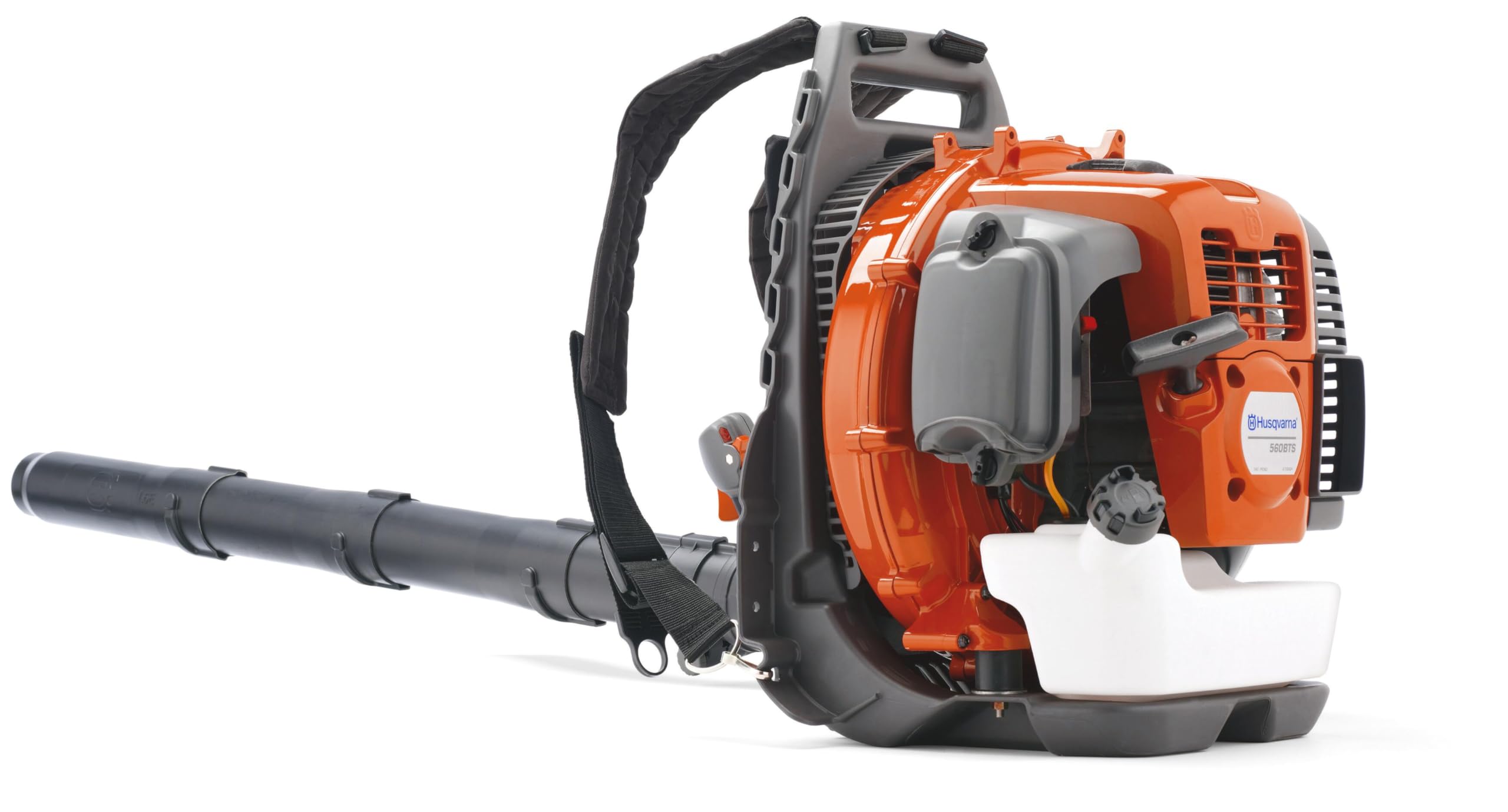
The Husqvarna 560BTS beats the Echo PB-9010T on air speed — 232 MPH vs 220 MPH — but falls behind on air volume with 631 CFM compared to 1110 CFM. That makes this Husqvarna better at blasting wet, caked-on debris loose, while the Echo is better at moving huge piles in bulk. The 65.6cc X-TORQ engine delivers 30 Newtons of blow force, which means it pushes sticks, wet leaves, and even light gravel without bogging down.
The two-stage air filter catches fine dust and debris, which extends engine life on dusty properties. Reviewers report it starts on the second pull every time even after sitting for weeks, and the tube-mounted throttle with an offset handle reduces wrist strain during long sessions. The harness is ventilated and distributes weight evenly, though buyers report there is no chest strap to secure the pack during active movement.
Choose the Husqvarna 560BTS over the Echo if you deal with tough, stuck-on debris on slopes or gravel where air speed matters more than raw volume. It is still heavy at 23.2 pounds and very loud, but the commercial-grade build means professionals report years of daily use without failure.
Where it shines
- Highest MPH in this roundup at 232 for dislodging wet debris
- Two-stage air filter protects the engine from fine dust
- Starts reliably on the second pull even after storage
Worth noting
- No chest strap included on the harness
- Loud enough that hearing protection is mandatory
- Heavy at 23 pounds; not ideal for smaller users
3. Echo PB-580T

You are clearing a wet, leaf-clogged driveway on a Saturday morning, and you want a blower that starts on the second pull and finishes the job without waking the neighbors. The Echo PB-580T is the choice for homeowners who want proven reliability without paying for commercial-level air volume they will never use. Its 58.2cc engine produces 510 CFM and 215 MPH — enough to clear a two-car driveway and most suburban lots in a single pass. At 70 decibels (dB), it is noticeably quieter than many competitors, which means you can use it in noise-sensitive neighborhoods without complaints.
Reviewers praise the easy maintenance and the fact that replacement parts are widely available because Echo has been making this platform for years. One buyer replaced a 20-year-old Echo with this model and reported it felt identical in comfort and power. The dry weight of 22.6 pounds is average for this class, but the vented back pad circulates air to keep you from overheating.
The standout spec here is the long-term value. At 510 CFM you give up about 120 CFM compared to the HTK 63CC at a lower price point, but the Echo brand track record means this blower is likely to outlast two budget blowers. If you want a tool that just works for a decade, this is it.
What stands out
- Quietest gas model at 70 dB for residential use
- Proven Echo reliability with easy parts availability
- Vented back pad reduces sweating
The trade-offs
- Assembly manual is poorly organized
- 510 CFM is adequate but not class-leading
- Heavier than some budget options at 22.6 lbs
4. HTK 63CC Backpack Blower
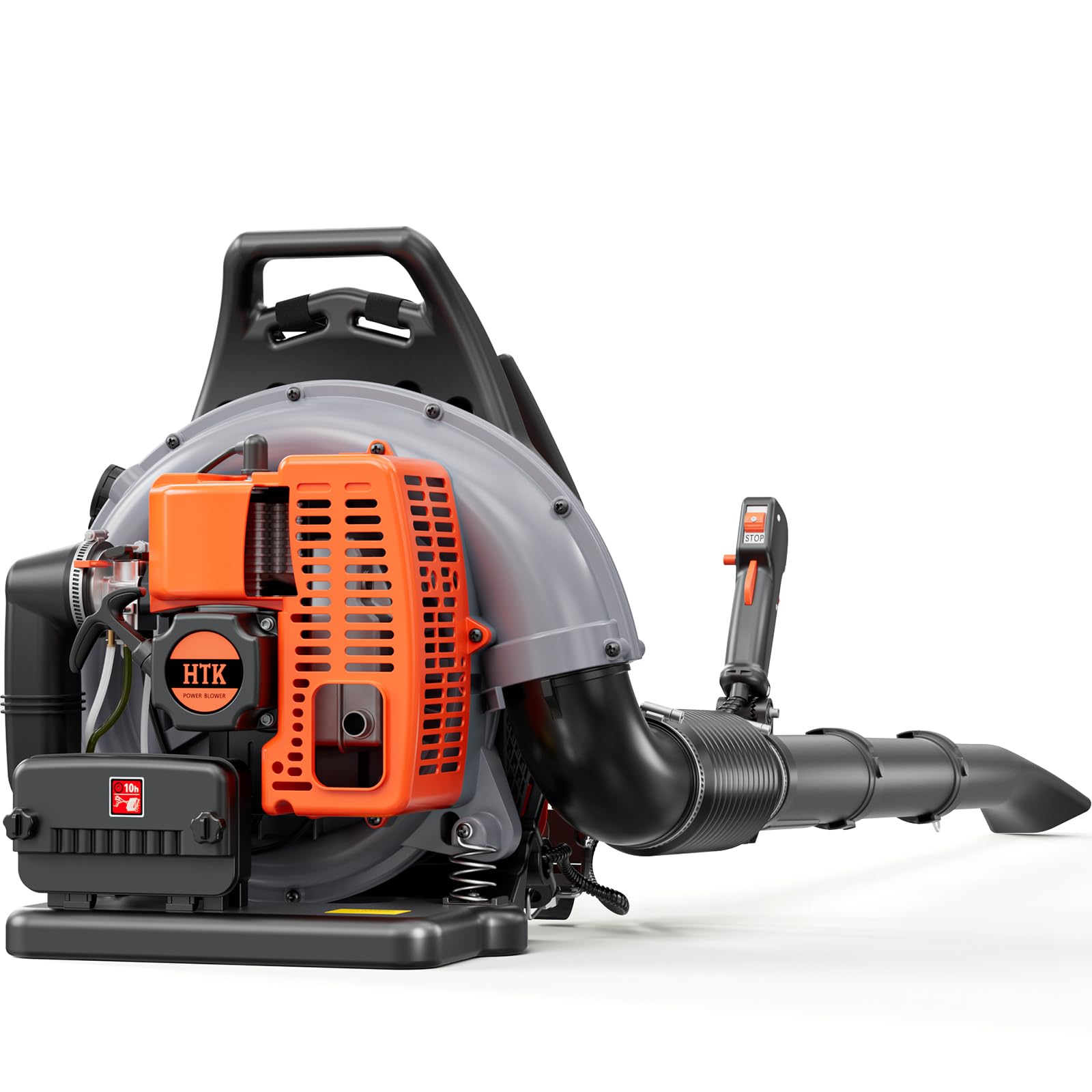
The single number that matters most in backpack blowers is CFM (Cubic Feet per Minute), and the HTK scores 665 CFM — 41% more air volume than the LawnMaster 31cc model, at a very competitive price. That extra volume means you clear wet leaves and light snow in far fewer passes, which is the real measure of how fast your yard work finishes. The 63cc engine is the largest displacement in the value tier, giving it commercial-grade grunt without the commercial price tag.
The downside you accept with the HTK is build quality. Owners mention that the plastic tubes feel thin, and the backpack pad and straps appear flimsy compared to brands like Echo or Husqvarna. One reviewer noted the actual weight is 18.25 pounds despite the listed 21 pounds, but the harness still spreads the load decently. At 205 MPH, it is slightly behind the 52cc Thalorus blower on air speed (230 MPH vs 205 MPH), but the higher CFM makes it better at moving bulk piles.
For a mid-range budget, you get a 63cc engine and 665 CFM that would cost significantly more from a premium brand. If you are willing to trade some polish on the plastics for raw power, the HTK is the smartest price-to-performance buy in the group.
The upsides
- 665 CFM delivers 41% more air than the 31cc class
- 63cc engine provides commercial-grade power
- Easy start with air purge system
Keep in mind
- Thin plastic tubes and straps feel less durable
- Very loud — hearing protection is essential
- Assembly manual could be clearer
5. Thalorus 52cc Backpack Blower
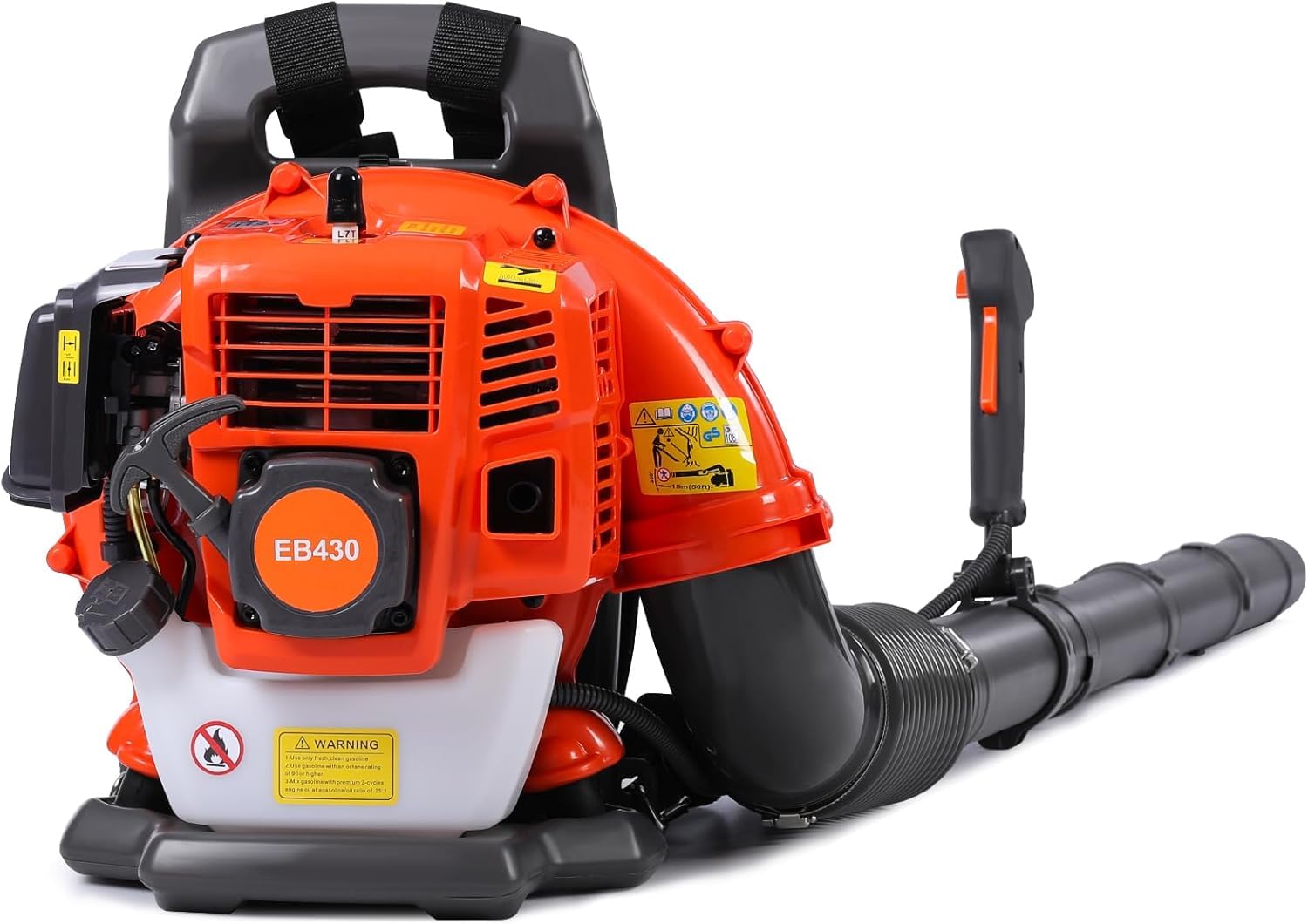
What you actually get at this lower price is the Thalorus 52cc, which hits 230 MPH — 12% faster than the HTK 63CC blower — making it better at breaking loose wet leaves stuck to grass and gravel. But its 550 CFM falls 115 CFM short of the HTK, so it needs more passes to move the same pile. So you choose between speed (Thalorus) and volume (HTK) based on what your yard throws at you.
Customers note that the low-vibration harness and adjustable straps are genuinely comfortable for longer sessions, and the 1-liter tank delivers up to 45 minutes of continuous run time. One buyer mentioned that the screw holding the trigger to its attachment point kept falling out until it was lost entirely — a small but annoying quality issue. The engine starts in two pulls when cold, and the thumb throttle with cruise control lets you lock a steady speed.
The standout spec is the 230 MPH top speed combined with reasonable weight (17 pounds claimed, though the listing also says 13.6 pounds in different places). If your main problem is wet leaves plastered to the lawn, this blower’s speed will save you more time than a higher-CFM model would — it is perfect for the budget buyer whose yard is dominated by wet, stuck debris rather than dry, deep leaf piles.
Why we’d pick it
- Top speed of 230 MPH for dislodging stubborn wet leaves
- Low-vibration harness is comfortable for long jobs
- Cruise control reduces thumb fatigue
A few caveats
- Trigger screw may loosen over time
- Shoulder straps are short when worn over a coat
- Loud enough that earplugs are recommended
6. Greenworks 80V Cordless Backpack Blower

The Greenworks 80V is built for you if you hate mixing gas and oil, dealing with pull cords, or smelling exhaust while you work. Its brushless motor delivers 610 CFM and 180 MPH — enough power that reviewers point out it matches or beats many gas handhelds, though it falls short of gas backpack units that push 200+ MPH.
The turbo button gives you on-demand burst power, but reviewers warn it drains the battery fast — a 4 Amp-hour battery lasts about one hour at normal speed and significantly less in turbo mode. The backpack is lightweight at just 8.1 pounds (tool only), less than half the weight of most gas models. The harness has no vibration since there is no engine shaking. One buyer notes the tube angles downward, requiring you to lean the blower back to blow straight.
The honest limit is runtime. You will likely need two 4Ah batteries to finish a medium-sized yard, and the battery and charger are sold separately, which adds to the upfront cost. If you have a smaller property and already own Greenworks 80V tools, this is a clean, quiet, comfortable choice — just be aware that its battery life may not stretch far enough for larger jobs without extra packs.
Strong points
- Weighs just 8.1 lbs — less than half a gas model
- No gas, no oil mixing, no exhaust fumes
- Turbo button provides on-demand power boost
Before you buy
- Battery and charger sold separately — significant added cost
- Runtime is limited; you may need two batteries
- Tube angles downward, requiring you to tilt the unit
7. Wild Badger Power 43cc Backpack Blower

The Wild Badger Power 43cc is the most affordable way to get into a backpack-style blower, and its 650 CFM air volume is surprisingly high for the price — only 15 CFM behind the much more expensive HTK 63CC model. The 43cc two-stroke engine produces 152 MPH, which is 78 MPH behind the Thalorus (230 MPH). So it struggles more with wet, compacted debris. But for dry leaves on pavement or grass, the high CFM moves them efficiently.
What that budget price gets you is a lightweight 17.4-pound unit with a 33.8-ounce fuel tank that runs 50 to 60 minutes continuously. The adjustable control handle rotates 90 degrees to reduce wrist strain, and the padded shoulder straps are breathable. However, shoppers say a real reliability concern: one reviewer stated the blower worked well for about eight hours over one season, then shut down and would not start despite cleaning the air filter and changing the gas. Other buyers report years of use, so consistency is a gamble.
If your budget is tight but your yard is too large for a handheld, the Wild Badger Power offers a hard-to-beat CFM-to-dollar ratio — just know you are trading long-term reliability for that low entry cost.
What we like
- 650 CFM at a budget price delivers strong dry-leaf performance
- Lightest gas model at 17.4 pounds with breathable straps
- 90-degree adjustable handle reduces wrist fatigue
The downsides
- Only 152 MPH — weak against wet, stuck debris
- Reliability is inconsistent; some units fail within a season
- Gas cap seal may tear; strap breakage reported after a year
8. LawnMaster NPTBL31AB No-Pull Backpack Blower

The 31cc engine with push-button electric start — no pull cord — makes the LawnMaster NPTBL31AB the top pick for anyone with arthritis, shoulder injuries, or a strong aversion to yanking a starter rope.
The included 7.2V rechargeable battery is designed to give up to 150 starts per charge, but reviewers report it lasts about five starts in practice, requiring frequent recharging. There is no pull-cord backup, so if the battery dies, you are done until it charges. The automatic choke and cruise control make operation simple, and one buyer with arthritic shoulders said this blower was exactly what they needed to manage their 10-acre property with maple trees.
Choose this over the Wild Badger Power if your main barrier to yard work is the physical difficulty of starting a gas engine. The trade-off is clear: you get push-button starting convenience, but the 31cc engine has less power and longevity than the 43cc or 52cc competitors.
Why it’s great
- Electric push-button start eliminates pull-cord struggles
- Lightweight and comfortable for users with physical limitations
- Automatic choke and cruise control simplify operation
Good to know
- 31cc engine is underpowered compared to 43cc+ models
- Battery lasts ~5 starts, requiring frequent recharging
- No pull-cord backup if battery dies
Understanding the Specs
CFM — Cubic Feet per Minute
This is the volume of air the blower moves. Higher CFM means you can push a wider pile of leaves in fewer passes. A blower with 600+ CFM clears a two-car driveway in under three minutes, while a 470 CFM model takes noticeably longer. If your yard is mostly open, flat, and covered in dry leaves, prioritize CFM over MPH.
MPH — Miles per Hour
This is the speed of the air coming out of the nozzle. Higher MPH blasts wet leaves loose from grass, dislodges debris from gravel, and moves compacted piles. A blower at 230 MPH strips wet leaves off a lawn faster than a 150 MPH unit, even if both have the same CFM. If your yard has wet, stuck, or heavy debris, check MPH first.
FAQ
What does CC mean on a backpack leaf blower engine?
Is CFM or MPH more important for a backpack leaf blower?
Final Thoughts: The Verdict
For most buyers, the best backpack leaf blowers winner is the HTK 63CC Backpack Blower because it packs 665 CFM and a 63cc engine at a price that undercuts premium brands by a wide margin. If you want professional-grade reliability and a quieter operation, grab the Echo PB-580T. And for maximum air speed to tackle wet, stubborn debris, the Husqvarna 560BTS leads with its 232 MPH top speed.