
Every backup drive does one job: keep your files safe when your computer fails. But the wrong pick could tie you to a slow transfer cable or fill up in a year. The core split here is between a solid state drive (SSD — no moving parts, super fast, smaller capacity for the money) and a mechanical hard drive (HDD — spinning platters inside, slower but gives you way more space per dollar).
I’m Min — the co-founder and writer behind Gadgets Feed. This guide is built by comparing the manufacturers’ published specifications and the patterns across verified customer reviews, so you get each pick’s real strengths and trade-offs instead of marketing spin.
Whether you need a rugged portable companion or a large desktop archive, finding the right best backup drive means matching speed and capacity to how you actually use your files every day.
How To Choose The Best Backup Drive
The most important decision for a backup drive is whether you need speed (SSD) or raw capacity (HDD). If you regularly move large video files or game installations and want instant transfers, an SSD is your answer. If your goal is a simple weekly Time Machine backup or a disaster recovery copy of your photo library, a spacious HDD will serve you just fine at a lower cost per gigabyte.
Data Transfer Rate
This number tells you how many megabytes or gigabits of data the drive can move per second. A budget HDD typically moves around 130 MB/s, while a modern SSD can hit 1,050 MB/s — about eight times faster. That difference means waiting minutes for a file to copy rather than hours. Your computer’s port (USB 3.0 or USB 3.2 Gen 2) also matters; an SSD plugged into an older port may not reach its full rated speed.
Durability and Physical Protection
If you carry your drive in a backpack or toss it into a laptop bag, look for an SSD with an IP55 or IP65 rating (resistant to dust jets and water splashes) and drop protection. SSDs have no spinning parts, so they survive bumps far better than HDDs. A mechanical hard drive remains fine for a desktop desk but can fail if knocked while reading data.
Capacity vs Portability
SSDs usually cap out around 2TB in a compact, pocket-sized shell. HDDs give you 4TB or 5TB for a similar price, but the physical enclosure is a bit larger and heavier. Decide what you most need: the smallest drive you can slip into a jacket pocket, or the largest archive that stays plugged into a wall outlet.
Quick Comparison
On smaller screens, swipe sideways to see the full table.
| Model | Category | Best For | Key Spec | Amazon |
|---|---|---|---|---|
| Samsung T7 Portable SSD | Premium SSD | Fast daily backups & on-the-go | 1,050 MB/s read | Amazon |
| SanDisk 1TB Extreme Portable SSD | Premium SSD | Rugged outdoor & travel use | IP65 water/dust resistance | Amazon |
| Crucial X9 1TB Portable SSD | Mid-Range SSD | Fast apps & game storage | 1,050 MB/s, IP55, 7.5ft drop | Amazon |
| Seagate Portable 2TB HDD | Mid-Range HDD | Simple file & console backups | 130 MB/s, 2TB capacity | Amazon |
| WD 2TB Elements HDD | Mid-Range HDD | Plug-and-play PC/Mac backups | 5 Gbps via USB 3.2 Gen 1 | Amazon |
| Seagate Portable 4TB HDD | High-Capacity HDD | Large archives & media libraries | 4TB capacity | Amazon |
| WD 5TB Elements Portable HDD | Max Capacity HDD | Massive backup archives at home | 5TB capacity | Amazon |
In‑Depth Reviews
1. Samsung T7 Portable SSD 1TB

Up to 1,050 MB/s (roughly 10GB copied in 10 seconds) in a tough aluminum unibody makes the Samsung T7 the top pick for anyone who shuttles large project files daily and wants rock-solid reliability without fuss.
In real use, a 20GB video project transfers in about 20 seconds instead of the 2.5 minutes an HDD would take. The T7 also writes at up to 1,000 MB/s, so you are rarely waiting on a progress bar. Buyers report it performs “much faster than HDD it replaced,” and the compact aluminum shell handles heat well enough that the drive never feels alarmingly hot.
The honest trade-off: the included USB-C cable is only about 1.5 feet long, so you will likely need a longer one if your computer sits under a desk. But for sheer speed and 256-bit AES hardware encryption (a built-in chip that locks your files with a password without slowing transfer speeds), this drive is the one to beat.
Why it’s great
- Reads/writes up to 1,050/1,000 MB/s — moves huge files in seconds
- Aluminum unibody dissipates heat well
- 256-bit AES hardware encryption for password-protected files
Good to know
- Cable is only ~1.5 ft; plan to buy a longer USB-C cable
- Ships in MBR format; you must reformat to GPT for modern computers
2. SanDisk 1TB Extreme Portable SSD (Old Model)

The SanDisk Extreme matches the Samsung T7’s peak read speed at 1,050 MB/s and pulls ahead in one key area: it shrugs off a splash or direct dust jet, thanks to its IP65 rating (dust-tight and water-jet resistant), and can survive a drop from up to 3 meters. That is a real advantage if you work outside or toss your drive loose into a backpack.
Where the Samsung relies on passive aluminum cooling, the SanDisk includes a carabiner loop so you can clip it to your bag strap. The same 256-bit AES encryption covers your private files, so a lost drive does not mean a data breach. Owners mention it runs slightly warm during long transfers, similar to the T7.
If you are a photographer, videographer, or field worker who needs a drive that can take a beating, the SanDisk’s IP65 rating and 3-meter drop protection make it the better choice over the T7. At 1TB capacity with read/write speeds around 1,050 MB/s, it is as fast as anything here but noticeably tougher. One buyer’s laptop was stolen with the drive attached, but the drive’s encryption meant their data stayed safe.
Where it shines
- IP65 water and dust resistance and drop-proof to 3 meters
- Reads up to 1,050 MB/s and writes up to 1,000 MB/s
- Built-in carabiner loop for attaching to a bag
Worth noting
- Runs slightly warm during sustained transfers
- Old model — newer revisions exist but same core specs
3. Crucial X9 1TB Portable SSD
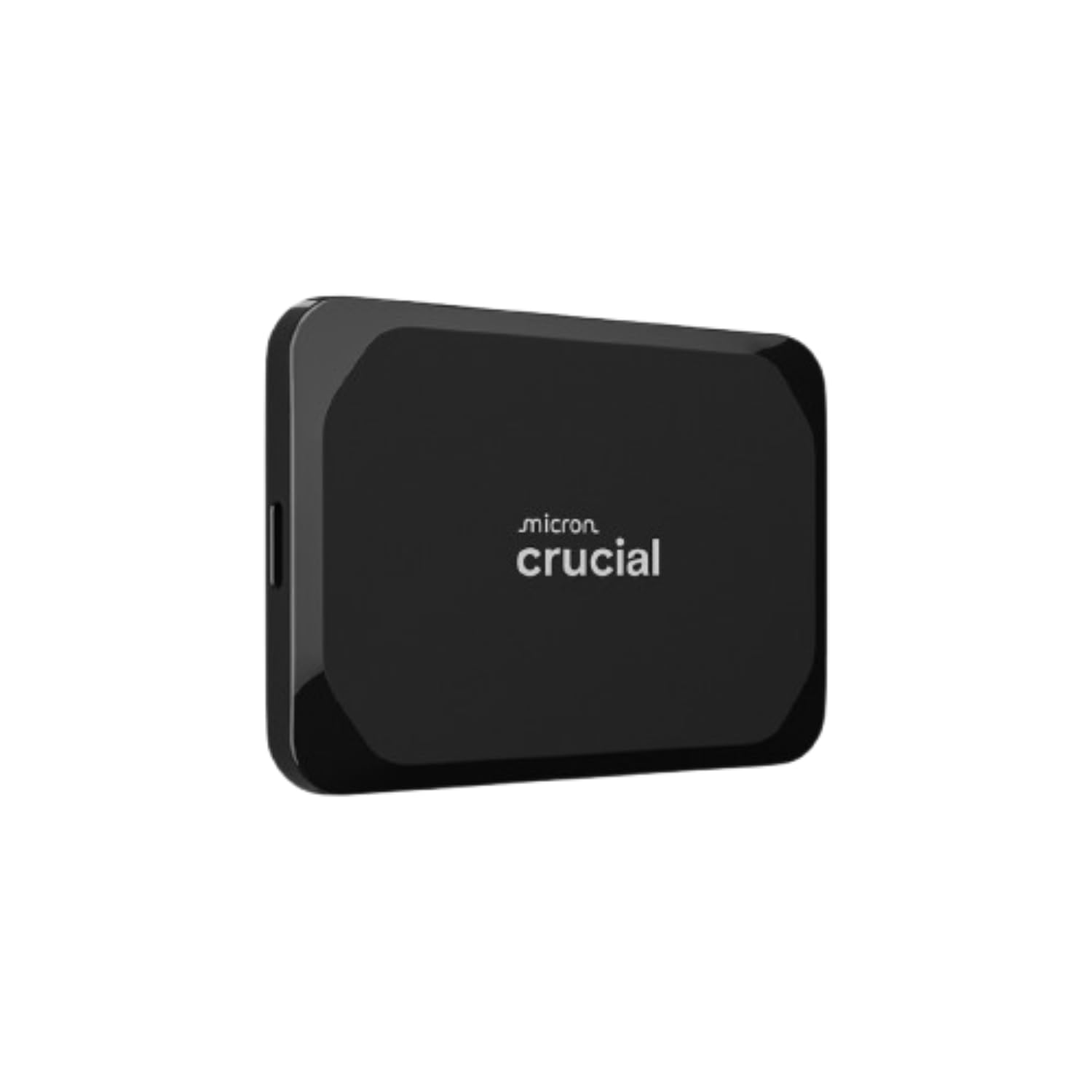
If you are a student rushing between a dorm laptop and a campus lab, or a creator shuttling video clips from an iPad Pro to a PS5, the Crucial X9 slips into a small pocket and still delivers the same 1,050 MB/s read speed as the Samsung and SanDisk, but its secret weapon is size — one reviewer noted they “can’t believe how small a device this is.” It packs 1TB into a compact polycarbonate shell that also shrugs off dust and splashes with an IP55 rating (dust-protected, splash-resistant) and survives a drop from 7.5 feet.
It connects to Windows, Mac, iPad Pro, Android, and both PS4 and PS5 via the included USB-C cable, so you can move game captures or video edits across all your devices. At roughly the same speed as the top two picks but at a lower price, this is the smart value option for a student or everyday user bouncing between devices.
The catch: the polycarbonate enclosure can heat up under sustained heavy writes, and 1TB fills faster than a 2TB HDD. But for pocketable speed with IP55 and drop protection, it undercuts the SanDisk and T7 on price while keeping performance.
What stands out
- Extremely compact and lightweight design
- IP55 water/dust resistance and 7.5 ft drop survival
- Works seamlessly with Windows, Mac, iPad, Android, PS4, PS5
The trade-offs
- Can heat up under heavy sustained writes
- 1TB capacity may fill quickly for large media archives
4. Seagate Portable 2TB External Hard Drive HDD
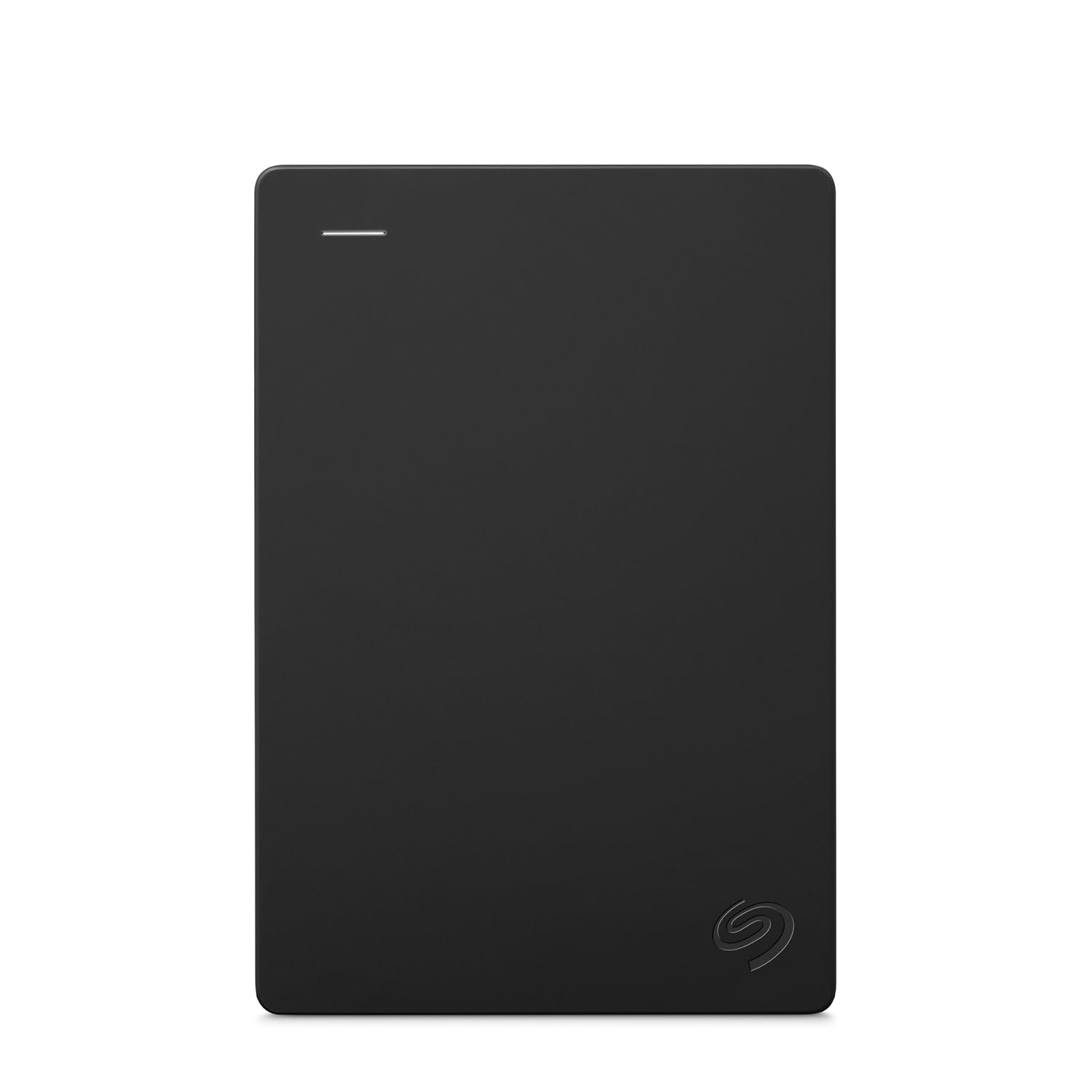
The single number that matters most in this category is capacity, and this drive delivers 2 terabytes at a data transfer rate of 130 MB/s. While that speed is eight times slower than an SSD, it is perfectly adequate for moving batches of photos, music projects, or game installs.
The downside you accept with this drive is vulnerability — because it uses a spinning mechanical hard disk, it can break if dropped while running. One buyer mentioned they “broke first one” from a fall. On the positive side, buyers consistently call it “fast, reliable, portable, well-built” and love the plug-and-play simplicity with PC, Mac, PlayStation, and Xbox. The included 1-year Rescue Service gives you recovery support if the drive does fail.
At this price tier, you get 2TB of space for the cost of a 1TB SSD, making it an excellent choice if you want maximum capacity per dollar and do not need lightning-fast transfers. You can buy this drive and a 1TB SSD for the same price as the Samsung T7 alone — that is the real value equation.
The upsides
- 2TB capacity for the price of a 1TB SSD
- Works out of box with PC, Mac, PS5, and Xbox
- Includes 1-year Rescue Service for data recovery
Keep in mind
- Fragile — can break if dropped while spinning
- No built-in hardware encryption
5. WD 2TB Elements Portable External Hard Drive

What you actually get at this lower price is 2TB of reliable HDD storage with a data transfer rate of 5 Gbps via USB 3.2 Gen 1 (a connection speed of five gigabits per second). For a simple weekly Time Machine backup or a local copy of your document folder, that speed means a 100GB backup finishes in roughly 15 minutes rather than the 2 minutes an SSD would need.
What you give up compared to an SSD is any meaningful drop protection or pocket portability. The 3.5-inch form factor makes this drive noticeably heavier and less pleasant to carry in a jacket. But buyers consistently say it “works great” and “never had a problem with it” — the 2TB capacity at a budget-friendly price is the whole point. One reviewer loved the “great size, good amount of storage.”
This is the exact right drive for someone who wants a simple, large backup that stays plugged into a desktop computer and rarely moves. No frills, no software dramas, just affordable Mass Storage. Compared to the Seagate 2TB, the WD does not include data recovery, but it often sells for a few dollars less — the exact budget buyer it is perfect for.
Why we’d pick it
- 2TB capacity at a budget-friendly price
- Plug-and-play with Windows out of the box
- Compact 3.5-inch design for a desktop desk
A few caveats
- Heavier and bulkier than a portable SSD
- Not ideal for constant travel or backpack carry
6. Seagate Portable 4TB External Hard Drive HDD
If your photo library, music project files, and game installs have outgrown 1TB or 2TB, the Seagate 4TB HDD delivers a huge 4 terabytes of storage at a data transfer rate of 120 Mbps (megabits per second — slower than any SSD here, but fine for overnight backups). That capacity is ideal for a music producer who needs to store sample libraries and virtual instruments — one reviewer who does exactly that says the drive handles plugins without any delay on an M4 MacBook Pro.
The feature that serves that person specifically is the straight drag-and-drop workflow with no extra software, plus compatibility with PlayStation and Xbox consoles. The 1-year Rescue Service provides a safety net if the spinning disk ever fails. Buyers also note the drive runs quiet and “reliable, portable, well-built” for storing essential backups.
The honest limit remains the same as any HDD: it is fragile if dropped. But if you keep it on a shelf and use it as a stationary archive, 4TB for the price of a 1TB SSD is an unbeatable value equation. This drive doubles the capacity of the Seagate 2TB for roughly the same physical size — worth it if you know you will grow into the space, though its spinning platters mean it cannot survive a tumble like a solid-state drive can.
Strong points
- 4TB of storage — enough for huge media libraries
- Drag-and-drop simplicity, no software required
- Works with PC, Mac, Xbox, and PlayStation
Before you buy
- 120 Mbps data transfer rate is much slower than SSDs
- Fragile — one drop can kill the drive
7. Western Digital 5TB Elements Portable External Hard Drive

The WD Elements 5TB sits at the top of the capacity chart — if you simply need the most storage for your money without caring about pocket size or transfer speed, this drive serves that one purpose better than anything else here. At 5TB, you can back up a full laptop, a game collection, and a photo archive all on one drive.
What that capacity actually gets you in real life: you can store roughly 1.25 million photos or 1,000 hours of high-definition video, or run a complete Time Machine backup for years without running out of space. Customers note it is “quiet, runs slightly warm” and works great as an archival buffer before moving files to cloud storage. At a data transfer rate of 1 MB/s via USB 3.2 Gen 1, initial backup will take a while, but subsequent incremental backups are fast.
The one reason to pick the Elements 5TB over the Seagate 4TB is pure capacity margin — you get 1TB more space in a similar form factor, making it the definitive pick for long-term archival storage at home. A cautious note: one owner reported the included cable can fail, so consider having a spare USB cable handy.
What we like
- 5TB capacity — the most storage in this lineup
- Plug-and-play with Windows out of the box
- Quiet operation for a desktop desk
The downsides
- Data transfer rate is 1 MB/s — fine for archiving, slow for daily moves
- Included cable can fail; consider a replacement cable
Understanding the Specs
Data Transfer Rate (MB/s vs Gbps)
This is the single most practical number on any drive spec sheet. It tells you how many megabytes or gigabits of data can move per second from the drive to your computer. A good SSD reads at 1,050 MB/s, meaning a 10GB file copies in roughly 10 seconds. A typical HDD moves 130 MB/s, making the same transfer take about 77 seconds. A higher number means less time staring at a progress bar.
IP Water and Dust Resistance
An IP rating (Ingress Protection) describes how well the drive keeps out solids (the first number, dust) and liquids (the second number, water). A rating like IP55 means the drive is dust-protected and can survive water splashes. IP65 means it is dust-tight and handles direct jets of water. This only matters if you carry the drive outdoors, near a beach, or in a bag that might get wet.
FAQ
Is an SSD always better than an HDD for backups?
Can I use a backup drive with a PlayStation or Xbox?
Final Thoughts: The Verdict
For most buyers, the best backup drive winner is the Samsung T7 Portable SSD because it pairs blazing 1,050 MB/s speed with a durable aluminum body and hardware encryption. If you need a tougher drive for outdoor work, grab the SanDisk Extreme Portable SSD for its IP65 rating and 3-meter drop survival. And for maximum capacity at a value price, the standout is the Western Digital 5TB Elements.