
You are juggling a walkie-talkie while trying to drive a race car, direct event staff, or inspect a machine. That is exactly when you need a 2 way headset — it frees your hands and puts the radio straight in your ear, without blocking your view. The best ones block out engine noise, stay on your head for hours, and plug into your specific radio without fuss. This guide compares five headsets based on their published specs and real buyer reviews, so you can pick the one that fits your gear and your daily job.
I’m Min — the co-founder and writer behind Gadgets Feed. This guide is built by comparing the manufacturers’ published specifications and the patterns across verified customer reviews, so you get each pick’s real strengths and trade-offs instead of marketing spin.
You need a headset that blocks background noise, stays comfortable all shift, and connects to your specific radio. Whether you coordinate a race team, run security at a large event, or work a loud construction site, one of these five headsets will fit your radio and your work.
How To Choose The Best 2 Way Headset
Picking the right headset comes down to matching the plug type to your radio, deciding how much hearing protection you need, and choosing between a wired or wireless setup. Here are the three most important things to check before you buy.
Check Your Radio’s Plug Type First
This is the single most common mistake buyers make. Two-way radios use different connector styles. Kenwood and Baofeng handhelds typically use a 2-pin K1 or K2 plug, while many Motorola radios use a different pinout. Racing headsets like those from Rugged Radios often use a 5-pin universal port. Before buying any headset, look up your radio model and confirm which connector it uses — or buy a headset that comes with the correct adapter cable.
Decide How Much Hearing Protection You Need
If you are working near loud engines, machinery, or race cars, you want a headset with a published Noise Reduction Rating (NRR). This number tells you how many decibels (a unit of sound intensity) the ear cups block out — for example, a rating of 24 decibels NRR cuts the noise down to a safe level so you can hear the radio clearly without damaging your hearing. For quieter environments like a retail floor or an office, a simple earpiece is fine.
Wired vs Wireless: What You Give Up
Wireless headsets offer more freedom of movement — no cable snagging on door handles or equipment. But the catch is battery life. Many wireless models only last 3-4 hours per earpiece, which means you need to carry spares or recharge mid-shift. Wired headsets never run out of power, and they tend to have more durable build quality, but the cable can be a minor annoyance if you move around a lot.
Quick Comparison
On smaller screens, swipe sideways to see the full table.
| Model | Category | Best For | Key Spec | Amazon |
|---|---|---|---|---|
| Rugged Radios H41 (Baofeng/Kenwood) | Premium Wired | Racing & heavy noise environments | 24 dB NRR hearing protection | Amazon |
| Rugged H41 + Motorola Cable | Premium Wired | Motorola radio users on track | 24 dB NRR + 3.5mm aux input | Amazon |
| Rugged Radios H41 (5-Pin) | Mid-Range Wired | Versatile multi-brand radio use | 24 dB NRR, 5-pin universal port | Amazon |
| SAMCOM BTEAR-02 Wireless | Mid-Range Wireless | Security & event staff needing mobility | 3-4 hours per earpiece battery | Amazon |
| Renastar Overhead Earpiece | Budget Wired | Simple comms on a budget | K1 2-pin plug for Baofeng/Kenwood | Amazon |
In‑Depth Reviews
1. Rugged Radios Noise Reduction Behind The Head Headset with Adaptor Cable for Baofeng/Kenwood

24 dB NRR (Noise Reduction Rating) makes the Rugged Radios H41 the top pick for anyone who needs to hear radio communications clearly over a roaring engine, and it comes with an adapter cable for Baofeng and Kenwood handhelds right out of the box.
Buyers report this headset “cut out race track noise so I can hear my driver and he hears me just as clearly,” and owners mention it works at high-profile venues like Daytona International Speedway. The behind-the-head design fits under a helmet, and the volume control knob on the right ear cup lets you adjust without fumbling for the radio. A coiled cable keeps things tidy, though some users wish it were slightly longer.
This is the headset to buy if you want a no-compromise wired model for loud, demanding environments.
Why it’s great
- 24 dB NRR hearing protection for loud environments
- Comes with adapter cable for Baofeng and Kenwood radios
- Behind-the-head design fits under helmets
- Crystal-clear audio and strong noise-cancelling mic
Good to know
- Coiled cable could be longer for some setups
- Premium price reflects heavy-duty racing build
2. Rugged Behind The Head Headset and Adaptor Cable for Motorola CP200

Against the top pick, this headset matches its 24 dB NRR hearing protection and behind-the-head design, but it includes a cable built for Motorola CP200 radios — which the Baofeng/Kenwood version does not support natively — making it the sharper choice than the 5-pin H41 for any Motorola user.
Customers note that this headset “improves hearing radio over loud racecars” and that the 3.5 mm audio input jack “allows cell phone connection for crew requests, eliminating constant phone checks.” One reviewer — a paralyzed dirt track photographer — said the headset made his job “50% easier” because he could stay on the radio without juggling his phone or radio while shooting.
Choose this over the top pick if you already own Motorola radios — the performance is identical, and you save the hassle of finding a separate adapter. The volume can be borderline for very soft-spoken voices over extreme NASCAR-level noise, and you might need an intercom system for the loudest tracks.
Where it shines
- Includes adapter cable specifically for Motorola CP200 radios
- 24 dB NRR hearing protection with clear audio
- 3.5mm aux input for phone or raceceiver
- Durable build, excellent for short track racing
Worth noting
- Volume may be low for soft voices in extreme noise environments
- Comfort is decent but not plush for all-day wear
3. Rugged Radios H41 Behind The Head Headset for Racing Radios (5-Pin)

If you switch between different radio brands — a Baofeng at the track and a Kenwood for off-roading — the 5-pin universal port on this H41 is what you need. It works with Rugged Radios, Baofeng, Motorola, Kenwood, HYT, TYT, and many others using the right adapter cables. It delivers the same 24 dB NRR hearing protection and behind-the-head design as the other Rugged models, and its 3.5 mm aux jack lets you plug in a raceceiver or phone.
Reviewers point out it has “held up to 3 years of use so far” in heavy-duty racing, with clear mic transmission over engine noise and comfortable wear under a helmet. One speedway official noted their headset shows “no wear yet” after three seasons. Unlike the Motorola-specific H41, this one requires buying a separate adapter cable (like a Kenwood 2-pin adapter) if your radio uses a different plug — but the flexibility is unmatched.
This is the headset for the buyer who owns multiple radios or plans to switch brands. The downside: some users find the rigid headband less comfortable than a rounded spring design, so try it first if comfort is your top priority. For the multi-radio owner, no other behind-the-head model covers this many protocols with a single 5-pin port.
What stands out
- 5-pin universal port works with many radio brands via adapters
- 24 dB NRR hearing protection with clear transmission
- Durable build that lasts years of heavy use
- 3.5mm aux input for phones or scanners
The trade-offs
- Adapter cable for Kenwood/Baofeng radios sold separately
- Some users find the rigid headband less comfortable than a rounded spring design
4. SAMCOM Wireless Headset with 2 Pin Dongle for FPCN10A/FPCN30A Walkie Talkies

The single number that matters most in this category is battery life per earpiece, and the SAMCOM scores 3-4 hours per earpiece, with a backup earpiece included for a combined 6-8 hours of shift coverage. That is where the SAMCOM wireless headset fits in: it gives you wireless freedom to patrol a conference center or retail floor without a cable snag.
The trade-off is that battery life is genuinely short per earpiece, and shoppers say it “doesn’t hold charge if unused for days.” The positive flip side is that SAMCOM’s customer service gets high marks for sending quick replacements. The noise-cancelling mic delivers clear transmissions, and the flexible earpiece and replaceable ear hooks make it comfortable for all-day wear.
This is a solid wireless pick for SAMCOM FPCN series radios — just be ready to swap earpieces mid-shift. It does not offer hearing protection like the Rugged models, so skip it for track or construction work and stick with a wired noise-reduction headset instead, making this a price-to-value pick for light-duty wireless use only.
The upsides
- Wireless freedom — no cable to snag on gear
- Noise-cancelling mic for clear transmissions
- Includes backup earpiece for extended 6-8 hour shifts
Keep in mind
- Only 3-4 hours battery per earpiece; needs mid-shift swap
- Does not hold charge if stored unused for days
- Only compatible with SAMCOM FPCN series radios
5. Renastar Overhead Earpiece with Boom Mic K1 Plug Two Way Radio Headset for Kenwood 2Pin Baofeng Radios
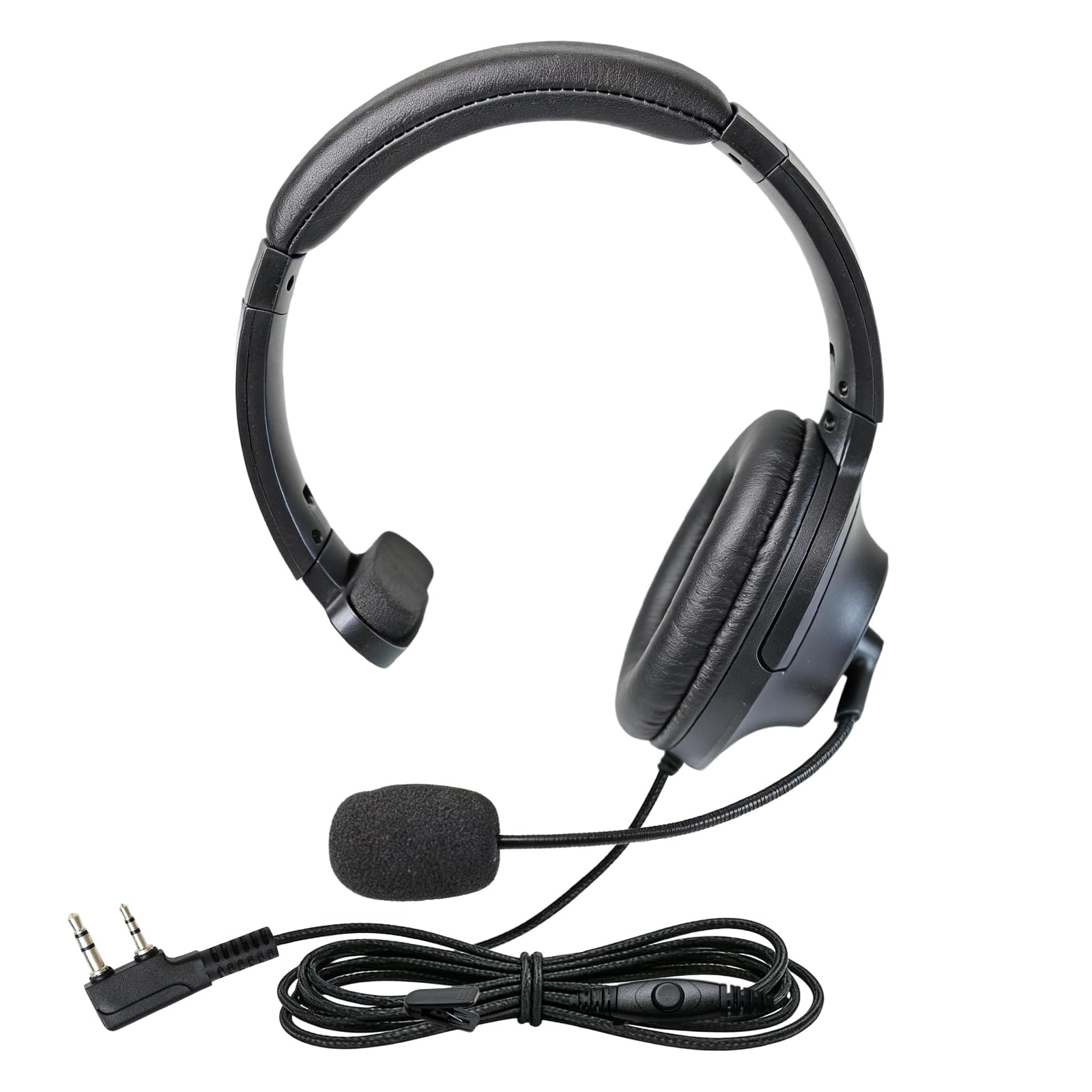
What you actually get at this lower price is the Renastar overhead earpiece with a K1 2-pin plug that connects directly to Baofeng, Kenwood, and Retevis radios. The boom mic stays near your mouth for clear transmission, and buyers report they were “a little concerned that the mouthpiece didn’t come all the way down to my mouth but people can hear me loud and clear.”
What you give up is hearing protection — there are no ear cups, just a single earpiece. It also does not work with Motorola, Icom, or Midland radios, so check your radio’s port first. The reinforced TPU cable (a tough, rubbery plastic) is built to last, though some users found the earpiece a bit large and tight on smaller heads.
Buy this for light-duty use like film sets, amateur radio (ham) events, or simple coordination where noise is moderate. skip it if you need hearing protection or work near loud machinery — pick a Rugged H41 instead. This is the exact budget buyer it is perfect for: someone who just needs to talk on a Baofeng or Kenwood radio without holding it, and wants to spend as little as possible.
Why we’d pick it
- Very affordable price for basic radio communication
- Clear sound quality from both speaker and mic
- Simple K1 2-pin plug for Baofeng, Kenwood, Retevis radios
A few caveats
- No hearing protection — single earpiece only
- Earpiece may feel tight or large on smaller heads
- Not compatible with Motorola, Icom, or Midland radios
Understanding the Specs
Noise Reduction Rating (NRR)
This is the number you see on racing headsets — it measures how many decibels (a unit of sound intensity) of background noise the ear cups block out. A rating of 24 dB NRR means the headset reduces the noise level reaching your ears by about 24 decibels. That is enough to turn a roaring engine into a manageable hum, so you can hear the radio clearly without damaging your hearing. If you work in a quiet environment like an office or retail floor, you do not need NRR at all — a simple earpiece is fine.
Plug Types and Radio Compatibility
This is the most overlooked spec. Two-way radios use different connectors: Kenwood and Baofeng handhelds often use a 2-pin K1 or K2 plug (two metal pins spaced 11mm apart). Motorola radios have their own pin layout. Many racing headsets use a 5-pin universal port (standard TA5FL connector). Always check your radio’s manual or look at the port before buying — a headset with the wrong plug will not work unless you buy an adapter cable separately.
FAQ
Will a Kenwood 2-pin headset work on a Baofeng radio?
Can I use a racing headset for non-racing work like security or construction?
How long do wireless 2 way headset batteries typically last?
Final Thoughts: The Verdict
Across the board, the best 2 way headset is the Rugged Radios H41 with Baofeng/Kenwood adapter because it combines 24 dB hearing protection with a durable build and crystal-clear audio that lasts for years. If you use Motorola radios, grab the Rugged H41 with Motorola adapter for a seamless fit. And for wireless freedom on security or event shifts, the SAMCOM BTEAR-02 is the best value for hands-free mobility without cables.