
When you get your first vinyl setup, you quickly find that the turntable matters as much as the record itself. Heavy decks with thick wood bases and adjustable tonearms let you hear the music clean and full, while flimsy plastic ones can skip, wobble, or even damage your grooves over time. This guide covers seven real options — from steady belt-drive models to direct-drive (motor built into the platter hub) DJ machines — so you can pick the one that fits your budget, your speakers, and how much you want to protect your collection.
I’m Min — the co-founder and writer behind Gadgets Feed. This guide is built by comparing the manufacturers’ published specifications and the patterns across verified customer reviews, so you get each pick’s real strengths and trade-offs instead of marketing spin.
Every turntable here includes a moving magnet cartridge (a common, affordable needle type) and a counterweighted tonearm (a weighted arm you can balance so the needle presses down at the right force). These two features are what separate a proper turntable from a toy. Whether you are building your first system or upgrading from a suitcase player, these are the 10 turntables that let you hear every pop, sizzle, and bass line your records have.
How To Choose The Best 10 Turntables
Picking a turntable comes down to three things: how much you care about sound quality, how much you want to adjust settings yourself, and what speakers or amplifier you already own. The biggest mistake beginners make is buying a unit with built-in speakers and a cheap ceramic cartridge (a basic needle type). Those decks lack a counterweight (a weight on the back of the tonearm you adjust), so the needle presses too hard into the groove and wears out your records after a few dozen plays. Every deck on this list has a proper moving magnet cartridge and an adjustable tonearm, so you start with decent sound and record safety.
Belt Drive vs Direct Drive
A belt-drive turntable uses a rubber belt to connect the motor to the platter (the disc your record sits on). This isolates motor vibrations from the record, giving you a quieter background and warmer sound — most audiophile decks are belt-driven. A direct-drive turntable has the motor built right into the platter hub, so it starts spinning instantly and holds speed more steadily under heavy hands; that is why DJ decks are almost all direct-drive. For home listening, belt-drive is the cleaner choice, but if you plan to scratch or back-cue records (spin them backward quickly), you want direct-drive.
Adjustable Counterweight and Anti-Skate
These two controls let you dial in exactly how much the needle presses down (tracking force, measured in grams) and how much sideways pull the tonearm resists (anti-skate). Without them, the needle can skip, wear a lopsided groove, or dig into one side of the stereo recording, so you lose balance. A turntable with a fixed tonearm is a no-go for anyone who owns records they care about. Look for a counterweight that lets you set tracking force in increments of 0.5 grams or finer, and an anti-skate knob that matches that range.
Quick Comparison
On smaller screens, swipe sideways to see the full table.
| Model | Category | Best For | Key Spec | Amazon |
|---|---|---|---|---|
| Fluance RT85N | Premium | Audiophile Home Listening | 16.8 lbs / Nagaoka MP-110 | Amazon |
| Pro-Ject Debut Carbon EVO | Premium | Audiophile Upgrade | 6 kg / Carbon Fiber Tonearm | Amazon |
| Audio-Technica AT-LP70XBT | Mid-Range | 6.4 lbs / Bluetooth 5.2 | Amazon | |
| Audio-Technica AT-LP70X | Mid-Range | Plug-and-Play Starter | 6.4 lbs / J-Shaped Tonearm | Amazon |
| Crosley C100A-SI | Value | Adjustable Entry-Level | 9.5 lbs / Adjustable Pitch | Amazon |
| DIGITNOW Belt Drive | Value | Digitizing Vinyl | 12.47 lbs / USB Output | Amazon |
| Pioneer DJ PLX-500 | Pro | DJ Mixing & Scratching | 12.7 kg / Direct Drive | Amazon |
In‑Depth Reviews
1. Fluance RT85N Reference High Fidelity Vinyl Turntable

The 16.8-pound mass paired with the Nagaoka MP-110 elliptical diamond cartridge makes this the top pick for anyone who wants a warm, detailed sound out of the box without spending twice as much.
The acrylic platter damps vibrations so effectively that buyers report old records from the mid-70s sounding “terrific with much less static.” The motor wobbles at only 0.07% wow-and-flutter, and the semi-automatic stop lifts the tonearm when the record ends. Compared to the Pro-Ject Debut Carbon EVO, owners mention the Fluance outpaces it on bass extension and included cartridge value.
The catch is that you need an external phono preamp since the RT85N does not include one — factor in that expense. Even with that, this is the deck that the New York Times Wirecutter voted best. If you already own a receiver with a phono input, this is the one for you; if you only have powered speakers and don’t want another box, pick the Audio-Technica AT-LP70XBT instead. This is the turntable that delivers reference-grade sound without any upgrades.
Why it’s great
- Nagaoka MP-110 cartridge delivers warm, detailed sound with rich vocals and tight bass
- Acrylic platter reduces static and vibrations for cleaner playback
- Semi-automatic stop protects your needle and records
Good to know
- No built-in phono preamp — requires external preamp or receiver with phono input
- Some buyers recommend adding the Fluance silicone platter mat to reduce static pops
2. Pro-Ject Debut Carbon EVO Turntable with Sumiko Rainier Cartridge

The Pro-Ject Debut Carbon EVO beats the Fluance RT85N on tonearm engineering — the 6-gram carbon fiber tonearm is stiffer and lighter than aluminum arms, so it tracks grooves with less resonant chatter (extra vibrations that blur the sound). This is the turntable that buyers call “a standard in sound quality,” and it pairs a quiet motor (running at a steady 33.40 RPM) with a Sumiko Rainier cartridge that sounds versatile across jazz, rock, and classical.
Customers note that the anti-skate placement is not obvious in the manual, but once set up, the deck delivers “a low noise floor” and a sound that improves as the cartridge breaks in. The three adjustable feet make leveling easy even on uneven furniture, and the speed switch for 33/45 RPM is a simple move of the belt on the pulley — no electronic toggles that can fail.
Choose this over the Fluance if you plan to swap cartridges in the future, because the Pro-Ject’s lightweight tonearm is compatible with a wider range of high-end moving magnet and moving coil options. It is fully manual though — there is no auto-stop, so you must lift the arm yourself when the record finishes. That makes it best for someone who enjoys the hands-on ritual and wants to experiment with different cartridges; skip it if you want convenience and auto-return.
Where it shines
- Carbon fiber tonearm resists resonance better than aluminum arms
- Sumiko Rainier cartridge is versatile and sounds rich across genres
- Three adjustable feet make leveling easy
Worth noting
- Fully manual operation — no auto-stop or auto-return
- Dust cover hinges are very tight and can damage the plinth if forced
3. Audio-Technica AT-LP70XBT Wireless Turntable

If you want to play records through a Bluetooth speaker or wireless headphones without a wire across the room, this is the turntable that does it cleanly — and reviewers point out that “Bluetooth paired within 15 minutes” with a Sony headset, so the connection process is genuinely beginner-friendly. It is a fully automatic belt-drive deck that handles 33 1/3 and 45 RPM records, and the J-shaped tonearm keeps tracking errors low so your records sound balanced.
The built-in switchable preamp means you can connect it to powered speakers or a receiver with a simple RCA cable, or flip the switch to phono mode if you already own a separate preamp. Shoppers say the sound quality through a cheap soundbar is “gorgeous” and that only experienced audiophiles would notice a difference from more expensive setups. At just 6.4 pounds, it is also the lightest deck here — easy to move around or set up on a shelf.
The standout feature here is the fully automatic operation: you press start and the tonearm lifts, moves over the record, and gently lowers itself. When you press stop or the record ends, the arm returns to its resting position. This makes it the most convenient option for anyone who does not want to hover over every side of an album — ideal for a living room setup where ease matters more than tinkering.
What stands out
- Bluetooth wireless lets you skip the RCA cable and pair with speakers or headphones
- Fully automatic operation — no manual tonearm fiddling
- Switchable built-in preamp works with or without external gear
The trade-offs
- Belt installation is the trickiest step; watch a video carefully
- Plastic chassis feels less premium than the MDF or wood decks
4. Audio-Technica AT-LP70X Automatic Turntable (Black/Bronze)

The number that matters most in the entry-to-mid-range category is cartridge compatibility. The AT-LP70X uses the AT-VM95C — the same cartridge body found on Audio-Technica’s higher-end decks — so you can upgrade just the stylus (the needle tip) from the basic conical to a microlinear or Shibata for around -100 without replacing the whole cartridge. This one spec makes it the smartest buy for someone who wants to grow into better sound over time rather than buying a whole new turntable later.
The downside you accept here is that the tonearm is pre-adjusted at the factory: you cannot set tracking force or anti-skate manually. For most listeners, the default settings work perfectly — buyers report it is “easy to set up and works perfectly” with no skipping or skating issues — but tweakers will feel limited. The three-piece chassis construction dampens resonance better than single-piece plastic decks, and the included J-shaped tonearm minimizes tracking errors on inner grooves.
At roughly two-thirds the price of its Bluetooth sibling (the AT-LP70XBT), this is the price-to-performance champion for anyone who connects speakers via cable and wants a fully automatic deck with an upgrade path. You lose the wireless convenience but gain the exact same motor, cartridge, and build quality. It’s the right pick for the budget-conscious buyer who plans to upgrade the stylus later.
The upsides
- AT-VM95C cartridge accepts multiple stylus upgrades for growing sound quality
- Fully automatic operation with adjustable auto-play for 7 and 12-inch records
- Switchable phono preamp works with any receiver
Keep in mind
- No adjustable counterweight or anti-skate — factory-set only
- Plastic chassis components feel less substantial than wood or metal decks
5. Crosley C100A-SI Belt-Drive Turntable

What you actually get at this price point is a fully adjustable audiophile-style tonearm on an aluminum platter — adjustable counterweight, anti-skate control, and even speed pitch control so you can fine-tune the rotation if a record was pressed slightly off. That is a rare combination in the budget tier, and buyers confirm it “sounds much better than my old turntable” right out of the box.
What you give up is automatic operation: the C100A-SI is a fully manual deck, so you cue the tonearm yourself and you must lift it when the record ends or the needle will spin in the run-out groove. The built-in preamp is functional but some buyers found it “a little shrill” and upgraded to an external tube preamp for warmer sound. The silver aluminum finish looks sharp on a shelf, and the 9.5-pound weight gives it a solid feel that cheap plastic decks lack.
This is the perfect entry point for the buyer who wants to learn the mechanics of turntables — setting tracking force, balancing the tonearm, and hearing how adjustments change the sound — without spending mid-range money. If you want a hands-on learning tool that can grow with you via a cartridge upgrade, this is your pick. pass on it if you just want to drop a record and press play; the Audio-Technica AT-LP70X does that for you.
Why we’d pick it
- Adjustable counterweight, anti-skate, and pitch control — full control at a budget price
- Aluminum tonearm with cueing lever for precise needle placement
- Built-in switchable preamp works with any receiver
A few caveats
- Fully manual — no auto-stop or auto-return
- Built-in preamp is passable but benefits from an external upgrade
6. DIGITNOW Belt Drive Turntable with USB Output
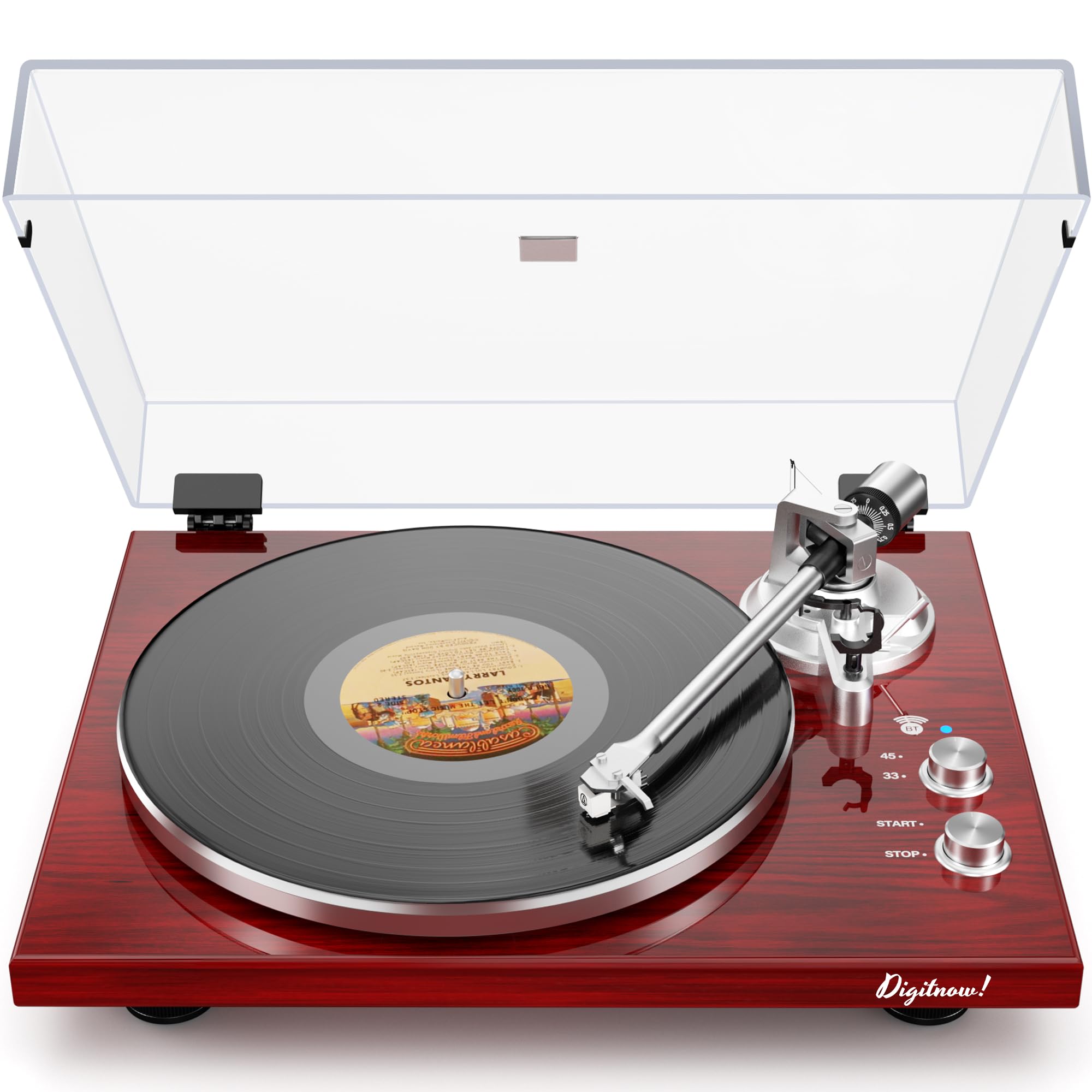
For the buyer whose primary goal is to turn a stack of old family records into digital files, the DIGITNOW turntable comes with a USB cable and a cartridge alignment protractor (a paper guide for centering the needle). Buyers confirm “it works well to digitize family LP recordings.” It connects to your PC, and the records play through your computer speakers or headphones while the software records them as audio files.
At 12.47 pounds, it is nearly double the weight of the Audio-Technica AT-LP70X (6.4 lbs), and that heft comes from the wood plinth — owners mention it “has a solid, sturdy feel to it, unlike many other budget turntables.” The AT3600L moving magnetic cartridge tracks grooves cleanly, and the adjustable counterweight lets you dial in the right tracking force so the needle does not dig in too hard. The Bluetooth output also works with wireless speakers, so you can play those newly digitized tracks through whatever you already own.
The one honest limit is the glossy red wood finish — it looks retro and elegant, but it is not for everyone’s decor. Still, for the specific job of preserving vinyl as MP3s or WAV files without spending hundreds, this deck punches well above its weight class. It is the clear pick if your stack of childhood records is your first priority, though the glossy red wood finish may not suit every listening room.
Strong points
- USB output lets you digitize records directly to a PC
- Solid wood plinth at 12.47 lbs reduces vibration better than plastic decks
- Adjustable counterweight and anti-skate protect your records
Before you buy
- No built-in speakers — requires powered speakers, Bluetooth speaker, or computer output
- Glossy red finish may not match all room aesthetics
7. Pioneer DJ PLX-500 Direct Drive Turntable

Compared to the home-listening decks above, the Pioneer PLX-500 costs roughly double the DIGITNOW turntable and three times the Crosley, but it is in a completely different category: direct-drive with a servo motor that locks speed instantly. That means you can back-cue and scratch (spin the record backward quickly) without any belt slipping. Customers note the motor is “speed accurate with no audible wow or flutter,” making it technically better for DJ work than any belt-drive deck.
What that money gets you is a full 12.7-kilogram (about 28-pound) body that sits rock-solid on a table, a tonearm height adjustable up to 6mm for different cartridge setups, and a USB output for recording vinyl to a computer — plus the ability to use it with rekordbox DVS software if you want to spin digital files with control vinyl. The included cartridge is decent at 3 grams tracking force, but most buyers swap it for a better one over time. The built-in preamp is mediocre, but DJs usually run through a mixer anyway, so that rarely matters.
The one reason to choose this over the field is if your primary use is mixing or scratching — no belt-drive deck on this list can handle fast back-cueing without slipping or wearing the belt.
What we like
- Servo direct-drive motor locks speed instantly and handles scratching without slipping
- USB output for recording vinyl to a computer
- Adjustable tonearm height and anti-skate for fine-tuning
The downsides
- No auto-return — you must lift the arm when the record ends
- Short fixed RCA cable limits placement options without an extension
Understanding the Specs
Tonearm Adjustments (Counterweight & Anti-Skate)
These two dials control how the needle sits in the groove. The counterweight sets the downward force (tracking force, measured in grams — usually between 1.5g and 3g). The anti-skate applies a small outward pull to balance the tonearm’s natural inward drift, so the needle does not dig deeper into one side of the stereo groove. Adjustable versions let you protect your records and get cleaner sound; fixed versions (like on the AT-LP70X) are factory-set for a safe middle ground.
Phono Preamp (Built-In vs External)
A phono preamp boosts the very weak signal from a turntable cartridge up to the level a regular stereo receiver can play. Some receivers have a dedicated “phono” input that does this — if yours does, you can skip the preamp. If you are connecting to powered speakers or a standard “aux” input, you need a preamp. Many turntables here have a switchable built-in preamp (you can turn it off if your receiver has one), saving you the cost and clutter of a separate box.
FAQ
Do I need a turntable with built-in speakers, or should I buy separate ones?
What does “belt drive” mean and why does it matter for sound quality?
Can I connect my turntable to a soundbar or a smart speaker?
Final Thoughts: The Verdict
When it comes down to it, the 10 turntables winner is the Fluance RT85N because its combination of the Nagaoka MP-110 cartridge, heavy acrylic platter, and semi-automatic operation delivers audiophile sound without needing a second mortgage. If you want wireless convenience and fully automatic play, grab the Audio-Technica AT-LP70XBT. And for the buyer on a budget who wants full manual control to learn the craft, the standout is the Crosley C100A-SI.