
Our readers keep the lights on and my morning glass full of iced black tea. As an Amazon Associate, I earn from qualifying purchases.
When the lights go out or you head off-grid, a 2400w power station keeps your fridge running, your coffee brewing, and your devices charged — without the noise and fumes of a gas generator. To get that, you need enough battery capacity, fast recharging, a clean pure sine wave (smooth AC power that is safe for sensitive electronics like laptops and CPAP machines), and a weight you can actually move.
I’m Min — the founder and writer behind Gadgets Feed. This guide is built by comparing the manufacturers’ published specifications and the patterns across verified customer reviews, so you get each pick’s real strengths and trade-offs instead of marketing spin.
Choosing the right 2400w power station comes down to battery chemistry, charge speed, and real-world portability.
Quick Picks
- OUPES Exodus 2400 Portable Power Station — Best Overall
- ALLWEI 2400W LiFePO4 Power Station — Expandable Power
- Anker SOLIX F2000 (PowerHouse 767) — Premium Build
- GROWATT INFINITY 2000 Pro — Best Power-to-Weight
- BLUETTI AC200L Portable Power Station — Expandable Ecosystem
- Jackery Explorer 2000 v2 — Ultra Compact
- EBL Acc2400 2400W Power Station — Budget Champion
- GRECELL Acc2400-ESL with 2x 100W Panels — Solar Ready Kit
How To Choose The Best 2400W Power Station
Picking the right station means balancing three things: battery capacity (how long your gear runs), charge speed (how fast you refill the tank), and physical weight (can you actually lift it into your car?). Here is what to look for.
Battery Chemistry and Lifespan
All the top picks today use LiFePO4 (lithium iron phosphate) cells, which are safer, run cooler, and last much longer than older lithium-ion batteries. Expect 3,500 to 4,000+ full charge cycles (one cycle is a full drain and full recharge), which translates to roughly 10 years of daily use before the battery drops to 80% of its original capacity.
Charge Speed is King
A station with a 2400W AC input can refill its battery from nearly empty to 80% in about 45 minutes to 1.5 hours. Slower units might take 6-8 hours from a wall outlet. If you plan to recharge during a lunch break or between storms, prioritize models with the highest AC charge wattage.
Output Ports Versus Real-World Needs
Count the number and type of ports you will actually use. A station with 4 AC outlets and a 30A RV port is overkill for a phone and laptop, but essential if you want to plug an RV or a well pump directly into it. USB-C PD (Power Delivery) ports at 100W or 140W are critical for fast-charging modern laptops and tablets.
Quick Comparison
On smaller screens, swipe sideways to see the full table.
| Model | Best For | Capacity (Wh) | Weight | AC Charge Speed | Amazon |
|---|---|---|---|---|---|
| OUPES Exodus 2400 | Best Overall Value | 2160Wh | 45.7 lbs | 0-80% in 1.2 hrs | $799.00Amazon |
| ALLWEI 2400W | Expandable Capacity | 2048Wh | 51 lbs | 0-80% in 45 min | $699.00$799.00Amazon |
| Anker SOLIX F2000 | Easiest to Move | 2048Wh | 67 lbs (wheels) | 0-80% in 1.4 hrs | $999.99$1,999.00Amazon |
| BLUETTI AC200L | Large Expandability | 2048Wh | 61.4 lbs | 0-100% in 1.5 hrs | $799.00$1,099.00Amazon |
| GROWATT INFINITY 2000 Pro | Lightest Premium Pick | 2048Wh | 26 lbs | 0-100% in 1.5 hrs | $648.99$799.00Limited time dealAmazon |
| Jackery Explorer 2000 v2 | Lightest 2kWh Station | 2042Wh | 39.5 lbs | 0-80% in 66 min | $799.00$1,499.00Amazon |
| EBL Acc2400 | Budget-Friendly | 1843.2Wh | 54 lbs | 0-100% in ~2 hrs | $559.94$699.99Limited time dealAmazon |
| GRECELL Acc2400-ESL | Includes Solar Panels | 1843.2Wh | 55 lbs | 0-100% in ~2 hrs | $699.99$849.99PrimeAmazon |
In‑Depth Reviews
1. OUPES Exodus 2400 Portable Power Station
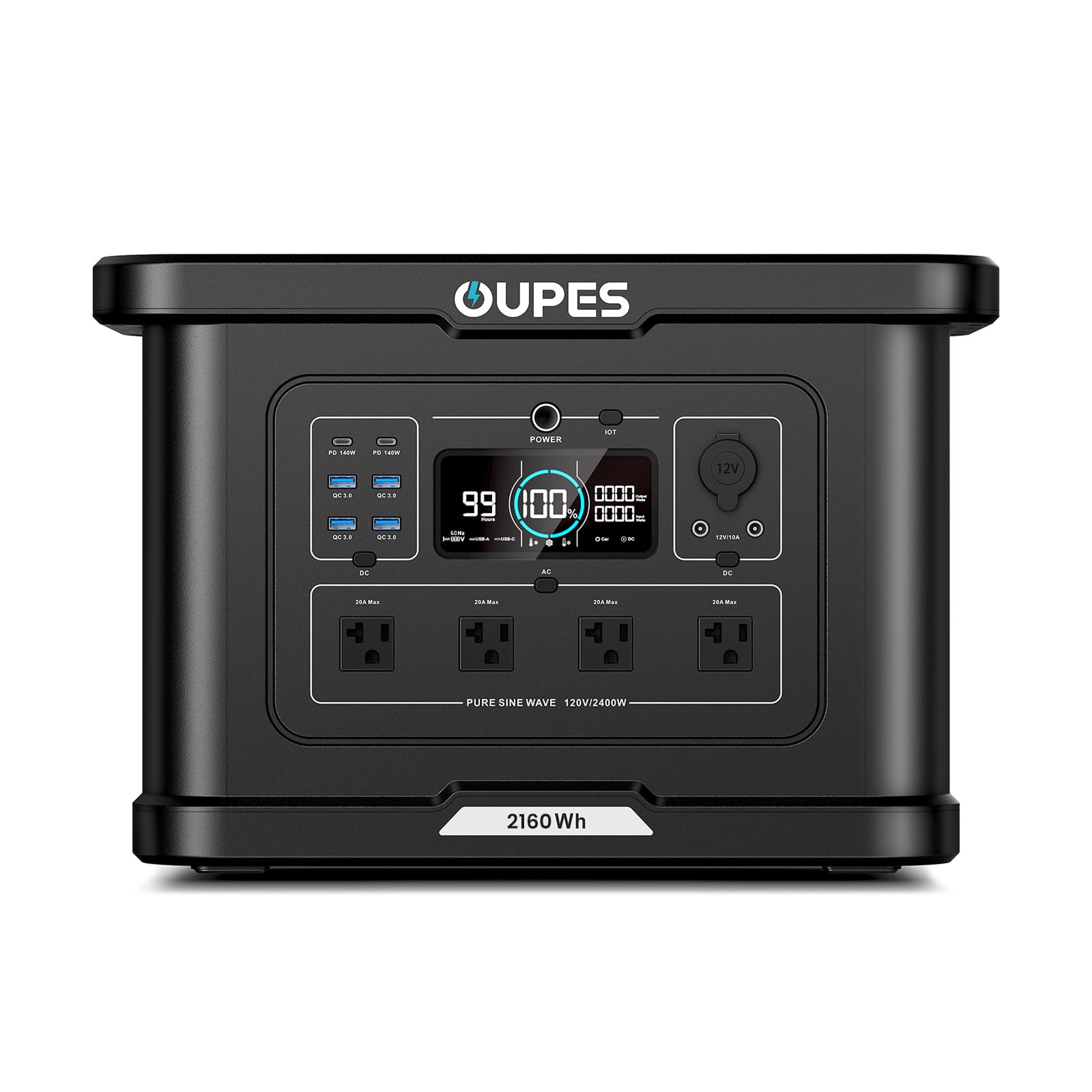
The station that balances raw power with smart app control and a price that undercuts bigger names.
The OUPES Exodus 2400 is the sweet spot of the category. It packs a 2160Wh battery (enough to run a fridge, a few lights, and a laptop for a full day) and delivers 2400W continuous AC power that can boost to 2600W and surge to 4500W for starting up motors like a well pump. Buyers report that during a 16-hour power outage, they used only 12% of the battery capacity while running a phone, a Keurig coffee maker, and a full-sized fridge — so you can expect this station to handle a multi-day outage with careful use.
Unlike the heavier EBL Acc2400, which weighs 55 lbs and lacks app connectivity, the OUPES Exodus comes in at 45.7 lbs and gives you full control via WiFi and Bluetooth app (monitoring battery level, scheduling charge times, adjusting eco mode). It also features a <20ms UPS (Uninterruptible Power Supply) switchover that keeps your desktop computer or router running without a hitch during a blip in grid power. The two USB-C ports deliver 140W each — plenty to charge a MacBook Pro at full speed.
The catch is that the OUPES Exodus 2400 is relatively new on the market compared to rivals like Anker or Jackery, so the long-term parts support and accessory ecosystem are still being proven. Still, the 5-year warranty and the fact it holds more capacity (2160Wh) than the EBL Acc2400 (1843.2Wh) — a 17% larger battery — make it the clear pick for value-minded buyers who want the latest tech.
Why it’s great
- Larger 2160Wh capacity than many competitors at the same price point
- Fast 0-80% charge in 1.2 hours via 1400W AC input
- Full smart app control for monitoring and scheduling
Good to know
- At 45.7 lbs, you will still want a cart or a second person for regular moves
- Newer brand with a smaller third-party accessory ecosystem
Best for: Buyers who want the best blend of the latest tech features, a fast recharge, and a large battery without paying a premium.
Skip if: You need an established ecosystem of extra batteries and support from a brand like BLUETTI or Anker.
2. ALLWEI 2400W LiFePO4 Power Station
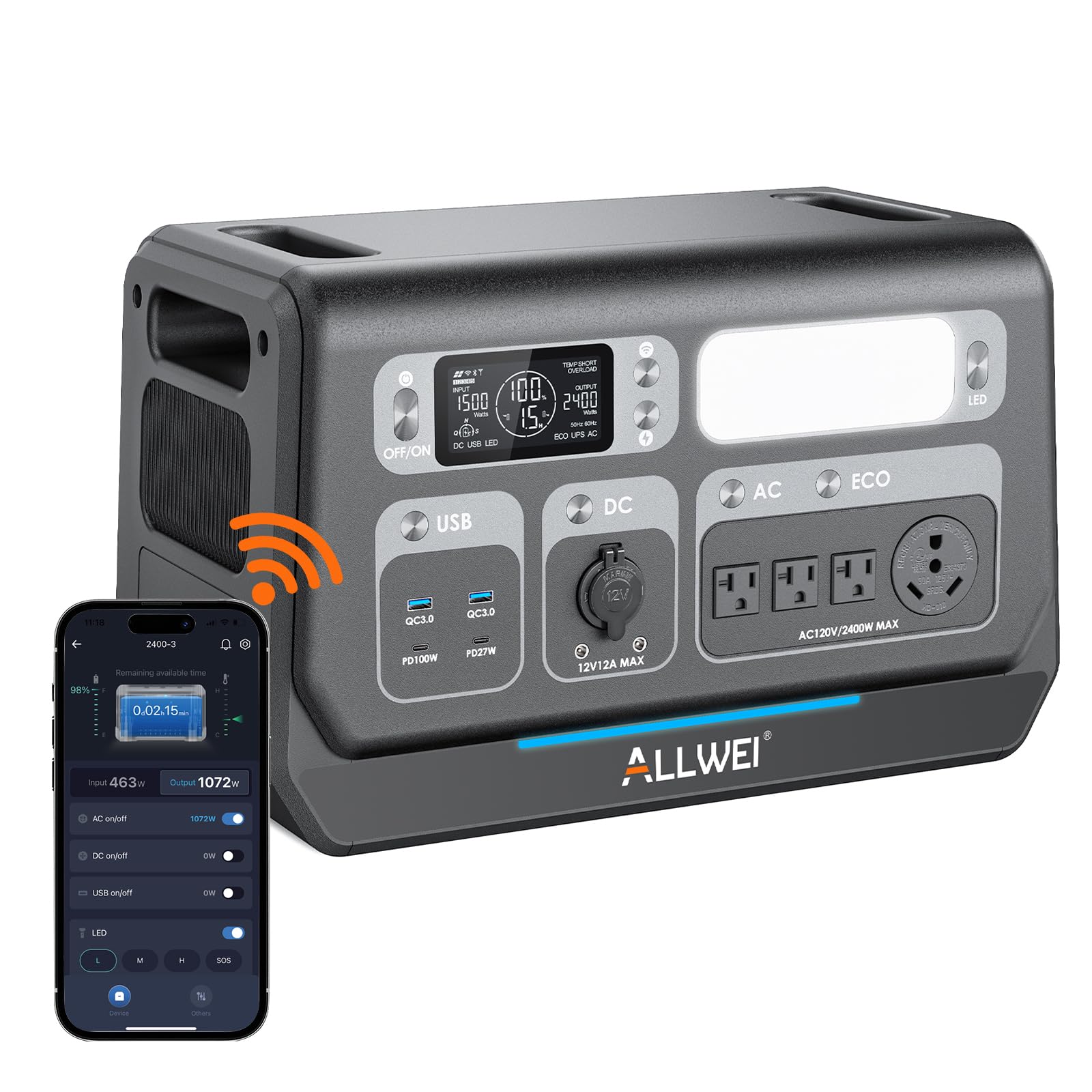
A heavy-duty unit that can grow with your power needs thanks to its huge expandable capacity.
The ALLWEI 2400W station is for the person who wants to start with a solid 2048Wh station but also wants the freedom to expand later. It supports adding extra ALLWEI SGR-B200 PRO battery packs (sold separately) to reach up to 10.24kWh — enough to run a whole home’s essentials for a day or two. One reviewer noted they connected their entire house to it via an RV plug, added two 12V 100Ah LiFePO4 batteries in series for a total of about 7kWh, and ran their home (except 240V appliances) for 12 hours without a hiccup.
Uniquely, it features a 2400W AC charging input that can take the station from 0-80% in just 45 minutes — noticeably faster than the EBL Acc2400’s roughly two-hour full charge. It is also one of the few stations at this price that includes an ATS (Automatic Transfer Switch) UPS function, which automatically kicks in during a grid failure without you having to flip any switches manually. The external dimensions (18.3 x 10.2 x 11.6 inches) are slightly taller than the EBL but still manageable for a portable unit.
The ALLWEI 2400W is heavier than the OUPES Exodus 2400 at 51 lbs, and some early reviews mention difficulty with the smart app setup. But if you need a station that can expand to whole-home backup territory and recharge in under an hour, this is the one to beat.
Why it’s great
- Expandable to 10.24kWh — the most capacity growth potential on this list
- Blazing 45-minute 0-80% AC charge time
- ATS UPS function provides automatic backup during grid outages
Good to know
- At 51 lbs, it is one of the heavier non-wheeled options
- App setup has frustrated some users in early reviews
Best for: Homeowners who want a starter station that can gradually expand into a whole-home backup system.
Skip if: You prioritize the lightest possible weight or want a proven ecosystem from a bigger brand.
3. Anker SOLIX F2000 (PowerHouse 767)

The station that rolls to where you need it, eliminating the struggle of loading a heavy box.
Anker is one of the most trusted names in consumer electronics, and the SOLIX F2000 (also called the PowerHouse 767) brings that reliability to the power station market. Its biggest edge is physical: at 67 lbs, it is the heaviest portable station on this list, but it has a built-in telescoping handle and two heavy-duty wheels, so you simply tilt and roll it like luggage. Buyers consistently say this feature alone makes it worth the price, as they can move it in and out of a truck bed or garage without lifting.
Anker uses its own SurgePad technology, which allows the single 2400W AC inverter to handle peak surges up to 3600W for starting appliances like a fridge compressor or a circular saw. The HyperFlash charging system recharges 0-80% in just 1.4 hours. It also has a 30A RV outlet, 4 AC ports, and 3 USB-C ports (including the top-of-category dual 140W USB-C ports that can charge two MacBook Pros simultaneously at full speed). The display is large and bright, showing input/output wattage and remaining time clearly.
One trade-off is that the 2048Wh capacity is fixed with this unit; it does not support expansion batteries like the BLUETTI AC200L or ALLWEI do. Also, the heavy weight and large footprint (20.67 x 9.84 x 15.55 inches) mean it is really a home backup unit that you occasionally take camping, not a daily grab-and-go adventure station.
Why it’s great
- Integrated wheels and handle make it the easiest to move despite its weight
- SurgePad handles up to 3600W peak without tripping
- Two 140W USB-C ports — fastest laptop charging on this list
Good to know
- Cannot expand with external batteries — you are stuck with the 2048Wh
- Bulkier than comparable 2kWh stations; better for home than daily camping
Best for: Anyone with back pain or frequent moves who still wants a 2kWh station with proven brand support.
Skip if: You need expandable capacity or want the lightest possible station for backpacking.
4. GROWATT INFINITY 2000 Pro
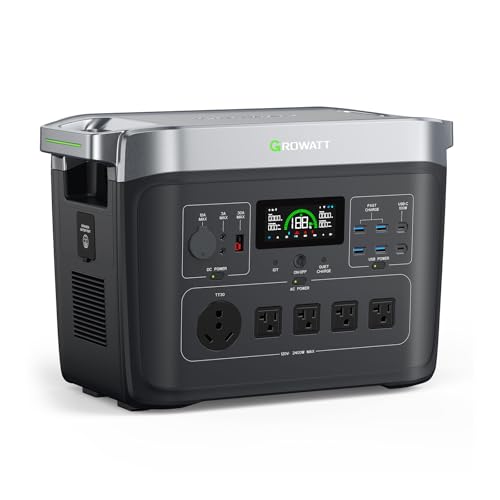
A 2kWh station that weighs less than a loaded hiking pack — perfect for mobile setups.
The GROWATT INFINITY 2000 Pro is a revelation for anyone who has ever grunted while loading a 50+ lb power station into a car trunk. It packs a full 2048Wh LiFePO4 battery and a 2400W pure sine wave inverter into a chassis that weighs just 26 lbs — easily half the weight of most competitors like the EBL Acc2400 (55 lbs) or the BLUETTI AC200L (61.4 lbs). This is achieved through a compact aluminum-and-plastic case (9.72 x 12.2 x 17.99 inches) and EV-grade LFP cells.
Despite its light weight, it does not cut corners on features. It includes a NEMA TT-30 outlet for RV hookups, an Anderson port for high-power solar charging, and Growatt’s Cold Start technology (the ability to operate down to -22°F / -30°C). Owners mention the station handles a full home office (PC, four monitors, lights, fridge) off-grid via solar. It supports up to 1800W AC charging for a 0-100% fill in about 90 minutes, and can accept up to 1200W of solar input simultaneously.
Two downsides: the plastic case feels less durable than the metal-clad OUPES or Anker units, and some customer reviews mention that getting a replacement unit for a defective one involves navigating a less-established support system compared to Anker’s or Jackery’s. Still, for a mobile professional, van-lifer, or overlander who lives by the maxim “an ounce on the ground is a pound in the truck,” this is the station to beat.
Why it’s great
- Incredible 26 lbs weight for a full 2048Wh capacity — more than 40% lighter than the average station
- NEMA TT-30 outlet for direct RV hookup
- Cold Start works down to -22°F for winter camping or northern climates
Good to know
- Plastic case may not survive hard drops as well as all-metal rivals
- Support and warranty service less established than Anker or Jackery
Best for: Van lifers, overlanders, and anyone needing a lightweight 2kWh station for frequent travel.
Skip if: You expect rugged all-metal build quality or the longest available warranty support.
5. BLUETTI AC200L Portable Power Station

A powerhouse with the most flexible expandability options in this class, backed by a proven brand.
BLUETTI is a veteran in the power station space, and the AC200L is their upper-mid-range offering that improves on the older AC200MAX by boosting the AC output to 2400W and offering Power Lifting (a temporary boost of up to 3600W for starting motors). It has a 2048Wh LiFePO4 battery that can be expanded up to 8192Wh by connecting two B300K (2764Wh each) or two B300 (3072Wh each) expansion batteries — giving you four times the original capacity.
One of the standout features is the dedicated 30A RV port, which allows direct connection to an RV’s shore power inlet without an adapter. The AC200L also supports both 1400W AC fast charging (0-80% in 45 minutes) and a 1200W solar input limit for a full solar recharge in about 1.7-2.2 hours. The UPS switchover is under 10ms — fast enough that a desktop computer will not even flicker. A reviewer who paired it with two B300 batteries for a total 8192Wh said they could run their home’s security system, a 64″ TV, a fridge, a freezer, and networking gear for about 10 hours without recharging.
The downside for this expandability is weight and bulk: the AC200L alone is 61.4 lbs, and adding expansion batteries quickly multiplies that. The interface is not the most intuitive — some users find the LCD menu navigation cumbersome compared to apps from OUPES or Jackery — but the sheer configurability makes it a top choice for serious home backup setups.
Why it’s great
- Expandable to 8192Wh — the second highest potential capacity on this list
- 30A RV port for direct plug-in to your camper or travel trailer
- Under 10ms UPS switchover for sensitive electronics
Good to know
- Weighs 61.4 lbs — one of the heaviest standalone units
- Prioprietary expansion cables and batterie can be expensive
Best for: RV owners and home backup users who want a modular system that you can grow over years.
Skip if: You need a lightweight station for regular carrying or prefer a simpler all-in-one device.
6. Jackery Explorer 2000 v2

A sleek, EV-derived design that trims weight without trimming performance.
Jackery is one of the oldest and most widely recognized brands in the portable power space, and the Explorer 2000 v2 is their latest take on the 2kWh class. This is thanks to Jackery’s proprietary CTB (Cell-to-Body) technology (where the battery cells themselves form part of the structural frame), similar to how some electric cars save weight.
Charging is fast: 0-80% in 66 minutes via standard AC, or a full charge in 102 minutes using an “Emergency Super Charging” mode that can be activated through the app. It also offers a silent charging mode that maxes the fan noise at under 30 dB — virtually whisper-quiet for nighttime charging in a bedroom or campsite. The UPS switchover is rated at 20ms, and it passed UL1778 certification for uninterruptible power supplies.
One catch: the AC output is rated at 2200W, not 2400W like most of the other stations here, so it falls slightly short for continuous high-wattage use (though it can still handle most appliances). Also, the solar input barrel ports are on a relatively thin plastic frame, and a few reviewers noted the side flexes slightly when plugging in heavy solar connectors. It is not a dealbreaker, but it is a detail that feels less robust than the brushed-aluminum chassis of the Anker SOLIX.
Why it’s great
- Ultra-lightweight 39.5 lbs makes it easy to carry for one person
- Silent charging mode at under 30 dB for overnight or office use
- UL1778 certified UPS for reliable backup to sensitive electronics
Good to know
- AC output is 2200W, slightly below the 2400W class standard
- Solar input barrel ports are mounted on a flexing plastic frame
Best for: Solo campers, photographers, and remote workers who carry their station to different spots daily.
Skip if: You need a true 2400W continuous output or a more robust chassis for heavy use.
7. EBL Acc2400 2400W Power Station
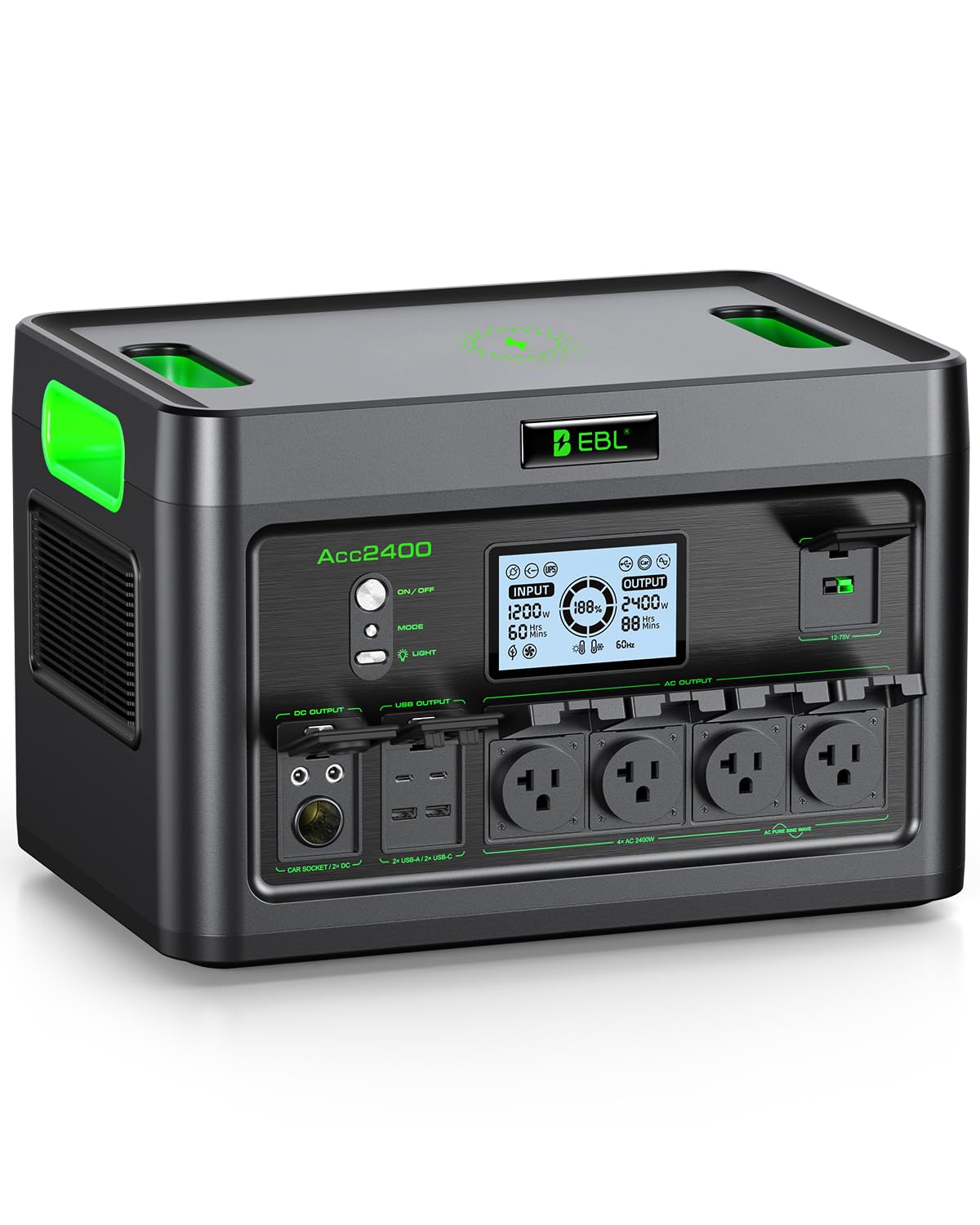
A wallet-friendly entry with solid capacity and a wireless charging pad built right in.
If you want a 2400W-class station but your budget is tighter, the EBL Acc2400 offers a compelling value proposition. The built-in wireless charging pad (Qi standard) on the top panel is a neat addition for topping off a phone or earbuds without fumbling for cables.
It has a full set of ports: 4 AC outlets (2400W total), 2 USB-A ports, 2 USB-C PD ports (100W max), a car port, 2 DC barrel ports, and that wireless charger. The emergency power mode switches to battery in 0.1 seconds if the grid goes down — fast enough to keep a desktop computer or router online without a blip. The battery is rated for 3500+ cycles (about 10 years).
There are compromises at this budget price point. The unit is heavy at 55 lbs with only side handles (no wheels), it recharges more slowly than the premium picks, and some early reviews reported that the display can be finicky and that pass-through charging (using the station while it is charging) can fail. The seller replaced a faulty unit for one reviewer, but the inconsistency is worth noting.
Why it’s great
- Best price-to-Wh ratio among the 2400W class picks
- Convenient Qi wireless charging pad on top for phones and earbuds
- 0.1s UPS switchover protects sensitive electronics
Good to know
- At 55 lbs with only side handles, it is hard to move without a cart
- Several customer reviews report screen glitches and slow recharge speed
Best for: Value-minded home backup users who want a budget station and don’t mind it being heavy.
Skip if: You absolutely need the fastest recharge speeds or a light, portable design.
8. GRECELL Acc2400-ESL with 2x 100W Panels
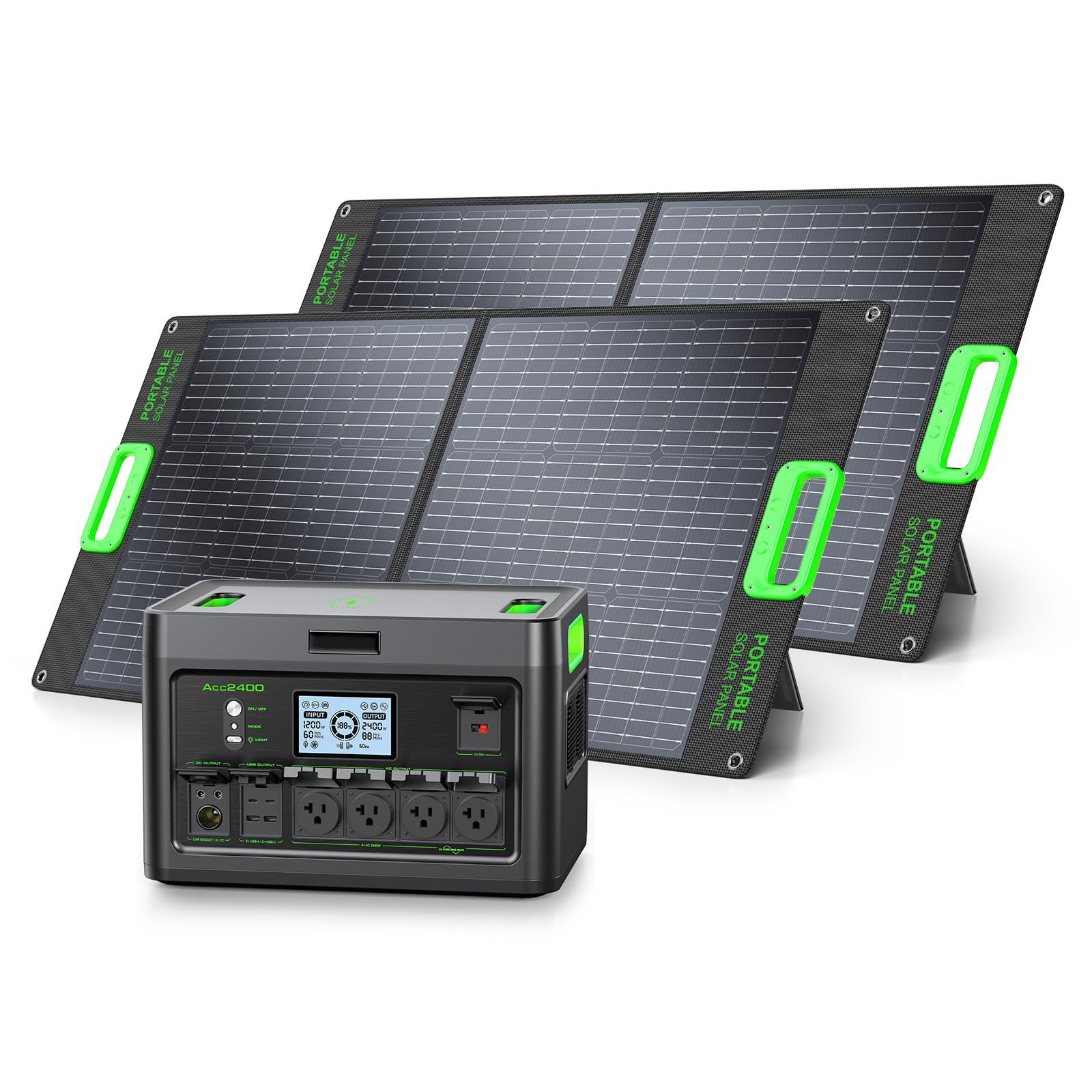
A complete solar generator kit that removes the guesswork of picking compatible panels.
The GRECELL Acc2400-ESL is essentially the same 1843.2Wh / 2400W power station platform as the EBL Acc2400 above, but packaged with two 100W portable solar panels — making it a true ready-out-of-the-box solar generator. The panels ship separately and use standard connectors (Anderson, 5.5×2.5mm, 7.9×0.9mm, etc.) that also work with most other power stations on the market.
The station itself mirrors the EBL’s specs: 2400W continuous AC output (4800W peak), 4 AC ports, 2 USB-A, 2 USB-C PD (100W), a car port, 2 DC ports, and a Qi wireless charging top. The 1843.2Wh LiFePO4 battery is rated for 3500+ cycles. One buyer mentioned that over 9 months of use in temperatures from 40°F to 90°F, the station reliably ran a fridge, a diesel heater, and device charging simultaneously without any hiccups. The 200W of included solar panels can recharge the station from empty in about 9-12 hours of direct sunlight.
The main limitation is that the solar input on this station is capped at a modest 155W, which means even if you add a third panel, the station cannot use it. For faster solar charging, you would need to look at the OUPES or BLUETTI systems with higher solar MPPT (Maximum Power Point Tracking) limits. Also, at 55 lbs for the station alone plus the panels, this kit is heavy and best suited for base-camp or home use.
Why it’s great
- Includes two 100W solar panels in the box — no extra searching
- Same proven 1843.2Wh LiFePO4 platform as the EBL for a reliable backup
- Pure sine wave and 4800W peak surge handle starting loads well
Good to know
- Solar input is capped at 155W — limiting future solar expansion
- At 55 lbs plus panels, it is one of the heaviest kits to transport
Best for: First-time solar generator buyers who want a complete system that works out of the box.
Skip if: You plan to expand your solar array to 400W+ or need a lighter station.
Understanding the Specs
Battery Capacity (Wh)
Measured in watt-hours (Wh), this tells you how much total energy the station holds. A 2000Wh station can power a 100W TV for 20 hours, or a 1500W space heater for about 1.3 hours. Higher is not always better if you are just running lights and a laptop — more Wh means heavier and more expensive. For most people, 2000Wh is the sweet spot for a weekend outage or a camping trip.
AC Charge Speed (W)
This is how fast the station can refill its own battery from a wall outlet. A station with a 2400W AC input can fully recharge in about 1 hour. A station with a 1200W AC input takes about 2 hours. This is the single most important spec if you need to recharge between uses — for example, during a lunch break at a job site or between two power outages.
UPS / EPS Switchover (ms)
Uninterruptible Power Supply (UPS) or Emergency Power Supply (EPS) switches the station to battery power when the grid fails. A 20ms (millisecond) or faster switchover is seamless for most computers, routers, and CPAP machines. Slower switchovers (>30ms) can cause sensitive electronics to reboot or flicker. Look for “≤20ms” for reliable backup.
Solar Input (W)
The maximum wattage the station can accept from solar panels. Higher numbers (1200W or 2400W) let you recharge faster or with more panels. Lower numbers (100-200W) mean you can only use one or two small panels, which take a full day to recharge a 2000Wh station. If you plan to live off-grid with solar, aim for at least 800W solar input.
FAQ
Can a 2400W power station run a whole house?
How long does a 2400W power station last?
Can I charge my EV with a 2400W power station?
What is the difference between LiFePO4 and lithium-ion batteries?
How fast can I recharge a 2400W station from a wall outlet?
Can I use a 2400W power station in an apartment?
What is pure sine wave output and why does it matter?
How do I choose between a power station and a solar generator?
Can I run a sump pump or well pump with a 2400W station?
How long can I store a power station before recharging it?
Final Thoughts: The Verdict
If you want one dependable pick, the 2400w power station winner is the OUPES Exodus 2400 because it offers the best blend of largest capacity (2160Wh), fast 1.2-hour recharge, full app control, and a very competitive price. If you want the lightest possible station to throw in a car or van, grab the GROWATT INFINITY 2000 Pro at just 26 lbs. And for whole-home expandability, the standout is the BLUETTI AC200L with its 8192Wh max expansion capacity.
How We Picked
We do not accept paid placement, and we did not hands-on test every unit. Instead, we match each pick to a real buyer and use-case by comparing the manufacturers’ published specifications against the patterns in verified customer reviews — so you get each pick’s real strengths and trade-offs instead of marketing copy.
Sources & Methodology
Specifications: manufacturer listings and product documentation. Review insights: verified customer reviews, as of June 2026. Pricing: not shown on this page (it changes often); check the current price via the retailer link.
As an Amazon Associate, Gadgets Feed earns from qualifying purchases. This does not affect which products we feature.
Product prices and availability are accurate as of the date/time indicated and are subject to change. Any price and availability information displayed on Amazon at the time of purchase will apply to the purchase of this product. As an Amazon Associate I earn from qualifying purchases.
CERTAIN CONTENT THAT APPEARS ON THIS SITE COMES FROM AMAZON. THIS CONTENT IS PROVIDED "AS IS" AND IS SUBJECT TO CHANGE OR REMOVAL AT ANY TIME.
Amazon and the Amazon logo are trademarks of Amazon.com, Inc. or its affiliates.