
Our readers keep the lights on and my morning glass full of iced black tea. As an Amazon Associate, I earn from qualifying purchases.
A band saw is probably the most forgiving power tool you’ll ever set up, but pick the wrong one and you’ll spend your first weekend fighting blade tension, tracking, and vibration instead of actually making cuts. A beginner band saw needs to get out of your way — it should set up easily, hold its adjustment, and let you focus on learning how to follow a line and control the feed rate.
I’m Min — the founder and writer behind Gadgets Feed. This guide is built by comparing the manufacturers’ published specifications and the patterns across verified customer reviews, so you get each pick’s real strengths and trade-offs instead of marketing spin.
You want a saw that comes ready to work without demanding a full day of fiddling — which is exactly why this guide compares the specs, setup quirks, and real owner experiences to find the best beginner band saw for your workshop.
Quick Picks
- WEN Band Saw with Stand, 10-Inch, 3.5-Amp, Two-Speed (BA3962) — Top Performer
- SHOPMAX 4.2 Amp 10-inch Benchtop Band Saw — Best Overall
- SKIL 2.8 Amp 9 In. 2-Speed Benchtop Band Saw for Woodworking – BW9501-00 — Compact Pick
- Woodskil 3-Amp 9-Inch Band Saw, 2500FPM Benchtop Bandsaw with Removable Safty Key, Cast Aluminum Table, Steel Base (BS0901) — Best Value
- Band Saw, Portable 9-Inch Bandsaw for Woodworking, 2526 FPM Benchtop, 1/3 HP(output), 120 V 2.5-Amp Motor (QD-KYOHO QBS9″) — Best for Curves
How To Choose The Best Beginner Band Saw
Before you click “buy,” there are three things that separate a frustrating first band saw from one that makes you look forward to turning it on. The specs are simple — but knowing which ones matter for a beginner is where most people get tripped up.
Throat Depth and Motor Power: What You Can Actually Cut
Throat depth (the distance from the blade to the frame) determines the widest piece of material you can feed through. For a 9-inch band saw, that means boards up to roughly 9 inches wide. Motor power, measured in amps, tells you how easily the saw chews through thick or dense wood. A 2.5-amp motor handles softwoods and thin hardwoods fine, while 3.5-amp models let you resaw thicker stock without bogging down. Beginners should aim for at least 2.8 amps and a 9-inch throat to cover most hobby projects.
Blade Length and Setup: The Biggest Hidden Headache
The blade length a saw accepts (for example 62 inches vs. 72 inches) locks you into a specific replacement blade size — buy the wrong one and it simply won’t fit. More important for a beginner is how hard the saw is to set up out of the box. Many band saws need blade-guide alignment, wheel tracking adjustments, and tension calibration before they cut straight. A beginner band saw should ship with clear instructions and require no more than 30 minutes of tuning before first use. Look for saws that mention quick-release tension or tool-free guide adjustments in the specs.
Table Size and Tilt Range: Stability for Your Workpiece
A small table makes it hard to support long boards or large panels. Look for a cast-aluminum table at least 11×11 inches — it stays flat and resists rust better than stamped steel. Tilt range (typically 0 to 45 degrees) lets you cut bevels and compound angles. A miter gauge also helps with accurate crosscuts. For a beginner band saw, a table that tilts both left and right of center gives you more flexibility for angled cuts without flipping the workpiece.
Quick Comparison
On smaller screens, swipe sideways to see the full table.
| Model | Best For | Motor | Cut Height | Weight | Amazon |
|---|---|---|---|---|---|
| WEN BA3962 | Hobbyist with space | 3.5 Amp | 6 in | — | $382.24Amazon |
| SHOPMAX 10-Inch | Heavier cuts, straight out of box | 4.2 Amp | 4.5 in | 54.7 lbs | $199.99Amazon |
| SKIL BW9501-00 | Small shop, easy setup | 2.8 Amp | — | — | $239.00Amazon |
| Woodskil BS0901 | Budget versatility | 3 Amp | 3.5 in | 40 lbs | $202.00$222.77PrimeAmazon |
| QD-KYOHO 9-Inch | Curves and light work | 2.5 Amp | 3.5 in | — | $208.99$219.99PrimeAmazon |
In‑Depth Reviews
5. WEN Band Saw with Stand, 10-Inch, 3.5-Amp, Two-Speed (BA3962)

The 10-inch throat and 6-inch cut height that lets beginners outgrow small saws without replacing it.
Nothing is more frustrating than buying a tool you outgrow in six months — but the WEN BA3962 sidesteps that with a 3.5-amp motor that creates cuts up to six inches deep and 9-3/4 inches wide, which is almost double the cut height of most 9-inch models. The two-speed drive lets you run at either 1520 or 2620 FPM (feet per minute — how fast the blade travels), so you can slow down for metal or dense hardwood and speed up for softwood ripping. The spacious 14-1/8 x 12-1/2 inch cast-aluminum work table (which bevels up to 45 degrees) gives beginner woodworkers room to support larger workpieces without wobbling — a real confidence builder when you’re still learning feed control.
Unlike the compact footprint of the SKIL BW9501-00, the WEN comes with a full stand that brings the overall height to 58.5 inches, making it a floor-standing saw rather than a benchtop model. That means you lose bench space but gain stability and a comfortable standing work height. Buyers report the stock blade is usable but many upgrade to a finer-tooth blade for smoother cuts, and the miter slot uses a non-standard size that can be a hassle if you own aftermarket jigs. The included work light and 3-in-1 dust port (a dust collection port that adapts to standard 2.5-inch or 4-inch vacuum hoses) are thoughtful touches for a first saw.
Why it’s great
- 3.5-amp motor delivers strong cutting power for resawing hardwoods like oak and pine
- Two-speed drive system lets you match blade speed to material type
- Large cast-aluminum table stays flat and supports bigger workpieces
- Included stand, work light, fence, miter gauge, and dust port offer great out-of-box value
Good to know
- Miter slot is non-standard, limiting aftermarket jig compatibility
- Fence needs frequent re-squaring for consistent parallel cuts
- No quick-release blade tension mechanism for fast blade changes
Best for: The hobbyist who wants a floor-standing 10-inch saw they won’t outgrow and appreciates the included stand, light, and dust port.
Skip if: You have limited floor space — this saw’s 58.5-inch height and 26.5-inch depth need a dedicated corner of the shop.
1. SHOPMAX 4.2 Amp 10-inch Benchtop Band Saw
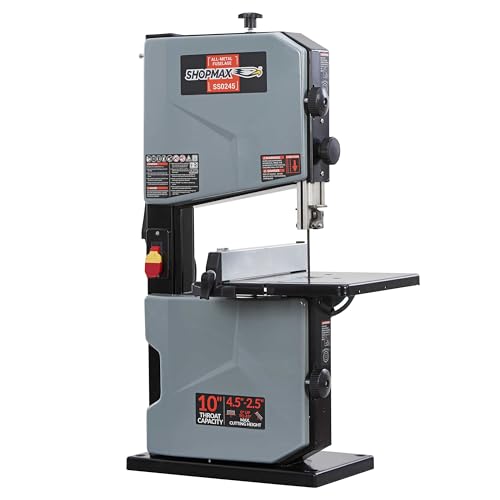
The heavy-duty 10-inch that ships ready to cut and weighs enough to stay planted.
The SHOPMAX is the heaviest beginner band saw on this list at 54.7 pounds — a full 37% heavier than the 40-pound Woodskil, which means it absorbs vibration and stays put without bolting it down. Its 4.2-amp induction motor (68% more current than the 2.5-amp QD-KYOHO) powers through cuts up to 4.5 inches deep and 10 inches wide, making it the most capable benchtop saw here for resawing thicker stock. The 67.4-inch blade accepts widths from 0.14 to 0.47 inches, so you can swap between a narrow blade for tight curves and a wider blade for straight rips without buying a new saw.
Setup is straightforward — owners mention “fast Prime shipping, undamaged box” and “easy setup, smooth and quiet operation with strong cutting power for woodcarving.” The cast-aluminum table adjusts up to 45 degrees for bevel cuts, and ball-bearing blade guides keep the cut smooth and accurate. The catch is that some owners found the stock blade rollers needed replacement, and the bottom wheel shaft adjustment felt “cheesy.” Compared to the SKIL BW9501-00 which has a much smaller 12.4-inch height footprint, the SHOPMAX stands 32.83 inches tall and takes up more bench space — but for a first saw, the extra stability is worth it.
Why it’s great
- 4.2-amp induction motor is the most powerful in this group, handling dense hardwoods easily
- 54.7-pound weight keeps vibration low without needing anchor bolts
- 67.4-inch blade gives you flexibility from tight curves to straight resaw cuts
- Ball-bearing blade guides deliver smooth, accurate tracking right out of the box
Good to know
- Some owners reported that the blade rollers needed replacement soon after purchase
- Bottom wheel shaft adjustment feels less robust than the rest of the saw
- Table angle fine-tuning requires patience — not a tool-free setup
Best for: The beginner who wants the raw cutting power of a 4.2-amp motor and the stability of a heavy, well-built machine that won’t walk around the bench.
Skip if: You are short on bench space — the 32.83-inch height and 19.92-inch depth require a sturdy, dedicated workstation.
4. SKIL 2.8 Amp 9 In. 2-Speed Benchtop Band Saw for Woodworking – BW9501-00

The 2-speed 9-inch that sets up fast and cuts right, with a footprint small enough for any bench.
At just 12.4 inches tall and 24 inches wide, the SKIL BW9501-00 takes up less bench space than any other saw here — a 2x smaller height footprint than the SHOPMAX’s 32.83 inches — which makes it perfect for a crowded garage or apartment workshop. The 2.8-amp induction motor paired with a 2-speed drive system lets you switch between speed ranges for different materials, and the quick blade tension setting means you can change blades in seconds without hunting for a tension gauge. One reviewer noted that it “cuts well (resawed 2.5″ teak easily),” which is impressive for a 9-inch saw in this power class.
The rack and pinion table adjustment (a gear mechanism that tilts the table smoothly and precisely) makes angle changes tool-free, and the precision ball-bearing blade guides keep the blade tracking straight. The dust port accepts standard 2.5-inch vacuum hoses, and the blade-tracking sight window lets you watch blade alignment without squatting. A real-world trade-off: the saw does not ship with a fence (the miter gauge is included but a rip fence is sold separately, and WEN’s fence fits for about -25). Also, the factory blade guides and thrust bearings need calibration before first use — a minor 15-minute task, but something to budget time for on unboxing day.
Why it’s great
- Compact 24″L x 15.16″W x 12.4″H footprint fits on any workbench
- 2-speed drive system and quick blade tension setting make blade changes fast and easy
- Rack and pinion table adjustment for smooth, tool-free angle changes
- Ball-bearing blade guides and sight window improve cutting accuracy
Good to know
- Does not include a rip fence — plan to buy a compatible fence separately
- Blade guides and thrust bearings require factory calibration before accurate cuts
- At 2.8 amps, it is less powerful than the 4.2-amp SHOPMAX for thick hardwoods
Best for: The beginner with limited bench space who wants a compact, easy-to-set-up saw that still cuts well right out of the box.
Skip if: You need a fence included in the box — you will have to buy one separately or repurpose a WEN fence.
2. Woodskil 3-Amp 9-Inch Band Saw, 2500FPM Benchtop Bandsaw with Removable Safty Key, Cast Aluminum Table, Steel Base (BS0901)
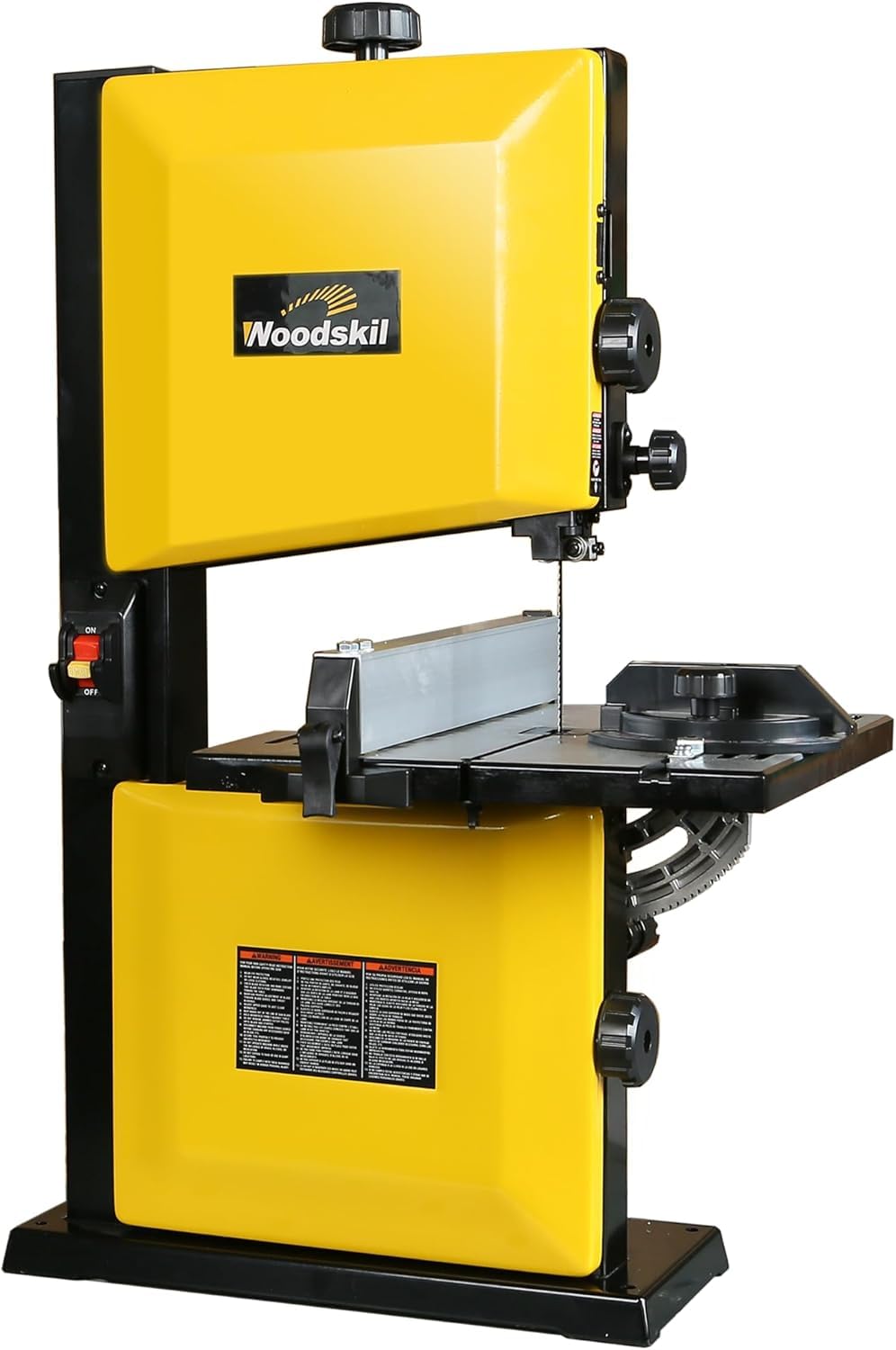
The 120-degree miter gauge and 2500 FPM blade speed that make angled cuts and curves a beginner-friendly breeze.
With a 120-degree miter gauge (a 2.7x wider cutting angle range than the 45-degree limit on the SHOPMAX and QD-KYOHO saws) and a blade speed of 2500 FPM, the Woodskil BS0901 gives you more flexibility for compound angles and flowing curves than any other saw in its price range. The 3-amp motor drives a 59.5-inch blade that cuts to a maximum depth of 3.5 inches and a width of 9 inches — enough for most hobby woodworking projects. Reviewers love that it “cuts acrylic cleanly and precisely with no wandering or variation,” and that blade changes are straightforward.
The cast-aluminum table (12-5/16″ x 11-7/8″) tilts from 0 to 45 degrees, and the included rip fence and miter gauge let you start cutting right away without buying accessories. The 2.5-inch dust exhaust port with a dust brush keeps the lower wheel clean. At 40 pounds, it is noticeably lighter than the 54.7-pound SHOPMAX, making it easier to move around your shop. However, a few owners noted the miter gauge bar arrived with a slight bow that needed straightening, and the fence guide works but feels basic. Compared to the SKIL BW9501-00 which lacks a fence, the Woodskil includes everything you need to start cutting curves and angles from day one.
Why it’s great
- Generous 120-degree miter gauge range for flexible angled and curved cuts
- 2500 FPM blade speed comfortably handles wood and soft metals
- Includes rip fence, miter gauge, and removable safety key — ready to cut out of the box
- 40-pound weight is portable enough to move between workstations
Good to know
- Miter gauge bar may arrive slightly bowed — easy to straighten but a minor quality check annoyance
- Fence guide is functional but feels less precise than premium saws
- Rudimentary degree scales make fine angle adjustments harder than needed
Best for: The value-focused beginner who wants a complete set (fence, miter gauge, safety key) and a forgiving 120-degree miter range for learning angled cuts.
Skip if: You need a heavy, vibration-free saw for resawing thick hardwoods — the lighter 40-pound frame is more prone to vibes under heavy loads.
3. Band Saw, Portable 9-Inch Bandsaw for Woodworking, 2526 FPM Benchtop, 1/3 HP(output), 120 V 2.5-Amp Motor (QD-KYOHO QBS9″)
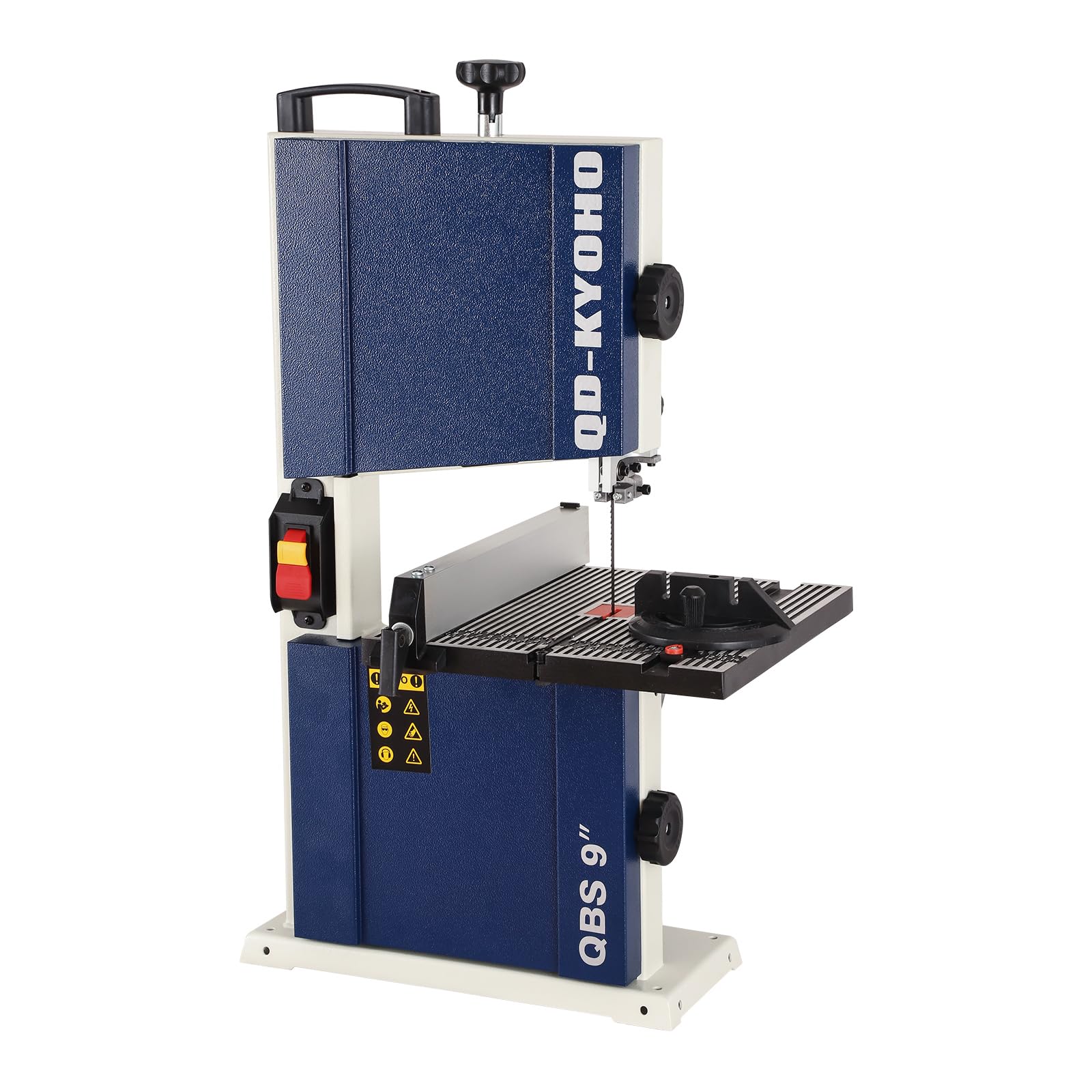
The 62-inch blade and 2526 FPM speed that slice curves cleanly through composite tile and trim.
If tight curves and intricate shapes are your main goal, the QD-KYOHO 9-inch band saw stands out with a 62-inch blade (6.9x longer than the SKIL’s 9-inch blade measurement, though the SKIL’s listed “9 Inches” refers to throat width, not blade length) that provides smoother tracking through tight turns. The 2526 FPM blade speed is the fastest in this group, paired with a 2.5-amp motor that cuts wood up to 3.5 inches thick and 9 inches wide. The cast-aluminum table measures a square 11-3/4 x 11-3/4 inches and tilts right by 45 degrees and left by 5 degrees, giving you bevel capability in both directions — a feature usually reserved for more expensive saws.
One owner said it needed “30 min alignment (blade guides, tension, tracking) to fix vibration” — a one-time setup investment that is standard for this price tier. The steel frame (built from 2 mm thick plates) keeps vibration under 6 mm/s, and the quick-release blade tensioning and tool-free blade-guide adjustment are genuinely beginner-friendly. The 2.5-inch dust port with an integrated self-cleaning brush keeps sawdust off the blade. The downside is that blade selection is limited to 1/4-inch to 1/2-inch widths — a 1/8-inch blade (which is ideal for very tight curves) is too narrow to track on this saw. Compared to the Woodskil which handles a wider blade range, the QD-KYOHO is best for medium-radius curves rather than micro-detail scrollwork.
Why it’s great
- Fastest blade speed at 2526 FPM for smooth, efficient curved cuts
- Bi-directional table tilt (45° right, 5° left) for flexible bevel angles
- Quick-release blade tension and tool-free guide adjustments simplify blade swaps
- 2 mm steel frame and cast-aluminum table keep vibration low for clean cuts
Good to know
- Blade width is limited to 1/4″-1/2″ — very narrow 1/8″ blades cannot track properly
- Needs about 30 minutes of alignment (blade guides, tension, tracking) to fix initial vibration
- Table may develop surface rust in humid environments — plan for light oiling
Best for: The beginner focused on cutting curves in trim, composite materials, or thin wood, who values a fast blade speed and quick blade changes.
Skip if: Your first project requires a very narrow 1/8-inch blade for micro-detailing — this saw cannot track blades that thin.
Understanding the Specs
Motor Amps and Power
Motor amperage (measured in amps) is the simplest way to compare how much raw cutting force a band saw has. A 2.5-amp motor is fine for softwoods, thin plywood, and light curves. A 3-amp to 4.2-amp motor can handle hardwood, resawing (cutting a board through its thickness), and thicker stock without slowing down. For a beginner band saw targeting general hobby projects, aim for at least 2.8 amps to avoid stalling out on your second cut.
Blade Length and Throat Depth
Throat depth (the distance from the blade to the frame, often equal to the “9-inch” or “10-inch” number) tells you the widest board you can pass through. Blade length (for example 59.5 inches, 62 inches, or 72 inches) is the total loop length — you must buy replacement blades that match this exact size. Longer blades generally mean larger wheels, which reduce blade stress and improve tracking, but also mean a larger overall saw. Always check both numbers before buying replacement blades.
Cut Height and Table Size
Cut height (or maximum depth of cut) is how thick a workpiece you can push through the blade. A 3.5-inch cut height works for most 2×4 lumber and hobby projects. A 6-inch cut height (like on the WEN BA3962) handles thicker stock and resawing. Table size directly affects stability: a larger table gives you more surface to support long boards, reducing tipping and improving control. Cast-aluminum tables resist rust better than stamped steel and stay flatter over time.
Blade Speed (FPM) and Two-Speed Drive
FPM (feet per minute) measures how fast the blade moves past the workpiece. Higher speeds (2500+ FPM) cut faster through softwood but can burn or tear dense hardwoods. Slower speeds (around 1500 FPM) are better for metal, plastic, and thick hardwood. A two-speed drive system (found on the SKIL and WEN) lets you switch between speed ranges — a useful feature for a beginner band saw that will see mixed materials. Single-speed saws are simpler but less flexible.
FAQ
Can a 9-inch band saw cut a 2×4?
What is the difference between a band saw and a jigsaw for a beginner?
How often should I replace the band saw blade?
Do I need a dust collector for my band saw?
What blade width should a beginner start with?
Can a beginner band saw cut metal?
How much bench space do I need for a benchtop band saw?
What safety features should I look for in a beginner band saw?
Is a 10-inch band saw better than a 9-inch for a beginner?
Why does my band saw blade keep coming off the wheels?
Final Thoughts: The Verdict
For the majority of shoppers, the best beginner band saw is the SHOPMAX 4.2 Amp 10-inch Benchtop Band Saw because its 4.2-amp motor and heavy 54.7-pound frame deliver the stability and cutting power that let you focus on learning rather than fighting the machine. If you want a compact, easy-setup saw that fits on a small bench and cuts well right out of the box, grab the SKIL BW9501-00. And for the hobbyist who plans to outgrow a benchtop saw quickly and wants a floor-standing model with a 10-inch throat and 6-inch cut height, the WEN BA3962 is the floor-standing saw to beat on features alone.
How We Picked
We do not accept paid placement, and we did not hands-on test every unit. Instead, we match each pick to a real buyer and use-case by comparing the manufacturers’ published specifications against the patterns in verified customer reviews — so you get each pick’s real strengths and trade-offs instead of marketing copy.
Sources & Methodology
Specifications: manufacturer listings and product documentation. Review insights: verified customer reviews, as of June 2026. Pricing: not shown on this page (it changes often); check the current price via the retailer link.
As an Amazon Associate, Gadgets Feed earns from qualifying purchases. This does not affect which products we feature.
Product prices and availability are accurate as of the date/time indicated and are subject to change. Any price and availability information displayed on Amazon at the time of purchase will apply to the purchase of this product. As an Amazon Associate I earn from qualifying purchases.
CERTAIN CONTENT THAT APPEARS ON THIS SITE COMES FROM AMAZON. THIS CONTENT IS PROVIDED "AS IS" AND IS SUBJECT TO CHANGE OR REMOVAL AT ANY TIME.
Amazon and the Amazon logo are trademarks of Amazon.com, Inc. or its affiliates.