
Our readers keep the lights on and my morning glass full of iced black tea. As an Amazon Associate, I earn from qualifying purchases.
You bought a boat to enjoy the water, not to listen to a blown-out, distorted mess from a corroded amplifier that gave up after one season. The salt, the spray, the constant vibration — a standard car amp just dies out there. You need an amplifier built specifically to survive the marine environment while delivering clean, powerful sound. This guide cuts through the marketing claims to find the real workhorses.
I’m Min — the founder and writer behind Gadgets Feed. This guide is built by comparing the manufacturers’ published specifications and the patterns across verified customer reviews, so you get each pick’s real strengths and trade-offs instead of marketing spin.
Whether you are upgrading a cuddy cabin or a center console, finding the right 2-channel marine amp means balancing power, size, and true weather resistance so your music outlasts every voyage.
Quick Picks
- NVX VADM2v2 2-Channel Class D Amplifier — Top Performer
- Rockville RXM-T2 Micro 2400W 2-Channel Class D Marine Amplifier — Best Value Power
- Rockville DBM25 Marine Amplifier — Best Overall
- DS18 NXL-N2 Hydro 2-Channel Class D Amplifier — Fully Waterproof
- Rockford Fosgate PM300X2 Punch Marine 300 Watt 2-Channel Amplifier — Premium Build
- Garmin Fusion AM Series Marine Amplifier, 400-watt 2 Channel — OEM Integration
How To Choose The Best 2-Channel Marine Amp
Finding the right amp for your boat, jet ski, or side-by-side isn’t about picking the highest wattage. You need an amplifier that delivers clean power reliably while fighting off moisture, salt, and temperature swings. Here are the two most important things to nail first.
RMS Power vs. Peak Power
Ignore the peak power number. It’s a marketing figure that has almost nothing to do with how the amp sounds in real use. What matters is RMS power (Root Mean Square — the continuous power the amp can deliver without overheating or distorting). Match the amp’s RMS output at your speaker’s impedance (ohm load) to your speakers’ RMS rating. If you feed a speaker rated for 100W RMS with 200W RMS, you will blow the speaker. Always match the RMS numbers.
Marine Protection: Conformal Coating vs. IP Rating
Most “marine” amps use a conformal coating — a thin polymer layer sprayed over the circuit board to repel moisture and salt corrosion. That is good, but it is not fully waterproof. For applications exposed to direct spray or rain, look for an IPX67 rating (meaning it is dust-tight and can handle immersion in up to a meter of water for 30 minutes). For a cabin or under-console install, a conformal-coated board with sealed terminals will serve you just fine. Your mounting location decides which level of protection you need.
Quick Comparison
On smaller screens, swipe sideways to see the full table.
| Model | Best For | RMS Power | Protection Type | Dimensions (inches) | Amazon |
|---|---|---|---|---|---|
| NVX VADM2v2 | Tiny spaces / powersports | 600W RMS (200W x2 @4Ω) | Conformal coated PCB | 6.49 x 3.3 x 1.48 | $199.99Amazon |
| Rockville RXM-T2 | High-power subwoofers | 1200W RMS (600W x2 @2Ω) | Conformal coated PCB | 16 x 8.6 x 3.8 | $159.95Amazon |
| Rockville DBM25 | Filling a cabin with full-range sound | 375W RMS (125W x2 @4Ω) | Conformal coated PCB + terminal covers | 5 x 11.5 x 18.9 | $129.95Amazon |
| DS18 NXL-N2 Hydro | Full weather exposure (spray/rain) | 300W RMS (150W x2 @2Ω) | IPX67 waterproof (fully sealed) | Ultra compact | $335.95Amazon |
| Rockford Fosgate PM300X2 | Trusted brand, punchy sound | 300W RMS (100W x2 @4Ω) | Marine-grade (plastic/composite + conformal coating) | 9.86 x 7.76 x 2.38 | $314.99$349.99Amazon |
| Garmin Fusion AM400 | OEM integration with Fusion radios | 400W RMS (est. 70W x2 @4Ω) | Conformal coated PCB | 11.65 x 9.02 x 2.09 | $159.95Amazon |
In‑Depth Reviews
1. NVX VADM2v2 2-Channel Class D Amplifier
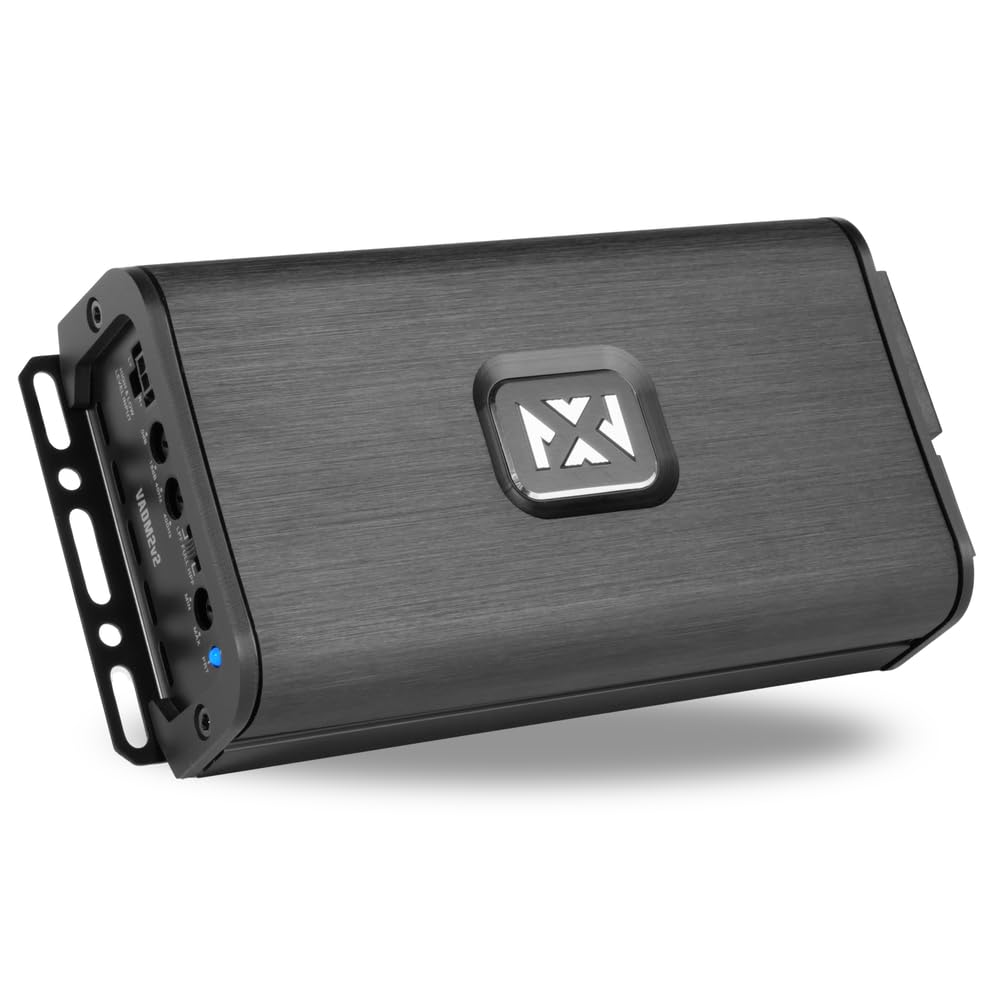
The smallest powerhouse here, perfect where every inch counts.
If you are cramming an amp into an ammo-can build, under a boat dash, or on a motorcycle, the NVX VADM2v2 solves a problem other amps cannot: it is only 6.49 x 3.3 x 1.48 inches — barely bigger than a smartphone. Despite that tiny footprint, it delivers 600W RMS total (200W x 2 at 4 ohms) from its Micro Class D design, so you get serious volume without draining your battery. Buyers report it is “powerful (150W RMS x2 @4 ohms), clean Class D sound, small footprint for ammo can builds, efficient power use.” The marine-grade, conformally coated circuit board resists moisture, and the 4-way protection circuitry keeps the amp from frying itself if a speaker wire shorts.
The catch? That small size means it runs hot at high volume — buyers mention it needs good ventilation. The terminal block screws face downward, which one reviewer found awkward since you must attach wires before permanently mounting the amp. Also, it lacks a dedicated bass knob. Still, no other amp in this list delivers this much power in a package this small.
Unlike the much bigger Rockville RXM-T2, the NVX trades peak raw wattage for installation flexibility. It is the right pick when your mounting space is the biggest constraint.
Why it’s great
- Tiny size fits in tight spaces like dashes and motorcycle fairings
- Balanced differential inputs eliminate alternator whine and noise
- Selectable HPF/LPF/Full crossover modes for precise tuning
Good to know
- Runs hot at high volume without ventilation
- Terminal screws face down, complicating pre-wiring
- No included remote bass level control
Best for: Tight installs on boats, ATVs, or motorcycles where space is at a premium.
Skip if: You need a bass knob control or plan to mount it in a sealed, unventilated compartment.
2. Rockville RXM-T2 Micro 2400W 2-Channel Class D Marine Amplifier

Huge power in a Class D design that stays cool, even in a hot engine bay.
When you want to drive big subwoofers on the water, the Rockville RXM-T2 delivers a massive 1200W RMS (600W x 2 at 2 ohms) — that is nearly a 10x power gap compared to the smaller Rockville DBM25’s 125W RMS. The Class D topology and MOSFET power supply keep it running cool and efficient, which matters when your amp is in a 110-degree Mojave desert side-by-side. A buyer who ran it on a 26-foot boat reported it is still running strong after “2+ years.” The conformal-coated PCB and aluminum chassis fight off moisture and corrosion, while the compact 16 x 8.6 x 3.8-inch size fits under many boat seats.
The honest trade-off: at 16 x 8.6 x 3.8 inches, it is about 3.2 times larger in volume than the NVX VADM2v2, so it is not for ultra-tight spaces. Also, it does not ship with an Allen wrench for the terminal set screws — one reviewer noted they are easy to strip. And there is no remote bass knob included, which some users miss for quick low-end adjustments while driving.
Compared to the DS18 Hydro NXL-N2, the Rockville delivers four times the RMS power for half the investment, making it the clear budget-power champion for big sub builds.
Why it’s great
- Highest RMS power in this lineup — drives large subs with authority
- Class D design runs cooler and draws less current than A/B amps
- Built with studio-grade output transistors for clean sound
Good to know
- Large footprint limits placement options
- No remote bass knob included
- Terminal set screws are easy to strip without proper tool
Best for: Powering large subwoofers or multiple speakers on boats and off-road vehicles.
Skip if: You have a very tight mounting space or need an ultra-compact amp.
3. Rockville DBM25 Marine Amplifier

The most complete all-around package with a bass knob and full tuning controls.
The Rockville DBM25 hits the sweet spot for most boat owners. It delivers a solid 375W RMS (125W x 2 at 4 ohms) through a Class A/B design — enough to drive a pair of marine speakers and a subwoofer with clean, crisp sound. One buyer “installed with Rockville head unit and 800W sub in Bayliner cuddy cabin” and reported great sound in both the cabin and cockpit. The marine-grade build includes a conformal-coated PCB, silicone terminal covers, a rustproof aluminum heat sink, and stainless steel hardware — the full weatherproofing suite. The adjustable crossover (low-pass from 50Hz-250Hz, high-pass from 60Hz-1.2kHz) plus the included remote bass control give you total command over your sound.
The honest catch: it is a Class A/B amp, not Class D, which means it runs warmer and draws more current than the Rockville RXM-T2. Multiple buyers confirm it is “HUGEISH” — at 5 x 11.5 x 18.9 inches, it needs real mounting space. And the “waterproof” claim is limited: one owner noted it “only has rubber Caps that go over wiring connections,” so it is not fully sealed from a direct spray.
Compared to the much pricier Rockford Fosgate PM300X2, the DBM25 delivers more RMS power (375W vs 300W) and includes a remote bass knob, making it the more versatile choice at a lower tier.
Why it’s great
- Full crossover controls (low-pass and high-pass) for speaker and sub tuning
- Included remote bass knob for easy on-the-water adjustments
- Rustproof aluminum sink and stainless steel hardware handle saltwater
Good to know
- Large physical size requires significant mounting space
- Class A/B design runs warmer and draws more current than Class D
- Rubber terminal caps offer limited water protection, not full sealing
Best for: A balanced full-range system with a sub in a boat cabin or under a console with decent space.
Skip if: You need a tiny amp for a cramped space or one that can survive direct spray.
4. DS18 NXL-N2 Hydro 2-Channel Class D Amplifier
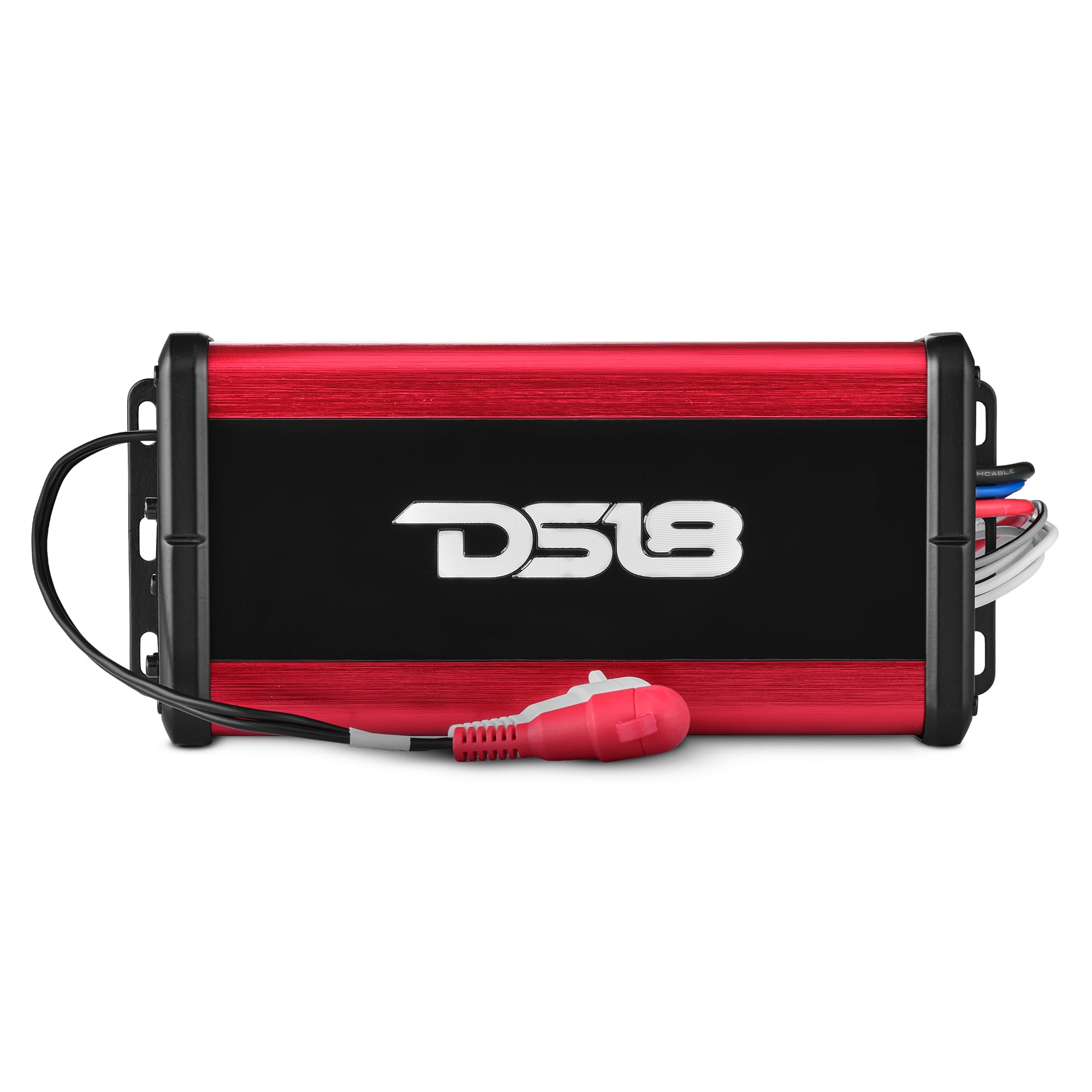
The only fully sealed amp here, built to survive direct rain and spray.
If your amp lives where it gets splashed — open on a jet ski, exposed on a wake tower, or under the sky on a Waverunner — the DS18 NXL-N2 Hydro is your best bet. It carries an IPX67 rating (meaning it is dust-tight and can survive immersion in a meter of water for 30 minutes), which is a far higher standard than the conformal coating on most other marine amps. It pumps 300W RMS (150W x 2 at 2 ohms) from its ultra-compact, Class D chassis. Owners mention it delivers quality sound: “waterproof amp delivers clear sound with good highs and lows; compact, easy install.” Multiple owners run two of them in Can-Am Spyders and Rykers.
The real drawback is that some units pick up signal noise and interference. One buyer mentioned his unit “produces interference/whine even with gains down on a Waverunner,” and a professional check found no connection issues. That is a problem on a sensitive marine electrical system. Also, at this power level (150W x 2), it cannot drive big subwoofers like the Rockville RXM-T2 can.
Compared to the Garmin Fusion AM400, the DS18 offers true IPX67 waterproofing instead of just a conformal coating, so it wins hands-down for exposed installations.
Why it’s great
- IPX67 rating — fully sealed against water and dust, not just coated
- Ultra-compact form factor fits anywhere
- Class D design is efficient and runs cool
Good to know
- Some units pick up signal noise/interference
- Lower RMS power limits it to speakers, not big subs
- Premium-tier cost for moderate power output
Best for: Exposed installations where the amp lives in direct spray or rain.
Skip if: You need high power for large subwoofers or have a noise-sensitive electrical system.
5. Rockford Fosgate PM300X2 Punch Marine 300 Watt 2-Channel Amplifier

Rockford Fosgate’s legendary build quality in a compact marine package.
The PM300X2 carries Rockford Fosgate’s reputation for robust, reliable amps that sound punchy right out of the box. It delivers 300W RMS (100W x 2 at 4 ohms) from a Class A/B design and includes the famous Punch EQ with an 18dB boost at 45Hz — that is a specific low-frequency boost that makes bass hit harder without needing a larger amp. Buyers confirm it is powerful enough to drive JL Audio Marine M-series speakers cleanly, with one noting the clipping indicator is “a very nice feature” for avoiding distortion. The marine-grade plastic and composite casing holds up to UV and salt spray, and the Full 2-year parts and labor warranty adds peace of mind.
The limitation here is raw power. At 300W RMS, it is less powerful than the budget-friendly Rockville DBM25 (375W RMS) or the RXM-T2 (1200W RMS), yet it sits at the highest price tier in the group. One reviewer did blow two speakers rated at 100W RMS because he was “cranking it,” meaning the amp can drive cleanly to its limit. It also is a Class A/B design, so it runs warmer and uses more battery than Class D alternatives.
Compared to the NVX VADM2v2, the Rockford Fosgate delivers a third of the RMS power at roughly the same price, so you are paying for the brand reputation and the Punch EQ tuning rather than sheer wattage.
Why it’s great
- Rockford Fosgate build quality and 2-year warranty
- Punch EQ with +18dB boost at 45Hz for stronger bass
- Built-in clipping indicator helps protect speakers
Good to know
- Lower RMS power than similarly priced options
- Class A/B runs warmer and draws more current than Class D
- Some users find the gain needs to be high before clipping sets in
Best for: Buyers who prioritize brand reliability and a specific punchy sound signature over raw wattage.
Skip if: You need maximum power for your dollar or want an energy-efficient Class D amp.
6. Garmin Fusion AM Series Marine Amplifier, 400-watt 2 Channel

The natural partner for a Fusion head unit in a premium boat build.
If your boat already runs a Fusion radio, the Garmin Fusion AM400 is the simplest drop-in upgrade. It is a 400-watt Class A/B 2-channel amp that directly pairs with Fusion’s signal processor and control system, giving you a seamless integration that third-party amps cannot match. Its conformal-coated PCBs and large heat sink are designed to handle the marine environment, and the 2-ohm stereo stable design can power up to four speakers or a single subwoofer. One owner reports it sounds “really good powering the 8.8 fusion tower speakers.” The variable bass boost, subsonic filter, and crossover filters give you standard modern tuning features.
The problems with this amp are real. A concerning number of customers note failures: one says it “stop working, at 8th month after i bought it.” Another tried running it with a single 12-inch subwoofer and found it “definitely not a good subwoofer amp” — even a 200W RMS sub was too much for it. There is no option for a remote subwoofer controller, which is a big miss for marine audio. And compared to the Rockville DBM25, the Fusion delivers roughly similar Class A/B power but for a higher cost and with no remote bass control.
This amp makes sense only if you insist on keeping everything in the Fusion/Garmin ecosystem. Otherwise, the Rockville DBM25 gives you more power and more control for less money.
Why it’s great
- Seamless integration with Fusion stereo systems
- Conformal-coated boards and generous heat sink for marine use
- Variable bass boost and filters for system protection
Good to know
- Multiple reports of amplifier failure within a year
- No remote subwoofer control included
- Underpowered for even a modest subwoofer
Best for: Adding clean amplification to an existing Fusion stereo system with a brand-new boat.
Skip if: You want to power a subwoofer, need a remote control, or prefer a more proven reliability track record.
Understanding the Specs
RMS Power (The Real Wattage)
RMS (Root Mean Square) is the number to trust. It tells you how much power the amp can deliver continuously without overheating, distorting, or shutting down. The “peak power” number you see on the box is a theoretical maximum that the amp can hit for a split second — it has almost no bearing on real-world listening. Always match your amplifier’s RMS rating at your speaker’s impedance (4 ohms or 2 ohms) to your speakers’ RMS rating. An amp delivering more RMS than the speaker can handle will blow the speaker.
Class D vs. Class A/B Efficiency
Class D amplifiers use switching technology that makes them much more efficient (around 80-90%) compared to traditional Class A/B designs (around 50-60%). On a boat’s limited battery capacity, that efficiency matters: a Class D amp draws less current, produces less waste heat, and puts more power into your speakers. Class A/B amps can sound slightly warmer to some ears, but they run hotter and stress your electrical system more. For marine use, Class D is almost always the smarter choice unless your budget is very tight.
FAQ
Can I use a car amplifier on my boat?
What is conformal coating on a marine amp?
How many watts do I need for my boat speakers?
What does “2 ohm stable” mean for a marine amp?
Do I need a remote bass knob for my boat amp?
How do I wire a 2-channel marine amp for a subwoofer?
What fuse size do I need for my marine amp?
Will a marine amp work in my side-by-side or ATV?
How long should a marine amplifier last?
Is the Garmin Fusion AM400 worth the money?
Final Thoughts: The Verdict
For the majority of shoppers, the 2-channel marine amp winner is the Rockville DBM25 because it delivers the best balance of RMS power (375W RMS), included remote bass control, full crossover tuning, and proven marine-grade construction at a very fair price. If you need a tiny amp for a tight space like a motorcycle or a small boat dash, grab the NVX VADM2v2. And for exposed installations where an IPX67 fully waterproof amp is the only safe choice, the standout is the DS18 NXL-N2 Hydro.
How We Picked
We do not accept paid placement, and we did not hands-on test every unit. Instead, we match each pick to a real buyer and use-case by comparing the manufacturers’ published specifications against the patterns in verified customer reviews — so you get each pick’s real strengths and trade-offs instead of marketing copy.
Sources & Methodology
Specifications: manufacturer listings and product documentation. Review insights: verified customer reviews, as of June 2026. Pricing: not shown on this page (it changes often); check the current price via the retailer link.
As an Amazon Associate, Gadgets Feed earns from qualifying purchases. This does not affect which products we feature.
Product prices and availability are accurate as of the date/time indicated and are subject to change. Any price and availability information displayed on Amazon at the time of purchase will apply to the purchase of this product. As an Amazon Associate I earn from qualifying purchases.
CERTAIN CONTENT THAT APPEARS ON THIS SITE COMES FROM AMAZON. THIS CONTENT IS PROVIDED "AS IS" AND IS SUBJECT TO CHANGE OR REMOVAL AT ANY TIME.
Amazon and the Amazon logo are trademarks of Amazon.com, Inc. or its affiliates.