
Our readers keep the lights on and my morning glass full of iced black tea. As an Amazon Associate, I earn from qualifying purchases.
You know that feeling — foggy-headed in a stuffy room, or groggy in a bedroom that feels a little close. A battery-operated CO2 detector (a sensor that reads carbon dioxide levels) tells you exactly when to open a window. You breathe clearly again, and you do not need a wall outlet to run it.
I’m Min — the founder and writer behind Gadgets Feed. This guide is built by comparing the manufacturers’ published specifications and the patterns across verified customer reviews, so you get each pick’s real strengths and trade-offs instead of marketing spin.
Finding the right battery operated co2 detector means matching the right sensor accuracy and battery life to your daily routine.
Quick Picks
- SwitchBot Meter Pro CO2 — Top Performer
- KDWKD Indoor Air Quality Monitor — Multi-Sensor Champ
- Temtop C1 CO2 Monitor — Best Value
- TEKCOPLUS CO2 Meter Portable — Industrial Grade
- Gain Express Portable CO2 Meter — Field Scout
How To Choose The Best Battery Operated CO2 Detector
Portable CO2 detectors differ in how accurately they measure, how long they last on a charge, and whether you also want to track things like temperature or dust particles. These three specs make the biggest difference in your day-to-day use.
Sensor Accuracy and Refresh Speed
The sensor is the most important part. Nearly all reliable battery-powered CO2 detectors use an NDIR sensor (which shines a beam of infrared light through air to detect carbon dioxide). Look for accuracy specs around ±40 ppm (parts per million) or ±50 ppm — that means the reading is probably off by no more than that small margin. A refresh rate around 1 to 5 seconds means you see a change in the air just seconds after it happens, so you can open a window and watch the number drop in real time.
Battery Life and Power Modes
Battery life varies hugely between models. Some run for a full year on a pair of AA batteries by only sampling every few minutes, while others with rechargeable batteries last only a few days of active use before needing a charge. If you want to simply place a monitor on a shelf and forget about it for months, choose a model with the longest advertised battery life. If you plan to carry it between rooms or use it daily for troubleshooting, a rechargeable battery with a few days of life is fine.
Extra Sensors and Form Factor
Pure CO2 monitors are usually more affordable, but multi-sensor units also measure temperature, humidity, VOCs (vapors from paint, cleaners, or new furniture), and PM2.5/PM10 (tiny particles from cooking smoke or wildfire smoke). Choose a multi-sensor model if you want to see a complete air quality picture, like during a remodel or during wildfire season. The physical size also matters — a slim, compact unit can be placed on a bedside table or packed in a carry-on bag for travel.
Quick Comparison
On smaller screens, swipe sideways to see the full table.
| Model | Best For | CO2 Accuracy | Battery Life | Extra Sensors | Amazon |
|---|---|---|---|---|---|
| SwitchBot Meter Pro CO2 | Smart home users who want app alerts | ±50 ppm +5% | Up to 12 months (AA) | Temp, Humidity, Comfort | $52.99$69.99Limited time dealAmazon |
| KDWKD Air Quality Monitor | Tracking PM2.5, VOCs, and formaldehyde | Not specified | 9 hours (Li-ion) | PM0.3-PM10, HCHO, TVOC, Temp | $99.99$109.99Amazon |
| Temtop C1 | Budget-friendly with long standby time | ±40 ppm +5% | 70 days (Li-ion) | Temp, Humidity | $29.99$39.99Amazon |
| TEKCOPLUS CO2 Meter | Handheld testing for leaks and ventilation | ±50 ppm +5% | Battery (AA) | Temp, Humidity, Dew Point | $132.59Amazon |
| Gain Express CO2 Meter | Professional-grade portable spot-checking | ±50 ppm +5% | Battery (AA) or 9V adapter | Temp, Humidity, Dew Point | $134.90Amazon |
In‑Depth Reviews
1. SwitchBot Meter Pro CO2

The set-and-forget monitor that stays accurate for an entire year on standard AA batteries.
The SwitchBot Meter Pro CO2 earns the top spot because it delivers accurate CO2 readings for up to 12 months on two AA batteries — no recharging needed. It uses a Swiss-made NDIR sensor with a CO2 accuracy of ±50 ppm +5% of the reading. In everyday terms that means if the real CO2 level is 1000 ppm, the display might show between 950 and 1050 ppm. One buyer verified it matched another high-end CO2 monitor within just 7 ppm (1140 vs 1147 ppm). Its 92-millimeter screen shows CO2, temperature, humidity, the time and date, and a comfort level all at once. Unlike the Temtop C1, the SwitchBot samples CO2 every 1 second by default. Buyers report the refresh slows to every 5 minutes on battery to save power. The catch is that phone alerts need a separate SwitchBot Hub.
Who it fits best: anyone who wants a low-maintenance, highly accurate detector with potential smart home upgrades. Who should skip it: you need phone alerts out of the box — you will have to buy the Hub.
Why it is great
- Up to 12 months of battery life on AA cells means almost zero maintenance.
- Fast 1-second refresh gives you near-instant feedback on air quality changes.
- Large all-in-one screen displays CO2, temp, humidity, date, and a comfort indicator.
Good to know
- Phone alerts require a separate SwitchBot Hub, adding to the cost.
- On battery, the CO2 sampling slows to every 5 minutes to conserve power.
- Occasional Bluetooth connectivity drops reported by some users.
Best for: Anyone who wants a low-maintenance, highly accurate detector with smart home upgrade potential.
Skip if: You need phone alerts out of the box — you will have to buy the Hub.
2. KDWKD Indoor Air Quality Monitor
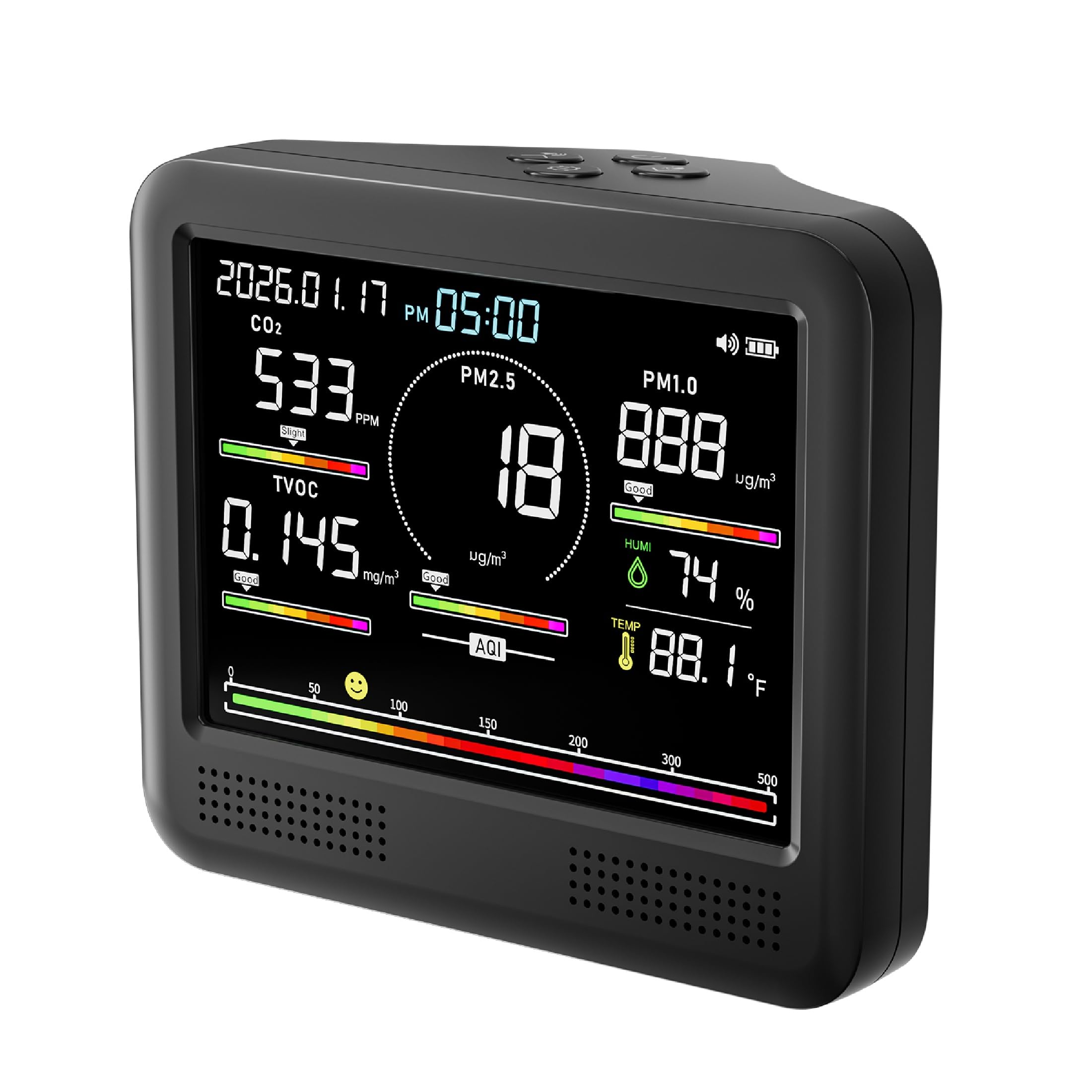
The portable lab that tracks everything from dust particles to paint fumes in a single glance.
If you are remodeling a room or battling seasonal allergies, the KDWKD monitor goes far beyond pure CO2 detection. It measures PM0.3, PM0.5, PM1.0, PM5.0, and PM10 (tiny particles you cannot see), HCHO (formaldehyde), TVOC (total volatile organic compounds from paint and cleaners), CO2, temperature, and humidity. All those readings appear on a large color screen with a 7-level AQI (Air Quality Index) display that changes color. One reviewer noted it was “essential for new construction/remodel to detect high VOCs/formaldehyde from fumes.” The downside: the built-in rechargeable battery lasts about 9 hours, so you will need to plug it in nightly for continuous monitoring. That is less than the year-long SwitchBot Meter Pro CO2, but you get far more sensor types. Its CO2 accuracy spec is not published, so if pinpoint CO2 precision is your top priority, the SwitchBot or Temtop is a more reliable bet.
Who it fits best: homeowners wanting to track dust, VOCs, and formaldehyde after a remodel or new furniture purchase. Who should skip it: you only need a pure CO2 monitor and do not want to manage a daily recharge.
Why it is great
- Detects PM0.3 through PM10, formaldehyde, TVOC, and CO2 for a complete air picture.
- Large color screen with a 7-level AQI readout makes interpreting data effortless.
- Portable and rechargeable for easy spot-checking in different rooms or while traveling.
Good to know
- 9-hour battery life requires daily charging for 24/7 monitoring.
- CO2 accuracy spec is not listed, unlike dedicated CO2 monitors.
- May be overkill if you only care about CO2 levels.
Best for: Homeowners who want to track dust, VOCs, and formaldehyde after a remodel or new furniture purchase.
Skip if: You only need a pure CO2 monitor and do not want to manage a daily recharge.
3. Temtop C1 CO2 Monitor

The most accurate budget-friendly CO2 monitor, with an impressive 70-day standby battery.
The Temtop C1 delivers the tightest CO2 accuracy in this lineup — ±40 ppm +5% of the reading. That is more accurate than the SwitchBot’s ±50 ppm spec (a gap of ±10 ppm between the two). It uses a Swiss-engineered NDIR sensor that refreshes every 5 seconds, so you see air quality changes quickly. The 70-day standby battery (under light use) means you can place this small monitor on a nightstand and not think about charging for months. One buyer used it to identify a high-CO2 zone next to their bed and corrected it with better ventilation. The trade-off: some owners mention that the CO2 readings in eco modes can stop updating unless you press a button. The SwitchBot Meter Pro avoids that quirk with its faster default refresh rate. Also, no Wi-Fi or smart home connectivity for remote monitoring.
The strong value proposition here is simple: if you want the most accurate CO2 reading without spending extra on app connectivity, this is the pick. skip it if you need reliable automatic updates — the Temtop may require a button press in certain modes.
Why it is great
- Highest CO2 accuracy in the group at ±40 ppm +5%, ideal for data-sensitive users.
- 70-day standby battery is excellent for long-term passive monitoring.
- Compact and lightweight at just 0.31 pounds, with a big display.
Good to know
- Some users report CO2 readings fail to update automatically in battery-saver modes.
- Audio alerts cannot be silenced without disabling the display light.
- No Wi-Fi or smart home connectivity for remote monitoring.
Best for: Budget-conscious buyers who want the most accurate CO2 number without worrying about app connectivity.
Skip if: You need reliable automatic CO2 updates — the Temtop may require a button press in certain modes.
4. TEKCOPLUS CO2 Meter Portable

The handheld workhorse built for leak-checking and ventilation surveys, with a huge measurement range.
The TEKCOPLUS meter goes up to 9999 ppm, doubling the range of the Temtop and KDWKD models, so it can detect CO2 in car cabins or warehouses. It uses a standard NDIR sensor with an accuracy of ±50 ppm +5% in the 0-2000 ppm range — same on paper as the SwitchBot. The alarm is customizable and sounds both an audible and visual alert when CO2 crosses your set limit. Customers note it is “ideal for detecting car exhaust leaks,” finding CO2 spikes faster than a carbon monoxide detector could. It comes in a plastic briefcase for easy transport. Unlike the sleeker SwitchBot, this meter is larger (13.9 inches deep) and more utilitarian. It runs on AA batteries. One limitation: no Bluetooth or app, and data logging needs a proprietary adapter.
This is the pick for mechanics, HVAC pros, or anyone who needs to check CO2 in vehicles or large spaces. pass on it if you want a sleek, always-on home monitor with smart features.
Why it is great
- Measures CO2 up to 9999 ppm, far beyond the 5000 ppm limit of basic models.
- Comes with a hard-shell carrying case for transport and storage.
- Audible and visual alarm with user-set thresholds for quick spot-checking.
Good to know
- Large and bulky (13.9 inches deep) compared to pocket-sized alternatives.
- No Bluetooth or app connectivity for data logging without a pricey proprietary adapter.
- CO2 sensor takes about 30 seconds to stabilize after turning on.
Best for: Mechanics, HVAC pros, or anyone who needs to check CO2 in vehicles or large spaces.
Skip if: You want a sleek, always-on home monitor with smart features.
5. Gain Express Portable CO2 Meter

The old-reliable portable meter with a handle, built to survive years of classroom and fieldwork.
The Gain Express CO2 meter runs on standard AA batteries (included) or an optional 9V adapter (not included), and it automatically switches to adapter power when plugged in. It covers the same wide 0-9999 ppm CO2 range as the TEKCOPLUS, with identical accuracy specs (±50 ppm +5% up to 2000 ppm). The portable handle design makes it easy to carry room to room or hold up to a car vent. Buyers call these meters “workhorses” and say the battery “lasts forever.” One reviewer used it to identify office CO2 levels of 800-900 ppm causing brain fog; after improving ventilation, the reading dropped to 430-500 ppm. The compromise: the retro design is large and bright yellow, with no smart connectivity or app. If you want a meter that simply works for years without fuss, this is your pick. If you prefer something you can place on a nightstand that looks like a modern gadget, the SwitchBot is a much cleaner fit.
The real value here is a proven, long-lasting field meter for teachers, facility managers, or any professional. it’s not for you if you prefer a compact, modern-looking monitor with app connectivity.
Why it is great
- Dual power supply (AA battery or 9V adapter) for flexible long-term use.
- Durable and reliable construction — multiple reviewers point out years of consistent accuracy.
- Large measurement range up to 9999 ppm with manual calibration capability.
Good to know
- No Bluetooth, app, or modern smart features — pure measurement tool.
- Large, bright yellow body with a handle is not designed for a nightstand.
- RS232 interface is outdated and cannot connect easily to modern phones or laptops.
Best for: Teachers, facility managers, or any professional who needs a proven, long-lasting field meter.
Skip if: You prefer a compact, modern-looking monitor with app connectivity and a sleek design.
Understanding the Specs
NDIR Sensor Accuracy (ppm)
NDIR stands for “non-dispersive infrared” — it is the gold standard technology in all the detectors on this list. It works by shining an infrared light through an air sample and measuring how much of that light gets absorbed by CO2 molecules. The accuracy spec, given in ± ppm (parts per million), tells you how far the reading might be from the true value. A spec of ±40 ppm means the device is probably within 40 ppm of the real CO2 level. For context, outdoor air is around 400 to 420 ppm. In a bedroom or office, levels of 1000 ppm or higher can make you feel drowsy. A difference of ±40 ppm matters when you are trying to stay below that threshold.
Sampling Rate vs. Battery Life
Sampling rate (measured in seconds) is how often the detector takes a new CO2 reading. A 1-second rate gives you near-instant feedback when you open a window — you can watch the number drop. A 5-minute rate saves battery but means you could miss a fast change in air quality. Every battery-powered detector must balance these two: a fast sampling rate drains the battery faster, while a slower rate extends battery life. If you are monitoring a room continuously, a detector with a 5-second rate and a 70+ day battery is a great middle ground. If you only spot-check occasionally, any rate works fine.
FAQ
Will a battery-operated CO2 detector work without Wi-Fi or Bluetooth?
Can I use a battery-operated CO2 detector in a car or RV?
How often should I calibrate a battery-operated CO2 detector?
What is the difference between a CO2 detector and a carbon monoxide (CO) detector?
Where is the best place to put a battery-operated CO2 detector in a bedroom?
Can I use a battery-operated CO2 detector in a greenhouse or grow tent?
Why does my CO2 detector show a different reading than my neighbor’s?
How do I know if my battery-operated CO2 detector is accurate?
Can I leave a battery-operated CO2 detector plugged in all the time?
What does the alarm on a battery-operated CO2 detector mean for my health?
Final Thoughts: The Verdict
For most people, the battery operated co2 detector winner is the SwitchBot Meter Pro CO2 because it combines a full year of battery life, fast NDIR sensor accuracy, and a clean display in a gadget that fits any room. If you want to track PM2.5 dust and VOCs from a recent remodel, grab the KDWKD Indoor Air Quality Monitor. And for the most accurate CO2 reading on a budget, you want the Temtop C1.
How We Picked
We do not accept paid placement, and we did not hands-on test every unit. Instead, we match each pick to a real buyer and use-case by comparing the manufacturers’ published specifications against the patterns in verified customer reviews — so you get each pick’s real strengths and trade-offs instead of marketing copy.
Sources & Methodology
Specifications: manufacturer listings and product documentation. Review insights: verified customer reviews, as of June 2026. Pricing: not shown on this page (it changes often); check the current price via the retailer link.
As an Amazon Associate, Gadgets Feed earns from qualifying purchases. This does not affect which products we feature.
Product prices and availability are accurate as of the date/time indicated and are subject to change. Any price and availability information displayed on Amazon at the time of purchase will apply to the purchase of this product. As an Amazon Associate I earn from qualifying purchases.
CERTAIN CONTENT THAT APPEARS ON THIS SITE COMES FROM AMAZON. THIS CONTENT IS PROVIDED "AS IS" AND IS SUBJECT TO CHANGE OR REMOVAL AT ANY TIME.
Amazon and the Amazon logo are trademarks of Amazon.com, Inc. or its affiliates.