
Our readers keep the lights on and my morning glass full of iced black tea. As an Amazon Associate, I earn from qualifying purchases.
Pushing a standard mower up a hill leaves you exhausted and the cut uneven. A self-propelled 22-inch mower does the walking for you, but the real difference between a good one and a frustrating one depends on which wheels drive and how much power the engine puts out. This guide breaks down four options, from a lightweight rear-drive pick for slopes to a high-torque machine for thick grass—so you can buy once and stop wrestling your lawn.
I’m Min — the founder and writer behind Gadgets Feed. This guide is built by comparing the manufacturers’ published specifications and the patterns across verified customer reviews, so you get each pick’s real strengths and trade-offs instead of marketing spin.
Every mower here shares a 22-inch steel deck (the metal housing underneath the mower that holds the blade) and a walk-behind self-propelled drive, but their engines, weights, and drive systems vary enough to match a specific yard size and terrain. That is exactly what makes finding the best 22 inch self propelled lawn mower for your property a decision worth a few minutes of careful comparison.
Quick Picks
- SENIX 22 Inch 3-in-1 Gas Lawn Mower, 201cc — Top Performer
- PowerSmart 22 in. 170cc Self Propelled Gas Lawn Mower — Best Overall
- SENIX Gas Lawn Mower, 22″ 170cc — Value Pick
- YARDMAX 22 in. 201cc Select PACE 6 Speed CVT High Wheel FWD — Budget Option
How To Choose The Best 22 Inch Self Propelled Lawn Mower
You only need to understand three things: the drive system (which wheels pull you forward), the engine power, and the cutting flexibility. These three specs decide whether a mower is a pleasure or a chore on your specific lawn.
Rear-Wheel Drive vs Front-Wheel Drive
On flat ground, both work fine. On a slope or uneven terrain, rear-wheel drive (RWD — where the motor drives the back wheels) gives you far better traction because the weight of the mower sits over the drive wheels. Front-wheel drive (FWD) tends to lose grip on wet grass and can be harder to turn, as buyers of the YARDMAX note. If your yard has any incline at all, prioritize a RWD model.
Engine Displacement and Starting
Engine size is measured in cubic centimeters (cc — the volume of the engine’s cylinders). A 170cc engine handles a typical suburban lawn up to about a third of an acre. A 201cc engine gives you extra torque (twisting force) for thick, damp, or overgrown grass, so the blade keeps spinning without stalling. Look for an auto-choke system (a feature that automatically adjusts the fuel-air mix for cold starts) so you avoid the frustration of priming and pulling repeatedly.
Cutting Height Range and Deck Material
You want a mower that can cut high (around 4 inches) in the summer to keep grass roots shaded and the soil moist, and low (around 1.25 inches) in early spring to remove dead winter growth. A bigger height range — the difference between the lowest and highest setting — means more control across seasons. The deck material matters too: a heavy-duty steel deck absorbs impacts from rocks and roots better than stamped steel, and it resists rust over the years.
Quick Comparison
On smaller screens, swipe sideways to see the full table.
| Model | Best For | Engine (cc) | Weight (lbs) | Cutting Height Range | Amazon |
|---|---|---|---|---|---|
| SENIX 22″ 201cc | Tough terrain / thick grass | 201cc | 72 lbs | 1.25″–4″ | $479.99Amazon |
| PowerSmart 22″ 170cc | Slopes / uneven ground | 170cc | 68 lbs | 1.5″–3.9″ | $349.99Amazon |
| SENIX 22″ 170cc | Small-medium flat yards | 170cc | 72.8 lbs | 1.25″–4″ | $409.00$439.00Amazon |
| YARDMAX 22″ 201cc | Budget-friendly straight runs | 201cc | 84.9 lbs | — | $359.99Amazon |
In‑Depth Reviews
1. SENIX 22 Inch 3-in-1 Gas Lawn Mower, 201cc
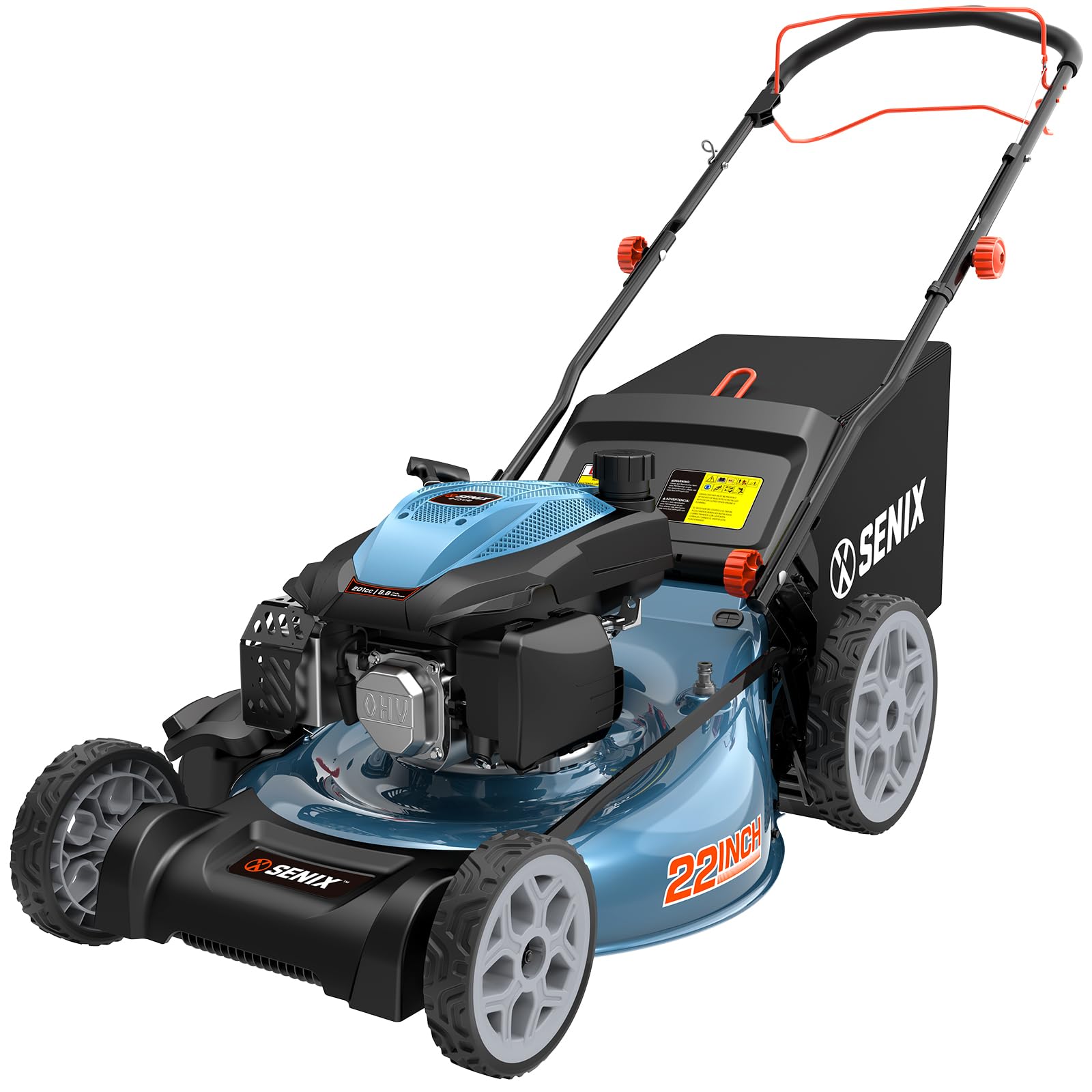
The 201cc powerhouse that pulls through thick grass without bogging.
If your lawn has thick, damp grass or rough spots, this SENIX is the strongest option here. It uses a 201cc OHV 4-cycle engine that delivers 4.7HP and 8.8 ft-lb of torque — that is 18% more engine displacement than the PowerSmart below — so the blade keeps spinning through overgrowth instead of stalling. The single-speed rear-wheel drive moves you at up to 2.9 MPH, which buyers report is the right pace for consistent mowing without dragging you forward.
The 22-inch heavy-duty cutting deck uses blades made from manganese steel alloy, hardened to 45–50 HRC (a scale that measures how well steel resists dulling from rocks and roots). That means cleaner cuts season after season. A central 6-position height lever adjusts cut from 1.25 inches to 4 inches — a wider range than the PowerSmart’s 3.9-inch maximum. The handle folds for compact storage. At 72 pounds, it is roughly 15% lighter than the YARDMAX (84.9 pounds), making it easier to maneuver despite the extra power.
Owners mention the mower starts on the second pull and handles uneven terrain smoothly thanks to rear-wheel drive. One owner mentions the grass catcher information is missing from the manual, and a separate review warns that the wheels fell off after the third use — so inspect and tighten all bolts before your first mow. The 201cc engine and RWD make this the best choice for demanding yards.
The case for it: The largest engine in this lineup (201cc) paired with rear-wheel drive gives you real pulling power on hills and through thick grass, backed by a 2-year warranty.
The catch: A few customers note wheels loosening or falling off, so you will want to inspect and tighten all hardware before the first mow.
Best for: Lawns up to 1/2 acre with thick grass, rough terrain, or inclines that need torque and rear-wheel traction.
Skip if: You want a lightweight mower for a small, flat, low-maintenance lawn — a 170cc model will cost less and carry easier.
2. PowerSmart 22 in. 170cc Self Propelled Gas Lawn Mower

The lightweight slope-master that actually pulls uphill without a fight.
At just 68 pounds, the PowerSmart is roughly 25% lighter than the 84.9-pound YARDMAX, yet it still uses rear-wheel drive (RWD) for real traction on inclines. On a sloped yard, the drive wheels sit under the engine weight, so they grip instead of spinning out. This is the core reason it beats front-wheel drive mowers on uneven ground.
The 170cc engine includes an auto choke (a system that sets the fuel-air mix automatically for cold starts), so you skip the priming ritual. The 22-inch all-steel deck offers three cutting modes — mulching, rear discharge, or bagging — with a 60-liter bag that empties quickly. Height adjustment is a 6-position rear-wheel lever that ranges from 1.5 inches to 3.9 inches, though that maximum is slightly shorter than the SENIX 170cc model’s 4-inch top setting. Reviewers point out the setup is tool-free and the mower starts first pull every time.
The downside, as one buyer notes: a unit arrived with no spark due to a faulty safety switch, requiring a two-hour DIY fix. That kind of quality-control miss is frustrating, but the weight, RWD, and easy-start engine make this the best-balanced value for most suburban yards.
Why it’s great
- Rear-wheel drive provides true traction on slopes
- At 68 lbs it is easy to push and store
- Tool-free assembly and auto-choke start
Good to know
- Some units arrive with a faulty safety switch (check spark before first use)
- Maximum cutting height of 3.9 inches is short of the 4-inch maximum on the SENIX models
Best for: Sloped or uneven yards where rear-wheel drive traction matters more than engine size.
Skip if: You need a premium 4-inch maximum cutting height for tall summer grass — the SENIX 170cc model offers that extra 0.1 inches of range.
3. SENIX Gas Lawn Mower, 22″ 170cc
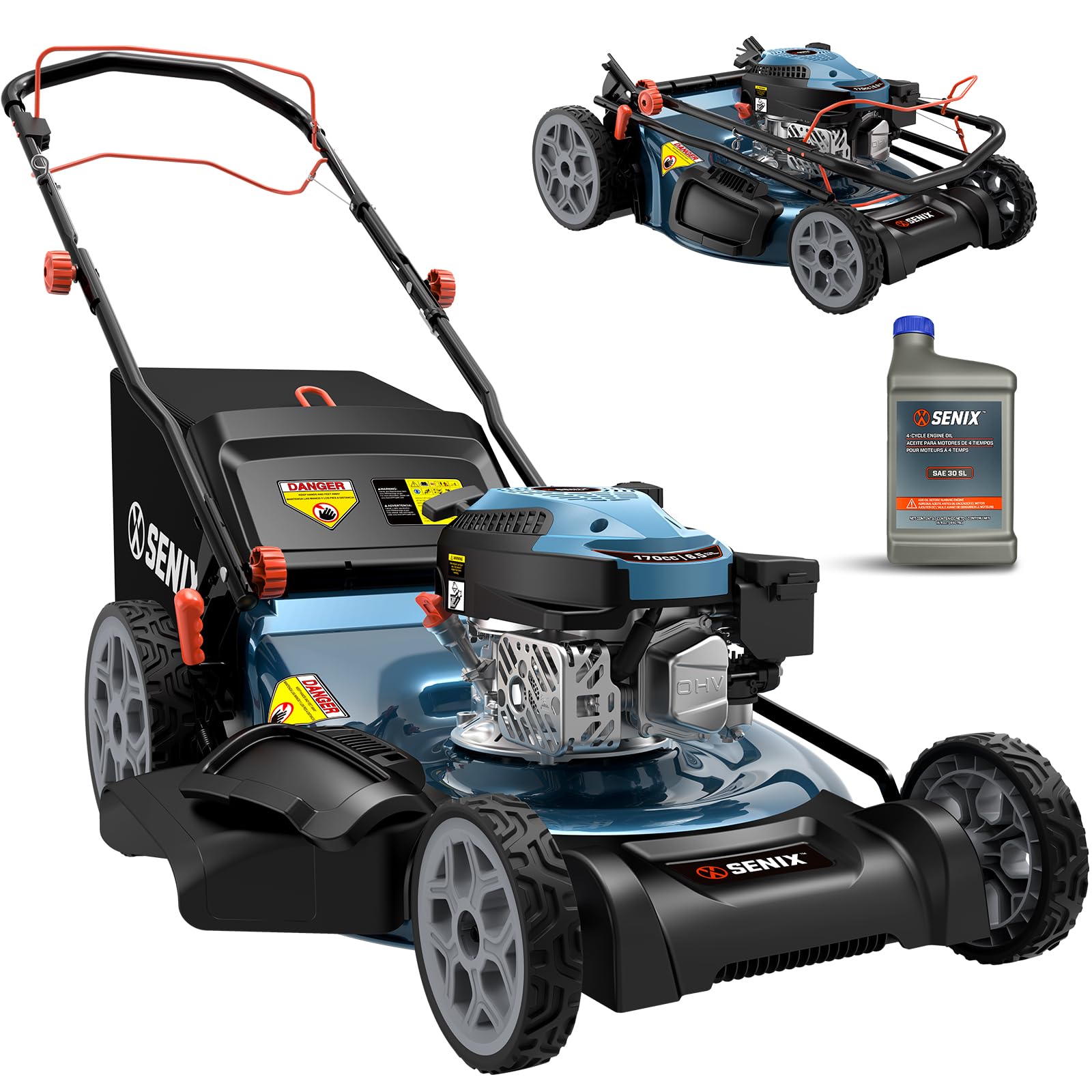
A solid rear-drive 170cc mower for small yards at a realistic price.
For a flat or gently sloping yard under a third of an acre, this SENIX delivers reliable rear-wheel drive without paying for engine capacity you will not use. Its 170cc OHV 4-cycle engine matches the PowerSmart’s displacement, but the SENIX offers a wider cutting height range: 1.25 inches minimum versus PowerSmart’s 1.5 inches — that is 20% lower for a closer early-spring trim. The maximum climbs to 4 inches (3% taller than PowerSmart’s 3.9 inches), giving you slightly more seasonal flexibility.
The 22-inch steel deck supports 3-in-1 mulching, side discharge, and rear bagging with a 19-gallon bagger included. An integrated washout port lets you hose off the underside without tipping the mower. The foldable handle and vertical storage design help it fit in tight garage spaces. Shoppers say assembly takes about 35 minutes with easy instructions, and the mower starts on the first pull.
The trade-off is self-propelled speed: this is a single-speed system, so you cannot vary your walking pace the way you could with a multi-speed or CVT (continuously variable transmission) mower. A couple of owners also note the instructions do not label where gas and oil go, which can stall a beginner. For its price, the RWD traction and wide height range make it a capable budget-friendly choice.
Why it’s great
- Wider cutting range (1.25″–4″) than most at this price
- Rear-wheel drive for solid traction on moderate slopes
- Easy assembly and first-pull starting
Good to know
- Single-speed self-propel cannot adjust to your walking pace
- No labeling on the mower for gas and oil fill points
Best for: Buyers with a small to medium, relatively flat yard who want rear-wheel drive at a budget-friendly price, and who prefer a wider height range than the PowerSmart offers.
Skip if: You need adjustable self-propel speed for varied terrain, or you prefer clearly labeled fill points for easy maintenance.
4. YARDMAX 22 in. 201cc Select PACE 6 Speed CVT High Wheel FWD
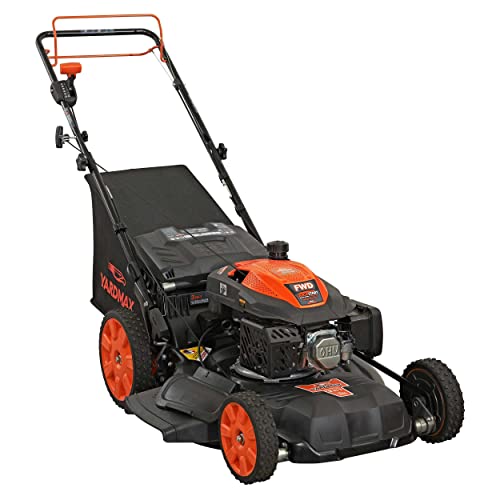
A 201cc engine in a heavy package, held back by front-wheel drive.
The YARDMAX pairs a 201cc engine with a unique CVT (continuously variable transmission — a belt-driven system that lets you smoothly shift through 6 speeds without gear steps) to match your walking pace. In theory, that sounds ideal for a large flat lawn.
Buyers report three specific frustrations: the self-propel speed lever slips to extremes during use, the front-wheel drive loses traction on wet grass and makes turning hard, and the bag is awkward to remove. One buyer summarized it as “very hard work, non-returnable, not recommended.” On the positive side, the engine starts reliably on the second pull, runs quieter than many gas mowers, and handles tough terrain when traction holds. The deck cleanout port is a handy touch for keeping the underside free of caked grass.
The fundamental issue is drive placement: front-wheel drive on an 84.9-pound mower means the drive wheels lose weight on slopes and slip on wet turf — exactly when you need pull most. If your yard is perfectly flat and dry and you value a wide speed range, the CVT has appeal. For nearly any other condition, a rear-wheel drive mower like the PowerSmart will give you less struggle for the same money.
The case for it: The 201cc engine delivers real cutting power, and the 6-speed CVT lets you fine-tune your walking pace on flat, dry lawns.
One limitation: Front-wheel drive on an 84.9-pound mower loses traction on wet grass and slopes, and owners mention the speed lever slips and the bag is awkward to empty.
Best for: A flat, dry, open lawn where you want the speed variability of a CVT and the grunt of a 201cc engine.
Skip if: Your yard has any slope, damp patches, or tight turns — the front-wheel drive will fight you on all three.
Understanding the Specs
Engine Displacement (cc)
Measured in cubic centimeters (cc), this number tells you the size of the engine’s cylinders. A bigger cc (like 201cc) produces more torque (twisting force), which means the blade spins harder through thick or wet grass without bogging down. A smaller cc (like 170cc) is lighter and uses less fuel but can struggle if your grass is overgrown. For a typical suburban yard under a third of an acre, 170cc is plenty. For damp or neglected lawns, 201cc gives you a comfortable margin of power.
Rear-Wheel Drive vs Front-Wheel Drive
This is the single most important spec for any slope. Rear-wheel drive (RWD) pulls the mower forward from behind, keeping the drive wheels under the heaviest part of the machine (the engine). That weight gives the tires grip on inclines and uneven ground. Front-wheel drive (FWD) pulls from the front, which can cause the drive wheels to lift and spin on a hill, especially with wet grass. On flat ground, both work — buy RWD if your yard has any tilt at all.
FAQ
What size engine do I need for a 22 inch mower?
Is front-wheel drive or rear-wheel drive better for hills?
Can I use a self-propelled mower without engaging the drive?
What does 3-in-1 mean on a lawn mower?
How low should I set my cutting height in spring vs summer?
Are 22 inch self propelled mowers hard to store?
How often should I sharpen the blade on a 22 inch mower?
What is the difference between single-speed and CVT self-propel?
Can I mow wet grass with a self-propelled mower?
Does a self-propelled mower use more gas than a push mower?
Final Thoughts: The Verdict
The 22 inch self propelled lawn mower that balances traction, ease, and value best for most suburban yards is the PowerSmart 22 in. 170cc — its rear-wheel drive, 68-pound weight, and tool-free assembly make it the easiest recommendation for slopes and flat lawns alike. If you have thick or difficult terrain and need extra torque to avoid stalling, grab the SENIX 22 Inch 201cc. For a flat, dry lawn where you want to control your walking pace, the budget-friendly YARDMAX 201cc CVT is a solid choice as long as you accept its front-wheel drive limits.
How We Picked
We do not accept paid placement, and we did not hands-on test every unit. Instead, we match each pick to a real buyer and use-case by comparing the manufacturers’ published specifications against the patterns in verified customer reviews — so you get each pick’s real strengths and trade-offs instead of marketing copy.
Sources & Methodology
Specifications: manufacturer listings and product documentation. Review insights: verified customer reviews, as of July 2026. Pricing: not shown on this page (it changes often); check the current price via the retailer link.
As an Amazon Associate, Gadgets Feed earns from qualifying purchases. This does not affect which products we feature.
Product prices and availability are accurate as of the date/time indicated and are subject to change. Any price and availability information displayed on Amazon at the time of purchase will apply to the purchase of this product. As an Amazon Associate I earn from qualifying purchases.
CERTAIN CONTENT THAT APPEARS ON THIS SITE COMES FROM AMAZON. THIS CONTENT IS PROVIDED "AS IS" AND IS SUBJECT TO CHANGE OR REMOVAL AT ANY TIME.
Amazon and the Amazon logo are trademarks of Amazon.com, Inc. or its affiliates.