
Our readers keep the lights on and my morning glass full of iced black tea. As an Amazon Associate, I earn from qualifying purchases.
If your caliper drifts by even a few thousandths of an inch (that is, about the thickness of a human hair) between readings, it is worse than useless — you will chase measurements that keep changing. The real question is not just which tool measures, but which one you can trust day after day without recalibrating, dead batteries, or a slide that sticks. This guide picks the calipers that earn a permanent spot in your toolbox by being consistently accurate and honestly built.
I’m Min — the founder and writer behind Gadgets Feed. This guide is built by comparing the manufacturers’ published specifications and the patterns across verified customer reviews, so you get each pick’s real strengths and trade-offs instead of marketing spin.
You will find options from a classic dial design that never needs a battery to a premium electronic caliper that keeps its zero for months — all of these belong on a shortlist when shopping for a caliper measuring tool you can rely on.
Quick Picks
- Mitutoyo 505-742J Dial Caliper, 0-6″ Range — Precision Pick
- Starrett Stainless Steel Electronic Slide Caliper EC799A-6/150 — Professional Digital
- Fowler 54-101-150-2, Xtra-Value Cal Digital Caliper — Repeatable Value
- General Tools Digital Caliper 1478 – 8″ Caliper Measuring Tool — Extra Reach
- werka Digital Caliper, 0-6” Calipers Measuring Tool — Gift-Ready
- Kynup Digital Caliper, Caliper Measuring Tool, 6Inch/150MM — Best Battery Life
- findmall 6″ Dial Caliper 0.001 Stainless Steel — No-Battery Dial
How To Choose The Best Caliper Measuring Tool
Three decisions separate a caliper that becomes a trusted shop companion from one that sits in a drawer collecting dust. Range, readout type, and build material are the specs that matter most for everyday measuring.
Range: 6 inches or 8 inches?
A 6-inch range covers the vast majority of household, automotive, and woodworking tasks — watch band lugs, board thicknesses, bolt diameters, and small step depths. An 8-inch range, like the one on the General Tools Digital Caliper 1478, gives you extra reach for larger parts such as pipe flanges or wide trim pieces, but the caliper itself is noticeably longer to store. Stick with 6 inches unless you regularly measure objects bigger than a standard envelope.
Dial versus Digital readout
A dial caliper uses a mechanical needle and a geared rack — no battery, no auto-off, no LCD that fades in bright sunlight. The downside is you must read the dial marks yourself, which takes a second of focus. A digital caliper gives you an instant number on a screen, often in inches, millimeters, or fractions at the push of a button. The trade-off is battery life: most digitals auto-shutoff after a few idle minutes, and a dead battery means a dead tool until you find a replacement.
Stainless steel versus carbon fiber
A full stainless steel frame resists rust and feels substantial in hand — you will notice the heft, which some people like for stability. The General Tools 1478 blends carbon fiber with stainless steel, which keeps the weight down (16 ounces) while still being non-marring on soft surfaces. For everyday garage or workshop use, stainless steel is the standard; for pocket-carry or delicate surfaces, the lighter hybrid option makes sense.
Quick Comparison
On smaller screens, swipe sideways to see the full table.
| Model | Best For | Range | Accuracy | Weight | Amazon |
|---|---|---|---|---|---|
| Mitutoyo 505-742J | Precision machining & inspection | 0-6″ | .001″ | — | $127.04$134.85Amazon |
| Starrett EC799A-6/150 | Professional daily use with digital readout | 0-6 inches | 0-6″: (±.001″) | 11.2 ounces | $139.99Amazon |
| Fowler 54-101-150-2 | Repeatable measurements with a brand name | 6″/150mm | +/-.001″/.02mm | 13.6 ounces | $78.05Amazon |
| General Tools Digital Caliper 1478 | Extra reach up to 8 inches | 8 inches | +/-0.0005 inches | 16 ounces | $63.15$66.99Amazon |
| werka Digital Caliper | Well-packaged gift-ready digital | 0-6″ | 0.001″/0.02mm | — | $35.99Amazon |
| Kynup Digital Caliper | Budget-friendly digital with complete shutoff | 0-6inch/150mm | ± 0.001″/0.02 mm | 6.95 Ounces | $19.99Amazon |
| findmall 6″ Dial Caliper | No-battery dial simplicity on a budget | 6 Inches | 0.001 inch | — | $19.89Amazon |
In‑Depth Reviews
1. Mitutoyo 505-742J Dial Caliper, 0-6″ Range
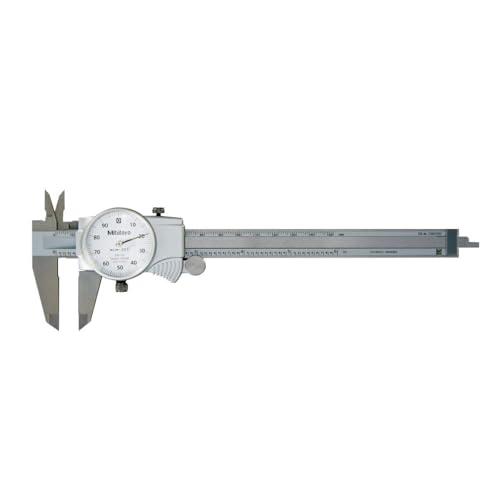
The dial caliper that machinists trust because it never needs a battery and never drifts.
This Mitutoyo is the benchmark for a reason. It gives you a crisp dial readout to 0.001″ and you can even interpolate to 0.00025″ by estimating between the marks — something no digital caliper at this price can display directly. There is no battery to replace, no auto-off to interrupt you, and no LCD that washes out under shop lights. The satin chrome finish cuts down glare, and the lock screw holds both the dial bezel and the jaw in place, so a measurement stays put even when you reach for a pencil.
Buyers report the dial is “accurate and repeatable” and call it a “high-quality Japanese perfection” tool. Compared to the Starrett EC799A below, this is a fundamentally different approach — mechanical rather than electronic — which means zero worry about battery drain during a long inspection shift. The case includes a fitted plastic tray, though owners mention the case has no foam and a plastic hinge that may wear over time. At 6 inches of range this covers most machining, gunsmithing, and automotive inspection tasks without the bulk of an 8-inch caliper.
The case for it: Dead-reliable mechanical accuracy, a dial you can read in any light, and a legacy of quality that aerospace and medical industries rely on.
One limitation: The case quality is basic — no foam padding and a plastic hinge that some owners worry about cracking after years of use.
Best for: Machinists, inspectors, and serious hobbyists who want repeatable accuracy without worrying about batteries.
Skip if: You prefer an instant digital number on a screen rather than reading a dial face.
2. Starrett Stainless Steel Electronic Slide Caliper EC799A-6/150
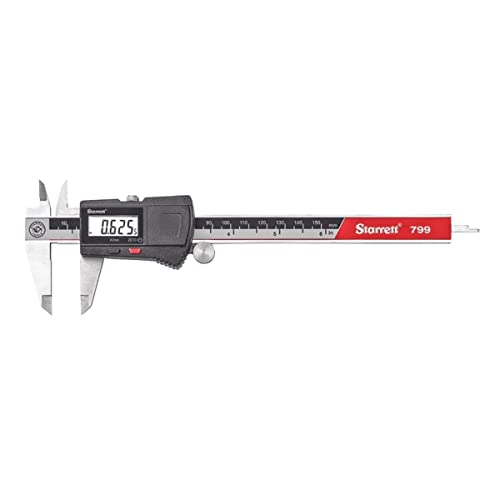
A hardened stainless steel digital caliper with a large LCD and a 30-minute auto-off timer.
The Starrett EC799A reads 0.01mm or.0005″ on a high-contrast LCD that you do not need to squint at — a real help when you are measuring under a workbench or in dim garage light. Its measuring surfaces are hardened stainless steel, which resists wear far longer than softer alloys. The fine-adjustment thumb wheel lets you creep the jaw closed by tiny increments, so you do not overshoot your target dimension. It automatically turns off after 30 minutes of no movement, and a one-second press of any button or a slide movement wakes it up without losing the zero.
Customers note it is “very accurate” against set-up blocks. However, unlike the Mitutoyo dial caliper above, this is an electronic tool with one notable limitation: it lacks a fractional-inch mode. One reviewer flagged that the battery drains rapidly when the caliper is off, sometimes leaving it dead when picked up for use. At 11.2 ounces, it is lighter than the Fowler (13.6 ounces) and easier to handle for long measuring sessions.
Why it’s great
- Hardened stainless steel measuring surfaces for long-term durability.
- Large high-contrast LCD is easy to read even in low-light conditions.
- Fine adjustment thumb wheel gives you precise control when closing the jaw.
Good to know
- No fractional-inch display — you must convert decimal inches manually.
- Some units drain battery quickly when off; check the battery compartment on arrival.
Best for: Professionals who want a well-built electronic caliper with a large, clear display and hardened stainless steel.
Skip if: You need a fractional-inch readout, or you want to avoid batteries entirely.
3. Fowler 54-101-150-2, Xtra-Value Cal Digital Caliper

A brand-name digital caliper that reviewers point out holds its zero better than generic no-name options.
Fowler has a reputation in the metrology world, and this Xtra-Value Cal model brings that engineering to a price point well below Mitutoyo or Starrett. It has an accuracy of +/-.001″/.02mm and a resolution of 0.0005″/.01mm, with a stainless steel body and an easy-to-read LCD. It uses two CR2032 lithium batteries (included with the caliper and a protective case). The zero button works at any point on the scale, so you can start a new measurement without resetting the whole tool.
Shoppers say that after owning two cheaper sets of calipers that disappointed them, the Fowler restored their confidence — measurements are repeatable and it does not lose zero often. One reviewer called it a “huge step up in quality from the no-name ones” and noted that after a few days of daily use, a co-worker bought his own pair. At 13.6 ounces it is heavier than the Starrett (11.2 ounces), which some people prefer for stability in hand.
The case for it: Genuinely repeatable measurements with a CR2032 battery that is easy to find, plus a smooth slide action that holds zero reliably.
The compromise: The LCD can be hard to read at extreme viewing angles — not ideal if you are measuring odd-shaped parts from an awkward position.
Best for: Anyone who has been burned by cheap calipers losing zero and wants a reliable brand-name digital tool without the professional price tag.
Skip if: You need a dial face (no batteries at all) or expect Mitutoyo-level build from a tool in this price range.
4. General Tools Digital Caliper 1478 – 8″ Caliper Measuring Tool

The 8-inch caliper that stays comfortable in hand thanks to a carbon-fiber and stainless steel blend.
Most calipers stop at 6 inches. The General Tools 1478 stretches to 8 inches — a 33% longer range than the findmall 6″ dial caliper — which matters when you are measuring wide parts like pipe flanges, large trim boards, or motorcycle handlebar diameters. It uses a hybrid build: heavy-duty stainless steel combined with non-marring carbon fiber, so you can measure painted or soft surfaces without scratching them. The extra-large LCD displays decimal inches, fractional inches, and millimeters at the push of a button, and the tool turns itself on and off automatically to save battery.
Buyers report that this is a “sturdy” all-metal tool with “no plastic housings” — one reviewer had owned the shorter 6-inch version of this brand for years and described it as reliable. If you carry a caliper in your apron all day, that extra heft will be noticeable, but for bench work it adds stability. The item dimensions are 1.25″L x 12″W, making the case long enough to protect that 8-inch ruler.
Why it’s great
- 8-inch range gives you significantly more reach than standard 6-inch calipers.
- Carbon fiber and stainless steel construction is non-marring on delicate surfaces.
- Extra-large LCD display is easy to read, and the auto-on/off feature preserves battery life.
Good to know
- At 16 ounces, it is noticeably heavier than most 6-inch digital calipers on the market.
- Battery compartment can be difficult to open, and the included instructions are not very clear.
Best for: Woodworking, construction, and DIYers who regularly measure parts larger than a 6-inch caliper can handle.
Skip if: You want a lightweight pocket-friendly tool, or you only measure small parts — an 8-inch case is bigger to store.
5. werka Digital Caliper, 0-6” Calipers Measuring Tool

A stainless steel digital caliper that comes in a hard plastic case ready to gift or store.
The werka caliper delivers the standard 0-6″ range with an accuracy of 0.001″/0.02mm, a large LCD display screen, and three display modes (inch, fractional inch, and millimeter). Its fine-polished stainless steel frame has a precise thumb roller for smooth slide movement. A low-battery warning feature flashes the screen when the battery is running low, so you are not caught mid-job without power. It uses 2 LR44 batteries that are included with the caliper.
Buyers describe the build as “solid construction” with a smooth and firm slider, a good lock, and accurate zero return. One reviewer called it “much more than I hoped and expected,” noting an accurate zero return and auto-on feature when the slide is moved. The hard plastic case with a sponge cavity provides comprehensive protection, making this a popular choice as a gift for someone who needs a precision tool for woodworking or hobby projects.
The case for it: Solid stainless steel feel, smooth operation, and a proper hard case with a sponge cutout — rare at this tier.
The drawback: The display digit spacing is slightly unbalanced, according to some owners, and it has no auto-on feature from rest — you must move the slider to wake it.
Best for: A giftable mid-range digital caliper that looks and feels more expensive than its price suggests.
Skip if: You need a dial caliper or a tool with a true off-button to save battery — the werka relies on auto-off after a period of inactivity.
6. Kynup Digital Caliper, Caliper Measuring Tool, 6Inch/150MM
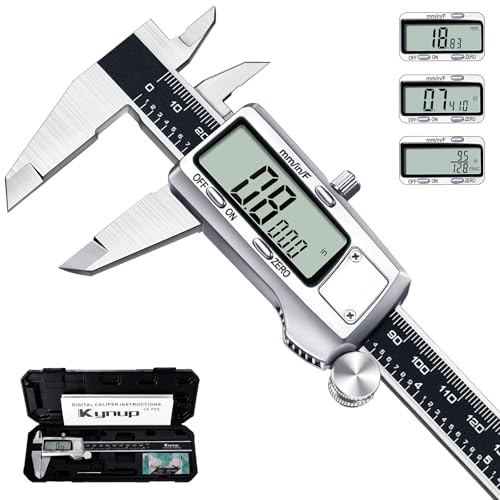
The digital caliper you can truly turn off so the battery is not draining inside your toolbox.
Most digital calipers only have an auto-off feature that still trickles a tiny current to the LCD. The Kynup solves that with a complete power-off button — press it and the caliper shuts down entirely, drawing zero power. That means the 3 included LR44 batteries (one installed, two spares) will last noticeably longer than in a standard caliper. It measures from 0 to 6 inches (150 mm) with an accuracy of ± 0.001″/0.02 mm and a resolution of 0.0005″/0.01 mm. The screen is splash-proof, and the housing is metal with a black painted surface.
Owners mention that it is “surprisingly good quality for a low price” and that the display is clear. One owner used it specifically to measure a 20mm watch band and reported that the watchband fit perfectly — concrete proof that the ±0.001″ accuracy translates to real-world fits. The thumb wheel has been noted as very loose on some units, though the rest of the slider feels tight and decently built for the price range. At 6.95 ounces, it is the lightest digital caliper on this list, making it easy to carry in an apron pocket without it dragging on your belt.
Why it’s great
- Complete power-off button stops battery drain completely when the caliper is not in use.
- Solid metal construction with a splash-proof screen for workshop durability.
- Comes with three LR44 batteries, including one pre-installed and two spares.
Good to know
- The thumb wheel is loose on some units, which can feel less precise during fine adjustments.
- The fractional display shows odd fractions like 59/260″, which may confuse users wanting standard fractions.
Best for: Budget-minded buyers who want a metal digital caliper with a genuine off switch to save batteries between uses.
Skip if: A loose thumb wheel would drive you crazy, or you prefer a dial caliper that never touches a battery at all.
7. findmall 6″ Dial Caliper 0.001 Stainless Steel
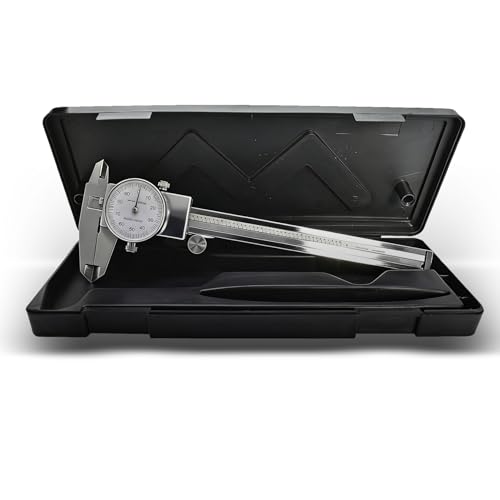
A mechanical dial caliper that works every time you pick it up because there is no battery to drain.
The findmall dial caliper uses a rotating bezel with a zero-reset function, so you can measure relative differences just by rotating the face to zero at any starting point. Its range is 6 inches with an accuracy of ±0.001″ and a resolution and repeatability of 0.0005″. The frame is finely polished stainless steel with a knurled thumb roller and a locking screw to hold the jaw in place. The dial itself is covered by a hard glass cover that resists scratching and glare, making it easier to read in bright workshop conditions than many digital screens.
Customers note that the caliper is “accurate to ~.501-.502″ on test objects” and praise the dial readout as easy to read. One reviewer noted that the case is flimsy but described the tool itself as a “good dial caliper” at its price point. Compared to the Kynup digital caliper above, this dial model is heavier and more robust in feel, though it lacks any kind of unit conversion — you read inch marks on the dial and that is it. The item dimensions L x W are 5.98″ each, indicating a square-ish case, but the tool itself fits in the hand well.
The case for it: Battery-free operation, a scratch-resistant glass dial cover, and repeatable accuracy that competes with digital tools for a fraction of the price.
The catch: The plastic case it comes in is flimsy, and the dial reads in inches only — no metric scale on the dial face itself.
Best for: Hobbyists and DIYers who want a no-battery, no-electronics caliper that just works when you grab it from the drawer.
Skip if: You need metric readings directly on the dial, or you want a rugged storage case that can survive a drop from a workbench.
Understanding the Specs
Accuracy and Resolution
Accuracy tells you how close the caliper’s reading is to the true dimension — a spec like ±0.001″ means the real measurement could be up to one thousandth of an inch off in either direction. Resolution is the smallest increment the tool can display or show on its dial (often 0.0005″). For hobby woodworking or measuring a watch band lug, ±0.001″ is more than enough. For machining a bearing bore, you might want the ±0.0005″ accuracy that the General Tools 1478 offers. Always match the accuracy to the tightest tolerance your projects require.
Dial versus Digital Readout
A dial caliper uses a geared rack and pinion to spin a needle on a printed scale. You read the inch marks plus the dial divisions manually — no battery, no screen glare, and no auto-off. A digital caliper converts the slide position into an LCD number via a capacitive sensor, typically offering inch, millimeter, and fractional modes at the push of a button. The digital advantage is instant readout and unit switching. The dial advantage is reliability over years and decades — a dial caliper from the 1980s still works today if kept clean, while a digital caliper from the same era is likely dead from obsolete batteries or failed electronics.
FAQ
Which is more accurate, a dial caliper or a digital caliper?
Will a 6-inch caliper cover most household and automotive jobs?
How do I clean and maintain a stainless steel caliper?
Why does a caliper lose zero and how do I fix it?
Can I use a digital caliper to measure wet or oily parts?
What is the difference between a 0.001″ and a 0.0005″ accuracy caliper?
Are any of these calipers made in Japan?
Which caliper has the longest battery life?
Can I use a caliper for internal diameter measurements?
Do I need a fractional-inch mode on a digital caliper?
Final Thoughts: The Verdict
For the majority of shoppers, the caliper measuring tool winner is the Mitutoyo 505-742J Dial Caliper because it combines mechanical reliability, repeatable 0.001″ accuracy, and a dial that never needs a battery, with the brand trust that machinists and inspectors rely on day after day. If you want a digital readout with the longest measuring range, grab the General Tools Digital Caliper 1478. And for a budget-friendly digital that you can truly turn off to save batteries, the standout is the Kynup Digital Caliper.
How We Picked
We do not accept paid placement, and we did not hands-on test every unit. Instead, we match each pick to a real buyer and use-case by comparing the manufacturers’ published specifications against the patterns in verified customer reviews — so you get each pick’s real strengths and trade-offs instead of marketing copy.
Sources & Methodology
Specifications: manufacturer listings and product documentation. Review insights: verified customer reviews, as of July 2026. Pricing: not shown on this page (it changes often); check the current price via the retailer link.
As an Amazon Associate, Gadgets Feed earns from qualifying purchases. This does not affect which products we feature.
Product prices and availability are accurate as of the date/time indicated and are subject to change. Any price and availability information displayed on Amazon at the time of purchase will apply to the purchase of this product. As an Amazon Associate I earn from qualifying purchases.
CERTAIN CONTENT THAT APPEARS ON THIS SITE COMES FROM AMAZON. THIS CONTENT IS PROVIDED "AS IS" AND IS SUBJECT TO CHANGE OR REMOVAL AT ANY TIME.
Amazon and the Amazon logo are trademarks of Amazon.com, Inc. or its affiliates.