
Our readers keep the lights on and my morning glass full of iced black tea. As an Amazon Associate, I earn from qualifying purchases.
You want deep, room-filling bass from a subwoofer that does not dominate your living room. An 8-inch home theater subwoofer is that balance, but many small subs sound boomy or weak. The trick is finding one that actually delivers clean, low-end punch you can feel. This guide compares nine of the best models on the market right now, using their real specs and what verified buyers actually say, so you can match one to your room size, your gear, and your budget.
I’m Min — the founder and writer behind Gadgets Feed. This guide is built by comparing the manufacturers’ published specifications and the patterns across verified customer reviews, so you get each pick’s real strengths and trade-offs instead of marketing spin.
The right subwoofer fills out the bottom octave of your sound system without rattling the walls or muddying the midrange. Whether you are upgrading a desktop stereo or building a compact surround setup, this breakdown of the best 8 inch home theater subwoofer options will help you hear the difference before you buy.
Quick Picks
- Rockville Rock Shaker 8 Black — Best Overall
- Dayton Audio Classic CS800 — Best Value
- Klipsch Reference R-8SW Surround Subwoofer — Compact Classic
- Edifier T5s Powered Active Subwoofer — Desktop Partner
- PreSonus Eris Sub 8BT — Studio Grade
- Earthquake Sound CP-8 Couch Potato — Sleeper Sub
- Audioengine S8 Powered Subwoofer — Premium Desktop
- Kanto SUB8VMW Sealed Powered Subwoofer — Accurate & Clean
- Polk Audio Signature Elite ES8 — High-End Compact
How To Choose The Best 8 Inch Home Theater Subwoofer
An 8-inch subwoofer is a compact powerhouse, but not every model works well in every room or with every pair of speakers. Here are the three most important things to check before you click “buy.”
RMS Power vs. Peak Power
RMS (Root Mean Square) power is the continuous wattage the subwoofer can handle over time — think of it as its real-world endurance. Peak power is a short burst that the amplifier can manage for a split second. Two subs might both claim 400 watts peak, but one might be rated for 200W RMS and the other for only 70W RMS. That RMS number tells you how much clean, steady bass it can produce without distortion. For an 8-inch driver, look for at least 70W-150W RMS for a noticeable upgrade in a small to medium room.
Frequency Response and Room Size
The frequency response, measured in Hertz (Hz), tells you how low the subwoofer can go. A lower number, like 28 Hz or 30 Hz, means it can produce deeper bass notes you feel in your chest. For movies with explosions and soundtracks, a sub that reaches down to around 30 Hz is excellent. For music, anything down to 35 Hz is usually satisfying. The catch is that a smaller room (roughly 12 x 12 feet) can make a sub sound boomy if you push the gain too high, so a sealed enclosure often works better in tight spaces than a ported one.
Connectivity: LFE, RCA, and Speaker-Level Inputs
Most modern AV receivers have a dedicated subwoofer output, which uses an RCA cable and an LFE (Low-Frequency Effects) channel. If your receiver lacks a subwoofer output, you need a sub with speaker-level inputs — binding posts that let you run speaker wire from the receiver to the sub and then from the sub to your speakers. This feature is listed as “high-level inputs” or “speaker-level inputs.” Bluetooth is a bonus for streaming music directly from your phone, but it is not a substitute for a wired connection for latency-free home theater use.
Quick Comparison
On smaller screens, swipe sideways to see the full table.
| Model | Best For | Power (RMS) | Frequency Response | Enclosure Type | Amazon |
|---|---|---|---|---|---|
| Rockville Rock Shaker 8 Black | Value Power | 200W | — | Rear-Ported MDF | Amazon |
| Dayton Audio Classic CS800 | Clean & Accurate Bass | 150W | 35 Hz | Brace-reinforced MDF | Amazon |
| Klipsch Reference R-8SW | Small Room Movie Bass | 150W peak | — | Down-firing MDF | Amazon |
| Edifier T5s Powered Active Subwoofer | Desktop & Small Stereo | 70W | 35 Hz | Front-firing MDF | Amazon |
| PreSonus Eris Sub 8BT | Studio & Music Production | 100W | 30 Hz | Front-firing | Amazon |
| Earthquake Sound CP-8 Couch Potato | Hidden Under-Furniture Bass | 150W continuous | 20Hz–180Hz | Down-firing, Ported | Amazon |
| Audioengine S8 Powered Subwoofer | Desktop Hi-Fi Upgrade | 250W | — | Down-firing | Amazon |
| Kanto SUB8VMW Sealed Powered Subwoofer | Accurate Music Reproduction | 300W peak | 35 Hz – 175 Hz | Sealed | Amazon |
| Polk Audio Signature Elite ES8 | High-End Small System | 100W | 28 Hz | Ported, Braced MDF | Amazon |
In‑Depth Reviews
1. Rockville Rock Shaker 8 Black

The budget-friendly bruiser that punches harder than its price tag suggests.
You get the most raw power for your money with this Rockville sub. It packs a 200W RMS amplifier (400W peak) and an 8-inch high-excursion driver inside a high-grade MDF cabinet with fire-resistant poly fill to keep the bass tight. Buyers report “excellent frequency range and signal-to-noise ratio for price; outperforms units costing 2-3x more.” That means you get clean, feelable low end that rivals subs twice the price — a huge win for someone building a theater on a budget.
The rear-ported enclosure helps move air, but placement matters — keep it a few inches from the wall to avoid muddy bass. It offers both RCA and speaker-level inputs, so it will work with older receivers that lack a dedicated subwoofer output. At 11.8 inches wide and 15 inches deep, it is compact enough to tuck near a media cabinet.
The case for it: The 200W RMS output is nearly three times more than the Edifier T5s’s 70W RMS, giving it a clear advantage in filling a medium-sized living room with deep, distortion-free bass.
The downside: The cabinet feels lighter than some competitors (one reviewer noted the wood build is thin), and the crossover knob lacks markings, so dialing in the perfect blend takes a bit of trial and error.
Best for: Anyone who wants maximum bass output on a tight budget without sacrificing sound quality.
Skip if: You need a subwoofer with precise, labeled controls or a more premium-feeling cabinet.
2. Dayton Audio Classic CS800
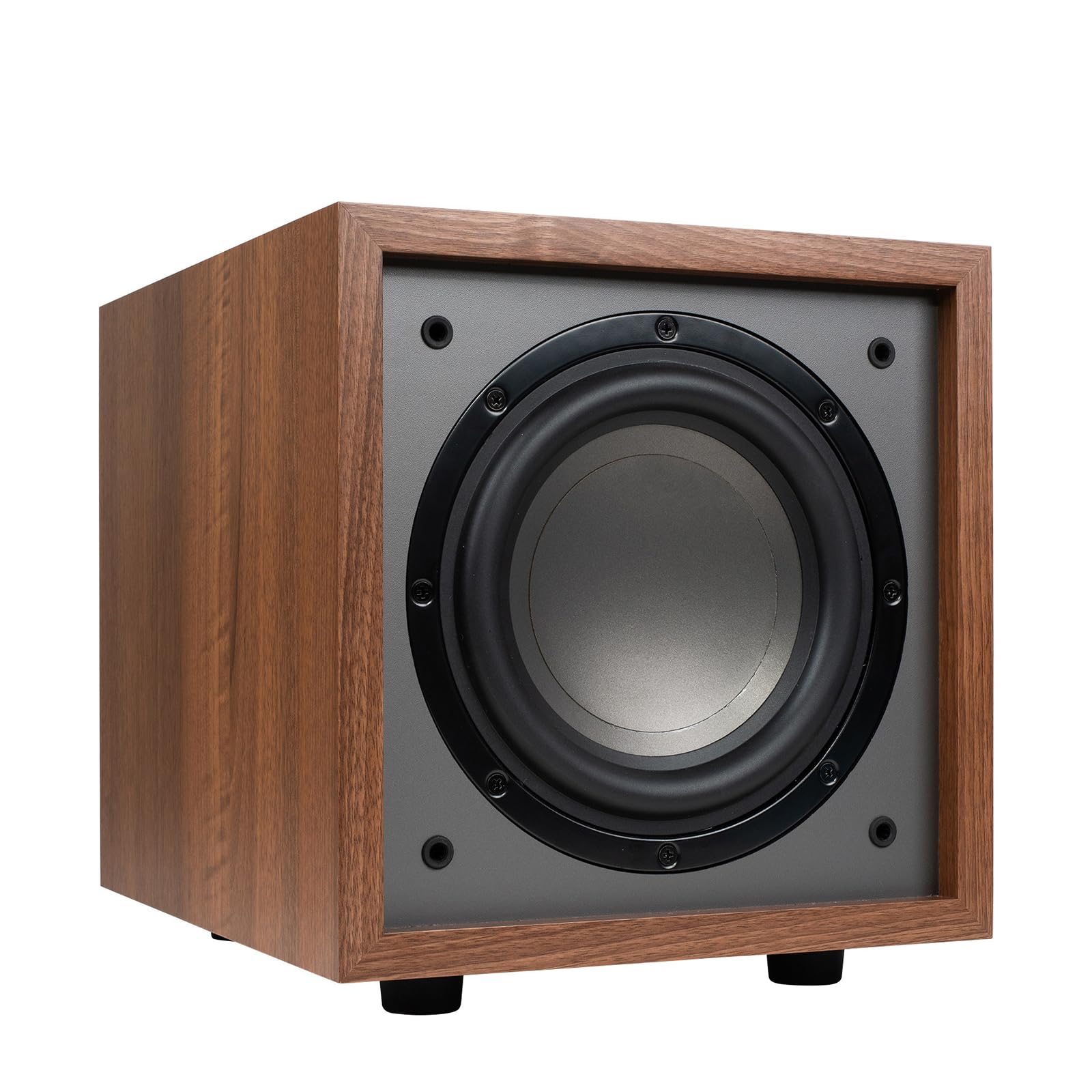
A no-nonsense performer that delivers clean, accurate bass with real subwoofer depth.
Dayton Audio designed the CS800 to be a straight shooter — no flashy gimmicks, just a solid 150W Class-D amplifier in a rigid, braced cabinet that keeps distortion low. One reviewer measured it and said it is “flat to ~35Hz (measured),” meaning it produces accurate, natural low-frequency extension down to that point without artificial boost. For music lovers, this means bass drums sound punchy and upright basses have a full, round tone without being boomy.
It comes in a wood-grain finish with a gray grille (a black grille is sold separately), so you can match it to your décor. Connectivity covers everything you need: stereo RCA, LFE, and speaker-level inputs, plus an auto-on function so it wakes up when a signal is detected. The 5-year warranty and USA-based design backing add confidence the other budget options do not offer.
Why it’s great
- Accurate 35 Hz low end measured by buyers — tight, not boomy
- LFE, RCA, and speaker-level inputs fit any system
- 5-year warranty for long-term reliability
Good to know
- One review noted screws on the woofer and amp vibrated loose after 2 months
- Flimsy grill cloth reported by some buyers
Best for: A music-first system where accuracy and clean extension matter more than earth-shaking volume.
Skip if: You need maximum SPL for a large home theater room and are willing to take a boomier sound.
3. Klipsch Reference R-8SW Surround Subwoofer

A small-room specialist from a trusted brand that delivers clean, tight bass without upsetting the neighbors.
Klipsch is a household name in home theater, and the R-8SW lives up to that reputation with “strong, clean, tight bass for its size,” as owners mention. The spun-copper IMG (Injection Molded Graphite) woofer is a Klipsch signature, and it is paired with an all-digital amplifier that produces 150 watts of peak power. For an apartment or a small den where you do not want to shake the entire building, this sub hits the balance of added depth without rattling the walls.
Its down-firing driver fires bass into the floor, which helps distribute the sound more evenly and makes placement a bit more forgiving — you can put it in a corner without it sounding too boomy. Setup is simple, though you will need to buy a subwoofer cable separately. The brushed black vinyl finish keeps it looking modern. Buyers do warn about a loud pop sound when you turn the unit off, so that is something to remember when powering down your system.
The case for it: It is the most neighbor-friendly option here, with fine-tunable bass that one buyer mentioned “wont disturb the neighbors” while still adding satisfying depth to music and movies.
The trade-off: It lacks speaker-level inputs, so it will not work with a stereo receiver that lacks a subwoofer output — you need a modern AV receiver or a subwoofer cable.
Best for: Apartment dwellers and small-room listeners who want a polished, clean bass upgrade from a top brand.
Skip if: You are connecting to an older receiver without a dedicated subwoofer output.
4. Edifier T5s Powered Active Subwoofer
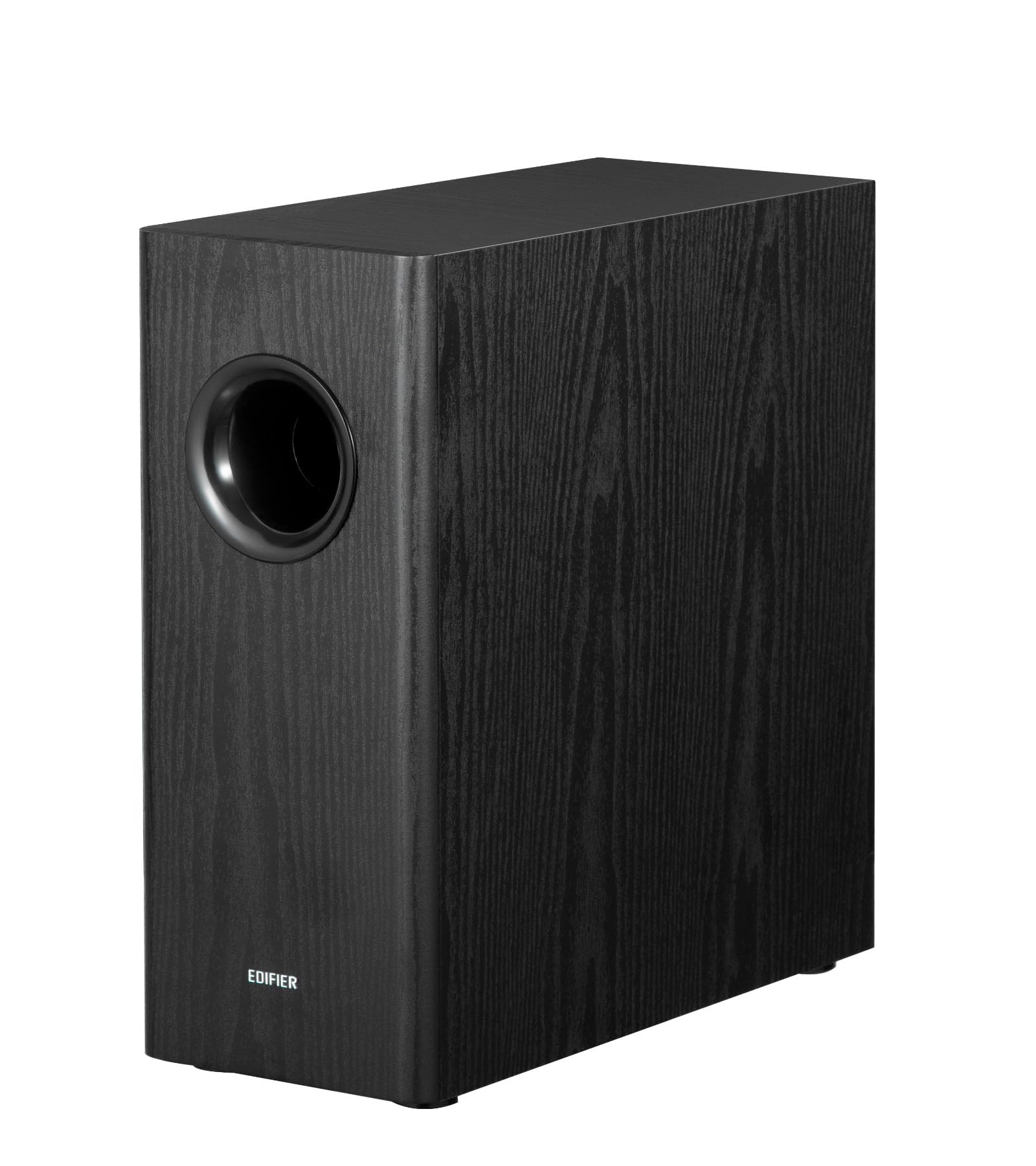
A compact, smart-powered sub that is made to pair perfectly with Edifier speakers and small desktop systems.
If you already own Edifier bookshelf speakers like the R1280Ts or R1700BTs, the T5s is the easiest subwoofer upgrade you can make. It uses an 8-inch long-throw woofer and a 70W RMS Class-D amplifier to hit down to 35 Hz, and buyers describe the bass as “deep, clean bass for movies and music.” The front-firing driver and right-firing port let you place it against a wall, and the slim, wood-grain finished cabinet is only a bit taller than a shoebox.
It is smart about power — an auto-standby mode kicks in after 15 minutes of no signal, saving electricity. The low-pass filter is adjustable (30Hz–160Hz), and there is a phase selector (0°/180°) to blend the sub smoothly with your main speakers. It includes both a 3.5mm-to-RCA cable and an RCA cable in the box, so you can start using it immediately. Note that for a setup without a subwoofer output, you must run the audio source through the sub first (the T5s has a pass-through signal output).
Why it’s great
- Designed to match Edifier speakers for smooth integration
- Auto-standby saves energy after 15 minutes idle
- Includes all cables for instant plug-and-play setup
Good to know
- At 70W RMS, it is the lowest-powered sub here — insufficient for large rooms
- Vertical design may look awkward in some furniture layouts
Best for: Desktop audio or a small bookshelf speaker system where space and easy integration are key.
Skip if: You need to fill a large living room with bass — the Rockville or Polk are better choices for that.
5. PreSonus Eris Sub 8BT

A studio-quality sub that brings accurate, sub-30Hz bass to music production, gaming, and home listening.
PreSonus is known for pro audio gear, and the Eris Sub 8BT brings that clarity home. Its 100W amplifier and 8-inch woven-composite woofer drop the frequency response down to 30 Hz, which is 17% deeper than the Edifier T5s’s 35 Hz response. That extra reach means you hear — and feel — the very lowest notes in movie soundtracks and electronic music without the bass sounding flabby or smudged. A buyer summed it up: “Powerful 8-inch subwoofer (100W, ~30Hz) with clean, punchy bass.”
It is the only sub in this list with Bluetooth 5.0 built in, so you can stream music wirelessly from your phone without connecting to the receiver at all. Connectivity is flexible: ¼-inch TRS balanced inputs for professional gear, unbalanced RCA inputs, and a front-panel ⅛-inch headphone input. Highpass and lowpass filter controls ensure the subwoofer starts working exactly where your main speakers stop. The auto power-saver mode kicks in after 40 minutes, which is longer than the Edifier’s 15 minutes.
The case for it: It is the only sub here that combines pro-audio connectivity (balanced TRS inputs) with Bluetooth streaming and a sub-30 Hz frequency response — a rare triple for under the premium tier.
One limitation: It lacks speaker-level inputs, so it will not work with a receiver that has no subwoofer output, and the auto-off timer is long at 40 minutes.
Best for: A content creator, gamer, or music lover who wants accurate, deep bass with the convenience of Bluetooth.
Skip if: You have an older receiver without a subwoofer output and need speaker-level inputs.
6. Earthquake Sound CP-8 Couch Potato

The ultra-slim subwoofer that hides under your couch and delivers tactile bass directly to your seat.
At just 7 inches tall, the CP-8 is designed to slide under a sofa or bed, firing its 8-inch down-firing driver into the floor for an amplified acoustic effect. The built-in 150W continuous (300W peak) Class AB amplifier and a large 3-inch bass-reflex port produce a frequency response of 20Hz–180Hz, meaning it can reach down to infrasonic levels that you feel more than hear. Customers note it “vibrates couches and room with movies and bass-heavy music” at only half volume.
This sub is all about placement and purpose — it works best when placed near the listening position to add tactile sensation, rather than being placed in a corner to pressurize the whole room. Connectivity includes both low-level (RCA) and high-level (speaker wire) inputs, so you can wire it to almost any receiver. A variable crossover (40Hz–120Hz) and a 0–180 degree phase control help blend it with your main speakers. Be careful when moving it, though — one owner reported the exposed speaker cone is easy to damage during relocation.
Why it’s great
- 7-inch height fits under virtually any couch or bed
- Down-firing design uses the floor as a bass amplifier
- Very low 20 Hz capability adds tactile, physical bass
Good to know
- Exposed woofer cone is vulnerable to accidental damage
- Best as a near-field sub for tactile bass, not room pressurization
Best for: Home theater enthusiasts who want floor-shaking bass without a visible subwoofer taking up floor space.
Skip if: You want a traditional front-firing sub for a clean, simple placement in a visible spot.
7. Audioengine S8 Powered Subwoofer

A refined desktop beast that brings studio-grade bass to your computer speakers without taking over your desk.
The Audioengine S8 is built to pair with the brand’s A2+ or A5+ speakers, but it works with any audio system that has a subwoofer output. Its 250W amplifier and down-firing 8-inch driver produce deep, controlled bass that reviewers point out makes it “the necessary add-on for full-range sound.” One owner described it as “tight, controlled bass” that stays clear even at higher volumes, which is rare for a sub that can tuck under a desk.
It features a sleep mode that auto-powers down when it is not receiving a signal, saving energy. If you want to place it far from your source, it is compatible with the Audioengine W3 wireless subwoofer adapter kit (sold separately), allowing you to skip running a long RCA cable. The down-firing design helps keep the bass even across the room. Keep in mind that one customer observed the sharp pointed feet can scratch hardwood floors, so adding a mat underneath is a smart move.
The case for it: It is one of the most powerful desktop subwoofers at 250W, and the optional wireless adapter gives you placement freedom that wired subs cannot match.
The compromise: It lacks speaker-level inputs, so it will not work with a receiver that does not have a dedicated subwoofer output, and the pointed feet can mark floors.
Best for: A premium desktop audio setup where you want powerful, controlled bass and the option of wireless placement.
Skip if: You need to connect with speaker wire to an older receiver without a subwoofer output.
8. Kanto SUB8VMW Sealed Powered Subwoofer

A sealed-cabinet sub that trades boomy volume for lightning-fast, accurate bass suitable for critical listening.
Sealed subwoofers (also called acoustic suspension) react faster to changes in the audio signal than ported designs, which means every bass note starts and stops precisely. The Kanto SUB8VMW uses an 8-inch paper cone driver inside a sealed MDF enclosure that measures roughly 11 inches in each direction, making it one of the most compact 8-inch subs you can buy. Its frequency response is rated from 35 Hz to 175 Hz, and shoppers say it delivers “tight, controlled bass” that “blends perfectly” with Kanto’s YU6MB speakers. One review summarized it: “the sound is warm and rich and accurate.”
The matte white finish (also available in black) looks clean next to modern furniture, and the removable metal grille protects the driver while keeping a sleek look. The adjustable high-pass filter and phase switch help you integrate it with any speakers, ensuring you are not leaving performance on the table. It has a universal power supply that works with 100V–240V, so it is ready for international use. The drawback is that it does not rumble as loud as a ported sub at the same size — it prioritizes quality over maximum volume.
Why it’s great
- Sealed design delivers fast, accurate bass response — no boominess
- Compact 11-inch cube fits under desks and in tight spaces
- Matte white and black finishes match modern décor
Good to know
- Does not dig as deep as ported subs (rated down to 35 Hz)
- One review noted the crossover bleeds higher frequencies at some settings
Best for: Stereo music lovers who value precise, articulate bass over earth-shaking volume.
Skip if: You want the deepest possible bass for action movies and heavy electronic music.
9. Polk Audio Signature Elite ES8

The deepest-reaching 8-inch sub here, engineered to deliver musical lows down to 28 Hz in a small, refined package.
The Polk ES8 uses an 8-inch long-throw woofer with a mineral-filled polymer cone and a 100W Class-D amplifier, but its standout feature is a frequency response that goes down to 28 Hz — the lowest of any sub on this list. That means it reproduces the deep rumbles in movie scores and the sub-bass in electronic music that smaller subs simply cannot reach. A buyer who uses it for music called it “prodigious, precise bass for music” and praised its tight, controlled sound.
It uses Polk’s Power Port design, which flares the port opening to reduce air turbulence and distortion, giving you that deep 28 Hz extension without the “chuffing” noise common in ported subs. Time-Smart Phase Control offers 360-degree adjustment to perfectly blend the subwoofer’s output with your main speakers, and a 4th-order lowpass filter ensures precise frequency cutoff. The cabinet is finished in durable black vinyl with curved edges and a removable grille, matching Polk’s Signature Elite series speakers. Buyers report it is a bargain at its price point given the fit, finish, and performance.
The case for it: Its 28 Hz low end is a full 7 Hz deeper than the Kanto SUB8VMW and Dayton CS800 (both rated at 35 Hz), giving it a clear advantage for buyers who want to hear and feel the deepest bass lines.
The catch: At 100W, it is not the most powerful amplifier here; buyers caution it is “not for home theater” if you want chest-thumping volume, and it requires a modern receiver with a subwoofer output.
Best for: A discerning listener who wants the deepest bass possible from a compact 8-inch subwoofer without the distortion.
Skip if: You need high SPL for a large home theater room — a larger 10-inch or 12-inch sub would serve you better.
Understanding the Specs
RMS Power and What It Means
RMS (Root Mean Square) is the continuous wattage a subwoofer’s amplifier can deliver — think of it as the engine’s cruising speed. The Rockville Rock Shaker 8 Black, for example, has a 200W RMS rating, which is nearly three times the Edifier T5s’s 70W RMS. That difference directly translates to how loud and full the bass can play without distorting. A higher RMS number generally means you can feel the bass deeper in the room, especially at moderate to high volumes.
Frequency Response and Port Design
The frequency response is measured in Hertz (Hz), and the lower number tells you the deepest bass note the sub can produce. A sub rated down to 28 Hz, like the Polk Audio ES8, can reproduce a note that you feel in your chest, while a sub rated at 35 Hz, like the Dayton CS800, stops a bit higher. Ported subs (like the Rockville and Polk) use a tube or slot to let air escape, increasing volume and low-end extension, but can sometimes sound boomy if not placed carefully. Sealed subs (like the Kanto SUB8VMW) are faster and more accurate, making them better for music.
FAQ
Will an 8-inch subwoofer produce enough bass for movies?
Can I connect an 8-inch subwoofer to a receiver without a dedicated subwoofer output?
What is the difference between a sealed and a ported subwoofer?
How low should a good 8-inch subwoofer go?
Does a powered subwoofer need an external amplifier?
How do I set the crossover frequency on my subwoofer?
Can I use an 8-inch subwoofer for music production?
Is a 200W RMS subwoofer too powerful for a small apartment?
What size room is best for an 8-inch subwoofer?
Does a subwoofer need to be placed on the floor?
Final Thoughts: The Verdict
For the majority of shoppers, the best 8 inch home theater subwoofer is the Rockville Rock Shaker 8 Black because it pairs a class-leading 200W RMS output with a price that outperforms subs costing significantly more, as verified by buyers. If you want the deepest possible bass from an 8-inch driver with precise, musical sound, grab the Polk Audio Signature Elite ES8 with its 28 Hz extension. And for a compact, accurate sub that blends smoothly into a desktop or living room stereo system, the Kanto SUB8VMW is the reliable choice.
How We Picked
We do not accept paid placement, and we did not hands-on test every unit. Instead, we match each pick to a real buyer and use-case by comparing the manufacturers’ published specifications against the patterns in verified customer reviews — so you get each pick’s real strengths and trade-offs instead of marketing copy.
Sources & Methodology
Specifications: manufacturer listings and product documentation. Review insights: verified customer reviews, as of July 2026. Pricing: not shown on this page (it changes often); check the current price via the retailer link.
As an Amazon Associate, Gadgets Feed earns from qualifying purchases. This does not affect which products we feature.