
Our readers keep the lights on and my morning glass full of iced black tea. As an Amazon Associate, I earn from qualifying purchases.
Sticky, humid air makes even a cool room feel uncomfortable. You want an air conditioner that actually pulls the moisture out, not one that just blasts cold air while leaving that damp cling behind. This guide compares the models that truly handle both jobs — cooling your space and keeping the humidity in check — so you can pick the one that ends that clammy feeling for good.
I’m Min — the founder and writer behind Gadgets Feed. This guide is built by comparing the manufacturers’ published specifications and the patterns across verified customer reviews, so you get each pick’s real strengths and trade-offs instead of marketing spin.
The hardest part is finding a unit that balances raw cooling power with effective dehumidification, and that is exactly what this look at the best air conditioner with humidity control options is designed to do — matching real specs to the rooms and situations where they actually work.
Quick Picks
- ZAFRO Smart Inverter Portable Air Conditioner, 14,000 BTU — Top Performer
- EnerGlow 14,000BTU Portable Air Conditioner — Best Overall
- Hykolity WiFi Enabled Portable Air Conditioner, 14,000 BTU — Smart Value
- HUMHOLD 14,000 BTU Portable Air Conditioner — High-Capacity Dry
- Feelfunn 12,000 BTU Portable Air Conditioner — Budget Champion
- YITAHOME 12,000 BTU Mini Split AC/Heating System — Permanent Power
- VIVOSUN AeroLush C08 Smart Air Conditioner — Specialist Pick
How To Choose The Best Air Conditioner With Humidity Control
Choosing the right unit means looking past the BTU number and checking how it handles wet air. Here is what to look for.
Understand the Real BTU Number
Many portable units list an ASHRAE BTU rating (the American Society of Heating, Refrigerating and Air-Conditioning Engineers rating) that is higher than the actual SACC rating (Seasonally Adjusted Cooling Capacity, a more realistic test). The SACC rating is the one you should trust for real-world cooling — it tells you how much heat the unit can actually remove under normal conditions. A 14,000 BTU ASHRAE rating often equals about 10,000 BTU SACC. Know this difference so you do not overestimate what a unit can cool.
Check the Dehumidifier Capacity
If you live in a humid climate, the pints-per-day removal number matters as much as the cooling power. A unit that pulls 95 pints per day is far more effective at removing that sticky feeling than one that only manages 50. Look for this spec specifically in the dehumidifier or dry mode description.
Look for Self-Evaporating or Drainage-Free Technology
Some units automatically evaporate collected moisture through the exhaust hose, meaning you rarely need to empty a water tank. This is a huge convenience for overnight use. Units without this feature may fill a bucket quickly in humid weather, requiring you to drain them manually or connect a continuous drain hose.
Consider Inverter Compressors for Quiet and Efficiency
Inverter compressors adjust their speed gradually instead of cycling on and off at full power. This keeps the room temperature more stable, reduces noise, and uses less electricity. If you are sensitive to the loud click of a traditional compressor kicking on, an inverter model is worth the extra cost.
Quick Comparison
On smaller screens, swipe sideways to see the full table.
| Model | Best For | Cooling Power (BTU) | Floor Area | Noise Level | Amazon |
|---|---|---|---|---|---|
| ZAFRO Smart Inverter | Efficiency & Quiet Cooling | 14,000 | 700 Sq.Ft | 42 dB | Amazon |
| EnerGlow 14,000BTU | Largest Room Coverage | 14,000 | 750 Sq.Ft | 42 dB | Amazon |
| Hykolity WiFi 14,000BTU | Smart App Control | 14,000 | 700 Sq.Ft | 42 dB | Amazon |
| Humhold 14,000BTU | High Pints Dehumidification | 14,000 | 700 Sq.Ft | 48 dB | Amazon |
| Feelfunn 12,000BTU | Value & Dorm Rooms | 12,000 | 600 Sq.Ft | 50 dB | Amazon |
| YITAHOME 12,000BTU Mini Split | Permanent Installation | 12,000 | 750 Sq.Ft | 25 dB | Amazon |
| VIVOSUN AeroLush 8,000BTU | Grow Tent Climate | 8,000 | 5×5 ft Tent | Silent Mode | Amazon |
In‑Depth Reviews
1. ZAFRO Smart Inverter Portable Air Conditioner, 14,000 BTU
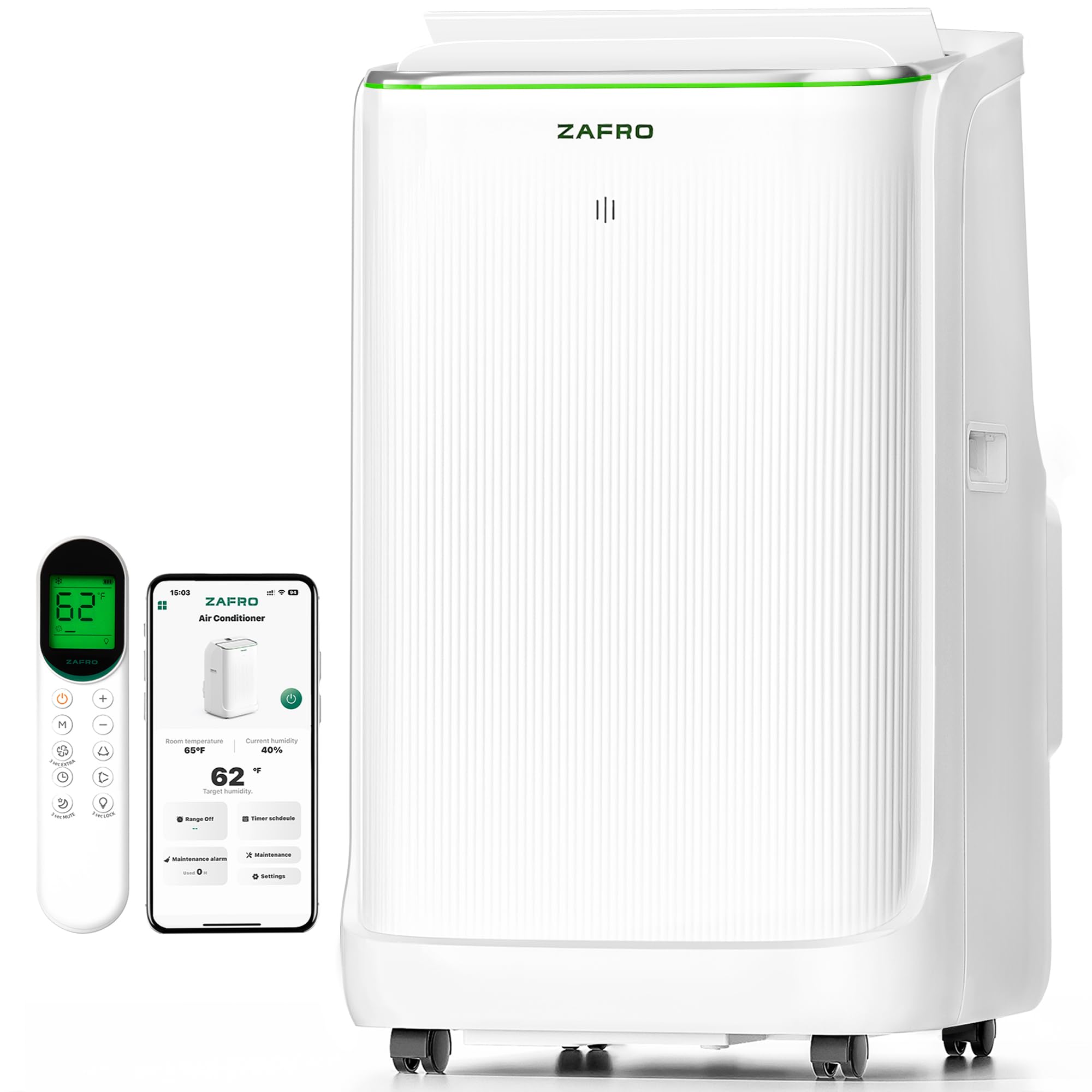
The inverter-driven dual-hose unit that sips power while it quietly dries the air.
This is the pick for anyone who wants their room cool and dry without the electric bill spiking. The ZAFRO uses a smart inverter compressor that adjusts its speed smoothly, so it avoids the loud on-off cycling of standard units. It achieves a CEER (Combined Energy Efficiency Ratio) of 12.8, which is well above the standard 7.83 — that means it moves a lot of heat per watt of electricity used. The dual-hose system pulls air from outside for the exhaust, so it does not create negative pressure that sucks hot air back into your room through gaps, making it more efficient than single-hose portable units.
On the humidity front, the self-evaporating system can run for 72 hours without needing manual drainage in conditions under 90% humidity. Buyers report it is quiet enough for sleep mode at 40-42 dB, and the app gives you full control over scheduling and modes from anywhere. It is not cheap, but the inverter technology and dual-hose design make it a long-term investment in comfort and lower energy use.
The case for it: The high CEER 12.8 and inverter compressor mean it keeps your room at a stable temperature with less noise and lower energy consumption than the single-hose EnerGlow.
The catch: The window panel kit is on the thinner side, and some buyers mention it can leave small gaps that reduce cooling efficiency — you may need to add extra sealing foam.
Best for: Those who want the most energy-efficient, quiet cooling with a drainage-free experience for days at a time.
Skip if: You need a simple budget-friendly unit without app connectivity or you are installing in a window with an unusual shape that the included panel may not seal well.
2. EnerGlow 14,000BTU Portable Air Conditioner
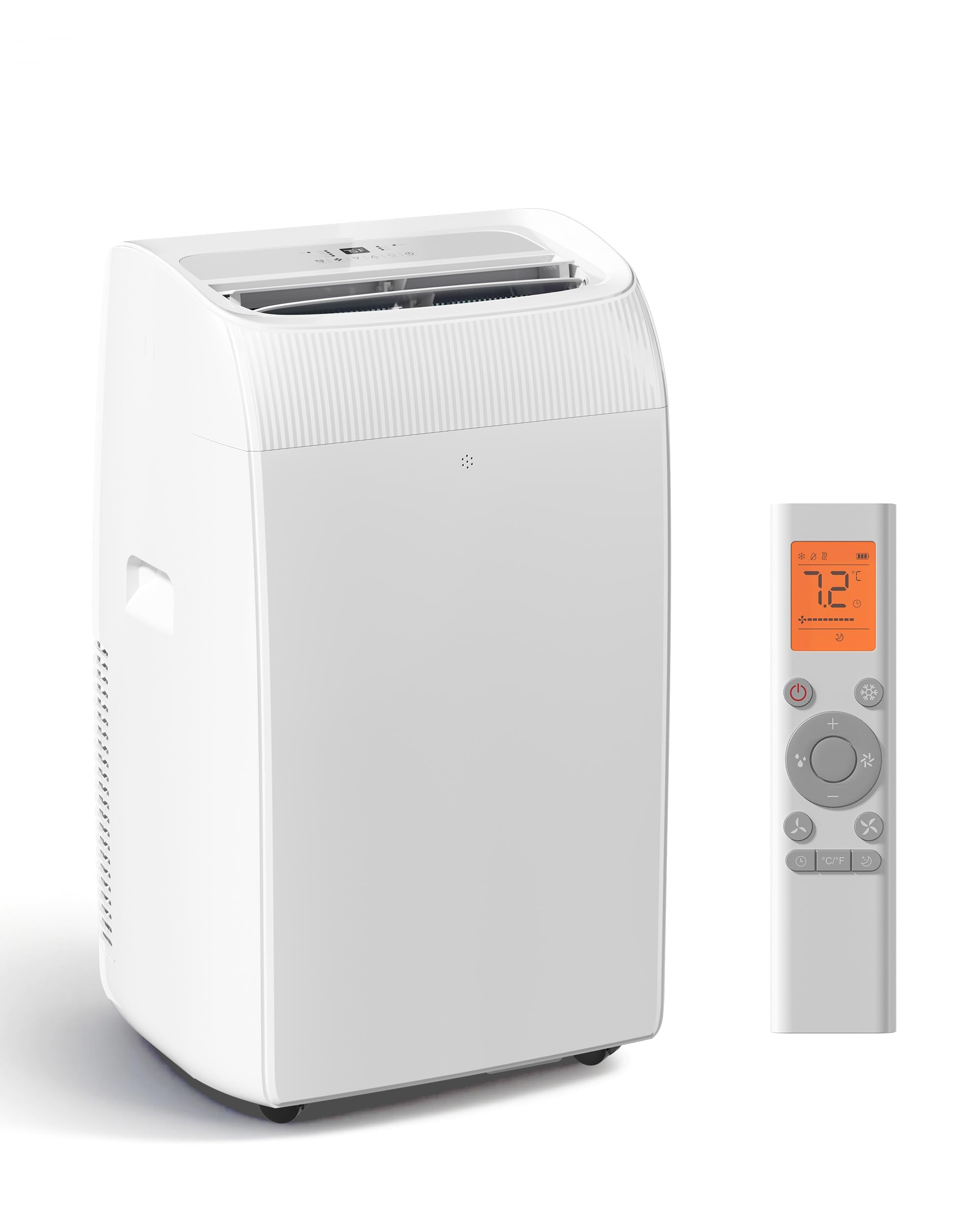
The biggest room coverage here with a dehumidifier that pulls 95 pints of water out of the air each day.
For large living spaces, this EnerGlow is the strongest all-around performer. It delivers a cooling power of 14,000 British Thermal Units and covers 750 square feet — that is 150 square feet more than the Feelfunn 12,000 BTU unit at 600 square feet. In its dry mode, it removes a significant 95 pints of moisture per day, which is among the highest dehumidification rates in this portable class. The airflow reaches 420 m³/h, and the CEER (Combined Energy Efficiency Ratio) of 7.8 is solid for a non-inverter unit of this size.
One reviewer noted it is an “excellent 8000 BTU portable AC for apartments banning window units” (referencing the SACC rating), and another said it quickly cools a living room area of 350+ square feet. The sleep mode dips to 42 dB with a dimmed display, and the 24-hour timer lets you schedule it around your routine. At 62.8 pounds, it is heavy but rolls smoothly on its 360-degree casters.
Why it’s great
- Covers the largest room area in this comparison at 750 square feet
- Dry mode removes 95 pints per day — excellent for humid climates
- Includes auto-swing louvers to circulate air to every corner of the room
Good to know
- Weighs 62.8 pounds, so moving it up stairs is a two-person job
- Single-hose design means it is less efficient than the dual-hose ZAFRO
Best for: Cooling and dehumidifying a large main living area or open-concept floor plan up to 750 square feet.
Skip if: You need a portable unit you will regularly move between rooms — its weight makes it more of a place-and-leave appliance.
3. Hykolity WiFi Enabled Portable Air Conditioner, 14,000 BTU
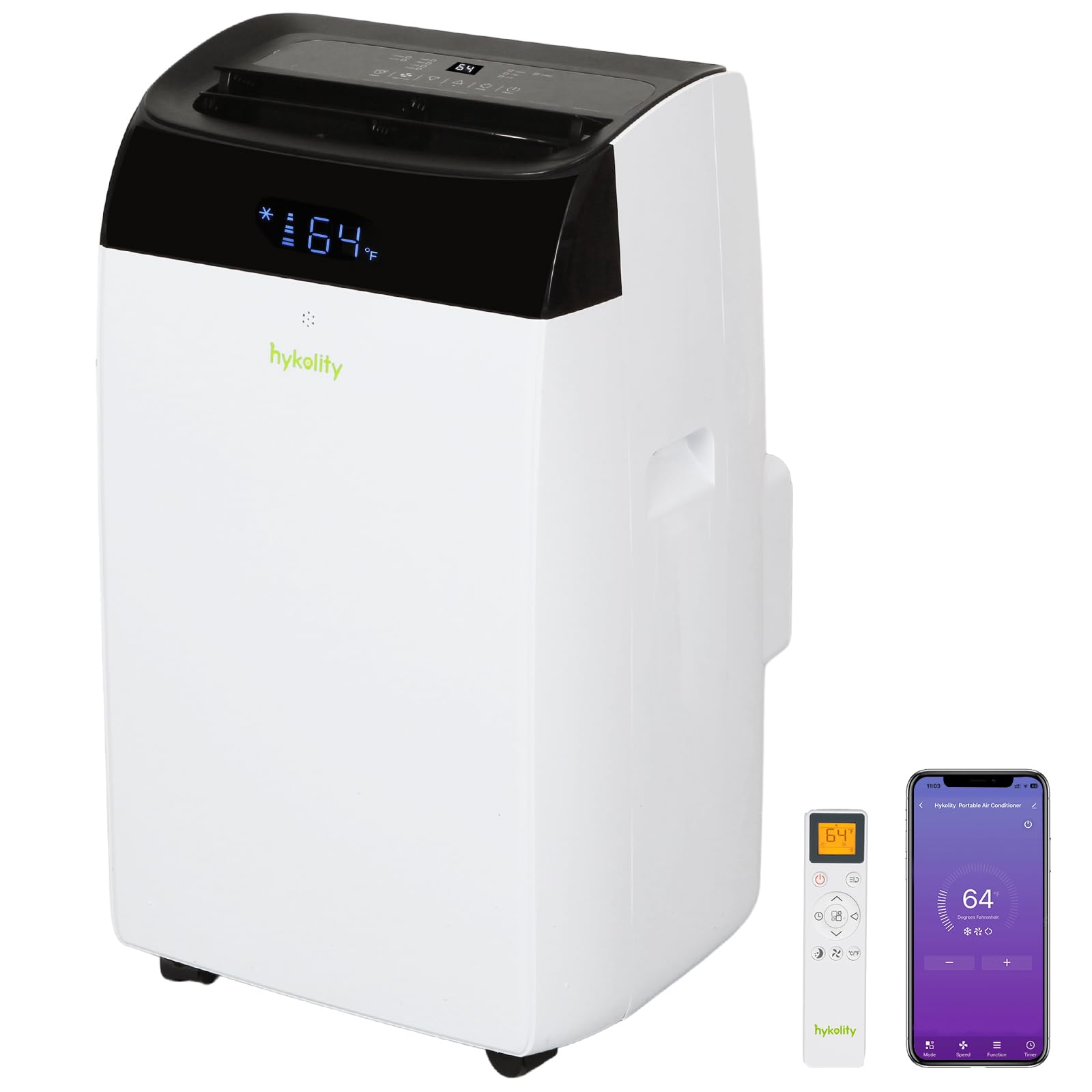
A mid-priced portable that brings smart app control and self-evaporating tech to the humidity fight.
The Hykolity strikes a nice balance between features and cost, especially if you want to control your AC from your phone. It offers five modes, including Turbo for instant cooling and a dedicated Dehumidify setting. The self-evaporating technology means it automatically handles most of the moisture it collects, so you are not constantly emptying a tank. One buyer mentioned they are “super happy about this purchase” because it cools their sun-baked porch fast and keeps their main AC from running as much, saving money.
With a cooling power of 14,000 British Thermal Units and a floor area rating of 700 square feet, it is in the same ballpark as the EnerGlow but costs less. One trade-off is that some owners mention it is noticeably loud on high fan speed, so it may not be your first choice for a silent bedroom if you are a light sleeper. The dual LED display is bright and easy to read, and the slide-out washable filter simplifies maintenance.
The case for it: You get WiFi control, self-evaporating drainage, and a 42 dB sleep mode for a lower entry price than the EnerGlow with these smart features.
The downside: On high fan and turbo mode, the noise level jumps significantly — not the unit for a noise-free nursery or home office.
Best for: Smart-home enthusiasts who want to pre-cool a room from their phone and prefer a self-evaporating unit that rarely needs manual draining.
Skip if: You are extremely sensitive to machine noise during the day — the high fan speed is more noticeable than the ZAFRO’s.
4. HUMHOLD 14,000 BTU Portable Air Conditioner

This unit focuses hard on pulling moisture out, with a dehumidifier capacity of up to 96 pints per day that rivals standalone units.
If your main battle is against humidity and you want cooling as the secondary goal, the HUMHOLD is a strong pick. Its dehumidifier mode can remove between 80 and 96 pints per day, which is close to the EnerGlow’s 95-pint rating and well ahead of most portable ACs. The 14,000 BTU ASHRAE cooling (10,000 BTU SACC) covers 550-700 square feet, and the sleep mode targets less than 48 dB for a quieter night.
Buyers in hot, humid climates report it cools a 15×17 room effectively. The unit uses a self-evaporating system for normal cooling, but in dry mode or in very humid rooms (above 85% humidity), you will need to connect the continuous drain hose — it does not evaporate all that moisture. The remote has a backlit display and works from up to 28 feet away, which is convenient for adjusting from across the room.
Why it’s great
- Dehumidifier capacity of 80-96 pints per day tackles very damp rooms effectively
- Sleep mode targets under 48 dB with a 24-hour programmable timer
- Auto-swing louvers distribute cool air across a 30-85 degree range
Good to know
- Measured noise on high fan is around 59-61 dB according to one detailed review
- Requires continuous drainage when running in dedicated dry mode
Best for: Anyone in a persistently humid climate who wants a portable unit that doubles as a serious dehumidifier.
Skip if: You want a low-maintenance drainage system — this one needs a hose connected in dry mode.
5. Feelfunn 12,000 BTU Portable Air Conditioner
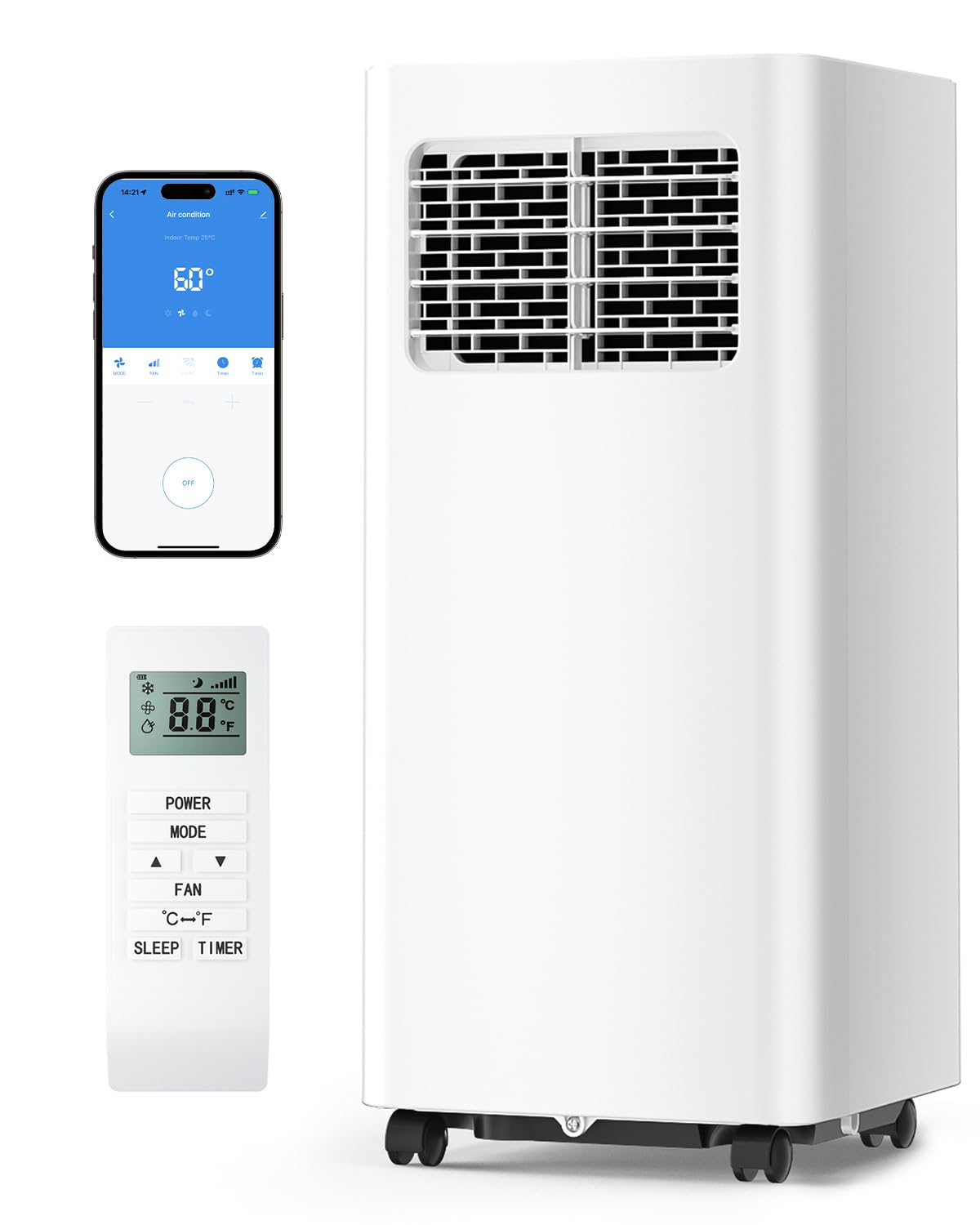
The most affordable pick here that still includes app control and a decent dehumidifier punch.
For a bedroom, dorm, or small apartment, the Feelfunn 12,000 BTU unit is a solid entry-level choice that does not skimp on smart features. It covers up to 600 square feet, which is a 25% smaller area than the EnerGlow, and its dehumidifier mode removes up to 76 pints per day — enough for a moderately humid room. Customers note “noise level similar to window fan,” which is acceptable for most people, and they consistently mention it cools a 10×12 bedroom and an adjoining dining area without issue.
It has WiFi and app control, so you can adjust the temperature from 60°F to 86°F from your phone, and it works with Alexa and Google Assistant if you have a smart speaker. The sleep mode automatically raises the temperature by 2°F each hour for the first two hours, which helps save energy overnight. At 50.7 pounds and on 360-degree casters, it is lighter than most 14,000 BTU units and easier to roll between rooms.
The case for it: You get WiFi controls and a 76-pint dehumidifier for the lowest entry price in this list, making it ideal for small spaces on a budget.
The trade-off: Some reviewers point out it is too loud for overnight use in a bedroom — one reviewer specifically said it is “not quiet enough for overnight use” and measures louder than 50 dB on high.
Best for: A small to medium bedroom or dorm where you want smart controls and dehumidification without spending premium money.
Skip if: You need whisper-quiet operation while you sleep — the noise level is comparable to a box fan.
6. YITAHOME 12,000 BTU Mini Split AC/Heating System
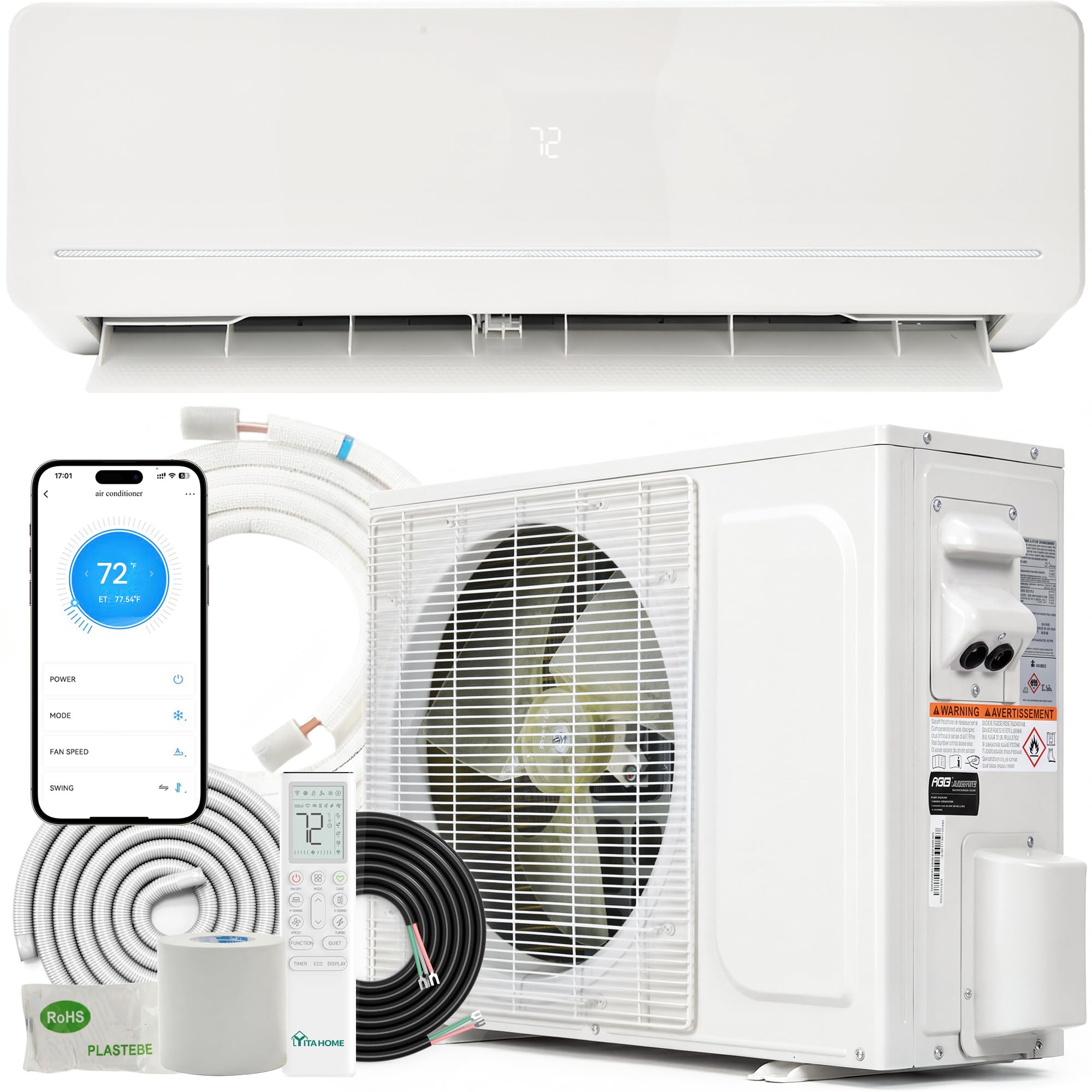
A permanently installed mini-split that is dramatically quieter — 25 dB in sleep mode — than any portable unit here.
If you are ready for a more permanent solution, the YITAHOME mini split changes the game entirely. It is a ductless system with an outdoor compressor unit and an indoor wall-mounted air handler. Instead of a portable unit taking up floor space and requiring a window hose, this mounts on the wall and connects through a small hole. The inverter compressor achieves a 20 SEER2 efficiency rating (Seasonal Energy Efficiency Ratio 2, a measure of cooling output per watt) — far higher than any portable — and the sleep mode noise level drops as low as 25 dB, which is barely audible.
It covers 750 square feet for cooling and also provides heating down to 5°F, making it a year-round solution. The dry mode acts as a dehumidifier, and the unit includes an iFeel sensor that adjusts the temperature based on the remote’s location. However, this is not a plug-and-play appliance. Installation requires a licensed HVAC professional, a vacuum pump, and a manifold gauge set. Buyers who installed it themselves confirmed it works great for cooling in Texas heat, but one warned that the unit can overcool if the blower does not shut off at the set temperature.
Why it’s great
- Sleep mode noise at 25 dB is far quieter than any portable unit’s sleep mode
- 20 SEER2 inverter efficiency means major energy savings over time
- Provides both cooling and heating, usable year-round from 5°F to 118°F
Good to know
- Requires professional installation — this is not a DIY portable unit
- Some units have quality control issues, with one buyer reporting failure after two days
Best for: Homeowners or long-term renters who want the quietest, most efficient cooling and heating with a permanent installation.
Skip if: You need a portable unit you can take with you when you move, or you do not want to arrange for professional HVAC installation.
7. VIVOSUN AeroLush C08 Smart Air Conditioner
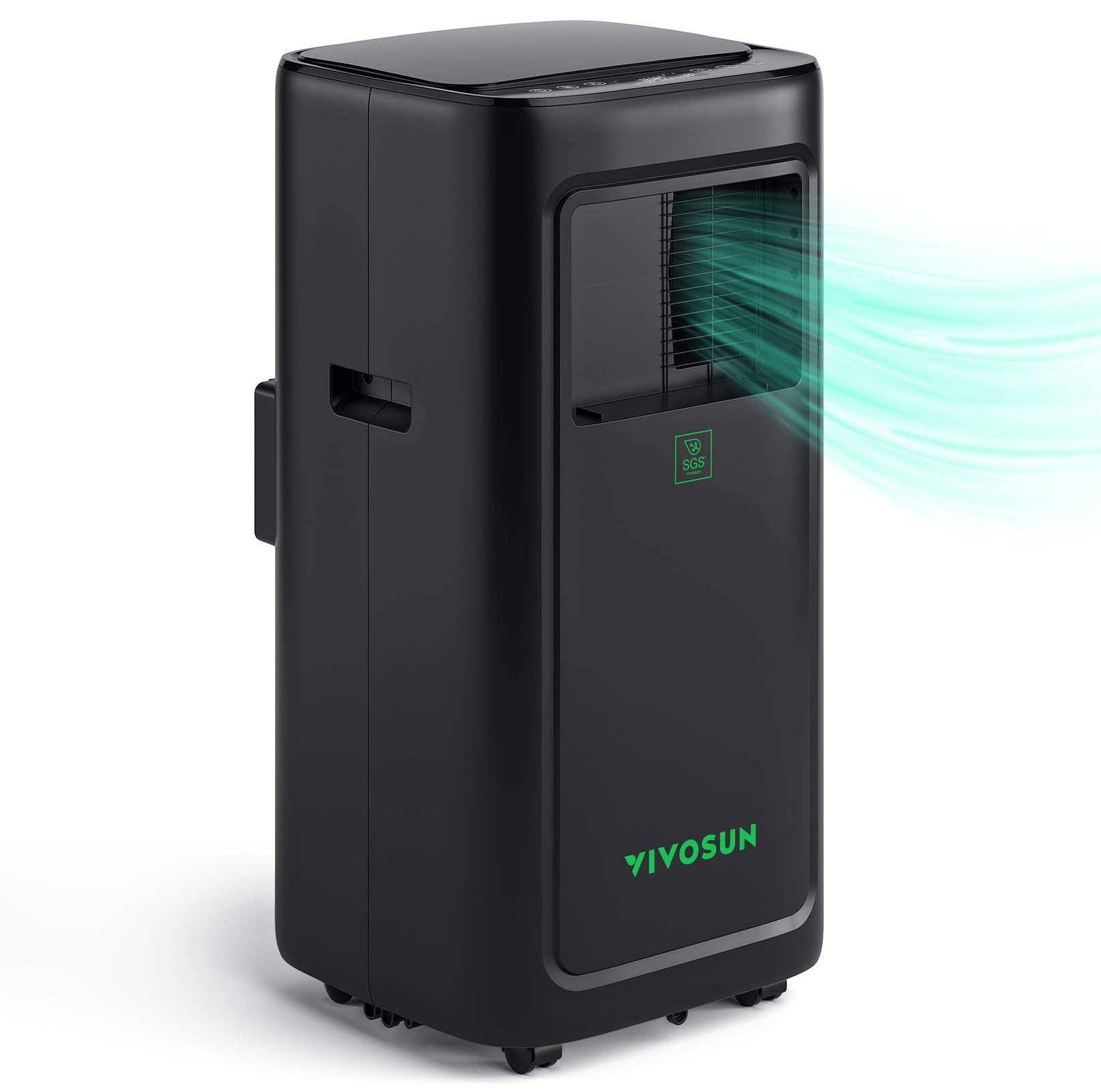
A precision climate machine built for grow tents, with an 8,000 BTU compressor and a sensor probe that tracks temperature and humidity in real time.
This is an unusual but highly specialized entry. The VIVOSUN AeroLush C08 is designed specifically for indoor growing environments, with an 8,000 BTU compressor and integrated Sensirion sensors for real-time temperature, humidity, and VPD (Vapor Pressure Deficit, a measurement that combines temperature and humidity to tell you how easily plants can transpire) monitoring. The sensor probe lets the unit respond to conditions right at the plant canopy level, not just at the unit itself. It offers cooling, drying, heating, and fan modes — four functions in one portable package.
Buyers using it in 4x4x6 grow tents report the dry mode targets 58-59% humidity effectively, cycling on and off every 8 minutes to maintain stable conditions for drying plants without mold. It is also recommended for grow tents up to 5×5 ft. The unit is self-evaporating and has auto-restart after a power outage, which is important for maintaining climate control around the clock. At 8,000 BTU, it is not designed for living room cooling, but for its niche, it is the most precise option available.
The case for it: The Sensirion sensor probe and VPD tracking give you climate control accuracy no other standard portable AC can match for grow tents.
One limitation: With 8,000 BTU, it is low on raw cooling power — it is not suitable for cooling a standard living room or bedroom in hot weather, and its performance drops above 85°F ambient.
Best for: Indoor growers who need precise temperature and humidity control in a tent up to 5×5 feet.
Skip if: You need to cool a living space — this unit’s BTU rating and design are tailored for grow environments, not general home use.
Understanding the Specs
ASHRAE vs. SACC BTU Rating
ASHRAE (American Society of Heating, Refrigerating and Air-Conditioning Engineers) BTU is the older, more generous test that often overstates a unit’s real-world cooling power. SACC (Seasonally Adjusted Cooling Capacity) is a newer, stricter test that better reflects how a unit performs in actual summer conditions. For example, a unit labeled 14,000 BTU ASHRAE might only be 10,000 BTU SACC. When comparing two units, always compare their SACC numbers for an honest picture of what they can cool.
CEER (Combined Energy Efficiency Ratio)
CEER measures how much cooling a unit provides per watt of electricity consumed. A higher CEER means better energy efficiency. Standard portable units typically have a CEER around 7.8, while premium inverter models can reach 12.8 or higher. This spec directly affects your long-term electricity costs — a unit with a CEER of 12.8 uses significantly less power than one with a CEER of 7.8 to produce the same amount of cooling.
Pints Per Day (Dehumidification)
This number tells you how much moisture the unit can remove from the air in its dry or dehumidifier mode over 24 hours. Higher numbers (80-95 pints/day) are better for humid climates like the Gulf Coast or Midwest summers. Lower numbers (50-76 pints/day) are fine for moderately humid areas. If you live in a place where the air feels sticky most of the summer, prioritize a unit with higher pint-per-day ratings.
Inverter Compressor
A standard compressor runs at full power until the room hits the set temperature, then shuts off completely. An inverter compressor adjusts its speed continuously to maintain the exact temperature without shutting off. This results in quieter operation (fewer clicking and clanking sounds), more stable room temperature (no hot or cold swings), and lower energy use (no power surge from restarting). Inverter models cost more upfront but often pay for themselves in efficiency.
FAQ
Can a portable air conditioner actually control humidity or does it just cool the air?
How many square feet will a 12,000 BTU air conditioner with dehumidifier cool?
Do I need to drain water from a portable air conditioner with humidity control?
What is the difference between a dual-hose and single-hose portable AC for humidity control?
Can I leave a portable air conditioner running all day to control humidity?
Is a mini split air conditioner better for humidity than a portable unit?
How loud is a typical portable air conditioner in sleep mode?
Will a portable AC with humidity control work in a room with no window?
How often should I clean the filter on my portable AC with a dehumidifier?
What is VPD and why does it matter for a grow tent air conditioner?
Final Thoughts: The Verdict
For the majority of shoppers, the best air conditioner with humidity control winner is the EnerGlow 14,000BTU Portable Air Conditioner because it offers the largest room coverage, a potent 95-pint dehumidifier, and a quiet sleep mode at a mid-range price. If you want the most energy-efficient cooling you can get and prefer a drainage-free experience, grab the ZAFRO Smart Inverter. And for a permanent, whisper-quiet solution that heats and cools year-round, the standout is the YITAHOME Mini Split.
How We Picked
We do not accept paid placement, and we did not hands-on test every unit. Instead, we match each pick to a real buyer and use-case by comparing the manufacturers’ published specifications against the patterns in verified customer reviews — so you get each pick’s real strengths and trade-offs instead of marketing copy.
Sources & Methodology
Specifications: manufacturer listings and product documentation. Review insights: verified customer reviews, as of July 2026. Pricing: not shown on this page (it changes often); check the current price via the retailer link.
As an Amazon Associate, Gadgets Feed earns from qualifying purchases. This does not affect which products we feature.