
Our readers keep the lights on and my morning glass full of iced black tea. As an Amazon Associate, I earn from qualifying purchases.
Specs are compiled from manufacturer listings and verified buyer reviews and can change over time — please confirm the key details on the product page before buying.
If you or someone you care for is spending long hours in bed, the biggest worry is pressure sores — painful skin breakdown that is far easier to prevent than to treat. An air mattress overlay is the single most effective tool for redistributing that constant pressure, but choosing the wrong one means either a noisy pump that ruins sleep or a pad that goes flat after a few weeks. This guide cuts through the marketing to show you exactly which models actually deliver on their promise of quiet, reliable, alternating pressure relief.
I’m Min — the founder and writer behind Gadgets Feed. This guide is built by comparing the manufacturers’ published specifications and the patterns across verified customer reviews, so you get each pick’s real strengths and trade-offs instead of marketing spin.
Whether you are caring for a bedridden family member at home or managing your own recovery, you need the best air mattress overlay that balances a quiet pump, a durable pad, and a cycle time that actually prevents sores without keeping you awake.
Quick Picks
- MedVance Premium Alternating Air Pressure Mattress Pad — Best Overall
- Drive Medical Med Aire Alternating Pressure Pump and Pad System — Great Value
- Lunderg Alternating Air Pressure Mattress Pad with Flocking (Full) — Most Comfortable
- Lunderg Queen Size Alternating Air Pressure Mattress Pad (53″ x 77″) — High Capacity
- Waffle Econo Extended Care Plus Mattress Overlay w/Pump (EHOB) — Simple Static Option
- Repose Premium Pressure Relieving Mattress Overlay with Pump — Hospital Grade
- Roho Prodigy Premium Mattress Overlay — Premium Pick
How To Choose The Best Air Mattress Overlay
The right overlay depends on a few key choices. Here is what to look for before you buy.
Alternating Pressure vs. Static Overlays
Most overlays use a pump that inflates and deflates sets of air cells every few minutes — this is the “alternating” motion that shifts pressure off bony spots like your tailbone or heels. Static overlays (like the Repose or Roho Prodigy) use a single air pressure throughout. Alternating is better for preventing sores when someone is fully bedridden; static can be more comfortable for sleep if the user moves around at night.
Pump Noise and Cycle Time
A quiet pump (under 20 dB or around 23 dBA) is essential for overnight use. Cycle time — how often the air shifts between cells — should be every 5 or 6 minutes. Faster cycling means no single area is under pressure for long, which is the main goal. Some pumps also offer a “static mode” that stops the alternating motion so the pad stays firm, helpful when someone wants to sit up in bed.
Pad Material and Surface Feel
Basic vinyl pads feel sticky and can trap heat, which leads to sweating. Newer “flocking” pads have a soft, fabric-like coating that breathes better. For someone who spends 15+ hours a day in bed, that fabric feel makes a real difference in comfort and skin health.
Quick Comparison
On smaller screens, swipe sideways to see the full table.
| Model | Best For | Cycle Time | Weight Capacity | Pump Noise | Amazon |
|---|---|---|---|---|---|
| MedVance Premium | Best Overall | Every 6 min | Not listed | Under 20 dB | $61.95$70.00Amazon |
| Drive Medical Med Aire | Budget-friendly | Every 5 min | 300 lbs | 4 LPM | $87.99Amazon |
| Lunderg Flocking (Full) | All-night comfort | Every 6 min | 300 lbs | 23 dBA | $89.95Amazon |
| Lunderg Queen | Larger individuals | Every 6 min | 320 lbs | 23 dBA | $94.95Amazon |
| Waffle Econo EHOB | Simple static design | Static (no pump) | Not listed | No pump | $101.96Amazon |
| Repose Premium | UK hospital grade | Static (manual pump) | 306 lbs | No electric pump | $331.58Amazon |
| Roho Prodigy | Premium static relief | Static (no pump) | Not listed | No pump | $439.00Amazon |
In‑Depth Reviews
1. MedVance Premium Alternating Air Pressure Mattress Pad
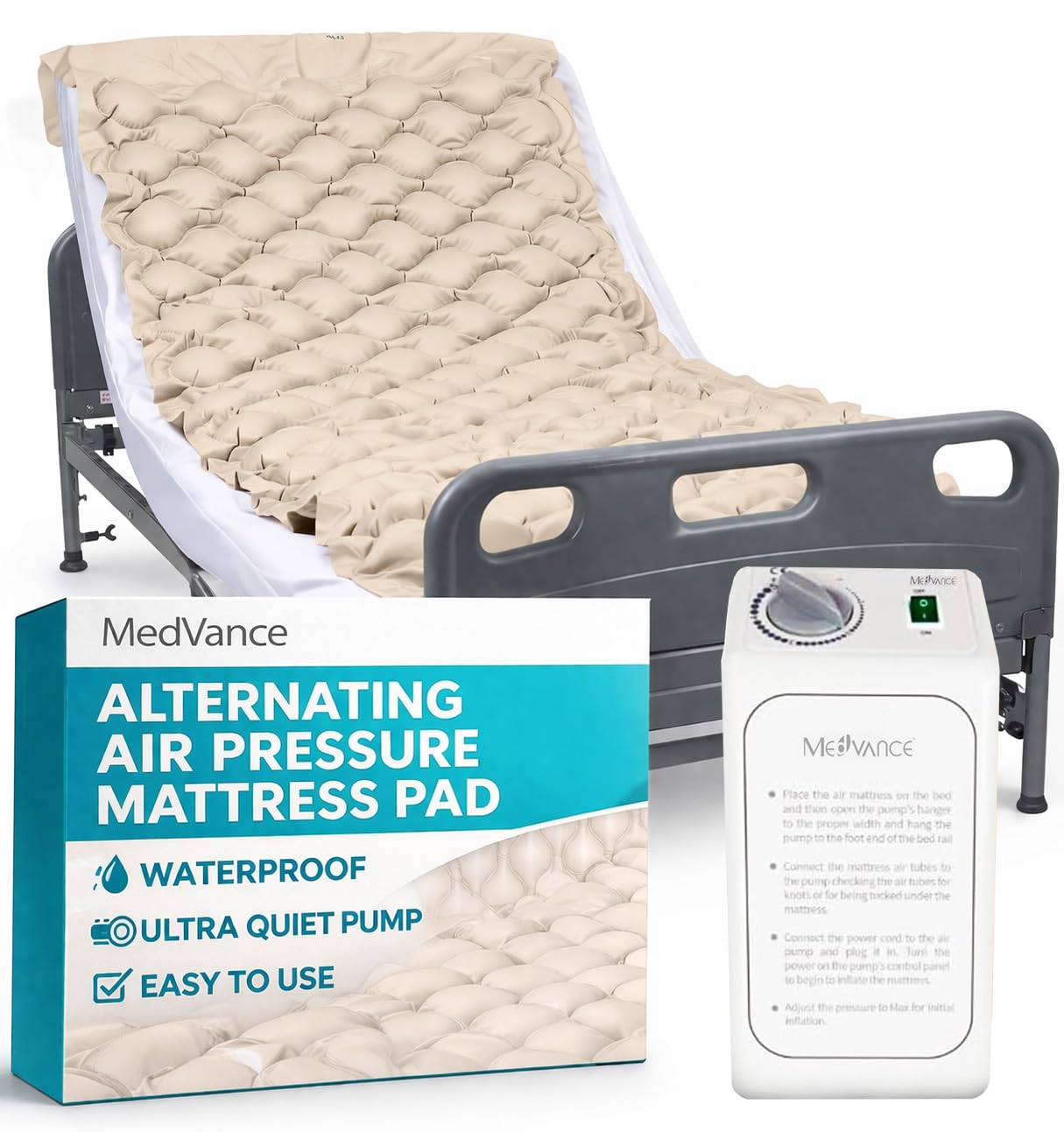
The quietest pump in the lineup — your room stays peaceful while pressure relief works on autopilot.
You get an alternating cycle every 6 minutes with a pump rated at under 20 dB, which buyers report sounds like white noise or a fan. That means it shifts the pressure off your hips, shoulders, and tailbone constantly through the night without waking you up. The digital control panel has alarms so a caregiver can monitor it, and the medical-grade vinyl pad is both waterproof and breathable — easy to wipe clean with a damp cloth and mild soap.
The MedVance cycles every 6 minutes, while the Drive Medical Med Aire cycles every 5 minutes, meaning a bit more movement for someone at very high pressure sore risk. But owners mention the MedVance is noticeably quieter — one reviewer noted they’ve “used since March 2024 (7 months)” with no issues, and another with a 93-year-old bedridden patient reported bedsores healed in a week and a half. Over two years of use with no leaks, the durability is tough to top at this level.
Two small things: the pump cord makes fitting a fitted sheet tricky at the foot of the bed, and the pad can feel “pokey” on the highest pressure setting — dropping to a lower setting or adding a 2-inch memory foam topper on top fixes it. Still, for the combination of whisper-quiet operation and proven bed sore healing, this is the one to start with.
Why it’s great
- Pump is under 20 dB — quieter than most competitors
- Automatic cycling every 6 minutes redistributes pressure
- Customers note it healed bedsores in 1.5 weeks
- Waterproof, easy-to-clean vinyl holds up for 2+ years
Good to know
- Cord placement makes fitted sheet fit awkward at the foot
- Highest pressure setting feels “pokey” for some side sleepers
Best for: Caregivers who need a reliably quiet pump so the patient sleeps through the night.
Skip if: You need a queen-size pad — this comes in Full only.
2. Drive Medical Med Aire Alternating Pressure Pump and Pad System

The faster alternating cycle — every 5 minutes — gives you more pressure shifts than most overlays at a lower price.
This is the classic, no-frills entry that has been around since 2009 and still works. The pad is made of heavy-gauge premium vinyl and measures 123 x 36 x 2.5 inches, with two end flaps that tuck under your mattress to keep the pad in place (buyers confirm the flaps work well to secure it even on a queen mattress). The pump runs at 4 liters per minute and includes a variable pressure setting so you can dial in softness or firmness.
The Drive Medical alternates its 130 individual bubble air cells every 5 minutes — a faster cycle than the MedVance’s 6 minutes — which helps prevent any pressure buildup on a single spot. One buyer caring for a bedbound family member under 100 lbs reported it “works well for nearly 2 months; excellent value.” Another reviewer said it was “better than any air mattress we have ever had” and that set-up took less than 5 minutes. Weight capacity is listed at 300 lbs.
The catch is noise. Several owners say the motor is “noisy at times,” and some place it at the head of the bed to avoid using an extension cord — a small inconvenience for the price. Unlike the MedVance, it lacks a digital alarm, but for straightforward alternating pressure on a budget, the Drive Medical remains a solid, proven choice.
The case for it: The alternating cycle runs every 5 minutes, versus every 6 minutes on the MedVance, so you get more frequent pressure shifts for just about the same price.
The downside: The pump is noticeably louder than quieter options like the MedVance (under 20 dB) or the Lunderg (23 dBA).
Best for: Budget-conscious buyers who need a reliable, fast-cycling overlay for a bedbound family member.
Skip if: You need a whisper-quiet pump for a shared bedroom or a lightweight sleeper under 100 lbs who needs very low pressure.
3. Lunderg Alternating Air Pressure Mattress Pad with Flocking (Full)
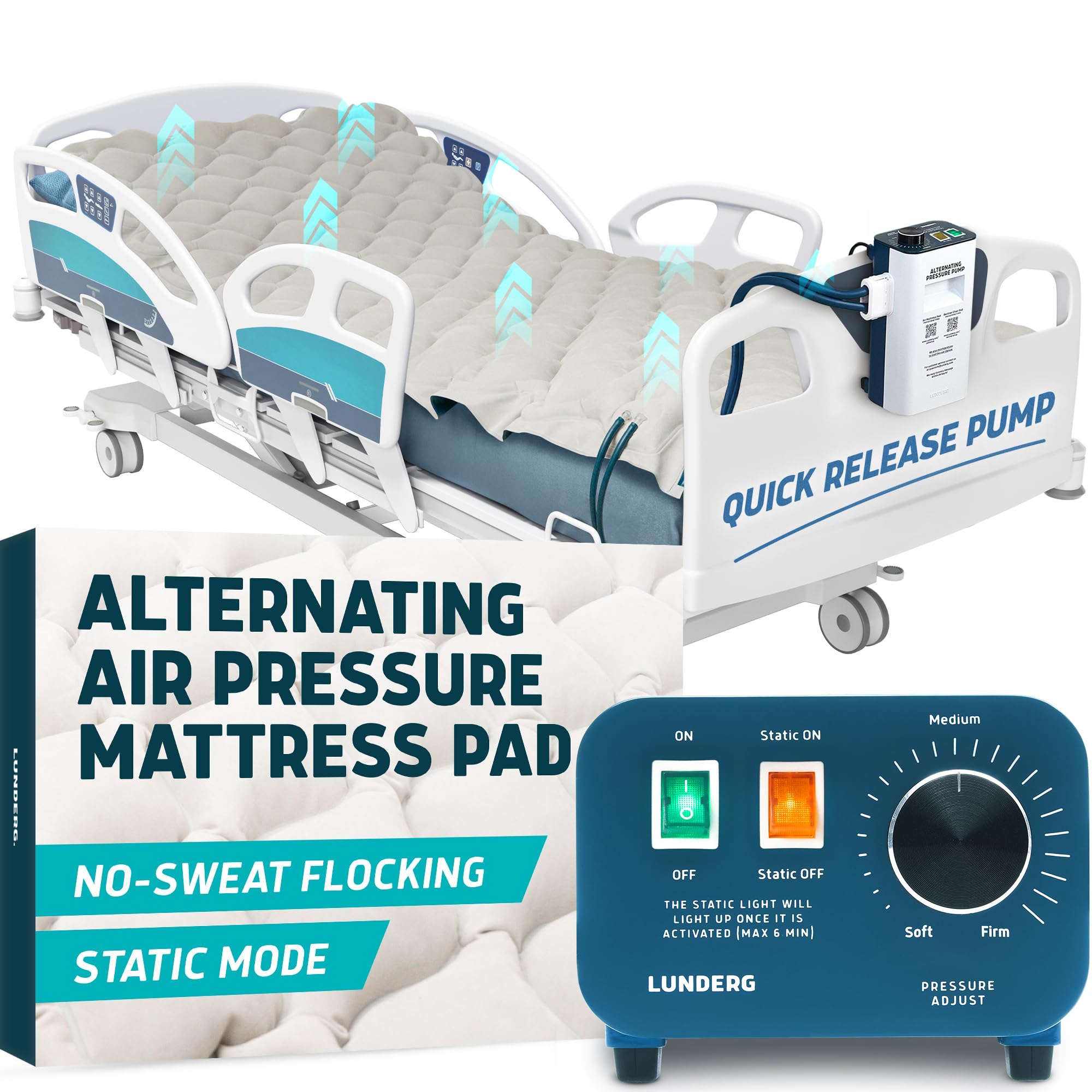
A soft, fabric-like surface that breathes — no more sleeping on a sweaty plastic sheet.
Typical vinyl overlays trap heat and feel sticky. Lunderg solved that with a “flocking” process that adds a soft, breathable fabric coating to the PVC air cells. The result is a surface that feels more like a mattress pad than a medical device, which makes a huge difference for someone who spends all day in bed. The whisper-quiet pump runs at just 23 dBA, and it offers both alternating mode (cycling every 6 minutes) and a static mode where all cells stay fully inflated — useful if the user wants to sit up comfortably.
Reviewers point out real results: one tetraplegic user weighed 230 lbs and after a month of use said, “No red marks after a month.” Another senior citizen noted they had “first long sleep in months” because the alternating cells felt “quiet and pleasant” and were relaxing enough to fall asleep during the afternoon test. The pad supports up to 300 lbs, and the pump’s static mode is a smart addition — reviewers who were initially confused by it later praised it for allowing their loved one to sit up without the pad shifting.
One thing to keep in mind: the inflatable part of the queen version measures 52×72 inches, slightly smaller than a standard queen mattress, so there is some fabric overhang. But the flocking feels noticeably nicer against skin than the bare vinyl of the MedVance or Drive Medical, making this the pick for anyone who prioritizes skin comfort.
Why it’s great
- Flocking coating breathes better than bare vinyl
- Static mode lets the user sit up without losing support
- Shoppers say no red marks after a month of use
- Pump rated at 23 dBA — near-silent operation
Good to know
- Queen inflatable section is 52×72 inches — smaller than a queen mattress
- At 230 lbs, the pad flattens slightly under the butt when sitting upright
Best for: Anyone who needs to spend 15+ hours a day on the overlay and wants a soft, non-sticky surface.
Skip if: You need a pad that exactly matches a queen mattress edge-to-edge — this one leaves a gap.
4. Lunderg Queen Size Alternating Air Pressure Mattress Pad (53″ x 77″)
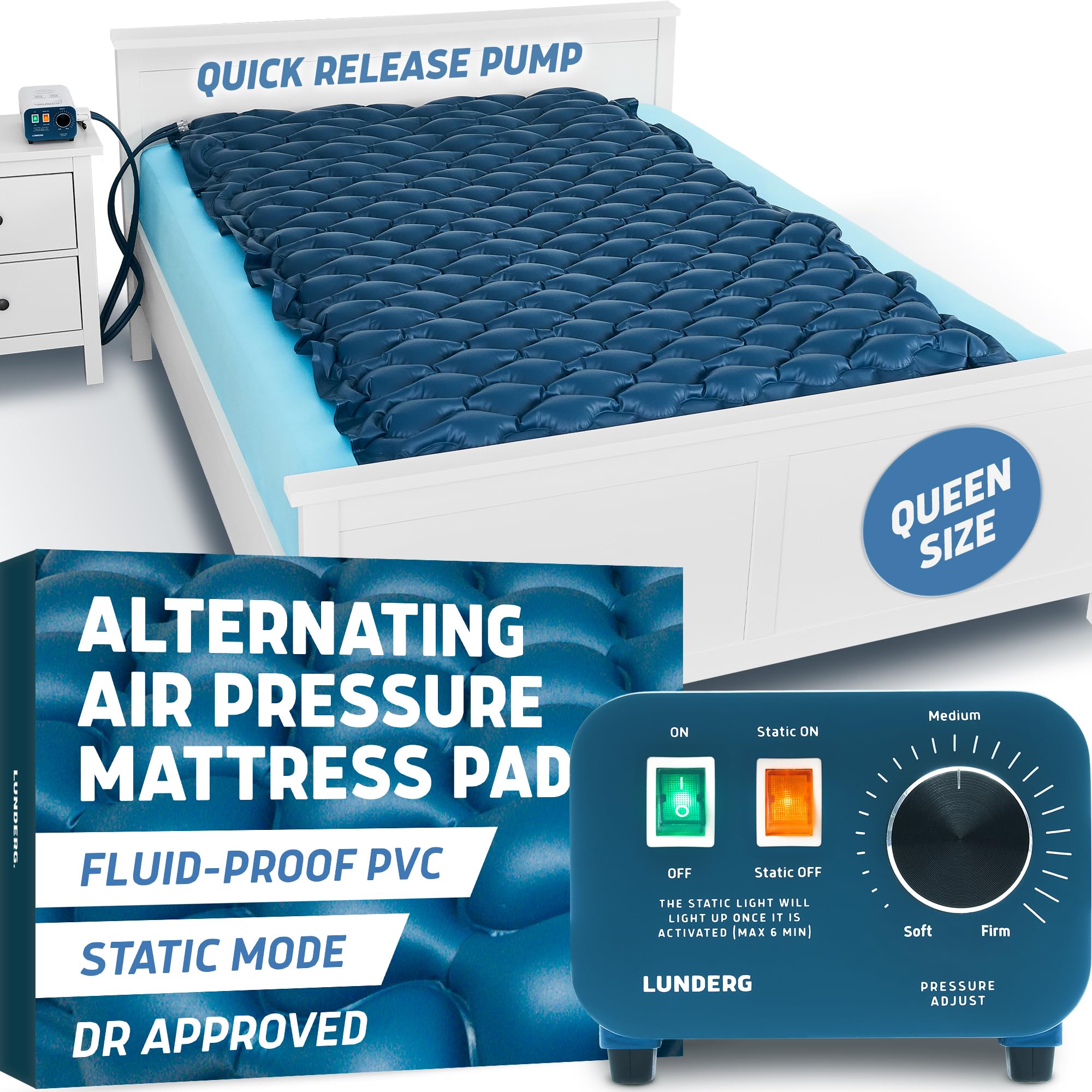
Built for bigger bodies — supports 320 lbs with 53 x 77 inches of alternating relief.
While the standard Lunderg (product 3) supports 300 lbs and measures 52×72 inches, this queen-specific version measures 53 x 77 inches and has a weight capacity of 320 lbs. The larger footprint and higher capacity matter for heavier individuals or anyone who needs a true queen fit. It still uses the same 23 dBA pump with static mode and the same alternating cycle every 6 minutes, plus a waterproof PVC construction that is easy to wipe clean.
Buyers report the same positive outcomes as the smaller Lunderg: one paraplegic user said the pad “provides pressure relief even with static mode on” and that the motor is “quiet.” Another reviewer with a tetraplegic family member — at a similar 230 lbs — confirmed “no red marks after a month.” The quick connector makes setup straightforward — you unroll, connect the hoses, and let it inflate for about 20 minutes (3 full cycles).
The main difference is that this version is pure PVC without the flocking coating, so the surface is vinyl rather than fabric-soft. If you need the soft feel but have a larger user, the flocked Lunderg (product 3) may still fit if weight is under 300 lbs — but for 320 lb capacity and a true queen fit, this is the correct choice.
The case for it: Holds 320 lbs, versus 300 lbs for the standard Lunderg version and 300 lbs for the Drive Medical, making it the most accommodating overlay for larger individuals.
The trade-off: The surface is bare PVC rather than the flocked fabric of the smaller Lunderg, so it may feel warmer and less breathable.
Best for: Larger users who need a queen-size pad with a higher weight capacity.
Skip if: A soft, fabric-like surface is essential — the flocked version is more comfortable against skin.
5. Waffle Econo Extended Care Plus Mattress Overlay w/Pump (EHOB)

A no-electricity, cotton-covered air mattress that relies on a simple hand pump — pure simplicity.
Unlike every other product on this list, the Waffle Econo does not use an electric pump. You inflate it manually with the included pump, set the air pressure, and it stays that way — no noise, no cords, no moving parts. The pad is made of cotton fabric over an air bladder, measuring 76 x 34 x 3 inches, and it is designed to fit a standard hospital bed. It is not water resistant, so a waterproof mattress cover underneath is essential.
Because there is no alternating pressure, the pressure relief is static — it distributes weight evenly across the air cushion. One buyer mentioned their bedridden sister has used it for 2 years and it “reduces bed sores, improves sleep, no temperature discomfort” and that it worked better than a memory foam topper. Another reviewer warned, however, that “the plastic material fails within 2 months; holes form for no reason” — a durability concern echoed by multiple owners. The pad is zippered, so you can remove the cotton cover for spot cleaning.
The main limitation is the duration: several reviews mention the pad developing air leaks after 30 days to 2 months, and the manufacturer’s care instruction is “Spot Clean Only.” For a short-term hospital stay or as a backup overlay, it works fine. For long-term, daily use, you will likely need to replace it sooner than an alternating pump model.
Why it’s great
- Completely silent — no electric pump or motor noise
- Cotton cover feels more breathable than vinyl
- Simple design; zipper-removable cover for washing
Good to know
- Multiple owners mention air leaks developing within 30-60 days
- Not water resistant — requires a separate waterproof cover
Best for: Short-term recovery or occasional use where silence and simplicity matter more than durability.
Skip if: You need a long-term daily-use overlay — the leak risk is too high for continuous care.
6. Repose Premium Pressure Relieving Mattress Overlay with Pump

Developed with the UK’s National Health Service (NHS) — used by over 3 million patients for a reason.
Repose was designed in 1997 in collaboration with the UK’s National Health Service, and it is still the go-to non-powered overlay for pressure ulcer prevention in British hospitals. It uses a manual pump (no electricity needed) to fill a single-chamber, seamed polyurethane pad that measures 70.1 x 30.3 inches inflated. The pad is completely waterproof and smooth, so there are no crevices for bacteria to hide. The weight limit is 306 lbs.
Since it is a static overlay (no alternating action), the pressure relief comes from the material itself — the foam-like polyurethane pad does not lose its shape over time, according to the manufacturer. One owner reported that this pad “improved husband’s bedsores where 3 others failed” and said the manual pump was easy to use. Another reviewer who was familiar with the same pad from an ICU stay said it was “super comfortable” and that this version was identical to the one used in intensive care but cost half the price of the NHS version.
The big catch: a few buyers experienced the pad going flat after 3 months with no repair option from customer service. Repose does offer a 60-day return policy and a 2-year warranty if bought directly, but some Amazon purchasers struggled with support. Also, since it is a static pad, it cannot cycle pressure like an alternating pump — so for someone who is completely immobile and at high risk of sores, an alternating overlay may be a better choice.
The case for it: The NHS-developed design uses a durable, smooth polyurethane pad that one buyer says “improved bedsores where 3 others failed.”
One limitation: A few customers note the pad deflating after 3 months with poor customer service follow-through on replacements.
Best for: Home care where you want a hospital-tested, non-electric overlay with a proven track record in the UK.
Skip if: The user is completely immobile and needs the active pressure-shifting that only an alternating pump provides.
7. Roho Prodigy Premium Mattress Overlay

The non-powered alternative that promises you will never “bottom out” — 3.5 inches of immersion that holds you up.
Roho is the most expensive overlay on this list by a wide margin, and it earns that premium by being completely different from the others. It uses a “dry-flotation” system — a series of interconnected air cells that you set to a single pressure with no pump or electricity. The key spec is the depth of immersion: 3.5 inches. That means your body sinks into the cells rather than hitting the mattress below, which is the most critical factor in preventing pressure sores. The makers claim alternating pressure pads typically allow only 1.5 inches of immersion, leading to bottoming out. The Prodigy has three zoned sections (head, hips, legs) that you can set to different pressures independently.
Buyers who need maximum comfort rave about it: one person with muscular dystrophy said it gave them “excellent pressure relief” and allowed them to sleep through the night for the first time in months. The three-zone design was a standout feature — “allowing variable air pressure” for different body areas. Another reviewer called it “sturdy, well-designed” with snap-together sections, and after 6 months had no leaks (though they needed to add air monthly). The unit is made in the USA, which is rare in this category.
The downsides are real. Some reviewers point out the large air cells make the pad feel “squeaky” — a padded topper helps. More importantly, one reviewer with a petite, bedbound user said the large cells caused heels and elbows to sink in and made it impossible to turn. The same user noted that the middle section “repeatedly fails to stay inflated” and that customer service was unhelpful. This is a specialized product that works best for larger, mobile users — not for very small or completely immobile individuals.
Why it’s great
- Industry-leading 3.5-inch depth of immersion prevents bottoming out
- Three zoned sections allow independent pressure for head, hips, and legs
- Zero electricity, zero noise, no moving parts
- Made in the USA
Good to know
- Large air cells are not suitable for petite or lightweight users
- Some shoppers say middle section leaks and unresponsive customer service
- Requires monthly re-inflation and can feel squeaky
Best for: Larger, semi-mobile users who need premium, non-powered pressure relief with zero noise.
Skip if: The user is petite, completely bedbound, or needs the active pressure shifts of an alternating pump.
Understanding the Specs
Cycle Time
Cycle time is how often the pump shifts air between the two sets of cells in an alternating overlay. A cycle every 5 minutes means no single area is under continuous pressure for long — that is the fastest option among these picks. Every 6 minutes is still effective but gives a slightly longer pause. Faster cycling is generally better for immobile patients, but it also means more motion, which can be distracting for light sleepers.
Depth of Immersion
This is the distance your body sinks into the overlay before hitting the mattress. It is only listed officially for the Roho Prodigy at 3.5 inches — the Roho makers claim alternating pads typically give only 1.5 inches. More immersion (sinking in) distributes weight over a larger area, reducing peak pressure on bones. That is why the Prodigy is effective: you never feel the hard bed underneath. For alternating pads, you rely on the air cell height (usually 2.5 to 3 inches) to gauge immersion.
FAQ
Can I use an air mattress overlay on a regular home bed?
How long does an alternating pressure overlay last?
What is the difference between alternating pressure and static mode?
How quiet is a quiet pump actually?
Can I use a queen-size overlay on a full-size bed?
How do I clean an air mattress overlay?
Will an overlay work on an adjustable hospital bed?
How do I know what pressure setting to use?
What is a patch kit for?
Is a non-powered overlay like the Roho better than an alternating one?
Final Thoughts: The Verdict
If you want one dependable pick, the best air mattress overlay winner is the MedVance Premium because it combines the quietest pump (under 20 dB), a reliable alternating cycle every 6 minutes, and proven durability — one customer observed no leaks after 2 years. If you want the soft, breathable fabric feel of flocking plus a static mode for sitting up, grab the Lunderg with Flocking. And for the largest capacity (320 lbs) in a true queen size, the standout is the Lunderg Queen.
How We Picked
We do not accept paid placement, and we did not hands-on test every unit. Instead, we match each pick to a real buyer and use-case by comparing the manufacturers’ published specifications against the patterns in verified customer reviews — so you get each pick’s real strengths and trade-offs instead of marketing copy.
Sources & Methodology
Specifications: manufacturer listings and product documentation. Review insights: verified customer reviews, as of July 2026. Pricing: not shown on this page (it changes often); check the current price via the retailer link.
As an Amazon Associate, Gadgets Feed earns from qualifying purchases. This does not affect which products we feature.
Product prices and availability are accurate as of the date/time indicated and are subject to change. Any price and availability information displayed on Amazon at the time of purchase will apply to the purchase of this product. As an Amazon Associate I earn from qualifying purchases.
CERTAIN CONTENT THAT APPEARS ON THIS SITE COMES FROM AMAZON. THIS CONTENT IS PROVIDED "AS IS" AND IS SUBJECT TO CHANGE OR REMOVAL AT ANY TIME.
Amazon and the Amazon logo are trademarks of Amazon.com, Inc. or its affiliates.