
Our readers keep the lights on and my morning glass full of iced black tea. As an Amazon Associate, I earn from qualifying purchases.
Specs are compiled from manufacturer listings and verified buyer reviews and can change over time — please confirm the key details on the product page before buying.
When the lights flicker and everything goes dark, the difference between losing a day of work and calmly saving your files depends on one box under your desk. A Backup UPS (Uninterruptible Power Supply) is a battery that keeps your devices running during a blackout — it turns a sudden power cut from a disaster into a minor inconvenience. Picking the wrong one leaves you with a paperweight.
I’m Min — the founder and writer behind Gadgets Feed. This guide is built by comparing the manufacturers’ published specifications and the patterns across verified customer reviews, so you get each pick’s real strengths and trade-offs instead of marketing spin.
That 600VA (Volt-Amp, a rough measure of capacity) unit on sale might look tempting, but some 600VA units deliver only 1.2 minutes of runtime at full load, which will not save your data. The best backup UPS gives you enough time to shut down properly or ride out the flicker — and we found exactly which models deliver that confidence.
Quick Picks
- APC UPS 600VA/330W BE600M1 — Best Overall
- SKE SK625 625VA/360W UPS — AVR Value Pick
- Tripp Lite BC600R 600VA UPS — Best Compact
- CyberPower AVRG900LCD 900VA/480W — High-Capacity Pro
- GOLDENMATE 1000VA/600W Lithium UPS — Lithium Pioneer
- CyberPower OR500LCDRM1U 500VA/300W — Rack-Mount Specialist
- APC Back-UPS Pro 1350VA BR1350MS — Premium Sinewave
How To Choose The Best Backup UPS
Buying a UPS is not about how many outlets it has — it is about whether it keeps your computer running long enough for you to save your work and shut down. Two units with the same VA (Volt-Amp) rating can have wildly different real-world runtimes. Here is what actually matters.
VA vs Watts — The Number That Actually Matters
VA (Volt-Amps) is the raw capacity figure on the box, but watts tell you how much real power the UPS can actually deliver to your devices. For a typical desktop PC and monitor pulling around 150-200W (watts), a 330W UPS gives you about 10-15 minutes — enough for a graceful shutdown. A 480W unit buys you 18-20 minutes. Always check the watts, not just the VA.
Runtime — The “How Long” Question
A UPS’s stated runtime always depends on the load you put on it. That 23-minute figure at 100W drops to roughly 5-8 minutes at a full 330W load. The real trick is matching your actual gear’s power draw to the runtime you need. If you just need to survive a 2-second flicker, almost any UPS works. If you need 20+ minutes to safely close apps and shut down a server, look for a 900VA class unit or higher.
AVR — The Feature That Saves Your Battery
Automatic Voltage Regulation (AVR — it smooths out minor dips and spikes in wall power) keeps your devices running during brownouts without draining the battery. Without it, your UPS switches to battery every time the grid dips — wearing out the lead-acid cells much faster. For areas with frequent flickers, AVR is worth the slight premium.
Sinewave vs Simulated Sinewave
Active PFC (Power Factor Corrected) power supplies — common in modern desktop PCs and servers — can shut down or buzz loudly on a simulated sinewave UPS. Pure sinewave output (like the APC Pro series and the GOLDENMATE lithium unit) delivers cleaner power that sensitive electronics prefer. If you have a high-end gaming rig or a NAS (Network Attached Storage), sinewave is safer.
Quick Comparison
On smaller screens, swipe sideways to see the full table.
| Model | Best For | Capacity (VA/W) | Rated Runtime | Outlets | Amazon |
|---|---|---|---|---|---|
| APC BE600M1 | Mid-Range Desktop + Router | 600VA / 330W | 23 min @ 100W | 7 (5 backup + 2 surge) | Amazon |
| SKE SK625 | Home Office / NAS Backup | 625VA / 360W | — | 6 (4 backup + 2 surge) | Amazon |
| Tripp Lite BC600R | Wall-Mount / Small Spaces | 600VA / 300W | 1.2 min @ full load | 4 backup | Amazon |
| CyberPower AVRG900LCD | High-Capacity Desktop / NAS | 900VA / 480W | 62 min @ 72W | 12 (6 backup + 6 surge) | Amazon |
| GOLDENMATE 1000VA | Long-Life / Silent Office | 1000VA / 600W | 40 min @ 22W | 8 backup | Amazon |
| CyberPower OR500LCDRM1U | Rack-Mount Network Closet | 500VA / 300W | 27 min @ 81W | 6 (4 backup + 2 surge) | Amazon |
| APC BR1350MS | Premium Home Office / Gaming | 1350VA / 810W | 17 min @ 300W | 10 (6 backup + 4 surge) | Amazon |
In‑Depth Reviews
1. APC UPS 600VA/330W BE600M1

The compact UPS that keeps your desktop alive through a full lunch-break outage.
You get 23 minutes of runtime at a 100W (watt) load — enough for a modest desktop PC and router to save documents, close apps, and shut down without rushing. By comparison, the Tripp Lite BC600R delivers 1.2 minutes at full 300W load despite a similar price. The APC BE600M1’s 600VA / 330W capacity handles standard computers.
Buyers report the “small size fits under desk, recessed on/off button prevents cat from turning off” — a design win for shared workspaces. It includes 5 battery-backup outlets with good spacing for bulky power bricks, plus two surge-only outlets for printers or speakers. The built-in 1.5A USB port charges your phone during an outage, so you are not left staring at a dark device.
The 10-hour recharge time is on the slow side at 10 hours versus the Tripp Lite’s 8 hours. Plan to let it rest fully after a deep discharge before relying on it again. The battery is user-replaceable (APC RBC154 cartridge), which keeps this unit working for years instead of ending up in e-waste when the cells age out.
What makes it a winner
- 23-minute runtime at 100W is top-tier for the price
- Recessed power button prevents accidental shutdowns
- Compact footprint fits easily under a desk
One real limitation
- 10-hour recharge is slow after full discharge
- Only 330W capacity — not enough for a high-end gaming rig under load
Who it fits: home office users with a standard desktop and router who need real shutdown time, not just a flicker bridge.
Where it falls short: anyone running a dual-GPU workstation or a server farm needs the higher-wattage CyberPower or APC Pro below.
2. SKE SK625 625VA/360W UPS

The feature-loaded UPS that gives you AVR and a real-time LCD for not much more money.
Unlike the APC BE600M1, the SKE SK625 packs Automatic Voltage Regulation (AVR — it smooths out small voltage dips without draining the battery), extending the life of your lead-acid cells. It also has a backlit LCD (Liquid Crystal Display) that shows input voltage, output voltage, battery capacity, and load level at a glance.
Owners mention it “charged from 75% to 100% in ~1 hour” — a surprisingly fast top-off rate for a lead-acid unit. The SKE weighs 9.3 pounds versus the Tripp Lite BC600R’s 4.41 pounds, so it feels solidly built but not portable. Its 12.4 x 3.94 x 5.63-inch footprint is longer than the CyberPower AVRG900LCD’s 3.5-inch width, so measure your shelf space before buying.
The main trade-off is the software: some users note the monitoring utility is outdated and the manual has rough English. But if you just want a plug-and-play UPS with AVR and an informative screen, this handles home office duty — PC, printer, router — without complaints.
Why it stands out
- AVR extends battery life by reducing unnecessary drain
- LCD gives live voltage and load data
- Fast battery top-off from partial discharge
Where it stumbles
- Bulky 9.3 lb frame with a large footprint
- Software and documentation are dated
Grab it when: you want AVR, a display, and slightly higher wattage than the APC 600 for the same budget.
Skip if: space is tight under your desk — the Tripp Lite wall-mount fits where this cannot.
3. Tripp Lite BC600R 600VA UPS
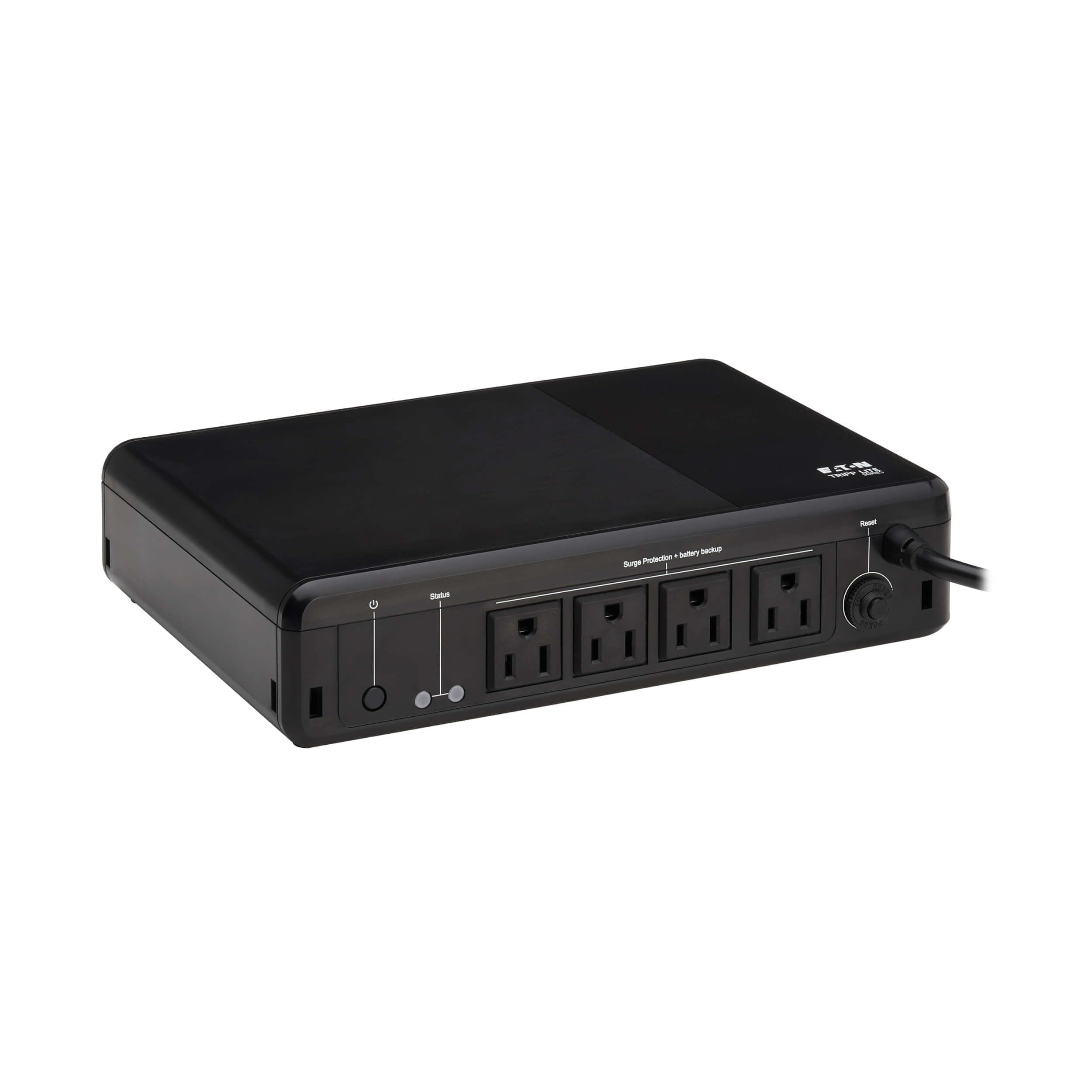
The ultra-slim UPS that bolts to the wall behind a TV or kiosk.
With dimensions of 7.1 x 10 x 2.3 inches and a weight of just 4.41 pounds, the Tripp Lite BC600R is built for locations where a tower UPS will not fit. The keyhole slots are spaced at a 100 x 100mm VESA (Video Electronics Standards Association) pattern, so you can mount it on any standard display arm or directly to the wall. Its recharge time is 8 hours versus the APC BE600M1’s 10 hours.
But there is a reason this is not the primary pick for a desktop: its runtime at full 300W load is only 1.2 minutes. That is enough to survive a blip — a brief flicker that would otherwise reset your modem or TV settings — but not enough to shut down a PC safely. Customers note it works great “for small appliances or wall mounted TV that keeps power blips from wiping out settings.”
The 190-joule surge rating is modest for a UPS; you are buying this for the form factor, not the brute protection. It is ideal for a point-of-sale terminal, a networking closet where every inch counts, or behind a wall-mounted display that loses its config on every flicker.
Its best tricks
- VESA-compatible wall mount saves floor space
- Weighs only 4.41 lbs — easy to install
- Faster 8-hour recharge
Hard limits
- 1.2-minute full-load runtime is not enough for a safe PC shutdown
- Low 190-joule surge rating
Ideal for: wall-mounting a UPS behind a TV or kiosk to survive brief flickers.
Not for: anyone who needs to shut down a desktop PC during an outage.
4. CyberPower AVRG900LCD 900VA/480W
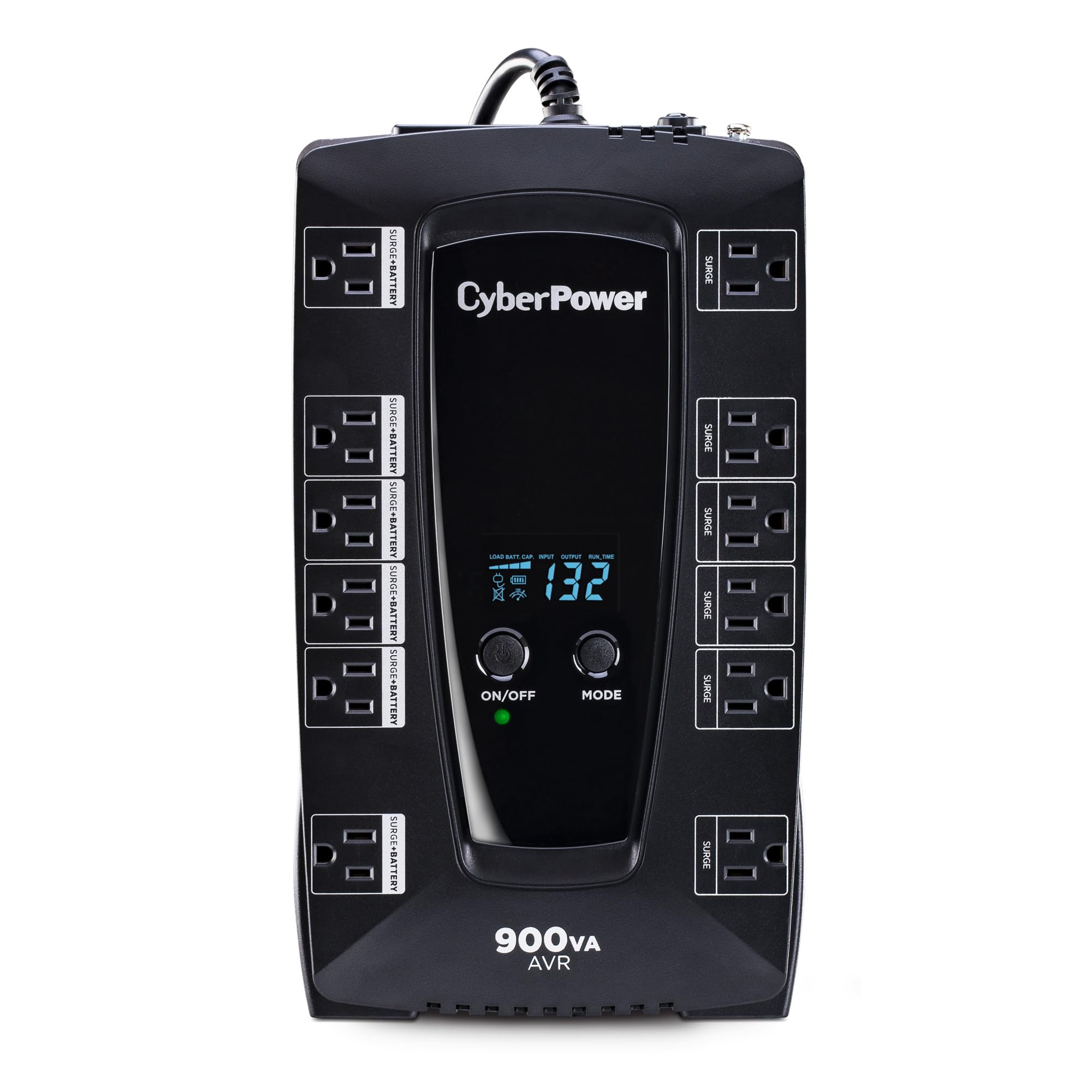
The 480W powerhouse that keeps a two-PC setup running for 18 minutes straight.
With 900VA / 480W capacity, the CyberPower AVRG900LCD delivers 480W versus the APC BE600M1’s 330W — enough to run two desktop computers and their monitors simultaneously. One reviewer noted that a “72W load provides 62 min runtime”, so if you run lean gear (a NAS and a modem), you have over an hour to ride out a storm. At a heavier 175-200W load (two computers), you still get 18-20 minutes.
Its 12 outlets beat every other unit on this list: six battery-backup and six surge-only. The compact footprint is deceiving: at 3.5 x 12.2 x 7 inches, it takes up barely any more desk space than the 600VA APC. AVR is built in, so voltage fluctuations get corrected without switching to battery. The free PowerPanel software handles automatic shutdown scheduling, and the UL (Underwriters Laboratories) certification means third-party safety testing.
One catch: this is a simulated sinewave UPS, which can cause issues with Active PFC (Power Factor Corrected) power supplies in some modern PCs and servers. If your gear uses a standard ATX (Advanced Technology Extended) power supply, you are fine. If you have a high-end workstation with a PFC unit, the pure sinewave APC BR1350MS below is the safer play.
What you get
- 480W capacity — handles two desktop setups
- 12 outlets, double most competitors
- 62-minute runtime at 72W for low-power gear
One caution
- Simulated sinewave not ideal for Active PFC power supplies
- Setup via mode button can be fiddly per some owners
Pick this for: a desktop-heavy home office or a multi-device NAS setup where runtime and outlet count matter more than sinewave purity.
Look elsewhere if: you have a modern gaming PC or server with an Active PFC power supply — go sinewave.
5. GOLDENMATE 1000VA/600W Lithium UPS

The first mainstream UPS that puts LiFePO4 batteries where lead-acid used to live — and gives you a 10-year lifespan.
Instead of the sealed lead-acid every other UPS here uses, the GOLDENMATE packs a Lithium Iron Phosphate (LiFePO4 — a type of lithium battery that lasts thousands of charges) battery pack rated for over 5000 charge cycles and a 10-year life. The maker claims the total cost of ownership is over 40% lower than traditional lead-acid because you will never replace the battery. Pure sinewave output means no compatibility issues with sensitive PFC power supplies.
One buyer mentioned it ran a “22W load for 40 min, still >90%” battery — meaning it barely sipped power during a light load. The 600W capacity is enough for a mid-range gaming PC and monitor. The built-in cooling fan activates under heavy load and stays below 50 dB (decibels), which is quieter than most desk fans. Buyers generally praise the weight — at 4.8 kg it feels dense but manageable, and the LCD gives real-time battery and load data.
The downsides are real: there is no USB or network data port for automated shutdown software, so you rely on manual observation. A few owners note a strong plastic smell initially, and the 20ms (milliseconds) switchover time may trip up some ultra-sensitive switching power supplies. The outlet spacing is also tight — plugging in large AC/DC transformers may require a short extension cord.
Why lithium wins
- LiFePO4 promises 10 years / 5000 cycles vs 3-5 years for lead-acid
- Pure sinewave output protects sensitive electronics
- Light load runtime is exceptional — 40+ min on a 22W draw
Where it cuts corners
- No USB / network port for automated shutdown
- Tight outlet spacing blocks large transformers
Who should upgrade: anyone tired of replacing lead-acid batteries every 3 years and wants a low-maintenance backup for a home office or media center.
Who should pass: users who need remote shutdown scripts — pick a CyberPower or APC with management software instead.
6. CyberPower OR500LCDRM1U 500VA/300W

The 1U rackmount UPS that fits a network closet and keeps a handful of switches alive through a flicker.
At 1.75 inches tall and 17.25 inches wide, this CyberPower slides straight into a standard 19-inch rack — unlike every other UPS here, which is designed for desktop placement. It provides 500VA / 300W of simulated sinewave backup, with four battery-backup outlets and two surge-only outlets. AVR is built in, so your networking gear sees stable voltage without chewing through the battery.
Reviewers point out it fits “small setups with few switches” and handles brief power dips cleanly. The front LCD panel shows runtime in minutes, battery status, and load level. One homelab owner noted running a “81W load, 27 min runtime” on an 80% battery, which is enough for a graceful shutdown of a small server or a handful of network switches. The optional RMCARD205 management card (sold separately) adds SNMP (Simple Network Management Protocol) remote monitoring.
The biggest limitation is capacity: 300W is tight for a full server stack. Also, the simulated sinewave output can cause issues with Active PFC power supplies common in enterprise servers. If your rack includes gear with PFC supplies, you want true sinewave. The metal enclosure feels durable, and the 10-foot power cord gives plenty of reach inside a rack.
Rack-ready highlights
- True 1U rackmount form factor
- AVR extends battery life in unstable grid conditions
- Optional SNMP card for remote management
Rackmounted limits
- 300W capacity limits the number of devices you can protect
- Simulated sinewave may not suit Active PFC servers
Use it for: a small network rack with a switch, router, and modem — or a homelab with low-power gear.
Not enough for: a full server rack with enterprise PSUs or anything needing more than 300W.
7. APC Back-UPS Pro 1350VA BR1350MS
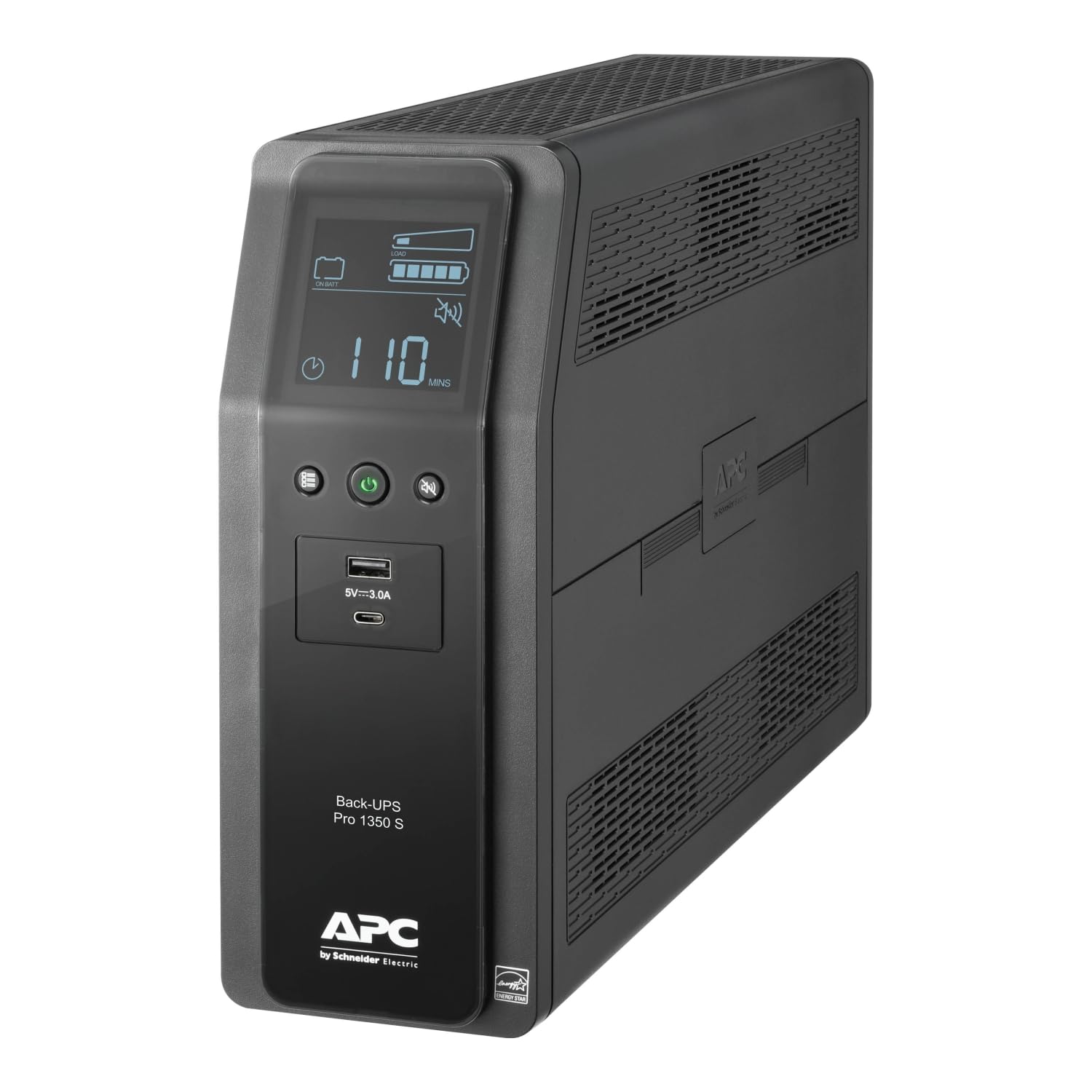
The 810W sinewave beast that protects a high-end gaming rig and charges your phone via USB-C.
This is the most powerful unit on the list — 1350VA / 810W is enough to run a high-end gaming PC with a GPU, a monitor, a router, and a NAS simultaneously. The pure sinewave output mimics utility electricity, so Active PFC power supplies, server-grade hardware, and sensitive audio equipment run without buzzing or shutting down. It provides 17 minutes of backup runtime at a 300W load, which is enough to save files and shut down a loaded system.
APC includes 10 total outlets (6 battery-backup + 4 surge-only), plus coax and Ethernet surge protection. A built-in USB-C and USB-A port (5V/3A shared) lets you charge a phone directly from the UPS during an outage — no need for an extra adapter. The LCD screen angles upward for reading from a seated position, showing runtime, load in watts, and battery status.
The 16-hour recharge time is the longest on this list, so a full discharge means waiting overnight to restore full protection. Some shoppers say the coaxial ports are too close to the top AC outlets, blocking bulky plugs. A few isolated reviews mention out-of-box failures, but APC’s warranty support is generally praised as responsive.
Why it justifies the price
- 810W capacity + pure sinewave handles any desktop gear
- USB-C charging port adds convenience
- 10 outlets + coax/Ethernet surge protection
One trade-off
- 16-hour recharge is the slowest on this list
- Coax jacks near AC outlets can block large wall warts
Who it is built for: power users with a demanding desktop, a home server, or audio gear that needs clean sinewave power — and want USB-C charging as a bonus.
Who should keep looking: budget buyers or anyone needing fast recharge between outages — the GOLDENMATE lithium unit recharges in 6 hours.
Understanding the Specs
VA / Watts
Volt-Amps (VA) is the rough capacity you see on the box, but watts tell you how much real power the UPS can actually deliver. A 600VA unit might output only 330W, which is about what a desktop PC and monitor draw. A 900VA / 480W unit can run two computers at once. Always check the watt rating against your gear’s total draw.
Runtime
Runtime varies dramatically by load. A UPS that lasts 23 minutes at 100W may last only 5-8 minutes at its full 330W rating. Match your actual expected wattage (add up your PC, monitor, router, and NAS) to the runtime chart in the product manual to see how long you really have.
AVR (Automatic Voltage Regulation)
AVR smooths out brownouts (low voltage) and overvoltages without switching to battery. This keeps your gear running during minor dips and extends the battery’s life because it is not cycling on and off for every small fluctuation. On a stable grid it is nice-to-have; on a flicker-prone grid it is essential.
Sinewave Type
Simulated sinewave (most budget units) works fine for standard PC power supplies. Pure sinewave (APC Pro series, GOLDENMATE) is required for Active PFC power supplies common in modern gaming PCs and servers. Using simulated sinewave on PFC gear can cause shutdowns or buzzing.
FAQ
What size UPS do I need for a standard desktop PC?
How long does a UPS battery last before replacement?
Can I plug a power strip into a UPS?
What is the difference between a UPS and a surge protector?
Does a UPS protect against lightning strikes?
Will a UPS work with a generator or solar power?
How do I know if my UPS needs sinewave output?
Can I replace the battery in my UPS or do I buy a new unit?
Why does my UPS beep when the power goes out?
What does an LCD display on a UPS show me?
Final Thoughts: The Verdict
Across the board, the best backup UPS is the APC BE600M1 because it delivers a class-leading 23-minute runtime at a mid-range price, with a compact design and cat-proof power button that real-world users love. If you want room to run two desktops and a NAS simultaneously, grab the CyberPower AVRG900LCD. And for pure long-term value with a 10-year lithium battery and clean sinewave power, the GOLDENMATE 1000VA is a smart investment if you plan to keep it for a decade.
How We Picked
We do not accept paid placement, and we did not hands-on test every unit. Instead, we match each pick to a real buyer and use-case by comparing the manufacturers’ published specifications against the patterns in verified customer reviews — so you get each pick’s real strengths and trade-offs instead of marketing copy.
Sources & Methodology
Specifications: manufacturer listings and product documentation. Review insights: verified customer reviews, as of July 2026. Pricing: not shown on this page (it changes often); check the current price via the retailer link.
As an Amazon Associate, Gadgets Feed earns from qualifying purchases. This does not affect which products we feature.