
Our readers keep the lights on and my morning glass full of iced black tea. As an Amazon Associate, I earn from qualifying purchases.
Specs are compiled from manufacturer listings and verified buyer reviews and can change over time — please confirm the key details on the product page before buying.
The single biggest frustration with a home beam is the wobble. An unsteady beam does not just feel wrong — it teaches your body the wrong balance patterns, making gym practice harder, not easier. The good news is that a stable, adjustable beam built for real practice exists without requiring a professional studio setup.
This guide is built by comparing the manufacturers’ published specifications and the patterns across verified customer reviews, so you get each pick’s real strengths and trade-offs instead of marketing spin.
A truly useful beam for home use must feel solid at every height and on any floor, and this article helps you find the right beam for gymnastics without overspending on unnecessary features or settling for a wobbly compromise.
Quick Picks
- Seliyoo Adjustable Balance Beam — Top Performer
- Tumbl Trak 8 Foot Addie Beam — Competition Feel
- defulion 8 Ft Gymnastic Balance Beam — Best Value
- Sealoha 8ft Ultrasimple Adjustable Foldable Beam — Quick Setup
How To Choose The Best Beam For Gymnastics
Not every home beam is built for actual skill work. Some wobble the moment you shift your weight; others have a top surface that grips too tight or slides too much. Here are the three factors that separate a useful training tool from a frustrating one.
Stability and Base Design
A beam that shakes or wobbles during a handstand or turn is dangerous. Look for a wide-leg or triangle-shaped base — this spreads your weight out so the beam stays planted even when you land off-center. The best home beams use a quad-triangle (four contact points) or big triangle support system that minimizes left-right sway and up-down bounce.
Height Adjustability and Portability
If you are a beginner, starting at floor height (around 7 inches) builds confidence before moving up. More experienced gymnasts need a beam that reaches at least 22 or 23 inches to match competition-like conditions. A foldable design is also a big practical advantage if you plan to store the beam between practice sessions — some units fold flat and fit under a bed in seconds.
Surface Material
The top cover determines how much grip or slide you get. Synthetic suede (a soft fabric that mimics the feel of real suede) is the most common choice for home beams because it offers a consistent feel close to competition equipment. However, some velvety suede fabrics create too much friction — buyers report that this “grips too much, making spins difficult.” If spins and turns are a big part of your routine, choose a beam with a smoother synthetic suede rather than a plush velvet texture.
Quick Comparison
On smaller screens, swipe sideways to see the full table.
| Model | Best For | Max Height | Weight | Frame Material | Amazon |
|---|---|---|---|---|---|
| Seliyoo Adjustable Balance Beam | Stability and height range | 29 inches | 21.32 kg | Wood + steel | Amazon |
| Tumbl Trak Addie Beam | Competition feel | 5 inches | 40 lbs | Wood | Amazon |
| Sealoha 8ft Ultrasimple Beam | Ease of assembly | 23 inches | 17.24 kg | Wood + iron | Amazon |
| defulion 8 Ft Gymnastic Beam | Value and adjustability | 22 inches | 15 kg | Wood + steel | Amazon |
In‑Depth Reviews
1. Seliyoo Adjustable Balance Beam
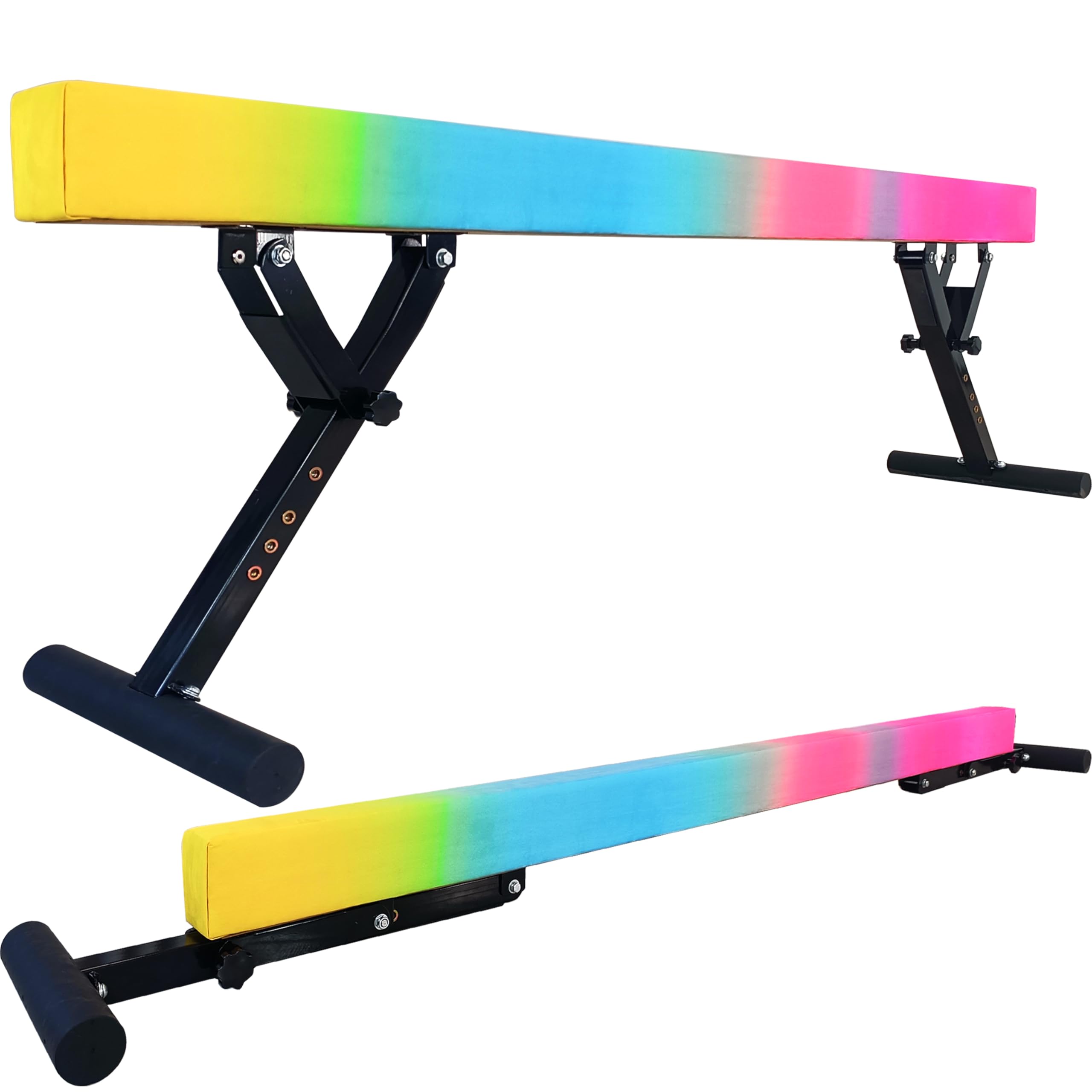
The beam that stays planted through walkovers and dismounts thanks to a 21.32-kg steel-leg foundation.
This Seliyoo beam leads this list because it solves the two biggest home-training problems at once: wobble and limited height range. You get a quad-triangle support system — four points of contact instead of the usual two — that buyers confirm “eliminates left-right wobble and up-down shaking completely.” That stability lets you practice turns and landings without the beam shifting under you, which is a big safety win when you are pushing into higher skills.
Heavier at 21.32 kg compared to the defulion’s 15 kg, this extra mass is part of the stability story — it stays planted because it is simply heavier. The synthetic suede top with a strong 1/4-inch foam layer under it gives the beam a competition-like feel, and the dual-twist locking system keeps the joints tight so the frame does not loosen over time. Owners mention that the beam “withstood three months of heavy play” from a five-year-old, and the folding design stores flat under a bed or in a closet. One reviewer noted it “supports nearly 300 lbs,” which is well above the weight limit of most kid-focused beams.
Rock-Solid Foundation: The quad-triangle base and 21.32 kg weight make this the most stable adjustable beam on this list — no wobble, no sliding, even on hardwood or carpet.
Height Not for Tiniest Beginners: The lowest setting is 7 inches, which is still a step up from the floor; a preschool beginner might prefer the Tumbl Trak’s 5-inch floor mode for first attempts.
Reach for this if: you train level 4-7 skills at home and need a wobble-free beam that adjusts tall enough — 29 inches — to mimic competition conditions.
Look elsewhere if: you only need a low floor beam for basic toddler balance work — the heavier build and higher price stretch beyond that simple use case.
2. Tumbl Trak 8 Foot Addie Beam
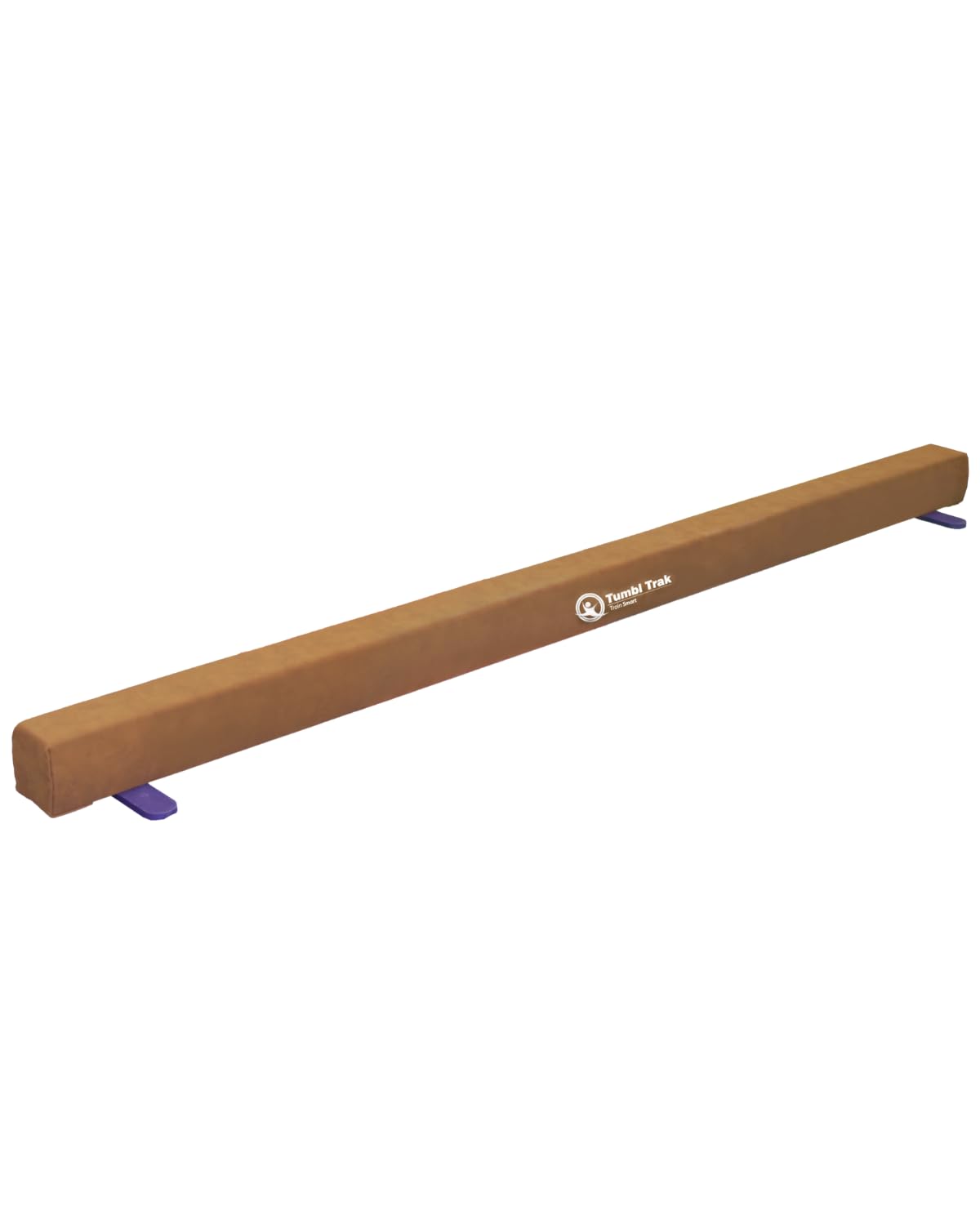
A true gym-standard beam for the home, built by people who actually know gymnastics.
Tumbl Trak is not a generic brand — according to the manufacturer, its staff includes coaches and former gymnasts, and this Addie Beam reflects that expertise. The rounded wood core is wrapped in a high-durability synthetic suede that one reviewer’s level-4 daughter described as “it feels like a competition beam.” That consistency of feel means your transition from home practice to gym competition is smooth, not a jarring switch to a different surface.
Unlike the adjustable beams above, this one is a fixed-height floor beam at about 5 inches — it does not raise to an elevated mode. The rounded edges and corners, plus a 1/4-inch foam layer under the suede, give it a soft but firm landing that mimics a real competition beam. Rubber-coated steel feet keep it from sliding, and assembly requires just two bolts and two washers per foot. At 40 lbs, it is the heaviest beam here, which adds to its planted feel even though the base is only a few inches off the ground. One practical detail buyers mention is that the flat rubber feet do not wobble on hardwood, and the beam can withstand daily use from a serious young gymnast without wearing down.
Designed by Gymnasts
- Rounded wood core with foam layer creates a competition-authentic feel
- Sold, heavy 40 lb construction stays put without extra weights
- Fast tool-free assembly — just 2 bolts per foot
The Trade-Off
- Fixed 5-inch floor height only — no elevated mode for advanced skills
- At 40 lbs, not a beam you move from room to room daily
Pick this if: you want the closest thing to a real competition beam for home use and your gymnast trains at floor level for basics.
Skip if: you need adjustability — the Seliyoo or defulion beams offer multiple heights the Tumbl Trak simply cannot match.
3. defulion 8 Ft Gymnastic Balance Beam
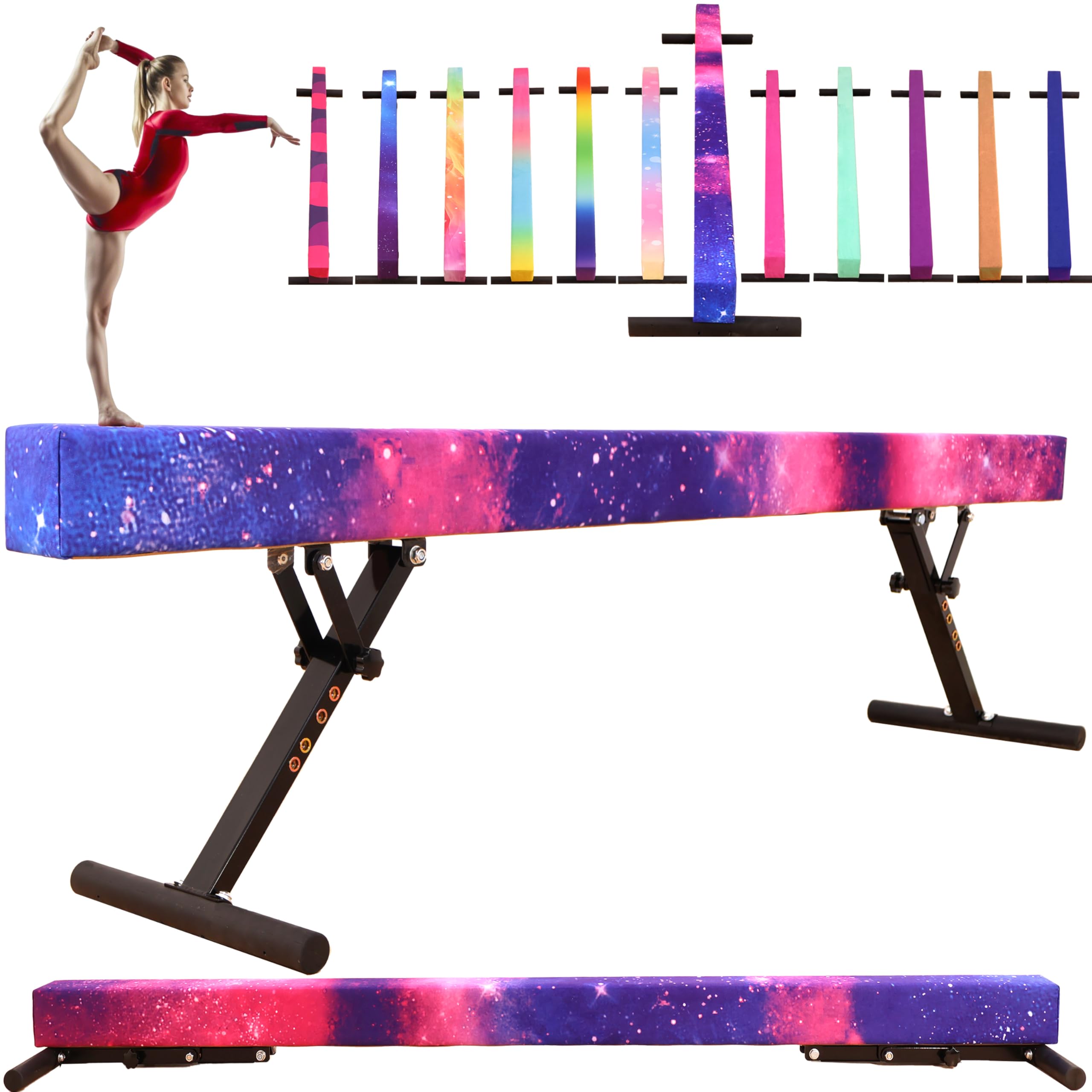
The mid-range option that gives you both floor and elevated modes without emptying your wallet.
This defulion beam competes directly with the Seliyoo above but at a lighter total package weight of 15 kg versus the Seliyoo’s 21.32 kg. The big triangle support structure is designed to handle left-right wobble and up-down shaking, and the beam’s legs feature thick rubber coating for 360-degree anti-slip grip. One owner reported they “put the weights on to help stabilize a little bit while doing bigger tricks,” suggesting the 15 kg frame may need a bit of extra anchoring during more aggressive skills.
The beam covers a practical range from 7 inches at floor mode all the way up to 22 inches, which suits beginner through intermediate level work (levels 1-10, per the manufacturer). The dual-layer cushion top — foam plus neoprene rubber (a flexible synthetic rubber) — sits under a high-quality synthetic suede cover that customers note is “nice and soft” and easy to adjust. Assembly is straightforward, and the beam’s 4-inch width matches competition dimensions so your kid gets the same feel they experience at the gym. Buyers consistently praise the “great quality for the price” and note that the beam feels professional enough for a serious 7-year-old gymnast, with sturdy steel legs that stay put on most flooring types.
Impressive Adjustability for the Price: Two modes (7-inch floor and 7-22 inch elevated) let you progress from beginner to intermediate without buying a second beam.
Lighter Frame Needs Help: At 15 kg it is easier to move than the Seliyoo, but some users find it benefits from added weight on the legs for high-intensity drills.
Best for: families with a growing gymnast who wants both floor and elevated practice without spending on a premium single-height beam.
Consider the Seliyoo if: your gymnast pushes hard into higher skills — that extra weight and quad-triangle base give noticeably better stability under load.
4. Sealoha 8ft Ultrasimple Adjustable Foldable Beam
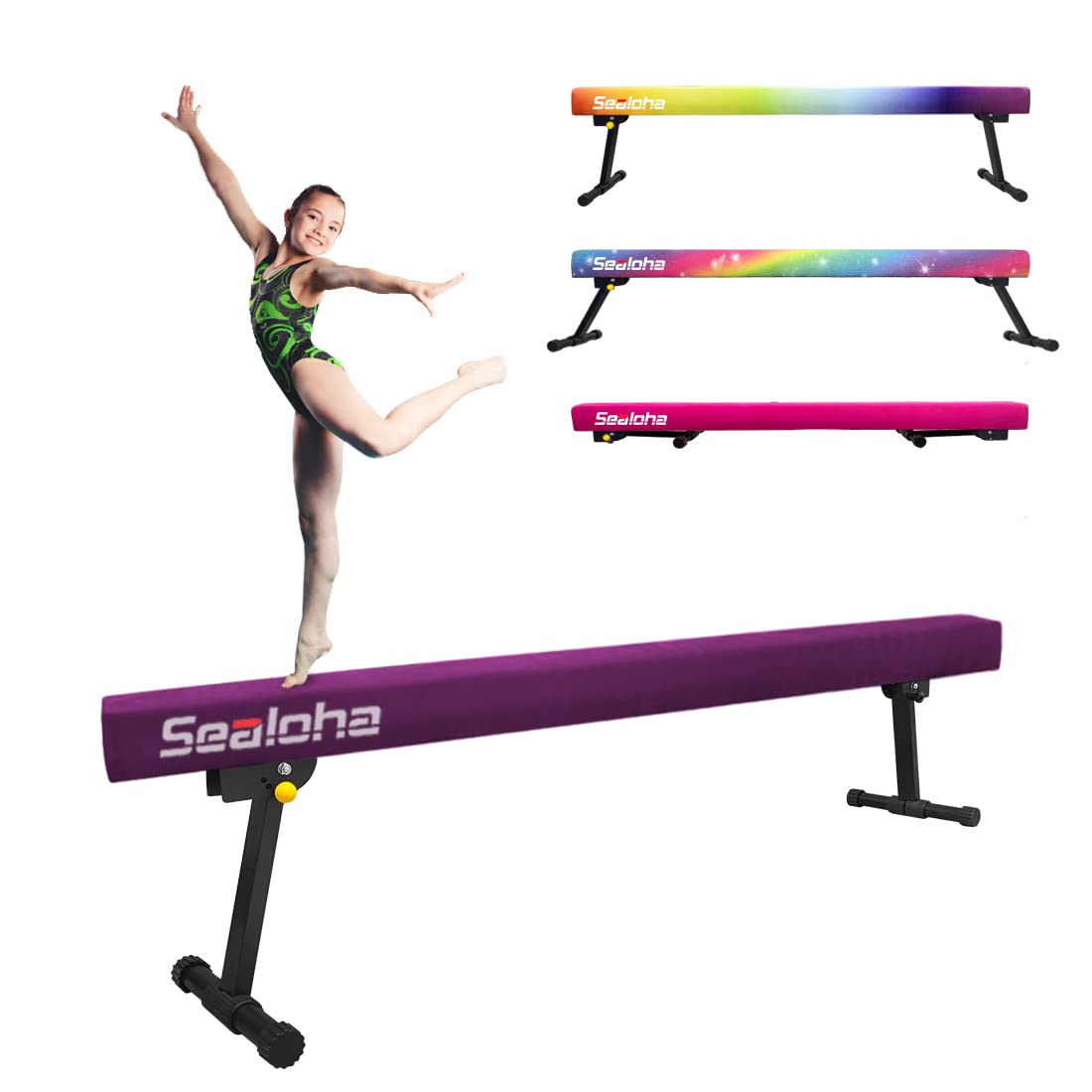
Folds and adjusts in seconds with zero tools — and holds up to 300 pounds.
This Sealoha beam takes the prize for easiest setup. No screws, no wrenches: the company’s patented design lets you fold it flat or adjust height in moments. It stands at floor height (8 inches) and adjusts to 14, 18.5, and 23 inches — a practical range for level 7 and below skills (per the manufacturer). With a high-density solid wood frame and heavy iron legs, the base is built for stability, though at 17.24 kg it sits between the defulion at 15 kg and the Seliyoo at 21.32 kg.
One detail worth knowing about the top surface: reviewers point out that the velvet/suede fabric “grips too much, making spins difficult.” If your child focuses on turns, leaps, and pirouettes, that extra friction can be frustrating. For basic walkovers, handstands, and jump practice, the grip is actually beneficial — it prevents slipping. The beam also features a non-slip rubber bottom that keeps the whole unit planted on hardwood or tile. Reviewers with young gymnasts praise the “sturdy, well-made” construction and call it “perfect for home practice.” The 1-year manufacturer warranty adds confidence for a beam that is meant to handle daily use.
Setup in Under a Minute
- Patented no-tool folding design — just pull, adjust, and lock
- 300-pound weight capacity means adults can train alongside kids
- Four heights (8, 14, 18.5, 23 inches) cover beginner to intermediate levels
Watch for This
- Velvet/suede top adds too much friction for spin moves, per multiple users
- Height adjustment stops at 23 inches, while the Seliyoo reaches 29 inches
Ideal for: a home where quick setup and breakdown matter — a beam that comes out for practice and disappears into a closet in seconds.
Not for: gymnasts working on advanced turns and spin routines; the grippy velvet top works against you there, and the Tumbl Trak or Seliyoo suede surfaces are smoother.
Understanding the Specs
Base Design and Stability
The base is the most important structural feature on a home beam. A straight-leg design is the simplest, but a triangle or quad-triangle base (a base with three or four support points in a triangular shape) distributes your weight across a wider footprint, reducing side-to-side wobble and up-down bounce. The best home beams use a big triangle or quad-triangle support system — you will see these terms in product descriptions, and they directly translate to a safer, more stable practice surface on almost any floor type.
Surface Material and Feel
The top cover affects how your feet interact with the beam. Synthetic suede is the most common material because it offers moderate grip without excessive friction. Velvet-style suede, by contrast, provides more traction but can make spins and turns difficult because your foot sticks rather than glides. Some beams use a dual-layer cushion: a foam base topped with neoprene rubber (a flexible synthetic rubber that adds shock absorption), then covered in suede, which gives a more forgiving landing.
Height Adjustability Range
Floor mode (usually around 7 inches) is ideal for absolute beginners learning basic walks and balances without fear. Mid-range heights from 14 to 23 inches let you practice walkovers, handsprings, and jumps with moderate risk. Some premium beams now reach up to 29 inches, which is close to a competition beam height and suitable for advanced training at home. A wider height range means the beam can grow with your skill level rather than being outgrown in one season.
Weight and Portability
A heavier beam is generally more stable because the extra mass resists movement during dynamic drills. However, weight also determines whether you can move the beam between rooms or take it to outdoor practice. A typical home beam weighs between 15 and 21 kg (33 to 47 lbs). Look for a foldable design if you need to store the beam — some collapse flat to under 10 inches in height and slide under a bed or into a closet without disassembly.
FAQ
What is the difference between a floor beam and an adjustable beam?
How much weight can a typical home gymnastics beam hold?
What does the suede or velvet cover feel like for training?
Can I use a gymnastics beam on hardwood or tile flooring?
How tall should the beam be for a beginner gymnast?
Is a heavier beam always more stable?
How do I store a balance beam when it is not in use?
Does the beam wobble left and right during turns?
Can adults use a children’s gymnastics beam?
What tools do I need to assemble an adjustable beam?
Final Thoughts: The Verdict
For most buyers, the beam for gymnastics winner is the Seliyoo Adjustable Balance Beam because its quad-triangle base and 29-inch max height deliver the highest stability and widest skill range of any option here. If you want a true competition feel at floor level without any adjustability, grab the Tumbl Trak Addie Beam. And for a budget-friendly beam that still adjusts from floor to 22 inches with a solid triangle base, the defulion 8 Ft Gymnastic Balance Beam gives you the most range per dollar.
How We Picked
We do not accept paid placement, and we did not hands-on test every unit. Instead, we match each pick to a real buyer and use-case by comparing the manufacturers’ published specifications against the patterns in verified customer reviews — so you get each pick’s real strengths and trade-offs instead of marketing copy.
Sources & Methodology
Specifications: manufacturer listings and product documentation. Review insights: verified customer reviews, as of July 2026. Pricing: not shown on this page (it changes often); check the current price via the retailer link.
As an Amazon Associate, Gadgets Feed earns from qualifying purchases. This does not affect which products we feature.
Product prices and availability are accurate as of the date/time indicated and are subject to change. Any price and availability information displayed on Amazon at the time of purchase will apply to the purchase of this product. As an Amazon Associate I earn from qualifying purchases.
CERTAIN CONTENT THAT APPEARS ON THIS SITE COMES FROM AMAZON. THIS CONTENT IS PROVIDED "AS IS" AND IS SUBJECT TO CHANGE OR REMOVAL AT ANY TIME.
Amazon and the Amazon logo are trademarks of Amazon.com, Inc. or its affiliates.