
Our readers keep the lights on and my morning glass full of iced black tea. As an Amazon Associate, I earn from qualifying purchases.
Specs are compiled from manufacturer listings and verified buyer reviews and can change over time — please confirm the key details on the product page before buying.
If tap water has a chlorine smell or a weird taste, you have probably wondered whether an under-sink filter is worth the hassle of installation and the cost over time. The short answer is yes — the right system slides into the cabinet, connects with a few twist-on fittings, and delivers noticeably cleaner water straight from your existing faucet without the bottleneck of a pitcher filter.
I’m Min — the founder and writer behind Gadgets Feed. This guide is built by comparing the manufacturers’ published specifications and the patterns across verified customer reviews, so you get each pick’s real strengths and trade-offs instead of marketing spin.
Every model here connects directly to your cold water supply line, requires no drilling, and targets the most common tap-water complaints. This article cuts through the product listings to help you choose the best under sink water filter system based on certified filtration, flow rate, and how often you actually have to swap the cartridge.
Quick Picks
- A.O. Smith AO-MF-ADV — Top Performer
- Brondell Coral UC300 — Premium Setup
- SimPure V7 — Best Overall
- Waterdrop AS13 — Best Value
- Culligan US-DC3 — Budget Champion
- Waterdrop TST-UF — High-Flow Pick
How To Choose The Best Under Sink Water Filter System
Every under-sink system filters water before it reaches your faucet. But differences in capacity, flow speed, and certification determine whether it solves your problem or clutters your cabinet. These three specs matter most.
Gallon Capacity vs. Real-World Filter Life
The number of gallons a filter can treat before replacement sounds straightforward, but manufacturers test under near-ideal conditions. A 4,750-gallon rating, for example, assumes your tap water has average sediment levels. Real-world usage often shortens that life — one reviewer of a 20,000-gallon system reported the filter stopped removing chlorine taste after four months. Always check how many gallons your household goes through in a month (roughly 80-100 gallons per person for drinking and cooking) and divide the rated capacity by that number to get a realistic timeline.
Flow Rate: 1 GPM vs. 1.6 GPM and Higher
Flow rate is measured in gallons per minute (GPM). A 1 GPM system fills an 8-ounce glass in about 3.75 seconds — fine for drinking. But if you routinely fill large pots for cooking or a pitcher for the fridge, a 1.6 GPM or higher system cuts that waiting time from about 3.75 seconds to about 2.3 seconds for an 8-ounce glass. Some premium models push up to 2.5 GPM, which feels almost identical to unfiltered tap flow.
Certifications: NSF/ANSI 42, 53, and 401
If a filter claims to remove lead, chlorine, or PFAS, look for the specific NSF or ANSI standard it was tested against. NSF 42 covers aesthetic improvements (taste and odor). NSF 53 addresses health-related contaminants like lead and mercury. NSF 401 covers emerging compounds like pharmaceuticals and certain pesticides. A filter certified to multiple standards gives you broader protection — but verify it on the manufacturer or IAPMO listing, not just the product page claims.
Quick Comparison
On smaller screens, swipe sideways to see the full table.
| Model | Best For | Capacity | Flow Rate | Material | Amazon |
|---|---|---|---|---|---|
| A.O. Smith AO-MF-ADV | Broad contaminant coverage | 784 gallons | 1.5 GPM | Activated Carbon | Amazon |
| Brondell Coral UC300 | Separate faucet with 3-stage clarity | 600 gallons | — | Plastic/Carbon | Amazon |
| SimPure V7 | High capacity + compact steel build | 20,000 gallons | 1.6 GPM | 304 Stainless Steel | Amazon |
| Waterdrop AS13 | No-drill setup and durable steel | 16,000 gallons | 1 GPM | 304 Stainless Steel | Amazon |
| Culligan US-DC3 | Budget-friendly direct connect | 4,750 gallons | 1.5 GPM | Plastic | Amazon |
| Waterdrop TST-UF | Strongest flow and ultra-filtration | 8,000 gallons | 2.5 GPM | 304 Stainless Steel | Amazon |
In‑Depth Reviews
1. A.O. Smith AO-MF-ADV

Certified to reduce 99% of 78 different harmful contaminants without wasting a drop of water.
This is the system to reach for if you worry about more than just chlorine taste. The A.O. Smith Claryum filter is IAPMO certified to NSF/ANSI 42, 53, and 401 — meaning it tackles lead, PFAS (PFOA/PFOS), microplastics, pharmaceuticals, and asbestos, all backed by third-party testing. Unlike some filters that claim broad reduction without certification, A.O. Smith lists each standard clearly. The trade-off is capacity: it treats just 784 gallons or six months, which is shorter than many alternatives, so larger households will swap the filter twice a year.
Installation connects directly to your cold water line — no separate faucet needed — and the dimensions of 4″ x 4″ x 20.5″ mean you need a taller cabinet to accommodate the upright design. Buyers report the push-fit connectors can be tricky; one noted that fully inserting the tubing to the second stop is essential to prevent initial leaks. The flow rate of 1.5 GPM keeps your sink feeling normal, and the system does not produce the wastewater that reverse osmosis units do.
Compared to the SimPure V7 (which has a much higher 20,000-gallon capacity but lacks NSF 401 certification), the A.O. Smith is the better choice if comprehensive contaminant reduction — particularly for pharmaceuticals and microplastics — matters more than how often you change the cartridge.
Why it stands out
- Third-party NSF/ANSI 42, 53, and 401 certified for 78 contaminants
- Zero wastewater — all filtered water goes to your faucet
- Lean 4″x4″ footprint (but check vertical clearance at 20.5″)
What to watch
- 784-gallon capacity means more frequent cartridge swaps for large families
- Push-fit connectors require a firm, full insertion to avoid leaks
Smart pick if: you want certified reduction of pharmaceuticals, microplastics, and PFAS — not just taste improvement.
Caveat: The short filter life (6 months) means staying on top of replacement reminders to keep performance up.
2. Brondell Coral UC300
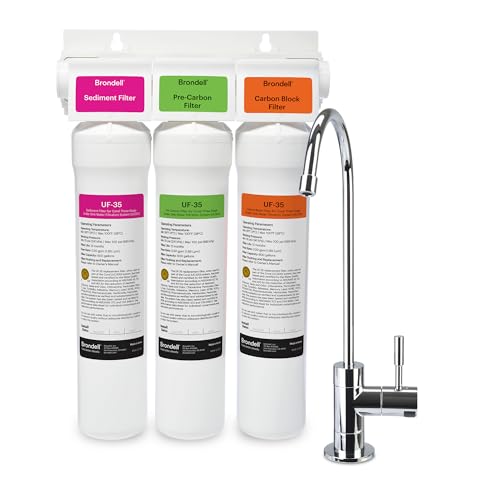
Three-stage filtration with a dedicated designer faucet and an LED light that tells you when to change the filter.
The Brondell Coral UC300 takes a different approach than direct-connect systems — it includes its own chrome faucet with a built-in LED indicator, so you never have to guess whether the filter is still good. The three-stage setup (sediment, pre-carbon, carbon block) targets physical particles, chemical contaminants, and general taste/odor while leaving beneficial minerals in the water. It is WQA Gold Seal-certified to NSF/ANSI 42, 53, and 372 for lead, so the performance claims are independently verified.
One clear trade-off is capacity: at 600 gallons and a 12-month filter life, this is among the lowest capacities here. A family of four drinking two liters per person per day would hit that limit in roughly eight months. The separate faucet also requires drilling a new hole in your counter or using an existing soap dispenser opening, which adds complexity compared to the direct-connect models. That said, buyers consistently praise the water quality — one reviewer noted it “tastes great, better than fridge filter” — and the twist-lock filter change makes annual replacement a 30-second job.
For someone who wants a dedicated filtered water tap with a clear change reminder and does not mind the lower capacity, the UC300 delivers a polished experience that direct-connect systems do not match.
Dedicated faucet advantage
- Separate chrome faucet with integrated LED filter-life indicator
- Three-stage WQA Gold Seal-certified filtration
- Tool-free Twist & Seal cartridge swaps
Installation nuance
- Requires a counter hole for the separate faucet
- 600-gallon capacity is low — heavy-use households may replace before 12 months
Best for: homeowners who want a sleek dedicated faucet with a visible maintenance reminder rather than a hidden filter on the main tap.
Think twice if: your counter is solid stone with no spare hole — drilling granite or quartz for the faucet adds cost and complexity.
3. SimPure V7

A remarkably compact 3.6″ wide steel filter that delivers 1.6 GPM and a claimed 20,000-gallon cartridge life.
The SimPure V7 solves the two biggest gripes about under-sink filters — it takes up almost no room (12″ tall, 3.6″ diameter) and its 20,000-gallon capacity is 20,000 gallons versus the Culligan US-DC3’s 4,750 gallons. That means for a typical two-person household drinking and cooking with filtered water, you could go over a year before swapping the cartridge. The 5-stage composite core filters down to 0.5 microns, reducing lead and chlorine while keeping beneficial minerals.
Build quality is a clear step up from budget plastic housings: the V7 uses 304 food-grade stainless steel, which resists cracking and corrosion. It connects directly to your cold water line with included 3/8″ and 1/2″ adapters, and installation takes about three minutes with a wrench. The catch, noted by multiple buyers, is that real-world filter life can fall short of the 20,000-gallon claim — one buyer mentioned chlorine taste returning after four months with two people using the water. That points to variable tap-water quality affecting performance, so if your water has high sediment or chlorine load, plan on changing the cartridge sooner.
At a 1.6 GPM flow rate, it fills an 8-ounce glass in roughly three seconds, while the Waterdrop AS13’s 1 GPM takes about 3.75 seconds for the same glass.
Why it wins overall
- Ultra-slim 3.6″ diameter fits even crowded cabinets
- Stainless steel housing outlasts plastic competitors
- Highest capacity in this lineup at 20,000 gallons
Honest callout
- Real-world filter life varies — high-chlorine water may cut it short
- Does not reduce TDS; if you want mineral-stripped water, look at RO systems
Reach for this if: cabinet space is tight and you want a metal-bodied filter with the longest listed cartridge capacity.
skip it if: your tap water has very high chlorine levels — you may need a pre-filter to protect the main cartridge’s lifespan.
4. Waterdrop AS13
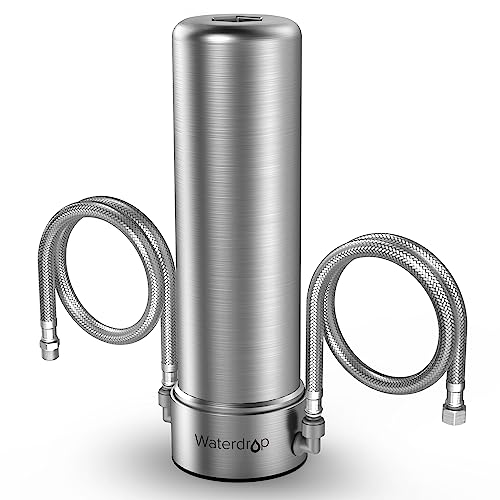
A no-drill, stainless steel system with a 16,000-gallon capacity and a smart filter-life reminder.
You get durable stainless steel and high capacity without a premium price with the Waterdrop AS13. Its 6-stage filter reduces PFAS (per- and polyfluoroalkyl substances, often called forever chemicals), lead, chlorine, and heavy metals, and it is NSF/ANSI 42 and 372 certified (meaning it meets standards for material safety and claims about taste and odor). The stainless steel housing measures 7.28″ x 5.9″ x 15.35″ — bulkier than the SimPure V7 but still fits under most sinks, even those with a garbage disposal. Installation uses push-to-connect fittings (no tools needed), and the smart indicator counts down the filter’s 12-month life so you know when to swap it.
The trade-off is the 1 GPM (gallons per minute) flow rate. That fills an 8-ounce glass in about 3.75 seconds — adequate but noticeably slower than the 1.6 GPM from the SimPure V7 or the 1.5 GPM from the Culligan. Owners mention that the included braided hoses and clear instructions make setup fast; one reviewer installed it in less than 10 minutes. They also note that the filter replacement cost is far cheaper than the multi-cartridge systems it replaced.
If you can live with the slightly slower pour, you get a well-built 304 stainless steel system that cuts plastic waste and delivers clean water for up to 16,000 gallons without needing a single tool to install.
Value highlights
- 6-stage filtration in a durable stainless housing
- No-drill install with included adapters for 3/8″ and 1/2″ lines
- 16,000-gallon capacity and smart filter-life reminder
Flow trade-off
- 1 GPM is the slowest among the non-RO systems here
- Larger dimensions than the SimPure V7 — measure your cabinet first
Grab this for: a stainless steel direct-connect filter with an easy setup and the second-highest capacity at a mid-range budget.
Better options exist if: you frequently fill large pots and a 1 GPM fill speed would frustrate you.
5. Culligan US-DC3
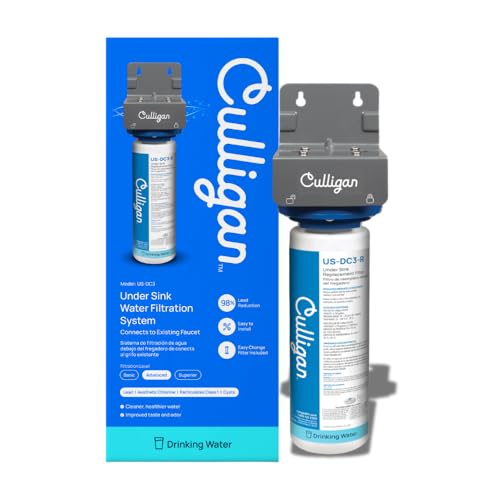
A well-known brand name with a strong 1.5 GPM flow and an easy tool-free filter swap at the lowest entry price.
The Culligan US-DC3 is the budget pick that does not feel budget where it counts — flow rate. At 1.5 GPM, it matches the A.O. Smith and beats the Waterdrop AS13, so you are not waiting long for a full pot. It is certified to reduce up to 99% of lead, chlorine, taste and odor, mercury, microbial cysts, and VOCs. The compact plastic housing (4″ x 6.1″ x 15″) sits easily in most cabinets, and the twist-lock cartridge change is genuinely tool-free: you twist the old one off and snap a new one in.
The biggest trade-off is the 4,750-gallon capacity — the smallest in this lineup. A household of two using about 80 gallons per month for drinking and cooking would need to replace the cartridge every 7-8 months. Buyers praise the easy installation, but one noted a common pitfall: the pre-cut tubing end has a crimp that can cause a leak, so you need to re-cut it and fully insert the tube to seat it properly. Once set up correctly, customers note the “flow rate same as unfiltered” and the taste improvement eliminated the need for bottled water.
For its entry-level price, you get certified performance and a strong flow, but you pay for that value with more frequent cartridge swaps than the larger-capacity steel alternatives.
Where it delivers
- 1.5 GPM flow matches more expensive competitors
- Tool-free twist-lock filter replacement
- NSF/ANSI 42 and 53 certified for lead and VOCs
Where it is limited
- 4,750-gallon capacity means more frequent replacements
- Plastic housing is less durable than stainless steel long-term
Perfect starter pick for: renters or first-time buyers who want a trusted brand name with certified lead reduction and a fast pour without spending on a steel housing.
Plan to upgrade if: you drink more than 2 liters of tap water per person per day — the smaller capacity will mean buying cartridges every 6 months.
6. Waterdrop TST-UF

The fastest flow of any system here, with a precision 0.01-micron ultrafiltration membrane in a heavy-duty stainless steel body.
If the biggest frustration with other under-sink filters is waiting for water, the Waterdrop TST-UF solves it with a 2.5 GPM flow rate versus the SimPure V7 at 1.6 GPM. It fills an 8-ounce cup in 2.3 seconds, which feels essentially the same as unfiltered tap. The 6-layer filtration includes a precision ultrafiltration membrane that traps impurities down to 0.01 microns — far smaller than standard carbon block filters — reducing chlorine, heavy metals, and sediment while keeping beneficial minerals. The 3-stage design means you replace individual cartridges on different schedules: the PP filter every 6-8 months, the UF filter yearly, and the CT filter every 12-24 months.
At 13 pounds, it is heavier than the other systems here — the stainless steel housings and the separate stages add significant weight. The dimensions of 12.99″ x 4.92″ x 14.49″ require more horizontal cabinet space than the slim SimPure V7. Reviewers point out that the push-to-connect fittings carry a small leak risk if not fully seated, and that removing the stainless housings for cartridge swaps takes more effort than twist-lock plastic systems. But those who replace a leaking plastic unit with this one praise the “well-made, no leaks” construction.
This is the right pick if speed and filtration precision matter more than the smallest footprint or the absolute lowest ongoing cost.
Speed and filtration
- 2.5 GPM is the fastest flow in this comparison
- 0.01-micron ultrafiltration targets particles down to 0.01 microns
- Staggered cartridge replacement extends individual filter life
Space and effort
- Largest and heaviest unit at 13 pounds
- Stainless housings are more difficult to unscrew than twist-lock cartridges
Choose this for: the fastest pour and the finest filtration level — ideal if you fill large containers frequently or want an ultra-filtration membrane for finer sediment.
Look elsewhere if: your under-sink cabinet is cramped or you prefer lighter, easier-to-service plastic housings.
Understanding the Specs
Flow Rate (GPM)
Gallons per minute tells you how fast water pours from your faucet after the filter. A 1 GPM system fills a standard glass in roughly 3.75 seconds — fine for drinking, but you will notice the wait when filling a 2-quart pot for pasta (about 30 seconds at 1 GPM and about 19 seconds at 1.6 GPM). Systems rated at 2.5 GPM feel almost identical to unfiltered tap.
Filter Life and Capacity
Manufacturers list capacity in gallons and time (e.g., 12 months). The gallon rating assumes clean municipal water. If your water has high sediment or chlorine levels, the filter’s actual useful life can be shorter. A 20,000-gallon system and a 4,750-gallon system can both fall short of their rated lifespan depending on water quality and usage.
FAQ
Will an under-sink water filter reduce TDS or remove minerals from my water?
How do I know if my under-sink filter is NSF certified?
Can I install an under-sink filter myself or do I need a plumber?
Will an under-sink filter work with a pull-out or sprayer faucet?
How often do I really need to change the filter cartridge?
What is the difference between a direct-connect filter and one with a separate faucet?
Will an under-sink filter fit under my sink if I have a garbage disposal?
Can an under-sink filter be used with well water?
Final Thoughts: The Verdict
For most buyers, the best under sink water filter system is the SimPure V7 because it combines a compact 3.6-inch stainless steel body, a fast 1.6 GPM flow, and the highest 20,000-gallon capacity in this lineup at a mid-range cost. If certified reduction of pharmaceuticals and microplastics is your priority, choose the A.O. Smith AO-MF-ADV with its NSF 401 certification (a standard for removing pharmaceuticals). For the fastest pour and ultra-fine 0.01-micron filtration (a micron is one-millionth of a meter, so this catches very tiny particles), pick the Waterdrop TST-UF, provided your cabinet has the space for its larger frame.
How We Picked
We do not accept paid placement, and we did not hands-on test every unit. Instead, we match each pick to a real buyer and use-case by comparing the manufacturers’ published specifications against the patterns in verified customer reviews — so you get each pick’s real strengths and trade-offs instead of marketing copy.
Sources & Methodology
Specifications: manufacturer listings and product documentation. Review insights: verified customer reviews, as of July 2026. Pricing: not shown on this page (it changes often); check the current price via the retailer link.
As an Amazon Associate, Gadgets Feed earns from qualifying purchases. This does not affect which products we feature.
Product prices and availability are accurate as of the date/time indicated and are subject to change. Any price and availability information displayed on Amazon at the time of purchase will apply to the purchase of this product. As an Amazon Associate I earn from qualifying purchases.
CERTAIN CONTENT THAT APPEARS ON THIS SITE COMES FROM AMAZON. THIS CONTENT IS PROVIDED "AS IS" AND IS SUBJECT TO CHANGE OR REMOVAL AT ANY TIME.
Amazon and the Amazon logo are trademarks of Amazon.com, Inc. or its affiliates.