
Our readers keep the lights on and my morning glass full of iced black tea. As an Amazon Associate, I earn from qualifying purchases.
Specs are compiled from manufacturer listings and verified buyer reviews and can change over time — please confirm the key details on the product page before buying.
You walk over to slice a ripe tomato, and the blade just squishes it. A dull kitchen knife is not just frustrating — it is actually more dangerous because you have to push harder, and slips happen. The right sharpener fixes that in minutes, turning a frustrating chore into the satisfying sound of a blade gliding through paper-thin produce.
I’m Min — the founder and writer behind Gadgets Feed. This guide is built by comparing the manufacturers’ published specifications and the patterns across verified customer reviews, so you get each pick’s real strengths and trade-offs instead of marketing spin.
This roundup of the best knife sharpener for kitchen breaks down seven top options so you can get back to cooking with confidence.
Quick Picks
- Chef’sChoice 15XV Professional Electric Knife Sharpener — Top Performer
- Work Sharp Ken Onion Knife Sharpener Mk.2 — Versatile Pick
- Chef’sChoice Professional UltraHone 2-Stage — Solid Electric
- Homly Professional Electric Knife Sharpener — Budget Electric
- Bogoni Rolling Knife Sharpener With Magnetic Angle Guide — Precision Manual
- Work Sharp Pull Through Kitchen Knife Sharpener — Compact Manual
- SHARPAL 191H Knife Scissors Sharpener — Compact Value
How To Choose The Best Knife Sharpener For Kitchen
Every knife sharpener does the same basic job — removing a tiny amount of metal to create a fresh edge — but the way they do it changes how long it takes, how sharp the blade gets, and how much skill you need. Here is what to look for.
Sharpening Angle — 15° vs 20°
The angle of the edge controls the trade-off between sharpness and durability. A 15-degree angle (measured per side) gives you a razor-sharp slicing edge ideal for high-carbon steel or Japanese-style knives. A 20-degree angle creates a stronger, more durable edge that holds up better on daily-use German stainless steel knives. Some sharpeners offer both, letting you choose based on the blade.
Abrasive Type — Diamond vs Ceramic vs Tungsten Carbide
Diamond abrasives are the hardest and fastest at removing metal — great for reshaping a dull or damaged edge. Ceramic discs or rods are finer and used for honing and polishing after the coarse work. Tungsten carbide blades are a budget-friendly option for quick edge setting but remove more metal per pass. For a home cook, a diamond-and-ceramic combo gives both speed and a refined finish.
Manual vs Electric
Manual sharpeners (pull-through or rolling styles) are compact, cordless, and cost less — ideal if you sharpen a few kitchen knives every month. Electric sharpeners use a motor to spin abrasive wheels or belts, so they work faster and require almost no effort from you. The trade-off: electric models cost more, take up more counter space, and you have less control over how much metal is removed.
Quick Comparison
On smaller screens, swipe sideways to see the full table.
| Model | Best For | Type | Abrasive | Weight | Amazon |
|---|---|---|---|---|---|
| Chef’sChoice 15XV | Pro-Level Home Sharpening | Electric, 3-Stage | 100% Diamond | 5 lbs | $165.99$186.99Amazon |
| Work Sharp Ken Onion Mk.2 | Versatile Belt System | Electric Belt | Flexible Abrasive Belts | 2 lbs | $169.95Amazon |
| Chef’sChoice UltraHone | Reliable 2-Stage Electric | Electric, 2-Stage | 100% Diamond | 16 oz | $94.95Amazon |
| Homly Professional Electric | Affordable Electric with Diamond | Electric, 3-Stage | 100% Diamond | 3 lbs | $79.99$89.99Amazon |
| Bogoni Rolling Sharpener | Precision Manual with Magnetic Angle Guide | Manual Rolling | Diamond & Ceramic Discs | 0.5 kg | $39.99Amazon |
| Work Sharp Pull Through | Fast, Compact Manual | Manual Pull-Through | Diamond & Ceramic | 0.5 lbs | $29.95Amazon |
| SHARPAL 191H | Budget-Friendly 3-Stage Tool | Manual Pull-Through | Tungsten Carbide & Ceramic | 3.04 oz | $16.99Amazon |
In‑Depth Reviews
1. Chef’sChoice 15XV Professional Electric Knife Sharpener

The electric sharpener that converts your 20-degree kitchen knives into razor-sharp 15-degree edges in about a minute.
This is for anyone who wants the fastest, most consistent sharpening without any guesswork. The Chef’sChoice 15XV uses a 3-stage EdgeSelect system with 100% diamond abrasives — stages 1 and 2 sharpen and hone the edge, while stage 3 polishes and extends the life of serrated blades (blades with a scalloped or saw-like edge). The manufacturer says the result is an ultra-sharp 15-degree Trizor XV edge that combines strength with slicing precision, so you can slice a tomato without crushing it. Buyers report that the brushed metal housing makes it feel built for daily professional use, and it weighs 5 pounds so it stays planted on the counter.
Unlike the Homly electric sharpener below (which runs on diamond abrasives but in a plastic body), the 15XV uses patented flexible spring guides that automatically adjust to the blade angle. Owners mention that re-sharpening a knife takes roughly 10 seconds once the initial edge is set. The catch is that it removes more metal than a manual sharpener, so you want to avoid excessive passes — one reviewer recommends practicing on a cheaper knife first to get the feel.
Reviewers also point out that the 15XV is the best electric sharpener on the market for good reason — one owner says theirs lasted 5 years and they are buying a third. It handles everything from cheap blades to high-end Wusthof and Henckels knives without hesitation.
Why You Will Love It
- 100% diamond abrasives in three stages for sharpening, honing (refining the edge without removing metal), and polishing
- Converts standard 20-degree edges to high-performance 15-degree edges
- Flexible spring guides adjust automatically — no skill required
One Thing To Watch
- Removes metal faster than manual sharpeners — use light pressure and few passes
Your Best Bet If: you want professional-level sharpening at home with almost zero effort and own a mix of daily-use knives that need a fast, accurate edge.
Think Twice If: you only sharpen a knife once or twice a year and want the cheapest option on the shelf.
2. Work Sharp Ken Onion Knife Sharpener Mk.2

A belt-driven sharpener designed with legendary knifemaker Ken Onion that handles everything from kitchen knives to axes.
The Work Sharp Ken Onion Mk.2 stands out because it uses flexible abrasive belts instead of fixed stones or wheels, giving you more control over the edge profile. It features electronic speed control and adjustable sharpening angles from 15 to 30 degrees, so you can tune the edge to match the knife’s steel and your cutting style. Customers note that the variable speed motor helps beginners start slow and build confidence — one owner calls it the best knife sharpener on the market and says this is their second unit.
At 2 pounds, it is noticeably lighter than the 5-pound Chef’sChoice 15XV above, and the compact design means it stores easily in a small cabinet. The learning curve is real, though — belts wear out over time, so you will need replacements if you sharpen often. The 3-year warranty covers defects, which adds confidence for the investment.
One reviewer mentions it sharpens scissors, serrated blades (blades with scalloped teeth like bread knives), and even axes, making it easily the most versatile system in this roundup. It is designed, engineered, and calibrated in Ashland, Oregon, which backs up the quality promise.
What Stands Out
- Adjustable angle from 15° to 30° for any blade type
- Flexible belt system removes metal evenly and quickly
- Covers knives, scissors, serrated blades, and outdoor tools
The Trade-Off
- Belt replacements add ongoing cost; learning curve is steeper than pull-through sharpeners
Reach For This If: you own a variety of blades (kitchen knives, pocket knives, scissors) and want the flexibility to set the exact angle yourself.
Look Elsewhere If: you want something you can hand to anyone in the family with zero explanation needed.
3. Chef’sChoice Professional UltraHone 2-Stage

A straightforward electric sharpener that brings hard German steel knives to a glass-smooth edge without fuss.
The UltraHone is a 2-stage electric sharpener with precision angle control and 100% diamond abrasives in both stages. Stage 1 uses larger diamonds to set the edge, and stage 2 uses advanced micron-size diamonds to refine and polish it to better-than-factory sharpness. The manufacturer says it works on both straight-edge and serrated knives at a 20-degree angle, which is the standard for most Western kitchen knives, so a German stainless steel chef’s knife will cut cleanly through an onion skin.
One reviewer who sharpens Wusthof and Henckels (German stainless steel — notoriously hard to sharpen) reports the edge comes out “smooth as glass.” The build is lighter than the 15XV at 16 ounces, making it easy to store in a drawer when not in use. The main trade-off: there is no third stage for extra polishing, and it is limited to 20-degree edges, so it will not convert knives to a 15-degree Japanese-style angle.
Reviewers point out it is fast and simple to use — one owner’s wife sharpened all their knives on the first try without any help. For the price, it delivers reliable results that satisfy almost any home cook.
Strong Points
- 100% diamond abrasives in both stages for sharpening and honing
- Works on straight-edge and serrated blades
- Priced well below premium electric models
Limitation
- Fixed 20-degree angle only — no option for 15-degree edges
Ideal For: home cooks who own standard Western knives and want a no-brainer electric sharpener that delivers consistent 20-degree edges.
Not For: anyone who needs to reprofile knives or sharpen Japanese-style blades that require a steeper 15-degree angle.
4. Homly Professional Electric Knife Sharpener

An entry-level electric sharpener that brings diamond abrasives and a 3-stage system to a price that surprises you.
The Homly Professional Electric uses 100% diamond abrasives in stages 1 and 2 for sharpening and honing, with stage 3 for finishing. The flexible spring guide rod keeps the blade at the right angle throughout the stroke, producing a durable arch edge across the entire length of the blade. It measures 12.2 x 4.8 x 4.8 inches and weighs 3 pounds — that is a 6.0x weight difference over the Work Sharp Pull Through at 0.5 pounds, so expect it to occupy permanent counter space.
Shoppers say that it sharpens quickly and passes the tomato-skin test (a simple home check: the blade should slice through a tomato skin without pressure). One reviewer mentions using light pressure to avoid leaving an indent on the blade and recommends sharpening every 4 months for regular kitchen knives. The 2-year warranty and lifetime customer support add reassurance at this price tier.
The plastic body is the main give-away vs the metal-housed Chef’sChoice models, but reviewers consistently say it outperforms more expensive sharpeners they have owned. It handles chef knives, Santoku knives (a Japanese all-purpose knife), and even pocket knives without complaint.
Why It Works
- Three sharpening stages with 100% diamond abrasives
- Flexible spring guide keeps the angle consistent
- Lifetime customer service and 2-year warranty
The Downside
- Plastic construction and 3-pound weight mean it is less portable and durable than metal electric models
Best For: budget-conscious cooks who want the speed and consistency of an electric sharpener without paying for a premium brand.
skip it if: you need a sharpener that can also handle scissors or serrated knives — this model focuses on straight edges.
5. Bogoni Rolling Knife Sharpener With Magnetic Angle Guide

A rolling manual sharpener with built-in magnetic guides that remove all the guesswork from the angle.
The Bogoni Rolling Sharpener uses a 400-grit diamond disc for reshaping dull blades and a 3000-grit ceramic disc for ultra-fine polishing. The breakthrough is the magnetic angle guide system: two preset N52 neodymium magnets (the strongest common type of permanent magnet) hold the blade at either 15 degrees (for a razor-sharp edge on high-carbon steel) or 20 degrees (for a stronger daily-use edge). One professional chef with 37 years of experience and tendonitis says it is easy and sharpens dinged blades to razor sharp in under 4 minutes.
Unlike the SHARPAL 191H at 3.04 ounces, this unit comes in a premium wood construction that feels substantial in the hand. It includes a leather strop (a strip used for final polishing) as a bonus for final refinement. Reviewers appreciate that the magnetic guide prevents slipping and wobbling, which is a real problem with freehand manual sharpeners. The trade-off is that you need to work the roller across the blade 30 passes on each side, which takes more time than an electric pull-through.
Buyers report it works great on both kitchen knives and pocket knives, and the elegant gift-box packaging makes it a strong option for giving to a chef or cooking enthusiast. At 0.5 kilograms, it is portable enough to take to a camping kitchen without much thought.
What Excites Buyers
- Pre-set 15° and 20° magnetic angle guides for consistent results
- Diamond disc (400-grit) and ceramic disc (3000-grit) for shaping and polishing
- Includes leather strop and premium wood build
The Extra Effort
- Requires manual passes — around 30 strokes per side for a dull blade
Who It Works For: cooks who enjoy the process of sharpening and want precision angles without the noise or cost of an electric motor.
Who Might Pass: anyone who just wants to drag a knife through a slot twice and be done — this takes a little more time.
6. Work Sharp Pull Through Kitchen Knife Sharpener

A tiny pull-through sharpener that weighs just half a pound and tucks into a kitchen drawer without a fuss.
The Work Sharp Pull Through is all about speed and convenience. It uses diamond and ceramic sharpening wheels to quickly set and refine the edge of any kitchen knife. At 0.5 pounds and 8.25 x 2.5 x 2.45 inches, it is dramatically more portable than any electric model on this list. One buyer summarizes the experience: “I sharpened 20 knives, it did a great job, it is very easy to use, thank you.”
The large rubber handle and rubber base make it comfortable and stable during use. One reviewer notes that it removes minimal metal compared to other sharpeners, which is good for preserving knife life, but the resulting edge is sharp enough for kitchen tasks — not for the “arm hair test” level of sharpness some enthusiasts seek. The diamond discs do darken over time, and there is no easy cleaning method for them.
Compared to the SHARPAL 191H below (which uses tungsten carbide and ceramic), the Work Sharp uses diamond and ceramic wheels, which typically last longer and cut faster. The 3-year warranty from Work Sharp backs it up, and the design fits easily with your BBQ kit as well as the kitchen.
The Upside
- Diamond and ceramic wheels for fast sharpening
- Compact at 8.25 inches and only 0.5 pounds
- Rubber handle and base for a secure grip
The Catch
- Not designed for ultra-fine razor edges — better for everyday kitchen use than precision work
Grab This If: you want a no-mess, fast, and portable sharpener that lives in a drawer and handles weekly touch-ups.
pass on it if: you regularly sharpen extremely dull knives or want a mirror-polished edge — you will want more aggressive abrasives or an electric model.
7. SHARPAL 191H Knife Scissors Sharpener
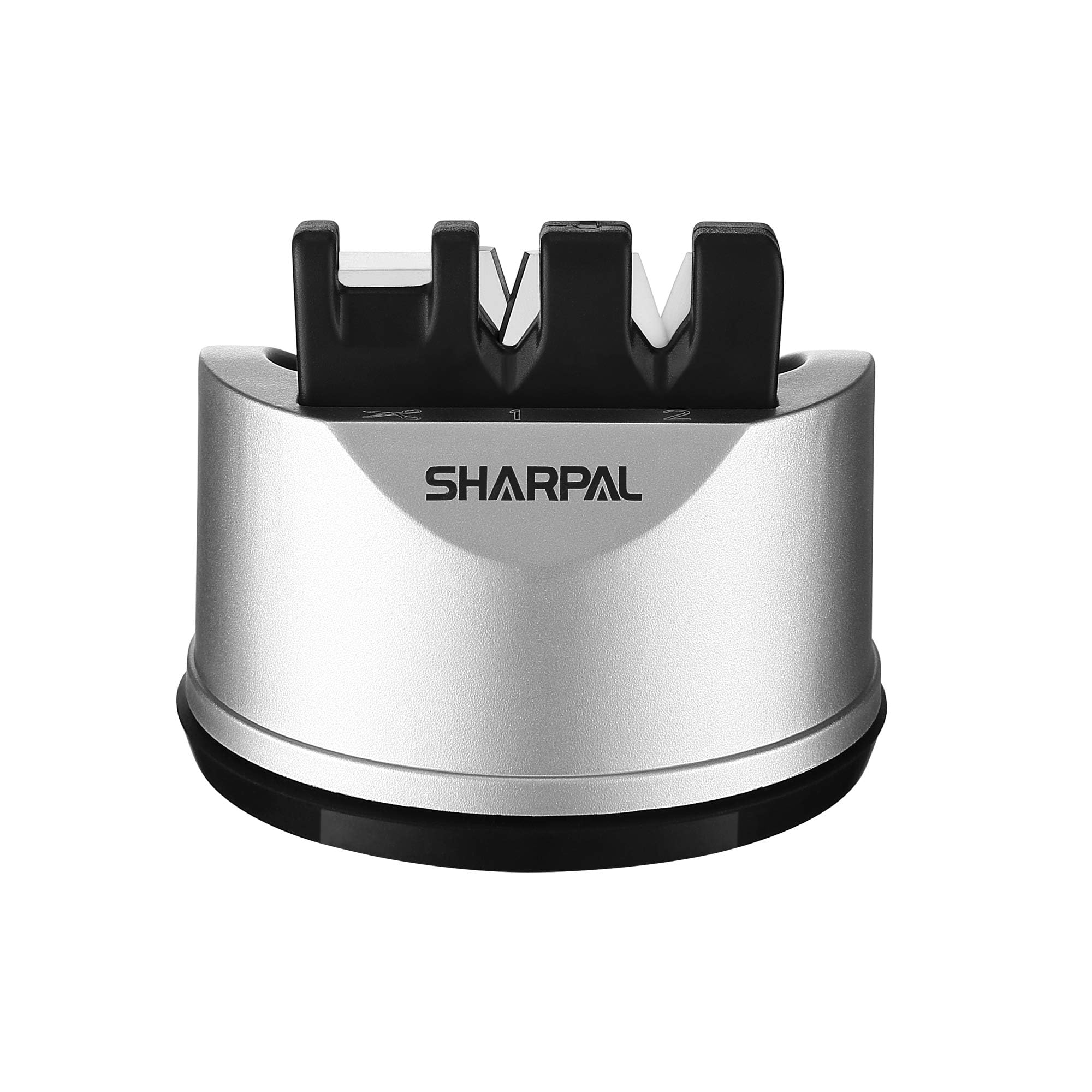
A tiny 3-stage sharpener with a powerful suction base that proves bigger is not always better in the kitchen.
The SHARPAL 191H is the most compact sharpener in this guide at just 2.76 x 2.36 x 2.76 inches and 3.04 ounces — that is a 4.4x dimensional difference compared to the Homly electric above. It uses tungsten carbide blades for quick edge setting, ceramic blades for honing (refining the edge), and a specialized carbide blade for sharpening scissors. The enhanced suction base locks it onto any smooth, flat surface, so you do not have to hold it by hand.
One buyer reports: “Sharpened dull shears and scissors in minutes.” Another calls it “proof that bigger isn’t better.” The compact size means it stores in a tiny drawer or hanging rack, and the 3-year warranty from a company headquartered in California (with branches in Germany and Australia) backs the build. It is designed for both right-handed and left-handed users, which not every sharpener bothers to accommodate.
The main difference from the Work Sharp Pull Through above is the abrasive type — tungsten carbide removes metal faster than diamond but also wears faster. For a home cook who sharpens a handful of knives every few months, this is a capable and affordable companion. The ceramic stage gives a decent honing finish that keeps edges sharp between sessions.
Highlights
- Three stages: tungsten carbide (edge setting), ceramic (honing), carbide (scissors)
- Suction base is twice as strong as similar products for stability
- Weighs only 3.04 ounces — fits in any kitchen drawer
Trade-Off
- Tungsten carbide blades wear faster than diamond — expect to replace the unit sooner with regular use
Perfect For: apartment kitchens with limited storage, or anyone who needs a fast, stable low-cost sharpener that handles both knives and scissors.
Not The Best If: you sharpen knives every week or own very hard steel that requires diamond abrasives to cut efficiently.
Understanding the Specs
Sharpening Angle — 15° vs 20°
The angle of the edge is measured per side of the blade. A 15-degree angle gives a sharper, thinner edge that excels at slicing tasks like filleting fish or slicing tomatoes (common on Japanese-style knives). A 20-degree angle produces a stronger, more durable edge that holds up to heavier cutting and chopping (the standard for most Western knives like Wusthof or Henckels). Some sharpeners let you switch between the two, so you can match the edge to the blade’s intended use.
Abrasive Material — Diamond vs Ceramic vs Tungsten Carbide
Diamond abrasives are the hardest and fastest at cutting steel — ideal for reshaping a very dull knife or working on hard German stainless steel. Ceramic is finer and used for honing and polishing after the rough work is done, giving a smooth, clean edge. Tungsten carbide blades are a budget-friendly alternative that cuts fast but removes more metal per pass and wears out sooner. For most home cooks, a diamond-and-ceramic combo provides the best balance of speed and finish.
FAQ
How often should I sharpen my kitchen knives?
Can I use a 15-degree sharpener on my German steel knives?
What is the difference between sharpening and honing?
Will an electric sharpener ruin my expensive knives?
Can a manual sharpener handle very dull knives?
How do I clean a knife sharpener?
Is a 3-stage sharpener better than a 2-stage one?
Can I sharpen serrated knives at home?
Final Thoughts: The Verdict
For most home cooks, the best knife sharpener for kitchen use is the Chef’sChoice 15XV because it combines the speed of diamond abrasives with automatic angle guides and a durable metal body — it delivers professional results in under a minute every time. If you want the flexibility of a belt system that can sharpen scissors, axes, and pocket knives along with your kitchen knives, grab the Work Sharp Ken Onion Mk.2. And for the most budget-friendly option that still works reliably, the Work Sharp Pull Through takes up no drawer space and handles weekly touch-ups without any learning curve.
How We Picked
We do not accept paid placement, and we did not hands-on test every unit. Instead, we match each pick to a real buyer and use-case by comparing the manufacturers’ published specifications against the patterns in verified customer reviews — so you get each pick’s real strengths and trade-offs instead of marketing copy.
Sources & Methodology
Specifications: manufacturer listings and product documentation. Review insights: verified customer reviews, as of July 2026. Pricing: not shown on this page (it changes often); check the current price via the retailer link.
As an Amazon Associate, Gadgets Feed earns from qualifying purchases. This does not affect which products we feature.
Product prices and availability are accurate as of the date/time indicated and are subject to change. Any price and availability information displayed on Amazon at the time of purchase will apply to the purchase of this product. As an Amazon Associate I earn from qualifying purchases.
CERTAIN CONTENT THAT APPEARS ON THIS SITE COMES FROM AMAZON. THIS CONTENT IS PROVIDED "AS IS" AND IS SUBJECT TO CHANGE OR REMOVAL AT ANY TIME.
Amazon and the Amazon logo are trademarks of Amazon.com, Inc. or its affiliates.