
Our readers keep the lights on and my morning glass full of iced black tea. As an Amazon Associate, I earn from qualifying purchases.
Specs are compiled from manufacturer listings and verified buyer reviews and can change over time — please confirm the key details on the product page before buying.
You clip a pulse oximeter onto your fingertip to see your blood oxygen level (SpO2, the percentage of oxygen your red blood cells carry) and your heart rate within seconds. If you manage a respiratory condition like COPD or asthma, train at altitude, or just want a quick health check at home, you need a device that gives numbers you can trust right away. The trick is picking one that reads fast and consistently without frustrating you with confusing results.
I’m Min — the founder and writer behind Gadgets Feed. This guide is built by comparing the manufacturers’ published specifications and the patterns across verified customer reviews, so you get each pick’s real strengths and trade-offs instead of marketing spin.
A small clip-on tool seems simple, but design details separate a reliable daily companion from a gadget that annoys you. You want accuracy where it counts, a display you can read at a glance, and a device that works on the first try every time.
Quick Picks
- Santamedical Dual Color OLED Pulse Oximeter Fingertip — Best Overall
- Innovo Deluxe iP900AP Fingertip Pulse Oximeter — Top Performer
- Easy@Home Fingertip Pulse Oximeter SpO2 (EHP035) — Smart Design
- Zacurate Pro Series 500DL Fingertip Pulse Oximeter — Best Value
- AccuMed CMS-50D1 Fingertip Pulse Oximeter — Compact Pick
- Fingertip Pulse Oximeter, Blood Oxygen Saturation Monitor (JPD-500E) — Budget Champion
- WRINERY Fingertip Pulse Oximeter, Oxygen Saturation Monitor — Travel Ready
How To Choose The Best Pulse Oximeter For Home Use
Picking a pulse oximeter is not hard, but a few key details separate a device that gives you confidence from one that leaves you guessing. Here are the three things to check.
Accuracy and Error Margin
The device’s main job is a reliable SpO2 reading. Most quality home-use models claim an accuracy of ±2%, which means your real oxygen level could be up to two points higher or lower than what shows on the screen — precise enough to spot a worrying trend that needs a doctor. The real test is whether it gives the same number two or three times in a row when you take it back-to-back.
Display Quality and Readability
You read this screen every time you use it, so brightness and clarity matter a lot. OLED displays (Organic Light-Emitting Diode screens) tend to be sharper and more readable from side angles than basic LED (Light-Emitting Diode) screens. Some oximeters have auto-rotating or multi-direction displays so you do not have to twist your wrist to see the numbers. If you plan to use it in bright outdoor light, look for a device with side shields that block stray sunlight from messing with the sensor.
Battery Life and Build
Almost every pulse oximeter runs on two AAA batteries, which is handy because you can keep spares around. Battery life ranges from about 24 hours to 32 hours of continuous use — a meaningful gap if you check your levels several times a day. Weight matters: a device at around 3.21 ounces feels bulkier in your pocket than one at 1.76 ounces. Also check the finger chamber size, especially if you have small hands or plan to use it on a child.
Quick Comparison
On smaller screens, swipe sideways to see the full table.
| Model | Best For | Display Type | Battery Life | Weight | Amazon |
|---|---|---|---|---|---|
| Santamedical Dual Color OLED | High accuracy at a low cost | Dual Color OLED | — | 3.21 oz | $16.95Amazon |
| Fingertip Pulse Oximeter (JPD-500E) | Quick, reliable readings | Digital Red LED | — | 2.4 oz | $19.45Amazon |
| Zacurate Pro Series 500DL | Longest battery life | LED | 30 Hours | 3.2 oz | $19.99Amazon |
| Easy@Home EHP035 | Outdoor/sunlight use | Rotatable OLED | 24 Hours | — | $23.83$25.09PrimeAmazon |
| WRINERY Fingertip Pulse Oximeter | Compact light travel | OLED | — | 4.66 oz | $26.99Amazon |
| Innovo Deluxe iP900AP | Advanced monitoring features | LED | 30 Hours | — | $31.49$34.99Limited time dealAmazon |
| AccuMed CMS-50D1 | Lightest and most portable | Rotating LED | 32 Hours | 1.76 oz | $34.99Amazon |
In‑Depth Reviews
1. Santamedical Dual Color OLED Pulse Oximeter Fingertip

Clinically tested accuracy that an ER nurse calls the best she has used, with a bright dual-color OLED display readable in any light.
You get very accurate readings from this Santamedical model because the manufacturer claims it has been clinically tested with a small error margin. The bright dual-color OLED screen (a display where each pixel lights up individually for sharp contrast) shows your SpO2 and pulse rate clearly in the dark, indoors, or under bright sunlight — so you never have to squint for a number. It fits most finger sizes from children to adults thanks to the finger chamber design, making it a versatile pick for a whole household.
One ER nurse with over 20 years of experience noted in her review that the device gave accurate readings on her mother’s cold fingers when other pulse oximeters failed. Another buyer, a medical doctor, confirmed the device works via Beer’s & Lambert’s laws (a physics principle of how light is absorbed by blood) and noted it is inaccurate on inanimate objects — a fact that explains the common “stuffed animal test” failure. The device includes a carry case, two AAA batteries, and a lanyard, and it auto-off after 10 seconds to save power.
This Santamedical is larger than the simpler Fingertip Pulse Oximeter (JPD-500E) — its product dimensions are 4.5 x 2.9 x 1.75 inches versus 3.2 x 2.5 x 1.9 inches. It also weighs 3.21 ounces versus 2.4 ounces, so it has a noticeably more substantial feel in the hand.
Why it earns the top spot
- Manufacturer claims clinically tested accuracy with a very small error margin
- Bright OLED display readable in both darkness and direct sunlight
- Finger chamber designed to fit children through adults
- Includes carry case, lanyard, and batteries from the start
What to watch for
- At 3.21 oz, it is noticeably heavier than the 2.4 oz Fingertip Pulse Oximeter (JPD-500E)
- Buyers report the lanyard can be difficult to thread
Reach for this if: you want a proven, accurate oximeter backed by medical professionals — it is the most reliable pick for home monitoring of COPD, asthma, or COVID-19 risks.
Look elsewhere if: you need the lightest possible device to carry in a pocket every day, as its 3.21 oz frame is heavier than lighter competitors.
2. Innovo Deluxe iP900AP Fingertip Pulse Oximeter
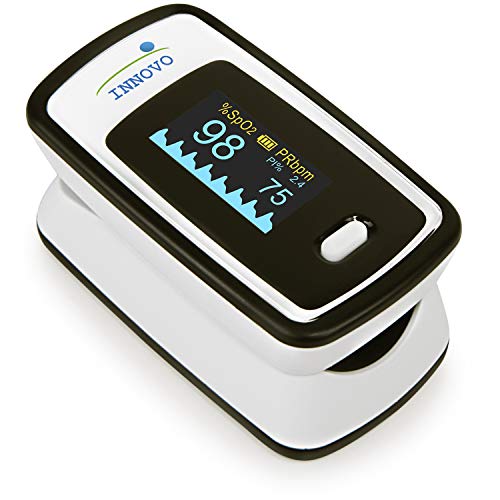
A premium model with a plethysmograph (pulse waveform) and an auditory alarm that serious home users want for verifying each reading.
The Innovo iP900AP includes features that help you decide if the number on the screen is trustworthy before you act on it. It has a plethysmograph (a visual waveform of your pulse beat) and a perfusion index (a number that tells you how strong your pulse signal is at the fingertip — higher means a more reliable reading). The manufacturer claims this device consistently beat other pulse oximeters in clinical studies, especially at low blood perfusion — meaning it works well even when your hands are cold.
The upgraded hardware includes an auditory alarm that sounds when your SpO2 or pulse rate goes outside your set limits, plus pulse detection beeps that confirm each heartbeat. You can also adjust the display brightness to suit your environment. A nurse who reviewed the unit said it had a quick response and was consistent and accurate. With a battery life of 30 hours, this device will last longer between battery changes than the Easy@Home, which offers 24 hours.
Owners mention the battery compartment can be tricky to close, and some report the display is side-oriented, which differs from the front-facing readout of the Santamedical. Still, for home users who want the extra layer of data, this is the most capable device here.
Advanced features that matter
- Plethysmograph (pulse waveform) and Perfusion Index (signal strength) confirm reading reliability
- Auditory alarm for out-of-range SpO2 or pulse rate
- 30-hour battery life versus the 24-hour Easy@Home
- Designed to work at low blood perfusion — good for cold hands
Minor downsides
- Sideways display orientation some find less natural to read
- Battery placement described as tricky by some users
Best for data-driven users: if you want the reassurance of a plethysmograph and an alarm system for confidence, especially for overnight monitoring.
Not ideal if: you prefer the simplest possible one-button operation with no extra settings to learn.
3. Easy@Home Fingertip Pulse Oximeter SpO2 (EHP035)

Unique side shields block stray sunlight so you get accurate outdoor readings where most other oximeters fail.
The Easy@Home EHP035 solves a real problem: most pulse oximeters give erratic numbers outdoors because stray sunlight leaks into the sensor and interferes with the reading. This device has unique side shields that block ambient light, enabling accurate SpO2 readings in direct sunlight where typical open-design oximeters fail, according to buyers. It gives you your SpO2, pulse rate, and pulse intensity within 8 seconds, and shows the reading as both a number and a waveform (plethysmograph) plus a bar graph.
The rotatable OLED display can be adjusted to four directions and seven display modes, with 10 brightness levels to choose from. Its battery life is 24 hours on two AAA batteries, which is solid but falls short of the 30 hours offered by the Zacurate and Innovo models. The device automatically powers off within 8 seconds of nonuse to save power. Reviewers praise its accuracy and the brightness of the screen, especially for use during travel.
If you spend time outdoors — hiking, biking, or skiing — or simply want to take readings on a sunny porch, this is the most reliable option for that specific scenario. The included carrying package and lanyard make it easy to take anywhere.
Why it stands out
- Side shields block stray light for accurate outdoor readings
- Rotatable OLED display with 7 modes and 10 brightness levels
- Shows plethysmograph (pulse waveform), bar graph, and numbers
- Compact and travel-friendly with included carry package
Trade-offs
- 24-hour battery life is 6 hours less than the Zacurate and Innovo models
- Not intended for medical use — sports and aviation only
Grab this for outdoor monitoring: if you need accurate readings in bright sunlight where other oximeters give erratic numbers — the side shields are a genuine advantage.
skip it if: battery life is your top priority, as the Zacurate and Innovo both offer 30 hours versus this unit’s 24.
4. Zacurate Pro Series 500DL Fingertip Pulse Oximeter
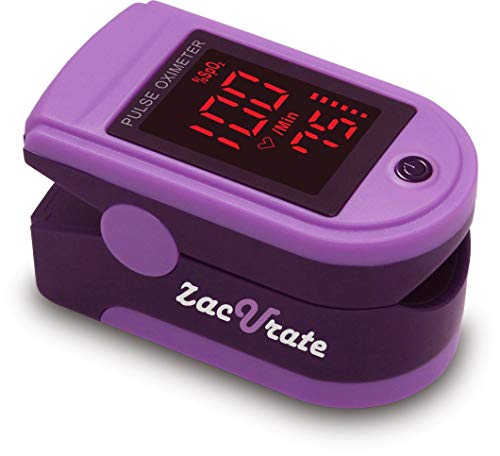
The only LED model here that reads SpO2 all the way up to 100%, with a 30-hour battery and a protective silicone cover.
The Zacurate Pro Series 500DL stands out because it can read and display SpO2 values up to 100% — a full range that matters if you train at altitude or track oxygen levels in high-performance settings. It delivers your SpO2, pulse rate, and pulse strength in about 10 seconds on a large digital LED display that faces the user, so you read it without twisting your arm. The finger chamber uses a SMART Spring System to fit a wide range of finger sizes, though the manufacturer notes it works for ages 12 and above.
One significant limitation shared by buyers is that the chamber size is unsuitable for very small hands: the device does not work for small children because their fingers are too small for the sensor to read. For adults, however, customers note the device provides consistently accurate blood oxygen and pulse readings, offering genuine confidence for respiratory issues. The included silicone cover protects the unit from dirt and damage, and the 12-month warranty with USA-based technical phone support adds extra confidence. With a 30-hour battery life, it matches the Innovo’s runtime and outperforms the 24-hour Easy@Home.
One reviewer noted that even though the device can be slow to get a stable reading on adults, it saved them an urgent care trip by showing stable readings during a flu season scare. For adult home monitoring, this is a rock-solid, affordable choice.
High-value features
- Full SpO2 readout from 70% to 100% — not capped like some competitors
- 30-hour battery life for fewer battery swaps
- Includes silicone cover to protect the unit
- 12-month warranty with USA-based phone support
Know before you buy
- Does not work for small children — fingers are too small for the sensor
- Can be slow to reach a stable reading even on adults
Perfect for adult home monitoring: if you want a long-lasting battery, a full 100% SpO2 scale, and a protective silicone cover at a great price point.
Not your pick if: you need to monitor oxygen levels on a child in the family under age 12 — the finger chamber will be too large.
5. AccuMed CMS-50D1 Fingertip Pulse Oximeter

At 1.76 ounces with up to 32 hours of battery, it is the lightest model here and also offers the longest listed runtime.
If portability is your main concern, the AccuMed CMS-50D1 is a strong choice. Weighing 50 grams (1.76 ounces), it is lighter than the 3.21-ounce Santamedical and comfortable enough to forget you are carrying it in your pocket or gym bag. It delivers blood oxygen saturation and pulse rate readings in 8 to 10 seconds, and it fits finger sizes from kids above four years old to adults, making it among the most inclusive options for younger users.
The rotating, crisp LED display auto-rotates as you move your hand, so you never have to read the numbers sideways or upside down. It delivers up to 32 continuous hours of battery life on two AAA batteries — longer than the Zacurate’s 30 hours. The device comes with a travel case that protects it from scratches, and a reviewer who used their first AccuMed for seven years before dropping it a final time confirms the build quality stands up to real daily abuse. One buyer mentioned the battery hatch feels flimsy and recommended securing it with medical tape.
Just keep in mind this device is not intended for medical use — it is designed for home, exercise, and travel scenarios where you want to track oxygen levels before and after workouts or while on an aircraft.
Why it wins on portability
- Weighs just 1.76 oz — the lightest in the entire list
- 32-hour battery life, the longest listed runtime here
- Auto-rotating LED display is easy to read at any angle
- Fits children ages 4 and up, plus adults
Small compromises
- Battery hatch feels flimsy to some buyers
- Not intended for medical use
Your go-to for travel and gym use: if you want the lightest device that runs the longest before needing battery changes, this is the most convenient companion.
Not for you if: you need medical-grade certification or the advanced features like a plethysmograph (pulse waveform) and perfusion index (signal strength).
6. Fingertip Pulse Oximeter, Blood Oxygen Saturation Monitor (JPD-500E)

A wallet-friendly device that reviewers point out matches their doctor’s equipment reading for reading — at a fraction of the cost.
The Fingertip Pulse Oximeter (JPD-500E) delivers blood SpO2, pulse rate, and pulse strength results within 8 to 10 seconds on a large red LED display. The manufacturer claims it is clinically tested for consistent results, and one owner reported accurate O2 (96%) and HR (86 bpm) readings within seconds that matched the equipment at their doctor’s office. The design accommodates a wide range of finger sizes and uses latex-free silicone material inside the finger chamber.
At 2.4 ounces, this model weighs less than the Santamedical at 3.21 ounces, making it more pocket-friendly while still feeling substantial enough to use comfortably. Its product dimensions are 3.2 x 2.5 x 1.9 inches, versus the Santamedical’s 4.5 x 2.9 x 1.75 inches. The package includes two AAA batteries, a carry case, a neck/wrist cord, and a 1-year manufacturer warranty. One customer observed the display is bright and the single-button operation is simple, but also mentioned the instruction to “read when the numbers stabilize” was a bit vague — a common issue with entry-level oximeters that lack a stabilization beep.
This is a solid entry-level choice for anyone who needs the basics: accurate numbers, a simple interface, and nothing extra to fiddle with. It does not offer an OLED screen, plethysmograph, or perfusion index, but it does the core job reliably for less.
What you get for the money
- Manufacturer claims clinically tested for accurate and quick readings
- Buyers confirm readings match doctor’s office equipment
- Weighs 2.4 oz versus the Santamedical’s 3.21 oz, with smaller listed dimensions
- Includes carry case, lanyard, batteries, and 1-year warranty
What is missing
- No OLED display — uses a basic red LED screen
- No plethysmograph (pulse waveform) or perfusion index (signal strength) to verify reading quality
- Some users find the stabilization guidance vague
Ideal for budget-first buyers: if you just need a reliable, no-frills pulse oximeter for occasional checks and want to keep costs low, this is the one.
Pass if you want advanced data: this device lacks the plethysmograph, perfusion index, and alarm features of the Innovo and Easy@Home models.
7. WRINERY Fingertip Pulse Oximeter, Oxygen Saturation Monitor
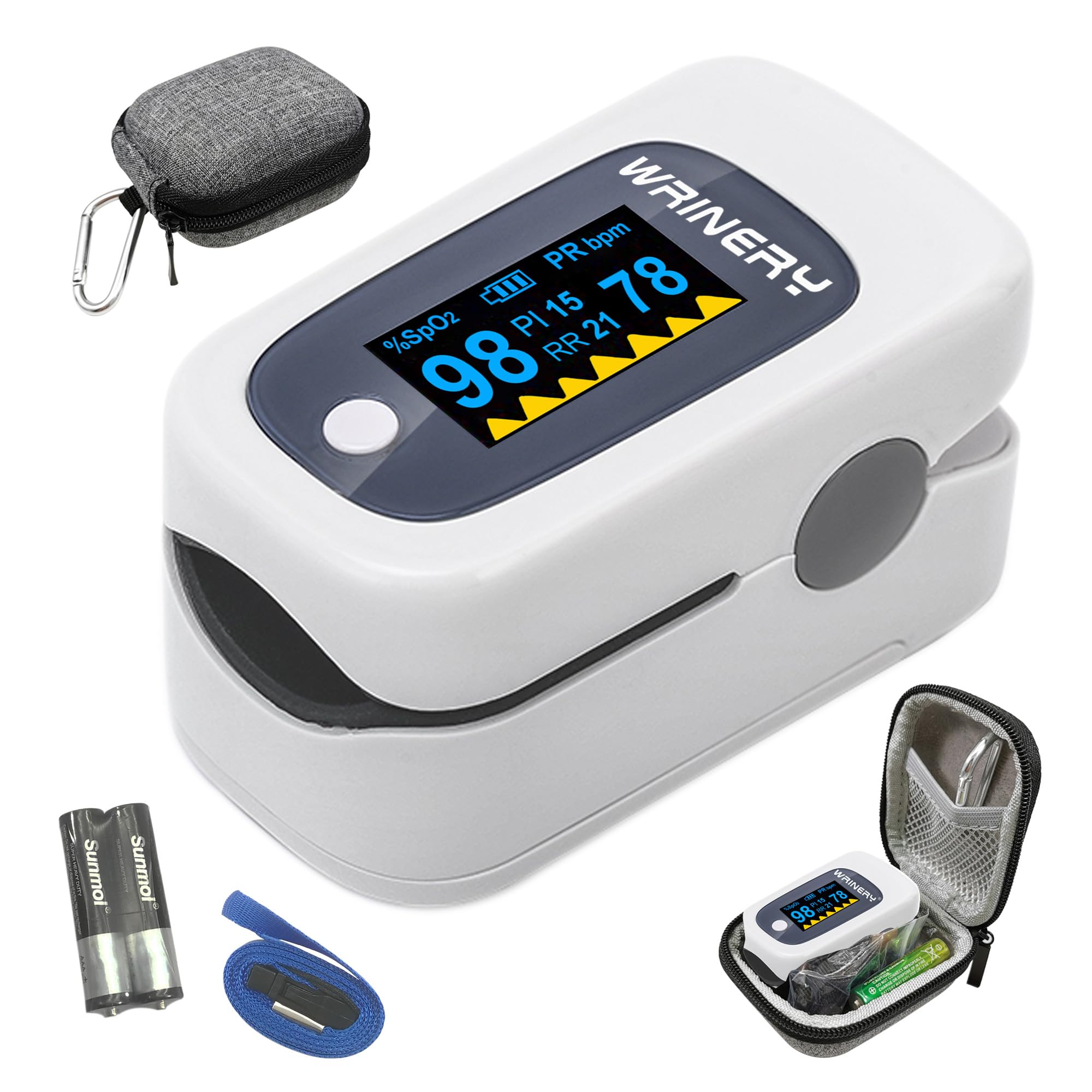
A high-definition OLED screen and a perfusion index packed into the smallest footprint here, though it is the heaviest device.
The WRINERY pulse oximeter packs a high-definition OLED screen into a very compact body with product dimensions of just 2.56 x 1.5 x 1.38 inches. It delivers your oxygen saturation level and pulse rate within 8 seconds, and importantly, it shows the perfusion index (PI, a number from about 0.02% to 20% that indicates the strength of your pulse signal at the fingertip) so you can choose the best finger for the most accurate reading. One buyer who is an ER nurse confirmed the device gives solid readings with a plethysmograph (pulse waveform) and accurate PI and respiratory rate.
The package is unusually generous for this price point: you get the oximeter, a high-quality protective case, a hook, a lanyard, two AAA batteries, and a user manual. The protective case alone was valued at around by a reviewer. At 4.66 ounces, this is the heaviest device on the list — noticeably heavier than the 1.76-ounce AccuMed and the 2.4-ounce Fingertip model — so it has a chunkier feel despite its small footprint. One user highlighted they were not a fan of the sound the device makes during operation.
This is a solid mid-range pick for someone who wants an OLED screen and the perfusion index feature but does not need the full clinical feature set of the Innovo iP900AP. It is designed for sports and aviation use, not medical use, so keep that context in mind.
What makes it worthwhile
- Sharp OLED display that is easy to read
- Shows Perfusion Index (PI, a measure of pulse signal strength) to help you pick the best finger for readings
- Includes a high-quality protective case — a value per one reviewer
- ER nurse confirmed accurate plethysmograph (pulse waveform) and PI readings
Trade-offs to know
- At 4.66 oz, it is the heaviest unit in this roundup, versus the 1.76 oz AccuMed
- Some buyers dislike the sound the device makes during use
- Not for medical use
Pick this if you want an OLED + PI combo: if you value a bright screen and the perfusion index feature in a compact package with a protective case included.
pass on it if weight matters most: at 4.66 ounces it is the heaviest device here, making the 1.76-ounce AccuMed or 2.4-ounce Fingertip model better for pocket carry.
Understanding the Specs
SpO2 Accuracy and Measurement Range
SpO2 stands for peripheral capillary oxygen saturation — it is the percentage of oxygen your red blood cells are carrying. A healthy reading is usually 95% to 100% for most people. The accuracy of most home oximeters is ±2%, meaning if the device reads 96%, your real oxygen level is somewhere between 94% and 98%. The measurement range tells you the lowest and highest SpO2 the device can detect. The Zacurate, for example, measures from 70% to 100%, while the Easy@Home can detect down to 35%, which is useful if you need to monitor very low levels in a clinical context, though home use rarely dips below 90%.
Plethysmograph and Perfusion Index
A plethysmograph is a visual waveform on the screen that shows each pulse beat as a wavy line. It confirms that the device is detecting a strong, consistent pulse — if the waveform is flat or erratic, the SpO2 number may be unreliable. The Perfusion Index (PI) is a number (usually between 0.02% and 20%) that tells you how strong the blood flow is at the fingertip. A higher PI means a stronger signal and a more reliable reading. These features help you decide when to trust a number and when to reposition your finger or try a different hand. They are standard on the Innovo iP900AP and the Easy@Home EHP035, and available on the WRINERY as well.
FAQ
What is a normal SpO2 reading for a healthy person at home?
Can I use a fingertip pulse oximeter on a child?
How long do AAA batteries last in a pulse oximeter?
What is the difference between OLED and LED displays on a pulse oximeter?
Why does my pulse oximeter sometimes show a fluctuating number?
Can I use a pulse oximeter for medical diagnosis?
Does nail polish affect pulse oximeter readings?
What does the Perfusion Index (PI) number mean?
How do I know if my pulse oximeter is accurate?
What is the “stuffed animal test” that reviewers mention?
Final Thoughts: The Verdict
Across the board, the pulse oximeter for home use winner is the Santamedical Dual Color OLED Pulse Oximeter because it delivers clinically tested accuracy, a bright OLED display readable anywhere, and buy-it-again durability praised by ER nurses and doctors — all at a value that is tough to top. If you want the reassurance of an auditory alarm and a plethysmograph (pulse waveform), grab the Innovo Deluxe iP900AP. And for outdoor use where sunlight blinds other sensors, the Easy@Home EHP035 with its unique side shields is the pick for that specific need.
How We Picked
We do not accept paid placement, and we did not hands-on test every unit. Instead, we match each pick to a real buyer and use-case by comparing the manufacturers’ published specifications against the patterns in verified customer reviews — so you get each pick’s real strengths and trade-offs instead of marketing copy.
Sources & Methodology
Specifications: manufacturer listings and product documentation. Review insights: verified customer reviews, as of July 2026. Pricing: not shown on this page (it changes often); check the current price via the retailer link.
As an Amazon Associate, Gadgets Feed earns from qualifying purchases. This does not affect which products we feature.
Product prices and availability are accurate as of the date/time indicated and are subject to change. Any price and availability information displayed on Amazon at the time of purchase will apply to the purchase of this product. As an Amazon Associate I earn from qualifying purchases.
CERTAIN CONTENT THAT APPEARS ON THIS SITE COMES FROM AMAZON. THIS CONTENT IS PROVIDED "AS IS" AND IS SUBJECT TO CHANGE OR REMOVAL AT ANY TIME.
Amazon and the Amazon logo are trademarks of Amazon.com, Inc. or its affiliates.