
Our readers keep the lights on and my morning glass full of iced black tea. As an Amazon Associate, I earn from qualifying purchases.
Specs are compiled from manufacturer listings and verified buyer reviews and can change over time — please confirm the key details on the product page before buying.
A dead phone on a camping trip is one thing. A dead CPAP machine (a sleep apnea breathing device) during a storm is an emergency. A battery portable outlet turns your car’s 12V socket (the cigarette lighter port) or a wall plug into a rechargeable power bank with real AC wall outlets — so you can run a mini-fridge, charge a laptop, or keep medical gear running hours after the grid goes down.
I’m Min — the founder and writer behind Gadgets Feed. This guide is built by comparing the manufacturers’ published specifications and the patterns across verified customer reviews, so you get each pick’s real strengths and trade-offs instead of marketing spin.
For most people, the right battery portable outlet pairs enough wattage (how much power it can deliver at once) with a battery capacity that matches your gear without weighing you down.
Quick Picks
- GRECELL Portable Power Station 330W — Best Overall
- BLUETTI Elite 30 V2 Portable Power Station 600W — Top Performer
- Apowking 300W Portable Power Station — Best Value
- ZeroKor 120W Portable Power Station — Compact Backup
- Jackery Explorer 2000 v2 Portable Power Station — Whole Home
How To Choose The Best Battery Portable Outlet
Picking a battery portable outlet depends on matching three numbers: how much power your device needs (watts), how long you need it to run (watt-hours), and how often you plan to recharge. Skip these and you could end up with a unit that won’t start your coffee maker or dies before dinner.
Match Wattage First
Every device has a running wattage you can find on its power brick or label. The portable outlet’s continuous output must be higher than that number, or it will shut off or get damaged. Motors in coolers and pumps often need two to three times that wattage for a split second at startup — so a 300W station might struggle with a small fridge rated for 100W during its compressor kick-on. Look for a pure sine wave inverter (a component that creates clean, house-quality AC power) listed in the specs, as it produces cleaner power that sensitive electronics like laptops and CPAP machines rely on.
Capacity Tells You the Run Time
Watt-hours (Wh) tell you the total energy stored. A 288.6Wh unit running a 60W fan will last about 4.8 hours in theory, but real-world efficiency and inverter losses trim that by 10-15%. The bigger the Wh number, the longer your gear runs — or the more devices you can plug in at once. If you only need to charge phones and a tablet for a weekend, a 100Wh model works. For a fridge or medical device through the night, aim for 200Wh or more.
Recharge Speed and Methods
Some outlets charge only from a wall plug and can take 6+ hours to fill. Others add a USB-C input (a modern, fast-charging port shape) for faster top-ups, a car 12V port, or solar panel compatibility. If you plan to recharge in the field, look for a model that supports solar at least 60W or has a fast wall charge under two hours. A unit that takes all night to recharge isn’t helpful when the power flickers back on for a short window.
Quick Comparison
On smaller screens, swipe sideways to see the full table.
| Model | Best For | Battery Capacity | AC Outlet Wattage | AC Outlets | Amazon |
|---|---|---|---|---|---|
| ZeroKor 120W | Ultra-portable backup | 97.6Wh / 26400mAh | 120W | 2 | $65.98$99.98PrimeAmazon |
| Apowking 300W | Balanced capacity & price | 220Wh / 60000mAh | 300W | 2 | $99.99$159.99PrimeAmazon |
| GRECELL 330W | Best overall value | 288.6Wh | 330W | 1 | $123.49$129.99PrimeAmazon |
| BLUETTI Elite 30 V2 | Fast-charging premium | 288Wh | 600W | 1 (with power lifting) | $219.00$299.00Amazon |
| Jackery Explorer 2000 v2 | Whole-home backup power | 2042Wh | 2200W | 3 | $899.00$1,499.00Amazon |
In‑Depth Reviews
1. GRECELL Portable Power Station 330W
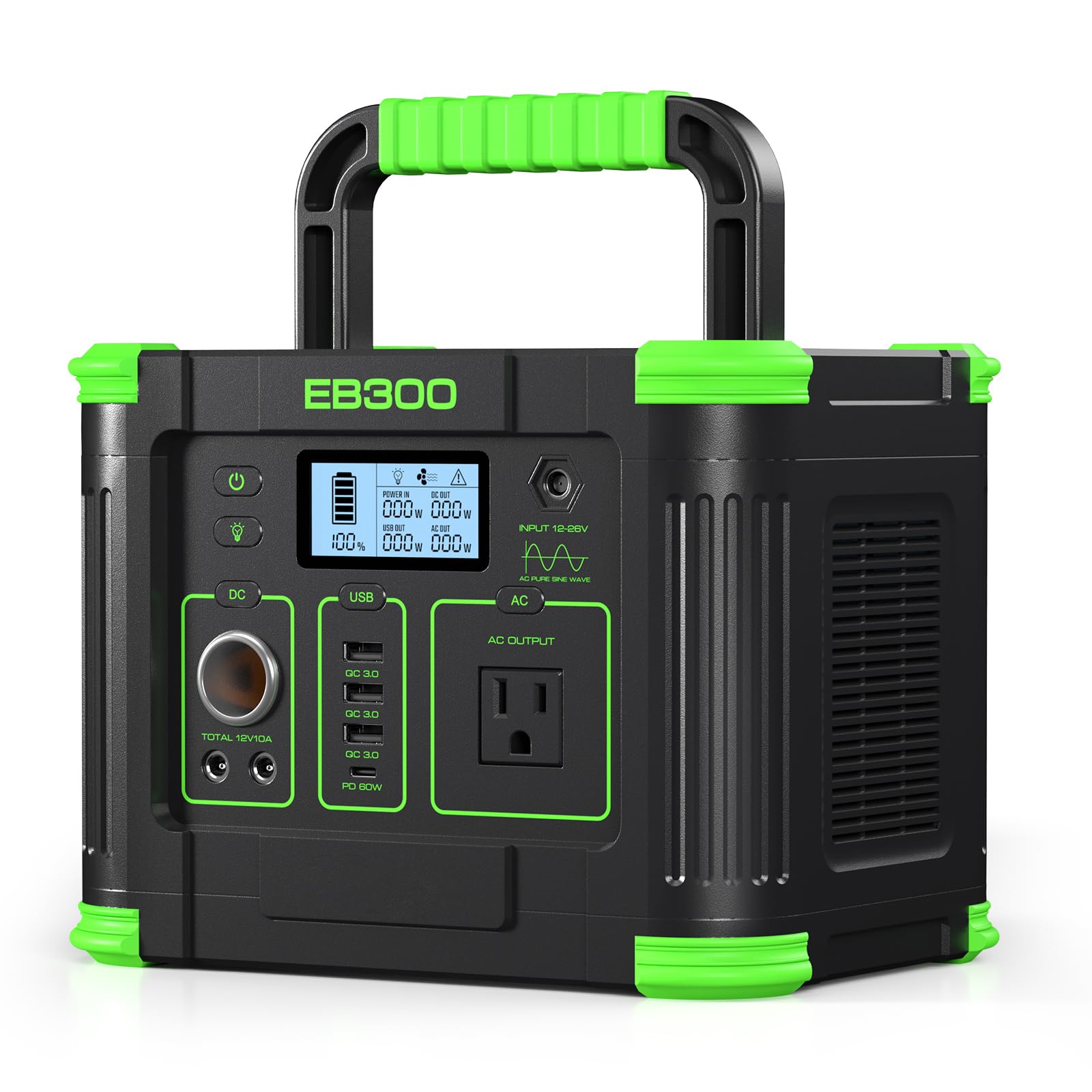
The mid-range champion that powers a mini-fridge and still fits in your trunk.
This unit packs a 288.6Wh lithium battery and a 330W pure sine wave AC outlet (600W peak) — enough to run a 200W rice cooker for two full cups of rice or keep a mini PC gaming for 4-5 hours, as buyers report. The real standout is the 60W USB-C PD (Power Delivery) port, a fast-charging port that can power many laptops directly, plus a 5W wireless charging pad on top so you can drop your phone and pick up juice without hunting for a cable. The GRECELL reaches full from a wall outlet in 6-7 hours or via a 100W solar panel in 5-9 hours depending on sun conditions, while the Apowking takes about 4 hours for a full wall charge.
Three USB-A ports (two at fast-charge 3.0 speed), a DC car port, and two DC 5521 output ports let you charge up to nine devices simultaneously, while the Apowking has seven output ports. The 3-level brightness LED flashlight with SOS mode can light a tent or signal for help, and the dual silent cooling fans keep temperatures in check without sounding like a vacuum cleaner.
One reviewer noted that after draining the station to 0% and fully recharging it once, the display accuracy resolved and the unit worked perfectly — a simple calibration trick worth knowing. The build quality across four owned units was consistently praised as excellent.
What makes it daily-ready
- 288.6Wh capacity runs small appliances for hours — a 200W rice cooker uses about half the battery per cup of rice
- 60W USB-C PD port fast-charges most laptops, replacing a dedicated laptop brick
- 5W wireless charging pad on top for cable-free phone top-ups
- Three recharging methods (wall, car, solar) give flexibility on the road
Where it cuts corners
- Only one AC outlet — you’ll need a power strip for multiple AC devices
- Wall recharge takes 6-7 hours, slower than newer units with 60W+ fast charging
- Fan kicks in after 3 minutes of high load and can be moderately loud in a quiet tent
Best for campers & home backup: If you need one compact power station for weekend trips and storm-season confidence, the GRECELL delivers the best blend of capacity, AC wattage, and charging options without jumping into premium pricing.
Look elsewhere if: You need to run multiple AC appliances at once — the single outlet means you’ll need a power strip and risk overloading the 330W limit with two high-wattage devices.
2. BLUETTI Elite 30 V2 Portable Power Station 600W
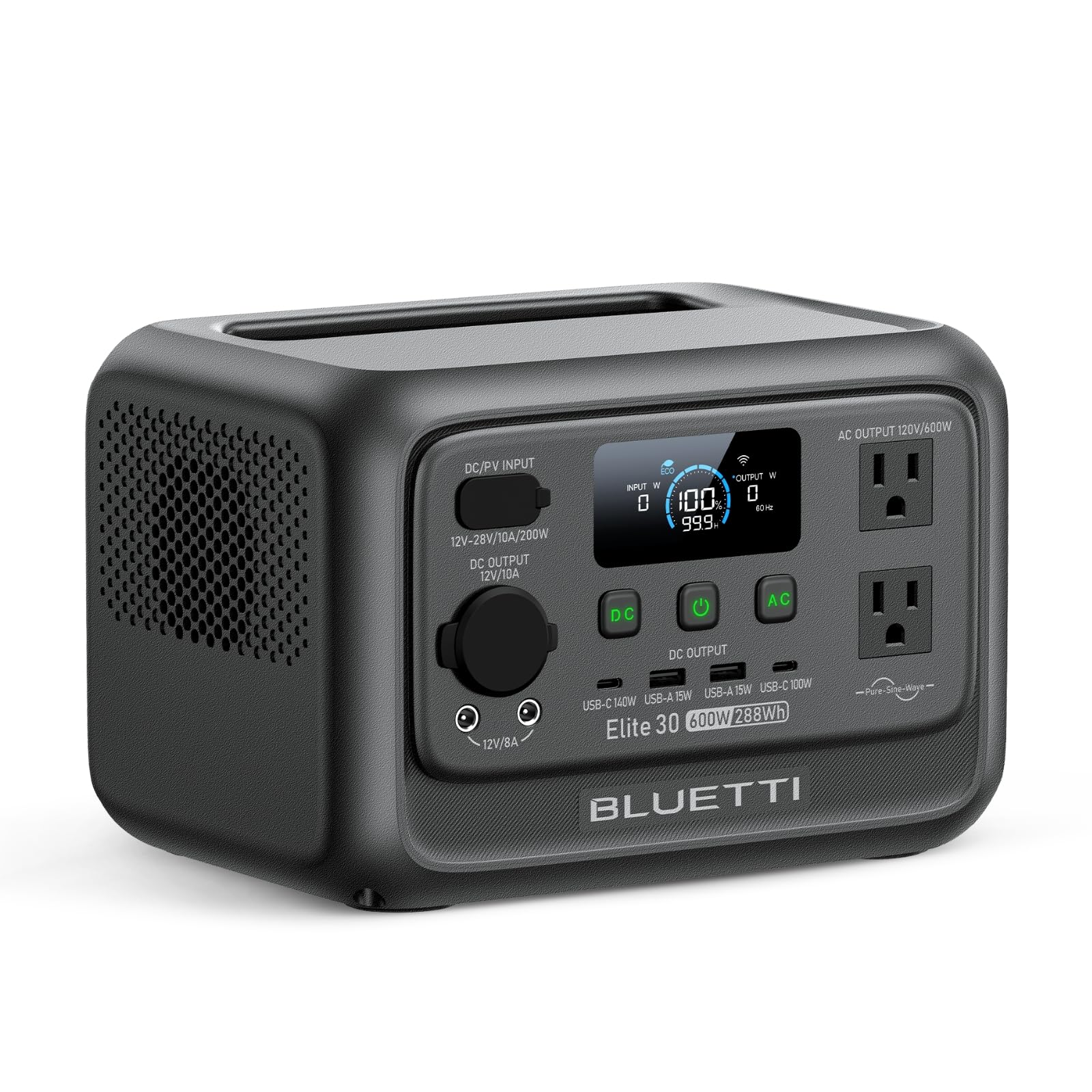
A 10ms UPS (uninterruptible power supply) disguised as a portable power station — it switches to battery in 10 milliseconds so your devices never flicker.
The BLUETTI Elite 30 V2 packs 288Wh capacity like the GRECELL and delivers 600W continuous output versus the GRECELL’s 330W, and it can surge to 1500W in Power Lifting Mode to start a small kettle or toaster. Its LiFePO₄ (lithium iron phosphate, a more durable battery chemistry) lasts more charge cycles than the standard lithium-ion in the ZeroKor or GRECELL, making this a smarter long-term investment if you plan to use it weekly for years. Owners mention it runs a home server and networking gear without any flicker thanks to the 10ms UPS switchover.
Wall charging hits 0-80% in just 45 minutes and a full charge in 70 minutes, versus 6-7 hours for a full wall recharge on the GRECELL. The smart cooling system cuts standby power consumption, so the unit sips only 4.5W on standby. An onboard app lets you monitor wattage, adjust settings, and set UPS mode — a feature the ZeroKor and Apowking both lack entirely.
At 9.4 lbs, it’s heavier than the 2.2 lbs ZeroKor but still easy to carry by the handle. The dual USB-C ports (140W and 100W) can fast-charge two laptops simultaneously, which alone replaces a bulky multi-adapter setup for remote work.
Why it earns the premium
- 600W continuous AC output (1500W surge) runs small appliances that 300W units can’t handle
- 0-80% wall charge in 45 minutes — one of the fastest in this class
- LiFePO₄ battery with 10-year lifespan and 50% lower standby power consumption
- 10ms UPS switch protects sensitive electronics during outages
Where it sits out
- 288Wh capacity equals the GRECELL despite costing nearly double — capacity isn’t higher
- Heavier and bulkier than entry-level models, less ideal for a daypack
- App needed for UPS setup and auto-restart features; manual controls are limited without it
Reach for this for home backup + daily device power: If you want a fast-charging, long-lasting power station that can double as a UPS for your router and PC during a blackout, the BLUETTI’s 600W output and LiFePO₄ chemistry justify the premium.
Not for you if: You just need to charge phones and a tent light for a weekend trip — the ZeroKor is lighter and much cheaper for that load.
3. Apowking 300W Portable Power Station
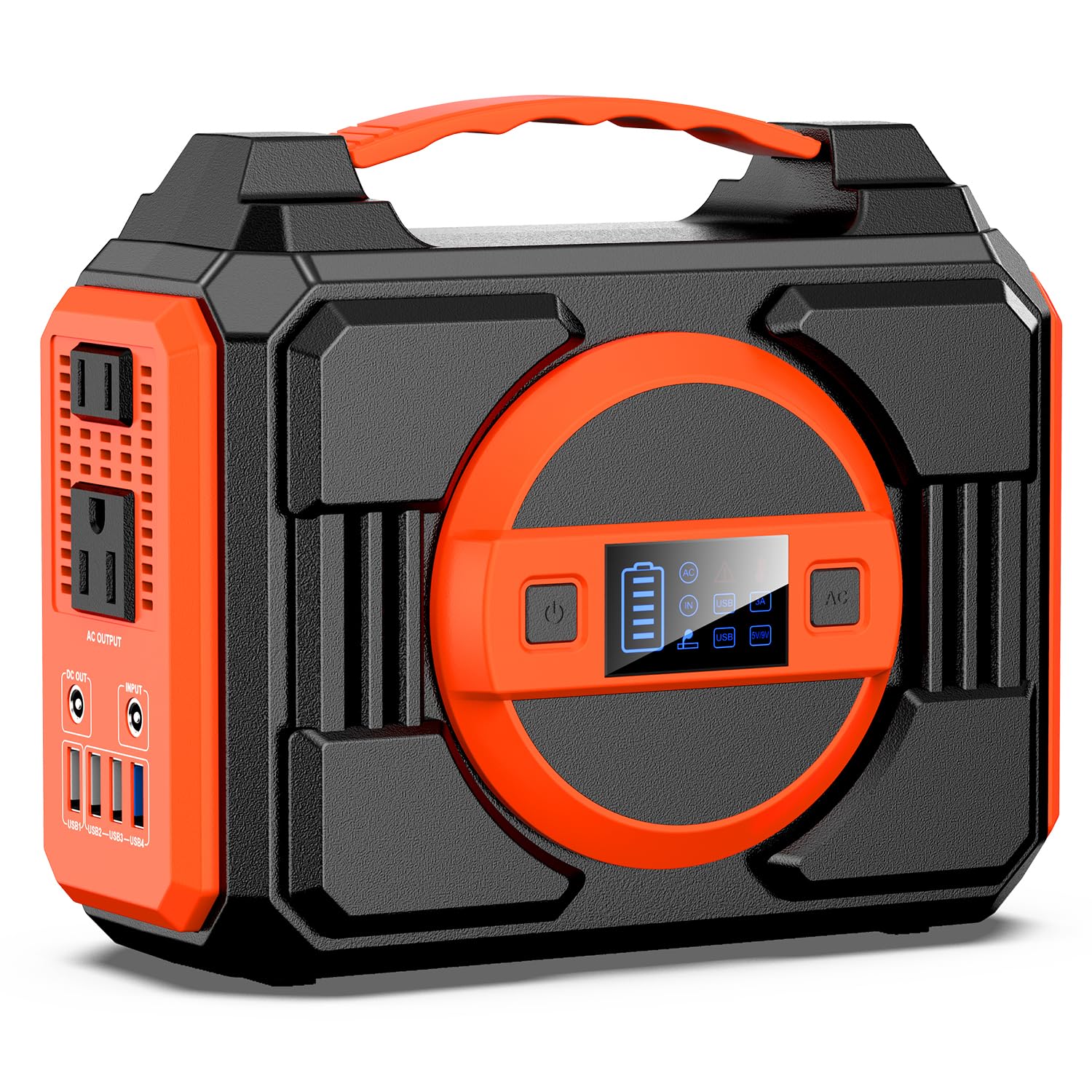
Two full-size AC outlets in a value pack that punches above its price tag.
The Apowking 300W packs a 220Wh / 60000mAh battery versus the ZeroKor’s 26400mAh and offers two 110V pure sine wave AC outlets, while the GRECELL and BLUETTI each have one AC outlet. This means you can plug a lamp and a laptop charger simultaneously without needing a power strip. Its 300W continuous (600W peak) output handles most camping essentials: phones, tablets, a projector, and even a small TV, with buyers reporting it lasted 3.5 hours running a 20L electric cooler in freezer mode.
Seven output ports total include three USB-A ports (5V/3.1A Max), one USB port (5V/3A, 9V/2A), and a DC vehicle output port (9-12.6V, 10A max). A large LED backlight illuminates a tent or room at night, while the ZeroKor has an LED flashlight. Customers note that solar charging is slow with the included 40W panel, but the unit accepts wall and car charging as well — wall charging takes about 4 hours.
One important trade-off: the Apowking lacks a USB-C port entirely, which the GRECELL and BLUETTI both include. If you need to fast-charge a modern laptop or tablet with a USB-C cable, you’ll need a separate adapter or pick a different model.
Where it stretches the dollar
- Two pure sine wave AC outlets — lets you run two AC devices at the same time
- 220Wh battery (60000mAh) runs a cooler or TV for several hours
- Large backlit LED panel brighter than typical onboard lights
- Passes full load tests with passthrough power from a wall outlet
Where it cuts back
- No USB-C port — can’t fast-charge modern laptops or tablets without an extra adapter
- Wall charging takes 4+ hours, slower than the BLUETTI’s 70-minute full charge
- Slow solar charging with the included panel; a 60W panel would be noticeably better
Smart pick for dual-AC device households: If you need more than one AC outlet at the campsite or during a power outage, the Apowking’s two outlets and 220Wh capacity offer the best price-to-port count in the list.
You’ll be frustrated if: You rely on USB-C charging for your laptop or tablet — the lack of that port means carrying a separate wall brick.
4. ZeroKor 120W Portable Power Station

The pocketable power station that disappears into a backpack at 2.2 lbs.
At just 2.2 lbs and dimensions of 5.7 x 4.4 x 4.1 inches, the ZeroKor 120W is smaller and lighter than any other unit here, which is noticeable when stashing it in a daypack.
The 97.6Wh / 26400mAh battery capacity is the smallest in the lineup at 97.6Wh versus the GRECELL’s 288.6Wh. That means it’ll charge a smartphone 8-10 times or run a 20L electric cooler in freezer mode for about 3.5 hours with power to spare, as one buyer mentioned. But it’s strictly for low-wattage devices under 120W AC; plugging in a coffee maker or hair dryer will damage the unit, as the manual warns.
Three charging methods (solar panel not included, USB-C wall adapter, car USB port) make it flexible for day trips. The built-in BMS (battery management system, an electronic brain that prevents damage) covers short-circuit, over-current, over-voltage, overload, and overheating protection, and the cooling fan automatically kicks in when temps rise. One minor quirk in reviews: the AC/DC button setup is confusing at first, and the manual doesn’t help much, but once you figure out the button sequence it works reliably.
What fits in your hand
- 2.2 lbs with handle — easy to toss in a backpack or purse
- Two 120W AC outlets for its tiny size — powers small electronics without a power strip
- LED flashlight with reading mode and SOS, useful for emergencies
What limits it
- 97.6Wh capacity is low — won’t run a fridge or CPAP machine all night
- 120W AC limit means no coffee makers, hair dryers, or any appliance with a motor
- Charges slowly via USB-C: a 100W charger delivers only 5V/2.3W, taking 4-5+ hours
Best for ultralight trips and daily EDC: If you only need to charge phones, a tablet, a camera, and maybe a small projector for a movie night, this is the most portable way to get AC power without a heavy battery.
Skip it for any appliance with a motor: The 120W limit and small capacity will leave you frustrated if you try to run even a mini fridge or fan for more than a couple hours.
5. Jackery Explorer 2000 v2 Portable Power Station

A 2042Wh powerhouse that runs two fridges and a sump pump for hours — a real gas-generator alternative.
The Jackery Explorer 2000 v2 sits in a different league entirely. Its 2042Wh LiFePO₄ battery (which the manufacturer says lasts up to 10 years) and 2200W continuous AC output (3 AC ports) can run two refrigerators and a sump pump for 4 hours while using less than 20% of the battery, according to one buyer’s real-world test during a storm. At 2042Wh versus the GRECELL’s 288.6Wh and 2200W versus the BLUETTI’s 600W, this unit doesn’t just charge devices, it substitutes for a gas generator during multi-day outages.
Despite its massive 2042Wh battery, the Explorer 2000 v2 weighs 39.5 lbs, thanks to CTB (Cell-to-Body) technology borrowed from EVs that packs cells directly into the chassis. AC fast charging takes just 66 minutes to hit 80%, and a silent charging mode keeps fan noise under 30dB — quieter than a library. The 20ms UPS switch is UL1778 certified (an Underwriters Laboratories safety standard), enough to keep a desktop PC running through a flicker.
Bluetooth and network control through the Jackery app let you monitor battery percentage, adjust charging speed, and switch between modes remotely. Solar charging via 400W panels fills the battery in about 6 hours, making it a viable off-grid power source. The USB-C PD 100W port fast-charges laptops, and the total of two USB-C and one USB-A port alongside three AC ports covers everything from a phone to a full-sized refrigerator.
Industrial capacity, consumer simplicity
- 2042Wh capacity and 2200W output run large appliances for hours — two fridges + sump pump for 4 hours at under 20% drain
- 0-80% wall charge in 66 minutes; full silent charge in 5 hours at under 30dB
- LiFePO₄ battery lasting up to 10 years, with CTB tech for lighter weight
- App control with real-time wattage and mode switching
What to watch for
- 39.5 lbs is still heavy — fine for rolling in a cart but not for carrying up stairs
- Solar barrel ports are not anchored on a solid frame; the side flexes inward when plugging in, a potential durability weak point
- Bluetooth connection is not persistent and may cause app pairing issues
Your whole-home backup station: If you face frequent storms, have medical devices or a home office that must stay running, and have the space to store a 39.5 lb unit, the Explorer 2000 v2 is the most practical gas-generator alternative available.
Overkill for everyone else: A weekend camper or single-device user will pay for capacity they never touch — the GRECELL or BLUETTI would serve them better for less weight and cost.
Understanding the Specs
Watt-Hours (Wh) — How Long It Lasts
A battery’s total energy is measured in watt-hours. Think of it as the size of your gas tank. A 288Wh battery can power a 60W fan for about 4.8 hours in theory, though inverter losses and device efficiency mean you’ll get closer to 4 hours in practice. To estimate, divide the Wh by the wattage of what you’re running — and subtract 10-15% for real-world conditions. A small phone charger uses under 10W, a laptop around 60W, a mini fridge around 50W, and a CPAP machine around 30W.
Continuous Watts (W) — What It Can Power
Continuous wattage tells you the maximum power a battery portable outlet can deliver at any moment. A 300W unit can handle most small electronics but will trip if you plug in a 400W coffee maker. Pure sine wave inverters (listed in specs as “pure sine wave”) produce cleaner AC power that won’t damage sensitive gear like laptops, CPAP machines, or medical devices. “Modified sine wave” inverters can cause humming or overheating in some electronics and are not recommended for anything beyond basic phone charging.
FAQ
Can I run a CPAP machine on a battery portable outlet?
How many times can I charge my phone with a 200Wh battery portable outlet?
What is the difference between LiFePO₄ and regular lithium-ion batteries in portable power stations?
Can I charge a battery portable outlet with a solar panel?
Will a 300W battery portable outlet run a refrigerator?
How long does it take to recharge a portable power station from a wall outlet?
Can I leave a battery portable outlet plugged in all the time?
What is the difference between pure sine wave and modified sine wave inverters in these power stations?
How many watts do I need for a camping trip?
Can a battery portable outlet start a car?
Final Thoughts: The Verdict
If you want one dependable pick, the battery portable outlet winner is the GRECELL 330W because it delivers the best balance of 288.6Wh capacity, 330W AC output, 60W USB-C fast charging, and multiple port options without jumping into premium pricing. If you want ultra-fast wall charging and a LiFePO₄ battery for long-term daily use, grab the BLUETTI Elite 30 V2. And for whole-home backup that runs two fridges and a sump pump through a multi-day outage, the standout is the Jackery Explorer 2000 v2.
How We Picked
We do not accept paid placement, and we did not hands-on test every unit. Instead, we match each pick to a real buyer and use-case by comparing the manufacturers’ published specifications against the patterns in verified customer reviews — so you get each pick’s real strengths and trade-offs instead of marketing copy.
Sources & Methodology
Specifications: manufacturer listings and product documentation. Review insights: verified customer reviews, as of July 2026. Pricing: not shown on this page (it changes often); check the current price via the retailer link.
As an Amazon Associate, Gadgets Feed earns from qualifying purchases. This does not affect which products we feature.
Product prices and availability are accurate as of the date/time indicated and are subject to change. Any price and availability information displayed on Amazon at the time of purchase will apply to the purchase of this product. As an Amazon Associate I earn from qualifying purchases.
CERTAIN CONTENT THAT APPEARS ON THIS SITE COMES FROM AMAZON. THIS CONTENT IS PROVIDED "AS IS" AND IS SUBJECT TO CHANGE OR REMOVAL AT ANY TIME.
Amazon and the Amazon logo are trademarks of Amazon.com, Inc. or its affiliates.