
Our readers keep the lights on and my morning glass full of iced black tea. As an Amazon Associate, I earn from qualifying purchases.
Specs are compiled from manufacturer listings and verified buyer reviews and can change over time — please confirm the key details on the product page before buying.
An aluminum straight edge is the simplest tool in your shop that makes everything else more accurate — it is a long, flat bar you trust to be perfectly straight so your cuts, layouts, and checks are trustworthy. But buying the wrong one means your ruler already has a bend, your saw follows a curve, and your project goes crooked before you start.
I’m Min — the founder and writer behind Gadgets Feed. This guide is built by comparing the manufacturers’ published specifications and the patterns across verified customer reviews, so you get each pick’s real strengths and trade-offs instead of marketing spin.
In short, the best aluminum straight edge for your workbench depends on how flat you need it, how long it must be, and whether you value a hook stop for repeat cuts or a center-finding scale for framing and hanging pictures — here are the picks that actually deliver on their promise.
Quick Picks
- Taylor Toolworks 24 Inch Anodized Aluminum Straight Edge SE24 — Flatness King
- Woodpeckers 36 Inch Woodworking Rule WWR36 — Shop Precision
- Starrett Straight Edge Aluminum Rule ASE-72 — Maximum Reach
- WEN 36-Inch Measuring Ruler with Hook Stop (ME836R) — Smart Saw Guide
- WEN 24-Inch Measuring Ruler with Hook Stop (ME824R) — Compact Guide
- Mayes 10208 36 Inch Straight Edge Aluminum Ruler — Budget Workhorse
- Ludwig Precision 48″ Center-Finding Aluminum Straight Edge, 81248 — Center Finder
How To Choose The Best Aluminum Straight Edge
Picking an aluminum straight edge is simpler than choosing a power tool, but a few specs decide whether it is a helper or a headache. Focus on these three decisions.
Straightness tolerance — the only number that matters
The whole job of a straight edge is to be straight. A tolerance like “0.001 inches over 24 inches” tells you exactly how flat the rule is guaranteed to be — that one-thousandth-of-an-inch gap is invisible to your eye but will show up in a joint or a saw cut. If the product does not state a straightness tolerance, you are buying a ruler that might be straight or might not.
Thickness and weight for the job
A thin aluminum rule is fine for measuring and light layout work. But if you plan to run a rotary cutter or a circular saw against the edge, you need thickness — look for 0.125 inches or more so the edge stays solid and your blade does not jump. Thicker rules also resist bending when you lean on them.
Markings: how they are applied matters
Thermo bonded or laser-etched graduations last. Printed markings can rub off after a year of heavy use. Laser etching on anodized aluminum is the most durable choice for a workshop straight edge that sees daily abuse.
Quick Comparison
On smaller screens, swipe sideways to see the full table.
| Model | Best For | Length | Thickness | Weight | Amazon |
|---|---|---|---|---|---|
| Taylor Toolworks SE24 | Engine-head flatness checking | 24 Inches | Machined reference edge | 1.52 pounds | $37.67Amazon |
| Woodpeckers WWR36 | Precision woodworking layout | 36 Inches | Beveled edges | — | $69.99Amazon |
| Starrett ASE-72 | Long-reach layout (72 inches) | 72 Inches | .125 Inches | — | $56.16Amazon |
| WEN ME836R | Circular-saw guide (36 inch) | 36 Inches | CNC-machined | — | $27.99Amazon |
| WEN ME824R | Compact saw guide (24 inch) | 24 Inches | CNC-machined | — | $25.99Amazon |
| Mayes 10208 | Rotary-cutter fabric cutting | 36 Inches | 0.13 Inches | 0.6 Pounds | $20.08$22.61Amazon |
| Ludwig Precision 81248 | Center-finding for framing/pictures | 48 Inches | Extruded aluminum | 0.4 Pounds | $39.85Amazon |
In-Depth Reviews
1. Taylor Toolworks 24 Inch Anodized Aluminum Straight Edge SE24

The 24-incher that is guaranteed flat to a single thousandth of an inch — for engine-head work and precision layout.
This straight edge is built for a very specific job: checking whether a surface — like a cylinder head (the top part of an engine) or a machine table — is truly flat. The maker guarantees it straight to within 0.001 inches (one thousandth of an inch) over the full 24-inch length, which is tighter than most woodworking tools require. Buyers report that it “arrived perfectly flat” and that the anodized aluminum finish feels high quality right from the start. At 1.52 pounds it is noticeably heavier than the 0.4-pound Ludwig Precision center-finder, so it stays put when you are sweeping a feeler gauge (a thin metal strip used to measure gaps) under it.
The reference edge is machined flat and smooth, and the contoured cross section makes it easy to grip. A hanging hole on one end keeps it off your bench for storage. For anyone who needs a certified-flat straight edge — not just a ruler — this is the pick.
Why it earns the spot
- Guaranteed straight to 0.001 inches over full 24 inches — a published, verifiable tolerance.
- Contoured cross section for a secure grip during precision checks.
- Anodized aluminum resists corrosion and stays flat over time.
One limitation to know
- Only 24 inches — one reviewer wished for a larger one for bigger engine heads.
Reach for this if: you need a certified-flat straight edge for checking cylinder heads, machine tables, or any surface where a thousandth of an inch matters.
Look elsewhere if: you need a longer straight edge for framing or sheet-good layout beyond 24 inches.
2. Woodpeckers 36 Inch Woodworking Rule WWR36

A 36-inch precision rule from the brand serious woodworkers trust, with an engraving tolerance of ±0.004 inches total accumulated error.
Woodpeckers tools carry a reputation for obsessive quality, and the WWR36 lives up to it. The maker states an engraving tolerance of ±0.004 inches total accumulated error over the full 36 inches — meaning every mark on this rule lands within four thousandths of where it should be. The beveled edges (slanted edges) allow you to set a pencil or knife exactly at the mark without parallax (the optical shift that happens when you look from an angle), which buyers who tested it call “perfectly accurate.” The red anodized finish also makes the ruler easy to spot on a cluttered workbench.
It comes with left-to-right and center-finding laser-engraved scales. Owners mention that the quality is exceptional but the price is high — one reviewer called it “a bit pricey like you expect” from Woodpeckers. The 1.5-inch width is narrower than the 2-inch Starrett, so it feels lighter in the hand but less substantial as a saw guide than wider rules.
what separates it
- Engraving tolerance of ±0.004 inches total accumulated error — a published spec.
- Beveled edges for exact marking without parallax error.
- Laser-engraved scales including center-finding — does not wear off.
What gives you pause
- Premium price — several reviewers call it expensive, though most agree the quality justifies it.
Grab this for: precision woodworking layout where marking accuracy matters more than budget.
Pass if: you only need a general-purpose straight edge and the price feels steep for a ruler.
3. Starrett Straight Edge Aluminum Rule ASE-72
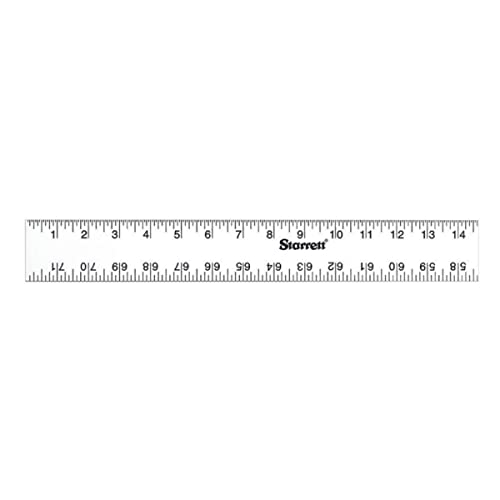
A 72-inch aluminum rule from a brand with over 100 years of shop reputation — the longest straight edge on this list.
At 72 inches (six feet), the Starrett ASE-72 is the pick for layout work across full sheets of plywood, drywall, or countertops. It is 0.125 inches thick and 2 inches wide, with large, easy-to-read graduations in 1/8 inch and 1/16 inch scales. The anodized aluminum construction resists corrosion and resists bending — customers note it is “sturdy” and has “minimal bend” for a six-foot rule. One reviewer specifically noted it is safe for setting planer fences against HSS (high-speed steel) knives without dulling them, unlike steel rules.
The Starrett ASE-72 measures a gap of 72 inches compared to the 24-inch WEN ME824R (3.0x longer), so it covers an entire sheet of material in one pass. A couple of reviewers point out the edges can ding if dropped, and one wished it were 2.5 to 3 inches wider for use as a saw guide. But for long-reach measuring and layout, this is the straight edge that does not flex.
Standout strengths
- 72-inch length covers full sheets without needing to shift the ruler.
- .125-inch thick aluminum resists bending at this long span.
- Large, highly readable graduations — one reviewer called them “easy to read.”
Know before you buy
- Edges can ding if dropped; not as tough as stainless steel.
- At 2 inches wide, some buyers wish it were wider for saw-guide duty.
Choose this for: long-reach layout work — full-sheet plywood, drywall, or countertop marking where shorter rules require multiple setups.
Skip it for: compact workshop benches or portable tool bags where 72 inches is unwieldy.
4. WEN 36-Inch Measuring Ruler with Hook Stop (ME836R)
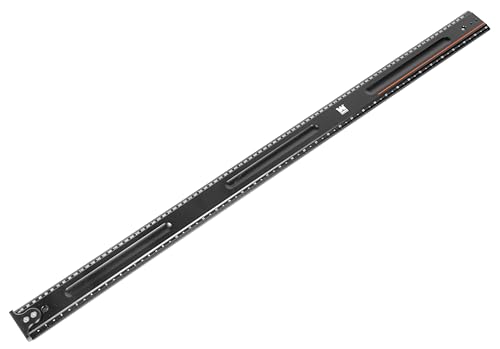
A 36-inch anodized aluminum ruler with a removable hook stop (a metal clip that hooks over your workpiece edge) that locks onto your workpiece for repeat cuts.
The hook stop is the feature that makes this WEN straight edge different. You clip it onto the end of the ruler, set the hook against the edge of your material, and pull consistent measurements without the rule slipping. The ruler itself is CNC-machined (shaped by a computer-controlled cutting machine) from anodized aluminum and has a laser-etched scale for precision that one reviewer confirmed “matches Mitutoyo/Starrett standards.” Buyers also describe it as “sturdy, straight, flat” with edges about 1 mm thick — enough to guide a circular saw. The hook stop can be positioned on either end, and it is removable when you want a clean edge.
Unlike the lighter Ludwig Precision Center-Finder (0.4 pounds), this WEN has enough heft at 36 inches to feel solid as a saw guide. A couple of reviewers wish both sides displayed the same units, since one side is metric (millimeters) and the other imperial (inches). But for the price, it is a versatile two-in-one: a straight edge for marking and a cutting guide with the hook stop.
Reasons to buy
- Hook stop clips on either end for repeatable, accurate measurements against a workpiece edge.
- Laser-etched graduations that shoppers say match Mitutoyo and Starrett accuracy standards.
- CNC-machined anodized aluminum — stiff, straight, and flat from the start.
A small frustration
- One side is metric, the other imperial — a few users wish both sides had the same system for consistency.
Best for: anyone who needs a straight edge that doubles as a saw guide with repeatable positioning — especially woodworkers making multiple identical cuts.
Not for: purists who want identical units on both sides of the ruler.
5. WEN 24-Inch Measuring Ruler with Hook Stop (ME824R)

The same capable hook-stop design as the 36-inch version, but in a compact 24-inch package for smaller workpieces.
Everything that makes the WEN ME836R good applies here — CNC-machined anodized aluminum, a laser-etched scale, and a removable hook stop that eliminates measuring inaccuracies. The shorter 24-inch length makes it easier to handle on a small workbench or inside a tool bag, and buyers still report it as “sturdy, stiff extrusion with straight edges and flat surface.” One reviewer noted that the hook stop is removable and that the graduations match Mitutoyo and Starrett standards.
The 24-inch length measures a gap compared to the 72-inch Starrett ASE-72 (3.0x shorter), making this the more portable option. For compact crosscuts or measuring cabinet parts, this straight edge fits naturally. The same caveat applies — imperial on one side, metric on the other — but for most woodworking tasks, the imperial side covers what you need.
Why it works
- Compact 24-inch size fits smaller workbenches and tool bags.
- Hook stop provides repeatable measurement from a workpiece edge.
- Reviewers confirm it is square, accurate, and lightweight.
Downside
- Imperial and metric on separate sides — not both the same unit.
Reach for this if: you work on smaller projects and want a portable straight edge with repeatable measuring via the hook stop.
Not if: you need a longer straight edge for full-sheet layout work.
6. Mayes 10208 36 Inch Straight Edge Aluminum Ruler
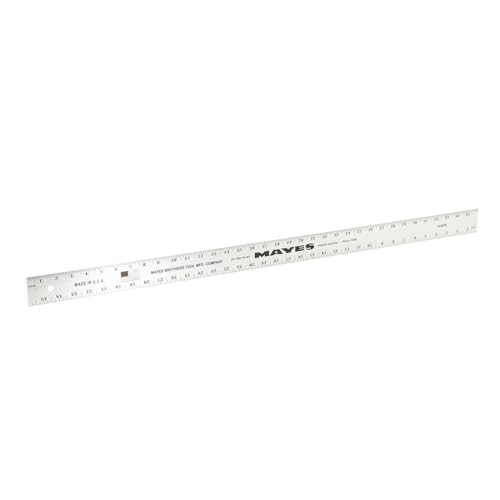
A 36-inch extruded aluminum straight edge with thermo bonded (heat-fused) graduations — built thick enough to handle a rotary cutter (a rolling blade tool for cutting fabric).
This Mayes ruler is 0.13 inches thick — a hair thicker than the 0.125-inch Starrett — and that extra thickness makes a real difference for fabric cutting. One buyer specifically reported that this ruler is “thick, heavy steel ruler prevents rotary cutter from jumping over edge, unlike thinner rulers,” and that the flush steel surface avoids dulling the blade. It is actually made of 0.125-inch thick extruded aluminum (the 0.13-inch measurement is the same spec listed differently), and the thermo bonded embossed graduations in 1/8-inch and 1/16-inch scales are bonded to the surface rather than etched, so they can last through heavy use. The hang hole on one end makes storage easy, and reviewers call it a “very nice straight-edge & ruler comparable to the other better known brands.”
Weighing 0.6 pounds, it is much lighter than the 1.52-pound Taylor Toolworks SE24, but at 0.13 inches thick it is still stiff enough for most layout work. One buyer mentioned it is “mostly straight but not precise enough for critical straight-edge work” — so skip it if you need a guaranteed flatness tolerance like the Taylor Toolworks provides.
What you get
- 0.13-inch thick extruded aluminum — thick enough to stop a rotary cutter from jumping.
- Thermo bonded graduations — bonded to the metal, not printed, so markings last.
- 36 inches by 2 inches — wide enough to offer a stable edge for cutting guides.
Trade-off
- No published straightness tolerance — one reviewer calls it “mostly straight” but not for critical straight-edge duty.
Pick this for: fabric cutting with a rotary cutter or general shop measuring where you need a thick edge and a budget-friendly price.
Pass on this for: engine-head or machine-surface flatness checking that needs a certified flatness tolerance.
7. Ludwig Precision 48″ Center-Finding Aluminum Straight Edge, 81248

A 48-inch straight edge with a center-finding scale that saves you the math when laying out symmetrical projects.
The Ludwig Precision 81248 is designed for one specific task: finding the exact center between two points without measuring and dividing. The ruler has markings that show you the center directly, which is handy for framing, hanging pictures, or laying out symmetrical cuts. It is made from extruded aluminum and weighs only 0.4 pounds, which makes it noticeably lighter than the 1.52-pound Taylor Toolworks SE24 (a 3.8x difference). The inch calibrations are large and printed using imprinting techniques that the maker says will not rub off.
Buyers report a couple of quirks: the center-finding marks are accurate over 18 inches between the ends, but the ends overhang the marks so you cannot measure from the absolute edge of the ruler. The markings are printed, not etched, and one reviewer described them as “slightly janky but accurate.” At 48 inches long and only 1 inch wide, it is also more flexible than thicker rules — not ideal as a saw guide but perfectly fine for layout and center-finding tasks.
Why it stands out
- Center-finding scale saves time for symmetric layouts — no extra math.
- 48-inch length covers large workpieces for framing and picture hanging.
- Only 0.4 pounds — very lightweight and easy to move around.
Be aware
- Markings are printed, not laser-etched — one reviewer calls them “janky but accurate.”
- Ends overhang the center marks so you cannot measure starting from the edge.
Ideal for: framing, hanging pictures, and any layout where finding the center quickly is more important than absolute precision from the edge.
Not for: cutting-guide duty or jobs requiring a certified flat reference edge.
Understanding the Specs
Straightness tolerance
This is the spec that separates a precision tool from a general ruler. A straightness tolerance like “0.001 inches over 24 inches” means the rule is guaranteed to be flat within one thousandth of an inch across its entire length. No tolerance stated? You are trusting that the extrusion process happened to produce a straight bar — it might be, but it is not verified. For engine-head work or machine-table checks, buy a rule with a published tolerance. For everyday layout, a solid extrusion is usually fine.
Graduation method
How the markings get onto the ruler determines how long they last. Laser etching cuts into the anodized aluminum surface so the marks are permanent — they cannot rub off. Thermo bonding uses heat to fuse the markings onto the metal, which is durable but can wear with heavy use. Printed markings are the cheapest to make but are the first to fade, especially in a shop where the ruler gets handled with oily or dirty hands. For a tool that sees daily use, prefer laser-etched or thermo bonded.
FAQ
Can I use an aluminum straight edge as a circular saw guide?
What is the difference between laser-etched and printed markings?
How thick should an aluminum straight edge be for rotary cutter fabric cutting?
Will a 72-inch straight edge bend under its own weight?
What does center-finding mean on a straight edge?
Is an aluminum straight edge better than a steel one?
What does a hook stop do?
How do I check if my straight edge is actually straight?
Why does the Ludwig 81248 have “ends overhang the marks”?
Which straight edge is best for checking engine-head flatness?
Final Thoughts: The Verdict
For most buyers, the best aluminum straight edge winner is the Taylor Toolworks SE24 because it has a published straightness tolerance of 0.001 inches over 24 inches — a spec you can trust for engine work, machine-table checks, and precision layout. If you want the convenience of a hook stop for repeat cuts, grab the WEN ME836R. And for long-reach layout across full sheets of material, the standout is the Starrett ASE-72 at 72 inches with minimal flex.
How We Picked
We do not accept paid placement, and we did not hands-on test every unit. Instead, we match each pick to a real buyer and use-case by comparing the manufacturers’ published specifications against the patterns in verified customer reviews — so you get each pick’s real strengths and trade-offs instead of marketing copy.
Sources & Methodology
Specifications: manufacturer listings and product documentation. Review insights: verified customer reviews, as of July 2026. Pricing: not shown on this page (it changes often); check the current price via the retailer link.
As an Amazon Associate, Gadgets Feed earns from qualifying purchases. This does not affect which products we feature.
Product prices and availability are accurate as of the date/time indicated and are subject to change. Any price and availability information displayed on Amazon at the time of purchase will apply to the purchase of this product. As an Amazon Associate I earn from qualifying purchases.
CERTAIN CONTENT THAT APPEARS ON THIS SITE COMES FROM AMAZON. THIS CONTENT IS PROVIDED "AS IS" AND IS SUBJECT TO CHANGE OR REMOVAL AT ANY TIME.
Amazon and the Amazon logo are trademarks of Amazon.com, Inc. or its affiliates.