
Our readers keep the lights on and my morning glass full of iced black tea. As an Amazon Associate, I earn from qualifying purchases.
Specs are compiled from manufacturer listings and verified buyer reviews and can change over time — please confirm the key details on the product page before buying.
You are shopping for a 5 octave keyboard — probably as a beginner, for a child, or for something portable. The hardest part is picking one that actually fits how and where you plan to play, not the one with the flashiest number of sounds on the box.
I’m Min — the founder and writer behind Gadgets Feed. This guide is built by comparing the manufacturers’ published specifications and the patterns across verified customer reviews, so you get each pick’s real strengths and trade-offs instead of marketing spin.
The reviews below break down the real-world trade-offs of every 5 octave keyboard on this list, from lighted keys for step-by-step lessons to foldable boards that slip into a backpack.
Quick Picks
- Roland GO:KEYS 3 Music Creation Keyboard — Best Overall
- Casio Casiotone LK-S250 – 61-Key Lighted Portable Keyboard — Premium Pick
- The ONE Smart Keyboard COLOR 61 Keys Piano Keyboard — Smart Value
- Yamaha 61-Key Portable Keyboard PSRE283 — Keylboard Classic
- Yamaha 61-Key Portable Keyboard YPT280 — Budget Champion
- Finger Dance 61 Key Folding Piano Keyboard — Travel Pick
- Ktaxon 61 Key Keyboard Piano Electric Keyboard (Nude Pink Complete Set) — Kid’s Choice
- 61 Key Keyboard Piano for Beginners with Lighted Keys & Pro Teaching Modes (IMGZAR) — Teaching Bundle
- Alesis Melody 61 MK4 Keyboard Piano for Beginners — Best Value
How To Choose The Best 5 Octave Keyboard
A 61-key keyboard covers five octaves (a “5 octave” range). That is enough to play most pop, rock, and beginner classical pieces with both hands. Before you buy, focus on these three factors that separate a keyboard you will outgrow quickly from one that keeps you learning for years.
Touch Response vs. Non-Weighted Keys
Touch response (also called velocity sensitivity) means the keyboard senses how hard you press a key and plays louder or softer accordingly. This is essential for developing proper finger control — without it, every note sounds at the same volume no matter how you strike the key. Most keyboards in the premium tier offer touch response, while many budget-friendly models skip it entirely. If you plan to eventually move to an acoustic piano, look for this feature.
Lighted Key Teaching Systems
Several keyboards on this list light up the next key to press, guiding you through a song step by step. The catch is that these systems vary widely. Some keyboards light keys only for built-in songs, while others connect to a phone or tablet app that streams any song you choose. Check whether the lighted key feature works with the device you own — a few setups only function with iOS devices, not Android.
Portability and Power
The size and weight of these keyboards range from 2.6 pounds (about the weight of a small laptop) to over 15 pounds. If you need to carry the keyboard between rooms, to a teacher’s house, or on a trip, pay attention to whether it runs on AA batteries, has a built-in rechargeable battery, or needs to stay plugged in. A foldable keyboard can be a genuine space-saver, but the trade-off is often thinner sound and a less sturdy feel.
Quick Comparison
On smaller screens, swipe sideways to see the full table.
| Model | Best For | Key Feel | Weight | Built-in Sounds | Amazon |
|---|---|---|---|---|---|
| Roland GO:KEYS 3 | Music creators & songwriters | Touch-sensitive, springy | 15.85 lbs | 1000+ | $384.99Amazon |
| Casio Casiotone LK-S250 | Self-teaching beginners | Touch-responsive, lighted | 4.98 kg | 400 | $239.99Amazon |
| The ONE Smart Keyboard COLOR | App-guided adult learners | Non-weighted, lighted | 3.49 kg | 256 | $159.99Amazon |
| Yamaha PSRE283 | Reliable beginner learning | Non-weighted | 8.8 lbs | Hundreds+ | $159.99Amazon |
| Yamaha YPT280 | Budget-friendly Yamaha quality | Non-weighted | 8.8 lbs | Hundreds+ | $149.99Amazon |
| Finger Dance 61 Key Folding | Travel & portability | Non-weighted, folding | 2.6 kg | Built-in via app | $129.99Amazon |
| Ktaxon 61 Key Nude Pink | Young children’s first set | Non-weighted | — | 200 | $99.99$109.99Amazon |
| IMGZAR 61 Key with Lighted Keys | All-in-one beginner kit | Non-weighted, lighted | 8.75 kg | 200 | $98.99Amazon |
| Alesis Melody 61 MK4 | Absolute budget starter | Non-weighted | 6.6 lbs | 300 | $85.00Amazon |
In‑Depth Reviews
1. Roland GO:KEYS 3 Music Creation Keyboard

The serious creator’s keyboard that packs Roland’s legendary ZEN-Core engine into a portable 61-note body.
The Roland GO:KEYS 3 exists for the person who wants to make music, not just play back songs. Its ZEN-Core engine delivers over 1000 Roland sounds — the same sound engine found in Roland’s professional synths — so you have classic synthesizer tones, drum kits, and even sound effects at your fingertips. Buyers report the chord sequencer with over 300 ready-to-play presets makes it easy to build a complete song on the spot, and the built-in stereo speakers let you play anywhere without extra gear.
At 15.85 pounds versus the Yamaha PSRE283 at 8.8 pounds, you get Bluetooth audio and MIDI support for streaming and song creation, plus a USB audio/MIDI interface to connect directly to music software on your computer or phone. One reviewer noted the onboard acoustic pianos are usable but not the best in class, and the manual can be confusing on the arpeggiator and scene functions. The real trade-off is weight: this is not a lap-friendly travel board, but for someone who wants to compose, record, and perform from a single keyboard, it is the most capable tool here.
Creation Toolbox
- Over 1000 pro-grade Roland sounds in a single keyboard
- Built-in chord sequencer with over 200 auto-accompaniment styles
- Bluetooth audio/MIDI and USB-C for smooth device connection
Heavy Lifter
- At 15.85 pounds, it is the heaviest 61-key on this list
- Built-in speakers sound “meh” per some owners, best used with headphones or external speakers
Grab it for: Anyone who wants to create original music, loop ideas, and explore hundreds of sounds without plugging into a computer.
Think twice if: You need a lightweight board to carry daily — the 8.8 lb Yamaha models are far easier to move around.
2. Casio Casiotone LK-S250 – 61-Key Lighted Portable Keyboard

The self-teacher’s best friend — four built-in lesson stages and keys that light up as you play.
Casio’s Casiotone LK-S250 is the pick for teaching yourself without a teacher in the room. Its Key Lighting System lights up to four keys at a time, and the 4-stage lesson system breaks every built-in song into small, manageable pieces. One buyer mentioned their daughter taught herself 15 songs in 4 months using the lighted key training mode with scoring feedback — that kind of real-world result makes this the best pick for motivated beginners.
Beyond the learning tools, this board offers 400 tones, 77 rhythms, and a Dance Music Mode for remixing EDM-style tracks. The touch-responsive keys (velocity-sensitive) mean your playing dynamics actually change volume with finger pressure, unlike the Yamaha PSRE283 which lacks that feature. Reviewers consistently praise the clear, crisp sound compared to competitors. The main catch: the lighted keys are limited to four at once, and the micro-USB connection feels dated compared to USB-C on newer models. At 4.98 kg it is portable but not the lightest, and the built-in handle makes carrying it easy.
Built to Teach
- Casio’s Key Lighting System + 4-stage lessons accelerate self-learning
- Touch-responsive keys develop proper finger dynamics, unlike the Yamaha PSRE283
- Dance Music Mode is genuinely fun for kids and teens
Light Limits
- Only four keys light up at a time, which can be frustrating on fast songs
- Uses micro-USB instead of the modern USB-C standard
Ideal for: A beginner who wants to teach themselves at their own pace with built-in scoring and visual guidance.
Not ideal for: Advanced players who need multi-track recording — you will need to pair it with an iPad app like GarageBand for that.
3. The ONE Smart Keyboard COLOR 61 Keys Piano Keyboard

A keyboard that doubles as your personal tutor with red LED lights guiding every note through a free app.
The ONE Smart Keyboard COLOR is designed for the adult beginner who wants to learn guitar, ukulele, or piano parts through an app without staring at sheet music. The built-in red LED lights above each key light up the next note to play, and the free companion app offers over 4000 pieces of sheet music, 100 instructional videos, and interactive games. You can learn one hand at a time, at your own pace, and the app gives you real-time feedback on which keys you hit.
It has 256 timbres (instrument sounds), 64-note polyphony (the number of notes it can play at once), and two 3W speakers. At 3.49 kilograms versus the Yamaha YPT280 at 8.8 pounds, it can run on 4 AA batteries for up to 6 hours — so you can take it to the park or a camping trip without hunting for an outlet. A critical detail from buyers: the light-up keys only work with the app on Apple devices, not Android. If your household is Android-only, skip this pick or you will lose the main teaching feature. The non-weighted keys also lack touch response, so every note plays at the same volume regardless of how hard you press.
Lighted Learning (with limits): The LED guide is genuinely helpful for learning new songs, but only works with iOS — Android users get a regular keyboard without lights. At this mid-range price, the 256 sounds and app integration make it a strong value for Apple households upgrading from a toy keyboard.
Pick this if: You have an iPhone or iPad and want a structured, app-guided learning experience without paying for lessons.
skip it if: You use Android phones or tablets — the light-up feature does not work on Android, according to buyer reports.
4. Yamaha 61-Key Portable Keyboard PSRE283

The portable keyboard that skips the gimmicks and delivers Yamaha’s benchmark sound in a no-fuss package.
Yamaha’s PSRE283 is what you buy when you want a reliable, well-built keyboard from a company known for acoustic pianos, without paying for fancy lights or app subscriptions. It has 61 full-sized keys, a “Portable Grand Piano Button” that instantly calls up Yamaha’s rich piano sound, and hundreds of built-in songs ranging from pop hits to children’s classics. The Smart Chord feature lets you play complex-sounding chords with just one finger, which is helpful for absolute beginners who are not ready for full chord shapes.
At 8.8 pounds and measuring 37 inches wide, it is easy to move between rooms or take to a lesson. One owner reported the sound quality is excellent for the price and that it functions well as an affordable backup keyboard. Owners appreciate the lack of annoying quirks — it just works. The catch is that it lacks lighted keys, so if you rely on visual guides to learn, you will need to use sheet music or a separate app instead. It also has no power indicator light, which a few buyers found mildly annoying when verifying the keyboard is turned off. This is the no-headache alternative to the Casio LK-S250 if you value build quality over teaching aids.
Solid Foundation: No touch response, no lighted keys, no app integration — just a straightforward Yamaha keyboard with excellent build quality and a sound library that punches above its price. This is the “buy it once and use it for years” choice for families who want durability over novelty.
Best suited for: Families who want a no-headache, long-lasting beginner keyboard with Yamaha’s trusted sound quality.
Not for: Learners who need visual key guidance or tactile feedback — consider the Casio LK-S250 if that is a priority.
5. Yamaha 61-Key Portable Keyboard YPT280

The Yamaha name and sound at a price that leaves room for accessories — no sacrifice on quality.
The YPT280 is the slightly more affordable sibling of the PSRE283, and it shares the same core feature set: 61 full-sized keys, hundreds of built-in songs, Smart Chord, and the one-button Portable Grand piano sound. The main difference is the YPT280 is positioned as Yamaha’s entry-level model for the pure budget buyer, while the PSRE283 adds some extra learning tools and a slightly updated soundset. In practice, both offer that signature Yamaha sound quality that reviewers consistently describe as “great for the price.”
At 8.8 pounds it matches the PSRE283 in weight, and it includes a music rest and power adapter right in the box. Owners mention it is a solid practice keyboard for relearning chords and melody, and one customer observed it is “feature-rich, lightweight, great sound” and suitable even for professionals as a portable backup. The missing features are the same as its sibling: no lighted keys and no touch response. This is a pure, honest keyboard for learning notes and songs the traditional way — with sheet music and your ears. For the budget-minded beginner who trusts the brand, this is the safest bet on the list.
Yamaha DNA
- Same excellent Yamaha piano sound as models costing more
- Lightweight at 8.8 lbs — easy to tote to lessons
- Hundreds of built-in songs keep practice interesting
No Frills
- No touch response means every key press sounds the same volume
- No lighted keys or app integration for guided learning
Why choose it: You want the proven Yamaha brand, great sound, and the lowest possible price to start learning without any risky “budget off-brand” compromises.
Look elsewhere if: You need touch-sensitive keys or lighted guidance — the Alesis Melody 61 MK4 gives you 300 sounds for a similar investment but still lacks touch response.
6. Finger Dance 61 Key Folding Piano Keyboard

The full 61-key piano that folds in half to slip into a bag — 2.6 kg of pure portability.
If your main requirement is taking a keyboard with you, the Finger Dance folding piano is in a category of its own. At 2.6 kilograms and folding 180 degrees, its packed dimensions of 2.95 x 35.43 x 2.13 inches differ from the Ktaxon at 37.6 x 11.61 x 13.39 inches when stored. It also comes with a travel tote bag for protection and a built-in rechargeable lithium battery that delivers 8-10 hours of playtime on a single USB-C charge.
The trade-off is sound quality. Customers note the sound is decent but thin due to small rear-facing speakers — it will not fill a room like the Roland or Casio. The key surface has a strange grippy texture some users found off-putting, and the sheet music holder is flimsy. On the plus side, it supports Bluetooth MIDI for connecting to teaching apps like GarageBand and Perfect Piano, and the USB-C charging is genuinely convenient. As one reviewer put it, “USB-C charging, light-up keys, folds easily — great for learning and travel.” Just be aware that the keys are exposed when folded, so the included soft case offers limited drop protection.
Portability Above All: At 2.6 kg versus the IMGZAR keyboard kit at 8.75 kg, the difference is the kind that can determine whether you carry a full keyboard to a friend’s house or leave it at home. If you travel frequently or have limited storage, this is the only 5 octave keyboard that fits in a backpack.
Reach for this if: You need a full 61-key keyboard for travel, dorm rooms, or anywhere space is tight — the foldable design is genuinely space-saving.
pass on it if: Sound quality and a stable key feel matter most to you — a traditional keyboard like the Yamaha YPT280 sounds fuller and feels more substantial.
7. Ktaxon 61 Key Keyboard Piano Electric Keyboard (Nude Pink Complete Set)
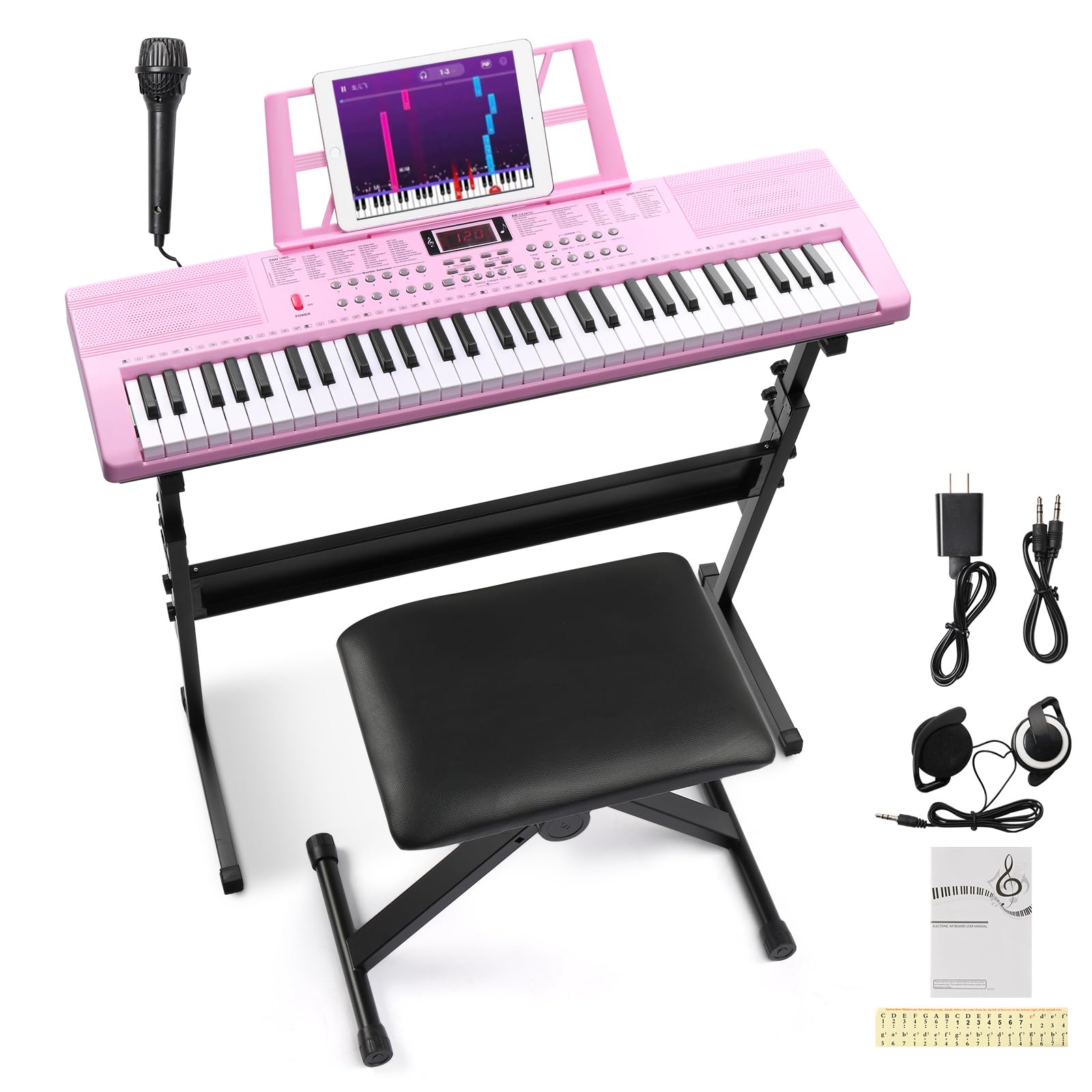
A complete beginner’s setup in one box, from H-stand to microphone, that fits under most Christmas trees.
The Ktaxon set is what you buy when you want everything in one purchase: the keyboard, an H-type stand, an adjustable bench, a microphone, headphones, a sheet music holder, and the power adapter. It comes in a Nude Pink color that stands out from the usual black instruments, which is a big deal if you are buying for a child who wants something pretty. The keyboard itself offers 200 timbres, 200 rhythms, and 60 demo songs, plus three teaching modes (One-Key, Follow, and Ensemble) to guide a beginner through their first songs.
Reviewers point out that young children love it — one parent wrote, “My 6-year-old absolutely loves this piano! It’s very easy to use and perfect for beginners.” The two 1.5W built-in stereo speakers produce decent sound for a kids’ keyboard, but the biggest complaints are about the sheet music holder that “falls off easily” and the microphone which one reviewer called “trash.” For a child’s first keyboard, the complete kit eliminates the need to buy accessories separately, and the adjustable bench (with 3 height settings) means it grows with your kid. The main concern is that the keyboard itself is entry-level — it lacks touch sensitivity and the sounds are basic. It is a better value for a young child than the Alesis Melody 61 MK4 if you want a stand and bench included, but expect to upgrade within a year or two.
from the start Ready
- Includes H-stand, bench, microphone, headphones, and sheet music rest
- Nude Pink finish appeals to kids who want color
- 200 timbres and 200 rhythms offer lots of exploration
Accessory Quality
- Sheet music holder falls off easily, per buyer reports
- Microphone quality is notably poor
- No touch-sensitive keys — every note plays at same volume
Best for: Parents buying a first keyboard for a young child who wants a matching stand, bench, and microphone to feel like a real musician.
Not suited for: Older beginners or teens who need better sound quality and touch response — they will outgrow this within a year.
8. 61 Key Keyboard Piano for Beginners with Lighted Keys & Pro Teaching Modes (IMGZAR)

An all-in-one kit with lighted teaching modes and a Z-shaped stand that seems like a steal — until you read the long-term reviews.
The IMGZAR keyboard kit bundles a 61-key electronic keyboard with a Z-shaped stand, bench, microphone, music stand, and headphones — everything a beginner could need in one box. Its main selling point is the two teaching modes: a “press any key” mode that plays the song even if you hit the wrong note, and a follow-play mode where a red light tells you which key to press next. The keyboard also includes 200 rhythms and tones, a drum kit function, and a metronome. At 8.75 kilograms it is heavy for a portable, but the stand makes it feel like a real piano setup at home.
Here is the honest catch: buyer reviews reveal a reliability issue that is hard to ignore. One reviewer wrote, “Had this keyboard 6 months and the right speaker blew for no reason.” While they noted customer service “made it right,” the fact that a speaker failed within half a year is concerning for product longevity. Other buyers praise it as a great first keyboard for kids, and the lighted teaching mode genuinely helps beginners feel like they are playing real songs immediately. The trade-off is clear: you get a lot of hardware for the price, but the build quality may not match the quantity of accessories.
Loaded Kit
- Comes with stand, bench, microphone, headphones, and music stand
- Two teaching modes use red lights to guide note-by-note playing
- 200 rhythms and 200 tones give beginners variety
Risk Factor
- Buyer reports of right speaker blowing within 6 months
- At 8.75 kg (19.3 lbs), it is one of the heaviest 61-key kits — not easily portable
- Customer support responsive but the reliability record is mixed
Consider for: A child who wants lighted key guidance plus a full stand setup — the teaching modes are genuinely useful for day-one playing.
Proceed with caution: The speaker reliability issue reported by multiple owners makes this a riskier bet than the Yamaha or Casio options for long-term use.
9. Alesis Melody 61 MK4 Keyboard Piano for Beginners
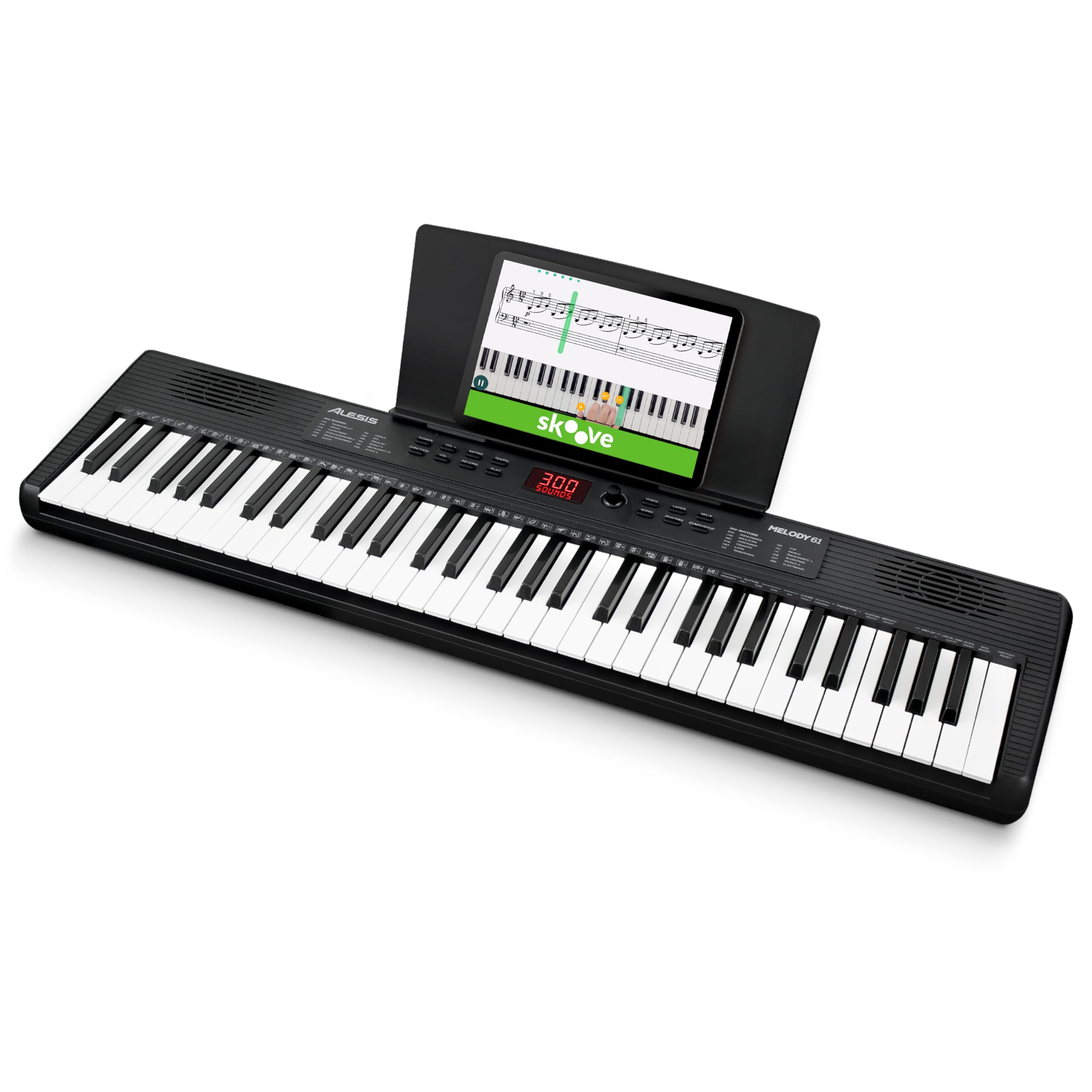
The entry-level champion that packs 300 sounds and USB-MIDI at a price that is tough to top.
The Alesis Melody 61 MK4 is the keyboard you buy when you are not sure if you or your child will stick with piano lessons — and you do not want to spend a fortune finding out. It also includes a full-back sheet music stand, a power adapter, and free access to online piano lessons from Skoove and Melodics.
For connectivity, it has a USB-MIDI port for connecting to a computer or tablet, a 1/4″ sustain pedal input, an 1/8″ aux input for playing along with your phone, and a headphone jack that mutes the speakers for private practice. Reviewers consistently note that it is lightweight and sounds good for the price, with one buyer saying, “Lightweight, good sound; basic piano sound imperfect but great for under.” Another reviewer praised its FL Studio/DAW compatibility for recording. The limitation is the non-weighted keys — they lack any touch sensitivity, so you cannot control volume by how hard you press. The basic piano tone is also not the richest, which matters if you are a parent hoping your child develops a love for piano specifically. The 6.6-pound weight makes it the lightest traditional (non-folding) keyboard here, at 6.6 pounds versus the Yamaha models at 8.8 pounds.
Starter Power
- 300 sounds and 300 rhythms — huge variety for exploration
- Extremely lightweight at only 6.6 lbs (3 kg)
- USB-MIDI works with DAWs and learning apps
Key Reality
- Non-weighted keys with no touch sensitivity — every note plays at the same volume
- Built-in piano sound is “imperfect” per reviewers, lacking the richness of higher-end models
Perfect entry point for: Absolute beginners, young children, or anyone who wants to test interest in piano without a big investment — the 300 sounds keep it fun even for casual exploration.
Time to upgrade when: You can consistently play a song and start noticing the lack of touch response — that is when you are ready for a Yamaha or Casio with velocity-sensitive keys.
Understanding the Specs
Touch Response (Velocity Sensitivity)
Touch response means the keyboard senses how hard or soft you press each key and changes the volume accordingly. On a non-weighted keyboard without this feature, every note sounds exactly the same loudness no matter how you attack the key. If you want to develop proper finger technique for eventually playing an acoustic piano, touch response is the single most important feature to look for. Among the keyboards here, only the Casio LK-S250 and the Roland GO:KEYS 3 offer this — the rest play every note at a fixed volume.
Polyphony
Polyphony is the number of notes the keyboard can play at the same time. If you play a chord with sustain pedal and the polyphony is too low, notes will drop out or cut off early. Most entry-level keyboards have 32-note or 64-note polyphony. For a beginner playing simple songs with one hand, 32 is fine. Once you start using the sustain pedal and playing complex chords with both hands, 64-note polyphony (like the The ONE Smart Keyboard COLOR offers) gives you more headroom before notes get stolen.
Lighted Key Systems
Lighted keys guide you by turning on the LED above the next key to press. These systems can be built-in (the keyboard lights keys for its preloaded songs) or app-based (the lights sync with a phone or tablet app that streams any song). The Casio LK-S250 uses built-in lighted keys for its lesson songs, while The ONE Smart Keyboard COLOR relies on its app to drive the lights. Important: the app-based system on The ONE keyboard only works with iOS devices, not Android — always verify compatibility before buying an app-driven keyboard.
Built-in Sounds and Rhythms
Manufacturers list the number of sounds (timbres) and rhythms as a selling point, but the real question is how many you will actually use. A keyboard with 300 sounds might have 10 usable piano tones and 290 forgettable synth noises. What matters more is the quality of the core sounds — the acoustic piano, electric piano, organ, and strings. Yamaha and Roland are known for having the best-sounding built-in voices in the budget and mid-range space, while lesser-known brands may offer more sounds but with thinner audio quality.
FAQ
Can a 5 octave keyboard play most beginner songs?
Is touch response important for a child beginner?
How do lighted keys work on these keyboards?
Will a folding 61-key keyboard feel like a real piano?
Can I connect a 5 octave keyboard to a computer for recording?
What is the difference between the Yamaha YPT280 and PSRE283?
Can I use headphones on these keyboards?
How long do the batteries last on portable keyboards?
Which keyboard has the most realistic piano sound?
Final Thoughts: The Verdict
For most people, the 5 octave keyboard winner is the Casio Casiotone LK-S250 because it combines lighted key teaching, touch-responsive keys, and 400 tones in a portable package that genuinely accelerates self-learning. If you want the ultimate music creation tool with professional-grade sounds and a chord sequencer, grab the Roland GO:KEYS 3. And for the most affordable entry point with zero risk, the Alesis Melody 61 MK4 gives you 300 sounds and USB-MIDI at a price that lets you test the waters without regret.
How We Picked
We do not accept paid placement, and we did not hands-on test every unit. Instead, we match each pick to a real buyer and use-case by comparing the manufacturers’ published specifications against the patterns in verified customer reviews — so you get each pick’s real strengths and trade-offs instead of marketing copy.
Sources & Methodology
Specifications: manufacturer listings and product documentation. Review insights: verified customer reviews, as of July 2026. Pricing: not shown on this page (it changes often); check the current price via the retailer link.
As an Amazon Associate, Gadgets Feed earns from qualifying purchases. This does not affect which products we feature.
Product prices and availability are accurate as of the date/time indicated and are subject to change. Any price and availability information displayed on Amazon at the time of purchase will apply to the purchase of this product. As an Amazon Associate I earn from qualifying purchases.
CERTAIN CONTENT THAT APPEARS ON THIS SITE COMES FROM AMAZON. THIS CONTENT IS PROVIDED "AS IS" AND IS SUBJECT TO CHANGE OR REMOVAL AT ANY TIME.
Amazon and the Amazon logo are trademarks of Amazon.com, Inc. or its affiliates.