
Our readers keep the lights on and my morning glass full of iced black tea. As an Amazon Associate, I earn from qualifying purchases.
Specs are compiled from manufacturer listings and verified buyer reviews and can change over time — please confirm the key details on the product page before buying.
You walk into your home office, and your video call freezes. You move to the basement, and your texts won’t send. Weak cell signal turns everyday tasks into a guessing game of where the bars are. A 5g signal booster for home fixes that by grabbing the faint signal outside your house and rebroadcasting it stronger indoors — so you get clear calls and fast data no matter which room you are in.
I’m Min — the founder and writer behind Gadgets Feed. This guide is built by comparing the manufacturers’ published specifications and the patterns across verified customer reviews, so you get each pick’s real strengths and trade-offs instead of marketing spin.
The right booster turns a dead-zone home into a place where every device works. This article covers seven of the best options, from budget-friendly single-room units to premium whole-house kits, with honest feedback from real buyers.
Quick Picks
- ZORIDA 5S Ultra — Best Value
- HiBoost PLUS 10K — Mid-Size Champ
- SureCall Fusion4Home Max — Best Overall
- HiBoost 10K SL — App-Enabled
- HiBoost 8K 2.0 — Multi-Room Power
- HiBoost 15K 2.0 SL — Large Home Hero
- CEL-FI GO G41 — Ultimate Power
How To Choose The Best 5G Signal Booster For Home
A booster is not a magic box. It needs a tiny sliver of usable signal outside to amplify. The better you match the booster to your home’s size and your carrier’s frequencies, the more reliable your connection will be.
Coverage Area vs. Your Real Floor Plan
Every booster lists a maximum square footage — for example, 4,500 sq ft or 6,500 sq ft. That number assumes an open space with few walls. In a real home with multiple floors, concrete, or steel framing, your actual coverage will be smaller. Buy a unit rated for roughly twice the size of the area you want to cover.
The Right Frequency Bands for Your Carrier
Your cell carrier broadcasts on specific frequency bands. Verizon uses Band 13 (700 MHz) and Band 4 (1700/2100 MHz). AT&T relies on Band 12/17 (700 MHz) and Band 2 (1900 MHz). T-Mobile uses Band 12, Band 2, and Band 71 (600 MHz) — but many boosters lack Band 71. Check the supported bands in the specs and match them to what your carrier uses in your area using a tower-finder app.
Antenna Gain and Signal Strength
Antenna gain, measured in dB (decibels), tells you how powerfully the booster pulls in a weak signal. A gain of 70 dB to 72 dB is common for home boosters. The highest gain units, like the CEL-FI GO G41 at 100 dB, can reach faraway towers that lower-gain units cannot touch.
Quick Comparison
On smaller screens, swipe sideways to see the full table.
| Model | Best For | Coverage | Gain | Key Feature | Amazon |
|---|---|---|---|---|---|
| ZORIDA 5S Ultra | Easy single-room fix | 4,500 sq ft | 72 dB | 3-year warranty | $179.99$219.99Limited time dealAmazon |
| HiBoost PLUS 10K | Mid-size homes up to 5,500 sq ft | 5,500 sq ft | — | App + LCD alignment | $418.89Amazon |
| SureCall Fusion4Home Max | Rural homes needing maximum reach | 6,500 sq ft | — | Patented ERT outdoor range | $499.99Amazon |
| HiBoost 10K SL | Large homes with app monitoring | 5,500 sq ft | — | SignalSupervisor app + LCD screen | $539.99Amazon |
| HiBoost 8K 2.0 | Multi-room, multi-user homes | 8,000 sq ft | 70 dB | 2 indoor antennas, AGC | $599.99Amazon |
| HiBoost 15K 2.0 SL | Two-story homes up to 12,000 sq ft | 12,000 sq ft | 72 dB | 400-type cable, 2 panel antennas | $1,029.99Amazon |
| CEL-FI GO G41 | Extreme rural, huge homes | 15,000 sq ft | 100 dB | 4th-gen chipset, 2x dome+panel antennas | $1,999.99Amazon |
In‑Depth Reviews
1. ZORIDA 5S Ultra
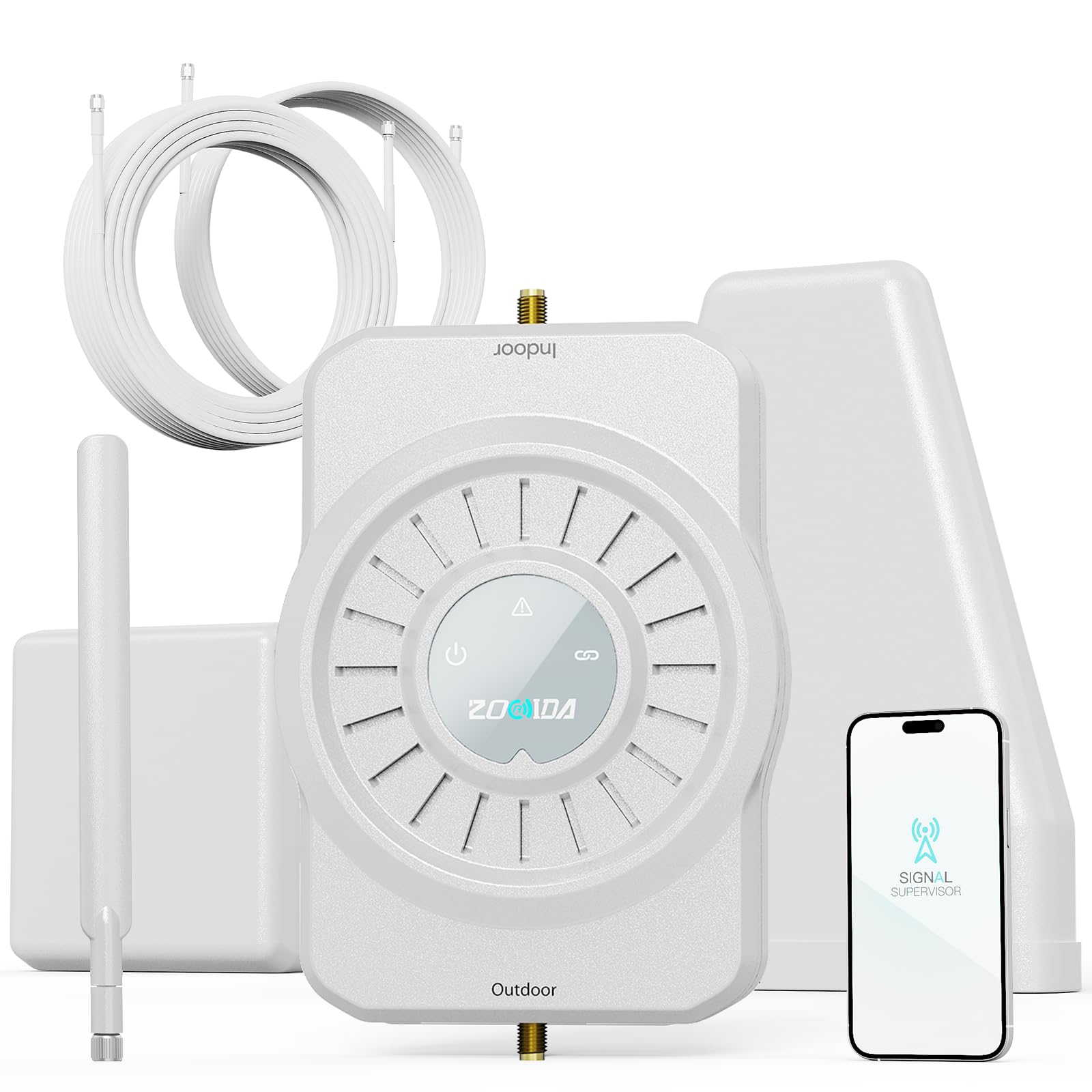
A compact booster that turns two shaky bars into five solid ones for under.
This ZORIDA unit covers up to 4,500 square feet, making it a strong fit for a typical single-floor home or a basement office. It works with all U.S. carriers — Verizon, AT&T, T-Mobile — and supports 5G and 4G LTE. The off-white enclosure is just 8 inches deep by 6 inches wide by 1 inch tall, so it tucks onto a shelf without standing out. Buyers report it “improved from 1-2 unreliable bars to 5 solid bars, enabling HD streaming.”
Setup requires aiming the outdoor directional antenna at the nearest tower, then keeping the indoor antenna separated from it by enough space to avoid signal loopback. Some reviewers mention the printed instructions are poor, but the tech support team — repeatedly praised by name — helps walk you through it. At 72 dB of gain, it is not the most powerful unit here, but for a standard suburban home it gets the job done without the premium price tag.
The key difference vs. the SureCall Fusion4Home Max below: the SureCall covers 6,500 sq ft (2,000 sq ft more) and uses patented extended-range technology to reach farther towers, but costs more than double the ZORIDA.
Ultra 5G speed
- Lowest price among the five picks but still FCC-certified and 5G-compatible
- Buyers consistently praise fast, knowledgeable customer support
- Small footprint — 1 inch thick — fits nearly anywhere
Setup complexity
- Coverage area (4,500 sq ft) is the smallest on this list
- Setup instructions are vague; expect to rely on support or third-party tower apps
- Outdoor antenna needs precise aiming and separation for best results
fastest data: you need an affordable fix for a single room or a modest home and do not mind spending a bit of time on setup.
simple install: your home spans two stories or you need to cover more than 4,500 square feet without adding a second unit.
2. HiBoost PLUS 10K
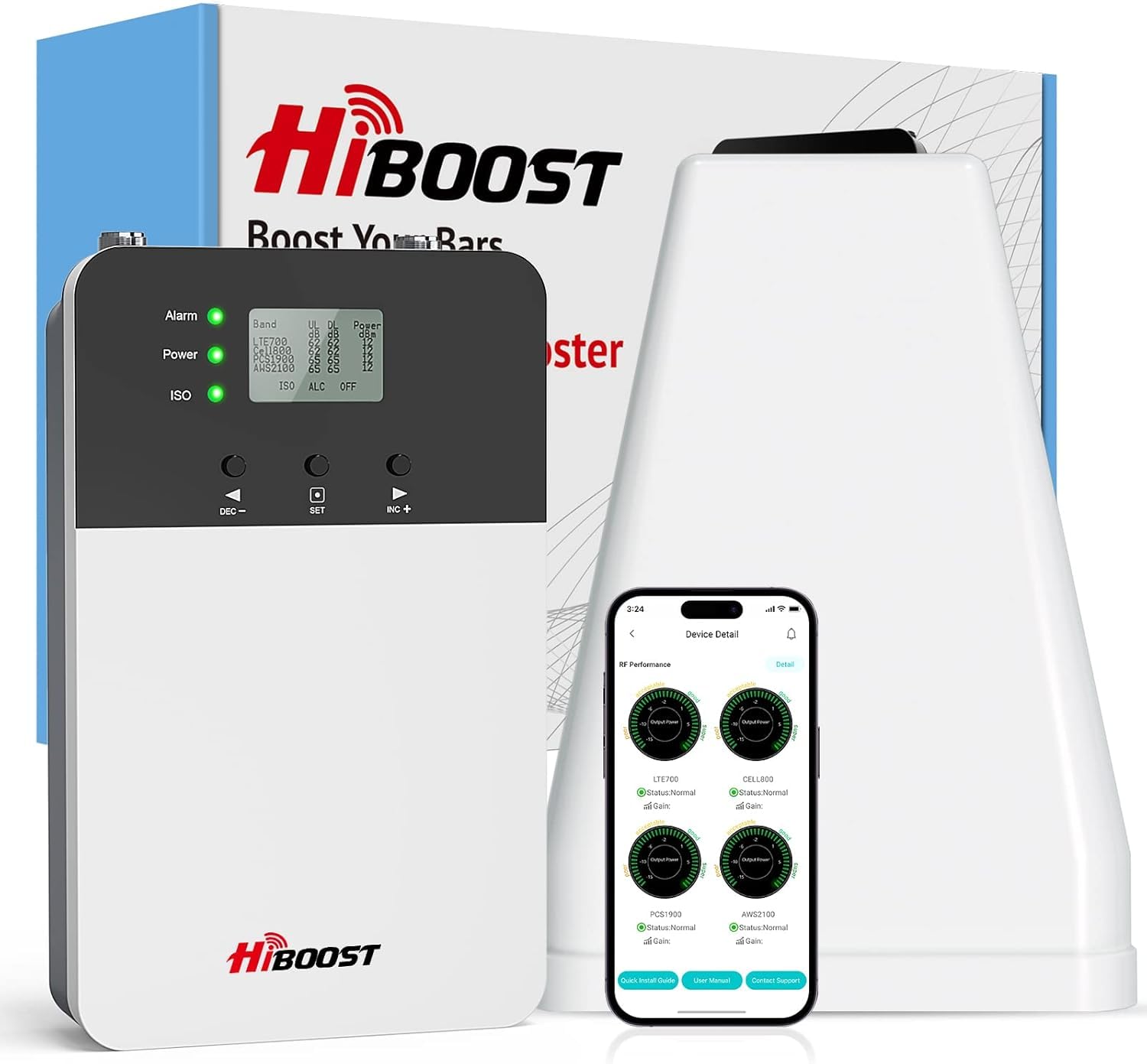
The mid-range booster that turned a basement from zero bars to a usable 40 Mbps.
HiBoost’s PLUS 10K is built for homes up to 5,500 square feet and supports all U.S. and Canadian carriers. It comes with an LCD display on the booster unit itself that simplifies antenna alignment — you can see signal strength changes in real time rather than guessing. One reviewer noted that in a basement with no signal, the unit delivered “0 to 2-3 bars, 40Mbps.”
That same buyer mentioned installation needed two people, and the cable connections can be confusing at first (you must use both included cables). The outdoor antenna placement takes some trial and error, but once it is locked in, the coverage is stable enough for remote work. The unit also works with an app for monitoring, though reviews describe the app as basic.
Compared to the ZORIDA above, the HiBoost PLUS 10K covers about 1,000 more square feet and adds the LCD guiding tool — helpful if you want a clearer picture of what your signal is doing during setup.
Strong 10K gain
- LCD display on the booster helps dial in antenna direction without guesswork
- Coverage area (5,500 sq ft) suits most mid-size homes
- Owners mention stable signal for remote work after setup
Bulky amplifier
- Install can be a two-person job; cable connections are not entirely intuitive
- App functionality is basic, not a full remote-control experience
- Outdoor antenna requires a line-of-sight path, which may not exist in dense woods or hilly terrain
large homes: you have a 3,000–5,000 square foot home and want the LCD alignment help that makes setup less frustrating.
small spaces: your home is on one floor and smaller than 2,500 sq ft — the ZORIDA will save you money with similar results.
3. SureCall Fusion4Home Max
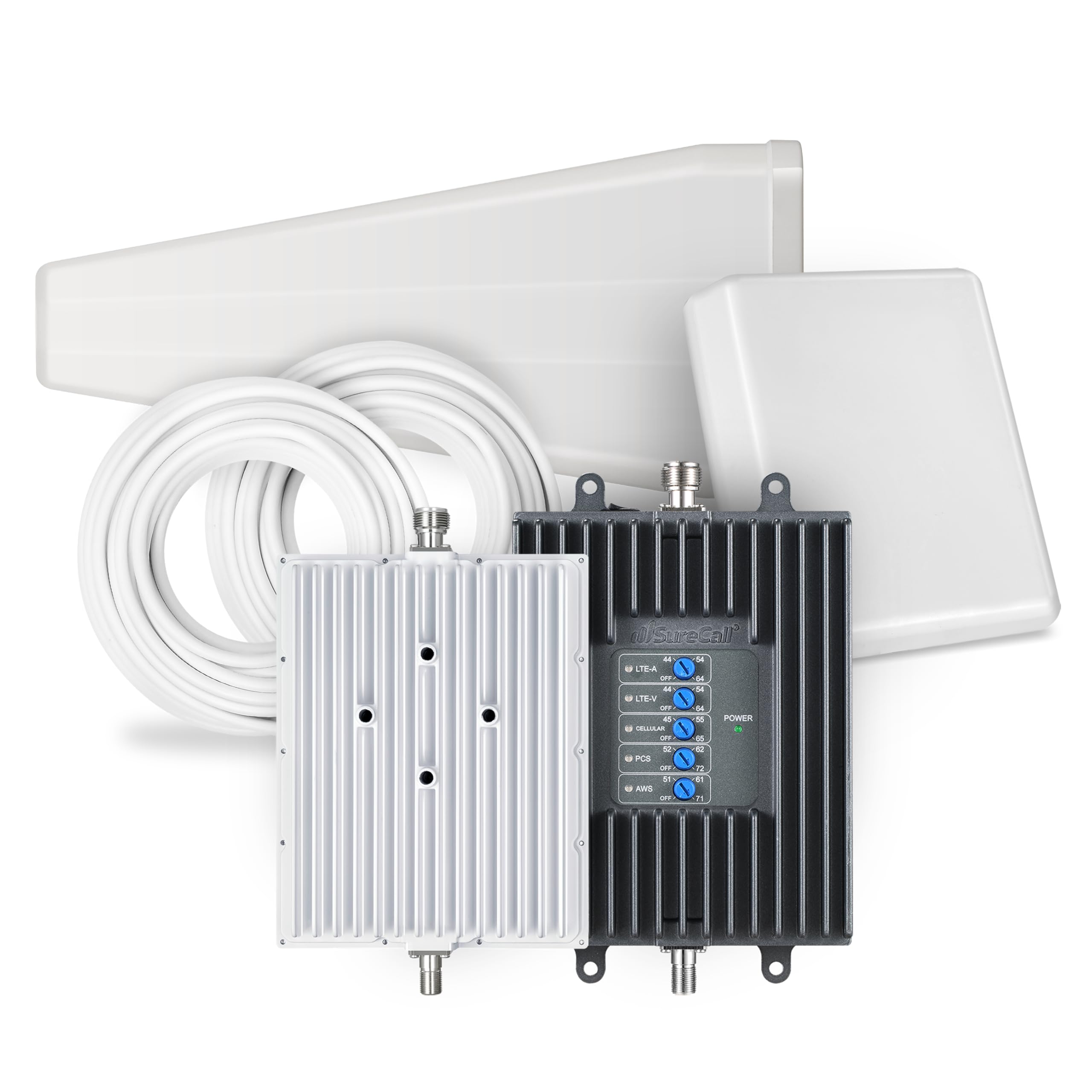
The most powerful home booster from a US-based brand — designed to pull signal from faraway towers.
SureCall’s Fusion4Home Max is the biggest home booster from a company that designs and assembles in the U.S. Its patented Extended Range Technology (ERT) works by amplifying the signal at its strongest point outside the building before sending it indoors. The rated coverage is 6,500 square feet, and it handles all U.S. carriers. Customers note it “increased signal strength by ~15 dB” — a meaningful jump that turns dropped calls into reliable conversations.
You get a 3-year warranty and lifetime U.S.-based support, so help is available if something goes wrong. One owner mounted the antenna in the attic and ran coaxial cable to the basement — installation is straightforward. The antenna swivels 180°, which helps when the nearest tower is not where you expected. The unit supports simultaneous connections for phones, tablets, and hotspots. One catch: you need at least a weak signal outside — the booster cannot invent signal from nothing.
By the numbers, the SureCall’s 6,500 sq ft is 2,000 sq ft more than the ZORIDA’s 4,500 sq ft, and its ERT tech gives it an edge in rural terrain where every decibel counts.
Multi-carrier support
- Extended Range Technology amplifies signal at the outdoor source for better reach
- Made in the USA with FCC certification — legal and safe on any carrier’s network
- Easy installation with clear documentation, according to buyers
High price
- More expensive than the HiBoost PLUS 10K, with roughly 1,000 sq ft less coverage
- Data speeds in far corners of the house (like the den) can still be slow
- Requires strict antenna separation and orientation to avoid signal interference
carrier flexibility: a rural or suburban home where the nearest tower is far and every dB of gain matters for stable calls.
budget pick: your property has a clear line-of-sight to a tower less than a mile away — a lower-gain unit will work fine and cost less.
4. HiBoost 10K SL

A 5,500 sq ft booster that lets you tune the antenna from your phone via Bluetooth.
The HiBoost 10K SL uses the company’s “SignalSupervisor” app and a built-in LCD screen to guide installation. The app also lets you see real-time signal strength as you adjust the outdoor antenna — a big help when you are up on the roof alone. The booster covers up to 5,500 square feet and supports bands 12, 13, 17, 5, 25, 2, and 4, which covers Verizon, AT&T, and T-Mobile. One reviewer in a forested valley went from under 1 Mbps to 25 Mbps down, 9 Mbps up after tuning the antenna with the app.
It weighs 2.2 kg and measures 2 inches deep by 8.6 inches wide by 6.5 inches tall — noticeably thicker than the ZORIDA but still manageable on a shelf. The kit includes a through-window cable so you do not need to drill holes. Some users note the app occasionally loses Bluetooth connection, and the booster lacks band 71 (600 MHz), which T-Mobile uses for long-range rural coverage.
Slim design
- Bluetooth app significantly simplifies finding the right antenna direction
- Through-window cable means no drilling for installation
- Reviewers point out huge speed gains — from <1 Mbps to 25 Mbps down
Limited range
- No support for T-Mobile’s Band 71 (600 MHz), important in deep-rural areas
- App connectivity can be flaky during setup
- Coverage drops quickly through multiple floors and walls
discreet look: tech-savvy homeowners who want to fine-tune antenna placement from their phone without a second person on the roof.
wide coverage: you are on T-Mobile in a rural area — the missing Band 71 support may leave you with weak results.
5. HiBoost 8K 2.0

A high-gain kit with two indoor antennas to cover multiple rooms without dead spots.
The HiBoost 8K 2.0 delivers up to 70 dB of gain and covers up to 8,000 square feet using two indoor antennas — one built into the main unit and one separate panel antenna. That second antenna means you can place the panel in a far room while the booster handles the rest of the house. It supports all major U.S. carriers and works on bands 2, 4, 5, 12, 13, 17, and 25. The built-in Automatic Gain Control (AGC) adjusts the booster’s power automatically, so you do not have to fiddle with settings when signal conditions change.
Buyers in multi-level homes — one buyer mentioned a 4,500 sq ft, 3-floor house — report that dropped calls stopped completely after installation. Another owner in a forested valley went from less than 1 Mbps to 25 Mbps down, 9 Mbps up. The unit comes with a 3-year warranty and lifetime U.S.-based support. The main drawback is that the 8,000 sq ft rating assumes an open floor plan; real-world coverage in a divided house may be noticeably less.
Balanced 8K power
- Two indoor antennas give better coverage across separated rooms and multiple floors
- AGC (Automatic Gain Control) handles signal adjustments automatically
- Buyers in challenging terrain saw speeds jump from <1 Mbps to 25 Mbps down
No app control
- Real-world coverage in a divided house is smaller than the 8,000 sq ft rating
- More expensive than single-antenna models with similar rated coverage
- Setup still requires careful outdoor antenna placement and separation from indoor units
mid-size homes: you have a multi-room home or office where one antenna cannot reach the far side of the building.
app users: your home is open-plan and under 4,000 sq ft — the ZORIDA or HiBoost PLUS 10K will cover it for less.
6. HiBoost 15K 2.0 SL

The big brother in the HiBoost line — 12,000 sq ft of coverage with 72 dB of gain and two panel antennas.
This HiBoost model is designed for two-story homes and large open offices. It includes two indoor panel antennas that can be placed in different rooms or on different floors to distribute the boosted signal evenly. The unit uses thicker 400-type coaxial cable for the outdoor connection, which reduces signal loss over long cable runs — a real advantage when the outdoor antenna has to be far from the booster. The built-in AGC (Automatic Gain Control) keeps the booster running optimally as conditions change.
Buyers in 4,500 sq ft, 3-floor homes found that dropped calls on Verizon and AT&T stopped. Another owner in a forested valley got 25 Mbps down, 9 Mbps up from a 1-bar starting point. The app and LCD display help with antenna alignment. The unit does not support Band 71 (600 MHz), which matters for T-Mobile users in deep-rural areas. At 2.2 kg and 8.6 inches deep by 6.5 inches wide by 2 inches tall, it is a substantial piece of equipment.
Top 15K output
- 12,000 sq ft coverage with two panel antennas for multi-room distribution
- 400-type cable minimizes signal loss on long outdoor cable runs
- AGC and app/LCD guide smooth installation and auto-adjustment
Overkill for most
- No Band 71 support — T-Mobile rural users may not get optimal speeds
- Premium price reflects the larger coverage area
- Requires at least one bar of usable signal outdoors to function
extreme range: a two-story home or large office where you need to push signal into far rooms and across multiple floors.
typical use: a single-story home under 5,000 sq ft — the HiBoost 8K 2.0 or SureCall Fusion4Home Max will cover it at a lower cost.
7. CEL-FI GO G41
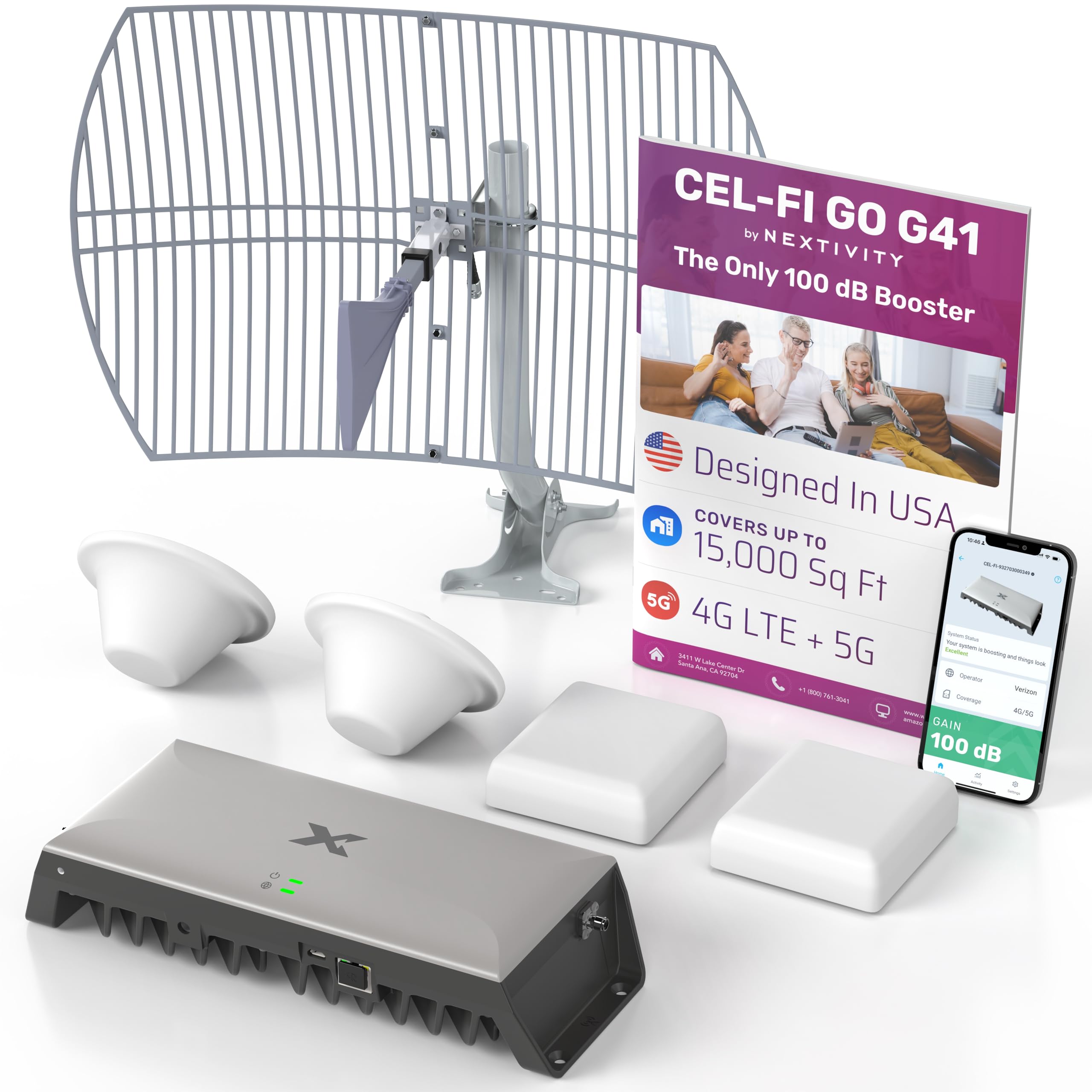
The 100 dB beast that pulls signal from miles away — the strongest consumer booster available.
Nextivity’s CEL-FI GO G41 is in a different league from the others here. It delivers 100 dB of gain — 30 dB more than typical home boosters — and covers up to 15,000 square feet. The 4th-generation IntelliBoost chipset supports 4G LTE, 5G-DSS, and 5G NR. The kit includes two dome antennas and two panel antennas (you use two and keep the others as spares). One buyer in a remote “holler” with zero cell service went to 3-4 consistent 4G bars across a 2,000 sq ft farmhouse, with fast data and reliable streaming.
Setup takes a full day according to some owners, but the WAVE app helps find the best antenna position. The booster amplifies only two frequency bands at a time (bands 2 and 12), which can cause issues if your carrier uses carrier aggregation with other bands like 30 or 66 — your phone may prefer those and ignore the boosted bands. Still, for extreme rural locations where no other booster works, the G41 is the most capable option on the market.
Enterprise reliability
- 100 dB gain — 30 dB more than standard boosters, reaching towers other units cannot
- 15,000 sq ft coverage, the largest on this list
- Includes 2 dome and 2 panel antennas for flexible indoor placement
Professional install
- Only amplifies 2 bands at a time; carrier aggregation with other bands may reduce effectiveness
- Premium price — the most expensive unit by a wide margin
- Installation can take a full day and requires patience with antenna positioning
business grade: extreme rural locations, metal-roof cabins, or any scenario where you have zero usable signal and need the most brute-force amplification.
DIY setup: you have a typical suburban home with at least one bar of outdoor signal — the SureCall or HiBoost units will work well for a fraction of the cost.
Understanding the Specs
Coverage Area in Square Feet
This number tells you the maximum open-floor space the booster can cover. In a real home with walls, furniture, and multiple floors, expect about half the rated coverage. So if a booster says 5,500 sq ft, it will realistically handle a 2,500–3,000 sq ft single-story house. For a two-story home, look for units rated at least 8,000 sq ft.
Gain in dB (Decibels)
Gain measures how much the booster amplifies the incoming signal. A typical home booster offers 70–72 dB. At 100 dB, the CEL-FI GO G41 can grab signals from towers that are much farther away. Higher gain usually means a larger outdoor antenna and more careful installation to avoid feedback between the indoor and outdoor antennas.
FAQ
Will any 5G signal booster work with my carrier?
How do I know if my home has enough outdoor signal for a booster to work?
Can I install a 5G signal booster myself, or do I need a professional?
How long does a typical 5G signal booster last?
What is the difference between a 5G booster and a 4G LTE booster?
Will a signal booster interfere with my neighbors’ cell signals?
Do I need to register my signal booster with my carrier?
Can I use a 5G signal booster with a metal roof or metal siding?
What happens if I move to a new house — can I take the booster with me?
Why does my booster need at least some outdoor signal to work?
Final Thoughts: The Verdict
For most buyers, the 5g signal booster for home winner is the SureCall Fusion4Home Max because it pairs the largest coverage area among mid-priced units (6,500 sq ft) with patented Extended Range Technology that reaches distant towers, all backed by a U.S.-based company and strong buyer reviews. If you want app-guided tuning and a slightly lower price, grab the HiBoost 10K SL. And for extreme rural locations where you have zero signal and need brute-force 100 dB gain, the standout is the CEL-FI GO G41.
How We Picked
We do not accept paid placement, and we did not hands-on test every unit. Instead, we match each pick to a real buyer and use-case by comparing the manufacturers’ published specifications against the patterns in verified customer reviews — so you get each pick’s real strengths and trade-offs instead of marketing copy.
Sources & Methodology
Specifications: manufacturer listings and product documentation. Review insights: verified customer reviews, as of July 2026. Pricing: not shown on this page (it changes often); check the current price via the retailer link.
As an Amazon Associate, Gadgets Feed earns from qualifying purchases. This does not affect which products we feature.
Product prices and availability are accurate as of the date/time indicated and are subject to change. Any price and availability information displayed on Amazon at the time of purchase will apply to the purchase of this product. As an Amazon Associate I earn from qualifying purchases.
CERTAIN CONTENT THAT APPEARS ON THIS SITE COMES FROM AMAZON. THIS CONTENT IS PROVIDED "AS IS" AND IS SUBJECT TO CHANGE OR REMOVAL AT ANY TIME.
Amazon and the Amazon logo are trademarks of Amazon.com, Inc. or its affiliates.