
Our readers keep the lights on and my morning glass full of iced black tea. As an Amazon Associate, I earn from qualifying purchases.
Specs are compiled from manufacturer listings and verified buyer reviews and can change over time — please confirm the key details on the product page before buying.
That orange TPMS (tire pressure monitoring system) light on your dash can mean a sensor battery died. You want a sensor that lasts years and fixes the warning, not one that fails in months. This guide looks at six battery-powered packs and picks the ones with real staying power versus those that might leave you with the light still on.
I’m Min, founder of Gadgets Feed. I built this by comparing maker specs and verified buyer reports, so you get each pick’s real strengths and limits.
These picks cover the most common 433 MHz and dual-frequency (433 MHz + 315 MHz) options for vehicles like a Chevy Silverado or a Ram 2500. You will find a clear take on the best battery tpms sensor for your model.
Quick Picks
- CDWTPS TPMS Sensor Dodge,4 Pack 433MHz Tire Pressure Monitoring System Sensor — Best Overall
- Autel TPMS Sensors Set of 4, MX TPMS Sensor 315MHz + 433MHz — Pro-Grade Universal
- Masoll TPMS Sensor for GM, 2026 New Upgrade Dual-Antenna Design 4-Pack — Strong Signal Pick
- A-Premium 4PCS Pre-Programmed TPMS Sensor — Certified Pick
- 433Mhz TPMS Sensor, GM Tire Pressure Monitoring System Sensor Compatible (Jsueng) — Best Value GM
- RENECTIV TPMS Sensor,4pcs 433MHz Tire Pressure Monitor Sensors — Budget Entry
How To Choose The Best Battery TPMS Sensor
A battery-powered TPMS sensor (a small electronic unit that screws into your tire valve stem and wirelessly sends pressure data to your car’s computer) uses an internal battery. Most makers claim 5–8 years of life; some claim 10 years. Actual life depends on how hot or cold it gets where you live and how many miles you drive daily.
Battery Chemistry: CR2032 vs CR2050
Most sensors use a flat CR2032 coin cell (the same battery type as a key fob). Higher-end models pack a CR2050, which holds more capacity (milliamp-hours). A CR2050 typically means longer service life, but the real factor is how much power the sensor’s chip draws while the sensor is asleep between drives.
Pre-Programmed vs Universal Programmable
Pre-programmed sensors arrive matched to a specific list of vehicle years and models from the factory. You install them, do a relearn (the process of pairing them to your car), and they work. Universal programmable sensors (like Autel’s MX) are blank. You need a dedicated TPMS tool (also from Autel) to write the vehicle data onto the chip. Pre-programmed is simpler for a DIY job; programmable is better for a shop that stocks one sensor for many different cars.
Dual-Frequency (315+433 MHz) vs Single-Frequency
If your car uses 315 MHz and you buy a 433 MHz sensor, it will never wake up. Dual-frequency sensors combine both radio bands in one unit, so you never have to guess which frequency your car uses. That is useful if you own a mix of domestic and Asian cars, or if the parts catalog is unclear about your model year.
Quick Comparison
| Model | Best For | Battery Claim | Frequency | Item Weight | Amazon |
|---|---|---|---|---|---|
| CDWTPS TPMS Sensor Dodge | Longest claimed battery life | Up to 10 years | 433 MHz | 5.3 oz | $28.99$35.99Amazon |
| Autel MX-Sensor 4 Pack | Universal DIY/shop tool | OEM-level | 315 + 433 MHz | 0.03 lbs | $109.00Amazon |
| Masoll TPMS Sensor | Dual-antenna signal strength | More than 5 years | 315 + 433 MHz | — | $37.99Amazon |
| A-Premium TPMS Sensor | Certified quality + aluminum valve | Ultra-long | 433 MHz | 0.15 kg | $37.99$42.49Amazon |
| 433Mhz TPMS Sensor (Jsueng) | Budget-friendly GM option | Up to 5-8 years | 433 MHz | 4.9 oz | $27.95Amazon |
| RENECTIV TPMS Sensor | Entry-level value pack | Up to 5-8 years | 433 MHz | 0.14 kg | $28.99Amazon |
In‑Depth Reviews
1. CDWTPS TPMS Sensor Dodge,4 Pack 433MHz Tire Pressure Monitoring System Sensor
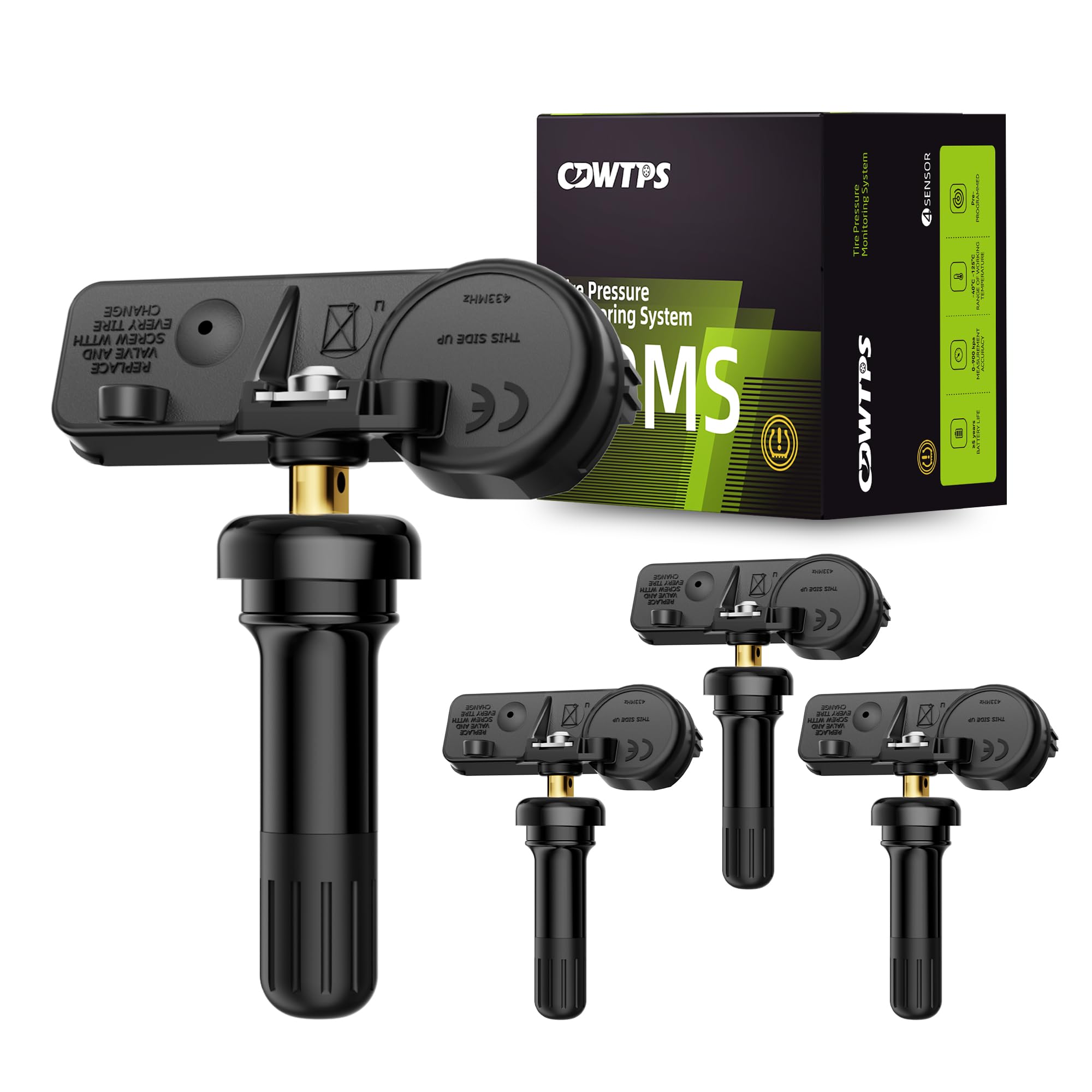
The Dodge/Jeep/Ram pack with a ten-year battery claim that real buyers report really delivers.
What matters most when you replace TPMS sensors is that the warning light goes off and stays off for years. The CDWTPS pack claims a 10-year battery life — that is twice the typical 5–8 year claim of most competitors — so you change sensors half as often. A buyer with a 2014 Wrangler wrote that the sensor “turned off after 10 years with the TPMS light on.” That is the kind of longevity you want. The package measures 4.8 x 3.07 x 2.68 inches, making the set about 13% larger in volume than the Jsueng GM set, but the payoff is that claimed decade of service.
These are pre-programmed specifically for Chrysler, Dodge, Jeep, and Ram vehicles (OE numbers like 56029398AB and 68241067AA). A buyer on a 2015 Durango reports the sensors began working immediately — even before driving the car — with zero programming steps beyond installation. The whole pack weighs 5.3 ounces, just 8% more than the lighter Jsueng set. One caution: a buyer with a 2012 Ram 2500 had the sensors fail to respond to a TPMS programmer, so check your specific model year before you order.
If you drive a Chrysler, Dodge, or Ram and want the longest possible battery life from a single-frequency (433 MHz) sensor pack, this is the one to beat.
What Makes It Stand Out
- Claimed 10-year battery life — longest in this lineup, twice the 5–8 year claim of the Jsueng and RENECTIV packs
- No programming needed after installation, per multiple buyer reports (a 2015 Durango owner saw it work before driving)
- Fits Chrysler/Dodge/Jeep/Ram with OE numbers like 56029398AB and 68241067AA
The Real Trade-off
- One buyer’s 2012 Ram 2500 sensors did not respond to a TPMS programmer at all
- Only 433 MHz — no dual-frequency fallback for vehicles that use 315 MHz
- Heavier than the GM-focused Jsueng set at 5.3 oz versus 4.9 oz
Grab it if: you need a reliable, long-lasting sensor pack for a Chrysler/Dodge/Jeep/Ram and want the strongest battery-life claim in the category.
Look elsewhere if: you drive a GM vehicle or a model year that might use 315 MHz, since this is 433 MHz only and Chrysler-specific.
2. Autel TPMS Sensors Set of 4, MX TPMS Sensor 315MHz + 433MHz
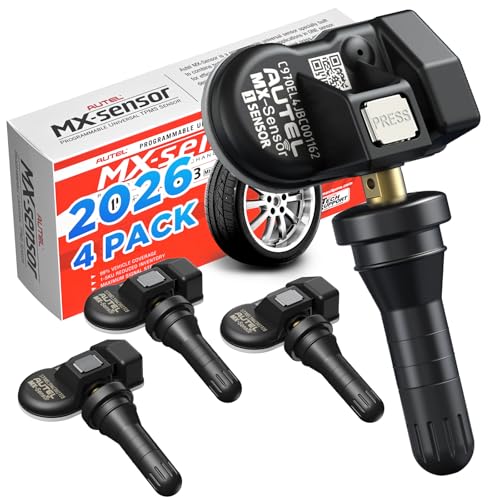
The universal sensor that covers 99% of cars from one box — but you need the Autel tool to program it.
Autel’s MX sensor is not pre-programmed. It is a blank sensor that you write vehicle data onto using an Autel TPMS programming tool (sold separately, like the TS408S or TS508). That makes it different from every other pick here. One sensor covers both 315 MHz and 433 MHz bands, so you never have to guess which frequency your car uses. The sensor weighs only 11 grams — far lighter than the 4.9-ounce Jsueng pack — and owners mention that reduces stress on the valve stem over time.
Customers note that Autel sensors “operated flawlessly since” a 2020 install on a Ford Explorer, and another owner used them on a BMW 645Ci with no issues years later. One tip from the reviews: if your tire shop lacks a current tool for a 2023 Subaru WRX, you can program this sensor as a 2021 Forester because both use 433 MHz. The catch: these sensors cannot be programmed by any non-Autel tool, so you are locked into Autel’s brand. A reviewer also found a hidden RF issue — a 12V phone charger plugged into the dash blocked the sensor signal during a Ford F250 relearn; unplugging the charger fixed it instantly.
The MX sensor is SAE J1205 / J1206 certified (an industry standard for TPMS performance) and comes with a 24-month or 24,000-mile warranty. The press-in rubber stem makes installation quick. If you already own (or plan to own) an Autel TPMS tool, or if you manage multiple vehicles from different brands, this one universal pack replaces stocking dozens of OEM-specific sensors.
Why Shops and DIY Enthusiasts Like It
- Combines 315 MHz + 433 MHz in one sensor — covers 99% of direct TPMS vehicles, unlike the single-frequency CDWTPS or Jsueng packs
- Lightest sensor in the lineup at 11 grams, reducing stem stress
- Unlimited reprogramming: you can reuse one sensor on a different vehicle later
The Real Catch
- Requires an Autel TPMS tool (sold separately) to program — no other brand tool works
- Premium price is the highest in this comparison, though each sensor is reusable
- Not compatible with 12V/24V commercial vehicles or Bluetooth-based TPMS like Tesla
Best for: the tech-savvy DIYer or shop owner who already has an Autel TPMS tool and wants one sensor that works across everything from Ford to BMW to Chevy.
skip it if: you have no Autel tool and just want sensors you can install and drive — a pre-programmed pack will be simpler and cheaper.
3. Masoll TPMS Sensor for GM, 2026 New Upgrade Dual-Antenna Design 4-Pack
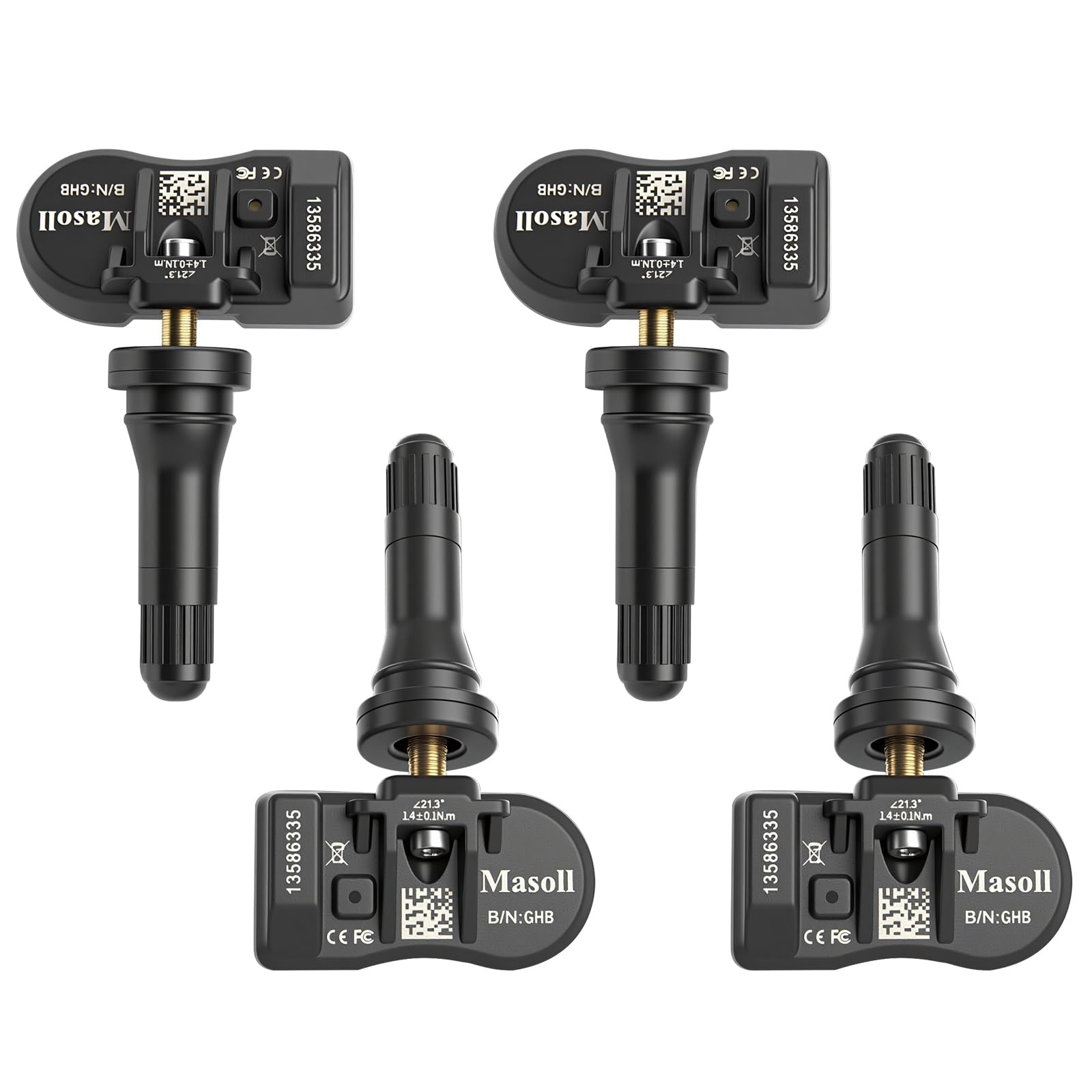
A dual-antenna design that keeps the signal strong on big GM trucks and SUVs.
Long-wheelbase vehicles like the Silverado, Suburban, or Yukon can sometimes lose the sensor signal because the tire is far from the car’s receiver. Masoll uses a dedicated dual-antenna design specifically for full-size GM trucks and SUVs. The sensor is also a 2-in-1, covering both 315 MHz and 433 MHz frequencies, so you do not need to check which band your GM uses. It includes a high-precision chip that gives you 1.5 psi (pounds per square inch) pressure accuracy, so you can spot a slow leak before it becomes a problem.
Reviewers point out the sensors “paired fine with GMC 3500HD” and “worked great on a 2017 Malibu Premier,” though one noted a sensor was slow to program at first. The automotive-grade CR2050 battery is a step up from the CR2032 used in cheaper packs like the Jsueng set. Masoll backs it with a 24-month warranty. The rubber valves use a smooth molding design intended to resist corrosion — a common failure point for sensors exposed to road salt and moisture. Like most pre-programmed sensors, you still need a relearn step after installation using a TPMS scan tool or GM relearn procedure.
It sits at a mid-premium price point alongside the A-Premium set. If you drive a full-size GM truck or SUV and have had range issues with other sensors, the dual-antenna design is a concrete advantage over the single-antenna CDWTPS or Jsueng packs.
Signal advantage: The dual-antenna design targets long-wheelbase vehicles where single-antenna sensors sometimes lose the signal — a real concern for Silverado and Suburban owners.
Need to know: A relearn procedure with a TPMS scan tool is required; the sensors are pre-programmed for GM but will not auto-pair on installation.
Reach for this if: you drive a large GM truck or SUV and want dual-frequency backup plus dedicated antenna hardware for reliable signal transmission.
Look elsewhere if: you drive a compact car where signal range is not a concern — you can save money with a single-antenna 433 MHz pack like the Jsueng.
4. A-Premium 4PCS Pre-Programmed TPMS Sensor
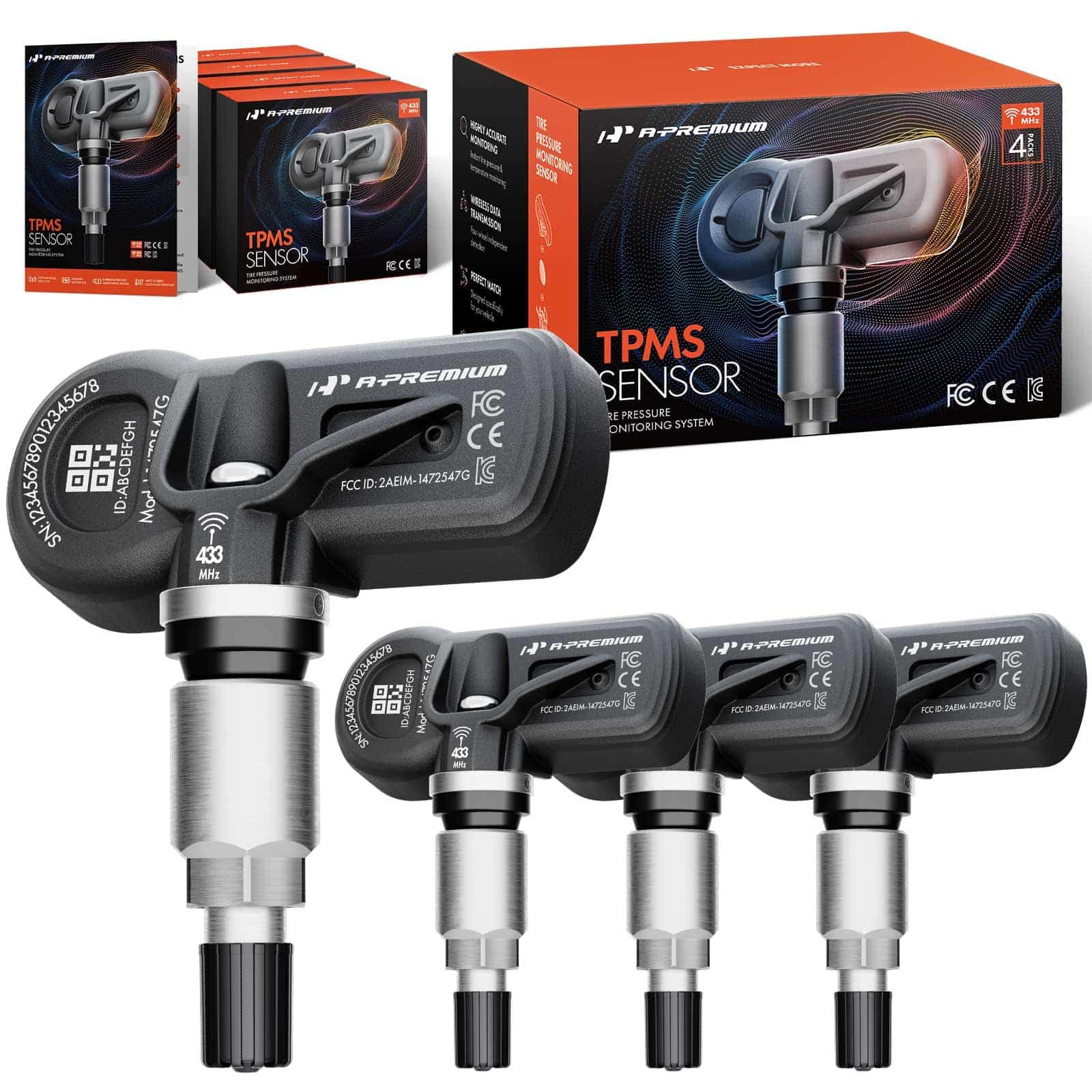
FCC and IC certified with an NXP chip and a metal valve stem for GM crossovers and trucks — better corrosion resistance than the rubber-stemmed Jsueng set.
Many budget TPMS sensors use basic chips and rubber valve stems. The A-Premium pack upgrades to a high-precision NXP semiconductor chip and an aluminum valve stem instead of rubber. The aluminum stem resists corrosion from road salt and handles heat cycles better than rubber — a real advantage if you live in a winter salt-belt region. The sensor is FCC and IC certified (meaning it passed tests for radio interference and signal quality) and tested to SAE J2657 standards (an industry standard for environmental endurance and data accuracy). Its measurement accuracy is ±0.06 Bar (about ±0.87 psi), which is sharper than the 1.5 psi rating on the Masoll sensor.
Shoppers say the sensors “keep great accurate reading” on a 2019 Chevy Malibu with no programming needed beyond the relearn step. One reviewer noted that local tire shops wanted per sensor, making this 4-pack a strong value. However, a buyer with a 2017 Chevy Silverado reported the sensor was “not responding” even after a mechanic tried, so check your specific trim. The CR2050 battery (larger than the usual CR2032) is the same upgrade found in the Masoll set, supporting the “ultra-long lifespan” claim. The included mounting hardware and clear manual make it a straightforward DIY replacement.
The sensor uses a single 433 MHz frequency, so confirm your GM vehicle uses that band before buying. If you want independent certification and an aluminum stem that fights corrosion, this is a strong mid-premium contender.
Build difference: An aluminum valve stem (instead of rubber) and an NXP chip with ±0.06 Bar accuracy — specs that justify the premium over the rubber-stemmed Jsueng set.
Reach for this if: you want a certified sensor with a metal valve stem for durability, especially if you deal with winter road salt.
Look elsewhere if: you drive a vehicle that might use 315 MHz — this pack is 433 MHz only and not dual-frequency.
5. 433Mhz TPMS Sensor, GM Tire Pressure Monitoring System Sensor Compatible (Jsueng)
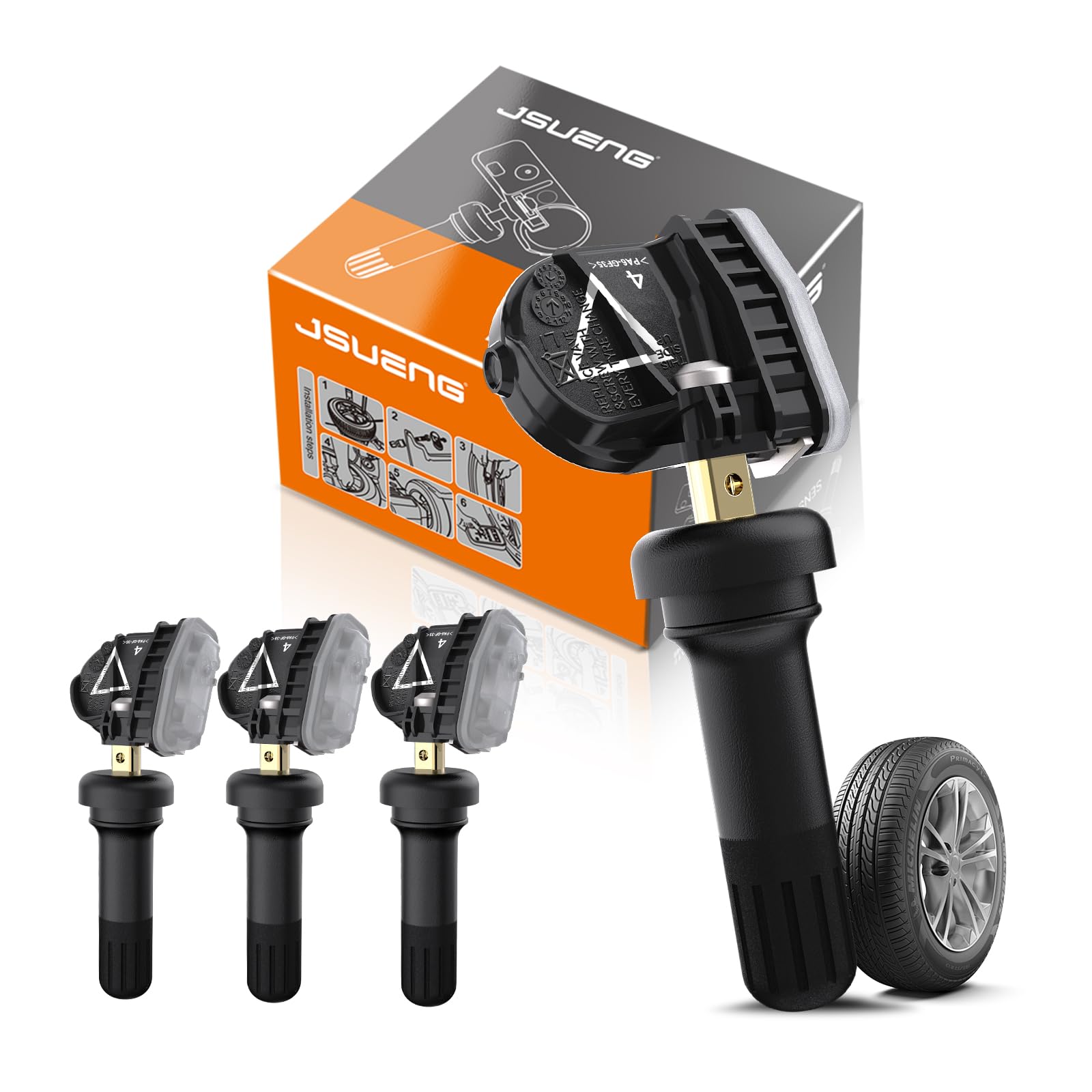
The lightest, most compact GM pack that buyers report “arrived and installed same day”.
At 4.9 ounces total for the 4-pack and measuring 4.25 x 3.54 x 2.44 inches, this Jsueng set is the lightest and smallest of the GM-compatible sensors. Lighter sensors put less stress on the valve stem over years of high-speed rotation and pothole hits. The pack is pre-programmed for a huge list of GM vehicles — Chevy Cruze, Malibu, Silverado, Suburban, Tahoe, Cadillac ATS, CT6, Escalade, Buick LaCrosse, Regal, GMC models — covering model years 2010 through 2025. One buyer wrote: “Arrived and installed same day. Took them to Discount Tire to install. They had no issues with my 2017 Chevy Cruze.” That low-maintenance installation is what a value buyer wants.
The CR2032 battery and 900 kPa (130.53 psi) chip are rated for “5-8 years of normal usage” per the maker and operate from -40°C to 125°C. Compared to the CDWTPS pack’s 10-year claim, this is a shorter window, but it is also the cheapest pre-programmed pack in the review. The sensors go through durability, temperature, salt-spray, and noise tests before leaving the factory, and Jsueng offers a 1-year guarantee. As with all pre-programmed sensors, you still need to do the OBDII or scan-tool relearn procedure after installation — the maker states that “pre-programming does not mean the sensor will automatically match your vehicle.” If you accept that step, you get a sensor that matches OEM fit and saves you significant cash over dealer parts.
The trade-off is that this pack is single-frequency 433 MHz only, so double-check your vehicle’s band before ordering. For a GM owner on a budget who wants the standard 5–8 year service life, this set delivers proven compatibility at the lowest price among the GM packs.
Why It Is a Value Leader
- Lowest price in the comparison for a 4-pack of pre-programmed GM sensors
- Lightest and smallest package at 4.9 oz and 4.25 x 3.54 x 2.44 inches
- Extensive GM fitment list covering Chevy, Cadillac, Buick, and GMC from 2010 to 2025
The Limits
- Claimed 5–8 year battery life is half the CDWTPS pack’s 10-year claim
- Single 433 MHz frequency — no dual-band fallback for 315 MHz vehicles
- 1-year warranty is shorter than the 2-year coverage on the A-Premium and Masoll sets
Grab it if: you are on a tight budget, drive a compatible GM vehicle, and want a sensor that buyers confirm installs and works the same day.
pass on it if: you want the longest possible battery life or need a dual-frequency sensor — the CDWTPS or Masoll are better bets for those priorities.
6. RENECTIV TPMS Sensor,4pcs 433MHz Tire Pressure Monitor Sensors
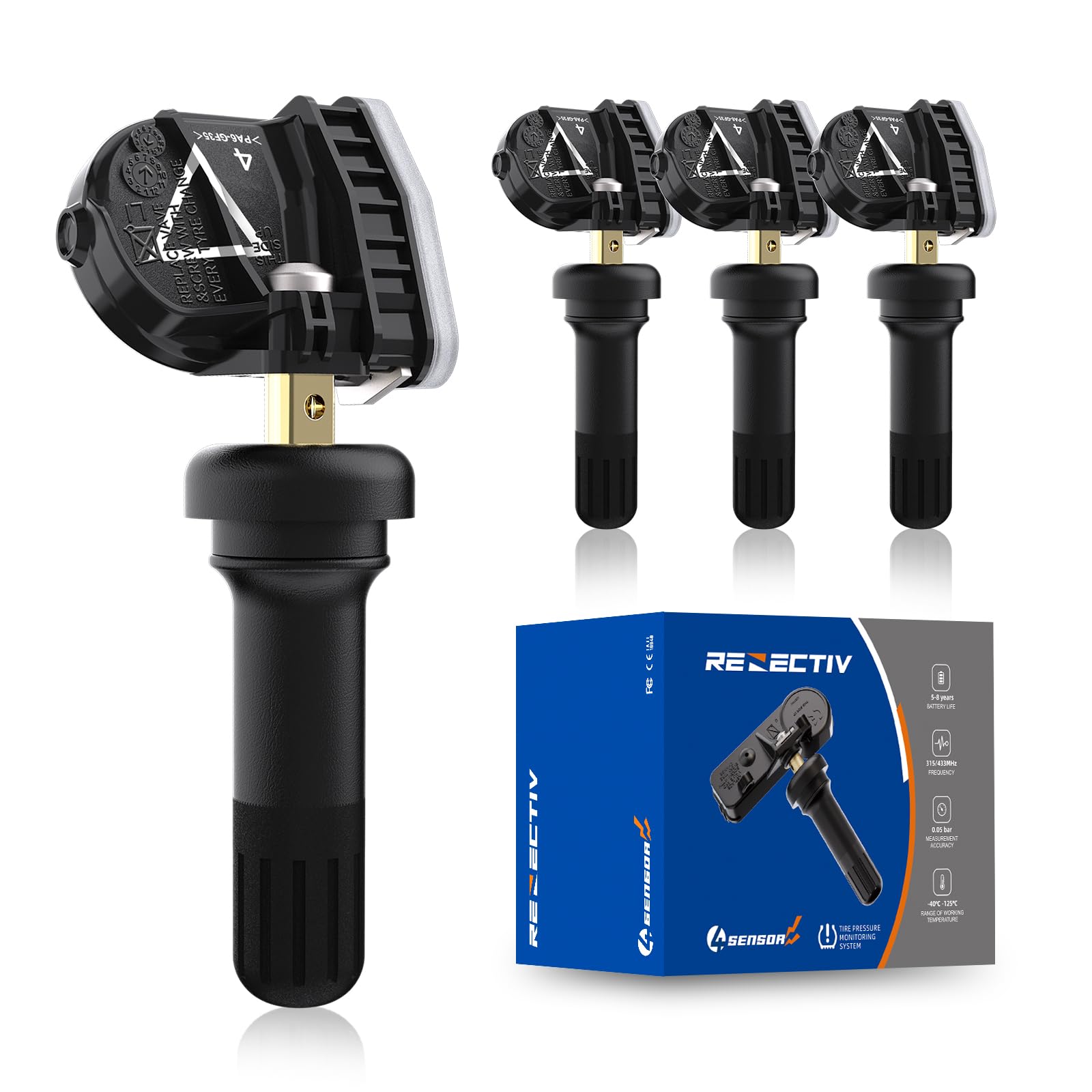
The cheapest 4-pack in the lineup — but buyer reviews warn of early failures that the Jsueng set does not show.
At for four pre-programmed sensors covering Buick, Cadillac, Chevy, and GMC models, the RENECTIV pack costs about the same as the Jsueng set. The specs look similar: a CR2032 battery with a 5–8 year claim, 433 MHz single-frequency, and compatibility with OE numbers 13598771, 13512347, and 13516165. Some buyers initially reported positive experiences — “worked great, connected to my vehicle no issues” — and said the pre-programmed nature saved time versus tire shop prices.
The warning sign is in longer-term reviews. One buyer wrote: “installed all 4 with new tires they worked for a few months then one stopped working I was sent another one and it took me a month or two to get it installed it didn’t work at all, over the next few months all of the sensors stopped working.” That pattern — a single sensor failing, then the entire set dying within a year — is the highest risk in this comparison. The manufacturer offers a 1-year warranty and “good service” support, but dealing with multiple replacements is a real hassle. The weight is 0.14 kilograms (about 4.9 oz), similar to the Jsueng set.
If you need a cheap pack for a vehicle you plan to sell soon, the low upfront cost might work. But for a long-term fix, the negative reviews suggest that spending a few dollars more on the Jsueng or A-Premium set cuts the risk of early failures.
Upside
- Lowest upfront price in the comparison for a 4-pack
- Pre-programmed for GM vehicles — some owners mention zero programming issues
- 1-year warranty included
Downside
- Multiple buyer reports of sensors failing within months — all four stopped working over time in one case
- Warranty claim process can be slow (one buyer waited 1–2 months for a replacement that also failed)
- Single-frequency 433 MHz only, no dual-band flexibility like the Masoll or Autel offer
Consider it if: you need a dirt-cheap pack for a vehicle you are flipping soon and can tolerate the risk of early failure.
it’s not for you if: you want sensors that will work reliably for years — the Jsueng or A-Premium are safer bets for a few extra dollars.
Understanding the Specs
Battery Life (Years)
This is the maker’s estimated service life based on typical daily driving — usually between 5 and 10 years for the sensors in this comparison. A higher number (like 10 years on the CDWTPS pack) means less frequent replacement, but actual life depends on how much you drive, temperature extremes, and the battery chemistry (CR2032 vs CR2050). The longer the claimed life, the better the value if you plan to keep the vehicle.
Frequency (MHz)
The radio band the sensor uses to talk to your car’s receiver. Most domestic vehicles use 433 MHz, but some Asian and older GM models use 315 MHz. Dual-frequency sensors (315 + 433 MHz) work on either band without you needing to know which one your car uses — a convenience if you own multiple vehicles or are unsure of your model’s spec.
Pre-Programmed vs Universal
Pre-programmed sensors arrive already matched to a list of vehicle years and models — you install them and do a relearn (pairing step). Universal sensors (like the Autel MX) are blank and require a proprietary programming tool to write the vehicle data onto them. For a simple home install, pre-programmed is easier; for a shop or multi-vehicle owner, universal saves inventory space.
Valve Stem Material
Most sensors use a rubber valve stem, which is cheap and works fine. Aluminum (or metal) stems resist road salt corrosion better and last longer in winter climates, but they cost more. If you live in a rust-belt area, a sensor with an aluminum stem (like the A-Premium set) is a practical upgrade.
FAQ
Will a 433 MHz sensor work on my car if it uses 315 MHz?
Do I need a special tool to install these sensors?
What is a relearn procedure and can I do it myself?
How long do CR2032 batteries last inside TPMS sensors?
Can I replace just one faulty sensor instead of all four?
What causes a TPMS sensor to stop transmitting early?
Will the Autel MX sensor work without an Autel programming tool?
Are these battery sensors compatible with the Ford F150 or F250?
Final Thoughts: The Verdict
For most Chrysler/Dodge/Jeep/Ram owners, the best battery tpms sensor winner is the CDWTPS 4-Pack because its 10-year battery claim and immediate no-programming installation have the strongest real buyer validation from long-term use. If you own a full-size GM truck and want dual-frequency flexibility plus a dual-antenna design for signal strength, grab the Masoll TPMS Sensor Set. And for the tech-ready owner who already runs Autel tools and wants a universal sensor that handles any frequency, the standout is the Autel MX Sensor Set.
How We Picked
We do not accept paid placement. Every pick is matched to a real buyer and a real use-case; we do not hands-on test units.
Sources & Methodology
Specifications: manufacturer listings and product documentation. Review insights: verified customer reviews, as of July 2026. Pricing: not shown on this page (it changes often); check the current price via the retailer link.
As an Amazon Associate, Gadgets Feed earns from qualifying purchases. This does not affect which products we feature.
Product prices and availability are accurate as of the date/time indicated and are subject to change. Any price and availability information displayed on Amazon at the time of purchase will apply to the purchase of this product. As an Amazon Associate I earn from qualifying purchases.
CERTAIN CONTENT THAT APPEARS ON THIS SITE COMES FROM AMAZON. THIS CONTENT IS PROVIDED "AS IS" AND IS SUBJECT TO CHANGE OR REMOVAL AT ANY TIME.
Amazon and the Amazon logo are trademarks of Amazon.com, Inc. or its affiliates.