
Our readers keep the lights on and my morning glass full of iced black tea. As an Amazon Associate, I earn from qualifying purchases.
Specs are compiled from manufacturer listings and verified buyer reviews and can change over time — please confirm the key details on the product page before buying.
You want a training partner that delivers ball after ball with the same pace and spin, not one that jams or throws wild shots after a few serves. The real trick is picking the right balance of speed, capacity, and portability so you actually use it more than once.
I’m Min — the founder and writer behind Gadgets Feed. This guide is built by comparing the manufacturers’ published specifications and the patterns across verified customer reviews, so you get each pick’s real strengths and trade-offs instead of marketing spin.
We break down every option from entry-level to pro-grade across speed, ball hold, battery life, and spin control to find the best tennis ball machine for your court and your skill level.
Quick Picks
- PUSUN PT-Smart Tennis Ball Machine — Best Overall
- Wilson Portable Tennis Ball Machine — Pro Build
- LOBSTER Sports Elite Tennis Ball Machine — Consistent Feeder
- Spinshot Pro Tennis Ball Machine — Metal Tank
- Nisplay N1-C-O Portable Tennis Ball Machine — Compact Power
- Furlihong 3819BH Portable Tennis Ball Machine — Budget Starter
- Spinshot Lite Tennis Training Machine — Junior Coach
How To Choose The Best Tennis Ball Machine
The right tennis ball machine depends on your playing level, how often you practice, and what you want to improve — footwork, shot consistency, or endurance. Focus on three things: ball speed range, hopper capacity, and how the machine lets you control spin and placement.
Ball Speed and Spin Control
Speed determines how much time you have to react. Machines that top out around 30 MPH are fine for beginners working on form, while models hitting 70-75 MPH let advanced players simulate match pace. Spin control — topspin and backspin — changes ball bounce and trajectory, so you can practice heavy kick serves or slice returns without a partner.
Battery Runtime and Portability
A machine that lasts less than two hours means you’re packing up early. Look for at least 2-4 hours of continuous play, and check if the battery is external (easier to swap or charge without hauling the whole machine). Weight and wheels matter too, especially if you have to cross grass or gravel to reach your court.
Oscillation and Placement
Random oscillation sends balls across the full width of the court, which is essential for practicing footwork and hitting on the run. Fixed oscillation patterns are better for grooving a single stroke. Some premium machines offer programmable landing points so you can simulate specific match scenarios.
Quick Comparison
| Model | Best For | Ball Speed | Ball Capacity | Battery Life | Amazon |
|---|---|---|---|---|---|
| PUSUN PT-Smart | App-driven training | 75 MPH | 100+ balls | 4-6 hours | $1,198.00Amazon |
| Wilson Portable | All-around match simulation | 10-75 MPH | 110 balls | Up to 4 hours | $1,545.00Amazon |
| LOBSTER Elite Liberty | Intermediate consistency | 10-70 MPH | 85 balls | 2-4 hours | $1,179.00Amazon |
| Spinshot Pro | Durable metal build | — | 60 balls | ~4+ hours | $1,099.00$1,199.00Amazon |
| Nisplay N1-C-O | Easy transport | 68 MPH | 80+ balls | 4+ hours | $998.00Amazon |
| Furlihong 3819BH | Budget entry-level | 30 MPH | ~21 balls | 8 D batteries | $239.99Amazon |
| Spinshot Lite | Junior & beginner mobile | — | ~50 balls | 2+ hours | $649.00$699.00Amazon |
In‑Depth Reviews
1. PUSUN PT-Smart Tennis Ball Machine
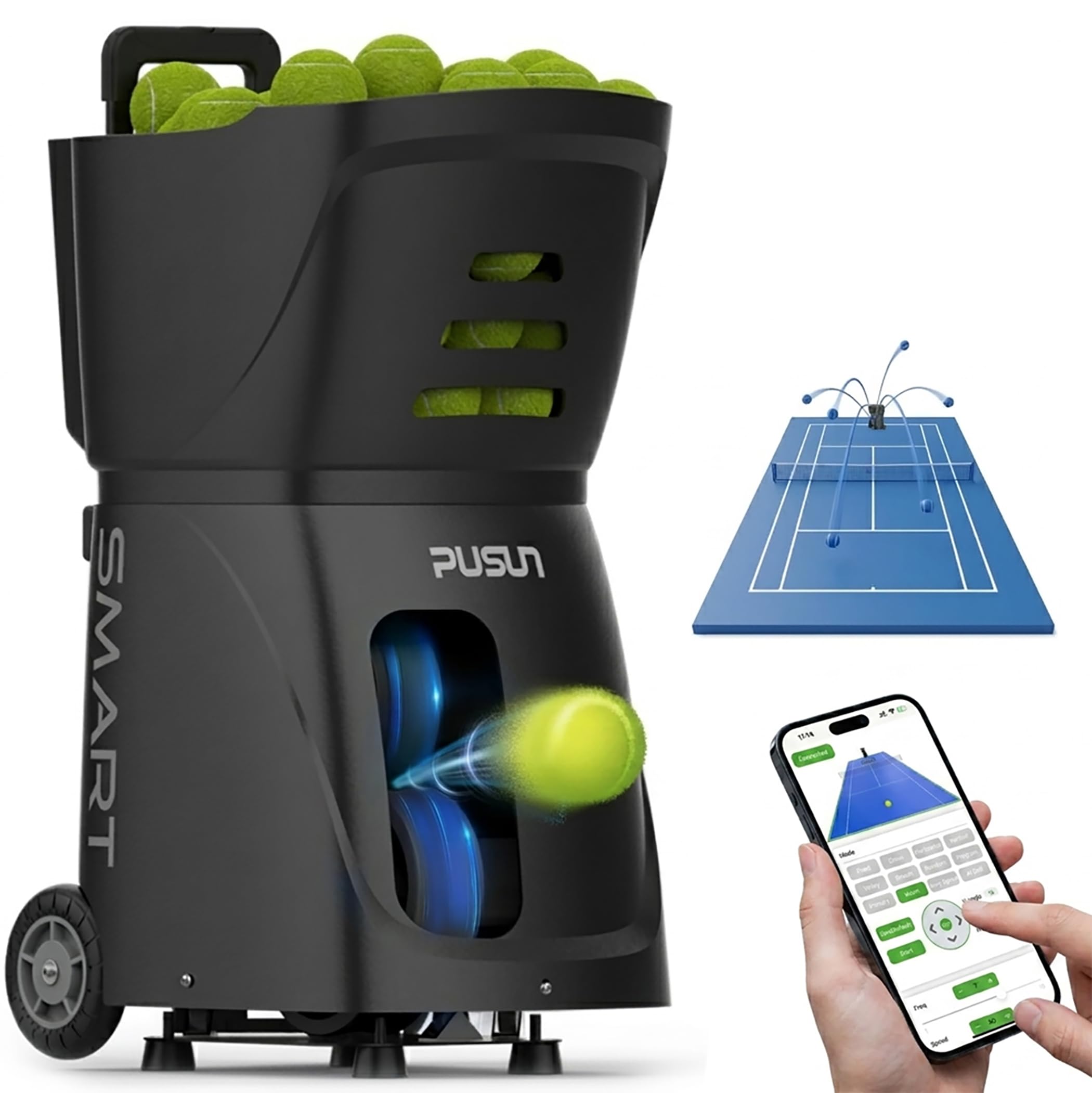
The smart machine that adapts its drills as your game improves.
This is the only machine in the lineup that grows with you from beginner rallies to pro-paced drills. The app-controlled system includes 12 built-in training modes that step you from NTRP 1.0 to 5.0, so you are not stuck with a single pattern as your footwork improves. You get 28 programmable landing points for full-court reactive training — far beyond the fixed random oscillation on pickups like the LOBSTER Elite.
Speed runs up to 75 MPH, with feed intervals adjustable from 1.8 to 8 seconds, and six levels of spin control. The external battery pack holds a 153.6Wh capacity for 4-6 hours of play, and at 32.6 lbs (14.8 kg) with a collapsible 100-ball hopper, it fits an SUV trunk easily. A specialized dust-proof mainboard resists clay erosion, which matters if you practice on red clay. Buyers report the app has excellent range and control, though a few noted inconsistent ball feed in the first few shots before settling into a rhythm.
Why it stands out
- App + remote + Apple Watch compatibility for control from your hitting stance
- External battery charges anywhere without moving the machine
- 28-point programmable placement for match simulation
Watch for
- Occasional inconsistency in the first 5-6 balls before settling
- Launch wheels can cause slight ball rotation drift at higher speeds
Your best training partner: Perfect for players who want a machine that scales from casual groundstrokes to intense match drills without buying another unit later.
Consider skipping if: You prefer simple knob controls over an app interface.
2. Wilson Portable Tennis Ball Machine

The 110-ball workhorse with a three-year warranty and honest knob controls.
Wilson teamed up with Sports Tutor to build a machine that does not need a phone. The speed runs from 10 to 75 MPH, and topspin or underspin is controlled with a single knob — no programming or app setup. The built-in rechargeable battery gives up to four hours of play per charge, and the Smart Battery Charger shuts off automatically overnight to prevent overcharging.
Ball capacity is 110, which means fewer reload breaks than the 60-ball Spinshot Pro. The random oscillator delivers shots across the full width of the court, and the towing handle with large wheels makes it easy to roll over grass and curbs. Owners mention it is reliable and consistent, though a few noted the advertised 75 MPH speed feels lower and the handle could be taller for easier transport.
Reliable on court
- Three-year warranty — much longer than most offshore brands
- 110-ball hopper means longer sessions between reloads
- Electronic elevation control for groundstrokes to lobs
Trade-offs
- Handle height makes it cumbersome to tow
- Some users felt speed falls short of 75 MPH
Built for the long haul: Ideal if you want a durable, no-app machine with generous capacity and the strongest warranty in this list.
Not for you if: You need true 75 MPH pace or a programmable random mode for match simulation.
3. LOBSTER Sports Elite Tennis Ball Machine

The reliable baseline partner for 3.0 to 3.5 players who want consistent spins.
Lobster Sports tuned this machine for intermediate players who need predictable shot placement and spin variety, not gimmicks. The Elite Liberty delivers ball speed from 10 to 70 MPH with elevation from 0 to 50°, and the spin control can go from heavy topspin to flat to heavy backspin. Horizontal oscillation covers the full court for random patterns.
At 35 lbs with a folding handle and 8-inch all-terrain wheels, it rolls smoothly over grass and gravel — easier to transport than the 49.8-pound Spinshot Pro. The rechargeable 8.5 amp battery offers 2 to 4 hours of court time. Customers note it is a good value for 3.0/3.5 players, but heavy topspin reduces speed by 15-20 MPH, and the sweep does not offer narrow or alternating patterns.
Why it works
- Consistent spin and speed for skill development
- Lightweight at 35 lbs with large wheels for easy transport
- Inverting hopper for quick ball load
What to know
- Heavy topspin drops speed by 15-20 MPH
- Only full-court random sweep, no narrow or alternating oscillation
Solid for intermediates: Pick this if you need reliable shot consistency and a lightweight machine that stores easily in a sedan trunk.
Upgrade if: You want programmable drill sequences or speed above 70 MPH.
4. Spinshot Pro Tennis Ball Machine

All-metal construction that outlasts plastic competitors, but you will feel every pound.
This is the only machine not made of plastic — the TPU and PU construction makes it a tank compared to the plastic-shell LOBSTER or PUSUN models. All features are knob-controlled so even a child can adjust speed, rotation, topspin, underspin, and lob without any app or remote confusion. The 60-ball hopper is smaller than the Wilson’s 110-ball capacity, but the durable build is built for years of frequent use.
Reviewers point out excellent customer service: one review noted the battery failed after 10-15 minutes of use within a year, and Spin Shot replaced it out of warranty. The new battery provides over four full ball reloads per charge. However, at 49.8 lbs it is noticeably heavier than the Nisplay N1 (26 lbs), and several users found it tough to move around the court. A few units arrived with broken hopper flaps or non-functional batteries.
Toughness you can trust
- All-metal body (only model not made of plastic)
- Knob controls are simple and intuitive
- Long battery life after replacement: 4+ reloads per charge
Heavy price to carry
- Weighs 49.8 lbs — hard to move between courts
- Some units arrived with broken flaps or dead batteries on arrival
For durability diehards: Choose this if you want a metal machine that can take abuse and you do not need to move it far.
Skip it for: Portability — at 49.8 lbs, the Nisplay N1 is almost half the weight.
5. Nisplay N1-C-O Portable Tennis Ball Machine

The lightweight dual-motor machine that fits in a sedan trunk with an 80-ball basket.
At 26 lbs, the Nisplay N1 is the lightest mid-range machine here and nearly half the weight of the Spinshot Pro (49.8 lbs). Dual motors shoot balls end to end at speeds up to 68 MPH, with elevation from 0 to 50 degrees and manual oscillation. The external lithium battery runs over 4 hours and is small enough to carry separately for easy charging.
Shoppers say it jams 3-4 times per 80 balls, but it self-corrects via three ball holes so you are not constantly bending down. The oversized wheels and 3-foot folding handle make it glide over grass and gravel, unlike the Wilson which has a lower handle that some found cumbersome. Buyers report the remote lacks oscillator control and the ball frequency knob is counter-intuitive (high setting = slow shots).
Easy to lug
- 26 lbs with folding handle and large wheels for easy transport
- External battery pack charges anywhere
- Dual motor for end-to-end coverage at 68 MPH
Quirky controls
- Remote does not control oscillator or stop launch wheels
- Occasional jams 3-4 times per 80 balls
Best for regular movers: If you haul your machine to different courts weekly, the 26 lb weight and rolling handle save your back.
Not for you if: You want a remote that controls all functions, or you dislike machines that need occasional jam clearing.
6. Furlihong 3819BH Portable Tennis Ball Machine
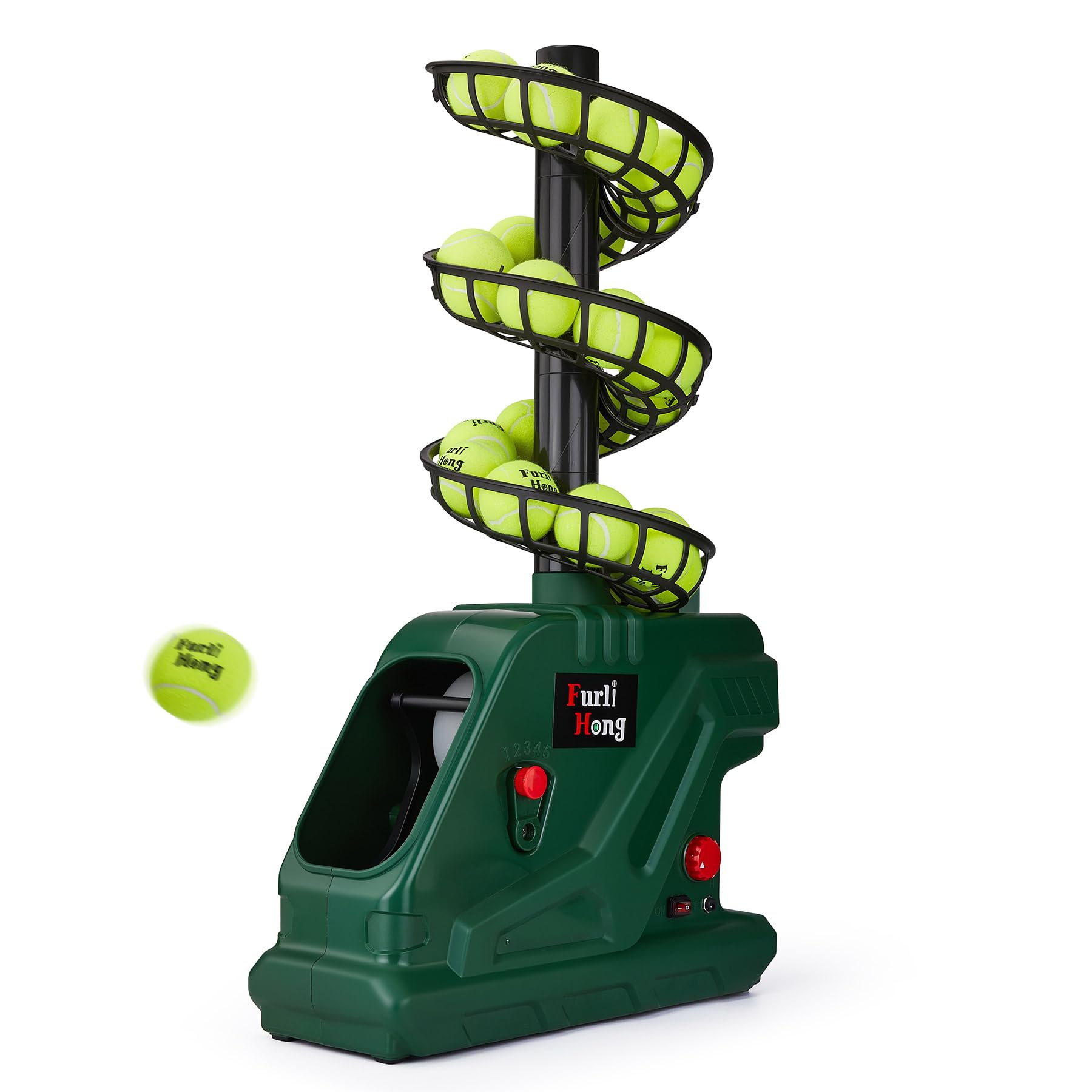
A lightweight entry-level machine that keeps training simple and affordable.
With a top speed of 30 MPH, the Furlihong is aimed squarely at beginners who need to build form without being overwhelmed. It offers 5 angle settings to practice forehands, backhands, flat shots, slices, and volleys, and you pick from 2 power levels and 4 serve intervals. At just 4.01 kg (8.8 lbs) it is the lightest machine in this roundup by a wide margin — more portable than the 16.92 kg Spinshot Lite, though the Spinshot has a longer battery life.
Owners mention it holds about 21 balls and runs on 8 D batteries (no rechargeable pack). One reviewer noted the first ball tends to launch high, and the feeder gets caked in ball hairs so it needs regular cleaning. Another had a defective unit that only shot 15 feet, but the replacement worked fine, and the seller communicated well.
Simple and light
- Weighs only 8.8 lbs for easy carry to any court
- 5 angle settings and 2 power levels for basic shot variety
- 12-month warranty included
Know the limits
- Runs on 8 D batteries, not rechargeable
- 21-ball capacity means frequent reloads
Perfect for casual practice: Grab this if you just want to hit a bucket of balls without a big investment.
Move up if: You need longer sessions or speeds above 30 MPH to challenge your timing.
7. Spinshot Lite Tennis Training Machine
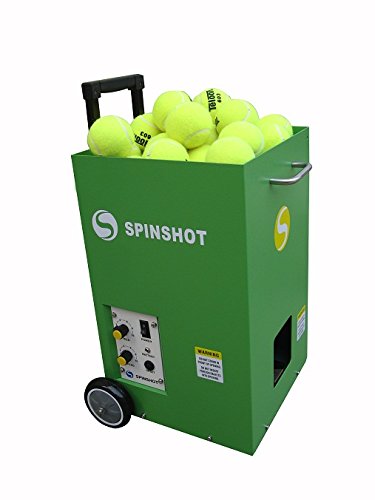
The most portable machine for intermediate players who train on the go.
Spinshot designed the Lite to be small enough to pop in a trunk and light enough to carry one-handed. Customers note the battery lasts over 2 hours, and the built-in oscillator adds shot variety without extra accessories.
Reviewers point out it is great for beginners and solo play, though the battery compartment lacks a buffer so the battery wriggles around inside. A few noted that with only 50 balls, you play for about 15 minutes then spend another 15 picking them up to reload. One buyer had the machine stop working after 6 months. At 16.92 kg (37.3 lbs) package weight, it is heavier than the Furlihong but still manageable for one person.
Good for starting out
- Compact size fits in most car trunks easily
- Oscillator included for varied shot patterns
- Multiple speeds and height settings
Small catches
- 50-ball capacity means frequent reloads
- Battery wriggles in compartment without a buffer
Great for juniors and mobile players: If you train at different courts and want a compact machine with oscillation, this fits the bill.
Look for more if: You need larger capacity to avoid constant pickup breaks, or you want a longer battery life.
Understanding the Specs
Ball Speed (MPH)
Speed determines the reaction time you get per shot. A 30 MPH top speed works for beginners learning contact point and footwork. 68-75 MPH gives intermediate and advanced players realistic match pace, including fast groundstrokes and volley reactions.
Spin Control (Topspin / Backspin)
Machines with adjustable spin let you practice heavy kick serves, slice approach shots, and flat drives all in one session. Without spin control, every ball comes in flat, which does not simulate real rally conditions.
Battery Life & Type
Rechargeable lithium batteries typically give 2-6 hours of play. External battery packs are better because you can charge them without hauling the whole machine. D battery machines are cheaper but cost more in the long run and run out mid-session.
Ball Hopper Capacity
Higher capacity (100-110 balls) means more continuous hitting before you stop to reload. Lower capacity (21-50 balls) forces frequent breaks, which disrupts flow. Pair a small hopper with a pickup basket to keep sessions efficient.
FAQ
What is the best tennis ball machine for intermediate players?
How many balls should a tennis ball machine hold?
Can I use non-pressurized balls in a ball machine?
How long does a tennis ball machine battery last?
Is a ball machine with oscillation worth the extra money?
What is the difference between topspin and backspin on a ball machine?
How heavy is too heavy for a portable tennis ball machine?
Will a tennis ball machine fit in a sedan trunk?
Do I need a remote control for my ball machine?
How do I clean a tennis ball machine?
Final Thoughts: The Verdict
For most players, the best tennis ball machine is the PUSUN PT-Smart because it combines app-controlled drill variety, 28-point placement, and a long-lasting external battery in a portable 32.6 lb package. If you want a simple no-app machine with the longest warranty, grab the Wilson Portable. And for a lightweight budget entry point that you can toss in any trunk, the Furlihong 3819BH gets you on court without a big commitment.
How We Picked
We do not accept paid placement. Every pick is matched to a real buyer and a real use-case; we do not hands-on test units.
Sources & Methodology
Specifications: manufacturer listings and product documentation. Review insights: verified customer reviews, as of July 2026. Pricing: not shown on this page (it changes often); check the current price via the retailer link.
As an Amazon Associate, Gadgets Feed earns from qualifying purchases. This does not affect which products we feature.
Product prices and availability are accurate as of the date/time indicated and are subject to change. Any price and availability information displayed on Amazon at the time of purchase will apply to the purchase of this product. As an Amazon Associate I earn from qualifying purchases.
CERTAIN CONTENT THAT APPEARS ON THIS SITE COMES FROM AMAZON. THIS CONTENT IS PROVIDED "AS IS" AND IS SUBJECT TO CHANGE OR REMOVAL AT ANY TIME.
Amazon and the Amazon logo are trademarks of Amazon.com, Inc. or its affiliates.