
Our readers keep the lights on and my morning glass full of iced black tea. As an Amazon Associate, I earn from qualifying purchases.
Specs are compiled from manufacturer listings and verified buyer reviews and can change over time — please confirm the key details on the product page before buying.
If you are chasing a misfire on an older engine or setting points dwell on a classic car, you need an automotive multimeter that actually holds a steady RPM reading instead of one that jumps numbers around. Most standard electrical meters do not have tach and dwell functions at all, and the cheap ones that do often give you readings that wander — making tuning feel impossible. This guide cuts straight to which models deliver stable, usable numbers for real car diagnostics.
I’m Min — the founder and writer behind Gadgets Feed. This guide is built by comparing the manufacturers’ published specifications and the patterns across verified customer reviews, so you get each pick’s real strengths and trade-offs instead of marketing spin.
Here you will find the honest breakdown of the best automotive multimeter choices, from budget-friendly units with basic dwell capability to pro-grade meters that handle hybrid systems without flinching.
Quick Picks
- Innova 3340 Professional Automotive Digital Multimeter, Black — Best Overall
- BTMETER BT-770K Auto Ranging Automotive Multimeter — Most Specs Per Dollar
- Fluke 88V Deluxe Automotive Multimeter — Pro-Grade Investment
- OTC 3980 750 Series Automotive Multimeter — Hybrid-Safe Specialist
- ANENG SZ26 Automotive Engine Analyzer Multimeter — Budget Entry Point
How To Choose The Best Automotive Multimeter
Not every multimeter that claims “automotive” can actually handle the specific measurements your car needs — RPM, dwell angle, duty cycle, and pulse width are the big ones. Here are the three specs that separate a useful car meter from a general-purpose one.
Automotive-Specific Functions (RPM, Dwell, Duty Cycle)
A standard electrician’s meter cannot read engine RPM or distributor dwell angle. If you work on older vehicles with points, you absolutely need a meter that includes dwell angle measurement — otherwise you are guessing at the gap. For modern engine diagnostics, duty cycle and pulse width let you test fuel injectors and variable-valve timing solenoids. Verify the meter lists these exact automotive functions before buying.
Input Impedance (10 MegOhm Minimum)
The vehicle’s ECU (engine control unit) is sensitive to current draw from a test lead. A meter with at least 10 MegOhm input impedance prevents the meter itself from damaging computer circuits during a diagnostic check. Most automotive-grade meters meet this spec; if the data sheet does not list it, look for another model.
Count Resolution and Stability
A 1999-count display reads voltage in coarser steps than a 6000-count display, meaning you see less detail on small signal changes. More important than raw count though is reading stability — some budget meters show RPM and dwell values that drift constantly, making tuning effectively impossible. Look for verified reviews that specifically mention steady dwell or RPM readings.
Quick Comparison
| Model | Best For | Display Counts | Automotive Functions | Weight | Amazon |
|---|---|---|---|---|---|
| Innova 3340 | Plug-and-play with inductive clamp | — | RPM, Dwell, Duty Cycle, Temp | 8 oz | $100.87Amazon |
| BTMETER BT-770K | Highest count resolution and temperature range | 6000 counts | RPM, Dwell, Duty Cycle, Pulse Width, Temp | 1 Pound | $66.99Amazon |
| Fluke 88V | Hybrid and pro-level shop diagnostics | — | Pulse Width, Duty Cycle, Min/Max/Avg | 3 Pounds | $590.00Amazon |
| OTC 3980 750 Series | Hybrid system compatibility with data logging | — | RPM, Dwell, Duty Cycle, Pulse Width, Temp | — | $237.38Amazon |
| ANENG SZ26 | Lowest entry price with basic dwell capability | 1999 counts | RPM, Dwell, Duty Cycle | — | $32.99Amazon |
In‑Depth Reviews
1. Innova 3340 Professional Automotive Digital Multimeter, Black

The Innova 3340 comes with the inductive RPM clamp included, not an extra purchase.
Many automotive multimeters make you buy the inductive pickup for RPM separately — this one puts it in the box along with a temperature probe and a carrying case. That means right from the start you can clamp around a spark plug wire to read RPM or poke the temp probe into a radiator hose, without tracking down extra accessories.
The meter measures up to 15 amps for device testing, and its 10 MegOhm input impedance means it is safe for the vehicle’s ECU. It measures 12.5 x 4.5 x 6.5 inches, while the Fluke measures 8 x 2 x 4 inches.
Buyers report that the auto-ranging feature and auto shut-off make this meter convenient for quick engine bay checks. If you need a do-it-all automotive meter, this is the one.
Real-world edge: The included inductive RPM clamp is a useful accessory for automotive diagnostics.
One trade-off: If low-light readability matters to you, compare the display features closely with backlit models.
The shop-ready choice: This suits any mechanic or serious DIYer who wants a complete automotive-specific kit without paying for separate accessories.
skip it if: You need a backlit display for low-light work, or you want the highest count resolution for very small signal diagnostics.
2. BTMETER BT-770K Auto Ranging Automotive Multimeter
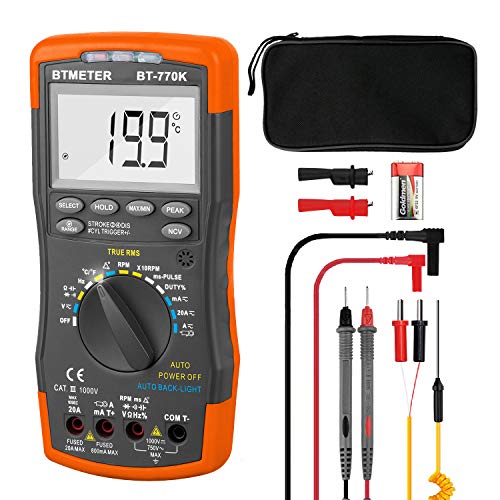
The BTMETER BT-770K packs a 6000-count display and 3.0-inch LCD into its package.
This meter gives you the highest display resolution (6000 counts) among the picks here, versus the ANENG SZ26’s 1999 counts, so you get finer detail when reading small voltage changes on sensors. The display is large and has an auto backlight sensor, which is a significant help when you are working under the dash or in dim engine bays.
It measures AC/DC voltage up to 1000V and current to 20A, plus temperature from -4°F up to 1832°F using the included thermocouple. You get automotive-specific tests including RPM (600-12000), dwell angle, pulse width, and duty cycle, with a cylinder selector for 3, 4, 5, 6, and 8-cylinder engines. A magnetic back lets you stick the meter to a metal surface, keeping your hands free while probing.
At 1 Pound, it is lighter than the Fluke 88V at 3 Pounds. The BTMETER also has a kickstand and a hanger, so you can position it for easy reading no matter where you are working. Note that RPM measurement uses the BTMETER BT-705A inductive clamp.
Where it shines
- 6000-count resolution versus the ANENG’s 1999 counts
- Backlit 3.0-inch display with auto sensor is readable in the dark
- Includes thermocouple for high-temp measurement (up to 1832°F)
The catch
- RPM measurement uses the BTMETER BT-705A inductive clamp
- Uses a standard 9V battery rather than a rechargeable cell
Best for sensor diag: Grab this if you need high resolution to catch small voltage shifts on modern oxygen sensors or MAF sensors.
Look elsewhere if: You want the inductive clamp included in the box, or you need heavy-duty professional ruggedization for daily shop abuse.
3. Fluke 88V Deluxe Automotive Multimeter

The Fluke 88V is the standard for pro shops that troubleshoot both conventional and hybrid vehicles.
This meter was designed specifically for the automotive environment — it measures pulse width, duty cycle, and has Min/Max/Avg recording to capture intermittent faults that other meters miss. The 10 MegOhm input impedance ensures it will not damage the sensitive computer circuits found on any modern car or hybrid drivetrain.
The rugged yellow body with a built-in holster is built for years of daily drops. At 3 Pounds and measuring 8 x 2 x 4 inches, the Fluke 88V weighs 3 Pounds, while the BTMETER BT-770K weighs 1 Pound — you feel the heft, but it signals the internal protection and build quality.
Fluke is the brand that professional electricians and automotive techs trust by default. If you are earning your living with this meter or you own a hybrid that requires precise diagnostics, the 88V is the one that will not let you down.
The pro’s take: The Min/Max/Avg recording function is genuinely useful for finding intermittent electrical gremlins that only appear under certain conditions.
Reality check: This is the most expensive meter on this list by a wide margin, and it does not include an inductive RPM clamp or temperature probe in the box.
Worth it for: Professional technicians, hybrid-vehicle owners, and anyone who needs a meter they can rely on every day without question.
Not for: Budget-focused DIYers doing basic tune-ups on older cars — you can get the job done for much less.
4. OTC 3980 750 Series Automotive Multimeter

The OTC 3980 is CAT III rated, making it one of the few meters certified for hybrid vehicle systems.
Hybrid vehicles run higher voltages and require a meter that is rated for the electrical environment — the OTC 3980 meets CAT III safety standards, so you can use it confidently on hybrid drive trains. It includes True RMS measurement for accurate readings on non-sinusoidal signals common in modern electronics.
The automotive-specific test functions cover True RMS, RPM, dwell, pulse width, temperature, and a backlit display. An RS232 port allows you to connect the meter to a PC for data logging (software and cable are included), which is rare at this tier. The kit comes with a black canvas case to keep everything organized.
This meter runs on a standard 9V battery and has an auto power-off feature. At roughly the same size bracket as the Innova (10 x 12.5 x 3.5 inches), it is not a pocket tool — it is a shop meter designed to stay on the bench or in the case until you need it.
Standout strengths
- PC connectivity with included software and cable for data logging
- CAT III safety rating suitable for hybrid vehicle diagnostics
- Includes both temperature probe and canvas carrying case
Limitations
- No inductive RPM clamp included in the box
- Does not list display count resolution, making sensitivity comparison hard
Best fit for: Technicians who work on hybrids and want PC-based data logging for documenting intermittent issues.
pass on it if: You just need a simple RPM/Dwell meter for a classic car tune-up — the OTC is overkill for that use case.
5. ANENG SZ26 Automotive Engine Analyzer Multimeter

The ANENG SZ26 gets you dwell and RPM measurement at the lowest entry price, but the readings have a catch.
This meter supports the core automotive functions — RPM from 500 to 10000, dwell angle, duty cycle, AC/DC voltage, DC current, and resistance — all on a large LCD that is easy to read. It comes with a comprehensive accessory kit including alligator clips, puncture needles, and a storage bag, so you have most connections covered immediately.
The display uses 1999 counts, which is the lowest resolution in this list; the BTMETER BT-770K has 6000 counts. More concerning though is what owners mention: “Dwell readings wander all over” and the RPM “reads off (1.5x high)” according to one verified reviewer. The hold feature is described as “useless when the reading never settles.” On the positive side, other customers note the display is clear and the included cables are generous.
If you are on a tight budget and just need to see whether a circuit has power, this meter will do that. But for precision tuning where steady dwell is critical, reported wandering readings make it a gamble.
What you actually get: A functional low-cost meter with all the right automotive features labeled on the dial, but with questionable reading stability reported by real buyers.
The honesty bit: If you need to adjust points accurately, the BTMETER or Innova are likely to be less frustrating.
Reach for this if: You are on a very tight budget and only need to check basic continuity and voltage on an older car — and you are willing to accept some risk on dwell accuracy.
it’s not for you if: You want reliable dwell and RPM readings; the wandering numbers reported by buyers make this a poor choice for tuning work.
Understanding the Specs
Count Resolution
Counts tell you how many steps the display splits a measurement into. A 1999-count meter shows roughly 0.1V steps on a 200V range, while a 6000-count meter shows about 0.01V steps. The BTMETER has 6000 counts, while the ANENG SZ26 has 1999 counts. Finer counts matter when you are checking tiny voltage changes from an oxygen sensor or a throttle position sensor.
Input Impedance (10 MegOhm)
Think of input impedance as how “grabby” the meter’s test leads are for current. A meter with 10 MegOhm impedance draws so little current that it will not affect sensitive computer circuits in your car’s ECU. Meters with lower impedance (say 1 MegOhm) can pull enough current to corrupt a sensor reading or even damage the ECU over time. Stick with 10 MegOhm for any modern vehicle.
FAQ
Can I use a regular electrical multimeter on my car?
What does dwell angle mean for car diagnostics?
Will a 1999-count meter work for tuning an older engine?
Do I need an inductive RPM clamp or does the meter plug directly into the engine?
What is True RMS and why does it matter for my car?
How does a CAT III rating affect what I can safely measure?
Can an automotive multimeter test diesel glow plugs?
What is the difference between duty cycle and pulse width?
Final Thoughts: The Verdict
For most buyers, the best automotive multimeter winner is the Innova 3340 because it delivers a complete automotive kit with the inductive RPM clamp and temperature probe included, at a mid-range price that beats buying accessories separately. If you want the highest count resolution and a backlit display for dark work, grab the BTMETER BT-770K. And for professional hybrid diagnostics or daily shop abuse, the standout is the Fluke 88V.
How We Picked
We do not accept paid placement. Every pick is matched to a real buyer and a real use-case; we do not hands-on test units.
Sources & Methodology
Specifications: manufacturer listings and product documentation. Review insights: verified customer reviews, as of July 2026. Pricing: not shown on this page (it changes often); check the current price via the retailer link.
As an Amazon Associate, Gadgets Feed earns from qualifying purchases. This does not affect which products we feature.
Product prices and availability are accurate as of the date/time indicated and are subject to change. Any price and availability information displayed on Amazon at the time of purchase will apply to the purchase of this product. As an Amazon Associate I earn from qualifying purchases.
CERTAIN CONTENT THAT APPEARS ON THIS SITE COMES FROM AMAZON. THIS CONTENT IS PROVIDED "AS IS" AND IS SUBJECT TO CHANGE OR REMOVAL AT ANY TIME.
Amazon and the Amazon logo are trademarks of Amazon.com, Inc. or its affiliates.