
Our readers keep the lights on and my morning glass full of iced black tea. As an Amazon Associate, I earn from qualifying purchases.
Specs are compiled from manufacturer listings and verified buyer reviews and can change over time — please confirm the key details on the product page before buying.
A dull chainsaw chain is a danger to your arms and a waste of your time. The real difference between a five-minute touch-up and a ruined chain cutter is the file you grab from your toolbox — the wrong steel, the wrong diameter (the thickness across the round file), or the wrong cut pattern (the arrangement of teeth on the file) makes your saw work harder and your wood look worse. This guide breaks down which chainsaw files actually hold an edge, which kits give you the right guides, and which one is brittle enough to snap in your hand.
I’m Min — the founder and writer behind Gadgets Feed. This guide is built by comparing the manufacturers’ published specifications and the patterns across verified customer reviews, so you get each pick’s real strengths and trade-offs instead of marketing spin.
You will find honest takes on five different approaches to keeping your chain sharp, from a 12-pack of Swiss-cut bullets to a full 14-piece kit with a stump vise (a clamp that holds your chainsaw bar steady on a log), so you can confidently choose the right chainsaw files for the work you actually do.
Quick Picks
- Oregon 5/32″ (4.0 mm) Professional Chainsaw Chain Sharpening Round Files, 12 Pack (70504) — Top Performer
- PFERD Tools Chain Saw File, Round, 8 inch x 7/32 inch – Part 17039 — Spiral-Cut Specialist
- Universal Field Chainsaw File Kit, 14pcs Chain Saw File Set (5/32″ 7/32″ 3/16″ 1/8″ 11/64″ 13/64″) with Stump Vise — Best All-Round Kit
- LIBRATON Chainsaw File Set, 5/32″, 3/16″, 7/32″ Chainsaw Sharpening File with Filing Guide, Depth Gauge, Bar Groove Cleaner — Comfortable Grip Set
- Oregon 104004 Chainsaw Sharpening Kits, 5/32″ — Best Starter Kit
How To Choose The Best Chainsaw Files
Picking the right file for your chainsaw chain is not complicated once you know three things: the diameter (the thickness) that matches your chain pitch (the spacing of the chain’s drive links), the type of cut that matches your filing style, and the material the file is made from. Ignore one of these, and you will either round off your cutters (the hooked teeth that do the cutting) or snap the file in half.
Match File Diameter To Chain Pitch
Your chain cutter’s pitch — stamped on the bar or the drive link — determines the file size. A 3/8″ low-profile chain takes a 5/32″ (4.0 mm) file, while a full-size 3/8″ chain needs a 7/32″ file. Using a file that is too small will not cut the steel; a file that is too large will dig into the depth gauge (the small bump in front of each cutter). Check your chain’s spec before you buy.
Spiral Cut vs. Double Cut
A spiral-cut file (like PFERD’s Classic Line) bites aggressively on the pull stroke and leaves a slightly rougher edge that some users say cuts wood faster than a polished finish. A Swiss double-cut file (like Oregon’s Professional line) has a finer tooth pattern (more but smaller cutting edges) that produces a smoother edge on the cutter. There is no wrong answer — it depends on if you want speed or finish.
Steel Quality and Brittleness
Many budget files are made from T12 carbon steel, which sharpens okay but wears out fast and snaps under side pressure. Premium sets use alloy steel or GCr15 high-chrome steel for longer life. If you file on the bar without a vise, you want a file that bends slightly before breaking — not one that shatters into three pieces on the first pass.
Quick Comparison
| Model | Best For | File Diameters | Pieces Included | File Cut Type | Amazon |
|---|---|---|---|---|---|
| Oregon 5/32″ (70504) | Daily professional sharpeners | 5/32″ only | 12 files | Swiss double-cut | $22.99Amazon |
| PFERD 17039 | Aggressive hand filing | 7/32″ only | 6 files | Spiral cut | $15.78Amazon |
| Universal Field Kit | Field-service variety | 6 sizes (1/8″ to 7/32″) | 14 pieces | Spiral cut (GCr15 steel) | $19.99Amazon |
| LIBRATON Set | Ergonomic grip & all-in-one kit | 5/32″, 3/16″, 7/32″ | 10+ pieces | Alloy steel | $22.99Amazon |
| Oregon 104004 Kit | First-time home sharpeners | 5/32″ | 7 pieces | Standard round file | $19.39$21.99Amazon |
In‑Depth Reviews
1. Oregon 5/32″ (4.0 mm) Professional Chainsaw Chain Sharpening Round Files, 12 Pack (70504)

The bulk box of Swiss-cut bullets that professional loggers keep in their truck.
When a file is the only thing between you and a full day of cutting, you grab the one that does not wear out by lunch. This 12-pack of Oregon 5/32″ files uses a Swiss double-cut design — a precision cutting-tooth pattern with fewer teeth per inch than competitive files — so it clears chips faster and does not skate across the steel. The files come from a precision centerless grind (a machine process that makes every file perfectly round and the same diameter), meaning every single one of the dozen has a uniform diameter and tooth height. That keeps your chain’s cutting angle consistent as you work through the pack.
Buyers report using these same Oregon files for the past eight years, and one reviewer notes they have “A reviewer reported that these files doubled the life of their 16″ Homelite chain.” — a real-world durability claim that matches the sandblasted, demagnetized finish you get at this price tier. At 10.24 ounces for the whole dozen, the box is light enough to toss into a tool bag, though one buyer did warn the cardboard packaging crumbles in transit and keeps the loose files in a PVC pipe instead. That is a minor hassle for files that cut true every time.
What they do right
- Swiss double-cut design cuts cleaner than spiral files and removes metal faster on the pull stroke
- 12 files in one box means you are not re-ordering every month — a 2.0x quantity gap vs. PFERD’s 6-pack
- Uniform diameter across the whole batch keeps your filing angle consistent
The honest limits
- Only available in 5/32″ (4.0 mm) — unusable for 3/8″ or.404 pitch chains without buying a different SKU (a different product code)
- Cardboard box disintegrates in the mail, so you need your own storage solution
Reach for these if: You sharpen your chain daily or weekly and want a bulk supply of consistent, long-lasting files that do not require you to re-learn your filing angle with each new one.
Look elsewhere if: You need a single kit with multiple file diameters, or you prefer a file with an ergonomic rubber handle already attached.
2. PFERD Tools Chain Saw File, Round, 8 inch x 7/32 inch – Part 17039

The aggressive spiral-cut file that professional sharpeners feel cutting steel on the first stroke.
PFERD’s Classic Line round file is the go-to for people who sharpen by feel. Its precise spiral cut (a single, continuous groove wrapped around the rod) means the file bites the instant you start pulling, so you remove more stock per stroke than a standard double-cut file — great for restoring a chain that has been running against dirt or hitting rocks. The 8-inch length gives you plenty of room to file across the entire cutter without the handle hitting the chain, and the tang (the pointed part that goes into the handle) is long enough to fit most regular file handles without slipping.
Buyers consistently mention how they can feel the quality difference — the file cuts with less pressure and The file outlasts generic brands in real-world use.. However, one reviewer noted a real vulnerability: “Also seems brittle as I’ve broken 2 so far.” That is a meaningful catch when you are paying a premium for a brand known for industrial abrasive tools. For chain pitches of 3/8″ or.404 inch, this 7/32″ diameter is the correct match, but if you have a low-profile chain, you will need to size down to PFERD’s 5/32″ variant instead.
Why choose these
- Spiral cut grabs the cutter edge aggressively, making quick work of dull steel in fewer strokes
- 8-inch length provides a long filing surface for full cutter contact without repositioning
- Classic Line formulation is balanced for service life and stock removal rate on steels up to 370 HV (38 HRC) — a measure of hardness indicating it can handle hardened cutter steel without wearing down quickly
What to watch for
- Some users find the file brittle — multiple owners mention snapping the file under normal hand pressure
- Only one diameter (7/32″) in the pack, so it is not a multi-size solution
Best for aggressive sharpeners: If you prefer a fast, aggressive cut and sharpen only full-size 3/8″ or.404 chains, this spiral-cut file restores bite faster than most competitors.
Pass if: You need a durable file that can handle side pressure or pressure on the push stroke — the brittle nature means it is best treated gently.
3. Universal Field Chainsaw File Kit, 14pcs Chain Saw File Set (5/32″ 7/32″ 3/16″ 1/8″ 11/64″ 13/64″) with Stump Vise
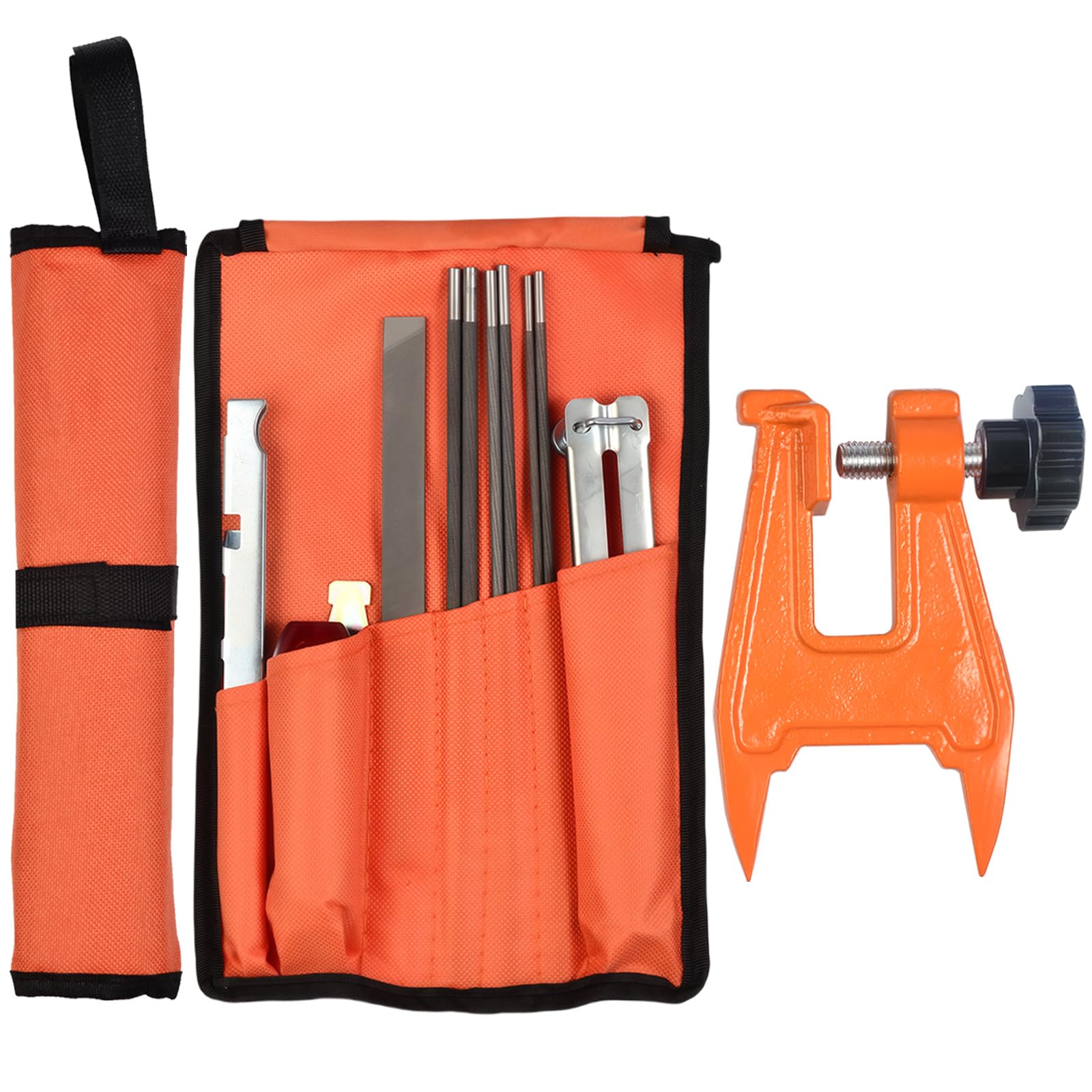
One roll-up pouch that fits every chain size you own, plus a stump vise that keeps the bar steady in the woods.
This kit is the Swiss Army knife of chainsaw sharpening — 14 pieces covering six file diameters (from 1/8″ up to 7/32″) so you can handle a homeowner 14-inch chain, a professional 20-inch bar, and everything in between without buying separate packs. The files are made from GCr15 high-chrome steel, which is noticeably harder than the T12 carbon steel found in cheaper kits, so they hold their abrasive grit longer and do not wear down to a smooth stick after a dozen sharpenings.
The stump vise is a genuinely useful inclusion: its upgraded large knob gives you enough grip to tighten it securely even with work gloves on, and it holds the guide bar firmly on any flat log or stump so you can file one-handed without the whole saw shifting. The whole set weighs 1.96 pounds and packs into a durable roll-up pouch — 21% more massive in dimensions than the LIBRATON set (11.41 x 4.33 x 1.57 inches), which means it takes up more bag space but is still portable. A buyer’s honest note: the 5/32″ file arrived bent and snapped into three pieces under light pressure, so check the smallest file before you head into the field.
What it covers
- 6 different file diameters mean one kit handles 1/4″, 3/8″ low-profile, 3/8″, and.404 pitch chains
- Stump vise with large-knob tightening provides a stable filing platform without needing a bench
- GCr15 high-chrome steel outlasts ordinary T12 carbon steel files
Single-file failure
- QC inconsistency: a real buyer received a bent 5/32″ file that snapped into three pieces during first use
- At 1.96 pounds, it is the heaviest option here (6% more than the LIBRATON set at 1.85 lbs), noticeable in a daily carry bag
Grab this if: You own multiple chainsaws with different pitches and want one portable kit with a built-in stump vise for on-site sharpening without returning to the truck.
skip it if: You only sharpen one chain size — a smaller dedicated kit or bulk 12-pack gives you better-value-per-file and less QC risk.
4. LIBRATON Chainsaw File Set, 5/32″, 3/16″, 7/32″ Chainsaw Sharpening File with Filing Guide, Depth Gauge, Bar Groove Cleaner
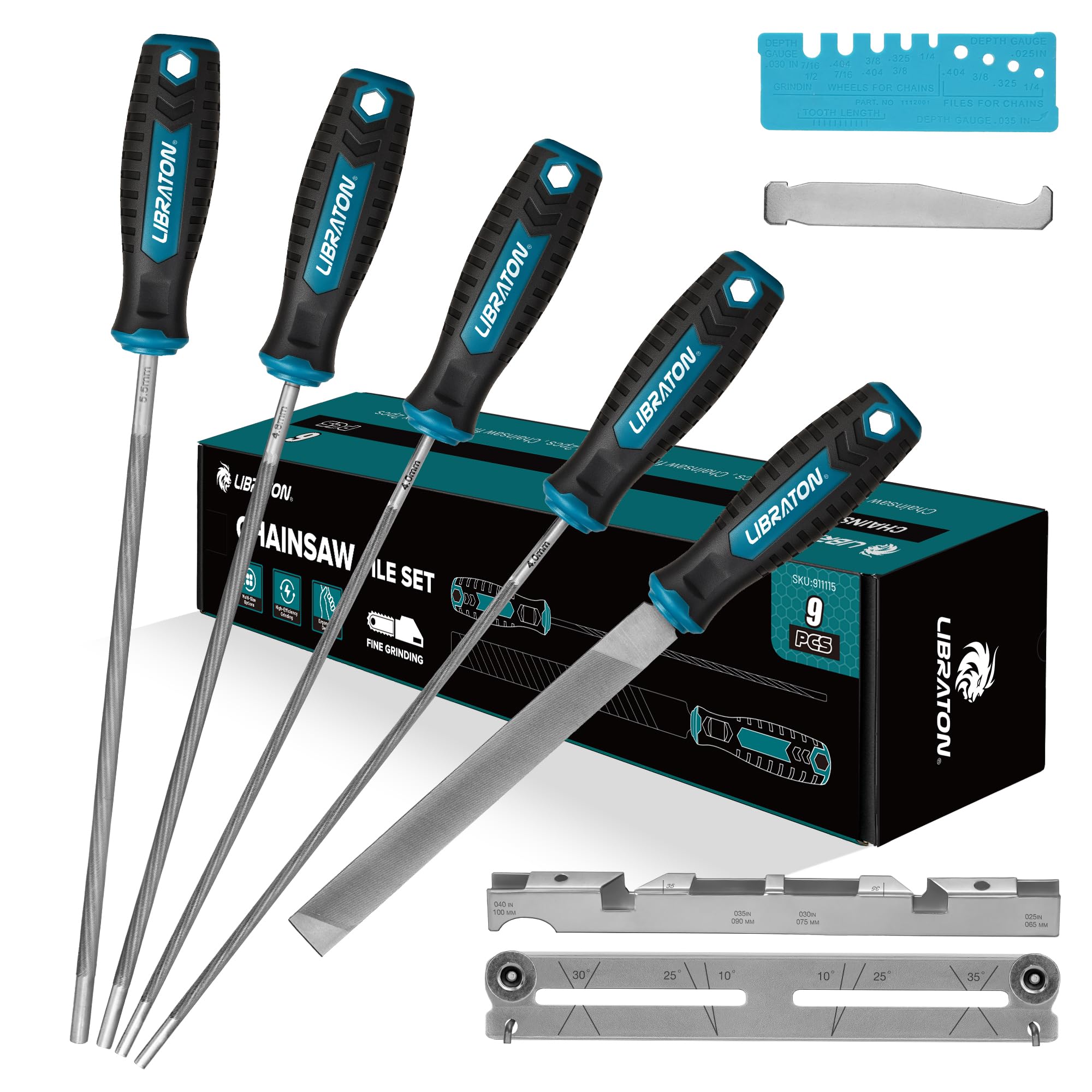
The three-file kit that solves the “sore hand after fifteen strokes” problem with rubber-coated handles.
Most round files come as bare steel rods that force you to either buy a separate handle or file with the raw tang (the pointed metal end) digging into your palm. LIBRATON pre-attaches an ergonomic PP (polypropylene) handle with a TPR (thermoplastic rubber) coating to all three round files and the flat file, so you get a comfortable non-slip grip right out of the pouch — no assembly, no extra purchase. The kit includes 5/32″, 3/16″, and 7/32″ round files plus a 6″ flat file for depth gauge maintenance, a filing guide, a check gauge, and a bar groove cleaner, all packed in a cloth pouch with a carry handle that measures 13.82 x 3.19 x 3.03 inches.
The alloy steel files are deeply quenched (heat-treated for hardness) for wear resistance, and buyers confirm they work well for the price. The accurate note, however, is on the raker depth gauge: one reviewer called it “trash,” saying it has too many cutouts to sit on multiple teeth simultaneously, making it impossible to get a usable measurement. If you rely on the depth gauge for consistent raker settings, this set’s gauge will frustrate you. The filing guide also blocks the file from reaching a perfectly sharp edge for some users, so you may need to freehand the final pass.
Why the grip matters
- TPR rubber-coated handles on every file mean zero hand fatigue, even when sharpening a full 20-inch chain in one session
- Three most common round file diameters (5/32″, 3/16″, 7/32″) cover the vast majority of homeowner and pro chains
- Weight of 1.85 pounds is manageable and comes with a convenient carry pouch
Where it falls short
- Raker depth gauge is unusable according to real buyers — too many cutouts prevent it from sitting on multiple teeth
- Filing guide can block the file from making an exact sharp edge; best used as a reference angle only
Choose this for: The comfort factor — if you sharpen multiple chains in a row and want a ready-to-grip handle without buying a separate wooden file holder, this is the most comfortable kit in the lineup.
Not the best for: Precision depth gauge work. The included gauge is functionally flawed, so you will need a dedicated Oregon or PFERD depth tool for accurate raker settings.
5. Oregon 104004 Chainsaw Sharpening Kits, 5/32″

The complete home-sharpening starter pack that shows you exactly where to hold the file and how deep to set the rakers.
Sharpening a chainsaw the wrong way leaves you with a chain that cuts sideways or bucks back at you. Oregon made this kit specifically to prevent that: the filing guide locks the file into the correct 30° or 35° angle versus the chain so you cannot accidentally file a flat top, and the 0.025″ depth gauge tool sets the raker (the depth gauge bump) height at the factory spec for most chains. The package includes a 5″ round file, a 6″ flat file, two wooden file handles, and a filing chart printed right on the back of the package that walks you through the process step by step.
Buyers with no prior sharpening experience report that 10 to 20 minutes of practice makes them as fast as a professional, and several note it “probably doubled the life of my 16″ Homelite chain.” One buyer called it a bit flimsy but still improved the saw’s bite. The kit is built around 5/32″ diameter, which means it is specifically for 1/4″ and 3/8″ low-profile chains — not suitable for full-size 3/8″ or.404 chains. If your bar takes a 7/32″ file, this kit will not fit your chain.
What makes it beginner-proof
- Filing guide locks in the correct sharpening angle so you cannot mess up the cutter profile
- 0.025″ depth gauge tool sets raker height to factory chain spec for safe, kickback-free cutting
- Printed filing chart on the package is a genuinely helpful reference for new sharpeners
What it does not do
- Limited to 5/32″ file diameter only — incompatible with 3/8″ and.404 pitch chains
- One buyer mentioned the guide feels a bit flimsy, so it may not survive heavy daily use in a pro environment
Best for the first-timer: If you have never sharpened a chain and want a guided setup that teaches you the correct angles and depth gauge settings before you go freehand, this kit removes all the guesswork.
Not for you if: Your chain takes a 7/32″ or 3/16″ file, or you already know how to sharpen freehand and just need bare files in bulk.
Understanding the Specs
File Diameter and Chain Pitch
The file diameter — measured in inches or millimeters (e.g., 5/32″ is 4.0 mm) — must match your chain’s pitch. A 1/4″ or 3/8″ low-profile chain uses a 5/32″ file; a standard 3/8″ chain uses a 7/32″ file. A file that is too large will clip the depth gauge (the small bump in front of each cutter), and a file that is too small will not reach the cutting edge’s full face, rounding the tooth instead of sharpening it.
File Cut: Spiral vs. Double-Cut
Spiral-cut files (often called “curved tooth”) have a single continuous groove around the rod. They cut aggressively on the pull stroke and leave a slightly textured edge that some cutters prefer for faster wood bite. Double-cut files (sometimes called “Swiss cut”) have two sets of grooves crossing at an angle, producing a smoother edge with less side friction. Double-cut files generally last longer because each tooth does less work per stroke.
Steel Type and Hardness
File steel determines how long the abrasive teeth stay sharp. T12 carbon steel is standard in budget kits; it wears down after 10-20 sharpenings. GCr15 high-chrome steel (often branded “alloy steel”) holds its grit 2-3 times longer but can be more brittle — bend it too far and it snaps. PFERD’s Classic Line files are rated for steels up to 370 HV (Vickers hardness), meaning they can handle even the hardened cutters on pro chains without glazing over.
FAQ
What size chainsaw file do I need?
How often should I sharpen my chainsaw chain?
Can I use a chainsaw file without a handle?
What is the difference between a round file and a flat file for chainsaws?
Why do my chainsaw files wear out so fast?
Is a spiral-cut file better than a double-cut file?
Can I sharpen a Stihl chain with Oregon files?
What is a depth gauge tool and why do I need one?
Can I use a chainsaw file in a drill for sharpening?
What should I do if my file snaps?
Final Thoughts: The Verdict
If you want a kit that covers multiple chain sizes with a single purchase, grab the Universal Field 14-piece Kit. And for the beginner who has never sharpened a chain before, the standout is the Oregon 104004 Sharpening Kit with its simple to use guide and depth gauge tool.
How We Picked
We do not accept paid placement. Every pick is matched to a real buyer and a real use-case; we do not hands-on test units.
Sources & Methodology
Specifications: manufacturer listings and product documentation. Review insights: verified customer reviews, as of July 2026. Pricing: not shown on this page (it changes often); check the current price via the retailer link.
As an Amazon Associate, Gadgets Feed earns from qualifying purchases. This does not affect which products we feature.
Product prices and availability are accurate as of the date/time indicated and are subject to change. Any price and availability information displayed on Amazon at the time of purchase will apply to the purchase of this product. As an Amazon Associate I earn from qualifying purchases.
CERTAIN CONTENT THAT APPEARS ON THIS SITE COMES FROM AMAZON. THIS CONTENT IS PROVIDED "AS IS" AND IS SUBJECT TO CHANGE OR REMOVAL AT ANY TIME.
Amazon and the Amazon logo are trademarks of Amazon.com, Inc. or its affiliates.