
Our readers keep the lights on and my morning glass full of iced black tea. As an Amazon Associate, I earn from qualifying purchases.
Specs are compiled from manufacturer listings and verified buyer reviews and can change over time — please confirm the key details on the product page before buying.
Picking a camp saw can feel like a gamble — will it cut through the wood you need, or will the blade bind and leave you wrestling at your campsite? A saw that powers through a 4-inch branch in about 30 seconds is different from one that feels like a toy, and that difference depends on blade length, tooth design, and handle stability. This guide covers seven folding saws ranked by how well they handle real camp tasks, from trimming kindling to bucking firewood.
I’m Min — the founder and writer behind Gadgets Feed. This guide is built by comparing the manufacturers’ published specifications and the patterns across verified customer reviews, so you get each pick’s real strengths and trade-offs instead of marketing spin.
You will find seven folding saws ranked by how well they handle real camp tasks, from trimming kindling to bucking firewood. This guide to the best camp saw focuses on blade length, weight, and cutting efficiency so you bring the right tool for the trail.
Quick Picks
- Silky Professional Gomboy Curve 240mm Outback Edition (752-24) — Top Performer
- AGAWA BOREAL21 Tripper Kit — Best for Base Camp
- Sven-Saw 60th Anniversary Engraved 21″ Folding Saw — Classic Powerhouse
- Gerber Freescape Camp Saw — Versatile Mid-Weight
- SOG Knives Folding Saw — Best Overall Mid-Range
- Outdoor Edge 4.4″ Flip N’ Zip Saw — Ultralight Specialist
- Opinel Folding Saw – Gardening and Camping Carbon Steel Saw — Pocket-Sized Charmer
How To Choose The Best Camp Saw
A camp saw is a tool you may only use for a few minutes a day, but those minutes define whether camp setup is a chore or a breeze. The right saw cuts quickly, packs small, and stays sharp through a season of trips. The wrong one leaves you wrestling with a blade that binds, a lock that slips, or a handle that blisters your palm. Here are the specs that separate a great camp saw from a frustrating one.
Blade length and cutting capacity
Blade length dictates the maximum thickness of wood you can realistically cut. A saw with a 4.4-inch blade handles branches up to about 2 inches thick, while a 21-inch blade can cut through a 4-inch branch in seconds and handle logs up to 12 inches in diameter. The trade-off is portability — longer blades fold into larger packages that are heavier to carry. For backpacking, a blade around 7 to 10 inches offers a good balance of cutting power and packability. For base camp or car camping, a 21-inch saw is more efficient for processing firewood.
Blade material and tooth geometry
The blade material determines how often you need to sharpen or replace the saw. High-carbon steel stays sharp longer than stainless steel but rusts if not dried after use. Impulse-hardened teeth (where the tooth tips are heat-treated) stay sharp up to three times longer than non-hardened teeth. The tooth pattern also matters — triple-ground teeth cut aggressively through bone and wood, while raker-tooth designs clear sawdust faster in green wood. A saw with 6.8 teeth per inch (TPI) cuts fast but leaves a rougher surface, while higher TPI gives a finer finish but cuts slower.
Handle design and lock mechanism
The handle is what transfers your arm power into cutting force. A folding saw with a lock-back mechanism keeps the blade rigid during heavy sawing and prevents accidental folding. Handles made of rubber or thermoplastic elastomer provide a secure grip even when wet, while wood handles are comfortable but can swell in damp conditions. The lock mechanism itself should be easy to operate with one hand — a sliding ring or a locking liner that engages positively. A handle that is too short forces you to choke up and lose leverage, so look for a handle length that allows a full grip without your hand overlapping the blade.
Weight and packed size
A camp saw competes for space in your pack with food, shelter, and water. Weight ranges from 2.5 ounces for ultralight models to over 1.2 pounds for full-size folding buck saws. The packed length is the dimension that matters most — a saw that folds to 22 inches may not fit inside a standard backpack, while one that folds to 5.5 inches slides into a side pocket. Consider how you will carry it. If the saw attaches to your pack with a sheath and clip, the weight is less noticeable. If it rattles loose inside your bag, every ounce feels heavier.
Quick Comparison
| Model | Best For | Blade Length | Weight | Cutting Capacity | Amazon |
|---|---|---|---|---|---|
| Silky Gomboy Curve 240mm | Fast, precise cuts on medium wood | 9.5 Inches | 10.08 oz | 4.7 Inches | $92.99Amazon |
| AGAWA BOREAL21 Tripper Kit | Heavy camp firewood processing | 21.5 Inches | 18 oz | 5+ Inches | $120.00Amazon |
| Sven-Saw 60th Anniversary 21″ | Thick hardwood and ground-level cuts | 21 Inches | Under 14 oz | 12 Inches | $52.95Amazon |
| Gerber Freescape Camp Saw | Backpacking and lightweight camp use | 12 Inches | 1 lb | 8 Inches | $60.80$74.99Amazon |
| SOG Knives Folding Saw | Reliable mid-size branch cutting | 7.5 Inches | 5.9 oz | ~3 Inches | $22.59Amazon |
| Outdoor Edge Flip N’ Zip | Ultralight backpacking and game processing | 4.4 Inches | 2.5 oz | ~2 Inches | $24.94Amazon |
| Opinel Folding Saw | Pocket-sized gardening and light camp use | 8 cm (3.15 Inches) | 3.6 oz (102 g) | ~3 Inches | $35.41$43.00Amazon |
In‑Depth Reviews
1. Silky Professional Gomboy Curve 240mm Outback Edition (752-24)

This Japanese pull saw cuts wood faster than you can say “dinner is ready” — and it is the fastest pick in the guide.
You get a 240-millimeter (9.5-inch) blade made from black nickel and tin-plated steel, with teeth that are taper-ground and impulse-hardened — meaning the tips are heat-treated to stay sharp up to three times longer than non-hardened teeth. The 6.8 teeth per inch (TPI; the number of cutting points per inch of blade) cut aggressively on both the push and pull stroke. That gives you a 4.7-inch cutting capacity, so limbs and small trunks up to the thickness of a fence post are no strain. The arbor composite handle stays secure even when your hands are wet and cold after a long hike.
Buyers report it cuts wood “like a hot knife through butter” and that the compact packed length makes it a perfect companion for a larger Silky 2000 saw. The blade folds into a custom carrying case, and the sturdy lock holds the blade rigid during heavy cutting. Unlike the Sven-Saw, which is built to tackle massive logs, the Gomboy is designed for precision on medium wood — it excels where speed and control matter more than raw leverage.
Speed-focused design: The curved blade gives you four cutting angles (rip, cross-cut, and slant) that leave a smooth finish, so you spend less time sawing and more time enjoying camp. The featherweight 10.08-ounce build means it disappears into your pack.
One trade-off: At a premium price, this saw is an investment. If you only process wood a few times a year, a mid-range option like the SOG or Gerber may serve you just as well.
Reach for this if: You want the fastest, smoothest cuts on medium wood sizes (up to 4.7 inches) and are willing to pay for Japanese-made quality that will last for years.
Look elsewhere if: You need a budget-friendly tool for occasional light trimming or you plan to cut logs larger than 5 inches in diameter.
2. AGAWA BOREAL21 Tripper Kit
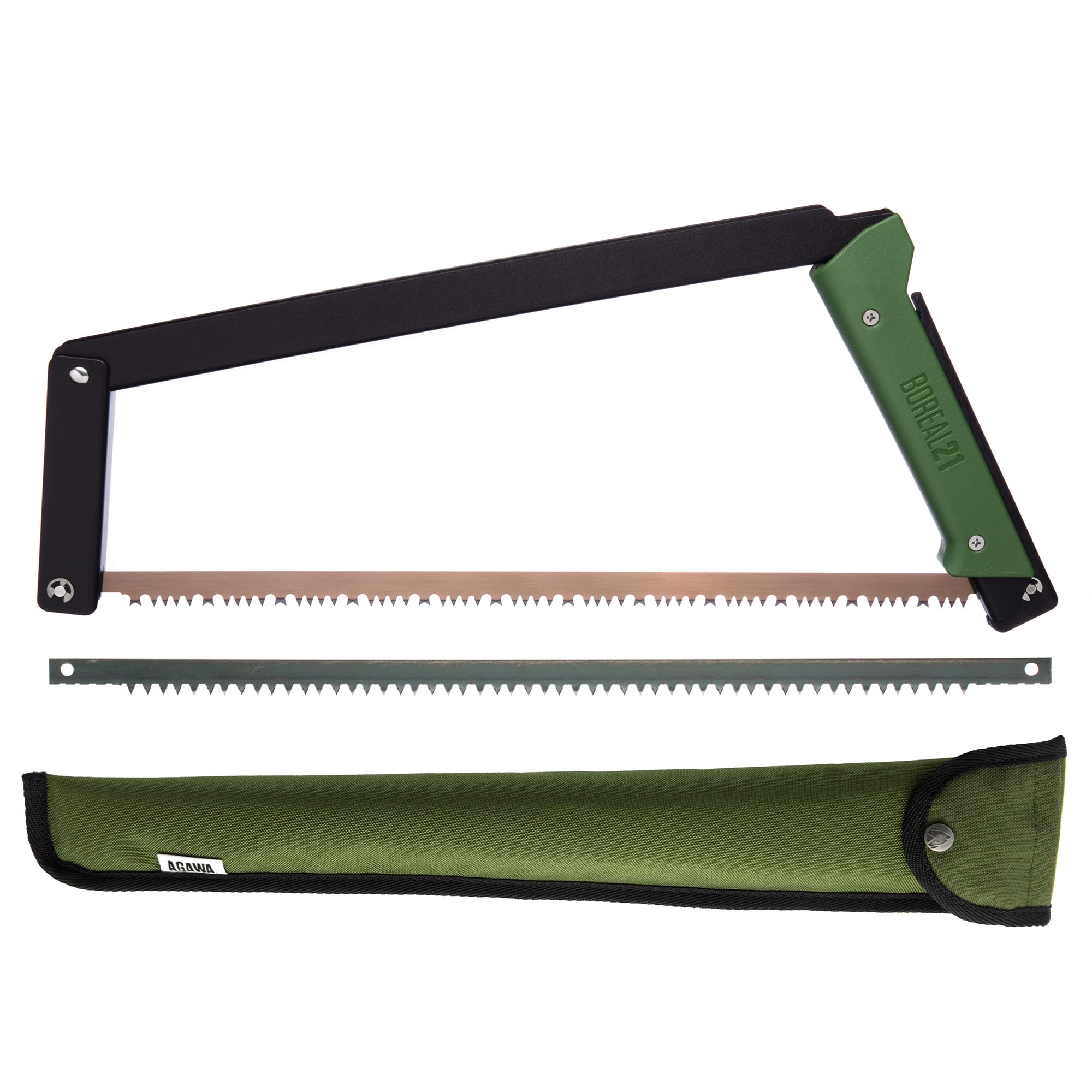
A folding buck saw that snaps into cutting position in seconds, with no loose parts to fumble — ideal for base-camp firewood.
Unlike the Sven-Saw, which uses a traditional wing-nut, the BOREAL21 uses a 3-hinged trapezium frame that snaps into position with automatic blade tensioning — no loose parts and no finger contact with the blade. The 21.5-inch stainless steel blade is coated for rust protection, and the kit includes two blades: an all-purpose medium-tooth blade for dry hardwoods and a custom aggressive blade that plows through wood faster. The high-strength anodized 6063 aluminum frame and fiberglass-reinforced nylon handle cover resist warping, rusting, and cracking in wet conditions.
Owners mention that this saw cuts a 6-inch dry black oak log in under 2 minutes straight from the start. At 18 ounces, it is heavier than the Gomboy but delivers a much longer stroke, making it ideal for processing firewood at a base camp. The included Cordura sheath protects the blade in your pack, and the extra blade means you have a backup ready if you hit a rock or nail on the trail.
Why you will love it
- Unfolds and locks into cutting position in seconds without touching the blade
- Two included blades let you switch between fast cutting and finishing cuts
- Rust-resistant coating on the blade and stainless-steel hardware hold up to moisture
The main downside
- At 18 ounces it is noticeably heavier than featherweight options like the Outdoor Edge for long backpacking trips
Who it fits best: Car campers, overlanders, and survivalists who need a durable saw that handles large wood quickly and packs down reasonably small.
Who should pass: Ultralight backpackers counting every ounce — the Sven-Saw is lighter and the Outdoor Edge is far lighter still.
3. Sven-Saw 60th Anniversary Engraved 21″ Folding Saw

With a 21-inch blade and a weight under 14 ounces, this American-made saw cuts a 4-inch branch in about 30 seconds — over and over again.
The Sven-Saw has the longest stroke in the lineup — it handles thick hardwood that would bind a shorter blade. The all-metal construction uses anodized aluminum for the handle and high-quality alloy steel for the blade, and it folds into a compact 22-inch package that weighs under 14 ounces. One reviewer noted it cuts “like a hot knife through butter” and outperformed a Silky BigBoy on 4-inch dry cedar with 50% less effort.
The high-visibility red handle makes it easy to spot among camp gear — a small detail that prevents losing a tool. Unlike the Silky Gomboy, which requires two hands to open, the Sven-Saw sets up in under 60 seconds with a simple wing-nut that tensions the blade. The trade-off is that the metal handle gets cold in winter and the wing-nut can misalign during folding if you are not careful.
Best for serious sawing: This saw is designed for thick logs and heavy use — you can grip it with both hands and lean into the cut, which is impossible on smaller saws. It cuts dry cedar, oak, and even 12-inch diameter fallen trees with ease.
One catch: The folded length is 22 inches, which is too long for many backpacks. It is better suited to car camping or strapping to the outside of a pack.
Reach for this if: You need a durable, full-length saw for processing firewood at base camp and you value American-made quality with a 60-year track record.
Look elsewhere if: You backpack ultralight and need a saw that fits inside your pack — the Gerber or Silky is more packable.
4. Gerber Freescape Camp Saw
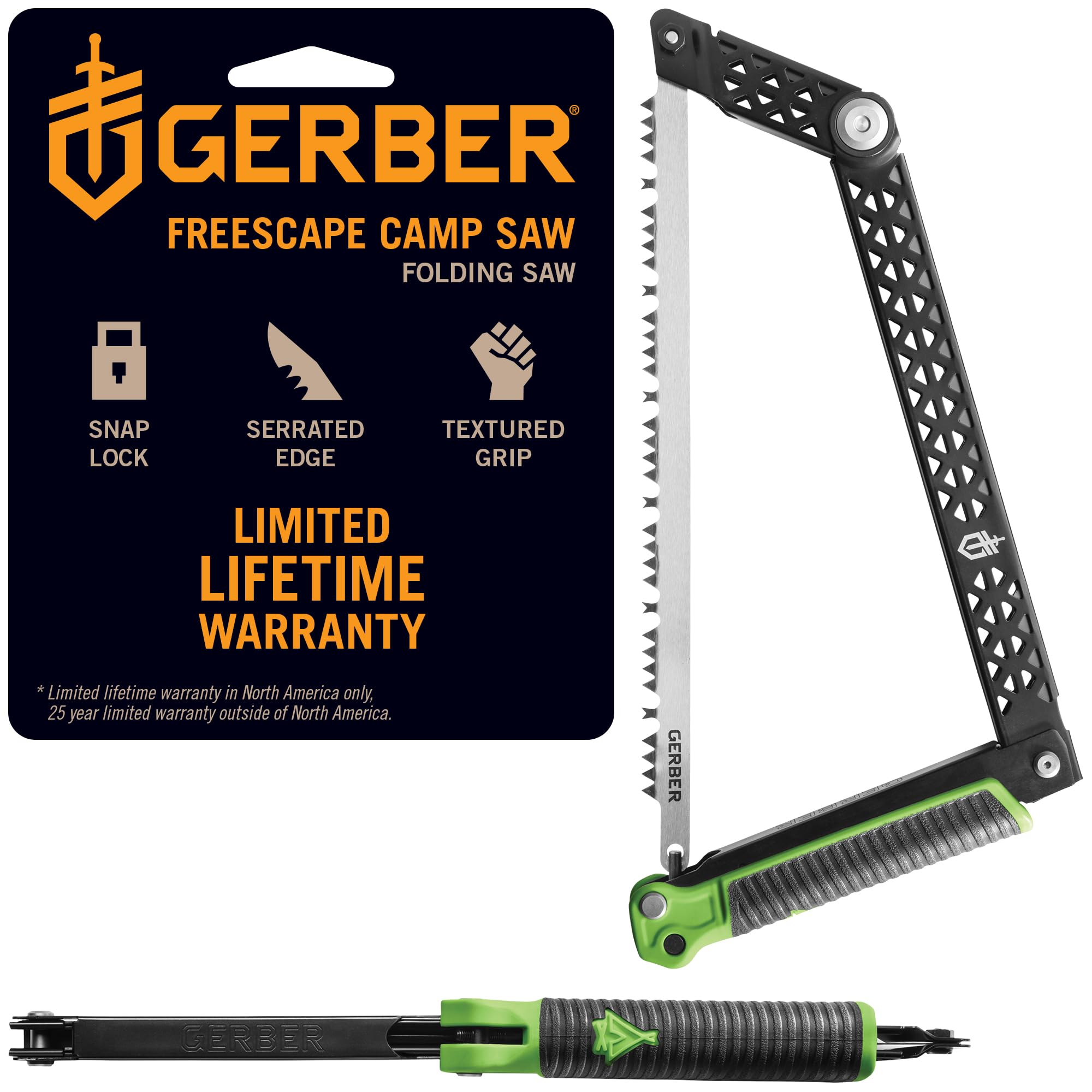
A folding saw that tucks into your pack at 5.5 inches folded length, yet still cuts an 8-inch tree in around 7 minutes — a true pack-and-perform tool.
The Freescape uses a 12-inch blade with an innovative 4-pivot folding design that keeps the saw fully assembled when folded — no loose parts to lose on the trail. The textured rubber handle provides a firm grip in wet or cold conditions, and the bright green accents make the saw easy to spot in a gear bin. Reviewers appreciate that it is “very well made and very light with a low profile both folded and assembled.”
Unlike the SOG’s 7.5-inch blade, which limits you to smaller branches, the Gerber’s 12-inch blade gives you enough stroke to handle wood up to 8 inches thick. It bridges the gap between pocket-friendly saws and full-size bow saws. One experienced camper noted the included blade has fewer teeth per inch than ideal, making cutting effort higher on dense hardwood — but the saw accepts standard replacement blades so you can upgrade later.
The smart design
- Folds completely flat to 5.5 inches — small enough for any pack pocket
- Rubber handle stays grippy even when you are breaking a sweat processing firewood
- Uses standard saw blades so replacement and upgrades are simple
The trade-off
- The stock blade has a lower tooth count, making cutting harder on dry hardwood compared to the Silky’s 6.8 TPI
Ideal for: Backpackers who want a folding saw that packs small but still handles serious cutting when needed.
Consider something else if: You process dense hardwood regularly and want the fastest cut possible — upgrade the blade or choose the Silky.
5. SOG Knives Folding Saw
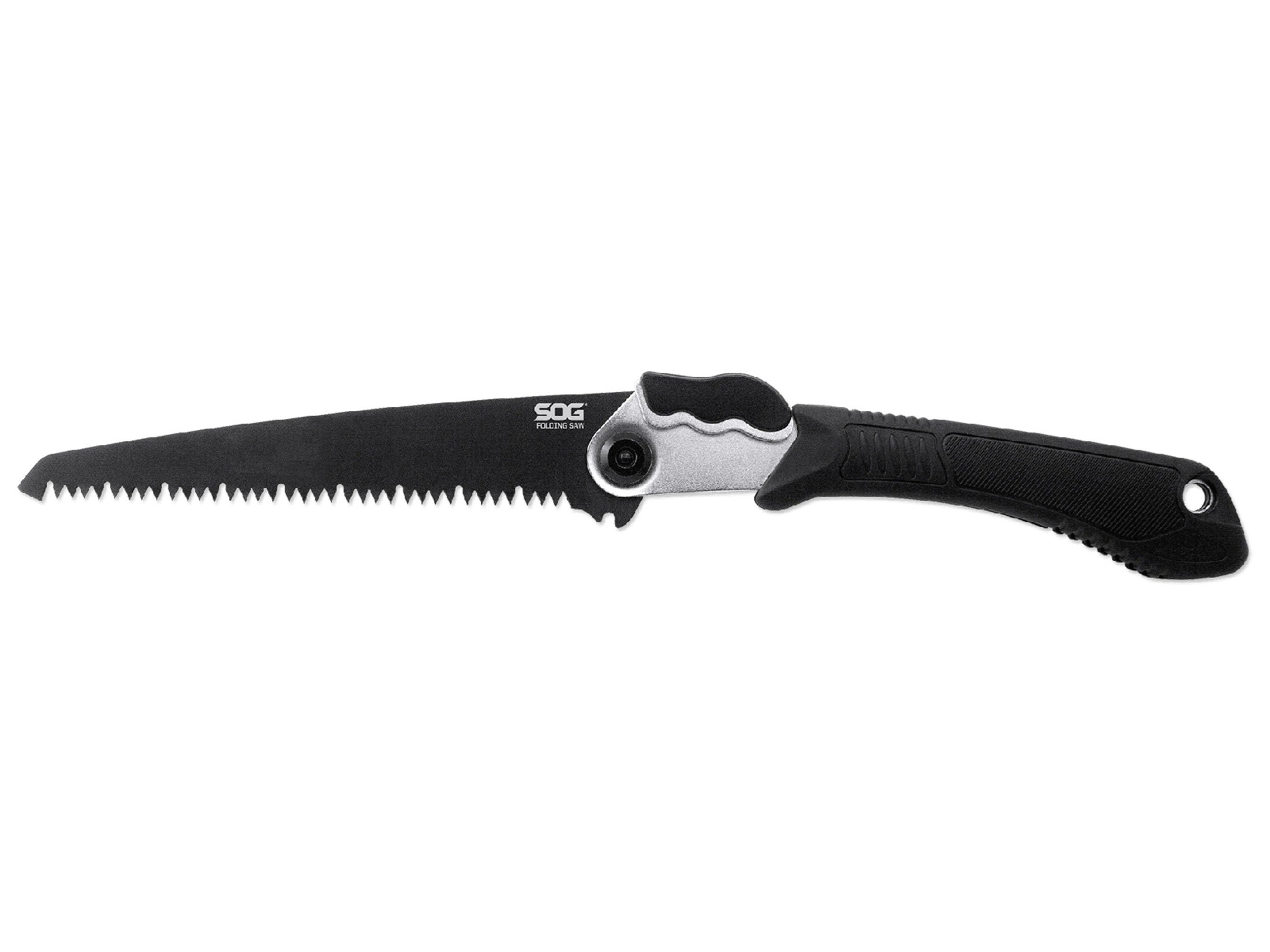
A sharp, belt-pocketable saw at 5.9 ounces that carries a lifetime warranty — and customers note it actually lasts.
This folding saw features a 7.5-inch high-carbon steel blade with a black powder coating that resists rust, and a soft TPR (thermoplastic elastomer, a durable rubber-like material) handle that stays comfortable during longer cutting sessions. At 5.9 ounces with its sheath, it is light enough to clip to your belt for a day hike in the garden or on the trail. Reviewers point out that “the saw blade is very sharp and cuts right through branches” and that the sheath attaches securely to a belt for easy carry.
Compared to the Outdoor Edge’s 4.4-inch blade, the SOG’s 7.5-inch blade gives you nearly double the cutting capacity — useful for branches up to about 3 inches thick. SOG carries a lifetime warranty from the manufacturer, which adds confidence for a tool that gets abused in the backcountry. The main concern from reviewers is that the blade feels thinner than older SOG saws, so it may not hold up to extreme levering in dense wood.
Great value for the weight: You get a 7.5-inch blade and a comfortable grip for just over half a pound — the best weight-to-blade-length ratio in the mid-range tier. The TPR handle is a clear upgrade over the hard plastic on many budget saws.
One honest caveat: The blade is thin enough that twisting it sideways while cutting could bend the teeth. Avoid using it as a pry bar and it will serve you well for years.
Reach for this if: You want a reliable, mid-size camp saw that fits on your belt and carries a lifetime warranty — perfect for weekend campers and gardeners who need one tool for both uses.
Look elsewhere if: You frequently cut branches over 3 inches thick or need a saw that can handle heavy levering without flexing.
6. Outdoor Edge 4.4″ Flip N’ Zip Saw

Weighing just 2.5 ounces, this is the saw you will actually carry on every trip — and it still cuts like a much bigger tool.
The 4.4-inch 65Mn spring-steel blade with triple-ground teeth (three bevels per tooth for aggressive cutting) tears through bone, wood, and tough hide, making this a dual-purpose saw for camp chores and game processing. The 6061-T6 aircraft-grade aluminum handle is anodized orange for visibility and has a textured grip that stays secure even with wet hands. It folds small enough to disappear inside a pocket or daypack, and the included nylon sheath with a clip keeps it accessible without bulk.
Shoppers say this saw weighs only 70 grams (80 grams with the nylon case), and one reviewer called it “sturdy, efficient sawing with front nub for groove focus, effective lock, comfortable.” Unlike the Opinel below, which uses a slip-ring lock, the Outdoor Edge features a lock-back safety mechanism that holds the blade firmly during heavy sawing. The catch is that the non-stainless steel blade will rust if not dried after exposure to moisture, and the Velcro sheath can be noisy for stealth hunting.
Why ultralight hikers love it
- At 2.5 oz it weighs less than a typical camping knife — you forget it is in your pack until you need it
- Triple-ground teeth cut aggressively through wood and bone without binding
- Orange handle is easy to spot in low light or among scattered gear
The honest trade-off
- The 4.4-inch blade limits you to branches under 2 inches thick — larger wood requires serious effort
Best suited for: Ultralight backpackers, hunters, and survivalists who prioritize weight savings and need a compact saw for small branches and game processing.
Better options exist if: You regularly need to cut wood thicker than 2 inches — step up to the SOG or Gerber for more cutting capacity.
7. Opinel Folding Saw – Gardening and Camping Carbon Steel Saw

A classic French folding saw at 3.6 ounces that fits in a large pocket — best for light pruning and kindling.
The Opinel features an 8-centimeter (3.15-inch) carbon steel blade with an anti-corrosion coating and a Virobloc safety ring — a sliding stainless steel ring that locks the blade both open and closed. The handle is crafted from beechwood, giving it a warm feel that is easy to hold and comfortable even after prolonged use. At 0.08 kilograms (2.8 ounces), it is 14% heavier than the Outdoor Edge, but the wood handle and classic design appeal to traditionalists and gardeners.
Buyers report that the slip ring on this model “works much more smoothly” than older Opinel knives, locking in place better while remaining easy to operate. The saw cuts on the pull stroke and is ideal for branches up to 2 inches. Larger wood up to 3 inches is possible but requires more effort. Unlike the SOG’s TPR handle, the beechwood handle can swell in damp conditions, and the carbon steel blade needs to be dried immediately after use to prevent rust.
Perfect for the weekend gardener: The beechwood handle looks great and feels warm in the hand, and the Virobloc ring locks the saw securely for safe pocket carry. The lightweight design (3.6 oz) disappears into a fishing bag or toolbelt.
The realistic limit: At 3.15 inches, the blade is the shortest in our list, making it best for light pruning and kindling rather than serious camp firewood processing. Carbon steel requires more care than stainless blades.
Reach for this if: You want a pocket-friendly camp saw for light trimming, gardening, and occasional backpacking — and you appreciate the craftsmanship of a French-made tool.
skip it if: You need a saw for heavy camp use or you do not want to worry about drying the blade after every use to prevent rust.
Understanding the Specs
Blade Length vs. Cutting Capacity
Blade length directly determines the maximum diameter of wood you can cut efficiently. A saw with a 4.4-inch blade (like the Outdoor Edge) can handle branches up to about 2 inches thick, while a 21-inch blade (like the Sven-Saw) cuts through 4-inch branches in about 30 seconds and can manage logs up to 12 inches in diameter. The trade-off is portability — longer blades require larger folded packages. For most camp tasks, a blade between 7 and 10 inches offers a practical balance of cutting power and packability.
Tooth Count and Cutting Speed
Teeth per inch (TPI) determines how fast the saw cuts and how smooth the finish is. Saws with 4-5 TPI (like aggressive blades) cut fast but leave a rough surface, while saws with 7-8 TPI (like the Silky’s 6.8 TPI) cut more slowly but leave a finer finish. Impulse-hardened teeth stay sharp up to three times longer than standard teeth because the tips are heat-treated. Triple-ground teeth (as on the Outdoor Edge) cut aggressively through both wood and bone without binding.
FAQ
What blade length is best for a camp saw?
How does a pull-cut saw differ from a push-cut saw?
How long does a camp saw blade stay sharp?
Can a camp saw cut bone?
Will a folding saw fit inside a backpack?
What is the difference between a bow saw and a folding camp saw?
How do I clean and maintain a camp saw?
What is the best camp saw for ultralight backpacking?
Can a camp saw replace a hatchet for splitting wood?
Final Thoughts: The Verdict
For the majority of shoppers, the best camp saw is the Silky Professional Gomboy Curve 240mm because its 9.5-inch impulse-hardened blade and 6.8 TPI teeth deliver the fastest, smoothest cuts for the widest range of camp wood. If you want a versatile packable saw for backpacking, grab the Gerber Freescape Camp Saw — its 12-inch blade folds flat to 5.5 inches and handles wood up to 8 inches thick. And for heavy base-camp firewood processing where weight is not an issue, the Sven-Saw 60th Anniversary 21″ Folding Saw delivers class-leading cutting speed and durability on large logs.
How We Picked
We do not accept paid placement. Every pick is matched to a real buyer and a real use-case; we do not hands-on test units.
Sources & Methodology
Specifications: manufacturer listings and product documentation. Review insights: verified customer reviews, as of July 2026. Pricing: not shown on this page (it changes often); check the current price via the retailer link.
As an Amazon Associate, Gadgets Feed earns from qualifying purchases. This does not affect which products we feature.
Product prices and availability are accurate as of the date/time indicated and are subject to change. Any price and availability information displayed on Amazon at the time of purchase will apply to the purchase of this product. As an Amazon Associate I earn from qualifying purchases.
CERTAIN CONTENT THAT APPEARS ON THIS SITE COMES FROM AMAZON. THIS CONTENT IS PROVIDED "AS IS" AND IS SUBJECT TO CHANGE OR REMOVAL AT ANY TIME.
Amazon and the Amazon logo are trademarks of Amazon.com, Inc. or its affiliates.