
Our readers keep the lights on and my morning glass full of iced black tea. As an Amazon Associate, I earn from qualifying purchases.
Specs are compiled from manufacturer listings and verified buyer reviews and can change over time — please confirm the key details on the product page before buying.
A power outage turns your home into a problem that a 7500-watt generator can solve.: it has enough muscle to run your well pump, fridge, and a window A/C unit all at once, but you do not need a concrete pad or a panel upgrade like you would for a whole-house standby unit. This guide compares four real models by their specs and verified buyer trade-offs.
I’m Min — the founder and writer behind Gadgets Feed. This guide is built by comparing the manufacturers’ published specifications and the patterns across verified customer reviews, so you get each pick’s real strengths and trade-offs instead of marketing spin.
The right best 7500 watt generator for you depends on whether you value easy starting, clean power for electronics, long-term durability, or the smallest size and lowest price.
Quick Picks
- Westinghouse 7500 Peak Watt EFI Dual Fuel Home Backup Portable Generator — Top Performer
- A-iPower 7600W Dual Fuel Quiet Portable Inverter Generator (SUA7600iED) — Cleanest Power
- WEN 8000-Watt 120V/240V Dual Fuel Portable Generator (DF8000X) — Best Value
- AIVOLT Generator 7500 Watt Dual Fuel Portable Generator with Wheels — Compact Value
How To Choose The Best 7500 Watt Generator
A 7500-watt generator is a decade-long investment. Three specs decide its long-term value: starting method, fuel type, and power cleanliness for electronics.
Fuel Type: Gasoline vs. Propane vs. Dual Fuel
Gasoline is easy to find at any gas station, but it goes bad in storage after a few months and can clog your carburetor. Propane stores forever and burns cleaner, but it gives you roughly 10% less peak power. A dual-fuel generator lets you run either fuel — a huge advantage during a long outage when gas stations may be closed or without power themselves. Most picks here are dual-fuel for this reason.
Starting System: Recoil vs. Electric vs. Remote
In a storm, electric start eliminates the frustration of yanking a pull cord in the rain. Electric start (key or button) simplifies cold mornings and stressful nights. Remote start, usually via a key fob, lets you fire up the generator from inside your house without walking out in bad weather.
Power Quality: Inverter vs. Conventional
Conventional generators produce “dirty” power with Total Harmonic Distortion (THD — a measure of how much the electrical wave is distorted) around 5-6%, which can damage sensitive electronics like laptops, TVs, and phone chargers over time. An inverter generator produces cleaner power (under 3% THD) that is safe for all your gadgets. The trade-off is that inverter models are usually quieter and more fuel-efficient, but they cost more upfront.
Quick Comparison
| Model | Best For | Rated Watts | Engine Size | Weight | Amazon |
|---|---|---|---|---|---|
| Westinghouse 7500 Peak Watt EFI | Home backup with easy starting | 6,000W (gas) | 298 cc | 139 lbs | $1,049.00Amazon |
| A-iPower 7600W Inverter | Sensitive electronics & quiet operation | 6,100W (gas) | 322 cc | 130 lbs | $1,490.99Amazon |
| WEN 8000-Watt Dual Fuel | Best value for serious off-grid use | 6,500W (gas) | 340 cc | — | $605.02Amazon |
| AIVOLT 7500 Watt Dual Fuel | Budget-friendly portable power | 6,300W (gas) | 322 cc | 128 lbs | $609.99$699.99Amazon |
In‑Depth Reviews
1. Westinghouse 7500 Peak Watt EFI Dual Fuel Home Backup Portable Generator
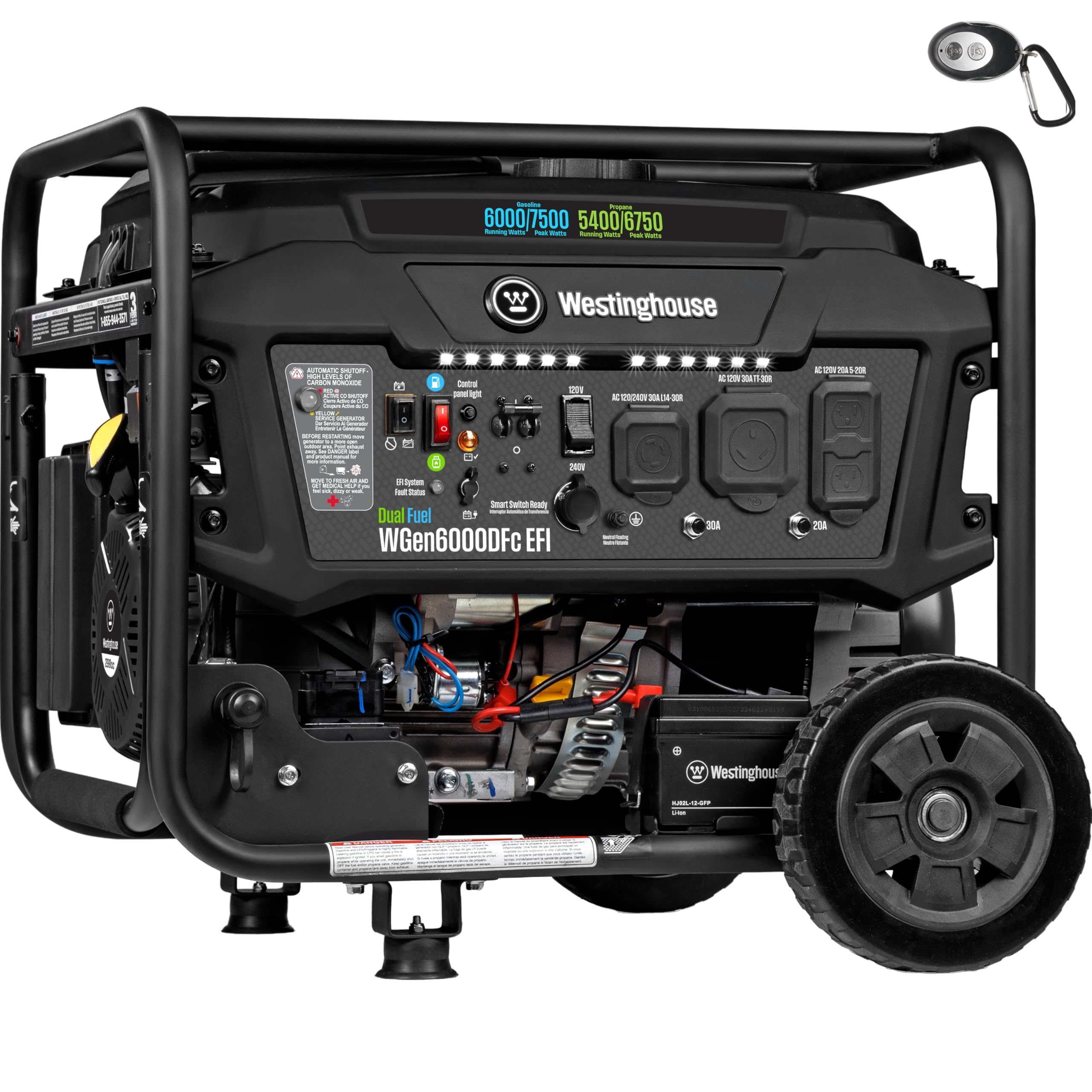
The generator that starts like a car, with no choke or carburetor guessing games.
This is the pick if you want the most low-maintenance starting in an emergency. The Westinghouse uses Electronic Fuel Injection (EFI — a computer that meters the fuel precisely) so you never have to fiddle with a choke or clean a gummed-up carburetor. It delivers 7,500 peak watts and 6,000 running watts on gasoline (6,750 peak and 5,400 running on propane). That is enough to handle a well pump, fridge, furnace, and lights all at once — one owner reported it “powered fridge, fans, TV through 9-day 100°F+ outage in Houston.” The 298cc engine is 14% smaller than the WEN’s 340cc engine, but the EFI system is designed to make up for it with better fuel efficiency and reliability.
You get three starting options: a remote key fob (so you can start it from inside your house), an electric push-button, and a manual recoil as a backup. The 4.75-gallon fuel tank gives up to 14 hours of run time on gasoline, or about 9.5 hours on a standard 20-pound propane tank. It weighs 139 pounds — 9% heavier than the AIVOLT at 128 pounds — but the padded handle and wheels make it manageable to roll. A CO sensor (carbon monoxide detector) shuts the generator down automatically if dangerous CO levels build up, adding a safety layer.
One honest drawback: buyers report the generator runs a bit rich from the start, with some noting the frequency can spike near 63 Hz (it should be 60 Hz). There is a small adjustment screw on the governor that brings it back into spec, and Westinghouse customer service is helpful, but it is a step you should budget a few minutes for. The unit also lacks a built-in panel light for nighttime operation.
Why it stands out
- EFI technology means no choke, no carburetor cleaning, and easier cold starts
- Three start methods (remote fob, electric, recoil) — start it from inside the house
- CO sensor provides automatic safety shutoff
- 3-year limited warranty plus nationwide customer service network
Things to know
- Engine may run at high frequency (63 Hz) from the start; needs a simple governor adjustment
- No panel light for low-light operation
- At 139 lbs, it is noticeably heavier than the AIVOLT
Best for: Homeowners who want the most reliable, low-hassle starting experience for emergency backup and who will use both gasoline and propane.
Consider the WEN if: You do not mind a carburetor and want a bigger engine (340cc vs 298cc) at about half the price.
2. A-iPower 7600W Dual Fuel Quiet Portable Inverter Generator (SUA7600iED)

Inverter-clean power that keeps your laptop, TV, and phone charger safe.
If you need to run sensitive electronics during an outage — a CPAP machine, a desktop computer, or a home theater — the A-iPower is the pick. Its inverter technology produces power with just 3% Total Harmonic Distortion (THD — a measure of electrical wave distortion), which is clean enough that you do not need a separate surge protector for your gadgets. It delivers 7,600 starting watts and 6,100 running watts on gasoline, and 6,900 starting and 5,500 running on propane, all from a 322cc engine — the same displacement as the AIVOLT but with the inverter advantage. This is noticeably cleaner power than the Westinghouse’s conventional output, so your laptop is safer here.
Noise is a major factor. At 62 decibels (about the level of a normal conversation), this generator is quiet enough to hold a conversation next to it, a big step down from a conventional open-frame generator that sounds like a lawn mower. Owners mention it is larger and heavier than a comparable Honda, tipping the scales at 130 pounds, but the telescoping handle and flat-free wheels make rolling it manageable.
A clever feature is the Fuel Sense Technology that automatically switches from propane to gasoline when the propane runs out, giving you a combined run time of up to 21.2 hours at 25% load. One owner reported using it to charge a 5,000 watt-hour solar generator and called it “pretty quiet over all.” On the flip side, some customers note that the engine runs lean when temperatures drop below 60°F, requiring you to manually engage the choke, and the recoil starter does not always fully retract.
Why it shines
- 3% THD clean power protects laptops, TVs, and phone chargers
- 62 dB sound level — quiet enough for a campground or a neighborhood
- Fuel Sense automatically switches from propane to gasoline for up to 21.2 hours runtime
- Telescoping handle and flat-free wheels for easy transport
Things to know
- Runs lean below 60°F — may need choke adjustment even when hot
- At 130 pounds, it is heavier than a Honda inverter in the same class
- Recoil starter sometimes does not fully retract
Reach for this if: You plan to power sensitive electronics (laptops, TVs, medical devices) without a separate power conditioner or surge protector.
Look elsewhere if: You need to start large motor loads like a big air compressor — the inverter struggles with surge demand that a conventional generator like the WEN handles more easily.
3. WEN 8000-Watt 120V/240V Dual Fuel Portable Generator (DF8000X)
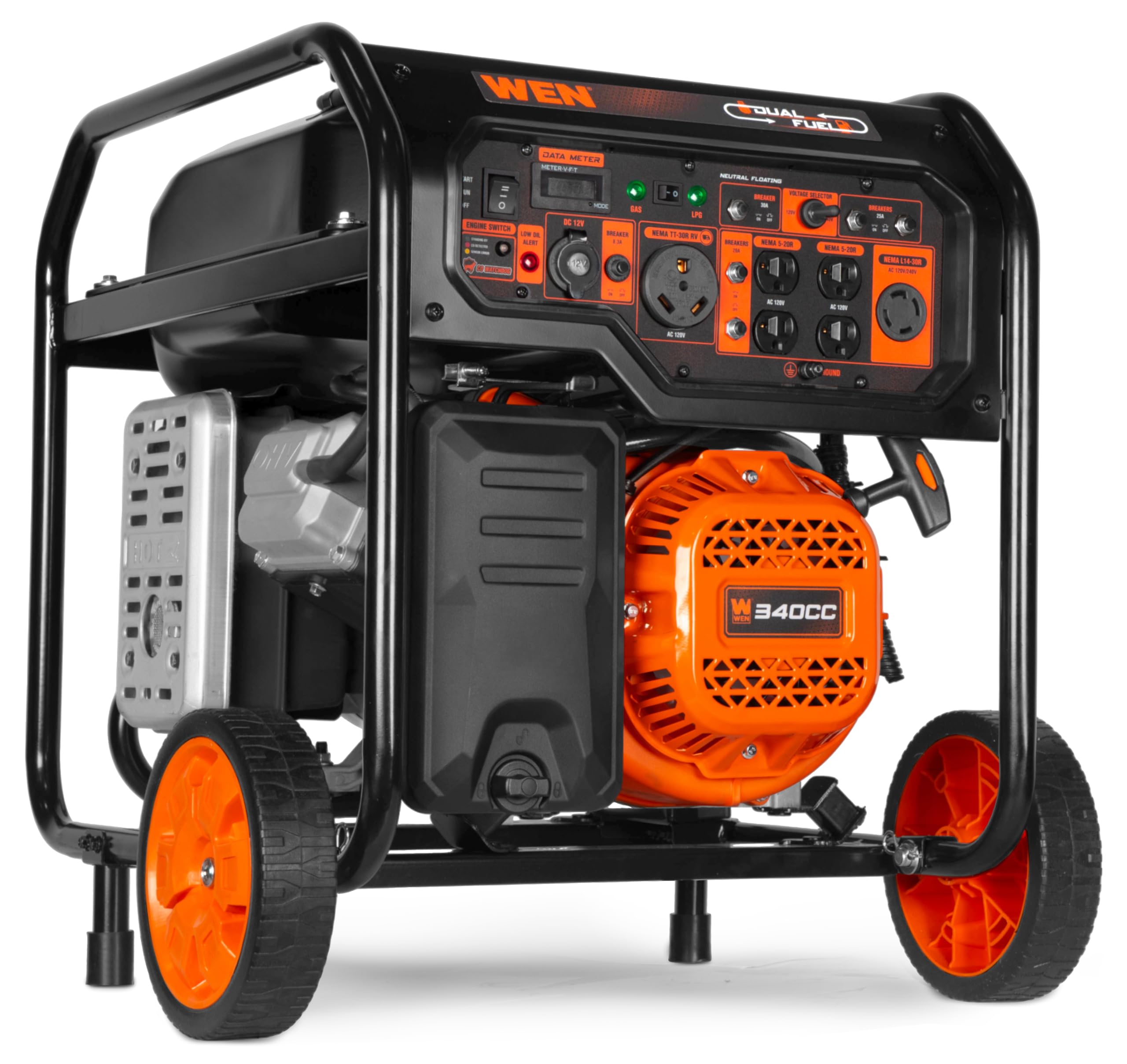
An off-grid workhorse that has run for months straight without complaint.
The WEN earns its spot not because it is cheap, but because it has proven itself in extreme use cases. One reviewer who lives off-grid reported, “Been running it everyday for 9 months straight cranks first pull 99% of the time and the 1% 2-3 pulls.” That kind of real-world endurance is rare at this price. It delivers 8,000 surge watts and 6,500 rated watts on gasoline (7,200 surge and 5,850 rated on propane), giving it 3% more rated watts than the AIVOLT’s 6,300 — a small but meaningful edge when you are running a well pump and a fridge simultaneously.
The 340cc engine is the largest displacement in this lineup, a 14% gap over the 298cc Westinghouse. That extra displacement means it does not have to work as hard to produce its rated power, which can translate to better longevity. A 6.7-gallon tank provides up to 10.5 hours of run time at half load. The WEN Watchdog CO Shutdown Sensor automatically turns off the generator if carbon monoxide builds up — a safety net. The control panel includes four standard 120V 20-amp outlets, one RV-ready 30-amp TT-30R outlet, and one transfer-switch-ready 120V/240V 30-amp L14-30R twist-lock receptacle.
Buyers do flag a couple of minor annoyances. The oil dipstick is prone to cross-threading, so you have to be careful when tightening it. The rocker switch does not kill the engine; you must use the fuel shutoff valve or the RPM lever to stop it. And at a 28.54-inch length and 24.96-inch height, it is 24% larger in overall dimensions than the AIVOLT, so it takes up more garage space.
Why it delivers
- 340cc engine — biggest displacement in this guide, built for longevity
- 6,500 rated watts (gasoline) — out-powers the AIVOLT by 3% at rated load
- Off-grid reviewers point out 9+ months of daily use without issues
- CO Watchdog safety sensor protects against carbon monoxide
Things to know
- Oil dipstick is easy to cross-thread
- Rocker switch does not shut off the engine — must use fuel shutoff or RPM lever
- Larger footprint than the AIVOLT (28.54″L vs 23″L)
Ideal for: Off-grid cabins, full-time RVers, or anyone who needs a generator that can run continuous daily loads without breaking down.
skip it if: You want inverter-clean power for electronics — the WEN is a conventional generator, so you will need a separate surge protector for your laptop and TV.
4. AIVOLT Generator 7500 Watt Dual Fuel Portable Generator with Wheels
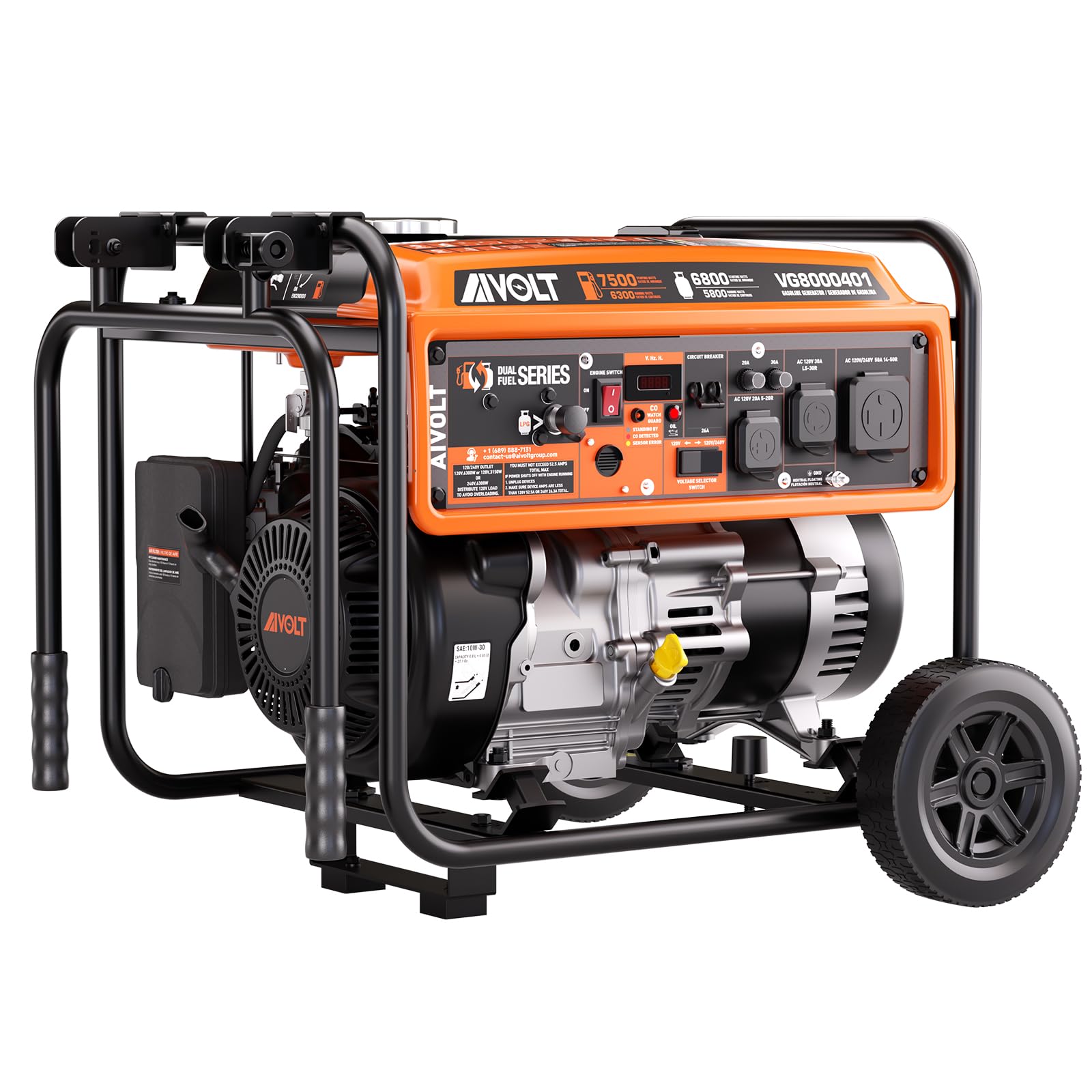
The smallest, lightest 7500-watt dual fuel generator at a price that is tough to top.
The AIVOLT is for the buyer who wants the most portable package in this power class without giving up dual-fuel capability. At 23 inches long by 19 inches wide by 19 inches high, it has a 24% smaller footprint than the WEN, and at 128 pounds it is 9% lighter than the 139-pound Westinghouse. It delivers 7,500 peak watts and 6,300 rated watts on gasoline (6,800 peak and 5,800 rated on propane). One owner said the “4-gallon tank runs 14 hrs at low draw,” making it a viable option for an extended weekend camping trip or a short-term outage.
The control panel includes a heavy-duty 120V/240V 50-amp NEMA 14-50R outlet, which is the same plug used by most large RVs and home transfer switches. There is also a 120V 30-amp twist-lock outlet and standard 120V 20-amp household outlets. A digital data center displays voltage, frequency, and total run time so you can monitor power quality and know when to schedule an oil change. The 322cc engine includes a cast-iron sleeve for durability, and the CO Watch-Guard system with visual alerts (red light for CO shutdown, yellow for service) adds an extra safety layer.
The catch is that some early units have had CO sensor failures — one reviewer noted a shutdown after two weeks and said the company was unresponsive. The included RV outlet has a non-standard pin configuration that requires a Nema L5-30P to TT-30R adapter for typical RV cords. Also missing is a dedicated hour meter, which is strange for a generator with a digital display.
Why it works
- Smallest and lightest dual fuel generator here — fits in tight truck beds and garages
- 50-amp RV outlet (NEMA 14-50R) for large RVs and transfer switches
- Digital display shows voltage, frequency, and run time at a glance
- Very quiet for its power class; owners note it is easy on the ears
Things to know
- Some units have had CO sensor failures; customer support responsiveness varies
- RV outlet needs an adapter for standard TT-30R RV cords
- No built-in hour meter despite having a digital display
Best for: RVers and campers who want a generator that is compact enough to carry and quiet enough not to annoy the neighbors.
Consider the WEN if: You need a generator for continuous daily use — the WEN has a bigger engine and a better track record for long-term reliability at a similar price.
Understanding the Specs
Peak Watts vs. Running Watts
The peak (or surge) wattage is the brief burst of power needed to start a motor — like your well pump or refrigerator compressor kicking on. The running (or rated) wattage is what the generator can sustain continuously. For a 7500-watt generator, you typically see around 7500 peak and 6000-6500 running. Always size your generator by the running wattage of everything you plan to run simultaneously, with extra headroom for startup surges.
Total Harmonic Distortion (THD)
THD measures how “clean” the electrical sine wave is. A conventional generator produces power with 5-6% THD, which can create a hum in audio equipment or overheat laptop power supplies over time. An inverter generator typically stays under 3% THD, producing power as clean as what comes from your wall outlet. If you plan to run computers, TVs, or medical devices, an inverter model (like the A-iPower) is worth the premium.
FAQ
Will a 7500-watt generator run my whole house?
What is the difference between gasoline and propane runtime?
How often do I need to change the oil?
Can I run a 7500-watt generator in the rain?
Do I need a transfer switch to connect a generator to my house?
How loud is a 7500-watt generator?
What does a CO sensor do and why does it matter?
Can I parallel two of these generators together?
Final Thoughts: The Verdict
For most people, the best 7500 watt generator winner is the Westinghouse 7500 Peak Watt EFI because its Electronic Fuel Injection eliminates the most common frustration of generator ownership — carburetor trouble — and gives you a remote start from inside the house. If clean power for sensitive electronics matters most, grab the A-iPower 7600W Inverter, which keeps your laptop and TV safe while running whisper-quiet. And for the budget-conscious buyer who needs a generator that can run daily for months, the WEN 8000-Watt Dual Fuel offers proven off-grid endurance at a price that is tough to match.
How We Picked
We do not accept paid placement. Every pick is matched to a real buyer and a real use-case; we do not hands-on test units.
Sources & Methodology
Specifications: manufacturer listings and product documentation. Review insights: verified customer reviews, as of July 2026. Pricing: not shown on this page (it changes often); check the current price via the retailer link.
As an Amazon Associate, Gadgets Feed earns from qualifying purchases. This does not affect which products we feature.
Product prices and availability are accurate as of the date/time indicated and are subject to change. Any price and availability information displayed on Amazon at the time of purchase will apply to the purchase of this product. As an Amazon Associate I earn from qualifying purchases.
CERTAIN CONTENT THAT APPEARS ON THIS SITE COMES FROM AMAZON. THIS CONTENT IS PROVIDED "AS IS" AND IS SUBJECT TO CHANGE OR REMOVAL AT ANY TIME.
Amazon and the Amazon logo are trademarks of Amazon.com, Inc. or its affiliates.