
Our readers keep the lights on and my morning glass full of iced black tea. As an Amazon Associate, I earn from qualifying purchases.
Specs are compiled from manufacturer listings and verified buyer reviews and can change over time — please confirm the key details on the product page before buying.
Mowing the lawn or working with power tools doesn’t mean you have to be bored or cut off from the world. The right pair of AM/FM radio headphones lets you listen to your favorite talk shows, local news, or a ballgame while keeping your hearing safe from noisy machinery like a lawnmower or chainsaw.
I’m Min — the founder and writer behind Gadgets Feed. This guide is built by comparing the manufacturers’ published specifications and the patterns across verified customer reviews, so you get each pick’s real strengths and trade-offs instead of marketing spin.
If you need to hear AM or FM radio while you work or enjoy a hobby, you want headphones with a real built-in tuner — not just Bluetooth streaming from a phone. These four models balance reception strength, comfort, and noise reduction so you can pick the right am/fm radio headphones for your situation.
Quick Picks
- Kalence EP025 AM/FM Radio Ear Protection Headphones — Best Overall
- PROHEAR 027 AM FM Radio Headphones — Rural Reach
- PROTEAR Digital AM FM Radio Headphones — Budget Champion
- PROTEAR AM/FM Radio Headphones 25dB NRR — Classic Pick
How To Choose The Best AM/FM Radio Headphones
The main feature is a built-in tuner, but the listening experience on a noisy jobsite is shaped by a few specific specs you need to compare.
Noise Reduction (NRR vs. SNR)
The Noise Reduction Rating (NRR) or Single Number Rating (SNR) tells you how many decibels the earmuffs block. A higher number means quieter surroundings. For a gas lawnmower or chainsaw, look for at least 25dB NRR (roughly 30dB SNR), which brings loud engine noise down to a safe, conversational level.
Reception and Presets
Not every radio chip is the same. Look for a model with an auto-scan function and preset memory if you switch between stations often. Some entry-level units store only a handful of presets, while more advanced headsets save up to 50 AM and 50 FM stations, which matters if you have multiple favorites across the dial.
Power Source and Runtime
You have two routes here: a built-in rechargeable battery with USB-C charging, or standard AA batteries. Rechargeable models cost more upfront but eliminate the ongoing cost and waste of disposables. AA models are simple and never leave you waiting for a charge, but you need to keep spare batteries handy.
Quick Comparison
| Model | Best For | Noise Reduction | Presets | Power | Amazon |
|---|---|---|---|---|---|
| Kalence EP025 | All-day use & heavy machinery | 30dB SNR | 50 AM / 50 FM | 2000mAh Rechargeable (USB-C) | Amazon |
| PROHEAR 027 | Farms & rural areas | 25dB NRR | 10 AM / 10 FM | 2x AA Batteries | Amazon |
| PROTEAR Digital | Budget-friendly protection | 30dB SNR | — | 2x AA Batteries | Amazon |
| PROTEAR 8830 | Entry-level pick | 25dB NRR | 8 AM / 8 FM | 2x AA Batteries | Amazon |
In‑Depth Reviews
1. Kalence EP025 AM/FM Radio Ear Protection Headphones
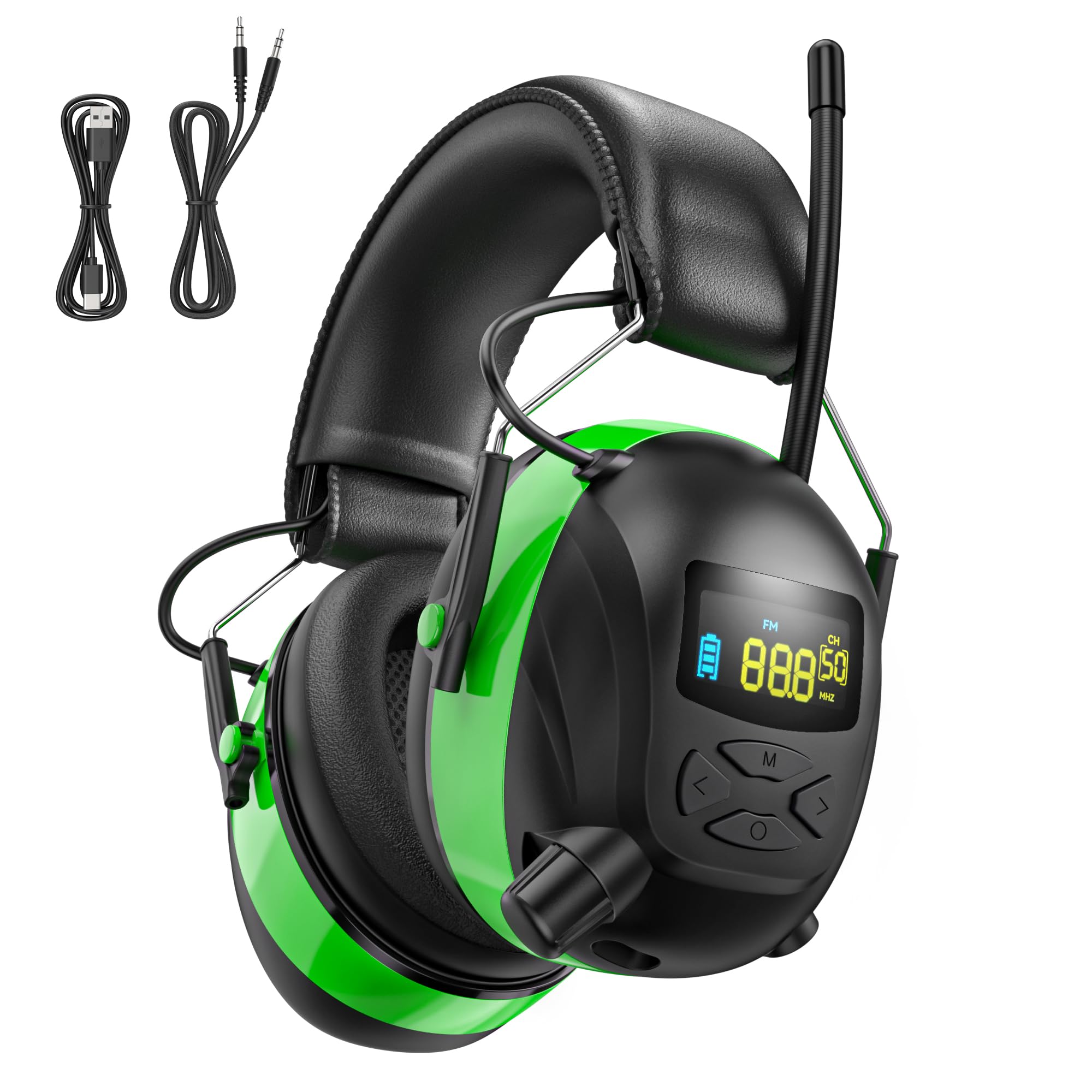
The headset that runs for weeks on a single charge and shuts out the loudest tools.
For anyone who spends full days on a zero-turn mower, a construction site, or a woodworking bench, the runtime and protection here matter most. The Kalence EP025 delivers a 2000mAh lithium battery that the maker says provides up to 120 hours of working time—meaning you charge it once every week or two. It is powered through a USB-C fast charge, so you never deal with AA batteries. It also earns a 30dB SNR noise reduction rating (the highest on this list), which brings the roar of a chainsaw or riding mower down to a tolerable level.
The EP025 has a 1.8-inch color backlit display — a jump above basic monochrome screens. Buyers report that the screen stays readable in bright sunlight, and one mentioned that they bought it for cutting grass on a zero turn mower, finding the reception clear and the engine noise blocked perfectly. It also stores up to 50 AM and 50 FM presets, — 100 total, compared to 20 on the PROHEAR 027 and 16 on the PROTEAR 8830. There is no Bluetooth—only AM/FM and a 3.5mm AUX input for connecting a phone or media player directly.
The only real trade-off is that you cannot use it while it is charging. If you forget to plug it in the night before, you are stuck waiting for a partial charge. But for routine use, the battery life mostly prevents that scenario from happening at all.
What stands out
- 120-hour battery life with USB-C charging
- 30dB SNR noise reduction — highest protection here
- 100 total station presets (50 AM + 50 FM)
One limitation
- Cannot use during charging
- No Bluetooth functionality
For heavy users: This is for anyone who mows professionally, works long industrial shifts, or needs the deepest noise reduction plus a long-lasting battery.
Think twice if: You need something you can use while plugged in or prefer the simplicity of AA batteries you can swap instantly.
2. PROHEAR 027 AM FM Radio Headphones

The dependable farm-friendly headset that pulls in distant stations without static.
If you live in the country or on a farm where AM and FM signals can be weak, this PROHEAR model is built to handle exactly that. The maker emphasizes “superior FM/AM radio signal reception,” and buyers confirm it — one reviewer from a rural area noted it “picks up many stations in rural area,” which is a meaningful advantage over cheaper chipsets. Its 25dB NRR (Noise Reduction Rating) is enough to silence a gas tractor or snowblower, and the volume is capped at 85 decibels for safer extended wear.
Unlike the Kalence, the PROHEAR 027 runs on two AA batteries, not a rechargeable pack. That means you can refresh the power in 10 seconds instead of waiting for a USB cable. One reviewer noted the battery lasts roughly 4-5 hours of continuous use. It stores up to 10 AM and 10 FM presets and includes a 3.5mm AUX cable for plugging in a phone or music player when you are in a high-interference building. A few reviewers mention it fits snug on large heads and that setting the presets via the menu can be fiddly on first use.
The main catch is the fit. Multiple buyers reported that the headband adjustment range is short and the ear cups pinch if you have a larger head, making it less comfortable than the EP025 for very long shifts. For most users doing routine mowing or shop work, though, the fit and reception quality make it a strong runner-up.
Where it shines
- Strong reception in rural areas — picks up distant stations
- Easy AA battery swap, no charging downtime
- 25dB NRR with a safe 85dB volume limit
Consider before buying
- Short 4-5 hour battery life on a fresh set of AAs
- Snug fit reported as tight for larger heads
Best for country listeners: If you have struggled with weak signal on other radio earmuffs, this model is designed to give you clear reception in rural areas where stations are farther apart.
Not ideal if: You have a large head shape or need all-day runtime between charging.
3. PROTEAR Digital AM FM Radio Headphones
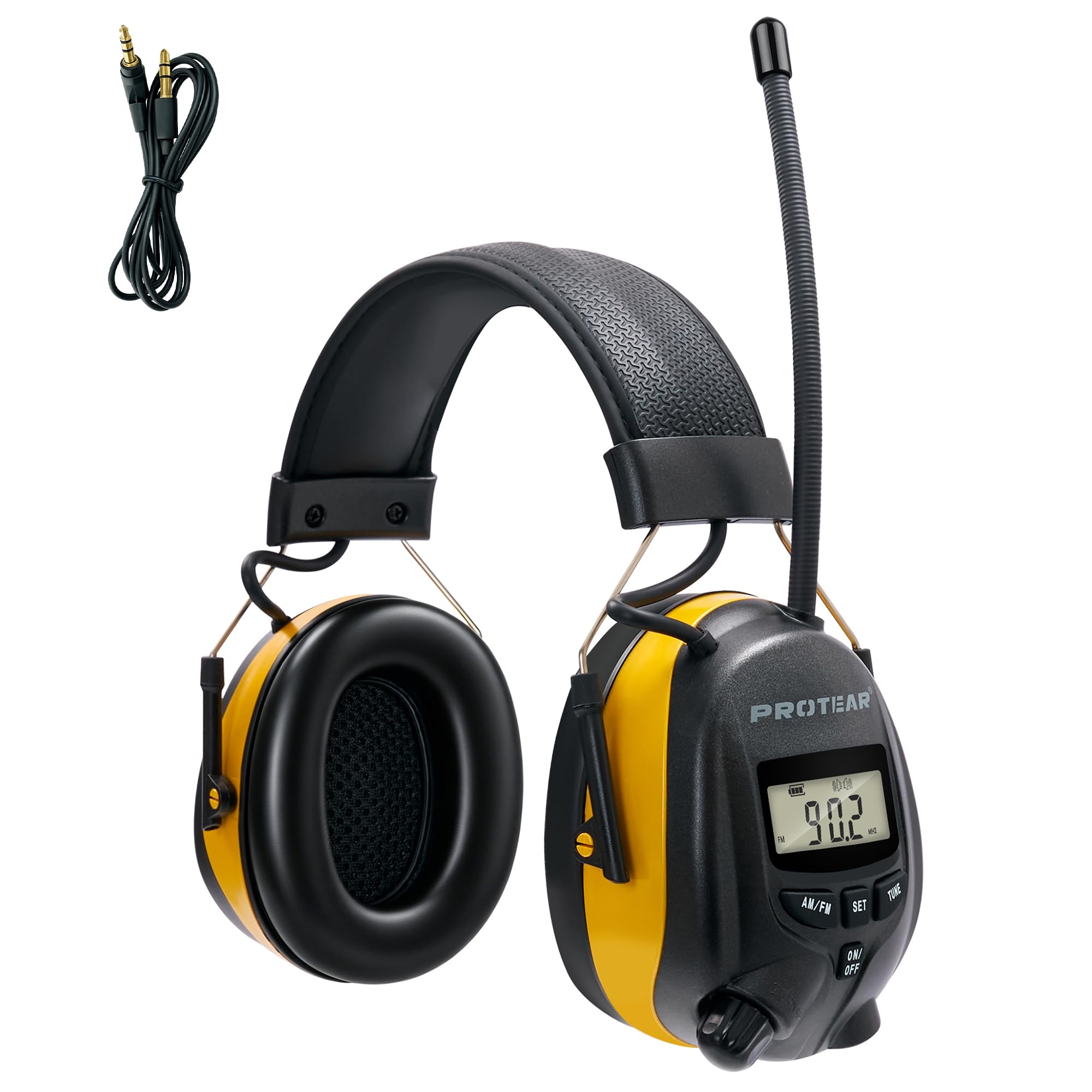
Entry-level protection that matches the highest noise reduction at a no-frills price.
This PROTEAR Digital model delivers the same 30dB SNR noise reduction as the top-ranked Kalence but at a lower price point. For someone who just needs to block out the noise of a lawnmower or leaf blower and listen to the radio, it gets both jobs done without extra features you might never use. It uses two AA batteries instead of a rechargeable pack, so if you already keep alkaline batteries in the garage, you are ready to go.
It is described for use with lawn mowing, construction, chainsaws, and woodworking — the same heavy tools the pricier models handle. The material is a durable ABS shell with soft ear cushions. One thing to note: there is no mention of a digital display, which means tuning is manual rather than push-button scanning. For someone who listens to just one or two local stations, that is perfectly fine. But if you flip through channels often, you will miss the convenience of a preset memory.
The honest downside is the lack of information on the product listing. There are no customer reviews yet to confirm real-world reception or comfort, so you are buying based on the spec sheet alone. For the same price as the PROHEAR 027, you get a higher noise rating but a less defined user experience. If proven reliability matters more to you than a couple extra dB of protection, the PROHEAR is a safer bet.
What you get
- 30dB SNR — top-tier noise blocking for the price
- Simple AA battery operation
- Listed for heavy machinery use
Where it falls short
- No preset memory or auto-scan
- No verified buyer reviews to confirm performance
For the no-fuss buyer: If you want maximum hearing protection at a low cost and only listen to one station all day, this is the most affordable way to get it.
Look elsewhere if: You want convenience features like presets, a backlit display, or user-verified reception quality.
4. PROTEAR AM/FM Radio Headphones 25dB NRR
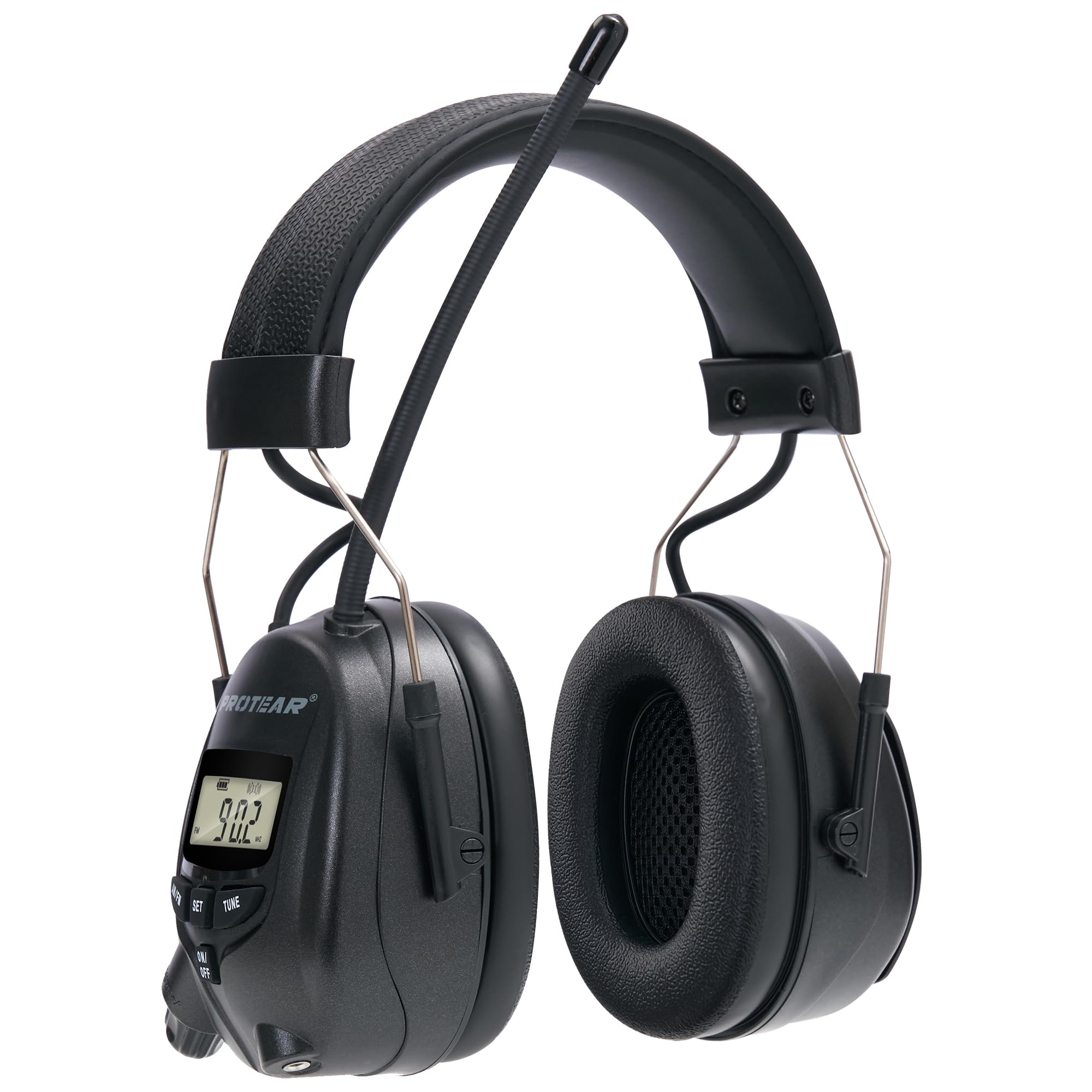
A straightforward digital headset with auto-scan that keeps things simple for occasional users.
Here is a basic no-frills option if you mow the lawn once a week and want something you can grab off the shelf quickly. This PROTEAR model (the 8830) is certified with a 25dB NRR (ANSI S3.19) and has a digital LCD display for tuning. It can store up to 8 AM and 8 FM stations in memory and uses an auto-scanning function to find them, which is a step up from the manual-only PROTEAR Digital model above.
The ear cups are made of a soft PU material with thicker cushioning than some budget headsets, and the maker says it is comfortable even with glasses. The adjustable headband also works with baseball caps. It runs on two AA batteries (not included), so you have to keep a set in the drawer. One potential annoyance: the manufacturer recommends taking the headphones off every 2-3 hours to let your ears relax, which hints that the clamping force may get tiring on long days.
There are no buyer reviews in the data to confirm the reception quality, battery life, or real-world comfort. If you are willing to take a chance on a proven spec sheet and a well-known noise-rating standard (ANSI S3.19), it is a clean entry point. Just be aware that for roughly the same money, the PROHEAR 027 has dozens of positive user reviews reinforcing its rural reception strength and overall build quality.
The basics done right
- Digital LCD screen with auto-scan tuning
- 8 AM + 8 FM preset memory
- Lightweight construction and soft ear pads
Limitations
- 25dB NRR is lower than the 30dB SNR models
- No verified customer reviews yet
Occasional users: This fits if you only need radio protection for light yard work and prefer a digital display over a completely manual dial.
Skip it for: Frequent heavy use or any situation where proven reception matters — the PROHEAR or Kalence models have better track records.
Understanding the Specs
NRR vs. SNR (Noise Ratings)
Noise Reduction Rating (NRR) is the U.S. standard for hearing protection, while Single Number Rating (SNR) is the European standard. A 25dB NRR roughly equals a 30dB SNR. For a gas-powered lawnmower—which measures around 90-95 decibels—a 25dB NRR brings that down to a safe 65-70dB, about the volume of a normal conversation. For chainsaws or snowblowers, the 30dB SNR on the Kalence EP025 gives you an extra margin of safety.
Preset Memory
This is how many stations you can save and skip between. If you listen to talk radio in the morning and a sports station in the afternoon, a model with 20 or more presets lets you toggle between them quickly. More limited headsets, such as the PROTEAR 8830 with 16 total presets, are fine if you listen to just one or two stations. The Kalence EP025 leads here with 100 total presets, which is overkill for most people but nice if you travel between different broadcast areas.
FAQ
Can I wear AM/FM radio headphones while charging?
Will these work in a rural area with weak signal?
What is the difference between NRR 25dB and SNR 30dB?
How long does a set of AA batteries last in these headphones?
Are these headphones safe for use with power tools?
Do any of these support Bluetooth for music streaming?
Can I store my favorite radio stations for quick switching?
Are these comfortable to wear with glasses or a hat?
Which model has the longest battery life?
Can I listen to both AM and FM stations?
Final Thoughts: The Verdict
Across the board, the am/fm radio headphones winner is the Kalence EP025. It gives you the highest noise reduction (30dB SNR, meaning it blocks 30 decibels of outside sound so you hear the radio clearly in a noisy workshop) plus a rechargeable battery that lasts 120 hours and memory for 100 station presets. That makes it the most versatile daily choice for professionals and serious hobbyists. If you want proven rural reception and the simplicity of AA batteries instead of recharging, pick the PROHEAR 027. And for the best value on a tight budget without losing protection, the PROTEAR Digital gives you the same 30dB SNR at the lowest entry price.
How We Picked
We do not accept paid placement. Every pick is matched to a real buyer and a real use-case; we do not hands-on test units.
Sources & Methodology
Specifications: manufacturer listings and product documentation. Review insights: verified customer reviews, as of July 2026. Pricing: not shown on this page (it changes often); check the current price via the retailer link.
As an Amazon Associate, Gadgets Feed earns from qualifying purchases. This does not affect which products we feature.
Product prices and availability are accurate as of the date/time indicated and are subject to change. Any price and availability information displayed on Amazon at the time of purchase will apply to the purchase of this product. As an Amazon Associate I earn from qualifying purchases.
CERTAIN CONTENT THAT APPEARS ON THIS SITE COMES FROM AMAZON. THIS CONTENT IS PROVIDED "AS IS" AND IS SUBJECT TO CHANGE OR REMOVAL AT ANY TIME.
Amazon and the Amazon logo are trademarks of Amazon.com, Inc. or its affiliates.