
Our readers keep the lights on and my morning glass full of iced black tea. As an Amazon Associate, I earn from qualifying purchases.
Specs are compiled from manufacturer listings and verified buyer reviews and can change over time — please confirm the key details on the product page before buying.
Your ball python needs a warm side to digest food and stay healthy, but a bright bulb at night messes up its day-night cycle. A ceramic heat emitter (a bulb-shaped heater that screws into a standard lamp socket but produces zero visible light) solves this by pumping out infrared heat without any light, so your snake gets the warmth it needs without sleep disruption.
I’m Min — the founder and writer behind Gadgets Feed. This guide is built by comparing the manufacturers’ published specifications and the patterns across verified customer reviews, so you get each pick’s real strengths and trade-offs instead of marketing spin.
A ball python ceramic heat emitter keeps your pet warm around the clock with no light pollution. You just need to match the wattage to your tank size and your lamp fixture’s bulb base.
Quick Picks
- Fluker’s Ceramic Heat Emitter, 100 Watt — Longest-Lasting
- Zoo Med Repticare 100 Watt Ceramic Infrared Heat Emitter — Moisture-Proof
- REPTI ZOO 150W Reptile Heat Lamp 2-Pack — Best Value 2-Pack
- MIXJOY 250W Ceramic Heat Emitters 2-Pack — Extreme Heat Option
- Zoo Med Labs 25W Nano Ceramic Heat Emitter — Compact Starter
- MaoTopCom 25W Mini Reptile Heat Lamp Bulb 2-Pack — Budget 2-Pack
How To Choose The Best Ball Python Ceramic Heat Emitter
The right heat emitter for your ball python depends on three things: the enclosure size, your room’s normal temperature, and what kind of lamp fixture you already own. A ceramic heat emitter is the standard solution for nighttime heating because it won’t mess with your snake’s circadian rhythm (its internal 24-hour sleep-wake cycle).
Wattage and enclosure size
Higher wattage means more heat output. For a 20-gallon tank, a low 25-watt emitter is often enough to raise the ambient temperature a few degrees, so your snake stays warm without overheating. For larger 40-gallon or 4x2x2 enclosures (measured in feet: 4 feet by 2 feet by 2 feet), a 100-watt or 150-watt model gives you the reach to create a proper warm side without overworking the bulb. Pairing any wattage with a thermostat is essential — without one, even a 25-watt bulb can push temperatures into the danger zone.
Bulb base compatibility
The most common base for heat emitters is the E26 (the standard US light bulb size, 26 millimeters in diameter). Some brands like Fluker’s use the smaller E12 base (12 millimeters, often called a candelabra base). If your lamp fixture works with E26, most emitters will screw right in. If it takes an E12, you need a different selection or an adapter. Check your fixture’s label before ordering, because a bulb that doesn’t fit is a complete loss.
Quick Comparison
| Model | Best For | Wattage | Bulb Base | Dimensions (WxH) | Amazon |
|---|---|---|---|---|---|
| Fluker’s 100W | Long-term reliability | 100W | E12 | — | $21.72Amazon |
| Zoo Med Repticare 100W | High-humidity enclosures | 100W | E26 | — | $21.74$23.00Amazon |
| REPTI ZOO 150W 2-Pack | Large tanks or multi-enclosure setups | 150W | E26 | 3.3″W x 3.9″H | $18.49Amazon |
| MIXJOY 250W 2-Pack | Extreme cold or large rooms | 250W | E26 | 4.1″W x 4.5″H | Amazon |
| Zoo Med Labs 25W Nano | Small 20-gallon enclosures | 25W | E26 | 2.31″W x 2″H | $19.24Amazon |
| MaoTopCom 25W 2-Pack | Budget backup or dual-zone | 25W | E27 | 2.36″W x 2.76″H | $14.99Amazon |
In‑Depth Reviews
1. Fluker’s Ceramic Heat Emitter, 100 Watt
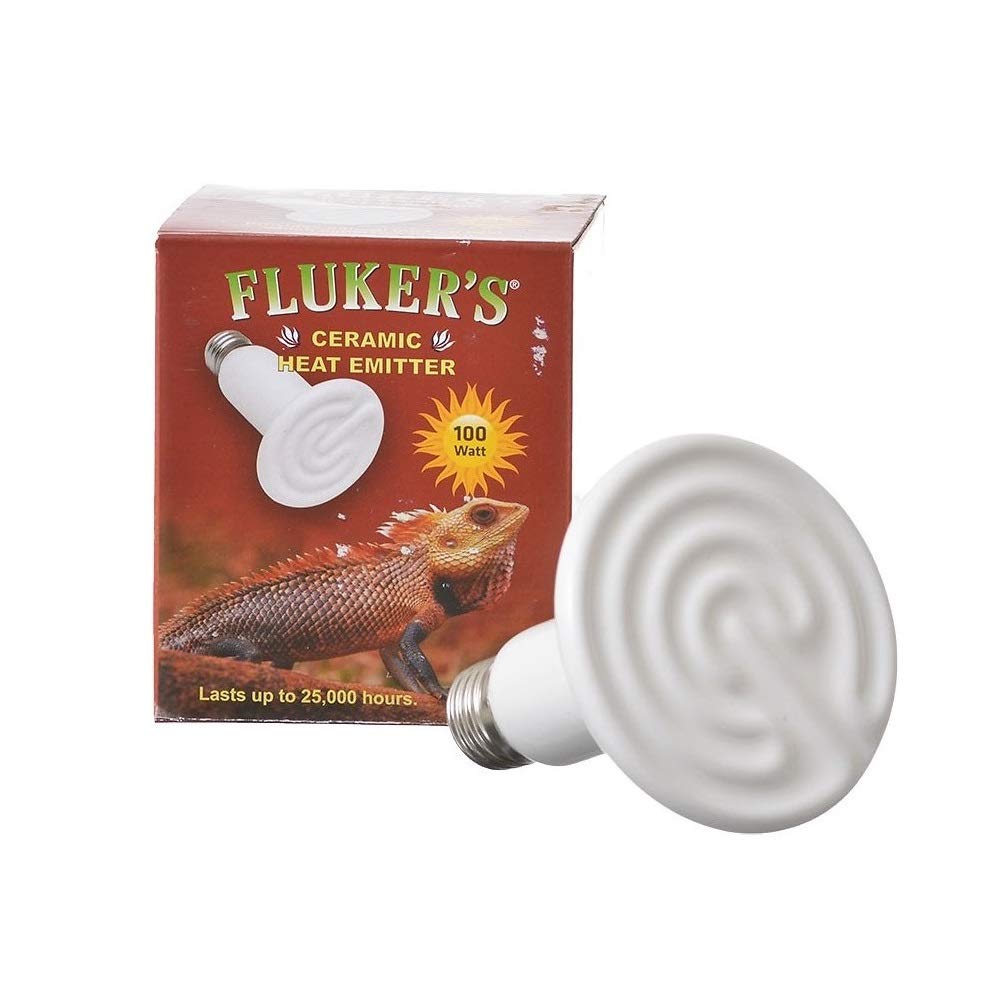
The one that keeps going years after cheaper competitors have burned out.
You want a heat emitter you can install and forget about. The Fluker’s 100-watt model earns that trust: buyers report this bulb has run for over two years straight. One reviewer noted using it since November 2014 and still working in 2022 — 7-8 years of operation. The 100-watt output creates a large circular basking area without visible light, so your ball python gets steady infrared warmth all night.
The trade-off is the bulb base. Fluker’s uses an E12 (candelabra) base, unlike the standard E26 that most other brands use. You need a lamp that accepts the smaller base, or you need a metal adapter. Buyers also note that when the unit eventually fails, it can melt or break at the socket connection, potentially damaging the lamp fixture itself. If your fixture accepts E12 bulbs and you want a set-and-forget heater, this is the most reliable option for the money — it’s a safer longevity bet than the REPTI ZOO 2-pack, whose owners mention 9-10 month lifespans.
If your lamp uses the standard E26 base, this Fluker’s simply will not fit without an adapter. That one spec makes it a skip for most standard fixtures.
Why owners stick with it
- Lasts 2-3+ years running 24/7 — far longer than most competitors
- Produces strong heat for its wattage, effectively warming a medium enclosure
- Completely light-free, so your ball python’s sleep rhythm stays natural
The big catch
- Uses an E12 (small) bulb base — will not fit standard E26 fixtures without an adapter
- When it fails, it may melt or break at the lamp socket, damaging the fixture
- No included dome or clamp — you must buy a separate compatible lamp
Grab it for: Long-term reliability that saves you from replacing bulbs every few months.
Look elsewhere if: Your lamp fixture uses the standard E26 base — the Fluker’s won’t fit without an adapter.
2. Zoo Med Repticare 100 Watt Ceramic Infrared Heat Emitter
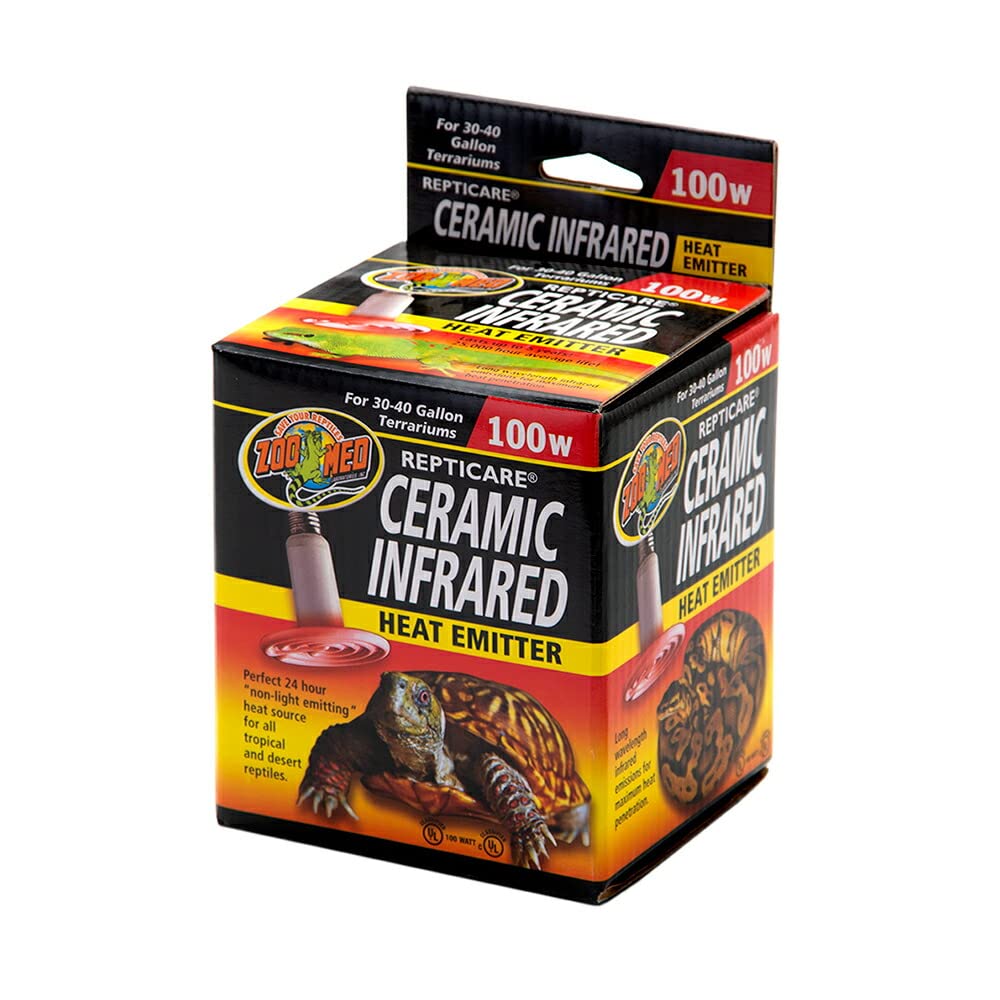
A tough workhorse built for the damp conditions inside a high-humidity terrarium.
Ball python enclosures run humid. Most ceramic emitters handle moisture fine, but Zoo Med’s Repticare is specifically designed for high-humidity environments — making it a natural fit for snake keepers. The flat face design directs heat downward into the enclosure more efficiently than conical emitters. Several buyers noted a surface temperature of 449°F, making a thermostat mandatory for safety.
This is a lighter pick than the Fluker’s at the same 100-watt rating. But the Fluker’s uses the less common E12 base, while the Repticare sticks with a standard E26 base that fits nearly every dome fixture sold today. One reviewer used three in a chicken coop during an Idaho winter at -18°F and kept the interior livable — proof of its heat output. Just let it burn off for the first hour outside the enclosure; a few buyers reported a noticeable burning smell during initial use.
If you want a standard-base 100-watt emitter that can handle the humidity of a snake enclosure without issue, this is the one to reach for. If you need a smaller wattage for a 20-gallon tank, though, the Zoo Med Labs 25W Nano is a better match at a quarter of the power.
Hands-down advantage: Standard E26 base fits any lamp, unlike the Fluker’s E12 — no adapter needed.
Honest drawback: Emits a burning odor for the first hour of use; run it outside the enclosure initially to avoid stressing your snake.
Best for: A reliable, standard-base heat emitter for medium-to-large enclosures with high humidity.
Skip if: You need a compact unit for a very small tank — the 100W output may be too much for a 20-gallon without careful thermostat management.
3. REPTI ZOO 150W Reptile Heat Lamp 2-Pack

Two 150-watt emitters in one box so you are never stuck without heat if one dies.
Owning a spare bulb means no panicked trips to the pet store when a bulb goes out at 2 AM. The REPTI ZOO 2-pack gives you two 150-watt ceramic emitters at a price that undercuts buying singles. At 3.3″ wide and 3.9″ tall, each bulb is noticeably larger than the compact 2.31″ x 2″ Zoo Med Nano — so they need a fixture with enough clearance. The E26 base fits standard dome lamps, and the 150-watt output is enough to heat a large 4x2x2 enclosure to proper ball python temperatures when paired with a thermostat.
That said, real-world durability isn’t as advertised. One buyer mentioned the first bulb died after 9-10 months — far short of the 10,000-hour claim. The bulbs work well while they last, and multiple customers confirm they provide consistent heat with quick warm-up, but the lifespan is a gamble. A few buyers also caution using gloves when handling the bulbs, as oils from your fingers can cause hot spots and shorten their life further.
For the price, getting two 150-watt emitters with a standard E26 base is tough to top. But if long-term reliability tops your list, this 2-pack’s reported 9-10 month lifespan falls well short of the Fluker’s single bulb’s multiyear track record.
Why the 2-pack makes sense
- Two bulbs for the price of a single premium model — great for multi-tank setups
- 150W per bulb provides strong heat output for large enclosures
- Standard E26 base fits the vast majority of dome fixtures
What several buyers warn
- Lifespan reported by some buyers is 9-10 months, not the advertised 10,000 hours
- Bulbs are physically larger and may not fit shallow or small lamp domes
- Fragile to oil contact — owners recommend wearing gloves when installing
Reach for this if: You keep multiple enclosures and want a backup on hand without paying for a second shipping charge.
Look elsewhere if: Long-term durability is your top priority — the Fluker’s single bulb has a better track record for longevity.
4. MIXJOY 250W Ceramic Heat Emitters 2-Pack
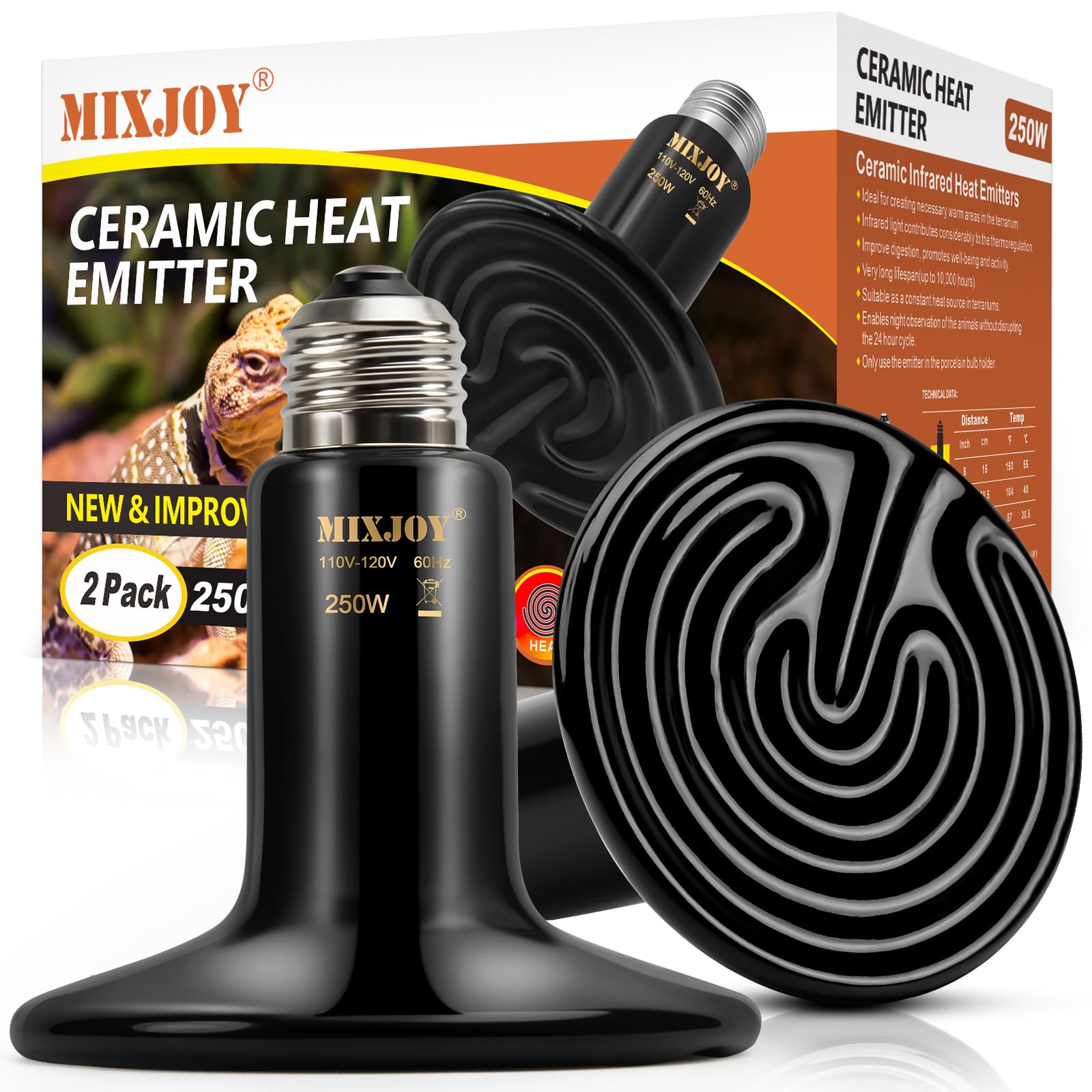
A massive 250-watt emitter meant for large rooms and cold climates, not small tanks.
The MIXJOY is the most powerful unit on this list by a wide margin — at 250W versus the 25W Zoo Med Nano. It heats up noticeably within ten seconds and reaches full temperature in 3-5 minutes. For a ball python keeper with a large enclosure in a cold basement, this is the only unit that can reliably push the ambient temperature high enough without running at maximum the whole time. The 2-pack includes an upgraded temperature display sticker that changes color when the bulb is hot — a helpful safety cue since ceramic emitters give no visible light.
However, the durability is a serious concern. One owner reported both emitters burned out after roughly 360 hours each — one month of 12-hour daily use, not the 10,000-hour claim. The bulb is also extremely hot to the touch; one buyer accidentally contacted it and suffered a skin burn. If your lamp fixture cannot handle 250 watts of power draw, this emitter is both useless and dangerous.
This is a niche pick for those who genuinely need 250 watts of heat in a very cold environment, not a standard ball python enclosure. For that, a 100W or 150W unit like the Zoo Med Repticare is safer and more sensible.
One-liner verdict: Impressive raw power, but customers note a 360-hour real-world lifespan versus the 10,000-hour claim — a massive reliability gap.
Only install this if: You have a very large space (a shed, a reptile room, or a cold workshop) and a fixture rated for 250W.
Avoid for a standard tank: 250W will overheat a typical ball python enclosure even with a thermostat, and the short lifespan makes it a frustrating buy.
5. Zoo Med Labs 25W Nano Ceramic Heat Emitter
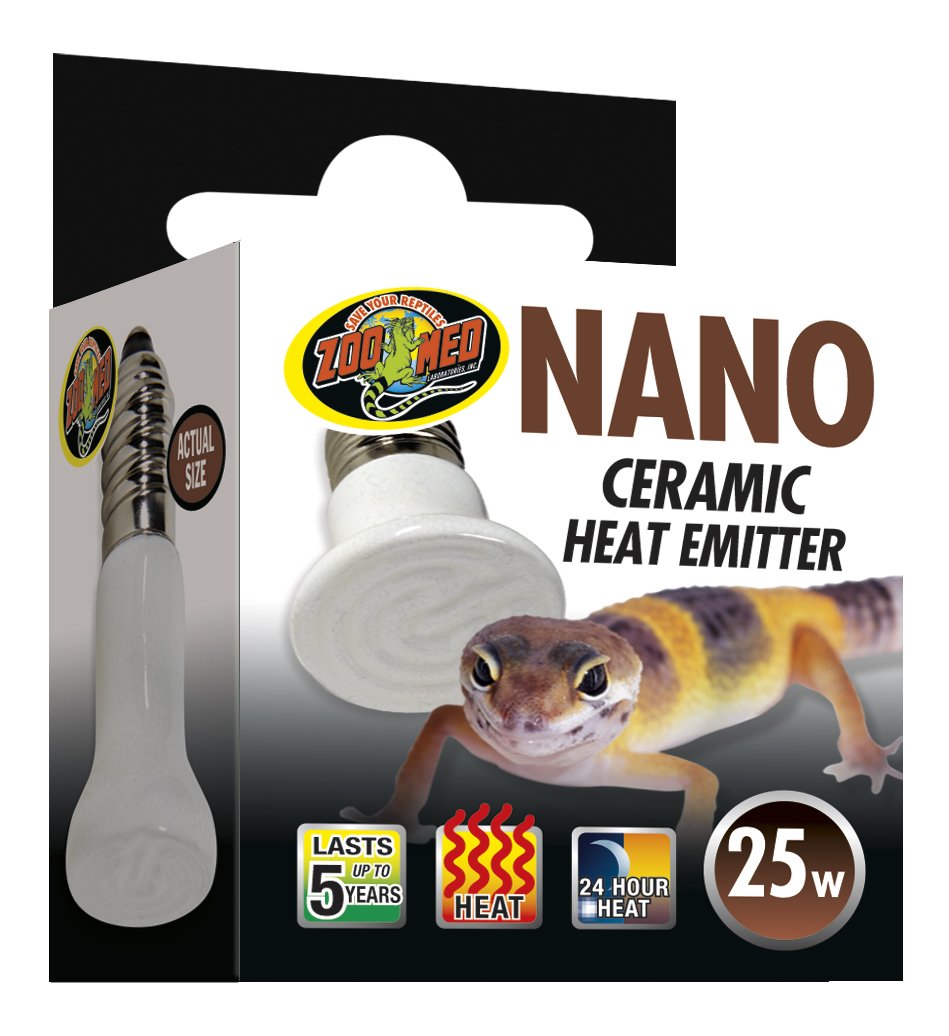
The tiny heater that gives a 20-gallon ball python tank just enough night warmth.
If you keep a young ball python in a 20-gallon tank and your room does not drop below 68°F, the 25W Nano is all you need. Reviewers point out it works “perfect on a dimmer switch” and gets the ambient temperature up just enough without making the enclosure dangerously hot. At just 2.31 inches wide and 2 inches tall, it is the smallest emitter on this list — small enough to fit inside a shallow lamp dome where a bigger bulb like the 3.3″-wide REPTI ZOO would not clear the sides.
The 25W Nano is dwarfed by the 250W MIXJOY so do not expect it to heat a large enclosure or a cold room. It is designed for low-power spot heating, not as a primary heat source for a big tank. The E26 base fits standard fixtures, and the manufacturer claims a lifespan of up to 5 years, though real-world longevity will depend on how often you cycle it on and off and whether you use a thermostat.
For a small, simple setup where you just need a gentle temperature bump at night, this is the ideal low-wattage solution. For a 40-gallon enclosure, step up to the 100W Zoo Med Repticare instead.
What makes it a good starter
- Low 25W output is safe for small tanks and won’t overheat a 20-gallon enclosure
- Compact size fits easily into smaller lamp fixtures
- Works with dimmer switches for fine temperature control
Where it falls short
- Too weak to serve as the sole heat source for a 40-gallon or larger enclosure
- Wattage is just 25W vs a 250W emitter — not suitable for cold rooms or large tanks
Perfect for: A small tank (20-gallon or less) where you need minimal supplemental heat at night without cooking your snake.
Not enough for: A large enclosure or a room below 68°F — you will need a 100W or 150W model to create a proper thermal gradient.
6. MaoTopCom 25W Mini Reptile Heat Lamp Bulb 2-Pack

Two 25-watt bulbs for less than the price of a single premium emitter — but with important safety caveats.
The MaoTopCom 2-pack is the most affordable entry point in this lineup, giving you two 25W emitters so you can heat two small tanks or keep a spare on hand. Buyers confirm the bulb reaches 425°F — scorching hot despite the low wattage. One review notes the heat dissipates quickly without a fan, so your enclosure needs to hold warmth reasonably well. The E27 base is nearly identical to the standard E26 and fits most US dome fixtures.
There are two catches. First, the bulb has been known to loosen in the socket over time — one customer observed it working well for two months of 24/7 use but noted the connection can become unreliable. Second, the heat output is modest; at 25W, this is a 4x step down from the 100W Fluker’s, so you should not expect it to raise the temperature of a large tank. It also gets very hot on the surface without necessarily warming the air effectively, which is a quirk you need to manage with a thermostat (or risk the enclosure hitting 86°F, as one customer discovered).
This 2-pack works as a backup bulb or for a very small tank. For primary heating of a standard ball python enclosure, step up to a 100W model like the Zoo Med Repticare — the MaoTopCom’s socket loosening and high surface temp are too much hassle for everyday use.
Rough math: 25W surface temp hits 425°F — that’s hot enough to burn your snake if there’s no guard or proper distance.
Buyer reality: Works decently for small pets, but the 2-pack’s main appeal is the price, not the performance.
Good for: A backup 25W bulb to keep on the shelf, or for heating a tiny travel enclosure.
Skip if: You need consistent, reliable heat for your ball python’s main enclosure — the socket loosening and high surface temp are too much hassle for everyday use.
Understanding the Specs
Wattage
Wattage determines how much heat the emitter produces. Higher wattage means more heat, but more heat is not always better — an oversized bulb will make your thermostat work harder and can spike the enclosure temperature if the thermostat fails. For a standard ball python setup (40-gallon or 4x2x2), a 100W to 150W emitter is usually the balance. Small 20-gallon tanks run fine on 25W, while very cold rooms may need 150W or more to maintain a proper warm side. Always use a thermostat, regardless of the wattage.
Bulb Base
The base is the threaded metal part that screws into your lamp fixture. E26 (1-inch diameter) is the standard US light bulb base and fits most reptile dome fixtures. E12 (candelabra base) is smaller and only fits fixtures designed for that size. The difference is critical: if you buy an E12 emitter and own an E26 lamp, it will not fit without an adapter. Check the base of your current fixture before ordering — this single spec has caused the most returns in this category.
FAQ
What wattage do I need for a ball python?
Can I use a ceramic heat emitter 24 hours a day?
Do I need a special lamp fixture for a ceramic heat emitter?
Is a thermostat required with a ceramic heat emitter?
How long do ceramic heat emitters last?
Can a ceramic heat emitter break the glass in my terrarium?
What is the difference between E26 and E12 bulb bases?
Will a 25W ceramic heat emitter keep my ball python warm enough in winter?
Why does my ceramic heat emitter smell when I first use it?
Can I use a ceramic heat emitter with a dimmer switch?
Final Thoughts: The Verdict
If you want one dependable pick, the ball python ceramic heat emitter winner is the Fluker’s 100W because it has the most reliable track record for longevity among all options — shoppers say years of 24/7 operation. If you want a standard E26 base that fits any lamp without an adapter, grab the Zoo Med Repticare 100W. And for a budget-friendly 2-pack that covers a small tank or serves as a backup, the MaoTopCom 25W 2-pack offers the lowest entry point.
How We Picked
We do not accept paid placement. Every pick is matched to a real buyer and a real use-case; we do not hands-on test units.
Sources & Methodology
Specifications: manufacturer listings and product documentation. Review insights: verified customer reviews, as of July 2026. Pricing: not shown on this page (it changes often); check the current price via the retailer link.
As an Amazon Associate, Gadgets Feed earns from qualifying purchases. This does not affect which products we feature.
Product prices and availability are accurate as of the date/time indicated and are subject to change. Any price and availability information displayed on Amazon at the time of purchase will apply to the purchase of this product. As an Amazon Associate I earn from qualifying purchases.
CERTAIN CONTENT THAT APPEARS ON THIS SITE COMES FROM AMAZON. THIS CONTENT IS PROVIDED "AS IS" AND IS SUBJECT TO CHANGE OR REMOVAL AT ANY TIME.
Amazon and the Amazon logo are trademarks of Amazon.com, Inc. or its affiliates.