
Our readers keep the lights on and my morning glass full of iced black tea. As an Amazon Associate, I earn from qualifying purchases.
Specs are compiled from manufacturer listings and verified buyer reviews and can change over time — please confirm the key details on the product page before buying.
If your amplifier sounds thin, your monitor cuts out mid-song, or you’re fighting a constant low hum, the culprit is almost always the same: a cheap or wrong 1/4-inch speaker cable. Unlike a guitar cable (which carries a weak instrument signal), a speaker cable carries the full power from an amp to a cabinet — and using the wrong one can literally cause your sound to drop or your gear to overheat. This guide cuts through the confusion to show you which cables actually survive the road, deliver clean signal, and match your rig’s power demands.
I’m Min — the founder and writer behind Gadgets Feed. This guide is built by comparing the manufacturers’ published specifications and the patterns across verified customer reviews, so you get each pick’s real strengths and trade-offs instead of marketing spin.
if you need a short patch cable for a pedalboard or a long run for a stage, the right 1/4 speaker cable depends on gauge (the thickness of the copper wire inside), build quality, and connector type (the plug that goes into your gear) — and these five picks cover every serious use case without inventing specs you don’t need.
Quick Picks
- Cable Matters 2-Pack Premium Braided 12 AWG 1/4 Inch Speaker Cable 3 ft — Best Overall
- HeyTones Professional 10 Feet 12 Gauge 1/4″ to 1/4″ TS Speaker Cables – 2 Pack — Stage Ready
- D’Addario Accessories Speaker Cable – Classic Series – 10 Feet — Premium Pick
- Pig Hog PHSC3 High Performance 14 Gauge 9.2mm 1/4″ Speaker Cable, 3 Feet — Reliable Shorty
- Yoico Pro 50 Feet 12AWG 1/4″ to 1/4″ Speaker Cable — Long Haul
How To Choose The Best 1/4 Speaker Cable
The first thing to know is that a speaker cable is not the same as an instrument cable. An instrument cable is designed to carry a weak, high-impedance signal from a guitar or keyboard to an amplifier. A speaker cable, on the other hand, carries a much stronger, high-current signal from the amplifier to the speaker cabinet. Using an instrument cable for this job can cause overheating and damage. Always look for a cable labeled specifically for speakers with a TS (Tip-Sleeve) connector (a two-contact plug that sends an unbalanced signal properly for high-power audio).
Gauge (AWG) — The Thicker, The Better for Long Runs
The gauge is the thickness of the copper wire inside the cable. Lower numbers mean thicker wire, which means less resistance. For a short 3-foot patch cable, 14 AWG (a mid-thickness wire) or even 16 AWG (a thinner wire) can work fine. But once you get to 10 feet or more, 12 AWG (a thicker, lower-resistance wire) becomes the safer choice to prevent signal loss and heat buildup. For long runs like 50 feet, 12 AWG is practically required for a clean, noise-free signal at higher volumes, so your amp does not strain or get hot.
Connector Build and Shielding
A 1/4-inch TS connector is your standard plug for this type of cable. Look for molded plugs — these offer good strain relief (protection where the cable meets the plug so it does not pull apart) and protection against the cable pulling loose at the joint. Some cables use metal barrels or heat-shrink connectors for extra durability. Two layers of shielding (a foil or braided wrap around the inner wire) help reject the hum and buzz you often get in live environments with lots of other gear around.
Cable Length vs. Flexibility
Longer cables are convenient for stage movement, but they introduce more resistance and can be a pain to coil up. A 50-foot cable is great for a large venue or a production, but a 10-foot cable is much easier to manage for a practice space or a small stage. Thicker cables (12 AWG) are stiffer, so plan for how you’ll store and transport them.
Quick Comparison
| Model | Best For | Gauge (AWG) | Length | Connector | Amazon |
|---|---|---|---|---|---|
| Pig Hog PHSC3 | Reliable short patch | 14 AWG | 3 Feet | TS Male-to-Male | Amazon |
| Cable Matters 2-Pack | Long-lasting daily driver | 12 AWG | 3 ft each (2-pack) | TS Male-to-Male | $18.99Amazon |
| HeyTones Professional | Balanced mid-length stage run | 12 AWG | 10 Feet (2-pack) | TS Male-to-Male | Amazon |
| D’Addario Classic Series | Premium signal clarity | 16 AWG | 10 Feet | 1/4″ Male-to-Male | $29.99Amazon |
| Yoico Pro 50 Feet | Extra-long stage/production | 12 AWG | 50 Feet | 1/4″ TS Male | Amazon |
In‑Depth Reviews
1. Cable Matters 2-Pack Premium Braided 12 AWG 1/4 Inch Speaker Cable 3 ft

The overbuilt two-pack that survives high-wattage rigs while staying affordable.
Your amp is pushing serious power, and you need a cable that handles it without overheating. This Cable Matters pack uses 12 AWG (American Wire Gauge) wire — 12 AWG versus 16 AWG found in basic cables like the D’Addario — inside a braided jacket. Buyers report that the “thick, durable braided cable with large connectors prevents fatigue and kinking.” That braided outer layer means you can step on it, wrap it tight, and drag it across a stage floor without the jacket fraying, so the cable lasts longer in tough gigging conditions.
The metal connectors are larger than standard ones, which one reviewer noted allows for “side by side connections on my audio interface” without blocking adjacent ports. Another reviewer mentioned this cable could “probably handle 1,000’s of watts” — a huge safety margin if you run a powerful bass rig or PA system.
It is slightly stiffer than a 14 AWG or 16 AWG cable due to the thick 12 AWG copper, but none of the reviews called it a dealbreaker. The 3-foot length each in a 2-pack is perfect for connecting a head to a single cabinet or linking gear on a pedalboard. For the price, you get pro-grade build quality that outlasts cheaper cables.
What stands out
- 12 AWG thick wire handles very high power without heat buildup
- Braided jacket prevents tangling and resists cutting
- Two-pack gives a spare or lets you set up left and right channels
The trade-off
- 3-foot length is short — not ideal for anything beyond a tight patch setup
- Slightly stiff cable may not coil as easily as rubber-jacket cables
Reach for it if: you want a bulletproof short cable for your amp head, bass rig, or PA setup that won’t fail mid-show.
Look elsewhere if: you need a 10-foot or longer cable to reach a speaker cabinet on stage, or if you prefer a more flexible rubber jacket.
2. HeyTones Professional 10 Feet 12 Gauge 1/4″ to 1/4″ TS Speaker Cables – 2 Pack

The 10-foot two-pack that bridges the gap between a patch cable and a long stage run — thicker wire than the Pig Hog for bigger rigs.
Most stage setups need more than 3 feet but less than 25 feet, and this HeyTones pack delivers exactly that balance. Each cable is 10 feet of 12 AWG (American Wire Gauge) oxygen-free copper (OFC — a copper wire with reduced oxygen content that improves conductivity) wire — that’s 20 amps of maximum current capacity according to the specs, which means it can handle even demanding PA subwoofers and power amplifiers without resistance issues, so your bass stays punchy and clean at high volume.
One buyer mentioned the “flexible, kink resistant shield” and “quality plugs and soldering” as key positives. Another reviewer who used them for a monitor rig mentioned that the 12 gauge is “stiffer than 16 gauge but works well for monitor setup.” They added their own yellow shrink wrap to differentiate them from instrument cables — a smart workaround. The heavy-duty PVC-85P rubber jacket protects against the bumps and tugs of a live environment while staying flexible enough for easy coiling.
Compared to the 14 AWG Pig Hog, these are 12 AWG versus 14 AWG, giving you more headroom for higher-wattage setups. And unlike the single-cable D’Addario, this is a two-pack, so you can run left and right channels or keep a spare in your bag. The 1-year warranty and 30-day money-back guarantee reduce the risk of buying online.
Reasons to pick it
- OFC conductors deliver cleaner signal with no distortion
- 10-foot length is the most versatile for small stages and practice spaces
- Two-pack offers great value vs buying single cables
One thing to note
- 12 AWG wire is stiffer than thinner cables, which some users find slightly less flexible for tight spaces
Grab these if: you need a reliable, clean-sounding 10-foot cable for a PA monitor, powered speaker, or amp-to-cabinet setup, and you want the extra thickness of 12 AWG over the thinner Pig Hog.
Skip them if: you only need a 3-foot patch cable and want a lighter, more flexible option like the 14 AWG Pig Hog.
3. D’Addario Accessories Speaker Cable – Classic Series – 10 Feet

The legendary brand’s entry that prioritizes signal purity over brute gauge thickness — a win for clean, quiet rigs.
D’Addario has been making accessories for over 20 years, and their Classic Series speaker cable reflects that pedigree. It uses 16 AWG (American Wire Gauge) wire — thinner than the 12 AWG of the Cable Matters or HeyTones picks, but with an important difference: their “In=Out Technology” combines low capacitance (the ability of the cable to hold an electrical charge, which can color your sound) with two layers of shielding for what the company calls “the purest signal transparency.” This means you get noise rejection that keeps your signal quiet even in live settings with lots of interference, so your monitor stays hum-free.
Owners mention that the “TRS connectors with compression rings” are a standout feature, noting the cable is “noise-free in live settings.” One owner reported their 25-foot model lasted three years of regular use, calling the molded ends “durable.” The catch is that those molded ends are non-repairable — if the plug fails, you cannot just solder on a new one. But for the typical user, that kind of lifespan is excellent.
This cable is best for the player who values clean, consistent sound over raw power-handling. It’s a premium choice for lower-wattage amps (think a 30W combo or a pedalboard setup) where you want the most transparent signal possible. At 0.66 lbs, it’s lighter than the 12 AWG cables and easier to manage in a practice space.
What makes it special
- Two layers of shielding effectively block hum and radio interference
- Molded plugs with strain relief protect the most common failure point
- Proven 3-year longevity reported in real-world use
The limitation
- 16 AWG wire is not ideal for long runs or very high-wattage amps
- Molded ends mean you cannot repair a broken plug yourself
Best choice for: the gigging musician who wants a reliable, noise-free connection for a combo amp or a low-to-medium power head, and who values the brand’s reputation for signal purity over the brute thickness of 12 AWG cables.
Pass on it if: you are running a 500W bass rig or need a 50-foot stage run — step up to 12 AWG.
4. Pig Hog PHSC3 High Performance 14 Gauge 9.2mm 1/4″ Speaker Cable, 3 Feet

A no-nonsense patch cable that feels tougher than its price suggests — and is the most flexible option in this lineup.
Sometimes you just need a short, dependable cable to link your amp head to a cabinet without any frills. The Pig Hog PHSC3 uses a 14 AWG (American Wire Gauge) wire — noticeably thicker than the 16 AWG D’Addario (14 AWG vs 16 AWG) but a step thinner than the 12 AWG heavies — and wraps it in a 9.2mm rubber outer covering. Buyers repeatedly call it “very thick and sturdy,” and one customer observed it felt “much better build than regular/cheap cables.” The heat-shrink protected connectors help prevent the jacks from loosening, a common failure point on budget cables.
Compared to the 3-foot Cable Matters 2-pack (12 AWG), the Pig Hog is a single cable at a lower price point, making it a good entry-level option if you only need one short connection. A reviewer noted that the “wrapped ends prevent jacks from unscrewing but stick out far from jacks,” so check your setup for clearance. One buyer even bought two for their head-and-cabinet setup and reported they “are quiet and plug in solidly.”
At 3 feet, this is a dedicated patch cable. It is not meant to run across a stage. But for its intended job, it performs reliably without introducing noise. The twist-lock feature (as one reviewer described it) ensures the plug stays secure even during movement — a simple design that just works.
Why it works
- 14 AWG wire is a good balance of flexibility and power handling for short runs
- Heat-shrink connectors protect against pull-out
- Budget-friendly without feeling cheap
Room for improvement
- Single cable only — need two for a stereo or dual-cabinet setup
- Connector length may block adjacent jacks on some interfaces or pedalboards
Solid pick for: a single short connection between an amp head and a speaker cabinet on a tight budget, and the most flexible of the short cables here.
Not the one if: you need a 10-foot cable, a pack of two, or the highest possible power handling like the 12 AWG Cable Matters.
5. Yoico Pro 50 Feet 12AWG 1/4″ to 1/4″ Speaker Cable
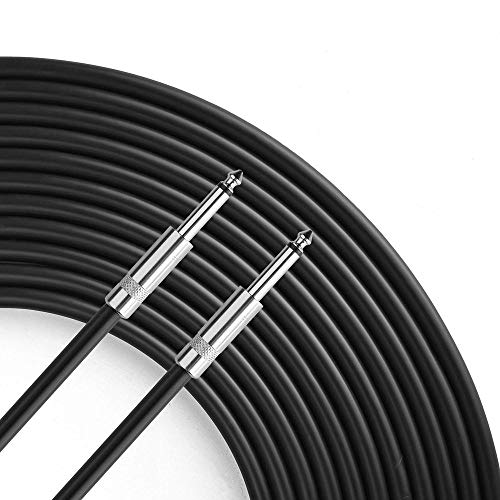
The extra-long 12 AWG lifeline for large venues, productions, and outdoor stages — your only option when 10 feet is not enough.
When your amplifier is at the front of the stage and your monitor or subwoofer is 40 feet away on the other side, a standard 10-foot cable won’t cut it. The Yoico Pro gives you 50 feet of 12 AWG (American Wire Gauge) heavy-duty wire, which is what you need to minimize signal degradation over that distance. A thinner gauge like 16 AWG would introduce too much resistance and voltage drop at 50 feet, causing your sound to lose power and clarity. Customers note that the “heavier gauge and well shielded” cable performed well in a children’s production where they “ran it a long way.” One reviewer even confirmed “minimal signal degradation” over the full 100-foot version.
At 50 feet, this is the longest cable in the lineup — a jump from 3 feet (Pig Hog) to 50 feet. To keep the signal clean over that span, the 12 AWG wire is the right tool for the job. The PVC-85P jacket is designed to be flexible despite the thick wire, and the manufacturer claims it can withstand being “stepped on, twisted, pulled, and dragged,” which is exactly what happens on a live stage.
One user highlighted the cable “worked, but ended up not being needed” after a setup change, but that’s more proof of how specific a 50-foot cable is. If you need this length, it delivers solid performance at a mid-range price point. The single-length format keeps it simple — just one cable, one job — and it is the only pick here that covers a large stage.
What you get
- 50-foot length gives you immense flexibility for large stage layouts
- 12 AWG wire ensures minimal signal loss over the long run
- Durable PVC jacket handles the abuse of live production
Keep in mind
- 50 feet is a lot of cable to coil and transport — plan your storage
- Single cable only; you need two for a stereo setup
Grab it for: large-venue gigs, school productions, or any scenario where your amp and speaker are separated by a long distance — it is your only 50-foot option here.
skip it if: your entire setup fits within a 10-foot radius — you will be fighting extra cable on the floor and would be better off with the HeyTones 10-foot pack.
Understanding the Specs
Gauge (AWG)
AWG stands for American Wire Gauge, a standard for wire thickness. A lower number (like 12 AWG) means a thicker copper wire inside the cable. Thicker wire has less electrical resistance, so more power gets to your speaker instead of being wasted as heat. For a short 3-foot connection, 14 AWG works fine. For a 10-foot or longer run, or for high-wattage amplifiers (think 300W and above), 12 AWG is the safer, more reliable choice. The difference between 12 AWG and 16 AWG is a matter of copper cross-section area (12 AWG versus 16 AWG).
TS vs TRS Connectors
A TS (Tip-Sleeve) connector has two contact points and is the standard for unbalanced speaker cables. A TRS (Tip-Ring-Sleeve) connector has three contact points and is typically used for balanced or stereo signals, such as for headphones or microphones. For connecting an amplifier to a speaker cabinet, you want a TS connector. Using a TRS cable in this role can cause signal issues or even damage. The 1/4-inch TS connector is exactly what every cable in this guide uses.
FAQ
Can I use a guitar cable as a speaker cable?
What gauge should I use for a 50-foot speaker cable?
What is the difference between a TS and a TRS 1/4 connector?
How long does a 1/4 speaker cable typically last?
Is a braided cable jacket better than a rubber jacket?
Can I plug a 1/4 speaker cable into a combo amp?
What does OFC mean in a speaker cable?
What happens if I use a cable that is too long?
Final Thoughts: The Verdict
Across the board, the 1/4 speaker cable winner is the Cable Matters 2-Pack because it gives you pro-grade 12 AWG build quality and a braided jacket in a convenient two-pack without a premium price. If you need a versatile 10-foot run for a stage monitor or PA speaker, grab the HeyTones Professional 2-Pack. And for the musician who values signal purity and a trusted brand over raw gauge thickness, the D’Addario Classic Series is the refined choice for a clean, quiet rig.
How We Picked
We do not accept paid placement. Every pick is matched to a real buyer and a real use-case; we do not hands-on test units.
Sources & Methodology
Specifications: manufacturer listings and product documentation. Review insights: verified customer reviews, as of July 2026. Pricing: not shown on this page (it changes often); check the current price via the retailer link.
As an Amazon Associate, Gadgets Feed earns from qualifying purchases. This does not affect which products we feature.
Product prices and availability are accurate as of the date/time indicated and are subject to change. Any price and availability information displayed on Amazon at the time of purchase will apply to the purchase of this product. As an Amazon Associate I earn from qualifying purchases.
CERTAIN CONTENT THAT APPEARS ON THIS SITE COMES FROM AMAZON. THIS CONTENT IS PROVIDED "AS IS" AND IS SUBJECT TO CHANGE OR REMOVAL AT ANY TIME.
Amazon and the Amazon logo are trademarks of Amazon.com, Inc. or its affiliates.