
Our readers keep the lights on and my morning glass full of iced black tea. As an Amazon Associate, I earn from qualifying purchases.
Specs are compiled from manufacturer listings and verified buyer reviews and can change over time — please confirm the key details on the product page before buying.
Choosing a 16-gauge finish nailer (a tool that drives medium-thickness nails for trim work) means deciding between dragging a compressor around or going fully cordless — and how much weight you are willing to hold for a full day of trim work. The five picks here span pneumatic workhorses that never jam and battery-powered models that ditch the hose entirely, each with real trade-offs in speed, balance, and runtime.
I’m Min — the founder and writer behind Gadgets Feed. This guide is built by comparing the manufacturers’ published specifications and the patterns across verified customer reviews, so you get each pick’s real strengths and trade-offs instead of marketing spin.
The key is matching the tool to the job — for high-volume daily use, a reliable pneumatic like the Bostitch BTFP71917 keeps going without battery swaps, while a premium cordless like the DEWALT DCN660D1 shines when you want to climb a ladder without a hose in your way. This roundup of the best 16g finish nailer options lays out exactly where each one fits best so you can decide without second-guessing.
Quick Picks
- Bostitch BTFP71917 — Best Overall
- Makita AF601 — Pro Precision
- Craftsman CMCN616C1 — Cordless DIY
- Paslode 916200 — Lightest Cordless
- DEWALT DCN660D1 — Pro Battery Leader
How To Choose The Best 16G Finish Nailer
A finish nailer’s job is to drive 16-gauge fasteners (nails that are 1.6mm thick, giving a good balance of holding power and a small hole to fill) cleanly into hardwood without splitting it, and to do that all day without jamming. The choice depends on three factors: power source (pneumatic or cordless), weight and balance, and the nail angle your trim work demands.
Pneumatic vs Cordless: Which Power Source Fits Your Day
A pneumatic nailer (one that runs on compressed air from a separate compressor) runs off an air compressor. It is generally lighter, simpler, and cheaper to buy, but you are tethered to a hose and the compressor’s noise. A cordless nailer uses either a battery alone or a battery-plus-fuel-cell system (where a small fuel cell provides the combustion force and a small battery runs a fan). It gives you total freedom of movement, but the tool body is heavier and the battery adds cost. Within cordless, two approaches exist: pure battery electric (like the DEWALT DCN660D1 and the Craftsman CMCN616C1) and fuel-cell hybrid (like the Paslode 916200, which uses a small fuel cell plus a battery for the fan). The Craftsman weighs 9.1 pounds — more than any pneumatic in this list — so for overhead nailing that extra weight adds fatigue.
Weight and Balance Matter for Every Nail
Every nail you drive involves lifting the tool, placing it, pulling the trigger, and repeating. A difference of a few pounds becomes a full-body workout by midday. The Paslode 916200 is 4.5 pounds, the DEWALT DCN660D1 is 6 pounds, and the Craftsman V20 is 9.1 pounds — the Craftsman at 9.1 pounds versus the DEWALT at 6 pounds. Heavier tools tend to have more driving power but cause more fatigue in continuous use. Balance also matters: a tool with an inline magazine (like the Craftsman) feels more nose-heavy, while an angled magazine (like the DEWALT and Paslode) shifts the center of gravity back, making it easier to hold one-handed for trim work.
Nail Angle: Straight vs Angled Magazine
A straight finish nailer (like the Bostitch BTFP71917, Makita AF601, and CRAFTSMAN CMCN616C1) uses straight-collated nails (nails glued together in a straight strip). The magazine sticks out below the grip, which can make it awkward in tight corners. An angled finish nailer (like the Paslode 916200 and DEWALT DCN660D1) uses nails that are glued together in a strip that is slightly angled. This angled magazine sits more to the side of the tool, so it can squeeze into corners for crown molding or baseboard — a real advantage when you are working inside a closet or around a door frame. The downside is that angled nails are less common at hardware stores than straight nails, so you may need to plan your nail supply.
Trigger Mode: Sequential vs Contact (Bump) Firing
Most finish nailers offer a selectable trigger system (a switch that changes how the tool fires). Sequential mode fires one nail each time you press the nose down and then pull the trigger — safer and more precise for corner work. Contact actuation (bump fire) keeps firing nails as fast as you bump the nose against the surface, which speeds up production nailing on flat runs of baseboard. The Bostitch BTFP71917 and DEWALT DCN660D1 both offer this choice. Only you know whether you work fast enough to benefit from bump fire or prefer the control of sequential for detailed trim.
Quick Comparison
| Model | Best For | Power Source | Weight | Magazine Type | Amazon |
|---|---|---|---|---|---|
| Bostitch BTFP71917 | High-volume trouble-free pneumatic nailing | Pneumatic | 7.34 lbs | Straight | $159.00Amazon |
| Makita AF601 | Accurate nailing through hardwood (oak) | Pneumatic | — | Straight | $224.00Amazon |
| Craftsman CMCN616C1 | DIY battery-powered portability, heavy build | Cordless (20V Li‑ion) | 9.1 lbs | Straight | $269.00Amazon |
| Paslode 916200 | Lightweight cordless freedom with fuel cells | Cordless (7V + fuel cell) | 4.5 lbs | Angled | $374.99Amazon |
| DEWALT DCN660D1 | Pro-grade battery runtime and durability | Cordless (20V Li‑ion) | 6 lbs | Angled | $439.00Amazon |
In‑Depth Reviews
1. Bostitch BTFP71917
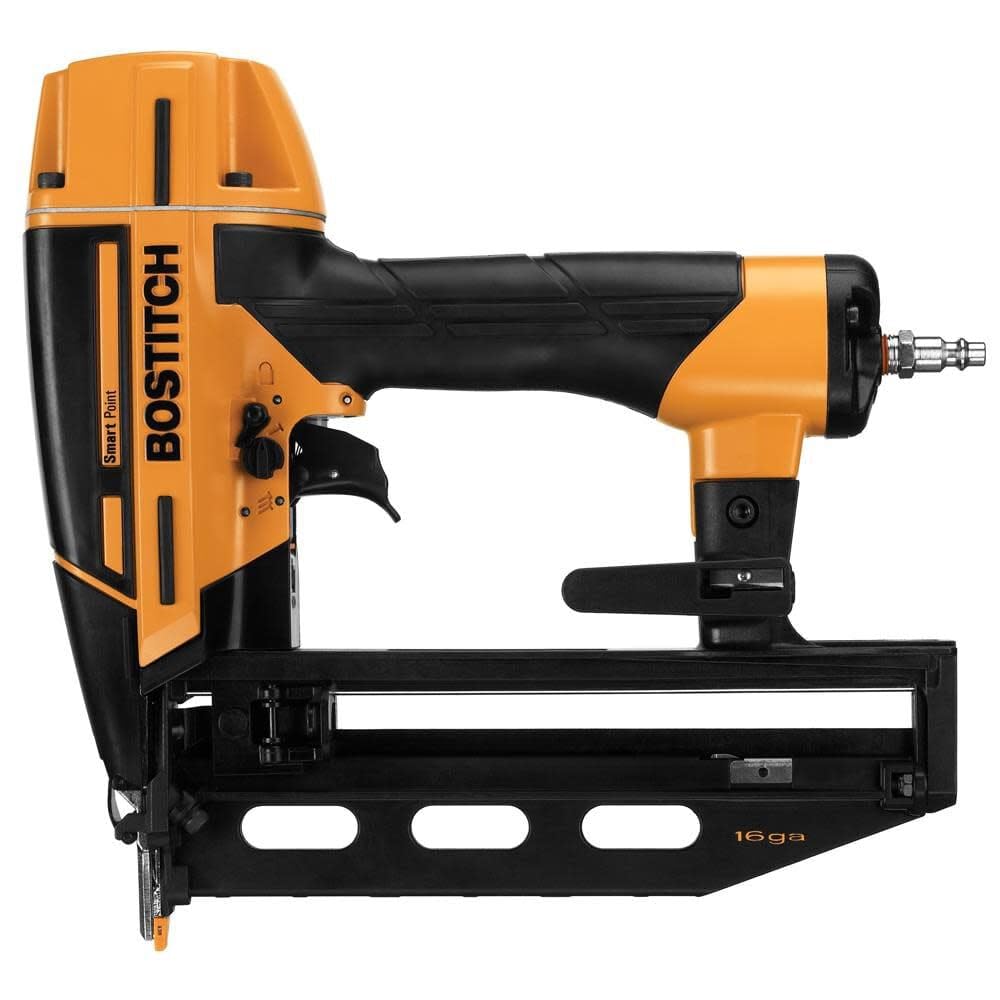
The pneumatic workhorse that keeps running when other nailers let go.
You get oil-free operation (no oil needed, so no stains on your trim) and a “Smart Point” nose (a smaller tip at the front that lets you see where the nail will land without tilting the tool). The Bostitch BTFP71917 drives 16-gauge finish nails from 1 inch up to 2-1/2 inches, using a selectable trigger system (sequential or contact actuation) so you can choose between slow precision and fast bump-firing. Buyers report the small nose makes placement far easier than a traditional large shoe. And because it runs oil-free, there is zero risk of leaving stains on your finished wood.
Owners mention that after about 2,000 square feet of nailing down a custom floor, this was the “best, trouble and frustration free nail gun” they had used — thousands of nails sunk and not one jam. The included 1/4-inch air fitting (the standard size for most air compressor hoses), extra no-mar tips (rubber tips that protect the wood surface from scratches), and carrying case round out the kit. At 7.34 pounds, it is a touch heavier than some pneumatics, but that mass helps drive nails deep into hardwood without bouncing. The main trade-off: loading the magazine feels a bit fiddly compared to older Bostitch designs, and the belt hook is small enough that buyers do not trust it for ladder work.
Why It Earns the Top Spot
- Oil-free operation eliminates stains on finished wood
- Smart Point nose lets you place nails without pressing the contact trip
- Selectable trigger (sequential or contact) adapts to pace of work
- 7-year limited warranty covers the tool for years
Two Real Caveats
- Straight magazine is less convenient in tight corners than angled models
- Included belt hook is small; not trustworthy for climbing ladders
Reach for this when: you want a pneumatic that can survive a full flooring or trim project without a single jam — it is the most reliable option in this list for high-volume work.
Look elsewhere if: you need to work in corners or tight spaces, where an angled magazine like the DEWALT or Paslode will fit better.
2. Makita AF601
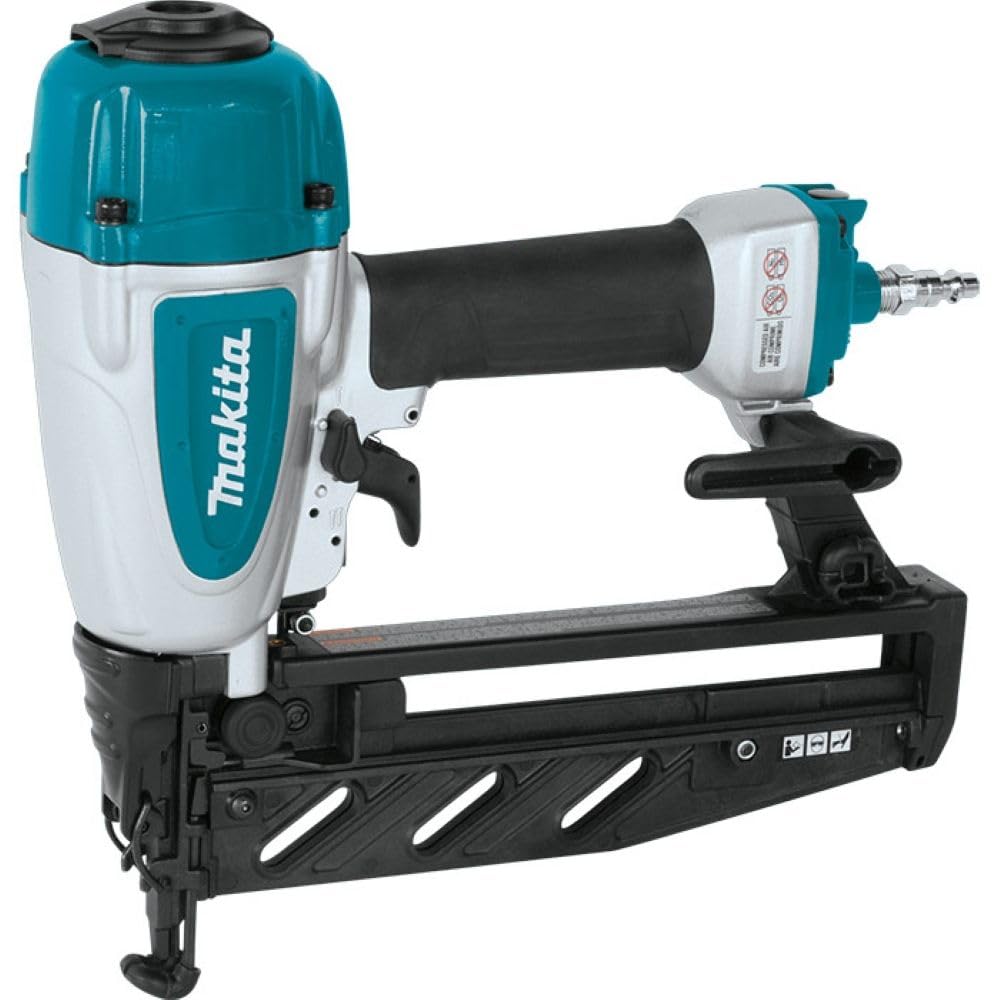
Drives perfectly straight through 3/4‑inch oak where other nailers bounce.
The Makita AF601 is built for the kind of trim work where every nail must land dead straight at the exact depth — and it delivers. The motor design provides high power that customers note drives nails consistently even through dense 3/4‑inch oak, with the tool‑less depth adjustment dial (a wheel you turn by hand to set how deep the nail sits) letting you dial in flush or countersink (slightly below the surface) in seconds. The nail lock-out mechanism (a feature that stops the gun from firing when the magazine is empty) stops dry fires (firing with no nails loaded), which protects both the tool and your work surface from damage.
Buyers specifically highlight that it “drives nails perfectly straight through 3/4″ oak” with consistent depth just by applying firm pressure and using the dial — finishing a project mid-way when a Porter Cable nailer stopped working. The built-in air duster (a nozzle that blows compressed air to clear sawdust) is a handy extra: it clears sawdust off your layout line so you get a clean mark every time. The one catch, mentioned by a buyer, is that the hand grip on this unit can start rolling up after shooting around 100 nails — a minor annoyance for a tool with otherwise professional build quality.
The Hardwood Specialist
- Nail lock-out prevents dry-firing damage
- Tool-less depth adjustment for fast countersink tuning
- Built-in air duster clears debris from work surface
- 2-mode selector switch for sequential or contact operation
One Minor Grip
- Grip material may roll up after extended use, per buyer feedback
Pick this if: accuracy through tough hardwoods is your top priority — the AF601 out-powers and out-aligns many competitors in that specific job.
skip it if: you want an angled magazine for corner work, because the AF601 is a straight-finish nailer.
3. Craftsman CMCN616C1

Battery‑powered freedom for the DIYer, but you will feel the 9.1 pounds.
The CRAFTSMAN V20 CMCN616C1 is a fully cordless finish nailer that eliminates compressors, hoses, and costly gas cartridges — just a 20V Li‑ion battery (a rechargeable lithium-ion battery that delivers 20 volts of power) and you are working anywhere. It drives adhesive‑collated 16‑gauge nails up to 2‑1/2 inches and provides consistent firing power across different climate conditions and materials. The tool‑free jam and stall settings let you clear a jam in seconds without hunting for a hex key, and the belt hook keeps it close at hand between shots.
Reviewers point out that this gun “works great” for DIY projects — one owner bought it after a budget “green brand” from a box store could not sink nails in cedar. The CRAFTSMAN sank them with no problem through 3/4‑inch hardwood and 1‑inch oak stair treads. The catch is weight: at 9.1 pounds versus the DEWALT DCN660D1 at 6 pounds. The review pattern is clear: it is “heavy” and not recommended for professional all-day use, but for the weekend remodeler who needs to escape the compressor, it gets the job done. It comes with a 20V battery and charger, plus 100 starter nails (50 of 2-inch and 50 of 2-1/2-inch).
Why It Works for DIY
- Fully cordless — no compressor, hose, or gas cartridge needed
- Tool-free jam and stall release for easy clearing
- Includes battery and charger in the kit
- Sinks nails through cedar and 1‑inch oak where cheaper models fail
The Weight Trade-Off
- 9.1 lbs makes it noticeably heavier than most competitors
- Not recommended for professional all-day use, per buyers
Best for: the DIYer who values cordless mobility and already uses Craftsman V20 tools, and can handle a heavier tool for short sessions.
Not for: anyone who needs to nail overhead for more than an hour — the weight will tire out your arm fast.
4. Paslode 916200

Featherlight at 4.5 pounds and the most maneuverable cordless finish nailer here.
The Paslode 916200 combines a 7V Li‑ion battery with a fuel cell (a small disposable cartridge that provides the gas for combustion) to drive nails without a compressor or a heavy battery pack — weighing just 4.5 pounds. That is the lightest weight of any product in this list and over 4 pounds lighter than the Craftsman CMCN616C1. The angled magazine (for 16‑gauge angled nails) lets it reach into tight corners where a straight magazine cannot go, making it ideal for crown molding and baseboard in closets or around door casings.
Shoppers say it is a “10/10” tool — one owner reports a single jam since purchase, which was “a very easy fix,” and notes “so much nicer not dragging around a hose!” The no‑mar tip (a rubber protector on the nose) protects finished surfaces from scratches, and the 7V battery can handle up to 12,000 nails per charge according to Paslode’s claims. That battery, together with a single fuel cell, lasts a full workday. The trade-off is that you need to keep both fuel cells and 7V batteries on hand — it is not a simple plug-and-charge system like pure battery nailers. But for anyone who has spent years pulling a hose, the freedom of movement at this weight is transformative.
What Makes It Special
- Only 4.5 lbs — the lightest cordless finish nailer in the roundup
- Angled magazine reaches corners and tight spaces easily
- 12,000 nails per charge (claimed); full-day runtime
- No‑mar tip prevents surface scratches
Consider These Limits
- Uses both fuel cells and a 7V battery — not a simple rechargeable system
- Fuel cells add ongoing cost compared to pure battery models
Grab this if: you want the lightest possible cordless finish nailer for overhead or corner work, and you are okay with buying fuel cells.
pass on it if: you prefer a simple battery‑only system without consumables — look at the DEWALT DCN660D1 instead.
5. DEWALT DCN660D1

A brushless cordless that runs a full 10‑hour shift on one battery charge.
The DEWALT DCN660D1 is a pure battery‑powered, 100% cordless finish nailer using a brushless motor (a motor with no brushes that rub, so it runs more efficiently and lasts longer) — no gas cartridges, no fuel cells, just a 20V MAX* battery. At 6 pounds it is heavier than the Paslode but significantly lighter than the Craftsman (9.1 pounds), and the angled magazine gives it the same corner‑hugging advantage. The tool‑free selectable trigger switches between sequential and contact actuation, the LED lights illuminate dark corner work, and the tool‑free jam release clears a blockage without extra tools.
Buyers consistently report that “batteries last a full 10‑hour day,” even in demanding finish work. That runtime comes from the brushless motor, which boost every amp‑hour (a measure of battery capacity). The kit includes one 2.0Ah battery (meaning it delivers 2 amps for one hour) and a charger, and since it uses the same DEWALT 20V MAX* platform, if you already own other DEWALT tools you have spares ready. A buyer notes that it “works as well as air nailers, with no oil and no misfires” — the main con is that it uses angled nails, which have a narrower selection at hardware stores than straight nails. Zero misfires or jams with DEWALT nails, and one owner has been using his for years saying it “just works great.”
Why Pros Choose It
- Brushless motor delivers maximum runtime — batteries last a full 10‑hour day
- Angled magazine fits tight corners for crown molding and baseboard
- Tool‑free jam release, depth adjustment, and trigger selector
- LED lights illuminate dark work areas
The Angled‑Nail Catch
- Uses angled nails, which are less commonly stocked than straight nails
- Heavier than a pneumatic nailer, though lighter than the Craftsman at 6 lbs
Reach for this when: you want a professional‑grade cordless finish nailer that runs all day on one battery, with no consumables beyond nails — it is the best pure‑battery option here.
Look elsewhere if: you need a lighter tool (4.5‑lb Paslode) or prefer the simplicity of a pneumatic setup for occasional use.
Understanding the Specs
Power Source: Pneumatic vs Cordless
Pneumatic finish nailers (like the Bostitch BTFP71917 and Makita AF601) use compressed air from a separate compressor. They are generally lighter and cheaper, but you are always attached to a hose. Cordless finish nailers fall into two sub-types: pure battery (Craftsman CMCN616C1 and DEWALT DCN660D1 use a 20V Li‑ion battery that you charge) and fuel‑cell hybrid (Paslode 916200 uses a small battery plus a fuel cell that must be replaced after a few thousand nails). Pure battery models are simpler to run — just charge and shoot — but the battery adds weight. Fuel‑cell models are lighter but add an ongoing consumable cost.
Weight and Balance in Everyday Use
A heavier nailer can drive nails into hardwood more easily because its mass absorbs the recoil, but you lift it for every single nail. The range in this list goes from 4.5 pounds (Paslode 916200) to 9.1 pounds (Craftsman CMCN616C1). That 4.6‑pound gap is the difference between a tool you can hold overhead for an hour and one that fatigues your arm after 15 minutes. Look at the weight figure plus the magazine type: an angled magazine shifts the center of gravity backward, making the tool feel lighter in your hand than the scale number alone suggests.
FAQ
Can I use 18‑gauge nails in a 16‑gauge finish nailer?
How long does a 20V cordless battery last when nailing trim?
What is the difference between sequential and contact (bump) trigger mode?
Do I need to oil a pneumatic finish nailer?
Will a 16‑gauge finish nailer hold baseboard securely?
What does “tool‑free depth adjustment” mean?
How do I clear a jammed nail from a finish nailer?
Can I use a 16‑gauge finish nailer for hardwood floor installation?
What does the angled magazine on the Paslode and DEWALT do?
How many nails come in the kit with the Craftsman CMCN616C1?
Final Thoughts: The Verdict
For most buyers, the best 16g finish nailer winner is the Bostitch BTFP71917 because it combines oil‑free reliability, a selectable trigger, and a smaller nose for precise placement — all at a price that beats what you would expect for this level of quality. If you want cordless freedom with pro‑grade battery life, grab the DEWALT DCN660D1. And for the lightest possible tool that fits tight corners without a hose, the standout is the Paslode 916200.
How We Picked
We do not accept paid placement. Every pick is matched to a real buyer and a real use-case; we do not hands-on test units.
Sources & Methodology
Specifications: manufacturer listings and product documentation. Review insights: verified customer reviews, as of July 2026. Pricing: not shown on this page (it changes often); check the current price via the retailer link.
As an Amazon Associate, Gadgets Feed earns from qualifying purchases. This does not affect which products we feature.
Product prices and availability are accurate as of the date/time indicated and are subject to change. Any price and availability information displayed on Amazon at the time of purchase will apply to the purchase of this product. As an Amazon Associate I earn from qualifying purchases.
CERTAIN CONTENT THAT APPEARS ON THIS SITE COMES FROM AMAZON. THIS CONTENT IS PROVIDED "AS IS" AND IS SUBJECT TO CHANGE OR REMOVAL AT ANY TIME.
Amazon and the Amazon logo are trademarks of Amazon.com, Inc. or its affiliates.