
Our readers keep the lights on and my morning glass full of iced black tea. As an Amazon Associate, I earn from qualifying purchases.
Specs are compiled from manufacturer listings and verified buyer reviews and can change over time — please confirm the key details on the product page before buying.
You want a spotting scope that shows you bullet holes at 200 yards and the feathers on a bird at half a mile, but you do not want to spend what a cheap used car costs. Affordable scopes have gotten genuinely good, but the difference between a scope you keep for years and one you hate after one trip depends on two things: the glass coating and the prism material. This guide cuts through the marketing to show you exactly which affordable scopes deliver clear, usable images without the premium price tag.
I’m Min — the founder and writer behind Gadgets Feed. This guide is built by comparing the manufacturers’ published specifications and the patterns across verified customer reviews, so you get each pick’s real strengths and trade-offs instead of marketing spin.
Whether you are spotting targets at the range, glassing ridgelines for game, or watching wildlife from your backyard deck, finding the right affordable spotting scope means knowing which specs actually matter and which ones are just numbers on a box.
Quick Picks
- Athlon Optics Argos HD 20-60×85 Spotting Scope — Top Performer
- GOSKY 20-60×80 HD Spotting Scope (Updated) — Digiscoping Star
- Gosky HD Spotting Scope 20-60x80mm — Best Value
- Athlon Optics Talos 20-60×80 Spotter Scope — Range Ready
- WOZEL 25-75×80 Spotting Scope with Tripod — Maximum Zoom
How To Choose The Best Affordable Spotting Scope
Buying an affordable spotting scope is a game of trade-offs. You want the brightest image, the most magnification, and the toughest build — but at this price level, you have to pick your priorities. Here is what actually separates a usable scope from a frustrating one.
Lens Coating Is Everything
The coating on the lens determines how much light reaches your eye. A “fully multi-coated” scope means every air-to-glass surface has multiple anti-reflective layers. This is the single most important spec for brightness. If the product page says “coated” or “fully coated” (without the “multi”), the image will look dim and washed out at higher magnifications.
BAK4 vs BK7 — Prism Glass Quality
BAK4 is denser, higher-quality glass that delivers a perfectly round exit pupil (the circle of light you see when you hold the scope at arm’s length). BK7, which is common in cheaper scopes, clips that circle into a square-ish shape, which means you lose light and edge sharpness. Every scope on this list uses BAK4.
Magnification and Objective Lens Size
A 20-60×80 scope zooms from 20x to 60x and has an 80mm front lens. The 80mm lets in a lot of light, but at 60x the image gets noticeably dimmer on affordable glass. Most users find the balance between 25x and 45x. Larger objective lenses (80mm to 85mm) gather more light but add weight.
Quick Comparison
| Model | Best For | Magnification | Objective Lens | Field of View (ft @ 1000yds) | Amazon |
|---|---|---|---|---|---|
| Athlon Argos HD 20-60×85 | Serious long-range shooting | 20-60x | 85mm | — | $249.99Amazon |
| Gosky 20-60×80 (Updated) | Digiscoping with DSLR | 20-60x | 80mm | 82.9-48 | $169.99$179.99Amazon |
| Gosky HD 20-60x80mm | Versatile outdoor use | 20-60x | 80mm | 114 | $159.99Amazon |
| Athlon Talos 20-60×80 | Range shooting on a budget | 20-60x | 80mm | 82 (approx) | $136.57Amazon |
| WOZEL 25-75×80 | Maximum zoom on a budget | 25-75x | 80mm | 82.9-48 | $119.99$149.99Amazon |
In-Depth Reviews
1. Athlon Optics Argos HD 20-60×85 Spotting Scope

The scope that rewrites what “affordable” means for serious long range glass.
The Athlon Argos HD jumps ahead of the rest by giving you an 85mm objective lens — 5mm wider than the standard 80mm on other picks — alongside genuine HD glass (high-density, low-dispersion glass that cuts color fringing). One buyer who shoots long range reported they could see details on a tower “just under 1,700 yards” clearly, even before sunset. That is a full 900 yards past where the Talos below feels comfortable, and it shows in the clarity of the image at distance.
The 45-degree angled eyepiece and rotating tripod ring let you twist the scope to whatever viewing angle you need, which is a huge comfort win when you are glassing a hillside for an hour. The argon gas purging is a step above the standard nitrogen fill — it keeps the scope fogproof and waterproof in weather that would fog up cheaper seals. Buyers confirm the image stays bright and color-accurate even in low light, with one noting Jupiter’s moons were “clearly visible.” The trade-off is that the eye relief is tight at full 60x zoom, and the polycarbonate housing (while sturdy and light at 68 ounces) does not feel as dense as an all-metal body.
The included soft case and lens caps are solid, but you will want a heavier full-size tripod for extended sessions — the scope’s weight and magnification make a lightweight tabletop tripod shaky at max zoom. For the price, you are getting the closest thing to premium glass that still fits the affordable description.
What Stands Out
- True HD glass delivers crisp, color-accurate images deep into low light.
- 85mm objective gathers noticeably more light than 80mm scopes.
- Rotating tripod ring and 45-degree eyepiece make long sessions comfortable.
- Argon purging beats standard nitrogen for fogproof reliability.
What to Know
- Eye relief gets tight at 60x — difficult for eyeglass wearers at full zoom.
- Polycarbonate housing feels less premium than all-metal bodies from Vortex or Swarovski.
- Needs a sturdy full-size tripod; the included one is basic.
the balance buyer: The shooter, birder, or hiker who wants near-premium clarity and an 85mm objective without paying near-premium money — this scope goes further than any other in this roundup before the image degrades.
The one limitation: If you plan to shoot at 200 yards with a.22, the lower-priced Talos may serve you just as well for less cash.
2. GOSKY 20-60×80 HD Spotting Scope (Updated)

The only scope in this price range that ships with a genuine DSLR adapter for serious digiscoping.
Gosky’s updated 20-60×80 is built for the person who wants to photograph what they see. It comes with both a smartphone digiscoping adapter and an SLR mount for Nikon cameras — a setup that usually costs extra on competitor scopes. One reviewer, an intermediate birder, said the smartphone adapter “is pretty easy to use once you get it set to your phone” and that the images were “much more detailed” than with their 8×30 binoculars. Another confirmed they could see Saturn’s ring and Jupiter’s moons from a light-polluted city.
The fully multi-coated 80mm green film lens and BAK4 Porro prism deliver a field of view at 82.9-48 feet per 1000 yards, which is standard for the class. The magnalium framework with rubber armor gives it a tougher feel than the all-polycarbonate Athlon Argos, and the nitrogen-purged waterproofing means you do not worry about morning dew or light rain. At 2.4 pounds, it is the lightest scope here by a wide margin — the Athlon Argos weighs 68 ounces.
Nothing is perfect: the zoom ring is a little stiffer than the Talos or Argos, and the DSLR adapter can be fussy to install on some camera bodies. One reviewer had a Nikon D500 and found the camera adapter “bit wobbly.” The angled eyepiece also takes getting used to — your hand naturally wants to look straight through, not at a 45-degree angle — but it saves your neck when you are scanning the sky or a hillside.
Why It Wins
- Includes both smartphone and Nikon DSLR adapters — rare at this price.
- Lightest build at 2.4 lbs, easy to carry on a hike.
- Magnalium frame feels tougher than polycarb alternatives.
- Clear enough to see Saturn’s rings and Jupiter’s moons from the city.
The Trade-Offs
- Zoom ring is stiffer than competitors — takes two hands to adjust smoothly.
- Angled eyepiece has a learning curve if you have only used straight scopes.
- DSLR adapter feels wobbly on heavier camera bodies.
Who this is for: The birder or nature enthusiast who wants to bring their DSLR into the field without buying a separate adapter — this is the most complete digiscoping package available for the money.
Who should look elsewhere: If you only shoot at the range with a.22, the Athlon Talos below is simpler and costs less.
3. Gosky HD Spotting Scope 20-60x80mm
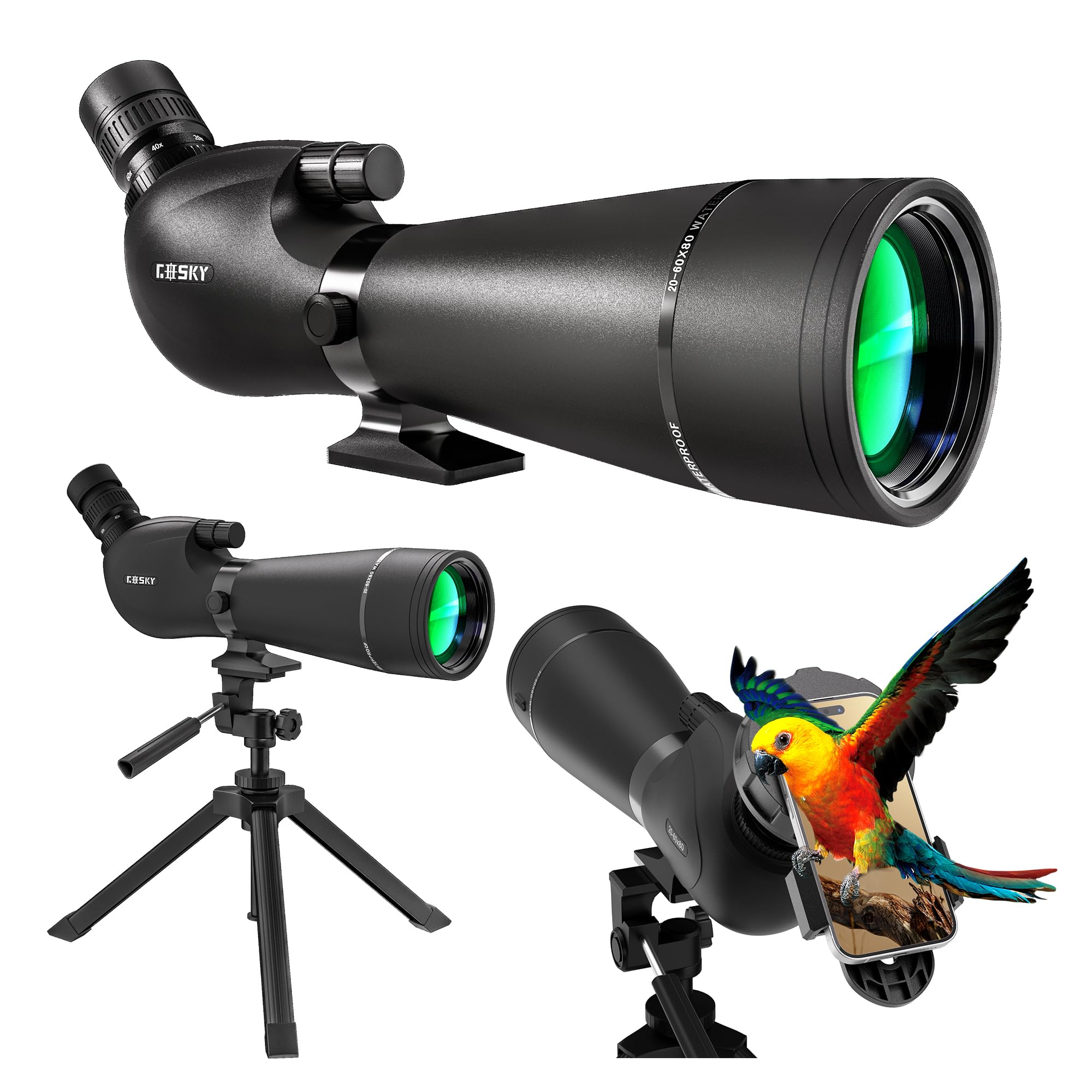
The well-rounded package that nails the essentials and skips the frills.
This is the Gosky HD that strips out the DSLR adapter and keeps everything else that makes the brand work. You get the same fully multi-coated 80mm green film objective lens and BAK4 prism for bright, clear images, and the same nitrogen-filled waterproof/fogproof body. The field of view is wider here than on the updated Gosky — 114 feet at 1000 yards vs 82.9-48 — which makes a real difference when you are scanning treelines for movement.
Reviewers consistently call the optics “decent” and “clear,” with one noting they could “see target holes at 100+ yards” easily. The 45-degree angled eyepiece is comfortable for extended use, and the included tripod is fine for tabletop or vehicle-hood use but gets shaky outdoors — a pattern across every scope in this roundup. The extendable sunshade is a thoughtful touch that cuts glare when the sun is low.
The phone adapter is the weak link here. Multiple reviewers call it “junk” or “poorly engineered,” saying the tracks slip off and it takes 3-5 minutes to realign after every adjustment. If you plan to digiscope seriously, you will want to buy a better adapter separately or step up to the updated Gosky above that includes the DSLR mount.
The Highlights
- Good, clear optics with a wide 114-foot field of view for scanning.
- Fully multi-coated 80mm lens and BAK4 prism for brightness.
- Nitrogen-filled and fogproof for all-weather use.
- Solid value for the price — delivers where it counts.
The Headaches
- Phone adapter is widely reported as poorly made and frustrating to use.
- Included tabletop tripod is shaky for outdoor use.
- Image gets dim at highest magnifications like most scopes in its class.
Grab this if: You want a reliable all-rounder for hunting, birdwatching, or range use and do not plan to take photos through the scope — the core optics are solid for the price.
skip it if: Taking pictures through the scope is part of your plan — buy the updated Gosky above or a separate phone adapter.
4. Athlon Optics Talos 20-60×80 Spotter Scope

The no-nonsense range scope that punches above its weight with clean glass.
Athlon’s Talos is the budget champion among shooters. It uses fully multi-coated lenses for good light transmission and an aluminum body that feels more rugged than the plastic-bodied competition. One reviewer noted, “I have used this out to 800 yards so far, and the glass is pretty clear at that distance and beyond,” which is impressive for a scope at this price tier. Another reviewer who sighted in a.223/5.56 could see the round “clearly” at 200 yards and found 300 yards “a bit of a strain but it does work.” That places it behind the Argos HD in long-range clarity, but the Talos costs less.
The rotating mount sleeve is a clever feature — you can spin the whole scope to get the eyepiece at the right angle without loosening the tripod head. The sunshade is short but effective, and the focus knob is “just right, not stiff, not too loose” according to one reviewer. The 1.57-degree field of view is on the narrower side compared to the wider-angle Gosky HD, but that is typical for this price range.
The catch is that the image gets noticeably dim after 40x, and the eye relief is tight. Buyers also note the included tripod could be heavier — one called it “ok” but not sturdy. The scope works best at 20-40x, where the glass is at its clearest. At 60x, you are pushing the limits of what this price point can deliver.
What Works
- Surprisingly clear glass for the money — buyers report good visibility to 800 yards.
- Aluminum body is tougher than polycarbonate competitors.
- Rotating mount sleeve lets you adjust the eyepiece angle easily.
- Lightweight for its size — easy to carry to the range.
What Does Not
- Image quality drops off after 40x magnification.
- Included tripod is basic — plan to upgrade if you use it in the field.
- Eye relief is short, which can be an issue with glasses.
Best for the budget-minded shooter: If you mostly shoot at 100-300 yards and want a scope that shows you hits without draining your wallet, the Talos is the right call — it does what it needs to do and nothing more.
Not the one for: Hunters or birders who need the widest field of view or the brightest image in low light — the wider-angle Gosky HD or premium Argos HD serve those needs better.
5. WOZEL 25-75×80 Spotting Scope with Tripod
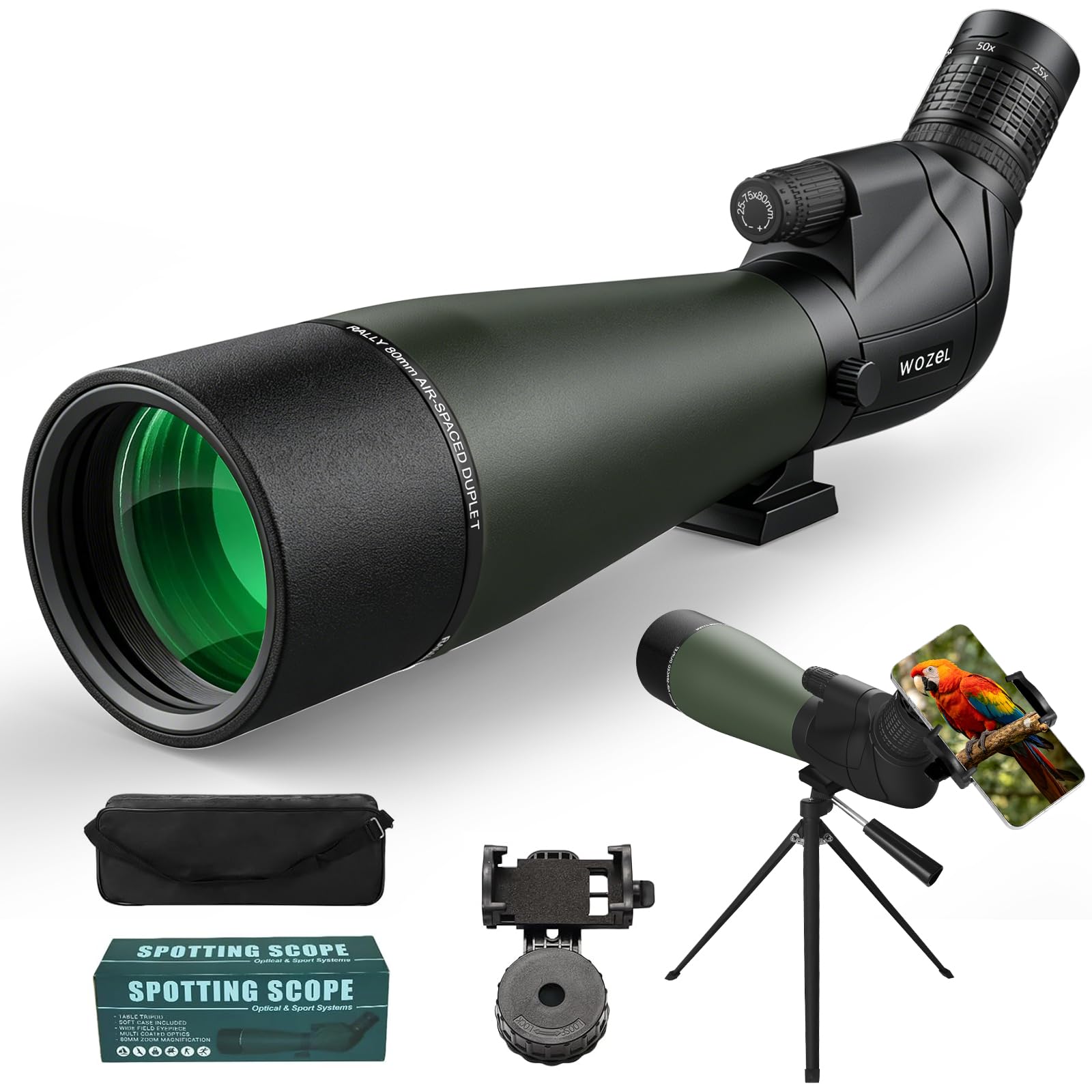
The scope that offers the highest top-end magnification in the affordable class.
WOZEL goes where few affordable scopes dare: 75x magnification. The WOZEL reaches 75x magnification while the Athlon Talos tops out at 60x. The 80mm fully multi-coated green film lens and BAK4 prism are the same glass formula that makes the Gosky models work, and the nitrogen-filled waterproof body matches the competition. One buyer confirmed “The little tripod is stable enough to spot hits out to 500 yd for sure,” which is solid performance at that distance.
The scope feels substantial in hand at 32 x 4 x 5.2 inches, and the quick-focus system and one-handed zoom knob are genuinely easy to use — even with gloves on. The adjustable twist-up eyecup fits different users, and the retractable sunshade helps on bright days. The kit is complete: scope, tripod, phone adapter, carrying case, lens covers, and cleaning cloth all in the box.
Speed matters here: running from 25x all the way to 75x means you have more range than any other scope in this list. The trade-off is that at 75x, the image is dim and the field of view narrows to 48 feet at 1000 yards — about the width of a two-lane road. The phone adapter is also finicky; one reviewer called it “questionable at best” and said it was “hard to line up the camera lens to the scope.”
The Upside
- Highest top-end magnification at 75x — beats every other scope in this roundup.
- One-handed zoom and quick-focus are intuitive and fast.
- Complete kit with tripod, case, and phone adapter included.
- Waterproof and fogproof for all-weather durability.
The Downside
- Image at 75x is significantly dimmer than at 50x or below.
- Phone adapter is notoriously tricky to align and keep aligned.
- Field of view narrows to 48 feet at 1000 yards at high magnification.
Reach for this if: You want the absolute highest magnification available in an affordable scope — for spotting hits at mid-range distances or getting the most zoom for your dollar, the WOZEL delivers that extra reach.
Pass it by if: You value image brightness and wide-angle scanning over max zoom — the Athlon Talos or Gosky HD give you clearer images at their usable magnification ranges.
Understanding the Specs
Fully Multi-Coated Optics
This is the spec that determines how bright your image actually is. “Fully multi-coated” means every surface of every lens element has multiple anti-reflective layers applied. This lets around 98% of the available light pass through each lens surface. A scope that is just “coated” (only the outer surfaces) or “multi-coated” (some surfaces but not all) will look noticeably dimmer at the same magnification. For an affordable spotting scope, this is the single most important feature to confirm before you buy.
BAK4 Prism Glass
The prism inside the scope flips the image so it looks right-side-up. BAK4 glass is denser and clearer than the cheaper BK7 glass found in bargain-bin optics. The easiest test: look at the eyepiece from about 12 inches away. If the circle of light you see is a perfect full circle, you have BAK4. If it looks clipped into a square or D-shape, it is BK7 — you lose light and edge sharpness. Every scope in this guide uses BAK4.
Magnification and Objective Lens
A spotting scope labeled “20-60×80” zooms from 20x to 60x and has an 80mm diameter front lens. The magnification range tells you how much closer things look — at 20x a deer at 200 yards looks as if it is 10 yards away. The objective lens size determines how much light enters the scope. A larger objective (80mm vs 60mm) gives you a brighter image, especially in low light, but adds weight. A 20-60×80 scope and a 20-60×85 scope have nearly the same zoom range, but the 85mm gathers slightly more light.
Waterproof/Fogproof
Waterproofing on affordable spotting scopes works via O-ring seals that keep moisture from getting inside the body. Fogproofing means the scope is filled with nitrogen or argon gas, which prevents condensation from forming on the internal lenses when you move between cold and warm air. If you intend to use the scope in rain, snow, or high-humidity environments (like a foggy marsh or a damp range), paying the extra few dollars for a nitrogen-purged model is worth it.
FAQ
Can an affordable spotting scope see bullet holes at 200 yards?
Is 75x zoom actually usable or is it just a number on the box?
What does a 45-degree angled eyepiece mean and do I need it?
Why do reviewers keep complaining about the phone adapter?
Is the included tripod good enough, or do I need to buy a separate one?
What is the difference between BK7 and BAK4 prism glass?
Can I use an affordable spotting scope for stargazing?
How important is the “fully multi-coated” lens spec?
Does a more expensive tripod actually make a difference for a spotting scope?
Final Thoughts: The Verdict
For most people looking for an affordable spotting scope, the winner is the Athlon Optics Argos HD 20-60×85 because its HD glass and larger 85mm objective deliver the clearest, brightest image at distance — and it comes close to premium scopes at half the price. If digiscoping with a DSLR is your priority, grab the Gosky Updated 20-60×80 for the included camera adapter and light weight. And for the tightest budget that still gives you usable range-glass, the standout is the Athlon Optics Talos 20-60×80 for straightforward, reliable performance on the bench.
How We Picked
We do not accept paid placement. Every pick is matched to a real buyer and a real use-case; we do not hands-on test units.
Sources & Methodology
Specifications: manufacturer listings and product documentation. Review insights: verified customer reviews, as of July 2026. Pricing: not shown on this page (it changes often); check the current price via the retailer link.
As an Amazon Associate, Gadgets Feed earns from qualifying purchases. This does not affect which products we feature.
Product prices and availability are accurate as of the date/time indicated and are subject to change. Any price and availability information displayed on Amazon at the time of purchase will apply to the purchase of this product. As an Amazon Associate I earn from qualifying purchases.
CERTAIN CONTENT THAT APPEARS ON THIS SITE COMES FROM AMAZON. THIS CONTENT IS PROVIDED "AS IS" AND IS SUBJECT TO CHANGE OR REMOVAL AT ANY TIME.
Amazon and the Amazon logo are trademarks of Amazon.com, Inc. or its affiliates.