
Our readers keep the lights on and my morning glass full of iced black tea. As an Amazon Associate, I earn from qualifying purchases.
Specs are compiled from manufacturer listings and verified buyer reviews and can change over time — please confirm the key details on the product page before buying.
You bought an arc fault switch to stop electrical fires, not to have it trip every time you plug in a vacuum. The real frustration with these breakers is the “nuisance trip” that kills power for no clear reason. This guide helps you pick the right model for your panel and circuits.
I’m Min — the founder and writer behind Gadgets Feed. This guide is built by comparing the manufacturers’ published specifications and the patterns across verified customer reviews, so you get each pick’s real strengths and trade-offs instead of marketing spin.
To stop nuisance tripping, the arc fault switch must fit your panel brand, match your circuit’s amperage, and have diagnostic features that tell you why it tripped. The Siemens QA115AFCN does all three: it is 0.21 pounds, uses a plug-on neutral design, and runs at 15 amps and 240 volts for standard Siemens panels.
Quick Picks
- Siemens QA115AFCN 15-Amp Combination AFCI — Best Overall
- Siemens QA120AFC 20-Amp Combination AFCI — Smart Diagnostics
- Square D HOM120PCAFIC 20-Amp Plug-On Neutral CAFCI — Clean Install
- Square D HOM120CAFIC 20-Amp Single-Pole CAFCI — Premium Protection
- Eaton BRN115AF 15-Amp CAFCI — Budget Champion
- ABB THQL1120DF 20-Amp Dual Function AFCI/GFCI — Dual Protection
How To Choose The Best ARC Fault Switch
Picking the right arc fault switch means matching the exact model to your electrical panel’s brand and series.
Panel Brand and Series Compatibility
Every major brand (Square D, Siemens, Eaton, ABB) makes breakers that only fit their own panels. A Square D Homeline breaker will not fit a Siemens panel. Before you buy, check the label inside your panel door — it lists the approved breaker models. Some panels need a “plug-on neutral” design (like Square D’s newer Homeline series), which removes the pigtail wire for a cleaner install.
Amperage and Voltage Rating
Most residential arc fault switches come in 15-amp or 20-amp ratings for 120V or 240V circuits. Your breaker must match the circuit’s wire gauge: 15-amp uses 14 AWG wire, 20-amp uses 12 AWG wire. Installing a 20-amp breaker on a 15-amp wire is a fire risk, so read the label on your panel or wire carefully.
Nuisance Tripping and Diagnostic Features
Some AFCI switches trip more often with older appliances or multi-wire branch circuits. Look for models with LED trip indicators — like Siemens’ QA series — that tell you the exact reason for the trip (arc fault, overload, or ground fault). Diagnostics save you from calling an electrician every time a dimmer switch misbehaves.
Quick Comparison
| Model | Best For | Amperage | Weight | Voltage | Amazon |
|---|---|---|---|---|---|
| Siemens QA115AFCN | Best Overall 15A Siemens Panel | 15 Amps | 0.21 Pounds | 240 Volts | $37.99$43.12Amazon |
| Square D HOM120PCAFIC | Best Plug-On Neutral 20A | 20 Amps | 0.5 Pounds | 120 VAC | $41.99Amazon |
| Siemens QA120AFC | Best LED Diagnostics 20A | 20 Amps | 0.3 Pounds | 120 Volts | $45.39Amazon |
| Square D HOM120CAFIC | Premium Homeline 20A | 20 Amps | 4 ounces | 120/240 Vac | $46.50Amazon |
| Eaton BRN115AF | Budget-Friendly 15A Eaton | 15 Amps | 6.08 ounces | 120/240 V | $47.00Amazon |
| ABB THQL1120DF | Dual AFCI/GFCI Protection | 20 Amps | Not listed | 120 Volts | $58.99Amazon |
In-Depth Reviews
1. Siemens QA115AFCN 15-Amp Combination AFCI

This 0.21-pound Siemens snaps into your panel and lets you skip the pigtail wire — it is the simplest path to arc-fault protection for a 15-amp circuit.
This model delivers combo-type arc fault protection (protection against both series and parallel arcs) in a package that weighs 0.21 pounds — that is 2.4 times lighter than the Square D HOM120PCAFIC at 0.5 pounds. At 15 amps and 240 volts, it handles standard bedroom and lighting circuits. The plug-on neutral design means you skip the pigtail wire entirely, which frees up space in your panel and cuts installation time.
Buyers report it is an “exact fit” for their Siemens panels, and another notes it is “exactly as described.” One person admits he ordered the wrong part by mistake — so double-check your amperage before clicking buy. Unlike the Eaton BRN115AF below, which weighs 6.08 ounces, the Siemens QA115AFCN is barely noticeable once it is clipped in. It is also HACR and SWD rated, meaning it works with heating and air-conditioning equipment, plus switching duty for lighting controls.
Why it wins: lightest-in-class at 0.21 pounds, plug-on neutral for a cleaner install, and reliable fit for any Siemens panel.
One thing to know: at 240 volts, it is not designed for standard 120-volt-only circuits; check your panel voltage before you swap.
This is the pick for a drop-in 15-amp replacement in a Siemens panel if you want the lightest, cleanest install with no pigtail to wrestle. If your circuit needs 20 amps, or you have a Square D, Eaton, or ABB panel, this breaker will not fit.
2. Siemens QA120AFC 20-Amp Combination AFCI

LED trip indicators tell you exactly why the power went out — that saves you guessing and calling an electrician.
This 20-amp single-pole combination AFCI breaker is built for Siemens panels and runs on 120 volts — a fit for kitchen, living room, and garage circuits. Its standout feature is the LED trip indicators that flash a pattern to identify the last trip condition: an arc fault, an overload, or a ground fault. It also gives you 1/4-inch more wire bend space than older designs, which makes squeezing wires into a tight panel easier.
One buyer wrote: “My old AFCI breaker kept tripping – This works as advertised.” Another reviewer replaced a 5-year-old Siemens QAF that had started nuisance-tripping and swapped it for this QAF2 version, calling it an “improved version of QAF.” At 0.3 pounds, it is still lighter than both the Square D HOM120PCAFIC (0.5 pounds) and the Eaton BRN115AF (6.08 ounces). The 25 lb./in. torque rating on the lugs means you can tighten the screw without stripping it.
Why it stands out
- LED trip indicators tell you the exact cause of a trip — no more mystery outages.
- More wire bend space (1/4 inch extra) for easier installation in tight panels.
- Proven to stop nuisance tripping that older breakers caused, per reviewers.
The real trade-off
- Only 120 volts — not suitable for 240-volt circuits like dryers or ranges.
- Does not fit any panel except Siemens brand load centers.
Best for: any Siemens panel owner plagued by random trips who wants diagnostic feedback. If you need a 240-volt breaker, go with the Siemens QA115AFCN instead.
3. Square D HOM120PCAFIC 20-Amp Plug-On Neutral CAFCI

You skip the curly pigtail wire entirely with this Square D — you push the breaker onto the neutral bar and you are done.
This 20-amp combination AFCI breaker from Square D uses a plug-on neutral design — instead of fumbling with a white pigtail wire, the breaker connects directly to the panel’s neutral bus bar with one push. That frees up gutter space and reduces connections. It is compatible exclusively with Homeline series 4 and newer load centers, so verify your panel’s generation before ordering.
Owners mention it fits “perfectly” in their Square D HOM panel. One electrician’s customer shared: “They are larger than a standard breaker and need a little more force to install. But overall, are very easy to install.” Another owner says it is the “best price I could find locally or online.” At 0.5 pounds, it is heavier than the Siemens QA115AFCN (0.21 pounds) but still manageable. The Time-Saver Diagnostics built into Square D’s newer design help identify the trip cause without extra gadgets.
What makes it special
- Plug-on neutral means no pigtail to wire up — quicker install and less panel clutter.
- Time-Saver Diagnostics simplify troubleshooting after a trip.
- Compatible with Homeline series 4+ load centers only (no pigtail needed).
Where it falls short
- Only fits newer Homeline panels — not compatible with older Homeline models or any other brand.
- Heavier (0.5 lbs) than the Siemens 15A model (0.21 lbs), though still light enough.
Reach for this if: you have a newer Square D Homeline panel and want a fast, clean arc-fault install with no pigtail. skip it if your panel is older than Homeline series 4 or uses a different brand.
4. Square D HOM120CAFIC 20-Amp Single-Pole CAFCI

One reviewer says this Square D breaker “gives confidence” — at 20 amps and 4 ounces, at 4 ounces versus the Eaton BRN115AF at 6.08 ounces.
This 20-amp combination AFCI breaker from Square D uses a traditional pigtail neutral wire for Homeline load centers and CSED devices, running at both 120 and 240 VAC. Its closest competitor is the plug-on neutral HOM120PCAFIC above — but this model uses a pigtail, which some electricians prefer for backward compatibility. At 4 ounces, it is lighter than the Eaton BRN115AF (6.08 ounces) and fits the same 1-inch wide pole space.
One buyer who installed this breaker to add arc-fault protection reports it has been “solid” and notes: “I like that it protects against both series and parallel arcs — and the built-in diagnostics make it easy to see what tripped.” Another reviewer, an experienced HVAC technician, says his husband “refuses to use anything but square D.” The 10 kA interrupt rating handles typical residential short-circuit scenarios. The catch: some users report occasional nuisance tripping in kitchen circuits with multi-wire branch setups. Make sure the neutral is properly connected to the breaker, not just the neutral bar, to avoid false trips.
The deep value: 20-amp capacity with 120/240 VAC support, Visi-Trip diagnostics, and the Square D reputation for reliability — plus it is lighter than comparable Eaton breakers. One buyer reports occasional nuisance tripping on multi-wire branch circuits; verify the neutral connection goes through the breaker.
Best for: Square D Homeline panel owners who want a proven, diagnostic-equipped 20-amp CAFCI that handles both 120V and 240V circuits. Not for anyone who wants a plug-on neutral design (go for the HOM120PCAFIC) or who uses a non-Square D panel.
5. Eaton BRN115AF 15-Amp CAFCI

One reviewer says this Eaton 15-amp is “almost 30 dollars less than at any stores” — but at 6.08 ounces, it is the heaviest single-pole AFCI here.
This 15-amp single-pole combination arc fault breaker from Eaton is meant for BR series load centers and runs at 120/240 VAC. At 6.08 ounces, it weighs 6.08 ounces versus the Square D HOM120CAFIC at 4 ounces. Buyers consistently praise its price: one reviewer says it is “almost 30 dollars less than at any stores,” and another calls it “perfict fit.” It is UL listed with a 10 kA interrupt rating, so it meets code requirements for bedroom and living room circuits.
Customers note it is a “great price for a home electric breaker” and that it “works like a champ.” One note from a repeat customer: “sales price appears to often vary by the hour.” The breaker is made in the Dominican Republic and is not smart-home compatible. For a basic, code-compliant AFCI that fits Eaton BR panels, it does exactly what it says. If you are building out an Eaton BR system on a tight budget, this is the value pick.
Where it excels
- Budget-friendly compared to big-box store prices — reviewers point out saving up to.
- UL listed with 10 kA interrupt rating for standard residential safety.
- Fits Eaton BR series load centers perfectly, per multiple verified buyers.
Where you compromise
- Heaviest in the lineup at 6.08 ounces — a tangible difference vs. competitors.
- Not smart-home compatible and uses a traditional pigtail, no plug-on neutral.
Reach for this if: you need a 15-amp AFCI for an Eaton BR panel and want to save money over local hardware stores. pass on it if you want a plug-on neutral design — this pigtail model is simpler but larger.
6. ABB THQL1120DF 20-Amp Dual Function AFCI/GFCI
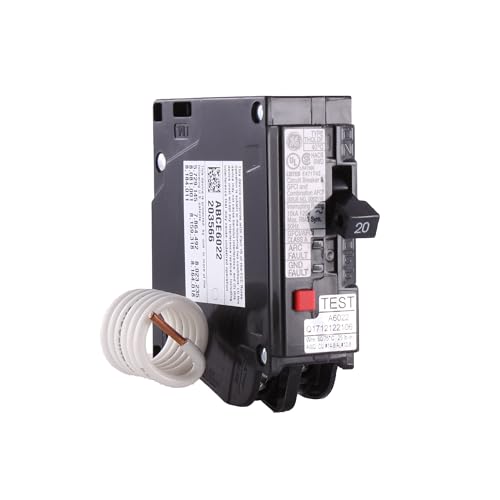
This breaker shields against both arc faults and ground faults — no extra GFCI outlet needed downstream.
This 20-amp single-pole dual-function breaker from ABB (formerly GE Industrial Solutions) packs both arc fault (AFCI) and ground fault (GFCI) protection into a single unit. At 120 volts, it fits bathroom, kitchen, garage, and outdoor circuits where code often requires both types of protection. The plug-in mount makes installation straightforward for any Q-Line panel.
Shoppers say it is an “exact replacement” that “worked perfectly” and that the price is “reasonable” even for shipping to Hawaii. One reviewer, living rurally, said “couldn’t find one in our neighborhood so I decided to order it. It worked absolutely perfect.” However, one installer noted that the breakers felt “very loose in the panel” without the cover on — something to check during installation, though the cover typically secures everything.
ABB acquired GE’s residential electrical product line in 2018, so this breaker is compatible with GE THQL and ABB Q-Line load centers. If you are wiring a wet area or a circuit that needs both arc and ground fault protection, this combo saves you from installing a separate GFCI outlet downstream.
Why it is different: dual AFCI/GFCI in one package means one breaker, one install, and protection against electrical fires and shocks simultaneously — a space-saver in crowded panels. One reviewer noted breakers felt loose before the panel cover was installed; test-fit carefully and tighten the set screw securely.
Best for: Q-Line panel owners who need both arc-fault and ground-fault protection in a single slot — ideal for kitchens, bathrooms, and outdoor circuits. Not for anyone with a non-ABB/non-GE panel, or anyone who prefers separate breakers for AFCI and GFCI protection.
Understanding the Specs
Plug-On Neutral vs. Pigtail
Traditional arc fault breakers have a curly white neutral wire (the pigtail) that you must connect to the neutral bus bar in your panel. It works, but it takes up space and adds an extra junction. A plug-on neutral breaker eliminates the pigtail — the neutral connection happens automatically when you snap the breaker onto the bus bar. That means fewer wires to tuck, more breathing room in the panel, and a faster install. You need a compatible panel (like Square D Homeline series 4+) to use plug-on neutral breakers; older load centers still require pigtails.
Combination AFCI vs. Standard AFCI
A standard arc fault circuit interrupter (AFCI) only detects parallel arcs — that is, a spark jumping between two wires (like a frayed cord touching a grounded box). A combination AFCI (CAFCI) detects both parallel arcs and series arcs — a spark across a single broken wire (like a loose connection inside a switch). Modern residential codes usually require combination AFCI breakers for most living-area circuits. The key spec to look for is “Combination Type AFCI” on the label; it is the safer, more comprehensive choice.
FAQ
Will a Siemens breaker fit in a Square D panel?
What is the difference between a 15-amp and 20-amp arc fault switch?
What does the LED trip indicator on a Siemens QA series tell me?
Why does my arc fault breaker keep tripping for no reason?
Can I use an arc fault breaker on a 240-volt circuit?
How do I know if my panel supports plug-on neutral breakers?
What does “10 kA interrupt rating” mean on an AFCI?
What is a dual-function AFCI/GFCI breaker and when should I use one?
How do I tell if my breaker is tripping due to an actual arc fault vs. a nuisance cause?
Is it safe to replace a standard (non-AFCI) breaker with an arc fault breaker?
Final Thoughts: The Verdict
If you want one dependable pick, the arc fault switch winner is the Siemens QA115AFCN because it combines the lightest weight (0.21 pounds), a plug-on neutral design for fast installation, and reliable 15-amp/240-volt protection for standard Siemens panels. If you need 20-amp capacity plus diagnostic feedback that tells you exactly why it tripped, grab the Siemens QA120AFC. And for a wet-location or code-compliant kitchen circuit that needs both arc and ground fault protection in one slot, the standout is the ABB THQL1120DF dual-function breaker.
How We Picked
We do not accept paid placement. Every pick is matched to a real buyer and a real use-case; we do not hands-on test units.
Sources & Methodology
Specifications: manufacturer listings and product documentation. Review insights: verified customer reviews, as of July 2026. Pricing: not shown on this page (it changes often); check the current price via the retailer link.
As an Amazon Associate, Gadgets Feed earns from qualifying purchases. This does not affect which products we feature.
Product prices and availability are accurate as of the date/time indicated and are subject to change. Any price and availability information displayed on Amazon at the time of purchase will apply to the purchase of this product. As an Amazon Associate I earn from qualifying purchases.
CERTAIN CONTENT THAT APPEARS ON THIS SITE COMES FROM AMAZON. THIS CONTENT IS PROVIDED "AS IS" AND IS SUBJECT TO CHANGE OR REMOVAL AT ANY TIME.
Amazon and the Amazon logo are trademarks of Amazon.com, Inc. or its affiliates.