
Our readers keep the lights on and my morning glass full of iced black tea. As an Amazon Associate, I earn from qualifying purchases.
Specs are compiled from manufacturer listings and verified buyer reviews and can change over time — please confirm the key details on the product page before buying.
Carving a chainsaw is a game of feel, not just raw power. You need a bar short enough for curves, a responsive motor, and a weight that won’t exhaust your arms after twenty minutes of detail work. The wrong saw fights you with every cut; the right one becomes an extension of your hand.
I’m Min — the founder and writer behind Gadgets Feed. This guide is built by comparing the manufacturers’ published specifications and the patterns across verified customer reviews, so you get each pick’s real strengths and trade-offs instead of marketing spin.
Whether you are roughing out a bear or adding the final feather to an eagle wing, finding the right chainsaw for carving means matching bar length, power source, and weight to the kind of detail work you actually do.
Quick Picks
- Makita XCU14Z 18V LXT Brushless Cordless 6″ Pruning Saw (Tool Only) — Detail Master
- Echo 12 in. 25.0 cc Gas 2-Stroke X Series Top Handle Chainsaw CS-2511T-12 — Pro Climber
- DeWalt Chainsaw Pruning CRDLS 20V 8IN DCCS623B (Tool Only) — Battery Precision
- SEESII Flagship 8-Inch Cordless Mini Chainsaw, 2026 Upgraded Brushless Motor (2×4000mAh) — Budget Workhorse
- FXAFXA Brushless Electric Chainsaw 12″ Cordless Tool Only for Dewalt 20V/60V Battery — Light Rough-Out
- SEESII Electric Chainsaw Cordless 12-inch, Handheld Chain Saws with 2 x 4.0Ah Battery — Long-Run Battery
- WTHW 25.4CC Top Handle Chainsaw – 12 Inch Gas Powered Arborist Saw for Tree Climbing & Pruning — Entry-Level Gas
How To Choose The Best Chainsaw For Carving
Picking a carving saw differs from picking a felling saw. You trade massive cutting speed for maneuverability and control. The three specs below tell you everything about whether a saw fits your work.
Bar Length: The First and Most Important Choice
Bar length determines the size of wood you can handle and the detail you can achieve. An 8-inch bar is the carving balance — it gives you enough reach to work a 12- to 16-inch log while staying nimble for curves and notches. A 6-inch bar is for ultra-fine detail and one-handed work on smaller pieces. A 12-inch bar is better for roughing out a shape from a larger log, but it is heavier and harder to maneuver on tight cuts. If you are just starting, the 8-inch length prevents you from feeling cramped while keeping control easy.
Power Source: Gas vs. Battery
Gas saws offer endless torque as long as you have mixed fuel — they do not fade as the battery depletes. The trade-off is noise, fumes, and maintenance like mixing fuel and cleaning the carburetor. Battery-powered saws (specifically brushless motor models) are quieter, start instantly, and let you work in a garage or backyard without neighbors complaining. The catch is runtime: a heavy carving session can drain two 4.0Ah batteries in an hour. For a professional carver working all day, gas is still the standard. For the hobbyist carving in the evening, a battery-powered saw with two batteries is often plenty.
Weight and Ergonomics
Carving is a repetitive, precision motion — you make hundreds of small cuts per project. Every extra pound multiplies fatigue in your arms and shoulders. Look for a saw under 9 pounds (battery models are often lighter than gas). A top-handle design also centers the weight in your palm, giving you better balance for overhead or angled cuts. A rear-handle saw shifts weight forward and tires your wrist faster on detail work. If you plan to carve for more than 30 minutes at a time, prioritize the lightest tool you can find with the power you need.
Quick Comparison
| Model | Best For | Bar Length | Power Source | Weight | Amazon |
|---|---|---|---|---|---|
| Makita XCU14Z | Ultra-fine detail carving | 6″ | Battery (18V) | 2.09 kg (4.6 lbs) | $229.00Amazon |
| Echo CS-2511T-12 | Professional all-day carving | 12″ | Gas (25.0 cc) | ~8.5 lbs | $598.99Amazon |
| DeWalt DCCS623B | Battery-powered precision | 8″ | Battery (20V) | 2.09 kg (4.6 lbs) | $148.99Amazon |
| SEESII Flagship 8-Inch | Entry-level budget carving | 8″ | Battery (2×4000mAh) | Lightweight | $75.98$99.00Limited time dealAmazon |
| FXAFXA 12″ Brushless (Dewalt-compat) | Rough shaping on a budget | 12″ | Battery (20V/60V) | 3.65 lbs | $75.99Amazon |
| SEESII 12-Inch Electric | Extended carving runtime | 12″ | Battery (2×4.0Ah) | 12 lbs | $88.98$107.99Limited time dealAmazon |
| WTHW 25.4CC Top Handle | Gas-powered carving without cord | 12″ | Gas (25.4 cc) | 8.5 lbs | $109.99$169.99PrimeAmazon |
In‑Depth Reviews
1. Makita XCU14Z 18V LXT Brushless Cordless 6″ Pruning Saw (Tool Only)

The lightest bar on this list — built for the carver who lives in the fine details.
At just 2.09 kilograms (about 4.6 pounds) and with a 6-inch bar, the Makita XCU14Z fits in one hand for maximum control on intricate cuts. Its brushless motor (a motor with no brushes to wear out, so it runs longer and cooler) delivers up to 140 cuts in 2-inch cedar on a single 18V LXT 2.0Ah battery, according to the maker — so you can carve a smaller project without stopping for a recharge.
Buyers report that it cuts through 4-inch live oak easily but stalls if you push it too hard. One owner noted the auto-tension chain system (which adjusts the chain slack automatically) can loosen if the blade jams, so check it after tough cuts. Unlike the heavier SEESII 12-inch (which weighs 12 lbs), the Makita lets you carve all afternoon without your arm going numb.
The trade-off is that tiny 6-inch bar limits you to smaller stock. You cannot rough out a shape from a 16-inch log with this saw — you need a 12-inch bar for that. This is the lightest, most maneuverable option on this list, but only for pieces smaller than about 8 inches in diameter.
lightweight pruning specialist: If your project fits in a 6-inch cut zone, this Makita gives you the most control per pound. The automatic oiler and tool-free chain adjust keep you in the cut, not fiddling with tools.
limited battery life: Not a rough-out saw. You need a separate tool if you are starting from a large log.
compact pruning: you carve fine detail for hours and want the lightest saw that still has a real automatic oiler and brushless power.
heavy cutting: you need one saw to both rough-out and detail — the 6-inch bar is too short for shaping from large stock.
2. Echo 12 in. 25.0 cc Gas 2-Stroke X Series Top Handle Chainsaw CS-2511T-12

The professional carver’s choice — relentless torque from a 25.0 cc gas engine that never fades.
While battery saws lose steam as the charge drops, the Echo CS-2511T-12 delivers consistent 12-inch bar speed all day. Its 25.0 cc 2-stroke engine is the smallest in Echo’s X Series pro line, but owners mention it easily outperforms the Stihl MS 201tc in reliability and power. One professional climber who switched from a 30-year Stihl loyalty said the Echo “paid for itself after 10 tanks.” This is a top-handle design — the engine weight sits in your palm, not ahead of your hand — which makes a huge difference for overhead carving and maneuvering.
Buyers also mention it cuts hard woods like 24-inch ohia, though slowly, and requires regular maintenance and chain sharpening. The 12-inch bar gives you the reach to handle larger logs for roughing out, but at 8.5 pounds (with bar and chain), it is noticeably heavier than the 4.6-pound DeWalt DCCS623B. You feel that weight after an hour of detail work.
This is the only gas-powered saw that competes with pro battery models for precision — the throttle response is instant and the torque is always there. However, it requires mixing fuel, managing exhaust fumes, and wearing hearing protection. A battery-powered saw makes more sense for the weekend carver. For the pro who uses a saw every day, the Echo is the standard.
powerful gas torque: The gas engine cuts through hardwood without bogging, and the 25.0 cc motor matches the 1.2HP of the WTHW gas saw but with a more refined powerband.
higher daily cost: Requires mixed fuel, regular air filter cleaning, and chain sharpening. Not a grab-and-go tool.
gas power: you are a professional or serious hobbyist who carves all day and cannot afford a battery to die mid-cut.
quiet operation: you want quiet, fume-free carving in a residential garage — the Echo is loud and smells like a racetrack.
3. DeWalt Chainsaw Pruning CRDLS 20V 8IN DCCS623B (Tool Only)

An 8-inch bar in a 4.6-pound body — the battery-powered carving saw that disappears in your hand.
This saw hits the carving balance: an 8-inch bar is long enough to rough out a shape from a medium log but short enough to maneuver into tight curves. Weighing just 2.09 kilograms (about 4.6 pounds) with the bar, it is one of the lightest options here, and DeWalt’s 20V battery platform means you probably already have batteries from your drill or impact driver. Customers note it cuts through 7-inch oak saplings with ease, and one owner said it “cut through some good size tree limbs like butter.” The 2.8 horsepower rating is far higher than the 1.2HP of the WTHW gas saw, but that figure likely refers to peak power in optimal conditions — real-world cutting is more modest.
Buyers also note it does not leak oil if stored properly — lay it flat with the oil cap up. One reviewer returned it for the 12-inch DeWalt model to handle larger limbs, which tells you the 8-inch bar is the right pick for detail work, not heavy bucking. Compared to the Makita’s 6-inch bar, the DeWalt gives you an 8-inch bar versus a 6-inch bar — a significant advantage for roughing out shapes without switching tools.
The only catch is it is “tool only,” so you need a DeWalt 20V battery. If you are already in the DeWalt ecosystem, this is the most practical carving saw on the list. If you are starting from scratch, factor in the cost of a battery and charger.
versatile battery system: If you own DeWalt 20V tools, you already have the battery. This 8-inch saw fits your existing gear perfectly.
limited run time: A 20V 2Ah battery drains fast in heavy cutting — buy a 5Ah or 8Ah battery for longer sessions. Reviewers point out a 2Ah battery powers through a weekend of light work, but not all-day carving.
ecosystem value: you want an 8-inch bar for carving detail and already own DeWalt 20V batteries — this is the easiest upgrade you can make.
single brand: you need a saw that runs on its own included batteries — this one is bare tool only.
4. SEESII Flagship 8-Inch Cordless Mini Chainsaw, 2026 Upgraded Brushless Motor (2×4000mAh)
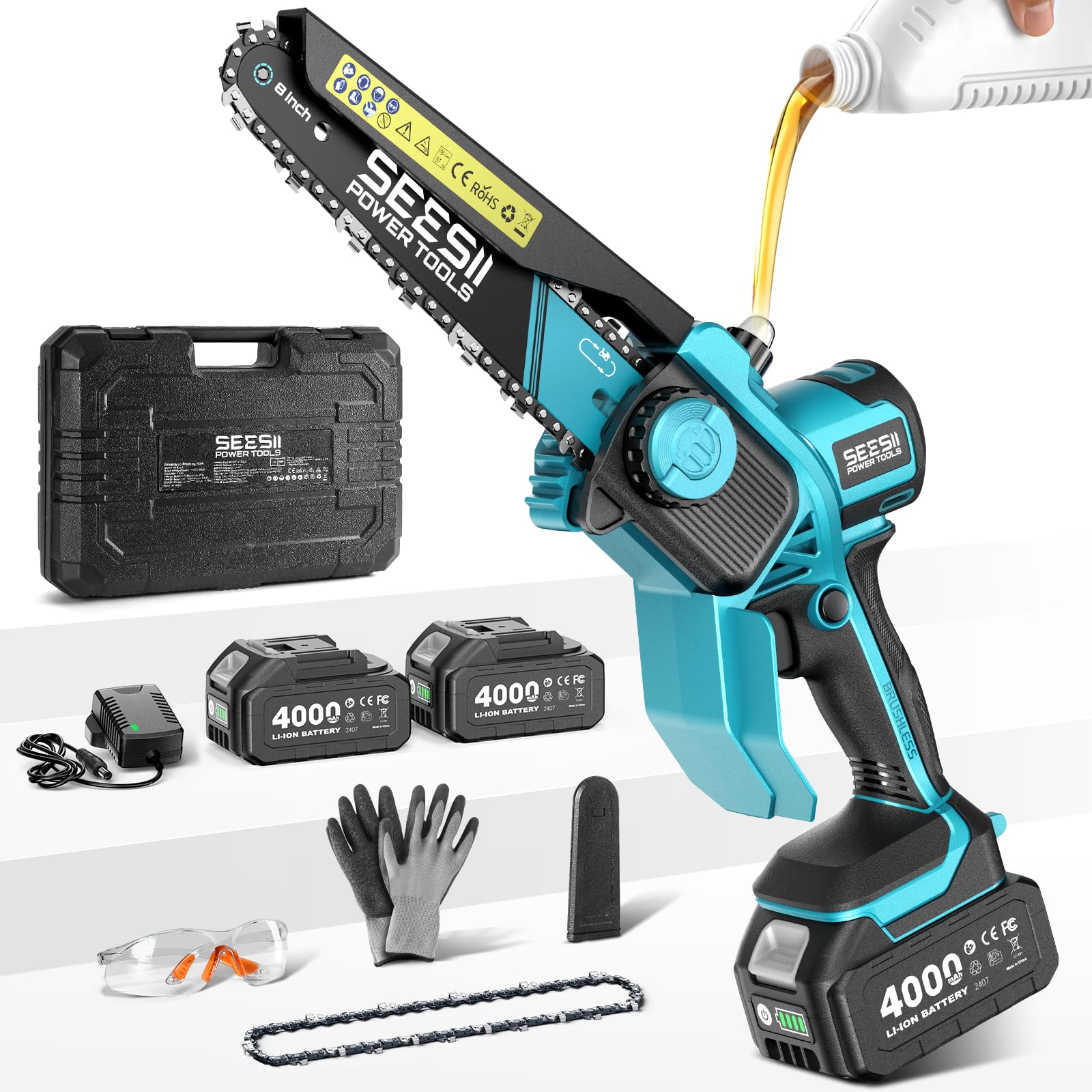
The entry-level 8-inch saw that refuses to feel cheap — brushless power and two batteries included.
Do not let the price fool you. This SEESII packs a 1000W brushless motor that the maker says cuts a 15 cm log in just 8 seconds at a chain speed of 10 m/s. That 8-inch bar versus the Makita’s 6-inch bar lets you handle larger rough-out projects. Shoppers say it is “powerful, cuts small trees fast” and one reviewer who is 5’4″ and 125 lbs found it lightweight and easy to use one-handed. The kit includes two 4000mAh batteries, a charger, gloves, goggles, and two chains — everything you need to start carving immediately.
Buyers also note the safety button is on the left side, which makes it right-handed only — a genuine ergonomic flaw for lefties. The trigger release is not ambidextrous. Compared to the DeWalt DCCS623B, the SEESII is heavier (though still lightweight) and lacks the DeWalt’s ecosystem integration. But at this price point, you get a complete carving setup including batteries, which the DeWalt does not offer.
The SEESII 8-inch is the ideal starter saw for someone who wants to try carving without investing hundreds. If you find you love carving and outgrow its power, you can upgrade to the Echo or DeWalt later. If you only carve occasionally, this saw will serve you well for years.
complete ready kit: Two 4000mAh batteries, two chains, safety gear — everything is in the box. No hidden costs.
ergonomic design flaw: The safety button and trigger are designed for right-hand use only. Left-handed carvers should look at the DeWalt or the WTHW gas saw for ambidextrous controls.
all-in-one: you are new to carving and want a complete, affordable 8-inch battery-powered kit to learn with minimal risk.
custom setup: you are left-handed or need a saw that works for regular professional-grade carving — the ergonomics favor right-hand users.
5. FXAFXA Brushless Electric Chainsaw 12″ Cordless Tool Only for Dewalt 20V/60V Battery
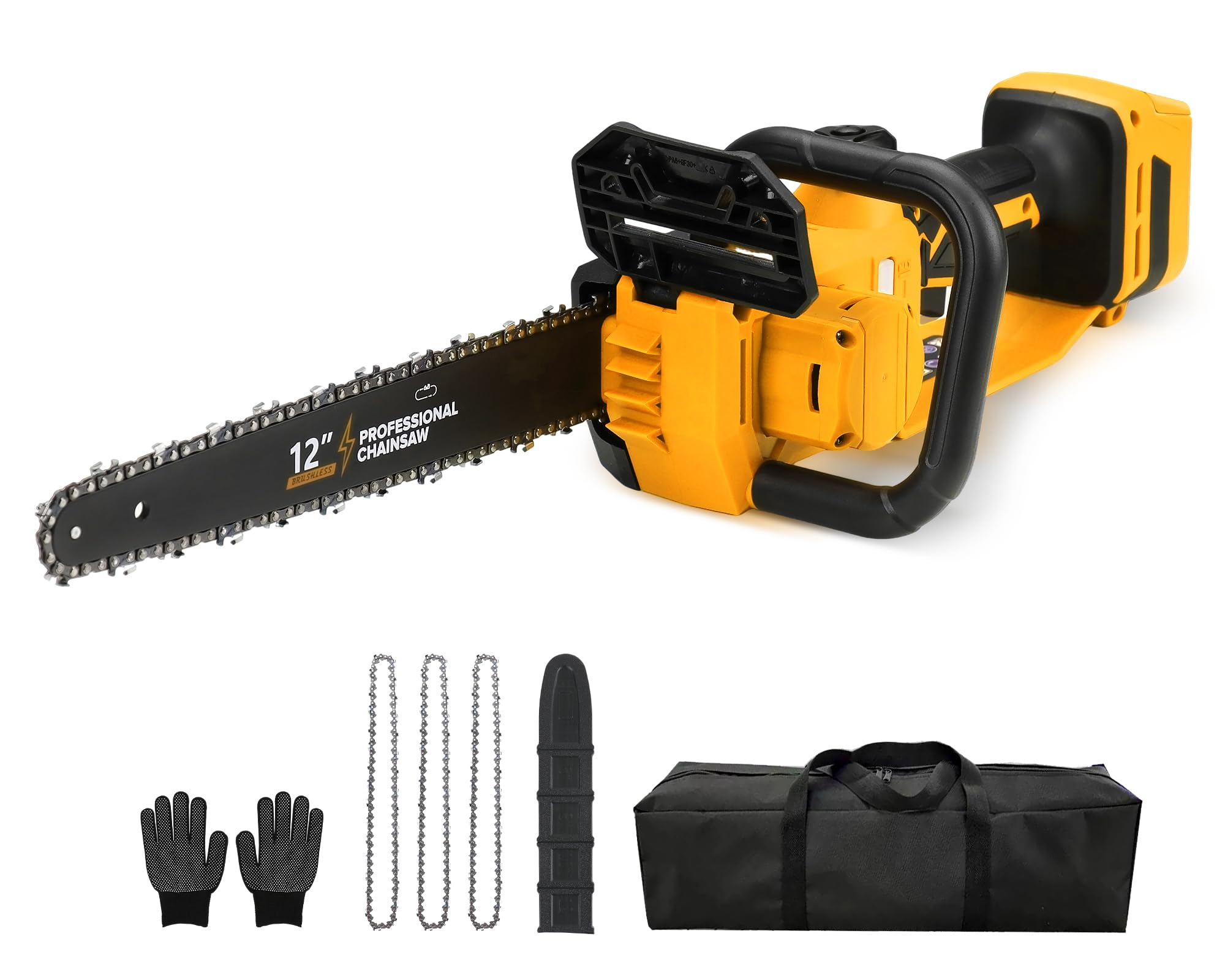
A sub-4-pound 12-inch saw that runs on your existing DeWalt batteries — lighter than most gas saws by a mile.
At just 3.65 pounds, the FXAFXA is the lightest 12-inch cordless saw on this list, and it works with any DeWalt 20V/60V battery (models DCB204, DCB205, DCB206, DCB184, DCB606, DCB609). That means if you already own DeWalt tools, you can add a 12-inch carving saw without buying a new battery system. The brushless motor delivers 1200W peak power, and buyers report it “slices through wood with ease, and 12‑inch logs are no problem.” One owner used it to clear a 13-inch hardwood branch after an ice storm and was impressed. The automatic oiler uses a pure copper oil pump, so your chain stays lubricated during long carving sessions.
Buyers also note the included adjusting wrench is the wrong size for the bar nuts — a known QC issue that requires contacting the seller for a replacement. And unlike the 8-inch SEESII (which has a 50% shorter bar), the 12-inch FXAFXA demands more muscle control for detail work; owners mention the chain tends to come off if you cut at an angle, which is a real limitation for carving where you need to tilt the bar. The DeWalt DCCS623B has a dimension of 22.53 inches versus the FXAFXA’s 16.54 inches but is heavier, so the FXAFXA wins on portability while losing on stability.
This is a budget-priced rough-out saw, not a detail carver. Use it to shape the general form of your piece, then switch to a 6-inch or 8-inch bar for the intricate work. At this weight and power for the price, it is a worthwhile companion saw.
excellent power-to-weight: 3.65 pounds with a 12-inch bar is lighter than any gas saw and most cordless saws at this bar length.
carving limitations: The chain pops off easily with angled cuts. Use this for straight rough-out cuts, not tight curves. Keep the auto-oiler filled to reduce wear.
lightweight power: you already own DeWalt 20V/60V batteries and want a lightweight, affordable 12-inch saw for roughing out shapes.
precision cuts: most of your carving involves angled detail cuts — the Makita 6-inch or DeWalt 8-inch is more stable for that work.
6. SEESII Electric Chainsaw Cordless 12-inch, Handheld Chain Saws with 2 x 4.0Ah Battery
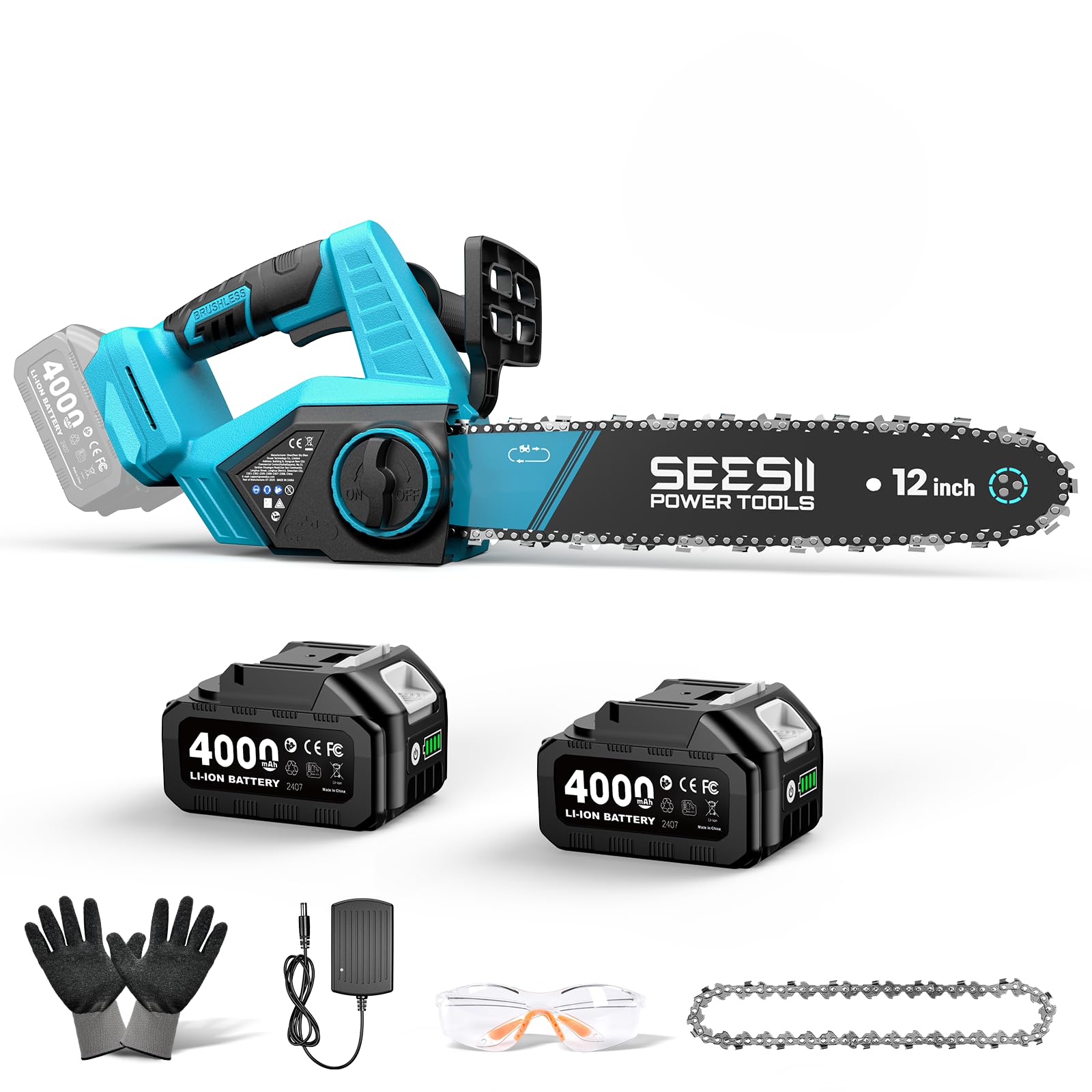
The longest-runtime battery carving saw — two 4.0Ah packs keep you cutting while the others recharge.
The SEESII 12-inch is the big brother of the 8-inch Flagship, stepping up to a 1200W brushless motor and a 12-inch cutting bar. It comes with two 4.0Ah lithium batteries — with a built-in battery indicator so you never guess the remaining charge. Customers note it is “excellent for hard wood (mangrove) after 20+ hrs” and that it works well for one-handed operation. The smart auto-oiling system adjusts flow based on cutting speed, so the chain stays lubricated during heavy passes. The 60mL oil tank reduces downtime for refills.
At 12 pounds, this is the heaviest pick on the list — weighing 12 pounds versus the FXAFXA’s 3.65 pounds. The 12-inch bar on the SEESII matches the Echo’s professional gas saw for length, but the SEESII is heavier and depends on battery power that fades. Reviewers point out that the safety button is on the left side (right-handed only) and that the durability is unknown for long-term use. However, the dual 4.0Ah batteries give you significantly more cutting time between charges than the 4000mAh packs in the 8-inch SEESII.
This saw is best for the carver who wants a 12-inch bar for roughing out larger logs and values long runtime over ultralight weight. If you plan to carve all afternoon and your project demands a longer bar, the SEESII 12-inch is worth considering.
long runtime battery: Two 4.0Ah batteries with a battery indicator let you swap and keep cutting. The smart oiler reduces maintenance.
heavier weight: At 12 pounds, this is the heaviest saw in the list. For a full day of carving, your arms will feel it. Compare to the 4.6-pound DeWalt or 3.65-pound FXAFXA.
extended use: you need a 12-inch bar for roughing out large logs and want a battery system that lasts through long carving sessions.
portability: every ounce matters for your carving style — the 12-pound weight will fatigue you faster than lighter options.
7. WTHW 25.4CC Top Handle Chainsaw – 12 Inch Gas Powered Arborist Saw for Tree Climbing & Pruning
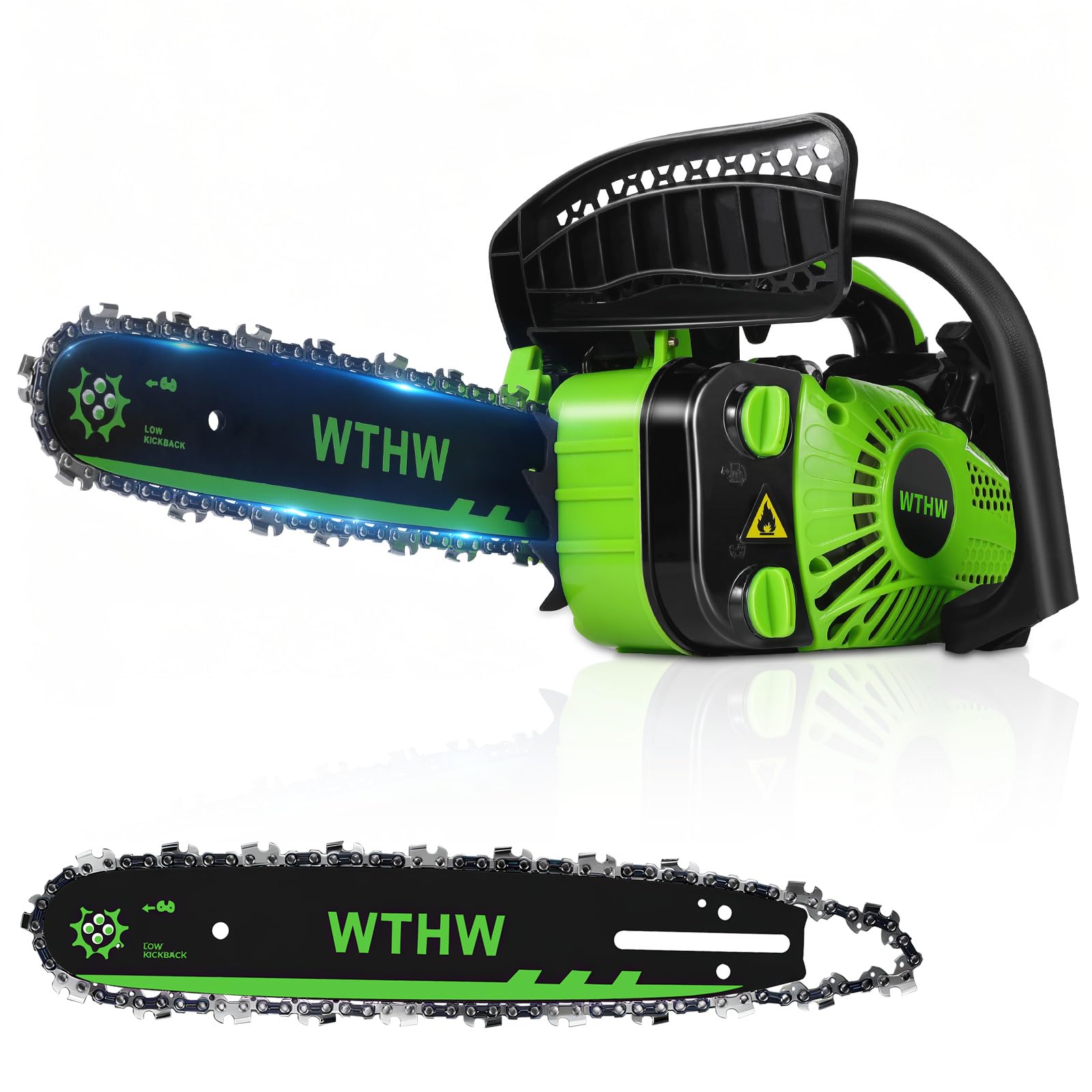
The cheapest gas saw on this list — a 25.4cc top-handle that delivers raw 1.2HP torque for a fraction of the price.
If you want gas power without the Echo’s pro-level price tag, the WTHW 25.4CC offers a 12-inch bar, 1.2 horsepower, and a chain speed of 9000 RPM. It is an 8.5-pound top-handle saw — the same weight class as the Echo — with a spring-assisted start system for easier pulls. Shoppers say it is “light weight for carry on saddle to clean up trails” and that it starts easily and runs smoothly. The automatic oiler keeps the chain lubricated for smoother cuts.
One reviewer noted it was initially underpowered but improved after the second tank of fuel and now cuts well for an inexpensive top-handle saw. The construction is mostly plastic, but buyers report it is “fairly stout.” Compared to the Makita XCU14Z (which is 50% lighter at 4.6 lbs), the WTHW has a 12-inch bar (100% longer reach than the Makita’s 6-inch) but is noticeably heavier. The gas motor has 1.2HP versus the 1200W of the battery SEESII models — they are roughly comparable in peak power, but the gas engine delivers consistent torque until the tank runs dry.
The trade-off is typical for budget gas saws: plastic build, unknown long-term durability, and the noise/fumes of a 2-stroke engine. One owner noted they had “no regrets, serves purpose; longevity uncertain.” This is a viable entry point into gas-powered carving if you want to test whether gas suits your style before investing in an Echo.
affordable gas power: The 25.4cc engine pulls hard at 9000 RPM, and the automatic oiler works well. The top-handle design keeps weight centered.
build compromises: Mostly plastic construction and a few QC issues (one buyer mentioned it runs better after a break-in period). Not a professional tool, but functional for home use.
budget gas: you want to try a gas-powered carving saw without spending on the Echo and you have experience mixing fuel for 2-stroke engines.
premium feel: you want pro-grade reliability and a refined throttle response — the Echo is in a different class entirely for gas saws.
Understanding the Specs
Bar Length and Pitch
The bar length (6 to 12 inches) determines the maximum depth of cut and the size of wood you can work. For carving, a shorter bar means more control and less fatigue. The chain pitch (the distance between drive links) matters too — a.325″ pitch is standard for carving and provides a balance of speed and precision. A smaller pitch like 1/4″ gives finer cuts but is less common. Most carving-specific chains use a.043″ gauge, meaning the chain drive links are 0.043 inches thick, which fits the narrow groove of a carving bar and allows for tighter turning radiuses.
Automatic Oiler vs. Manual
An automatic oiler steadily lubricates the chain during cutting, which reduces friction and heat so the chain stays sharp longer. For carving, where you make many small cuts, this is critical — a dry chain wears out in minutes. Most battery-powered carving saws include an automatic oiler as a standard feature. Some models, like the SEESII 12-inch, have a smart oiler that adjusts flow based on cutting speed. Manual oiling (pressing a button to drip oil) is rare on carving saws; avoid it for serious carving work. A 60mL oil tank is typical for a full session without refilling.
FAQ
What bar length is best for a beginner carving?
Can I use a regular chainsaw for carving?
Is a gas or battery chainsaw better for carving?
What is the right chain pitch for carving?
Do I need a special bar for carving?
How often should I sharpen the chain?
Can a left-handed person use a carving chainsaw comfortably?
How do I maintain my carving chainsaw between uses?
Can I carve with a 6-inch bar?
How much does a good carving saw weigh?
Final Thoughts: The Verdict
If you want one dependable pick, the chainsaw for carving winner is the DeWalt DCCS623B because its 8-inch bar hits the balance between reach and control, it weighs only 4.6 pounds for fatigue-free carving, and it runs on the widely available 20V battery platform. If you want ultra-fine detail work on smaller pieces, grab the Makita XCU14Z with its 6-inch bar. And for professional all-day carving where battery runtime just will not cut it, the Echo CS-2511T-12 — the pro-grade gas saw that runs until your arms give out, not your battery.
How We Picked
We do not accept paid placement. Every pick is matched to a real buyer and a real use-case; we do not hands-on test units.
Sources & Methodology
Specifications: manufacturer listings and product documentation. Review insights: verified customer reviews, as of July 2026. Pricing: not shown on this page (it changes often); check the current price via the retailer link.
As an Amazon Associate, Gadgets Feed earns from qualifying purchases. This does not affect which products we feature.
Product prices and availability are accurate as of the date/time indicated and are subject to change. Any price and availability information displayed on Amazon at the time of purchase will apply to the purchase of this product. As an Amazon Associate I earn from qualifying purchases.
CERTAIN CONTENT THAT APPEARS ON THIS SITE COMES FROM AMAZON. THIS CONTENT IS PROVIDED "AS IS" AND IS SUBJECT TO CHANGE OR REMOVAL AT ANY TIME.
Amazon and the Amazon logo are trademarks of Amazon.com, Inc. or its affiliates.