
Our readers keep the lights on and my morning glass full of iced black tea. As an Amazon Associate, I earn from qualifying purchases.
Specs are compiled from manufacturer listings and verified buyer reviews and can change over time — please confirm the key details on the product page before buying.
A backpacking hatchet needs to pull off a tough trick: you want enough steel to split kindling and clear trail debris, but not so much heft that you leave it home after the third mile. The right pick feels almost like an extension of your arm, sharp enough to trust and light enough to forget you are carrying it. This guide breaks down the key specs and real-world trade-offs of six solid options to help you match one to your next trip.
I’m Min — the founder and writer behind Gadgets Feed. This guide is built by comparing the manufacturers’ published specifications and the patterns across verified customer reviews, so you get each pick’s real strengths and trade-offs instead of marketing spin.
You need a hatchet that splits campfire wood after dark and clears branches from the trail, but the right backpacking hatchet balances blade length, weight, and handle grip — a few extra ounces can turn a useful tool into a burden you leave behind.
Quick Picks
- Fiskars 375501-1001 Hatchet with Sheath, 14″, Black — Best Overall
- Morakniv Boron Steel Camping Axe — Premium Pick
- Kershaw Deschutes Skinner Hatchet Camp Ax, Tan Design, 14 Inch Overall — Compact & Capable
- NedFoss Warthog Camping Axe, 9″ Full Tang Small Axe with Leather Sheath — Budget Champion
- Gerber Gear Freescape Hatchet, 17.5″ Forged Steel Blade Axe with Sheath — Premium Pick
- Husqvarna Hatchet, Small Axe with Leather Sheath and Hickory Handle — Traditional Craft
How To Choose A Backpacking Hatchet
Picking a hatchet for the trail is different from picking one for the garage. Every ounce counts, and the handle that feels fine in the store might tire your hand out after an hour of splitting. Here are the key things to weigh before you buy.
Blade Length and Steel
A blade between 3.5 and 4.5 inches gives you the best balance for backpacking. A shorter blade saves weight but forces you to swing more times to split a log. The steel type also matters: boron steel keeps its edge longer between sharpenings, while standard stainless steel resists rust better in a damp pack. Blade thickness matters too — a thicker blade (around 5-6 mm) handles batoning (splitting wood by striking the spine with a baton) without bending.
Handle Design and Grip
Wood handles look classic but can swell, crack, or get slippery when wet. Plastic or composite handles (like glass-filled nylon) stay consistent in all weather and often include rubber overmold sections (a textured rubber coating) that keep the hatchet from twisting in your palm. Full-tang construction — where the steel runs through the entire handle — is more durable, but adds weight. A compromise is a molded head over a composite handle, which is lighter but still tough.
Weight and Carry
For backpacking, you want a hatchet between 1.3 and 2 pounds total. Anything heavier becomes a chore to carry. A good sheath is non-negotiable: it protects the edge inside your pack and keeps you from accidentally slashing your gear. Leather sheaths look great but can be bulky; molded plastic sheaths are lighter and often include belt loops or straps for easy attachment to your pack.
Quick Comparison
| Model | Best For | Blade Length | Item Weight | Handle Material | Amazon |
|---|---|---|---|---|---|
| Fiskars 375501-1001 | Ultralight backpacking | Not listed | 1.5 Pounds | Composite (DuraFrame) | $35.63Amazon |
| Morakniv Boron Steel | Versatile camp chores | 4.5 Inches | 17.6 Ounces (1.1 lbs) | Plastic | $51.99Amazon |
| Kershaw Deschutes | Compact EDC carry | 3.5 Inches | 1.56 Pounds | Glass-filled nylon | $64.49Amazon |
| NedFoss Warthog | Budget-friendly entry | 4.2 Inches | 15.2 Ounces | Wood | $29.99$35.99PrimeAmazon |
In‑Depth Reviews
1. Fiskars 375501-1001 Hatchet with Sheath, 14″, Black

A legendary ultralight that feels heavier than it should in the swing.
At just 1.5 pounds, the Fiskars is the hatchet you will actually carry every trip. The key is its DuraFrame handle — a composite that is stronger than steel but lighter, and the molded head will never loosen over time. A low-friction blade coating (a slick surface treatment) helps the hatchet glide through wood instead of sticking, so you spend fewer swings getting kindling started. Buyers report replacing older X7 models with this one, calling it “a cheap practical tool very light weight easy to pack.”
The 15.5-inch overall length makes it short enough to fit inside a backpack side pocket, and the proprietary blade-grinding technique (a specific sharpening method unique to Fiskars) delivers a sharper-than-average edge from the start. Some users note that the included edge cover is not the most protective, but the trade-off for this weight is hard to argue with. Compared to the Morakniv’s 17.6 ounces, the Fiskars shaves off several ounces while keeping the same kindling-splitting ability.
One reviewer noted the short handle fits in a backpack easily and found it effective for splitting small wood on its side. The hatchet is also great for limbing and even personal defense on the trail. Its only real limit is that you cannot swing it two-handed effectively, but for ultralight duty that is rarely a problem.
Weight champion: At 1.5 pounds with a shock-absorbing handle, this is the hatchet to grab when every gram in your pack matters.
The one trade-off: The short 15.5-inch handle means less leverage for big logs — stick to small-to-medium kindling and you will be fine.
Reach for this if: you want the lightest reliable hatchet that can still split kindling and clear trail debris.
Look elsewhere if: you plan to fell trees or split large rounds — you need a longer handle and more head weight.
2. Morakniv Boron Steel Camping Axe

Boron steel that holds its edge through a full season of camp chores.
Morakniv brings its knife reputation to the hatchet world with a 4.5-inch boron steel blade that is thick — 6.0 mm — so you can baton wood without worrying about snapping the tip. The blade has a black ED-coating (electrodeposition coating, a tough paint layer that resists scratches) to protect the head during hard use.
The plastic handle is designed for safe grip in all weather, even when your hands are wet or cold. A vegetable-tanned Swedish leather sheath protects the edge inside your pack. Owners mention that the edge stayed sharp with few touch-ups after heavy use, and the Scandi grind (a simple, single-bevel edge geometry) is easy to maintain in the field with a basic sharpening stone. The back of the head works for hammering tent stakes in a pinch, though reviewers advise using the side of the handle near the head instead of the thin poll (the flat striking surface opposite the blade).
Its 12.7-inch total length is noticeably more compact than the Kershaw Deschutes, making it a better fit for tight backpack compartments. One buyer even claimed it was sharp enough to shave with — proof of the factory edge. The lanyard hole is a nice touch for attaching a wrist loop.
Edge retention king: The 6.0 mm boron steel blade stays sharp through heavy use and is thick enough for batoning kindling.
The catch: The plastic handle might not feel as premium as wood, but it is genuinely more durable and weather-resistant on the trail.
Take this if: you want a hatchet that keeps cutting trip after trip without constant sharpening.
skip it if: you prefer the feel of a traditional wood handle — this one is all function and no nostalgia.
3. Kershaw Deschutes Skinner Hatchet Camp Ax, Tan Design, 14 Inch Overall

A full-tang ultralight that balances like a much larger axe.
The Kershaw Deschutes uses a full-tang 3Cr13 stainless steel blade (the steel runs through the entire handle, making it extremely strong) with strategic cutouts to keep the weight down. At 1.56 pounds, it is only slightly heavier than the Fiskars, but it has a 3.5-inch blade that is purpose-built for carving and shaving kindling rather than big swings. The glass-filled nylon handle has textured rubber inserts — rubber overmold sections — that give you a secure grip even when your hands are sweaty or wet.
The included glass-filled nylon sheath and nylon carrying case with straps mean you do not need to buy anything extra for safe carry on your backpack. A buyer reported that the great size and weight make it ideal for easy travel during hiking and backpacking, and they found it very balanced compared to other camp axes they tested. The full-tang design gives you confidence when hacking through thick knots, and the black-oxide finish hides trail scratches well.
One reviewer accidentally hit a rock directly with the blade and only got a tiny chip that was easily sharpened out — a good sign for durability. The poll (back of the head) is relatively thin, so this is not your hammer, but it is a fine chopper and carver. The Kershaw has a 14-inch overall length, and the Fiskars is 15.5 inches overall; the blade is nearly an inch shorter, which makes it more precise for detail work like notching or carving.
What works
- Full-tang 3Cr13 stainless steel is tough and rust-resistant
- Included molded sheath with nylon carry case — ready to pack immediately
- Textured rubber inserts give excellent grip in wet conditions
What to know
- Thin poll means you cannot hammer tent stakes or split wood with the back
- Needs regular sharpening after each use to maintain peak performance
Best for: hikers who want a do-everything camp axe that packs small and feels balanced in the hand.
Not for: people who need a tool for hammering or heavy log splitting — the thin poll and short blade are not designed for that.
4. NedFoss Warthog Camping Axe, 9″ Full Tang Small Axe with Leather Sheath

A full-tang budget hatchet that punches above its price point.
The NedFoss Warthog is a 9-inch full-tang hatchet with a 4.2-inch stainless steel blade that is thick — 5.0 mm — making it sturdy enough for light splitting and batoning despite its compact size. It weighs only 15.2 ounces, which is lighter than the Morakniv and Fiskars, and the etched warthog handle adds a unique look. The included leather sheath can be worn on a belt or attached to a pack, giving you a traditional carrying option.
Customers note it is extremely sturdy and sharp from the start, but also note that it is smaller than expected — the 9-inch total length is very compact. The curved blade edge is good for precise cuts, and the head design lets you choke up (slide your hand up the handle) for carving tasks. One buyer mentioned the wood handle feels slippery in wet conditions, and the sheath quality is basic. The lack of a hammerhead (a flat striking surface on the back of the head) means you cannot use it as a hammer for tent stakes.
For the price, you get a full-tang hatchet with a genuine leather sheath, which is rare in the budget tier. The heat-treated steel blade holds a decent edge for light camp tasks, such as bark removal and pruning. Compared to the Kershaw Deschutes, it is shorter and lighter, making it easier to pack in a day bag, but it lacks the durable composite handle and premium molded sheath of the Kershaw.
Budget full-tang: At 15.2 ounces with a 5.0 mm blade thickness, this is the lightest full-tang option that still feels solid in hand.
Honest limit: The wood handle gets slippery when wet, and the basic sheath is not as protective as a molded plastic case — store the blade carefully.
Pick this if: you are on a tight budget but want a full-tang hatchet with real stainless steel and a leather sheath.
Pass if: you need a hammer poll or a weather-proof handle — the NedFoss is for dry-weather, light-duty trips only.
5. Gerber Gear Freescape Hatchet, 17.5″ Forged Steel Blade Axe with Sheath

A forged-steel pack axe that chops deeper with every swing.
The Gerber Freescape is built with a PTFE-coated forged steel head — a non-stick coating that reduces friction, so the blade glides through wood instead of binding. This is a 17.5-inch hatchet, notably longer than the others, which gives you more leverage for splitting small logs. The composite handle is designed to absorb shock, reducing the jarring vibration that tires your hand during extended chopping sessions.
At 32.6 ounces (just over 2 pounds), the Freescape is heavier than the Fiskars or Morakniv, but reviewers point out that the extra head weight halves chopping time for branches up to 4 inches thick compared to a smaller hand hatchet. The soft-touch handle overmold (a rubber-like grip layer over the composite handle) keeps your hands comfortable during long use. Made in Finland, the Freescape includes a slim sheath for safe storage and transport, though some shoppers say the blade cover is bulkier than they would like and may replace it with a leather alternative.
One owner reported it splits firewood up to 3.5 inches in diameter easily with its very sharp blade. However, the 17.5-inch length makes it less packable than the 14-inch or shorter options. The belt hangers on the sheath are too small for a typical hiking belt, so you will likely store it inside your pack rather than carry it externally. It is a compromise between a full-size axe and a backpacking hatchet — great for car camping or basecamp use, but bulky for ultralight backpackers.
Why it stands out
- PTFE-coated forged steel head chops smoother and binds less in wet wood
- Shock-absorbing composite handle reduces hand fatigue during extended use
- Longer 17.5-inch handle gives real leverage for splitting small logs
Backpacking trade-offs
- Heavier at 32.6 ounces — noticeable in a pack compared to sub-2-pound options
- Bulky sheath and 17.5-inch length make it harder to fit in a daypack
Reach for this if: you are basecamping or car camping and want a hatchet that chops hard without killing your arm.
pass on it if: you are an ultralight backpacker — the Freescape is more pack axe than backpacking hatchet.
6. Husqvarna Hatchet, Small Axe with Leather Sheath and Hickory Handle
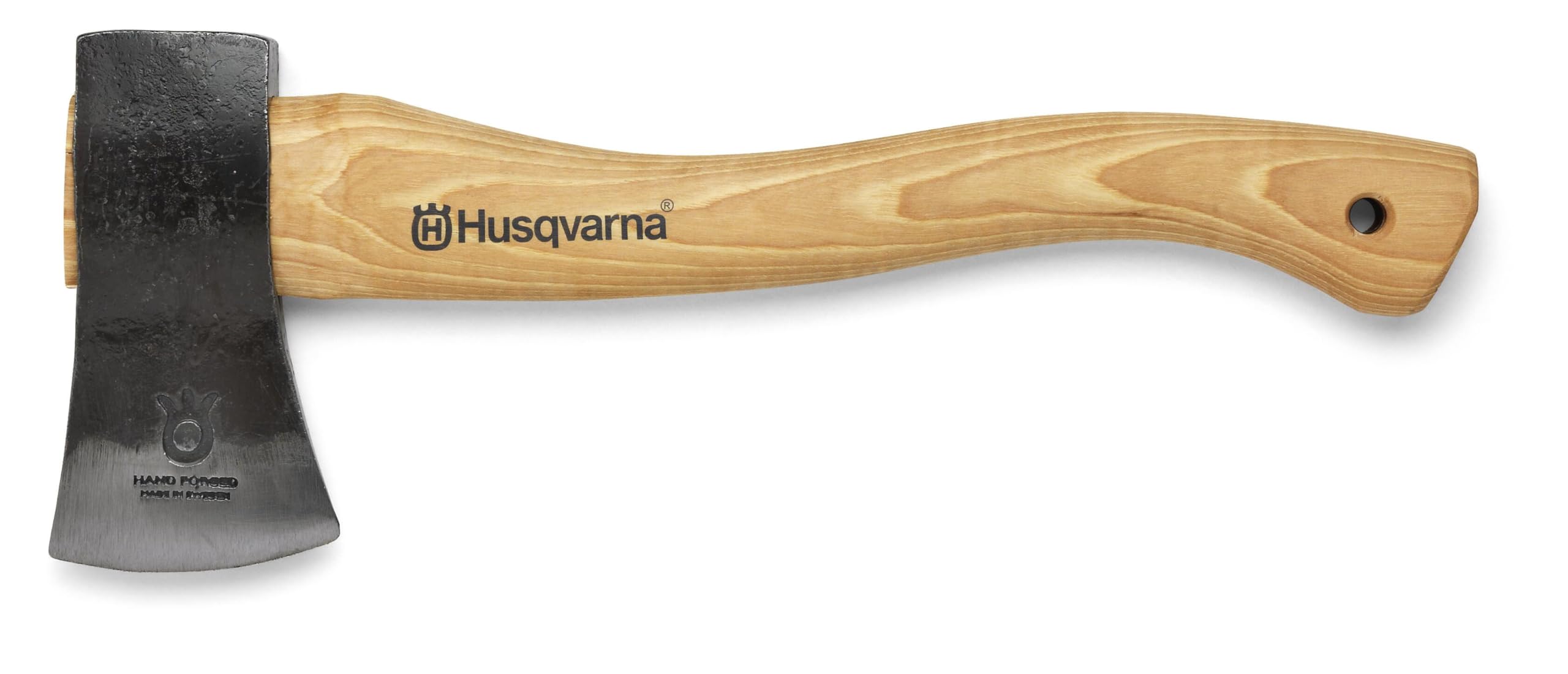
Hand-forged Swedish steel on a hickory handle — built for one-handed trail work.
The Husqvarna Hatchet is designed for one-handed use on light wood cutting, with a 1.32-pound hand-forged axe head made from Swedish steel. The hickory handle combines traditional materials with modern durability — hickory is one of the toughest woods for tool handles and absorbs shock well. The hatchet comes with a leather sheath for protection and safety, and the grain of the hickory handle gives it a classic, tactile feel that composite handles lack.
Buyers report the blade arrives dull from the start and needs sharpening before first use, but it takes an edge easily and holds it well. One customer observed the handle lacquer needed to be sanded off and the wood treated with oil for a better grip. The leather sheath is functional but basic — one user highlighted the snap came off and had to add a tie cord. The hatchet is made in Sweden by Hultafors, which carries a reputation for quality forging.
With a 14.97-inch overall length and a weight of just 1.3 pounds, it is lighter than the Gerber Freescape and comparable to the Fiskars. The straight blade edge is good for precise carving, and the thin Swedish steel blade cuts efficiently. However, if you are not willing to spend time hand-sharpening and conditioning the handle, this hatchet might feel like unfinished work. For the enthusiast who enjoys maintaining their gear, it is an excellent value with a top-notch forged head.
For the traditionalist: A hand-forged 1.32-pound Swedish steel head on a hickory handle — genuine craftsmanship for those who appreciate it.
Ready to work: The blade arrives dull and needs sharpening, and the handle lacquer may need sanding — plan for an hour of setup before your first trip.
Ideal if: you enjoy tuning and maintaining your gear and want a traditional forged hatchet with a replaceable wood handle.
Not for: anyone who wants a grab-and-go tool — the Husqvarna needs prep work to reach its potential.
Understanding the Specs
Blade Steel and Edge Retention
The steel type determines how often you need to sharpen your hatchet on the trail. Boron steel (like the Morakniv uses) is an alloy with a small amount of boron added — it hardens deeply and holds an edge much longer than standard carbon steel. Stainless steels like the 3Cr13 used in the Kershaw Deschutes resist rust better but may need more frequent touch-ups. The blade thickness (measured in millimeters) affects durability: 5-6 mm is thick enough for batoning (splitting wood by striking the spine with a baton), while thinner blades are better for carving and slicing.
Handle Material and Grip
Wood handles (hickory on the Husqvarna, natural wood on the NedFoss) offer a traditional feel and good shock absorption but can swell in wet weather or crack if left dry. Composite handles like the glass-filled nylon on the Kershaw or the DuraFrame on the Fiskars are weather-proof and won’t loosen over time. Some composite handles include rubber overmold sections — a textured rubber coating — that keep the hatchet from slipping when your hands are sweaty or wet. For backpacking, a composite handle is generally more practical than wood.
FAQ
What is the best blade length for a backpacking hatchet?
Can I use a backpacking hatchet to split firewood?
What is a full-tang hatchet and why does it matter?
How often do I need to sharpen a backpacking hatchet?
Is a wood handle or composite handle better for backpacking?
What is a PTFE coating on a hatchet blade?
How much should a backpacking hatchet weigh?
Does a backpacking hatchet come with a sheath?
Final Thoughts: The Verdict
For most backpackers, the backpacking hatchet that makes the most sense is the Fiskars 375501-1001 because it combines a featherlight 1.5-pound weight with a shock-absorbing handle that makes every swing count. If you value edge retention and a thicker blade for batoning, the Morakniv Boron Steel Camping Axe is your best bet with its 6.0 mm boron steel blade. And for a compact full-tang option that is ready to carry from the start with its included sheath and sling, the Kershaw Deschutes is a fine choice that will not weigh you down.
How We Picked
We do not accept paid placement. Every pick is matched to a real buyer and a real use-case; we do not hands-on test units.
Sources & Methodology
Specifications: manufacturer listings and product documentation. Review insights: verified customer reviews, as of July 2026. Pricing: not shown on this page (it changes often); check the current price via the retailer link.
As an Amazon Associate, Gadgets Feed earns from qualifying purchases. This does not affect which products we feature.
Product prices and availability are accurate as of the date/time indicated and are subject to change. Any price and availability information displayed on Amazon at the time of purchase will apply to the purchase of this product. As an Amazon Associate I earn from qualifying purchases.
CERTAIN CONTENT THAT APPEARS ON THIS SITE COMES FROM AMAZON. THIS CONTENT IS PROVIDED "AS IS" AND IS SUBJECT TO CHANGE OR REMOVAL AT ANY TIME.
Amazon and the Amazon logo are trademarks of Amazon.com, Inc. or its affiliates.