
Our readers keep the lights on and my morning glass full of iced black tea. As an Amazon Associate, I earn from qualifying purchases.
Specs are compiled from manufacturer listings and verified buyer reviews and can change over time — please confirm the key details on the product page before buying.
Your nose cannot smell it, your eyes cannot see it, and by the time you feel dizzy, it could already be too late. Carbon monoxide (CO) poisoning sends thousands of people to the emergency room every year in the US alone, often from a faulty furnace, a gas stove left on, or a car running in an attached garage. The good news is that a small, affordable battery-powered alarm is all it takes to catch this invisible threat before it becomes a tragedy.
I’m Min — the founder and writer behind Gadgets Feed. This guide is built by comparing the manufacturers’ published specifications and the patterns across verified customer reviews, so you get each pick’s real strengths and trade-offs instead of marketing spin.
The real decider between one battery operated carbon monoxide alarm and another depends on how long the sensor lasts, how clear the display is, and whether the design fits the spot you need to protect.
Quick Picks
- Kidde Carbon Monoxide Detector, AA Battery Powered, Digital Backlit Display (COBD) — Best Overall
- X-Sense Smoke & Carbon Monoxide Alarm, SC06, 1-Pack (10-Year Battery) — Two Threats, One Unit
- Kidde Carbon Monoxide Detector, Battery Powered CO Alarm with LEDs (KN-COB-LP2) — Smart & Portable
- Heiman Carbon Monoxide Detector, Mini CO Detector, Long Battery Operated (C1-S) — Mini & Long-Life
- Kidde KN-COB-B-LP Nighthawk Carbon Monoxide Alarm, Battery Operated — Premium Longevity
- First Alert CO400 Carbon Monoxide (CO) Detector, Battery Operated Alarm — Budget Pick
- Kidde Smoke & Carbon Monoxide Detector, 10-Year Battery Powered, Voice Alerts (2 Pack) — Premium 2-in-1 Voice
How To Choose The Best Battery Operated Carbon Monoxide Alarm
A CO alarm is not the kind of gadget you upgrade for fun. You buy it once, install it, and forget about it for the better part of a decade. That means the choices you make upfront — sensor type, battery life, display, warranty — will still matter five or six years from now. Here are the three specs that separate a good alarm from a risky one.
Sensor Technology: Electrochemical is the only real option
The sensor is the heart of any CO alarm. All the reliable picks here use an “electrochemical sensor” (a small, sealed cell filled with a chemical solution that reacts specifically to carbon monoxide molecules and triggers the alarm). This type is accurate, long-lasting, and almost never triggers a false alarm from something like steam or cooking fumes. Cheap knock-offs might use a “metal oxide” sensor, which wears out faster and false-alarms constantly — so stick to UL-listed units with an electrochemical sensor.
Power Source: Replaceable AA batteries vs sealed 10-year lithium
You have two battery options. Replaceable AA batteries (like the Kidde COBD or the First Alert CO400) let you swap in fresh cells yourself, but you must remember to change them once a year or whenever a low-battery chirp starts. A sealed 10-year lithium battery (like the X-Sense SC06 or the Kidde combo unit) eliminates all battery maintenance for a full decade — no chirps, no late-night swaps. The trade-off is that when the 10-year “end-of-life” timer runs out, you throw the entire unit away and buy a new one, because the battery is not replaceable.
Digital Display vs Basic Alarm
A basic alarm sounds a loud 85-decibel siren when CO hits a dangerous level, and that is enough to wake you up. But a digital display (like the Kidde COBD has) shows you the actual number — parts per million (ppm) — in real time, so you can see if there is a small, gradual leak long before the siren goes off. For a bedroom or a vacation rental, a digital display gives you extra confidence because you can glance at it and know the air is clean instead of just hoping.
Quick Comparison
| Model | Best For | Sensor & Alarm | Power | Weight | Amazon |
|---|---|---|---|---|---|
| Kidde COBD | Overall with digital display | Electrochemical / 85 dB | 2x AA (included) | 5.92 oz | $26.15$31.97Amazon |
| X-Sense SC06 | 10-year 2-in-1 smoke & CO | Photoelectric + Electrochemical / 85 dB | Sealed lithium (10yr) | — | $37.99$42.99PrimeAmazon |
| Kidde KN-COB-LP2 | Simple & portable | Electrochemical / 85 dB | 2x AA (included) | 8 oz | $25.99Amazon |
| Kidde Nighthawk | Premium battery longevity | Electrochemical / 85 dB | 3x AA (included) | 9.6 oz | $33.09Amazon |
| Heiman C1-S | Tiniest unit for RVs | FIGARO Electrochemical / 85 dB | Sealed lithium (10yr) | 3.52 oz | $26.98Amazon |
| First Alert CO400 | Budget-friendly reliability | Electrochemical / 85 dB | 9V battery | 11.2 oz | $22.49Amazon |
| Kidde 10-Year Combo | Premium 2-pack no-maintenance | Electrochemical / voice alerts | Sealed lithium (10yr) | — | $127.21Amazon |
In‑Depth Reviews
1. Kidde Carbon Monoxide Detector, AA Battery Powered, Digital Backlit Display (COBD)
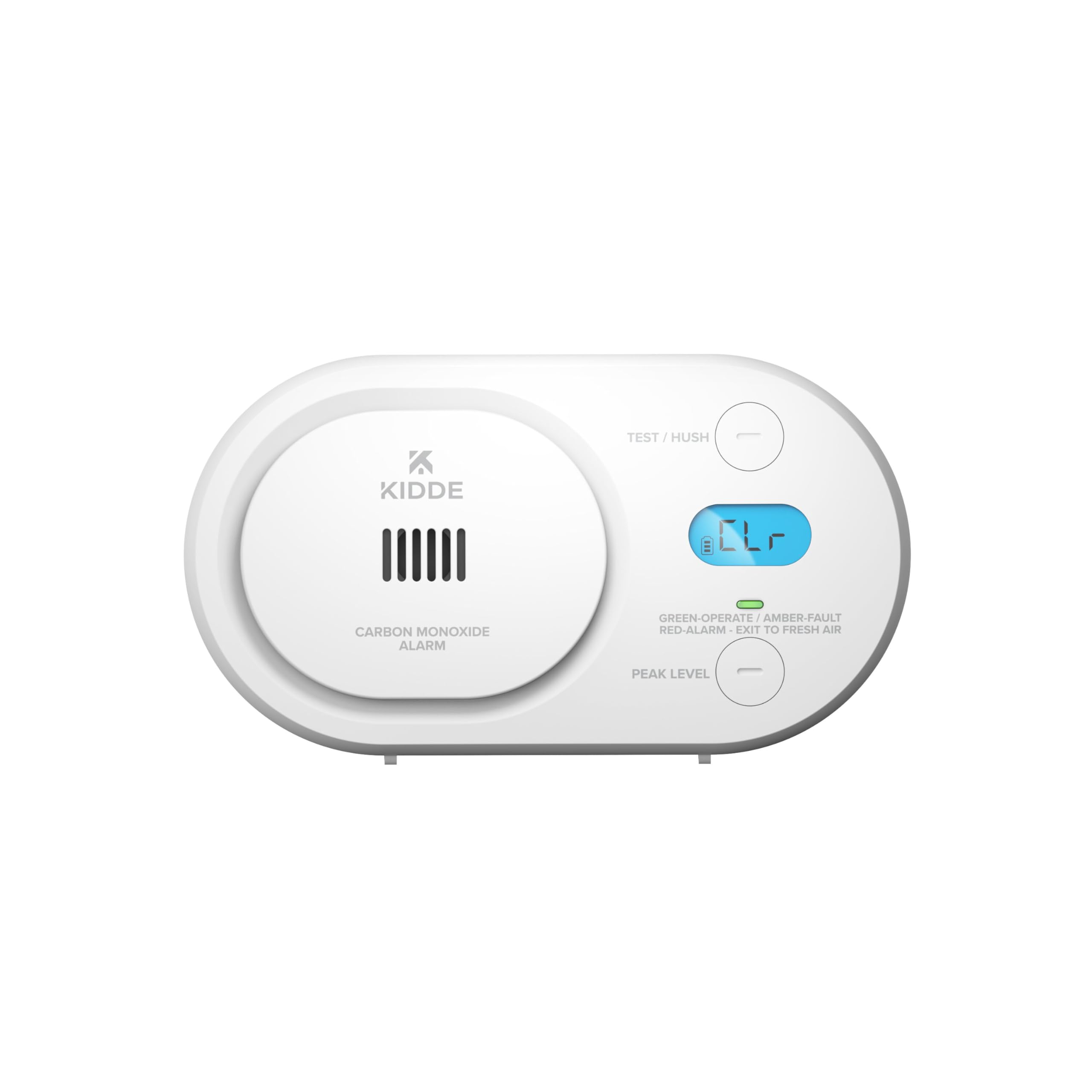
The one that shows you the CO level on a backlit screen so you know long before the siren screams.
This Kidde COBD gives you something the basic alarms leave out: a backlit digital display that shows the parts-per-million reading in real time. Instead of just waiting for the 85-decibel alarm to tell you something is wrong, you can glance at the screen and spot a slow-rising CO level from a furnace leak or a running car while the air is still safe. The display also shows the alarm status and the end-of-life timer, so you always know where things stand.
It runs on two included AA batteries (no wiring needed), installs in minutes on a wall or sitting on a tabletop, and weighs just 5.92 ounces — making it a full 5.28 ounces lighter than the First Alert CO400, so it is an obvious pick if you plan to travel with it. Reviewers mention testing it in a car with the windows closed and getting no alarm, but then the alarm sounded briefly with a low CO reading when the windows were opened in traffic — confirming it catches small levels even when the air is moving. It carries a 10-year limited warranty and is rigorously tested to meet UL 2034, 5th Edition standards.
The main trade-off is that the hanging holes on the back do not line up with screws from older Kidde models — you will likely need to patch and re-drill, which a few buyers noted in their reviews. But for a compact, data-aware alarm that fits equally well at home or in a hotel bag, this is the unit to beat.
The Display Advantage
- Backlit digital display shows real-time CO levels (ppm) — see a small leak building before the alarm sounds.
- At 5.92 oz versus the First Alert CO400 at 11.2 oz, so you can actually pack it for travel.
- UL 2034 5th Edition certified and carries a 10-year limited warranty.
One Setup Headache
- Mounting holes do not match the screw spacing from previous Kidde models, so you will have to drill new holes or patch old ones.
- AA batteries need annual replacement (compared to a sealed 10-year lithium unit like the X-Sense SC06).
Reach for this if: you want a clear digital readout of CO levels at a glance and the lightest, most portable form factor in this list, all backed by a 10-year warranty.
Look elsewhere if: the idea of having to swap AA batteries every year bothers you and you would rather have a sealed battery you never touch for a decade.
2. X-Sense Smoke & Carbon Monoxide Alarm, SC06, 1-Pack (10-Year Battery)
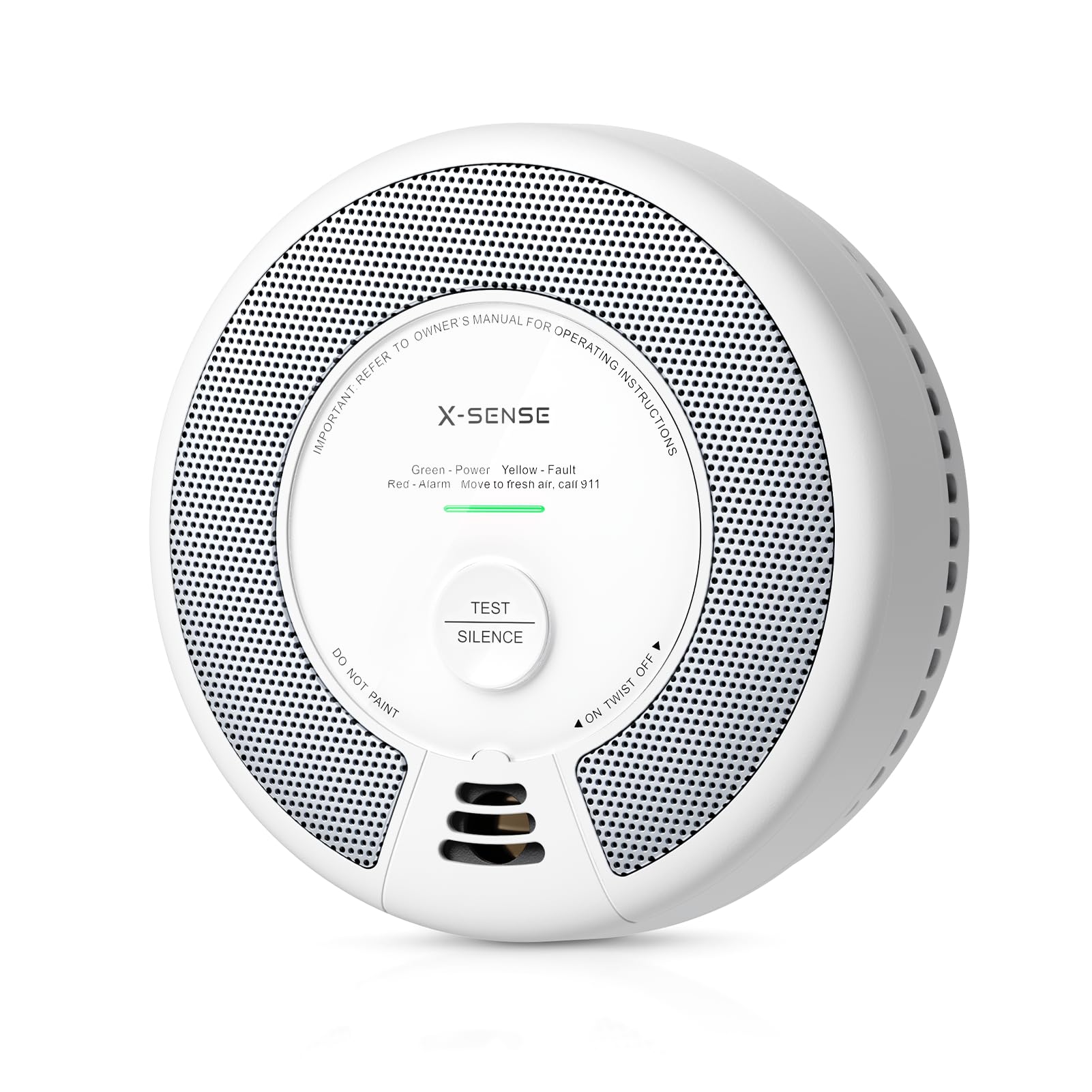
Combines smoke detection and CO monitoring into one sealed-battery alarm you install and forget for a decade.
This X-Sense SC06 pulls double duty: it protects against both smoke and carbon monoxide from a single unit, so you do not need two separate alarms cluttering the ceiling. The smoke sensor uses “photoelectric” technology (it detects smoke particles by shining a small light beam inside the sensor chamber), which is much less prone to false alarms from cooking steam than the older “ionization” type. The CO side uses an electrochemical sensor, just like the standalone CO alarms.
What really sets this apart is the sealed lithium battery that lasts a full 10 years. No AA swaps, no chirping at 2 a.m., no wondering if you forgot to change them. When the 10-year end-of-life timer runs out, the unit lets you know with a low-battery warning and then it is time to recycle it and buy a fresh one. It meets both UL 217 (smoke) and UL 2034 (CO) safety standards. X-Sense backs it with a 60-day money-back guarantee, a 5-year quality warranty, and lifetime technical support.
The honest catch: if you buy a multi-pack, there is a small chance one unit triggers a nuisance CO alarm early, as one reviewer experienced at around 14 months. The deactivation pin is physically blocked from OFF on that model, so you cannot silence it permanently. For most buyers, the other four units in that pack worked flawlessly, but the failure rate on a single unit is worth knowing. For a hallway or bedroom where you want smoke and CO protection under one lid with zero battery fuss, this is the smart pick.
Set-and-Forget Value
- Combines smoke and CO detection in one alarm; no need to install separate devices.
- Sealed lithium battery lasts 10 years — no battery swaps, no low-battery chirps.
- Photoelectric smoke sensor reduces false alarms from cooking steam.
The Risk With Multi-Packs
- A small number of buyers reported a single unit in a 5-pack giving a CO nuisance alarm early (around 14 months), and the deactivation pin is blocked — so you must discard it.
- Non-replaceable battery means the whole unit is e-waste when the 10-year timer expires.
Go for it if: you want one alarm that covers smoke and CO for a decade with absolutely no battery maintenance.
skip it if: you already have good smoke alarms and just need a dedicated, standalone CO detector — in that case, a simpler CO-only unit will save you money.
3. Kidde Carbon Monoxide Detector, Battery Powered CO Alarm with LEDs (KN-COB-LP2)

A simple, no-display alarm that records the last CO event and alerts you with green and red LEDs.
This Kidde model keeps things simple but adds a clever trick: Event Memory. It logs the last time carbon monoxide was detected or the last time you tested the unit — and shows it with the green (power) and red (CO present) LED indicators. So if you walk into a room and the red LED is lit, you know CO was detected at some point even if the alarm is silent now. That is a useful extra layer of info that the basic First Alert CO400 does not offer.
It runs on two included AA batteries, is light at 8 ounces, and measures 4.5″ wide by 2.75″ tall — compact enough to toss in a suitcase for hotel stays. The 85-decibel siren is piercing, and the green LED gives you a constant visual cue that the unit is powered on. Buyers report it is easy to mount, reliable, and reasonably priced, though one pointed out that all CO detectors start a 6-year internal clock and shut themselves off after 6 years, so you cannot just replace the batteries forever. Kidde backs this with a 10-year limited warranty (the best in this price tier).
Where it falls slightly short of the COBD above is the lack of a digital display — you get LEDs telling you CO was detected, but you never see the actual ppm number. For many homes, the simplicity is fine, but if you want the data, the COBD is a better fit.
Memory Feature Helps
- Event Memory logs the last CO detection or test, shown by a red LED — so you know if CO was present even after the alarm silence.
- Green LED gives constant visual confirmation the alarm is powered on.
- 10-year limited warranty, the longest of the basic units here.
No Numeric Readout
- No digital display — you get LED colors, not the actual ppm number.
Best for: the buyer who wants a reliable, portable alarm with a memory cue and constant power indication, but does not need a digital screen.
Consider another if: you want to see the exact CO level in parts per million, because the COBD gives you that display for just a few dollars more.
4. Heiman Carbon Monoxide Detector, Mini CO Detector, Long Battery Operated (C1-S)
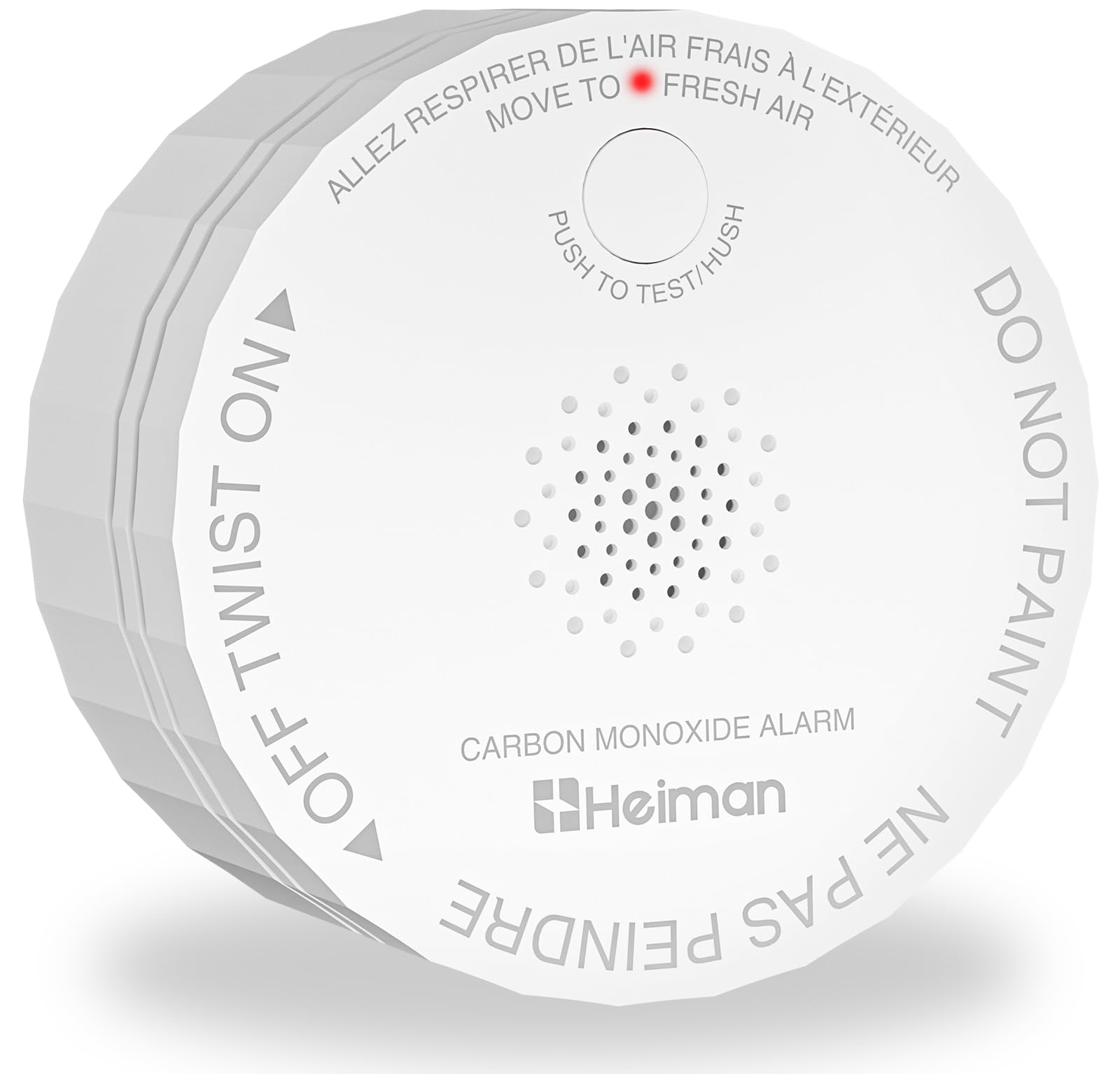
The smallest and lightest CO alarm here at 3.52 oz, with a sealed 10-year battery that fits in a pop-up RV.
If you have very limited wall space or you need a CO alarm for a small RV, camper, or rental apartment, the Heiman C1-S is built specifically for tight quarters. At 3.52 ounces and just 2.75 inches in diameter, it is about the size of a hockey puck — and it is the lightest unit in this lineup. It uses a FIGARO electrochemical sensor (made in Japan), which is the same reliable sensor technology found in much more expensive industrial units, so the detection accuracy stays high for years.
Power comes from a sealed lithium battery rated for a 10-year average life, meaning you install it and do not touch it again until the end-of-life chirp tells you to replace the whole unit. It emits a loud 85 dB alarm with a flashing LED for visual confirmation. The housing is made from UL94 V-0 rated flame-retardant ABS+PC plastic, so it resists heat and corrosion even in a garage or basement. Heiman backs it with a 7-year warranty that offers free replacement for non-human-induced damage.
The trade-off is that the instructions mention a paper clip release hole to remove the mounting bracket, which is easy to forget about when the 10-year battery finally dies. One reviewer noted that if you lose track of that trick, the bracket can be annoying to separate. But if you need a truly tiny CO alarm with a sealed decade battery and a top-tier FIGARO sensor, this is the one to grab.
Tiny Package, Big Battery
- Weighs just 3.52 oz with a 2.75″ diameter — the smallest and lightest unit here.
- Uses a Japan-made FIGARO electrochemical sensor for accurate, long-lasting CO detection.
- 10-year sealed lithium battery provides 24/7 monitoring with zero maintenance.
Last-Second Trick Needed
- You need a paper clip to release the bracket from the base, which is easy to misplace or forget over a decade.
- Non-replaceable battery means the whole unit is replaced after 10 years (but that is standard for this battery type).
Ideal for: RVs, campers, tiny apartments, or any spot where wall space is tight and you want a sealed 10-year battery in the smallest possible package.
Not ideal if: you want a digital display or the ability to replace batteries yourself — this is a completely sealed, throw-away-after-a-decade unit.
5. Kidde KN-COB-B-LP Nighthawk Carbon Monoxide Alarm, Battery Operated

Kidde claims 40% longer battery life than other CO alarms., with a seven-year end-of-life warning built in.
This Nighthawk model is Kidde’s step-up option in the battery-powered lineup. It runs on three included AA batteries (instead of the usual two), and Kidde states it offers 40% longer life than other CO alarms (that is their claim, not a tested number). The extra battery capacity is useful if you place the alarm in a high-traffic area or a cabin that gets used only seasonally, because it means fewer dead-battery surprises.
It measures in at 9.6 ounces, heavier than the standard Kidde models due to the third battery and slightly larger chassis. It has a test-reset button for quick checks, and a seven-year end-of-life warning chirp that alerts you when the sensor can no longer be trusted. It meets all Underwriters Laboratories (UL) requirements. Reviewers who use it off-grid in an uninsulated cabin with a wood stove say it saved them twice in three years by alerting to low oxygen from heat, even in temperatures below 20°F — that is a strong endorsement for reliability in tough conditions.
The downside reported by a few buyers is that the batteries are hard to install, and the unit cannot use rechargeable batteries. It is a no-frills detector — no digital display, no event memory, just a loud alarm and a long-life design. If you need an alarm that keeps running for years in a remote or extreme-weather location, this one earns its premium spot.
Built for Extreme Use
- Runs on three AA batteries for extended life (Kidde claims 40% longer life than other CO alarms).
- Seven-year end-of-life warning means you get a full seven years before replacement, longer than the 6-year timer on the KN-COB-LP2.
- Proven in real-world cold conditions — reviewers report it worked reliably below 20°F in uninsulated cabins.
Install Friction
- Battery compartment is tricky to load, and the unit cannot use rechargeable AA batteries.
- No digital display, no event memory — purely an alarm with a test button.
Grab this for: a cabin, workshop, or off-grid spot where you need a battery-powered alarm that can survive temperature extremes and keep running for years without fuss.
Pick another if: you want a digital display or a compact, travel-ready design — the Nighthawk is bigger and heavier than the COBD.
6. First Alert CO400 Carbon Monoxide (CO) Detector, Battery Operated Alarm

First Alert is the most well-known name in home safety., offering a simple battery-operated CO alarm at the lowest cost.
First Alert has been the most trusted brand in home safety, according to a 2018 company survey. since it launched the first residential smoke alarm in 1958. The CO400 is their entry-level, battery-only alarm — no plug, no digital screen, just a 9V battery (included) and an 85-decibel siren that sounds when CO levels reach dangerous levels. It uses an advanced electrochemical sensor that detects CO accurately no matter where you place it in the room.
At 11.2 ounces, it is the heaviest unit in this roundup by a clear margin — it is 5.28 ounces heavier than the Kidde COBD. It measures 5″ wide, 3″ tall, and 1″ deep, so it takes up a bit more wall real estate than the smaller Kidde models. The 5-year limited warranty is a full 5 years shorter than the 10-year warranty on the Kidde COBD, which is a meaningful difference for a safety device you expect to last. Owners mention it works as advertised and is easy to set up, though one buyer mentioned surprise at the battery-only operation and wished they had read the description more carefully.
For the price, it is a perfectly functional alarm from a household name. But the heavier weight, larger footprint, and shorter warranty make it harder to recommend when the Kidde KN-COB-LP2 costs about the same and brings a 10-year warranty and event memory.
Brand Reliability
- From First Alert, the most trusted brand in home safety, per a 2018 company survey..
- Electrochemical sensor detects CO accurately regardless of placement in the room.
- Loud 85 dB alarm wake you up fast.
Heavier & Shorter Warranty
- At 11.2 oz, it is the heaviest unit here — 5.28 oz more than the Kidde COBD.
- 5-year limited warranty is half the length of the Kidde COBD’s 10-year coverage.
- No digital display, no event memory, no LED indicators — purely a basic alarm.
Choose this if: you have always used First Alert and want the simplest possible CO alarm from a brand you recognize, and the price is your top consideration.
pass on it if: you want a longer warranty, a lighter weight, or extra features like event memory — the Kidde KN-COB-LP2 beats it on all three fronts for roughly the same price.
7. Kidde Smoke & Carbon Monoxide Detector, 10-Year Battery Powered, Voice Alerts (2 Pack)

A 2-pack of voice-alert combo alarms with a sealed 10-year battery that also reduces false alarms from cooking.
This Kidde 2-pack is the premium all-in-one solution: it detects both smoke and carbon monoxide, never needs a battery change for 10 years, and uses voice alerts that clearly say “Fire!” or “Warning! Carbon Monoxide!” so you know exactly which danger is present without having to look. That voice distinction alone can save precious seconds in an emergency — if you wake up to “Warning! Carbon Monoxide!” you know to get outside rather than grab a fire extinguisher.
It features enhanced sensing technology that reduces false smoke alarms often triggered by cooking, which is a genuine daily-life annoyance with older smoke detectors. The unit is self-testing — internal components check the alarm’s operation — though Kidde still recommends a manual button test once per week. It meets UL 217 9th Edition (smoke), UL 2034 4th Edition (CO), and FCC standards. Because it is battery-powered (not hardwired), you can install it anywhere without an electrician. One owner reported that the base is different from older Kidde models, so if you are swapping out an old unit, you cannot reuse the existing bracket — you need to swap the base (two screws).
The main drawback is the premium price point for a 2-pack, which some reviewers felt was high. But if you are outfitting a new home or replacing all the alarms on a floor, covering both threats with a ten-year, no-maintenance, voice-alert system is a set-and-forget upgrade over separate units.
Voice Alerts Save Time
- crisp voice announcements say “Fire!” or “Warning! Carbon Monoxide!” so you know the threat instantly.
- Sealed 10-year battery means no battery swaps for a decade, and Kidde claims it saves money over the detector’s life..
- Enhanced sensing reduces false alarms from cooking — a huge improvement over older detectors.
Premium Price & Base Swap
- Costs more than buying separate smoke and CO detectors, especially as a 2-pack.
- The mounting base does not fit older Kidde models, so you must replace the bracket (two screws, but still an extra step).
Best upgrade for: anyone who wants to replace old smoke alarms with a combo unit that has voice alerts, no battery maintenance, and reduced false alarms — all in one Kit.
it’s not for you if: you already have a working smoke alarm and just need a battery-operated CO detector — a simpler, cheaper CO-only alarm will cover that gap without the added cost of the smoke sensor.
Understanding the Specs
Electrochemical Sensor
This is the type of sensor inside every reliable CO alarm on this list. It works by using a small, sealed cell filled with a chemical solution that reacts specifically to carbon monoxide molecules. When CO enters the cell, it triggers a small electrical current that the alarm reads as a dangerous level. The big advantage is accuracy — it almost never false-alarms from steam, cooking fumes, or aerosol sprays. It also lasts the full life of the alarm (5 to 10 years), unlike older “metal oxide” sensors that could drift out of calibration.
End-of-Life Timer
Every CO alarm has a built-in timer that starts counting down the moment you first power it on. After a set number of years (typically 6, 7, or 10, depending on the model), the sensor is no longer accurate enough to trust, and the unit will chirp in a specific pattern to tell you to replace it. You cannot reset this timer — even if the alarm still looks fine, the sensor inside has degraded. That is why a longer end-of-life (like 10 years vs 6 years) means one less replacement cycle over the lifespan of your home.
FAQ
Where should I mount a battery operated CO alarm?
How often do I need to replace a battery operated CO alarm?
Can I use a battery operated CO alarm in a motorhome, camper or RV?
What is the difference between a CO alarm and a CO detector?
Can a battery operated CO alarm detect a slow leak before the alarm sounds?
How loud is 85 decibels and is it enough to wake me up?
Are there battery operated CO alarms with voice alerts?
Can I install a battery operated CO alarm in a bathroom or kitchen?
Final Thoughts: The Verdict
For most people, the battery operated carbon monoxide alarm winner is the Kidde COBD because it combines a backlit digital display showing real-time CO levels with a 10-year limited warranty and the lightest travel-friendly weight (5.92 oz) in this class. If you want zero battery maintenance and combined smoke/CO protection, grab the X-Sense SC06 with its sealed 10-year lithium battery. And for a premium whole-home upgrade with voice alerts and a 2-pack, the standout is the Kidde 10-Year Combo.
How We Picked
We do not accept paid placement. Every pick is matched to a real buyer and a real use-case; we do not hands-on test units.
Sources & Methodology
Specifications: manufacturer listings and product documentation. Review insights: verified customer reviews, as of July 2026. Pricing: not shown on this page (it changes often); check the current price via the retailer link.
As an Amazon Associate, Gadgets Feed earns from qualifying purchases. This does not affect which products we feature.
Product prices and availability are accurate as of the date/time indicated and are subject to change. Any price and availability information displayed on Amazon at the time of purchase will apply to the purchase of this product. As an Amazon Associate I earn from qualifying purchases.
CERTAIN CONTENT THAT APPEARS ON THIS SITE COMES FROM AMAZON. THIS CONTENT IS PROVIDED "AS IS" AND IS SUBJECT TO CHANGE OR REMOVAL AT ANY TIME.
Amazon and the Amazon logo are trademarks of Amazon.com, Inc. or its affiliates.