
Our readers keep the lights on and my morning glass full of iced black tea. As an Amazon Associate, I earn from qualifying purchases.
Specs are compiled from manufacturer listings and verified buyer reviews and can change over time — please confirm the key details on the product page before buying.
You want 6 marine speakers that sound clear and last more than one season, not gear that crackles and rusts after a few weekends in the sun. The real difference depends on three measurable specs: RMS wattage (continuous power handling, not peak fake numbers), frequency response (how low the bass goes), and materials that resist UV rays and corrosion. This guide compares six 6.5-inch marine coaxial speakers against those benchmarks using published specs and real owner experiences.
I’m Min — the founder and writer behind Gadgets Feed. This guide is built by comparing the manufacturers’ published specifications and the patterns across verified customer reviews, so you get each pick’s real strengths and trade-offs instead of marketing spin.
Whether you are outfitting a pontoon boat, a bass boat, a fishing skiff, or an RV that sees the coast, these 6 marine speakers represent the balance where size, power, and weather resistance finally make sense together.
Quick Picks
- Polk Audio MM652 Monitor Series 6.5″ Coaxial Speakers — Top Performer
- Rockford Fosgate M0-65B Marine Grade 6.5″ Coaxial Speakers — Purpose Build
- KICKER KM65 6.5-Inch Marine Coaxial Speakers — Premium Pick
- PIONEER TS-MR1600 6.5″ Marine Speakers (Pair) — Value Pick
- BOSS Audio Systems MR6B 6.5″ Marine Stereo Boat Speakers — Budget Champion
- Pyle Low-Profile Waterproof Marine Speakers – 240W 6.5 Inch 2 Way — Slim Fit
How To Choose The Best 6 Marine Speakers
Picking the right set of 6.5-inch marine speakers is simpler when you focus on the three things that determine whether they will sound good and actually survive the environment.
Power Handling: The RMS Number You Can Trust
Manufacturers often advertise “peak power” or “max watts” — a huge number that the speaker can theoretically survive for a split second. What actually matters for daily listening is the RMS (Root Mean Square) rating, which tells you the continuous power the speaker can handle cleanly without distorting or overheating. A speaker with a 100W RMS rating will play louder and cleaner than one with a 25W RMS rating, assuming your amplifier or head unit can deliver that power. If you run a small stereo, a high-RMS speaker may never reach its potential. If you run a big amp, a low-RMS speaker may blow.
Frequency Response: The Bass You Will Actually Hear
This spec, measured in hertz (Hz) to kilohertz (kHz), shows the range of sound the speaker can reproduce. The lower number is crucial: a speaker that reaches down to 40Hz can deliver deep, punchy bass that you feel in your chest, while a speaker that only reaches 80Hz will sound thinner and brighter, missing the low end entirely. A wide range like 40Hz–40kHz gives you both thumping bass and crisp highs. A narrower range like 80Hz–20kHz leans toward a more treble-forward sound that works fine for talk radio or podcasts but feels hollow for music with bass lines.
Weather Resistance: Beyond Just “Waterproof”
Marine speakers face salt fog, UV (ultraviolet) rays, humidity, and direct water spray — not just a few rain drops. Look for materials like UV-treated cones and surrounds (Santoprene or rubber), stainless steel mounting hardware, and an ABS (Acrylonitrile Butadiene Styrene – a tough plastic) basket that resists corrosion. An IP56 rating, as seen on the Polk MM652, means the speaker is tested against dust ingress and powerful water jets. Cheaper speakers may label themselves “weatherproof” but use basic plastic cones and untreated cloth surrounds that degrade quickly under the sun. Sealed motor structures and locking terminal covers, found on the KICKER KM65, also keep moisture from reaching the electrical connections.
Quick Comparison
| Model | Best For | RMS Power | Frequency Response | Mounting Depth | Amazon |
|---|---|---|---|---|---|
| Polk Audio MM652 | High-power systems | 100W | 40–40,000 Hz | — | $106.99$179.00Amazon |
| Rockford Fosgate M0-65B | Off-road / rugged use | 65W | — | 2.52″ | $116.99$129.99Amazon |
| KICKER KM65 | All-around durability | — | — | — | $159.96Amazon |
| PIONEER TS-MR1600 | Budget upgrade from stock | 25W | — | — | $69.99Amazon |
| BOSS Audio MR6B | Extreme budget builds | — | 80–20,000 Hz | 2.2″ | from $77.99Amazon |
| Pyle Low-Profile | Slim-fit / LED accent | 120W | 60–18,000 Hz | 0.92″ | $40.99Amazon |
In‑Depth Reviews
1. Polk Audio MM652 Monitor Series 6.5″ Coaxial Speakers

The muscle speaker that swallows 300 peak watts without flinching.
The Polk MM652 is the speaker you buy when you are running a serious amplifier and you want every watt to translate into clean, audible output. With a 100W RMS rating versus the Pioneer TS-MR1600’s 25W RMS, the Polk can play louder and stay tighter at high volume without breaking up. The 40–40,000 Hz frequency response (the range of sound it can produce) is the widest in this lineup by a significant margin, giving you deep, punchy bass (the low 40Hz extension) and shimmering highs from a 1-inch Terylene fabric dome tweeter (a small speaker for high frequencies) that most marine speakers simply lack.
Buyers report that the MM652 “handles my 600 watt amplifier with no problem,” which backs up the engineering: a titanium-plated composite woofer cone, Santoprene rubber surround (a durable rubber that resists UV and salt), and an epoxy-coated internal crossover (the circuit that splits audio frequencies) keep the sound distortion-free even when you push it hard. The IP56 (Ingress Protection rating 5 for dust, 6 for powerful water jets) Advanced Ultra-Marine certification means this speaker has been tested against salt fog, UV rays, high humidity, and water spray — not just a splash here and there. The trade-off is the mounting hole pattern: some owners note that the grille covers allow debris ingress (small objects can get through), so if you are installing low in a boat, you may want to add a protective screen behind the grille.
Unlike the KICKER KM65 and Rockford Fosgate M0-65B, which both sit in a similar price tier, the Polk gives you the widest frequency response and the highest RMS (continuous power) handling in this comparison. If you value authoritative bass and crisp highs above all else, this is the pick that will reward a good amplifier.
What Makes It Shine
- 100W RMS (continuous power) / 300W peak power — the highest continuous handling in this group
- 40–40,000 Hz frequency range delivers real bass and airy highs
- IP56-rated (tested against dust and powerful water jets) against salt fog, UV (ultraviolet), and humidity for long-term marine survival
Watch Out For
- Some owners mention the grille design lets debris pass through; not ideal for very low mounting positions
- Fitment can be tricky if replacing existing speakers with non-standard hole patterns
Who It Fits: You are running a 300W+ amplifier, want the deepest bass in this list, and need a speaker that passes serious marine certification.
The Honest Catch: The grille openings are wide enough that small debris can reach the cone; add a mesh screen if you mount near the deck.
2. Rockford Fosgate M0-65B Marine Grade 6.5″ Coaxial Speakers

The off-road warrior that shrugs off desert dust and lake spray equally.
Rockford Fosgate designed the M0-65B with “Element Ready” weatherproofing — a construction that seals the motor, cone, and crossover (the circuit that splits audio frequencies) against water, salt, dust, and UV (ultraviolet) rays. The 65W RMS (continuous power) at 4 ohms (the speaker’s electrical resistance, a common standard) is not the highest in this list, but it is a very honest 65W: customers note the speakers sound “loud clear” even when paired with modest head units, and the grille-integrated LCP (Liquid Crystal Polymer – a durable plastic) balanced dome tweeter delivers smooth, detailed highs without harshness. At 2.52 inches mounting depth (the space needed behind the speaker), these are relatively shallow and fit many boats and off-road vehicles without spacer rings.
Compared to the Polk MM652, the Rockford gives up some bass extension and raw power, but it gains a more compact footprint and a widely praised build quality that one buyer called “so much better than old speakers” after upgrading from factory units. The included 2-year warranty from Rockford Fosgate adds confidence that the cheaper options in this list simply do not offer. The catch is the mounting hole requirement of 5.38 inches — measure your existing cutout before buying, because the Rockford has a specific fit that does not match every universal pattern.
Unlike the PIONEER TS-MR1600, which feels like a budget-oriented stopgap, the M0-65B feels like a purposeful outdoor audio component. Pair these with a small amplifier, and you get clean, loud music that holds up in direct sun and occasional rain without any worry.
Strengths
- Element Ready construction seals against water, salt, dust, and UV (ultraviolet)
- Grille-integrated dome tweeter produces smooth, fatigue-free highs
- 2-year warranty from a well-known car audio brand
Limitations
- 65W RMS (continuous power) is moderate — not suited for very high-power amplifier setups
- Requires a specific 5.38″ mounting hole; check fitment before ordering
Pick This If: You need a speaker that survives desert heat, salt air, or dust storms without degrading, and you value a cohesive, balanced sound over deafening volume.
skip it if: You have a high-wattage amplifier and want the maximum clean output — the Polk MM652 delivers more headroom (room to play louder without distortion).
3. KICKER KM65 6.5-Inch Marine Coaxial Speakers
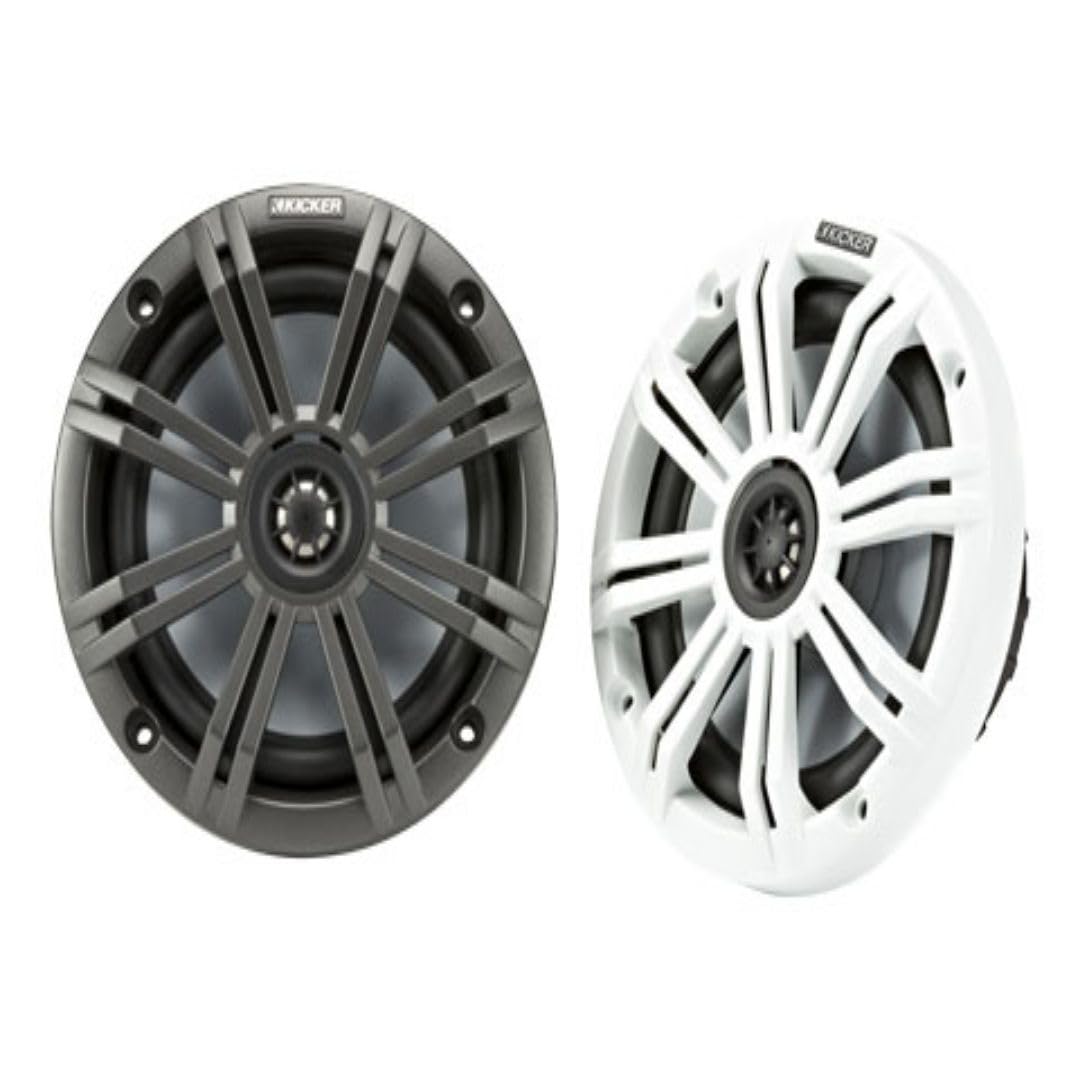
The long-haul champion that stays crisp season after season.
KICKER’s KM65 is built around material choices that prioritize longevity: UV-treated (ultraviolet-protected) injection-molded polypropylene cones, Santoprene rubber surrounds (a durable rubber that resists UV and salt), and a sealed motor structure with locking terminal covers that keep moisture away from the electrical connections. One reviewer noted their previous pair lasted over three years in a marine environment — a strong signal that the construction details work. The 3/4-inch (20mm) tweeter produces “excellent sound quality” with crisp high frequencies, especially noticeable with acoustic music, jazz, or vocals that need clarity rather than boom.
Unlike the Rockford Fosgate M0-65B, which uses a grille-integrated tweeter (a small speaker for high frequencies built into the grille), the KICKER KM65 uses a separate tweeter design that some listeners find produces a slightly more open, spacious soundstage. The included charcoal and white grilles let you match the boat’s interior easily. One minor complaint from a buyer: the factory screws were about 1/8-inch too short, requiring a trip to the hardware store for longer ones. This is a small inconvenience for a speaker that otherwise excels in durability and balanced sound reproduction.
The sealed motor structure is the standout feature here. While other marine speakers rely on basic waterproofing, the KM65’s design physically blocks moisture from reaching the moving parts, reducing corrosion risk over years of use. For owners who plan to keep the same boat for the long haul, this durability edge is worth the premium.
Long-Term Strengths
- Sealed motor and locking terminal covers block moisture from electrical components
- UV-treated (ultraviolet-protected) cone and Santoprene surround resist sun damage and cracking
- Interchangeable charcoal/white grilles for color matching
Short-Term Annoyances
- Included screws are about 1/8″ too short for some installations; budget for longer hardware
- Price is higher than the Rockford and Polk options with comparable build
Reach For It If: You want a speaker that will survive multiple seasons of direct sun and salt exposure, and you are willing to pay a bit more for sealed-motor protection.
Look Elsewhere If: You need maximum power handling for a high-output amplifier — the Polk MM652 offers nearly double the RMS (continuous power) capacity.
4. PIONEER TS-MR1600 6.5″ Marine Speakers (Pair)

The honest entry-level speaker that does not pretend to be premium.
The PIONEER TS-MR1600 is built for a specific mission: replacing tired, crackly factory speakers on a budget, without the hassle of professional installation or an amplifier upgrade. With 25W RMS (continuous power) and 100W max power, these are the lowest-power-handling speakers in this roundup — at 25W RMS compared to the Polk MM652’s 100W RMS. However, that modest power figure is actually a match for a basic marine head unit (the stereo unit in your boat), which typically delivers around 20W–30W per channel. You can screw these into the existing holes, connect the speaker wires, and hear a noticeable improvement over the stock paper-cone speakers that came with your boat.
Reviewers point out that “you would have to go up about another per set to get something significantly different,” which frames the TS-MR1600 accurately: it is a decent step up from terrible factory sound but not a substitute for a proper amplified system. The water-resistant design includes UV protection (ultraviolet ray resistance) and corrosion-resistant components, though there is no IP (Ingress Protection) rating like the Polk’s IP56. The construction uses basic materials — not the Santoprene or sealed motors of the premium picks — so long-term exposure to harsh sun or salt spray may accelerate wear. One owner noted the speakers sound “good for the price” but suggested spending more if you listen to music often.
Unlike the BOSS Audio MR6B, which pairs a similar price with deceptive warranty terms (the cost to claim it is very high), the Pioneer at least comes from a brand with a long track record in mainstream audio. If all you need is something that plays music while you fish and you are not trying to impress anyone with sound quality, this gets the job done without overspending.
Best For Budget Builds
- Easy screw-in installation — no amplifier required for decent volume
- Genuine upgrade over extremely cheap factory speakers
- Trusted Pioneer brand with solid basic construction
The Trade-Offs
- 25W RMS (continuous power) limits loudness and headroom; will distort if pushed by a high-powered head unit
- Materials are basic — no IP (Ingress Protection) rating, no sealed motor — so long-term outdoor durability is limited
Ideal For: The casual boater who wants a quick, low-cost replacement for worn-out speakers and does not plan to add an amplifier or subwoofer.
Not Right For: Anyone running an aftermarket amplifier or who expects deep bass and volume for social gatherings on the water.
5. BOSS Audio Systems MR6B 6.5″ Marine Stereo Boat Speakers

The no-frills pair that lets a fishing boat play music while staying affordable.
At the entry level of the entry level, the BOSS MR6B is a plastic-bodied, polypropylene-cone 2-way speaker built for one thing: playing music in a wet environment at a price that makes it almost disposable. With an 80Hz–20kHz frequency response, it lacks the bottom-end reach of the Polk MM652 (40Hz) or even the Pyle MR6B (60Hz), so bass-heavy genres like hip-hop or rock will sound thin. Shoppers say that the sound is “acceptable” for a budget setup, and one buyer used them in a “boom box” build with a basic Bluetooth amplifier, finding they worked great for the purpose.
The real catch is the warranty. BOSS advertises a “3-year platinum online dealer warranty,” but buyers report the reality: after paying shipping both ways plus a return fee, the effective warranty cost exceeds the speaker price itself. One owner called it “deceptive warranty marketing,” noting that the speakers cost roughly per set, so the warranty is essentially meaningless. For a simple powerboat where the radio is mostly background noise, these work fine. Just do not count on long-term support or premium sound.
Compared to the PIONEER TS-MR1600, the BOSS offers a slightly lower price point and a higher sensitivity rating of 89 dB (decibels – a measure of how efficiently it converts power into volume), meaning it can produce louder volume from the same amplifier wattage. The trade-off is overall build quality: the Pioneer uses slightly better materials and has a more reputable brand behind it. If your budget is truly bottom-line, the MR6B plays music. If you can stretch a little further, the Pioneer or Pyle options give you more for your money.
The Upside
- Very low cost makes these an easy replacement for trashed speakers
- 89 dB (decibel) sensitivity means decent volume even from a low-power head unit
- Simple fitment with a 4.75″ mounting hole and 2.2″ depth
The Warning
- Warranty is expensive to use — shipping and fees effectively nullify the coverage
- Limited bass response (80Hz) and basic plastic construction
Grab It If: You need the absolute cheapest functional marine speaker for a boat where music is purely background noise, and you do not care about warranty support.
Avoid It If: You want a speaker that will last more than one season in direct sun or saltwater — step up to the PIONEER or Pyle for a few more dollars.
6. Pyle Low-Profile Waterproof Marine Speakers – 240W 6.5 Inch 2 Way

The thin mount that slides into spaces where full-depth speakers cannot go.
With an astonishingly shallow mounting depth (the space needed behind the speaker) of 0.92 inches, the Pyle MR6B is the speaker to pick when your boat or RV has minimal clearance behind the mounting surface — think thin fiberglass panels or tight cockpit walls. Despite the slim profile, it claims a 120W RMS (continuous power) and 240W max power handling, plus a 60Hz–18kHz frequency response that gives it a noticeable bass advantage over the BOSS MR6B (80Hz). One buyer reports “running 4 of these and 4-10″ wet sounds off of 1000 watt digital amp,” proving that even with a low-profile design, these can integrate into a larger amplified system.
The speakers include built-in blue LED (Light Emitting Diode) illuminating lights that add a visual pop at night — a genuine fun factor that the premium Polk and Rockford options do not offer. However, sound quality reviews are split: one owner calls them “great sound” while another says they “look great, sound bad.” The inconsistency suggests that performance depends heavily on the installation environment and the amplifier driving them. The construction uses an ABS (Acrylonitrile Butadiene Styrene – a tough plastic) machined gasket and grill to combat UV (ultraviolet) damage, which is a smart design choice for a speaker at this price, but the overall material quality is not in the same league as the KICKER or Polk options.
The catch is the fit: at 7.3 inches total diameter with a 0.92-inch mounting depth, these require a specific cutout size you should measure carefully before ordering. The included 9.8-foot speaker wires are a welcome convenience for DIY installers, saving a trip to the parts store. For an RV, a utility boat, or any spot where a full-depth speaker protrudes too far, the Pyle solves the clearance problem without sacrificing as much power as you would expect.
Unique Advantages
- 0.92″ mounting depth fits ultra-tight installations where other 6.5″ speakers cannot
- 120W RMS (continuous power) is high for a slim speaker — works well with amplifiers
- Blue LED (Light Emitting Diode) lights add a visual accent at night
Reality Check
- Sound quality is inconsistent — some buyers love it, some find it disappointing
- Slim design limits cone excursion (how far the cone moves), so maximum bass output is lower than deeper speakers
Best For: The tight-space installer who needs a shallow speaker that still handles real power, and who appreciates LED (Light Emitting Diode) lighting as a bonus feature.
Not For: The audiophile who demands consistent, high-fidelity sound — the Polk, Rockford, or KICKER options offer more predictable performance.
Understanding the Specs
RMS vs Peak Power
RMS (Root Mean Square) is the continuous power a speaker can handle cleanly — it is the spec that determines real-world volume and clarity. Peak power is the maximum the speaker can survive in a split second before damage. A speaker with 100W RMS will play louder and cleaner than one with 25W RMS, assuming your amplifier delivers that power. Always compare RMS numbers between speakers, not peak numbers, because peak figures are often inflated for marketing.
Frequency Response and Bass
The frequency response, given in hertz (Hz) and kilohertz (kHz), shows the range of sound a speaker can reproduce. The lower number (the bass end) matters most for music: 40Hz delivers deep, thumping bass you can feel, while 80Hz sounds thinner and brighter. The upper number (the treble end) affects detail and sparkle — 20kHz is enough for most human hearing. A wide range like 40Hz–40kHz covers both extremes, while a narrower range like 80Hz–20kHz sacrifices bass for cost.
FAQ
Can I use 6.5-inch marine speakers in my car or RV?
What is the difference between RMS (Root Mean Square) and peak power for marine speakers?
Do I need an amplifier for 6.5-inch marine speakers?
How do I know if 6.5-inch speakers will fit my boat?
How long do marine speakers typically last?
Are LED (Light Emitting Diode) marine speakers worth the extra cost?
Can I mix different brands of marine speakers on my boat?
What is the difference between coaxial and component marine speakers?
Final Thoughts: The Verdict
If you want one dependable pick, the 6 marine speakers winner is the Polk Audio MM652 because it delivers the widest frequency response (40–40,000 Hz) and the highest clean power handling (100W RMS) of any speaker in this comparison, backed by genuine IP56 marine certification that covers salt fog, UV (ultraviolet), and humidity. If you want the best balance of ruggedness and all-around sound for long-term outdoor use, grab the KICKER KM65 for its sealed motor design and UV-treated materials that survive season after season. And for a tight-space installation where mounting depth is measured in fractions of an inch, the standout is the Pyle Low-Profile speakers with their 0.92-inch depth and 120W RMS handling.
How We Picked
We do not accept paid placement. Every pick is matched to a real buyer and a real use-case; we do not hands-on test units.
Sources & Methodology
Specifications: manufacturer listings and product documentation. Review insights: verified customer reviews, as of July 2026. Pricing: not shown on this page (it changes often); check the current price via the retailer link.
As an Amazon Associate, Gadgets Feed earns from qualifying purchases. This does not affect which products we feature.
Product prices and availability are accurate as of the date/time indicated and are subject to change. Any price and availability information displayed on Amazon at the time of purchase will apply to the purchase of this product. As an Amazon Associate I earn from qualifying purchases.
CERTAIN CONTENT THAT APPEARS ON THIS SITE COMES FROM AMAZON. THIS CONTENT IS PROVIDED "AS IS" AND IS SUBJECT TO CHANGE OR REMOVAL AT ANY TIME.
Amazon and the Amazon logo are trademarks of Amazon.com, Inc. or its affiliates.