
Our readers keep the lights on and my morning glass full of iced black tea. As an Amazon Associate, I earn from qualifying purchases.
Specs are compiled from manufacturer listings and verified buyer reviews and can change over time — please confirm the key details on the product page before buying.
You are cleaning carpets in a car, boat, or on stairs, and you care about one thing: does the machine actually pull the dirty water back out? Most consumer-grade carpet cleaners just spray water in and leave the padding soaked. A real carpet extractor 3 gallon gives you the tank size and suction power to finish a job in one pass without stopping to dump every few minutes. This guide compares five 3-gallon extractors, from the budget-friendly workhorse to the premium heated model, so you know which one is worth your money.
I’m Min, founder of Gadgets Feed. This guide is built from the manufacturers’ published specs and real patterns across verified customer reviews, so you get honest strengths and trade-offs, not marketing spin.
You need a machine that handles car detailing and home upholstery without breaking down after a few uses. That means looking past the marketing hype and focusing on pump pressure, vacuum motor type, and real owner experiences highlighted in this carpet extractor 3 gallon roundup.
Quick Picks
- Sandia 50-4000 Spot-Xtract 3-Gallon Spot Extractor Heater — Top Performer
- Sandia 50-7000 Single 3 Stage Fan Sniper Indy Automotive Spot Commercial Extractor — Compact Heater
- Adam’s Polishes Heated Carpet Extractor — Enthusiast Choice
- Sandia Spotter 50-1000 Carpet Extractor — Best Value
- Sandia 50-1000 Spot-Xtract Commercial Extractor with Clear View Plastic Hand Tool — Stairs Specialist
How To Choose The Best Carpet Extractor 3 Gallon
A 3-gallon carpet extractor is a step up from a home carpet cleaner. You get bigger tanks, stronger suction, and usually a higher-pressure pump. But not all extractors are built the same. Here are the specs that separate a tool you will use for years from one that frustrates you after months.
Pump Pressure (PSI) and Flow
The pump pushes cleaning solution into the carpet. Higher pressure (PSI, or pounds per square inch) forces the solution deeper into the fibers to loosen dirt. Most 3-gallon extractors in this range run a 55 PSI pump, which is solid for upholstery and auto carpets. For heavy commercial carpets or matted pet fur, you want headroom, like a 100 PSI available pump — running at 55 PSI gives you reserve power when needed.
Vacuum Motor (Stages, CFM, and Lift)
The vacuum motor pulls the dirty water back out. The two key numbers are CFM (cubic feet per minute) — how much air the motor moves — and water lift (in inches) — how hard it pulls. A 2-stage motor (about 100 CFM and 95+ inches of lift) is the balance for a 3-gallon extractor. It dries carpet fast so the pad does not stay wet and grow mildew. A single-stage motor leaves more moisture behind.
Heated vs Non-Heated
A heated extractor can bring water up to around 200 degrees Fahrenheit. Heat helps break down oil, grease, and baked-on stains in car upholstery and kitchen-area carpets. But buyer reports on several models show the heater can fail. If you clean mostly light soil, a non-heated machine with good suction may be more reliable. If you detail cars professionally, hot water extraction cuts your cleaning time significantly.
Quick Comparison
| Model | Best For | Pump PSI | Vacuum Motor | Weight | Amazon |
|---|---|---|---|---|---|
| Sandia Spotter 50-1000 | Budget-friendly entry-level detailing | 55 PSI | 2-Stage, 804W / 100 CFM | 19 Pounds | $619.89Amazon |
| Sandia 50-1000 Spot-Xtract | Stairs and upholstery maneuverability | 55 PSI | — | — | $632.16Amazon |
| Sandia 50-7000 Sniper Indy | Detailers needing a compact heater | 55 PSI | Single 3-Stage | 42 Pounds | $896.96Amazon |
| Sandia 50-4000 Spot-Xtract Heater | Professional heated extraction | 55 PSI | 2-Stage, 100 CFM | 40 Pounds | $874.00Amazon |
| Adam’s Polishes Heated Extractor | Enthusiast car detailing with heat | — | — | 20.07 Kilograms | $1,070.99$1,199.99Amazon |
In‑Depth Reviews
1. Sandia 50-4000 Spot-Xtract 3-Gallon Spot Extractor Heater
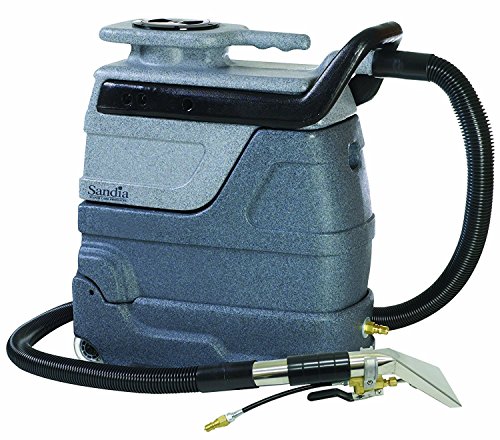
Heated extraction and big suction for professionals who need one-pass drying.
This machine wins on water lift. The Sandia 50-4000 delivers 103 CFM (cubic feet per minute of air movement) and a 95-inch water lift — that pulls water out of deep carpet pile aggressively, so the backing is not left wet. It pairs those numbers with a 55 PSI pump and a heater that the maker says reaches 200 degrees Fahrenheit, though some buyers report it needs pre-heated water to get hot. The 3-gallon solution and 3-gallon recovery tanks are matched, so you finish a full car interior without stopping to dump dirty water.
The 4-inch stainless steel hand tool is better than the plastic wands on lower-priced extractors. Stainless resists cracking if you knock it against a curb or truck bed. The 15-foot hose reaches around seats and into the back of an SUV without dragging the machine. Unlike the lighter Sandia Spotter 50-1000 at 19 pounds, this unit is 40 pounds — the weight comes from the heater and the 2-stage motor that gives it commercial-grade suction. One reviewer noted the “hose coming with is not good” after two months, and cleaning the tank interior is a chore. Heater reliability is the biggest risk — one owner reported the machine arrived not spraying water, and the manufacturer did not offer support. Test the heater and spray on day one.
What Pulls You In
- 103 CFM and 95″ lift for serious drying power
- Stainless steel hand tool resists wear
- Matched 3-gallon tanks for longer runtime
Where It Falters
- Heater may not reach 200° without pre-heated water
- Hose quality is a common complaint
- Heavy at 40 pounds; not for quick spot touches
Professional’s pick: If you detail cars or clean commercial upholstery daily and need suction that dries a carpet, the 50-4000 has the specs to do it.
Inspect on arrival: The heater and hose are the weak links — test everything immediately within the return window.
2. Sandia 50-7000 Single 3 Stage Fan Sniper Indy Automotive Spot Commercial Extractor
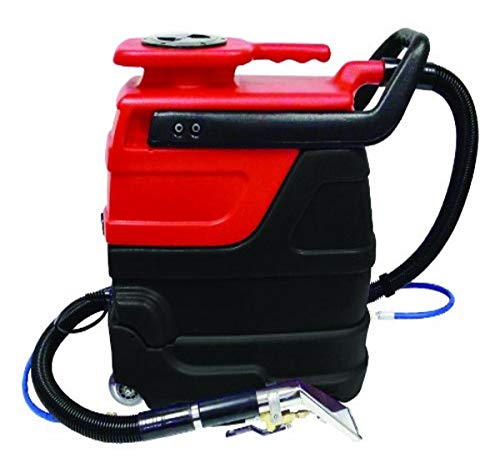
A 3-stage motor for quieter operation, paired with an in-line heater in a compact canister.
This extractor has a different shape. Instead of a tall canister, the 50-7000 has a low profile that owners mention fits well in a detailing trailer. It uses a single 3-stage vacuum motor — three impellers in series that pull air harder than a 2-stage motor, giving strong suction at 64 decibels (about as loud as a conversation, so you can talk over it). The in-line heater warms the solution as it flows, not from a tank heater, which some owners prefer for energy efficiency.
The 4-inch stainless steel hand tool is tougher than the plastic wands on cheaper units. The 8-foot vacuum and solution hose is shorter than the 15-foot hoses on the 50-4000 or Adam’s Polishes machine, so you move the canister closer to each work area. Semi-pneumatic wheels roll smoothly on concrete and garage floors. At 42 pounds versus the Sandia Spotter 50-1000 at 19 pounds — you feel that weight loading it into a truck, but the build is sturdier. Buyer reviews report frequent early failures, making reliability a major concern. Multiple customers note failures: one said the “heater failed on day 3-4,” another reported the vacuum stopped and the pump would not spray after fewer than eight uses. Sandia support apparently blamed Amazon as an “unauthorized reseller” for one owner, refusing warranty. This extractor performs well when it works, but the failure rate in reviews is alarmingly high.
Motor noise level: At 64 dB, this is the quietest extractor in the group — you can use it at a residential property without bothering neighbors.
The reliability gamble: The 3-stage motor and heater design are legitimately good, but the risk of a dead-on-arrival unit or early pump failure is the highest in this lineup. Buy from a seller with a solid return policy.
Trailer detailers: The slim canister and low noise work well in mobile detailing rigs if you accept the reliability risk.
A critical caution: If you need a machine you can count on for more than a few months without a backup plan, the review pattern here is too risky.
3. Adam’s Polishes Heated Carpet Extractor

A heated extractor built for car enthusiasts who want steam-like cleaning without a commercial price tag.
Adam’s Polishes is a known name in car detailing chemicals, and this extractor is designed to pair with their shampoo. The machine heats water up to 200 degrees Fahrenheit — reviewers point out visible steam and “dark brown water” coming out of carpets that looked clean on the surface. The 3-gallon tank covers a full car interior, and the 15-foot hose wraps around seats and into footwells without dragging the unit. The 4-inch clear head hand tool lets you see the dirt as it comes up, which is satisfying and practical for hitting every spot.
The main physical difference from the Sandia extractors is the weight. At 20.07 kilograms (about 44 pounds), this is the heaviest unit here. It is also wider — 14 inches deep and 28 inches tall — so it takes up more floor space in a shop or garage. Unlike the Sandia Spotter 50-1000 at 19 pounds, you are not carrying this one easily; it is designed to roll on its wheels between jobs. The reviews split hard on performance. Enthusiasts love the steam and clear head. But one critical buyer said it was “outperformed by a 20-year-old Rug Doctor” and fails to extract deep dirt, doing only surface cleaning. Another owner noted the clear head is plastic and had to buy a stainless steel wand separately, which they were not happy about. The heater works well for grease and oil, but for embedded sand or fine grit, the suction may not match the Sandia 50-4000’s 103 CFM.
Where it shines: The steam-like heat breaks down coffee spills, body oils, and greasy car upholstery stains that cold-water extractors cannot touch.
The trade-off: You pay for the heater and brand name. The suction is not the strongest in this lineup, and the plastic wand may not hold up under daily commercial use.
Weekend detailers: If you are an enthusiast wanting heated extraction for your own car or friends’ cars, the steam performance and long hose make this a satisfying tool.
Skip it for pro use: If you are cleaning multiple cars per day and need industrial suction, the Sandia 50-4000 or the simpler Spotter 50-1000 may be more durable.
4. Sandia Spotter 50-1000 Carpet Extractor

The lightest 3-gallon extractor here, at 19 pounds, with real 2-stage vacuum power for the price.
This is the entry-level gateway to commercial-grade extraction. The Sandia Spotter 50-1000 gives you a 2-stage Ametek motor running at 804 watts and 100 CFM — the same motor family used in more expensive units — with a 55 PSI pump that has an available 100 PSI if you need to turn it up. The weight is the standout stat: at 19 pounds, it weighs 19 pounds versus 42 pounds for the Sandia 50-7000 and 44 pounds for the Adam’s Polishes unit, making it genuinely portable for multi-location detailing.
Buyers who own detailing businesses love the low cost. One buyer mentioned it “replaced a Bissell” and praised the longer hose, bigger tank, and strong suction. The tank capacity is matched — 3-gallon solution and 3-gallon recovery — so you can do a full sedan. The lack of a heater is the main missing feature, but many detailers pre-mix with hot water in the bucket before pouring it in. The reliability warning is real. One owner reported: “Used for car detailing business; worked great for 3 months, then water stopped and unit won’t turn on.” They noted the Asurion protection plan did not cover it, and customer service was poor. Multiple reviews mention the hand tool is plastic, not the metal one shown in product images. This machine is a good value, but it may not survive daily commercial use beyond a few months.
Value proposition: It delivers similar suction for cold-water cleaning.
Build reality: The plastic wand and the risk of pump failure after three months are the trade-offs for the low price.
Mobile detailers on a budget: If you are starting a detailing business and need a real extractor without spending thousands, the 50-1000 gets you strong performance at a lower price.
Not for daily pro use: If you run 3+ cars a day, the failure rate in reviews suggests you will replace this within a year.
5. Sandia 50-1000 Spot-Xtract Commercial Extractor with Clear View Plastic Hand Tool
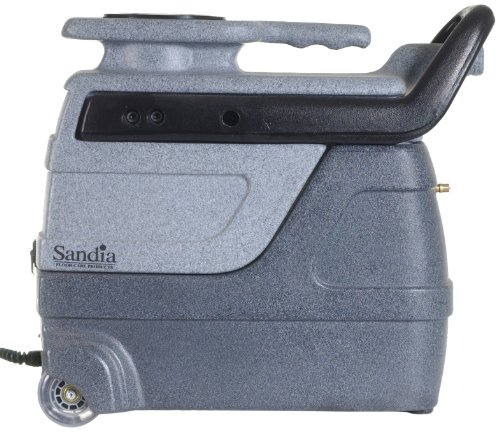
A narrow 4-inch clear wand that lets you see dirt lift while cleaning stairs and upholstery.
The Sandia 50-1000 Spot-Xtract is essentially the same platform as the Spotter, but it ships with a clear plastic hand tool. The 4-inch wide clear plastic wand is a real advantage for stairs — you see exactly when the suction stops pulling dirt, so you know when to move the tool. The 7-foot hose is shorter than the 15-foot hoses on the premium models, but the machine is compact enough to sit on a stair tread. Buyers specifically praise that “the width of this machine makes it super easy for one person to clean stairs with.”
The 3-gallon recovery tank can be removed from the base for emptying — a cleaner process than tilting the whole machine to dump dirty water. The 55 PSI pump pushes solution effectively, and the suction is strong enough for upholstery and automotive use. One customer observed this machine made “150 chairs that haven’t been cleaned for months look like NEW,” pulling out gum and oil. Reliability issues mirror those of other Sandia entry-level units. One user highlighted that after 3-4 months, water started leaking underneath, and the sprayer pump stopped after about 1.5 years. Another buyer reported the “water motor stays on when not in use, wasting water,” and the pump running continuously. The plastic hand tool is fine for light use, but if you drop it on concrete regularly, it will crack faster than stainless steel.
Stair-Cleaning Advantage
- Clear 4″ wand lets you see extraction in progress
- Removable recovery tank for easy dumping
- Compact design fits on stairs and in small spaces
Durability Concerns
- Plastic wand may crack under heavy use
- Pump and water motor failures reported after months
- Short 7-foot hose limits reach vs 15-foot options
Home and auto detailers: If your main cleaning is stairs, boat upholstery, and chair seats, this clear-wand machine is purpose-built for seeing your progress.
The durability catch: The plastic wand and pump reliability issues mean this is best for occasional weekly use, not 8-hour professional shifts.
Understanding the Specs
Pump Pressure (PSI)
PSI stands for pounds per square inch — it measures how hard the pump pushes cleaning solution into the carpet. At 55 PSI, a carpet extractor pushes water into medium-pile carpet and upholstery effectively. Higher PSI means deeper penetration to loosen dirt. Some extractors advertise 100 PSI available but ship set to 55 PSI, giving you headroom for stubborn stains.
Vacuum Motor: CFM and Water Lift
CFM (cubic feet per minute) measures how much air the vacuum motor moves. Higher CFM means more water extracted per second, drying the carpet faster. Water lift (in inches) measures suction pressure — how hard the vacuum pulls. A 2-stage motor in the 100 CFM range with 95+ inches of water lift is the professional standard. A 3-stage motor is even more powerful but usually on larger truck-mount or trailer units. For a portable 3-gallon extractor, 100 CFM is a strong benchmark — consumer-grade units often sit at 50-70 CFM.
FAQ
Can I use a 3-gallon carpet extractor for home carpet cleaning?
What is the difference between a solution tank and a recovery tank?
How do I clean and maintain a carpet extractor?
Does a heated carpet extractor really clean better than a cold one?
What size hand tool should I get: 4-inch or wider?
Can I use a carpet extractor to clean my car seats?
Why does my extractor lose suction after a few minutes?
Is the Sandia 50-1000 Spotter the same as the 50-1000 Spot-Xtract?
How much cleaning solution do I need for a 3-gallon tank?
What should I do if my extractor stops spraying water?
Final Thoughts: The Verdict
For most buyers, the carpet extractor 3 gallon winner is the Sandia 50-4000 Spot-Xtract Heater because it delivers the best combination of high water lift (95 inches) and 103 CFM suction for professional drying, plus the option of heated cleaning. If you want a lightweight portable machine for mobile detailing, grab the Sandia Spotter 50-1000 at 19 pounds. And for enthusiast car detailing with steam-like heat, the standout is the Adam’s Polishes Heated Carpet Extractor.
How We Picked
We do not accept paid placement. Every pick is matched to a real buyer and a real use-case; we do not hands-on test units.
Sources & Methodology
Specifications: manufacturer listings and product documentation. Review insights: verified customer reviews, as of July 2026. Pricing: not shown on this page (it changes often); check the current price via the retailer link.
As an Amazon Associate, Gadgets Feed earns from qualifying purchases. This does not affect which products we feature.
Product prices and availability are accurate as of the date/time indicated and are subject to change. Any price and availability information displayed on Amazon at the time of purchase will apply to the purchase of this product. As an Amazon Associate I earn from qualifying purchases.
CERTAIN CONTENT THAT APPEARS ON THIS SITE COMES FROM AMAZON. THIS CONTENT IS PROVIDED "AS IS" AND IS SUBJECT TO CHANGE OR REMOVAL AT ANY TIME.
Amazon and the Amazon logo are trademarks of Amazon.com, Inc. or its affiliates.