
Our readers keep the lights on and my morning glass full of iced black tea. As an Amazon Associate, I earn from qualifying purchases.
Specs are compiled from manufacturer listings and verified buyer reviews and can change over time — please confirm the key details on the product page before buying.
Judging an integrated amplifier by its wattage alone is the easiest way to end up disappointed. Raw power numbers tell you almost nothing about whether the music will sound good in your room with your speakers. What you actually need to consider is the noise floor (the background silence between notes), the inputs you will use, and the sonic character of the amp — all packed into one box that simplifies your setup.
I’m Min — the founder and writer behind Gadgets Feed. This guide is built by comparing the manufacturers’ published specifications and the patterns across verified customer reviews, so you get each pick’s real strengths and trade-offs instead of marketing spin.
Whether you are building your first hi-fi system or upgrading an aging receiver, these eight models represent today’s best value, sound quality, and versatility within the affordable integrated amplifier market.
Quick Picks
- WiiM Amp — Best Overall
- Denon PMA-600NE — Analog Plus Digital
- Dayton Audio HTA200 — Tube Hybrid Powerhouse
- AIYIMA A80 — Desktop DAC-Amp
- Marantz PM6007 — Audiophile Reference
- Cambridge Audio AXA35 — Best Value Analog
- Dayton Audio HTA100 — Entry-Level Tube Hybrid
- Oldchen EL34 Single-Ended Class A — Pure Class A Tube
How To Choose The Best Affordable Integrated Amplifier
An integrated amplifier combines a preamp (which selects inputs and controls volume) and a power amp (which boosts the signal to drive speakers) into one box — it is the control center for your passive speakers. The right one depends on your sources (vinyl, streaming, TV), the sensitivity of your speakers (how efficiently they turn power into sound), and how much you value things like a phono input or a built-in DAC (digital-to-analog converter, which turns digital audio from a computer or TV into an analog signal) over sheer power figures.
Topology Matters — Class D vs. Class A/B vs. Tube
Class D amplifiers use rapid on-off electrical pulses to drive speakers — they are highly efficient, run cool, and pack serious power into a small chassis, ideal for desktop or hidden setups. Class A/B amps use a continuous analog signal with two transistor pairs; they run warmer but often deliver a more natural, dynamic sound that analog purists prefer. Pure tube amplifiers use vacuum tubes instead of solid-state transistors; they produce a warmer, richer character but typically output much lower wattage (10W or less) and work best with sensitive speakers rated at 88dB or higher efficiency (a measure of how loud they get with one watt of power).
Inputs Are The Real Decision-Maker
Count the sources you actually own — a turntable needs a phono input (some amps have one built in, which adds the necessary equalization and amplification for vinyl records), a TV needs HDMI ARC (Audio Return Channel, which sends sound from the TV to the amp and lets the TV remote control volume) or optical, a computer needs USB, and streaming is handled by Bluetooth or Wi-Fi. If you plan to add a subwoofer later, check for a dedicated subwoofer output with adjustable crossover (the frequency where the sub takes over from the speakers), which models like the WiiM Amp and Denon PMA-600NE include.
Speaker Sensitivity — A Watt Is Not A Watt
A low-wattage amplifier (10W) can fill a room with sound if your speakers are rated 90dB or higher (meaning they produce 90 decibels of loudness from just 1 watt), while a 35W amp may struggle with speakers rated 85dB. That is why the Oldchen EL34 (10W) and the Cambridge AXA35 (35W) can both satisfy completely different speaker pairings. Always match your amplifier’s power and topology to the sensitivity and impedance (4Ω or 8Ω — electrical resistance that affects how much current the amp needs to deliver) of your speakers.
Quick Comparison
| Model | Best For | Topology | Max Power Per Channel | Phono Input | Amazon |
|---|---|---|---|---|---|
| WiiM Amp | Streaming & Multiroom | Class D | 120W (4Ω) | No | $299.00Amazon |
| Denon PMA-600NE | Analog Purist with Digital | Class A/B | 70W (4Ω) | Yes | $599.00Amazon |
| Dayton Audio HTA200 | Hybrid Tube Style | Class A/B + Tube Pre | 100W RMS (8Ω) | Yes | $399.98Amazon |
| AIYIMA A80 | Desktop Hi-Res Setup | Class D | 300W*2 | No | $229.99Amazon |
| Marantz PM6007 | Pure Audiophile 2-Channel | Class A/B | 45W (8Ω) | Yes | $750.00Amazon |
| Cambridge Audio AXA35 | Analog Minimalist | Class A/B | 35W (8Ω) | Yes | $449.00Amazon |
| Dayton Audio HTA100 | Vintage Look, Modest Power | Class A/B + Tube Pre | 50W RMS (8Ω) | Yes | $299.98Amazon |
| Oldchen EL34 | Pure Tube Sound | Single-Ended Class A | 10W | No | $299.99Amazon |
In‑Depth Reviews
1. WiiM Amp

A streaming-first integrated amplifier that turns any passive speakers into a smart multiroom system.
The WiiM Amp combines a music streamer (built-in Wi-Fi with AirPlay 2, Google Cast, and Alexa support), a 60W (8-ohm) amplifier, and the full WiiM Home app for control — all in a compact box that weighs just 4.1 pounds. It also delivers 120 watts per channel into 4-ohm speakers, so it handles lower-impedance loads with more current. An HDMI ARC port (Audio Return Channel) connects directly to your TV, letting you control amp volume with your TV remote — a simple way to upgrade TV sound. One reviewer noted streaming music via Chromecast/Google Cast without interruptions, calling it a solid Chromecast solution for small to midsize rooms.
Unlike the AIYIMA A80, which focuses on desktop features and balanced inputs, the WiiM Amp leans fully into ease of use: the app handles everything from EQ (equalization, adjusting bass and treble) to room correction, and it works alongside other WiiM devices and smart speakers for whole-home audio. The trade-off is that it lacks a phono stage (needed for turntables without a built-in preamp) and a headphone jack — so vinyl lovers or late-night headphone listeners will need extra gear.
What It Does Best
- Full multiroom streaming with AirPlay 2, Google Cast, and Alexa
- HDMI ARC for easy TV connection
- 120W per channel into 4-ohm speakers
- Excellent app with room correction and independent EQ
What It Skips
- No phono preamp for turntables
- No headphone jack
- USB port is for music files only — not a USB DAC input
Reach for this if: you want a single box that streams, powers speakers, and hooks up to your TV, all controlled from a polished app.
Look elsewhere if: you need a phono stage for vinyl or a headphone output — those are missing here.
2. Denon PMA-600NE

A traditional integrated amp with Bluetooth and a built-in DAC, plus the option to shut the digital side off entirely.
The Denon PMA-600NE delivers 70 watts per channel into 4-ohm speakers so it can power most bookshelf and floorstanding speakers with ease. It includes a phono input for turntables, two optical and one coaxial digital input, Bluetooth, and a built-in DAC (digital-to-analog converter, which processes digital audio from a TV or computer). A unique Analog Mode lets you disengage the digital circuits completely — turning off Bluetooth and the DAC for a pure analog listening path, which some listeners believe reduces electrical noise. This is the heaviest unit in the roundup at 18 pounds, and buyers report it drives Elac and Q Acoustics speakers easily, with one reviewer noting it “sounds like a warm, tube-like 1970s solid-state amp.”
While the WiiM Amp excels at streaming, the Denon is built for someone who wants both digital convenience and the ability to go purely analog. It lacks the multiroom streaming ecosystem of the WiiM, and its remote is described as laggy and coarse, but the combination of a quality phono stage, subwoofer output, and the option to cut out digital noise gives it genuine flexibility that the Cambridge AXA35 (which has no digital inputs whatsoever) cannot match.
The Strong Suits
- Analog Mode to disengage digital circuits for purer sound
- Built-in phono stage and subwoofer output
- 70W per channel into 4-ohm speakers
- Three-year manufacturer warranty
The Weak Spots
- No Wi-Fi or streaming app — Bluetooth only
- Remote is laggy and coarse
- Heavy at 18 pounds
Go with this if: you want a phono input, digital inputs, and the ability to switch to a pure analog signal path — all in a solid, traditional chassis.
skip it if: you need app-based streaming or multiroom audio — this amp does not do Wi-Fi.
3. Dayton Audio HTA200

A high-power hybrid that gives you tube warmth without the low-wattage limitations of a pure valve amp.
The HTA200 uses a Class A/B power section to deliver 100 watts RMS per channel (continuous power, not peak), so it drives demanding speakers without strain. A vacuum tube preamp stage adds the warmth and character associated with classic valve amplifiers. It includes RCA, optical, USB DAC (a built-in digital-to-analog converter for computer audio), Bluetooth 5.0, and a phono preamp for turntables — making it among the most input-dense options in this group. A motorized volume knob, front-panel VU meters (volume unit meters with swinging needles that show signal level), and the glow of the exposed tubes give it a vintage look that reviewers consistently praise alongside the sound: one owner paired it with Triangle Borea BR03 speakers and called the optical input “clearly clearer and louder” than Bluetooth.
Where the HTA100 (the 50W version below) runs warmer and may trigger its internal fan, owners mention the HTA200 runs cooler — one buyer mentioned the fan “never starts.” The trade-off is the remote: several owners describe it as poor quality and sluggish. Compared to the Marantz PM6007, the HTA200 offers more power and a warmer tonal tilt, while the Marantz is more neutral and resolving. If you want a tube-infused look and feel without sacrificing the ability to drive demanding speakers, this is the one.
Why It Stands Out
- 100W RMS per channel — genuine power for most speakers
- Phono input, optical, USB DAC, and Bluetooth 5.0
- Motorized volume knob with remote control
- Runs cooler than the HTA100 — fan stays off
What Holds It Back
- Remote is sluggish and feels cheap
- Bluetooth occasionally drops out, per some owners
Perfect for: anyone who wants tube-like warmth and a vintage aesthetic but needs real power (100W RMS) and full connectivity including phono.
Not for: headphone-only listeners — the headphone output works but is not the star here.
4. AIYIMA A80
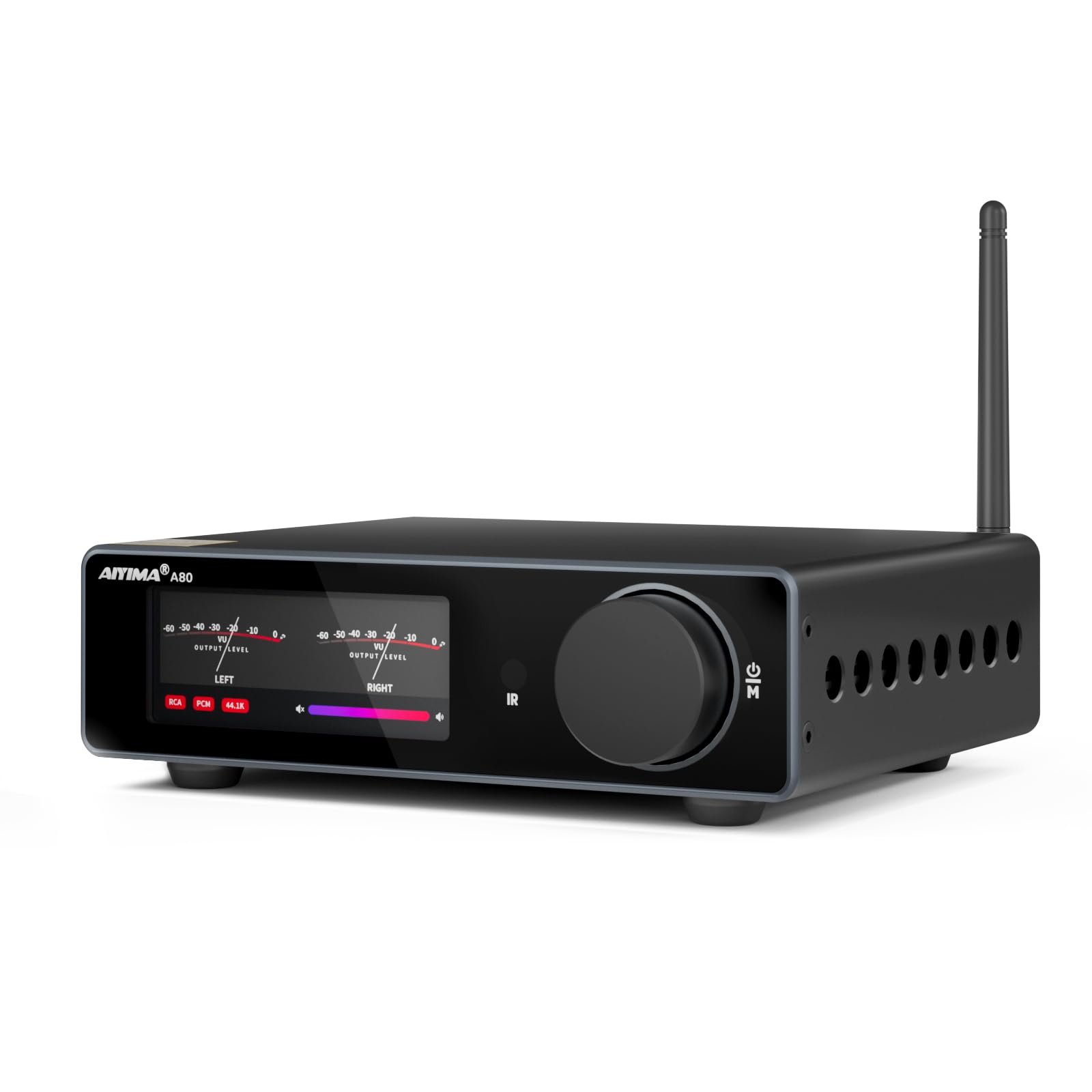
A feature-packed desktop powerhouse with a studio-grade DAC, balanced inputs, and a digital VU meter.
The AIYIMA A80 pairs an ESS9038Q2M DAC chip (a premium digital-to-analog converter that supports ultra-high resolution formats like DSD512 — a very high-definition audio format for audiophiles — and PCM, standard digital audio) with a TPA3255 Class D amplifier, rated at 300W*2 maximum output. The real differentiator here is the inclusion of professional TRS balanced inputs (Tip-Ring-Sleeve, a three-conductor connector that rejects electrical interference) — something you almost never see on a desktop amp — which customers note completely isolate environmental hum and eliminate speaker hiss. Reviewers consistently praise the “very low noise floor (no hiss at 100% volume)” and the fact that it runs cooler than similar dual-TPA3255 amps like the Fosi V3 or 3E A7. The compact dimensions (6.1 x 4.84 x 1.61 inches) and included DC48V 5A power adapter make it a true desktop fit.
The A80 also includes a 12V trigger input (to turn on with other gear), USB, optical, and coaxial inputs, plus a subwoofer pre-out and tone control via remote. One limitation reviewers point out is that while the amp gets loud, heavy bass with low-ohm subs may push beyond its gain limits — the stated 300W*2 power numbers are optimistic in real use. If you need balanced connectivity and a clean, hiss-free nearfield experience, this beats the WiiM Amp for a desktop role, though the WiiM has far better streaming integration.
Standout Features
- TRS balanced inputs — rare at this price point
- ESS9038Q2M DAC with DSD512 support
- Very low noise floor — shoppers say zero hiss at full volume
- Compact size with digital VU meter display
Watch Out For
- Power output falls short of 300W*2 claims in real use
- Auto-off feature and no power-on with AC are drawbacks
- No phono input or streaming
Ideal for: desktop listeners who need a balanced input, a high-quality DAC, and a near-silent noise floor — especially with sensitive nearfield monitors.
Consider something else if: you need streaming, multiroom, or high-ohm subwoofer support — this is a pure desktop DAC-amp.
5. Marantz PM6007

A no-nonsense stereo amplifier built around a toroidal transformer for clean, low-noise power delivery.
The Marantz PM6007 delivers 45 watts per channel into 8 ohms and 60 watts into 4 ohms, with a frequency response spanning 10 Hz to 70 kHz (the range of audio frequencies it can reproduce). It includes a built-in phono stage (MM, for moving-magnet cartridges — the most common turntable type), a high-quality optical DAC, and five analog inputs. The design uses a toroidal transformer (a circular-core power transformer that minimizes electromagnetic interference and noise) which owners say produces a clean, quiet background. One enthusiast reported the PM6007 sounds “better than the PM7000N” and noted it needs high volume for loud listening with Quad 22Ls, but that the optical DAC is “superb.”
Unlike the Denon PMA-600NE, which offers Bluetooth and an Analog Mode, the Marantz is pure analog with a single digital optical input — no Bluetooth, no Wi-Fi, no streaming. This makes it a true audiophile’s amp for listeners who prioritize soundstage and detail over convenience. Compared to the Cambridge AXA35, the Marantz feels more substantial (it weighs over 10 kilograms) and has a slightly richer midrange. The catch: no subwoofer output and no digital inputs beyond that single optical. If your sources are a turntable and a CD player, this is a lifetime buy.
what separates it
- Toroidal transformer for ultra-clean power
- Excellent soundstage and detail retrieval
- Built-in phono stage (MM)
- Solid, heavy build quality
What It Lacks
- No Bluetooth or Wi-Fi
- No subwoofer output
- Only one digital input (optical)
Choose this for: a pure two-channel analog system — turntable, CD player, and high-quality speakers — where soundstage and clarity outweigh convenience features.
Pass on it if: you need Bluetooth, a sub out, or streaming — the Marantz offers none of that.
6. Cambridge Audio AXA35

A purely analog integrated amplifier that punches well above its price in build and sound quality.
The Cambridge Audio AXA35 outputs 35 watts per channel into 8 ohms and includes a built-in phono stage, four RCA inputs, and a front-panel 3.5mm aux input. It has no digital inputs, no Bluetooth, no subwoofer output — it is analog-only, and that is the point. Reviewers consistently describe it as “staggeringly good for the right setup,” with one comparing it favorably against both the NAD 3020 and the Denon PM6000, calling it “open, punchy, easy” while being the cheapest of the three. The sound is clean, with detailed bass and clear vocals, and the phono stage brings vintage turntables to life.
Compared to the Marantz PM6007, the AXA35 costs significantly less and delivers a slightly leaner, more neutral sound — less rich in the lower mids but equally precise. Where the AXA35 loses is connectivity: no digital inputs at all, so you need an external streamer or DAC to use a TV or computer. An owner paired it with an Arylic S50 Pro+ for streaming and called it the “value for king of HiFi.” If your sources are all analog (turntable, CD player, tape deck), this is arguably the smartest money you can spend in this category.
What It Excels At
- Excellent analog sound quality for the price
- Built-in phono stage (MM)
- Clean, detailed presentation with good bass control
- Solid build and straightforward controls
Where It Falls Short
- No digital inputs — you need a separate DAC or streamer
- No subwoofer output
- Speaker wire connectors could be better
Buy this if: you run an all-analog source setup (turntable + CD player) and want superior sound without paying for digital features you will not use.
pass on it if: you need to connect a TV, computer, or streaming device directly — the AXA35 has no digital inputs.
7. Dayton Audio HTA100

A visually striking hybrid that brings the tube aesthetic and a warm sound to a budget-friendly package.
The HTA100 delivers 50 watts RMS per channel from a Class A/B amplifier with a vacuum tube preamp section, giving you the warm, slightly rounded character tube lovers enjoy without the low-power ceiling of a pure tube design. Inputs include RCA, Bluetooth 5.0, USB DAC (a digital-to-analog converter for computer audio), and a phono preamp, so you can connect a turntable, a phone, or a computer. The classic VU meters on the front panel and the exposed tubes make it a conversation piece in any listening room. Reviewers praise its warm, engaging sound — “good bass, smooth mids, relaxed treble” — with one noting it drives DT 880 Pro and HD6XX headphones well, even working with planar magnetic models.
Compared to its bigger brother, the HTA200, this model has half the power (50W vs 100W) and runs warmer — buyers report the HTA200’s fan never starts, while the HTA100 may trigger its fan more often. The remote is also sluggish here, same as the HTA200. If you like the tube look but do not need to fill a large room, the HTA100 gives you the same visual appeal and hybrid sound at a lower entry point. Just pair it with moderately sensitive speakers; it does not have the headroom for hard-to-drive floorstanders.
The Appeal
- Classic VU meters and glowing tubes — looks great
- Phono input, USB DAC, Bluetooth 5.0
- Warm, engaging sound with good headphone output
- Excellent value for a hybrid tube design
The Compromise
- Only 50W RMS — limited headroom for large rooms or low-sensitivity speakers
- Runs hot — fan may trigger during extended use
- Remote is sluggish and feels cheap
Great for: someone who wants the tube aesthetic and warm sound in a smaller setup — desktop, bedroom, or office — with moderate speakers.
Not for: large rooms, power-hungry speakers, or anyone who runs gear for hours without ventilation.
8. Oldchen EL34 Single-Ended Class A
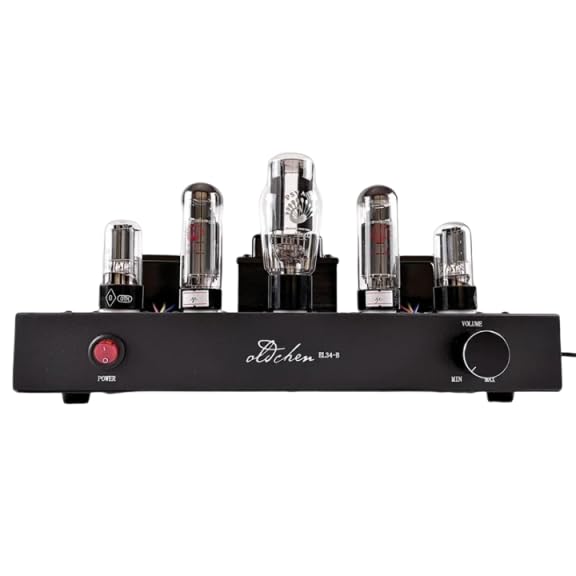
A hand-wired, single-ended Class A tube amplifier that gives you audiophile-grade sound at a fraction of the usual cost.
The Oldchen EL34 is a pure tube amplifier, not a hybrid — it uses EL34C power tubes, a 5U4G rectifier (a tube that converts AC to DC power), and 6SN7GT preamp tubes in a single-ended Class A circuit (the simplest and most linear tube design, where the output device is always on). It outputs just 10 watts per channel, but those watts are pure, warm, and detailed, delivered through hand-wired point-to-point circuitry with Teflon silver-plated wiring and premium components like a Japanese ALPS potentiometer (a high-quality volume control) and custom-wound transformers using imported Japanese Z11 silicon steel. Owners describe the midrange as “3D and holographic with huge soundstage,” and report zero hum or noise — the noise floor is an exceptionally quiet 0.5-1mV (millivolts, a measure of background electrical noise). One reviewer driving HiVi Swans 2.2 speakers says it operates efficiently at just 25-35% volume.
This amp only works with sensitive speakers — you need a sensitivity of 88dB or higher (90dB+ is ideal). Unlike the Dayton HTA200, which can drive almost anything, the Oldchen is a specialist. It also lacks a phono input, Bluetooth, or any digital connectivity — this is a straight analog device for listeners who value texture and soundstage over convenience. One reviewer called it “sweet sounding” with Klipsch Quartet speakers, describing the detail as “jaw dropping.” If you have high-efficiency speakers and want pure tube magic, this is the most affordable path in.
The Magic
- Hand-wired point-to-point with audiophile-grade components
- Ultra-low noise floor (0.5-1mV)
- Warm, holographic, 3D soundstage
- Genuine single-ended Class A tube sound at a low price
The Limits
- Only 10W — needs speakers with 88dB+ sensitivity
- No phono, Bluetooth, or digital inputs
- No remote control
This is for: the dedicated listener with high-efficiency speakers who wants the most affordable entry into classic single-ended tube sound.
Walk away if: you need power, streaming, or a phono input — this is a pure, limited-purpose tube amp.
Understanding the Specs
Class D vs. Class A/B vs. Single-Ended Class A
Class D amplifiers are switching amps — they use rapid on-off pulses to drive speakers, which makes them extremely efficient (small, cool, powerful). Class A/B amps use a continuous analog signal with two transistor pairs — they run warmer but often deliver a smoother, more natural sound that many listeners prefer. Single-ended Class A (used in the Oldchen EL34) is the most inefficient but most linear topology: the output device is always fully on, producing the purest sound with the most distortion-free low-level detail, but at very low wattage. Hybrid amps (Dayton HTA100/200) use a tube preamp for warmth but a solid-state Class A/B output stage for power — offering a middle ground.
Speaker Sensitivity and Power Matching
Speaker sensitivity, measured in decibels (dB), tells you how loud a speaker gets with 1 watt of power. A speaker rated 90dB will produce 90dB of sound from just 1 watt — that is loud enough for most rooms. A speaker rated 84dB needs twice the power for the same volume and quadruple for every 3dB increase. This is why the Oldchen (10W) can satisfy a room with 90dB+ speakers, while a 35W Cambridge AXA35 might struggle with 84dB floorstanders. Always match your amplifier’s power and topology to your speaker’s sensitivity — a mismatch is the most common reason buyers end up dissatisfied.
FAQ
What is the difference between an integrated amplifier and a receiver?
Do I need a phono input for a turntable?
Can I use an affordable integrated amplifier with a TV?
How many watts do I really need for normal listening?
What does a tube amplifier do that a solid-state amp does not?
Will a 10W tube amplifier be loud enough for my room?
Can I add a subwoofer to a stereo integrated amplifier?
Which amplifier is best for a desktop computer setup?
Final Thoughts: The Verdict
For most people, the best affordable integrated amplifier is the WiiM Amp because it combines streaming, multiroom, HDMI ARC, and genuine 60W power into a compact, app-controlled package that fits almost any modern listening scenario. If you want the sound quality and build of a classic analog amplifier with a built-in phono stage and the option to go purely digital-free, the Denon PMA-600NE is your next best choice. And for pure tube warmth with a show-stopping look, the Dayton Audio HTA200 delivers 100W RMS and a phono input in a package that will be the talking point of your listening room.
How We Picked
We do not accept paid placement. Every pick is matched to a real buyer and a real use-case; we do not hands-on test units.
Sources & Methodology
Specifications: manufacturer listings and product documentation. Review insights: verified customer reviews, as of July 2026. Pricing: not shown on this page (it changes often); check the current price via the retailer link.
As an Amazon Associate, Gadgets Feed earns from qualifying purchases. This does not affect which products we feature.
Product prices and availability are accurate as of the date/time indicated and are subject to change. Any price and availability information displayed on Amazon at the time of purchase will apply to the purchase of this product. As an Amazon Associate I earn from qualifying purchases.
CERTAIN CONTENT THAT APPEARS ON THIS SITE COMES FROM AMAZON. THIS CONTENT IS PROVIDED "AS IS" AND IS SUBJECT TO CHANGE OR REMOVAL AT ANY TIME.
Amazon and the Amazon logo are trademarks of Amazon.com, Inc. or its affiliates.