
Our readers keep the lights on and my morning glass full of iced black tea. As an Amazon Associate, I earn from qualifying purchases.
Specs are compiled from manufacturer listings and verified buyer reviews and can change over time — please confirm the key details on the product page before buying.
You want a portable power station that can keep a fridge running, run power tools, or get you through a blackout. The real question is not just how many watts it makes — it is how fast it recharges, how many years the battery will last, and whether you can actually carry it. A 1000W generator is a strong middle ground: it powers serious appliances but is still small enough to bring camping or stash in your trunk. The right one has a battery chemistry that lasts thousands of cycles and an inverter that handles the start-up spike when a motor kicks on.
I’m Min — the founder and writer behind Gadgets Feed. This guide is built by comparing the manufacturers’ published specifications and the patterns across verified customer reviews, so you get each pick’s real strengths and trade-offs instead of marketing spin.
We sorted through the spec sheets and real buyer experiences to find the 1000 watt solar generator that truly delivers reliable power for home backup, RV living, and off-grid work without the noise and fumes of a gas generator.
Quick Picks
- Jackery Explorer 1000 v2 — Best Overall
- DJI Power 1000 V2 — Fastest Recharge
- GRECELL 999Wh (Standalone) — Best Value
- GRECELL EB1000 + 200W Solar Panel — Complete Kit
How To Choose The Best 1000 Watt Solar Generator
Inside a 1000W class, every generator uses a different battery, inverter, and charging port setup. Those choices decide if it fits your life or just sits in the garage.
Battery Chemistry: LFP vs. NMC
You want a battery that lasts. Lithium iron phosphate (LFP, also called LiFePO4) batteries deliver roughly 4,000 charge cycles before dropping to 70% capacity — that translates to a solid decade of daily use. Older nickel manganese cobalt (NMC) packs often give only 500 to 800 cycles. For a generator you plan to keep ready for emergencies or use weekly, LFP is the chemistry worth prioritizing.
Surge Power vs. Continuous Power
The continuous rating tells you what the generator can sustain (around 1000W to 1500W in this class). The surge peak matters for starting motor-driven appliances like a refrigerator compressor, a sump pump, or a circular saw. A generator with a 3000W surge handles that initial spike far more reliably than one with a 2000W surge.
Recharge Speed and Solar Input
You need a recharge speed that matches your routine. In an outage or a busy camping day, some units recharge from a wall outlet in about one hour using an app-enabled emergency mode. Others require more than two hours. Solar input is measured in watts; higher solar input means topping up from panels takes less time, even in partly cloudy conditions.
USB-C Power Delivery (PD)
You charge your laptop, drone batteries, or tablet directly from the generator, so the USB-C PD (Power Delivery) wattage matters. A 100W USB-C port refills a MacBook Pro in about an hour, while a 60W port handles a standard ultrabook but charges slower. The newer 140W double USB-C ports add even more flexibility for creator kits and camera gear.
Quick Comparison
| Model | Best For | Battery Capacity | AC Output (Continuous / Surge) | USB-C PD Output | Amazon |
|---|---|---|---|---|---|
| Jackery Explorer 1000 v2 | Long-daily-use home backup & camping | 1070Wh | 1500W / 3000W | 100W | $429.00$799.00Limited time dealAmazon |
| DJI Power 1000 V2 | Fast-recharge emergency & drone work | 1024Wh | 2600W / 2600W | 140W (dual ports, 280W total) | $449.99$699.00Amazon |
| GRECELL 999Wh (standalone) | Budget-friendly all-around use | 999Wh | 1000W / 2000W | 60W | $284.99$499.99Limited time dealAmazon |
| GRECELL EB1000 + 200W Solar Panel | First-time buyer wanting a complete kit | 999Wh | 1000W / 2000W | 60W | $509.99Amazon |
In‑Depth Reviews
1. Jackery Explorer 1000 v2

You get a 3000W surge — 50% more headroom than the GRECELL’s 2000W surge — plus a decade-long LFP battery and a 1-hour recharge mode.
The Jackery Explorer 1000 v2 delivers a 1500W continuous AC output with a 3000W surge peak — that is a 50% higher surge than the GRECELL 999Wh’s 2000W peak, so it handles the moment a fridge compressor or a saw motor kicks on without tripping. At 23.8 lbs with a foldable handle, you can carry it from your trunk to a campsite easily.
Recharging is one of its best tricks. With the free Jackery App you can switch to emergency mode and go from 0 to 100% in one hour; the default 1.7-hour mode protects long-term battery health. The LFP (lithium iron phosphate) chemistry inside is rated for 4,000 cycles, which translates to about ten years before it drops below 70% of original capacity. Three USB-C ports are included, one of which delivers 100W PD (power delivery) — fast enough to top off a laptop without a separate power brick.
Buyers report it works reliably for vendor fairs, powering a printer and charging phones all day while still having over 85% left. Another reviewer noted it ran a fridge and a portable AC simultaneously during hurricane prep. The catch is that this unit is compatible only with Jackery’s own solar panels for solar charging, so if you already own non-Jackery panels you will need to factor in a panel purchase.
Jackery reliable backup: Between the 3000W surge, the decade-long LFP lifespan, the one-hour fast recharge, and the 1070Wh capacity that kept one reviewer’s fridge running for 14 projected hours, this is the most versatile pick for home backup, camping, or daily off-grid use. It is also significantly quieter than a gas generator at 30 dB in overnight mode. The buyer who needs blazing-fast dual 140W USB-C ports for heavy-duty drone or camera charging should pick the DJI below instead.
home emergency use: you want the best balance of runtime, surge headroom, recharge speed, and weight in a single 1000W-class generator. It is ready for hurricane season and weekend trips alike.
fast power needs: you already own non-Jackery solar panels or plan to charge two high-wattage laptops simultaneously via USB-C — the DJI offers more USB-C power and broader panel compatibility.
2. DJI Power 1000 V2
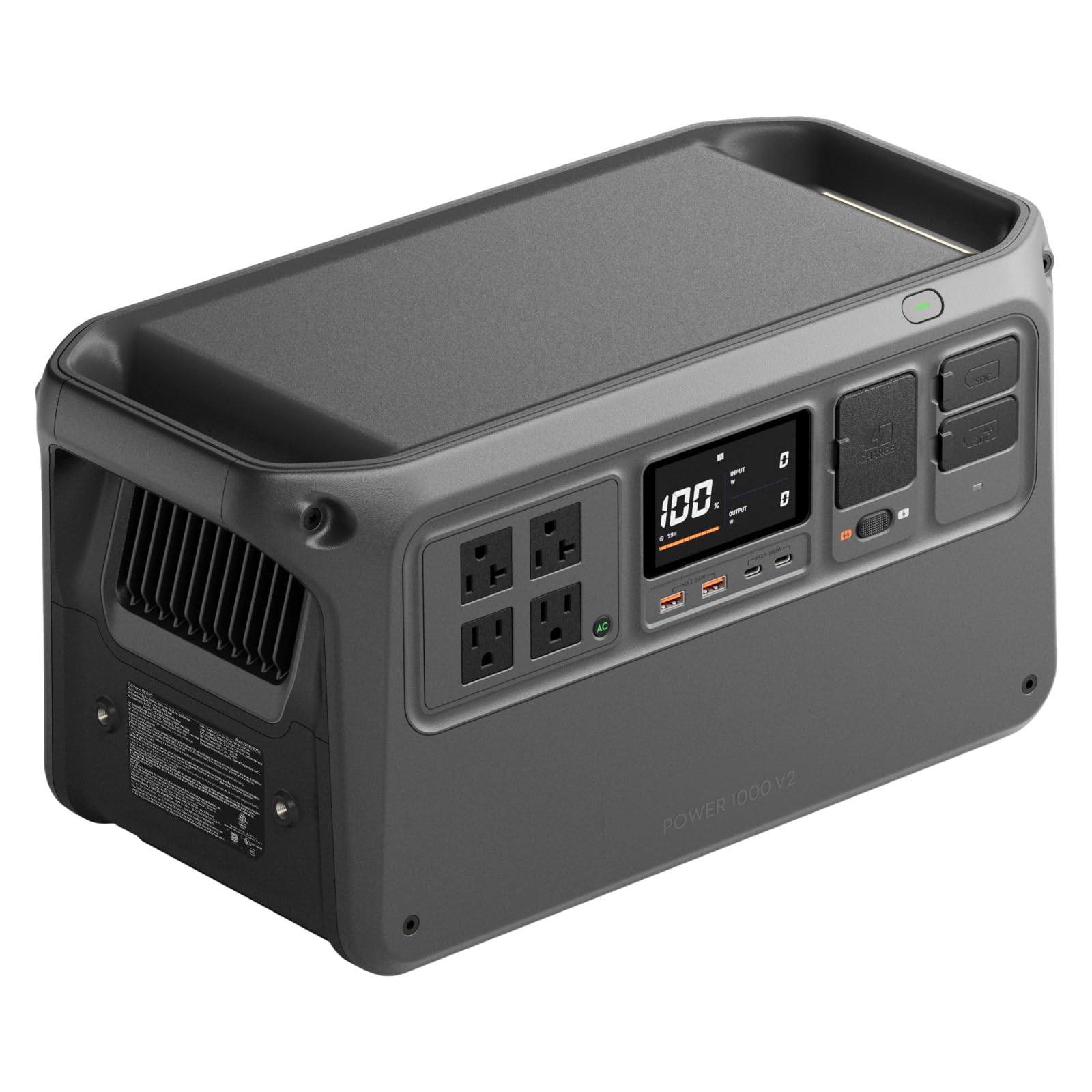
It hits 80% in 37 minutes — faster than any other model here — and gives you dual 140W USB-C ports for a laptop-and-drone workflow.
The DJI Power 1000 V2 is not messing around for recharge speed — it goes from 0 to 80% in just 37 minutes, and one reviewer noted the final stretch from 80 to 100% took only 15 to 20 more minutes via a wall plug. That is faster than any other generator in this roundup. It delivers a continuous 2600W AC output (versus 1500W on the Jackery), which means you can run heavy appliances like kettles, cookers, and power tools without worrying about the limit. The 1024Wh LFP battery is rated for a 10-year lifespan with a built-in intelligent BMS and flame-retardant housing for safety.
The USB-C output is also class-leading: dual 140W USB-C ports combine for 280W total, which is a 2.3x gap compared to the GRECELL’s single 60W port. That matters if you charge two laptops, a drone battery, and a tablet at the same time from the same generator. At just 26 dB the DJI is whisper-quiet — one buyer mentioned it runs their entire camper silently, replacing a loud gas generator. The UPS (uninterruptible power supply) switches in 10ms, so a desktop computer or a router never blinks during an outage.
The trade-off is size and shape. At 17.64 inches long it is the largest in this group by a 52% margin compared to the GRECELL 999Wh, and the fixed grip can feel awkward to carry. Another reviewer noted that the AC plug orientation is not the easiest, though it is still portable. Also, connecting solar panels or a car battery requires a separate compatible adapter.
DJI ultra-fast charging: The DJI is the right pick if you need the fastest possible recharge and dual high-power USB-C ports for a laptop-heavy workflow or drone business. It is also the quietest at 26 dB. skip it if your priority is compact storage or simple socket-style panel hookup without extra adapters — the Jackery is more straightforward there.
pro power users: you run a drone business, need dual 140W USB-C charging for laptops and cameras, or want the fastest AC recharge on the market for emergency preparedness.
budget buyers: you need a small footprint for tight van/RV storage — the GRECELL units are far more compact.
3. GRECELL 999Wh (Standalone)
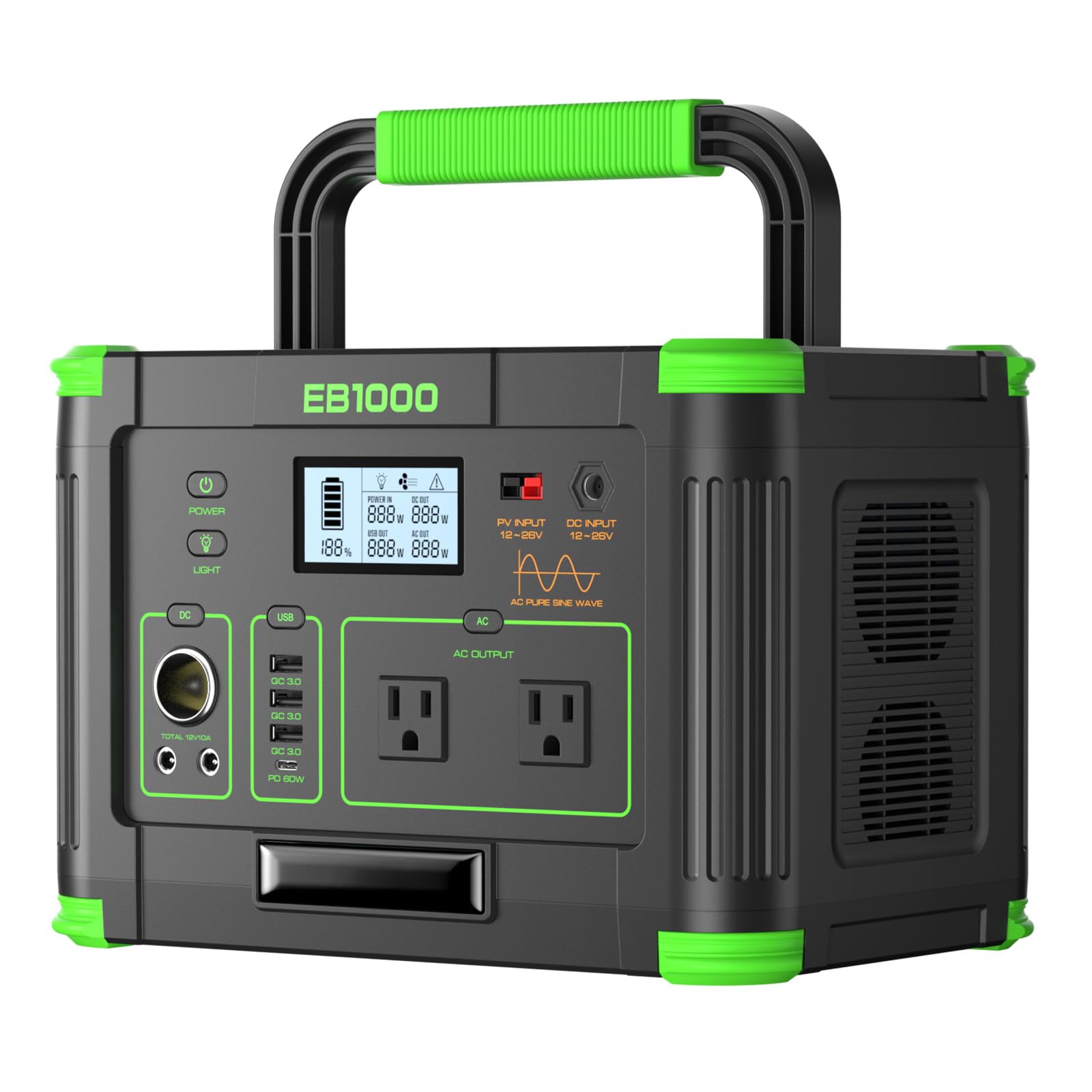
It packs a 999Wh battery and a built-in MPPT controller into the smallest frame here — just 11.6 x 7.91 x 7.91 inches at 23 lbs.
The GRECELL 999Wh delivers a 1000W continuous pure sine wave output with a 2000W surge — enough to handle most small appliances, a mini-fridge, and a 55-inch TV (which one buyer confirmed runs at about 65W, leaving 260W of headroom for other devices). It holds 999Wh of capacity, close to the 1070Wh on the Jackery but in a significantly smaller package: just 11.6 x 7.91 x 7.91 inches, making it the most compact unit here. At 23 lbs it is also the lightest by a small margin (the Jackery is 23.8 lbs).
This station includes a true built-in MPPT (Maximum Power Point Tracking) controller, which tune solar charging so you extract maximum power from your panels even in partly cloudy conditions. It offers three recharge methods: AC wall outlet, car outlet, and solar panel (the included 7909 solar charging cable is in the box). The USB-C PD port delivers 60W, which is fine for an ultrabook but half the speed of the Jackery’s 100W and well behind the DJI’s 140W ports. The unit also features a wireless charging pad on top and an LCD display that one buyer described as showing power in, power out, and remaining charge clearly.
The main trade-off is the lower surge capacity and USB-C speed compared to the top two picks. A buyer in Michigan noted they use it as a winter backup for a room, running a fan, TV, and soundbar, with good build quality and a reasonable price. The dual built-in cooling fans run quietly but are audible on high demand. The side-mounted outlets can feel less convenient than front-facing ports.
GRECELL compact value: The GRECELL 999Wh is the right choice if you want the smallest footprint and a budget-friendly entry into the 1000W class without sacrificing a built-in MPPT or decent surge capacity. The Jackery or DJI will serve you better if you need fast laptop charging via USB-C or a surge that can handle power tools.
budget conscious: you have a tight storage space, are new to solar generators, and need an affordable unit that still includes MPPT for efficient panel charging.
heavy power demands: you plan to run heavy power tools or charge laptops rapidly — the 60W USB-C and 2000W surge are limiting there.
4. GRECELL EB1000 + 200W Solar Panel
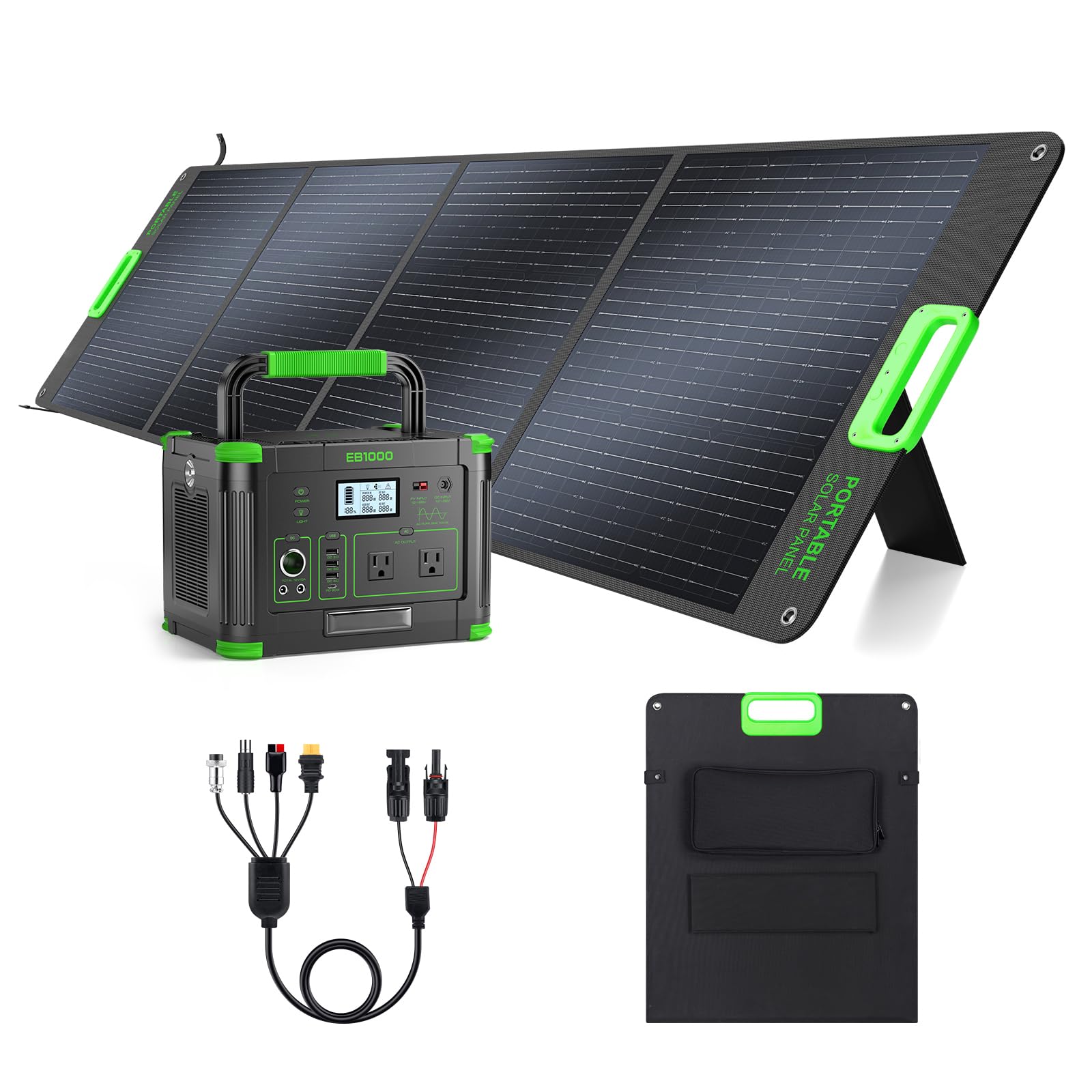
You get the same 999Wh station plus a rugged 200W, IP65-rated solar panel in one box — a true starter bundle.
The GRECELL EB1000 kit combines the same 999Wh, 1000W continuous (2000W surge) power station as the standalone unit above with a 200W monocrystalline solar panel, all in one box. That is the key difference — you get everything you need for solar charging right out of the gate, including an MC-4 to 4-in-1 charging cable with XT60, Anderson, DC79*09mm, and aviation connectors, designed to work with many different solar generators and battery types. The station packs the same 2 x AC sockets, 3 x USB QC ports, 1 x USB-C PD port at 60W, a wireless charging pad, and an LCD display.
The included solar panel stands out on its own: it has a PET-coated surface and a rugged 840D Oxford fabric backing for heat and dust resistance, plus an IP65 water-resistance rating — meaning it can handle splashes and rain during camping trips. One owner reported they used it to charge phones, a fan, and a headlamp while dry camping for 5 days, with the solar panel working well even in indirect sunlight.
The catch is clear: the station inside is identical to the standalone GRECELL, so it shares the same 60W USB-C PD limitation and 2000W surge ceiling. Also, the solar panel and power station ship separately, with two different tracking numbers, so you should plan for two deliveries. One customer observed that via solar it would not charge more than 82 amps (likely a misstatement — it charges in watts), but overall the kit was described as useful and light.
all-in-one solar kit: This package is perfect for someone who wants to start solar-powered right away without buying panels separately. The IP65-rated panel with wide connector compatibility makes it a solid choice for camping and RV use. If you already own solar panels or need faster USB-C charging, the standalone GRECELL unit (without the panel) might be a better fit.
first-time solar users: you are a first-time buyer who wants a complete solar generator kit — station plus panel — right from the start, and you value panel durability with IP65 water-resistance.
experienced off-gridders: you need high-speed USB-C charging or already have compatible solar panels — the Jackery or DJI units will give you more power throughput.
Understanding the Specs
Battery Capacity (Watt-Hours)
Watt-hours (Wh) tell you how much energy the generator can store — think of it like the size of your fuel tank. A 1000Wh unit can run a 100W device for roughly 10 hours, but real-world efficiency losses and inverter draw mean you should expect a little less. For a 1000W-class generator, look for at least 1000Wh of capacity to run a mini-fridge for about 12 hours or charge a laptop 20 times. Higher Wh means longer runtime between charges, so the 1070Wh Jackery gives you about 7% more endurance than a 999Wh GRECELL.
USB-C Power Delivery (PD)
USB-C PD (Power Delivery) is the fast-charging standard for modern laptops, tablets, and high-end phones. A 100W PD port can refill a MacBook Pro in about an hour, while a 60W port handles an ultrabook but charges it slower. Dual 140W ports (like the DJI has) mean you can charge two laptops at full speed simultaneously — ideal for a video-editing team or drone pilot. If the generator has only 60W USB-C and you need to top off a laptop, expect it to take roughly twice as long as a 100W port.
FAQ
Can a 1000W solar generator run a refrigerator?
How long does a 1000Wh generator last on a single charge?
What is the difference between LFP and standard lithium batteries?
Can I charge a solar generator while using it at the same time?
How fast does a 1000W generator recharge from a wall outlet?
What does pure sine wave mean for a solar generator?
Can I use solar panels from other brands with these generators?
How much does a 1000W solar generator weigh?
Final Thoughts: The Verdict
Across the board, the 1000 watt solar generator winner is the Jackery Explorer 1000 v2 because it delivers the best real-world runtime, the highest surge capacity (3000W), and a decade-long LFP battery — all in a reasonably portable 23.8-lb package. If you need the absolute fastest recharge and dual 140W USB-C ports for a laptop-heavy workflow, grab the DJI Power 1000 V2. And for a budget-friendly entry with a built-in MPPT that fits in tight spaces, the GRECELL 999Wh is a solid value pick.
How We Picked
We do not accept paid placement. Every pick is matched to a real buyer and a real use-case; we do not hands-on test units.
Sources & Methodology
Specifications: manufacturer listings and product documentation. Review insights: verified customer reviews, as of July 2026. Pricing: not shown on this page (it changes often); check the current price via the retailer link.
As an Amazon Associate, Gadgets Feed earns from qualifying purchases. This does not affect which products we feature.
Product prices and availability are accurate as of the date/time indicated and are subject to change. Any price and availability information displayed on Amazon at the time of purchase will apply to the purchase of this product. As an Amazon Associate I earn from qualifying purchases.
CERTAIN CONTENT THAT APPEARS ON THIS SITE COMES FROM AMAZON. THIS CONTENT IS PROVIDED "AS IS" AND IS SUBJECT TO CHANGE OR REMOVAL AT ANY TIME.
Amazon and the Amazon logo are trademarks of Amazon.com, Inc. or its affiliates.