
Our readers keep the lights on and my morning glass full of iced black tea. As an Amazon Associate, I earn from qualifying purchases.
Specs are compiled from manufacturer listings and verified buyer reviews and can change over time — please confirm the key details on the product page before buying.
If your pipes rattle, your faucets sputter, or you have already replaced a burst hose or a failed toilet fill valve, the culprit is almost certainly water pressure that is too high. A back pressure regulator valve clamps down on that incoming force, protecting your home’s plumbing from damage and cutting down on wasted water — but picking the wrong one means leaks, poor flow, or another replacement inside a year.
I’m Min — the founder and writer behind Gadgets Feed. This guide is built by comparing the manufacturers’ published specifications and the patterns across verified customer reviews, so you get each pick’s real strengths and trade-offs instead of marketing spin.
For a whole-house setup that can handle tough supply lines, the back pressure regulator valve with the best safety margin is the Snooweerin NR3XLDU, thanks to its 100 PSI (pounds per square inch) maximum pressure rating, while the Zurn Wilkins valves are rated for 75 PSI. If your pipes are 1/2-inch and you want tool-free installation, the Cash Acme EB45 push-to-connect model is your simplest entry point.
Quick Picks
- Cash Acme EB45 Pressure Regulating Valve — Compact Fit
- Snooweerin NR3XLDU 3/4″ Brass Pressure Reducing Valve — High-Pressure Boss
- Zurn Wilkins 34-NR3XLDU 3/4″ NR3XL Pressure Reducing Valve — DIY Favorite
- Zurn Wilkins 3/4″ Competitor Replacement Pressure Reducing Valve (34-625XL) — Premium Swap
How To Choose The Best Back Pressure Regulator Valve
A valve that does not match your pipe size or water pressure range will either starve your fixtures of flow or fail to protect them from surges. Focus on three core specs first, then check the build quality.
Connection Type and Size
You need the valve’s inlet and outlet connection to match your pipe’s diameter and thread standard so it seals properly. A 3/4-inch female national pipe thread (FNPT) valve, for instance, screws directly onto standard 3/4-inch threaded copper or galvanized pipe, while a 1/2-inch push-to-connect valve simply pushes onto PEX or CPVC without tools. Measure your pipe’s outer diameter or check the fitting stamp before buying — the wrong size will not seal.
Adjustable Pressure Range
To protect your plumbing, you need a regulator that can be set to the right output pressure. Every regulator has a factory set point (often 50 or 60 PSI) and an adjustable range, usually between 10 and 75 or 100 PSI. Look for a valve whose maximum rating is at least 10-15 PSI above your incoming static pressure so you have headroom to dial in the exact output you want. For example, a valve rated for 75 PSI max cannot safely handle a supply line that pushes 90 PSI at night.
Build Materials and Internals
To ensure the valve lasts, choose materials that resist corrosion. A brass or bronze body resists corrosion better than plastic or pot metal, especially in hot-water lines (some regulators tolerate up to 180°F). A built-in stainless steel strainer screen traps sediment before it reaches the valve’s internal diaphragm (the flexible disc that controls pressure), extending the valve’s life. Cartridge-loaded designs let you replace the working guts without cutting the pipe — a major time-saver on the next repair.
Quick Comparison
| Model | Best For | Max Pressure | Connection Size | Connection Type | Amazon |
|---|---|---|---|---|---|
| Cash Acme EB45 | Tool-free push-fit install | 60 PSI | 1/2 Inch | Push-to-Connect | $68.54Amazon |
| Snooweerin NR3XLDU | High-pressure supply lines | 100 PSI | 3/4 Inch | Threaded FNPT | $89.99$139.99Amazon |
| Zurn Wilkins 34-NR3XLDU | Compact swap-in replacement | 75 PSI | 3/4 Inch | Threaded FNPT | $96.78$232.99Amazon |
| Zurn Wilkins 34-625XL | Premium competitor replacement | 75 PSI | 3/4 Inch | Threaded FNPT | $339.56Amazon |
In‑Depth Reviews
1. Cash Acme EB45 Pressure Regulating Valve
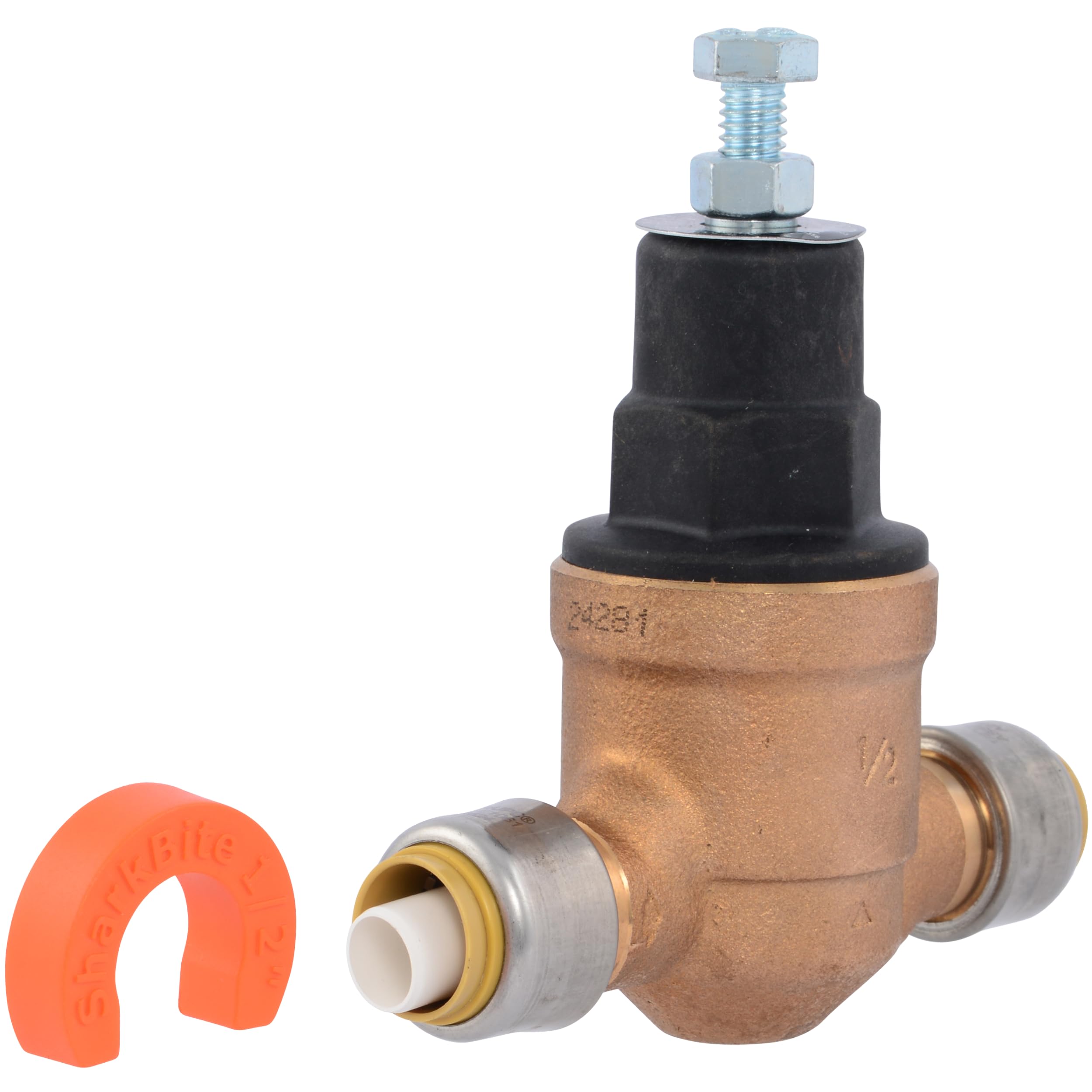
The push-fit valve that lets you skip the wrench entirely.
If you have ever wrestled with threaded brass fittings in a tight crawlspace, you will appreciate what this valve does differently: its push-to-connect design (a fitting that simply pushes onto the pipe without tools) accepts standard 1/2-inch copper, PEX, or CPVC pipe with a simple push — no soldering, no thread tape, no pipe wrench. The stainless steel teeth grip the pipe while the O-ring (a rubber ring seal) compresses for a leak-free seal, and the included SharkBite disconnect clip lets you pull it back apart just as easily if you need to reposition it. At just 2.39 inches deep and 5.62 inches long, it squeezes into spots where a bulkier threaded valve simply will not fit.
To protect your fixtures from high pressure, the valve is factory-set to 60 PSI, and you can adjust the output between 10 and 70 PSI using the tamper-resistant poly top (a polymer cap that locks in place so accidental bumps do not change your setting). It handles hot water up to 180°F and is assembled in the USA from brass, stainless steel, and polymer components compliant with NSF/ANSI 372 for potable (drinkable) water. Buyers report that once installed, “it does its job and keeps the pressure steady at 60 PSI like it’s supposed to,” and several noted the tool-free install made the job far simpler than a traditional regulator swap.
The catch is the 1/2-inch connection — this is a point-of-use or small-house valve, not a whole-home regulator for larger 3/4-inch or 1-inch supply lines. One reviewer also reported a leak within a year, which suggests the polymer components may not match the longevity of an all-bronze body. For a quick, clean install on a single fixture or a small home at a mid-range price, however, this is tough to top in convenience.
Best for push-fit simplicity: If your pipes are 1/2-inch and you want a valve you can install in minutes without special tools, this is the easiest entry point in the group.
Watch the polymer internals: A single report of an early leak means you should verify the seal after installation and check the valve annually.
Reach for this if: you value speed of installation over brute-force durability.
Consider another if: your main supply line is 3/4-inch or your incoming pressure regularly exceeds 80 PSI.
2. Snooweerin NR3XLDU 3/4″ Brass Pressure Reducing Valve
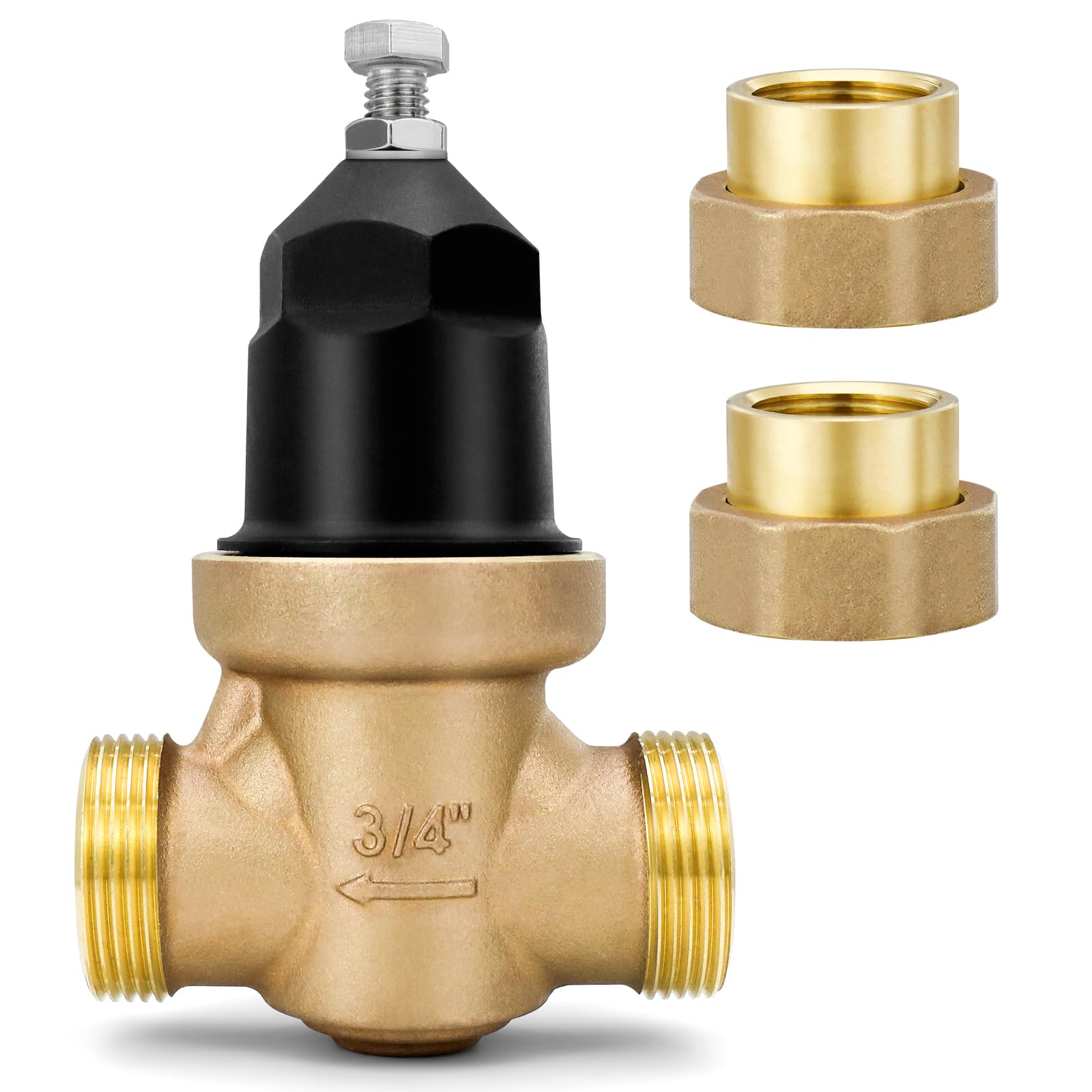
The bronze workhorse that handles the highest incoming pressure of the group.
To protect your plumbing from aggressive water supply spikes, this valve offers the highest safety margin: a maximum pressure rating of 100 PSI, while the Zurn Wilkins valves are rated for 75 PSI. That extra capacity means it is built for homes with municipal water that shoots above the typical 60-80 PSI range. The all-bronze body resists corrosion and is designed so The maker claims it reduces water waste by up to 50% by lowering high supply pressure to a safe 50 PSI.. Its double union FNPT connections (two threaded nuts that let the valve body disconnect without unthreading the entire pipe assembly) speed up installation: you thread the unions onto your 3/4-inch pipes, then tighten the nuts over the valve body without having to turn the whole assembly.
To extend the valve’s service life, a built-in stainless steel strainer screen catches sediment, scale, and debris before they reach the internal diaphragm — a detail that directly extends the valve’s life compared to a regulator with no filter. At 5.5 x 2.8 x 5.5 inches, it is compact enough for a utility closet or under-sink space, and it comes preset to 50 PSI from the start. Buyers confirm it is an “exact match for old name-brand nr3xl” and that it works as a drop-in replacement; one noted the threads are razor sharp and advised sanding them before installation to avoid cuts.
This is a mid-range offering — not the cheapest option, but not the premium Zurn either. One reviewer who worked in water services their whole life called it “a good one,” which carries weight given the industry experience. If you need to tame supply pressure that regularly pushes 80-100 PSI, the NR3XLDU’s higher ceiling gives it a clear advantage over the Zurn Wilkins 34-NR3XLDU, which maxes out at 75 PSI.
What you gain
- Highest max pressure rating at 100 PSI — handles the toughest supply lines
- Integrated stainless steel strainer traps debris before it reaches the diaphragm
- Compact 5.5-inch lay length fits tight spaces
One real drawback
- Threads reported as razor sharp — sandpaper recommended before tightening
Your best bet for high-pressure zones: If your water supply routinely hits 80-100 PSI, this valve is the only pick in the group that handles that force without exceeding its rating.
skip it if: you need a push-to-connect fitting — this requires threaded pipe and a wrench.
3. Zurn Wilkins 34-NR3XLDU 3/4″ NR3XL Pressure Reducing Valve
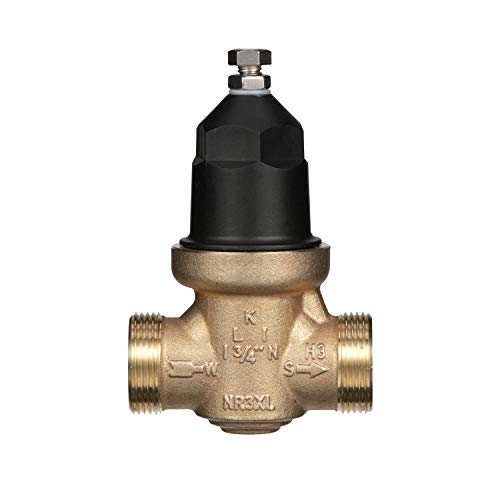
The short-body regulator that makes future repairs a 10-minute job.
To save you time and hassle on future repairs, this valve uses a cartridge-loaded design (the internal working parts are contained in a single replaceable unit). You can rebuild it without cutting the pipe or unthreading the entire assembly from the wall. Just unscrew the bronze bell, pop out the old cartridge, and slide in a new one — a feature buyers repeatedly praised for turning what could be a plumbing project into a half-hour swap. One reviewer noted it was a “perfect fit for replacing a different manufacturer’s valve” and that it “reduced city pressure from over 100 psi to 60 psi.”
This Zurn Wilkins valve shares the same 5.5-inch lay length (the measurement between the two connection points) and 3/4-inch double union FNPT form factor as the Snooweerin above, but it brings a premium pedigree for safety. Rated for a maximum pressure of 75 PSI, the valve is ASSE Listed 1003 and IAPMO Listed, and it meets NSF/ANSI 61 for drinking water safety. The compact design includes an integral stainless steel strainer screen to protect the cartridge from debris, and the threaded bell is highly durable and resists corrosion — important in damp basements or crawlspaces. Buyers also reported that it “reduced city pressure from 95 psi to 55 psi” and made their appliances quieter after installation.
The honest trade-off here is the maximum pressure: at 75 PSI, it has less headroom than the Snooweerin’s 100 PSI rating. For homes with supply pressure that stays below about 90 PSI, that is fine — you still have room to adjust down to your target. But if your static pressure routinely hits 100 PSI, you will be operating at the very edge of this valve’s safe range. The double union connection is the stronger argument for this pick: it simplifies removal so much that one DIY buyer called the swap “half an hour job” even on a first attempt.
Cartridge convenience wins here: No other valve in this lineup makes future cartridge swaps as painless — a real plus if you plan to keep the home for years.
Keep an eye on the pressure ceiling: At 75 PSI max, this is not for supply lines that regularly sit at 90 PSI or higher.
Perfect for the DIY homeowner: If you want a valve you can service yourself in minutes without calling a plumber, the cartridge design and double union make this the smartest mid-range choice.
Pick the Snooweerin instead if: your incoming pressure is consistently above 80 PSI and you need the higher safety margin of the Snooweerin’s 100 PSI rating.
4. Zurn Wilkins 3/4″ Competitor Replacement Pressure Reducing Valve (34-625XL)

The drop-in upgrade that fits where a competitor’s valve once sat.
This is the valve you buy when your old Watts regulator fails and you want a replacement that bolts into the same footprint without re-piping. The 34-625XL is engineered with an equivalent lay-length (the distance between connection points) to the main competitor, so you remove the old unit and thread this one into the same space — no new pipe, no extra fittings, no soldering. The bronze threaded bell speeds access to the cartridge internals, which The maker claims it reduces labor by 50% compared to competitor bolted-style bodies.. It also includes an integral by-pass check valve (a built-in valve that prevents backflow) and a 20-mesh strainer screen (a filter with 20 openings per inch) to trap debris.
Rated to a maximum of 75 PSI, this Zurn handles the same pressure ceiling as the 34-NR3XLDU but comes in a larger package: at 14.3 x 8.3 x 4.5 inches, while the more compact Snooweerin NR3XLDU measures 5.5 x 2.8 x 5.5 inches, so it needs more clearance inside the valve box or utility room. Owners mention that it “reduces both the static and dynamic pressure from 120 PSI to 55 PSI,” and one reviewer who had three Watts units fail found that the “Zurn PRV outperforms Watts” and provides fully adjustable pressure. Another noted it held pressure steady at 70 PSI.
The premium price is the big hurdle here — this is the most expensive valve in the roundup by a wide margin. You are paying for the purpose-built competitor replacement design and the by-pass check valve, which is not present on the other picks. If you are replacing a failed regulator that uses a proprietary mounting footprint, this saves you from having to adapt the plumbing; otherwise, a standard double-union valve like the Zurn 34-NR3XLDU or the Snooweerin will do the same job for less.
The big advantages
- Drops into a competitor’s existing footprint without re-piping
- Integral by-pass check valve and 20-mesh strainer built in
- Customers note it outperforms failed Watts units and holds pressure reliably
The real cost
- Significantly larger dimensions than other 3/4-inch options — needs room to fit
- Premium price that is hard to justify unless you need the exact competitor footprint
Strictly for competitor replacements: If you are swapping out a dead Watts or similar valve and want to avoid re-piping, this is the cleanest path forward.
Skip it for fresh installs: For a new installation where you control the footprint, a standard double-union valve like the Zurn NR3XLDU or the Snooweerin delivers the same performance for a fraction of the cost.
Understanding the Specs
Maximum Pressure Rating
This is the highest incoming water pressure — measured in pounds per square inch (PSI) — the valve can safely handle before risking damage or failure. So, a valve rated for 75 PSI max should never be installed on a supply line that regularly hits 90 PSI; you need at least 10-15 PSI of headroom above your static pressure. The Snooweerin NR3XLDU leads here at 100 PSI, while both Zurn Wilkins valves cap at 75 PSI.
Connection Type and Inlet Size
The connection type determines how the valve attaches to your pipes. Push-to-connect fittings (like the Cash Acme EB45) push onto 1/2-inch PEX or copper without tools or thread sealant. Threaded FNPT (female national pipe thread) connections, found on all 3/4-inch valves here, screw onto standard threaded male pipe fittings. The inlet size must match your supply line diameter — 1/2-inch for point-of-use fixtures, 3/4-inch for whole-home installations.
FAQ
What size back pressure regulator valve do I need for a whole house?
Can I install a push-to-connect regulator on copper pipe?
What does the double union on a pressure reducing valve do?
How do I adjust the output pressure on a regulator valve?
Will a back pressure regulator valve work with a well pump system?
How often does a pressure reducing valve need to be replaced?
What happens if I install a regulator with a maximum pressure rating lower than my supply pressure?
Is a brass or bronze regulator better than a plastic one?
Final Thoughts: The Verdict
The back pressure regulator valve that balances safety margin, build, and price for most users is the Snooweerin NR3XLDU. Its 100 PSI maximum rating gives you greater headroom than the Zurn Wilkins options’ 75 PSI, plus it packs a built-in stainless steel strainer and a compact 5.5-inch double union body at a mid-range price. If you want tool-free installation on 1/2-inch pipes, grab the Cash Acme EB45. And for a cartridge-based valve that makes future DIY repairs the simplest of the group, the Zurn Wilkins 34-NR3XLDU is a strong choice.
How We Picked
We do not accept paid placement. Every pick is matched to a real buyer and a real use-case; we do not hands-on test units.
Sources & Methodology
Specifications: manufacturer listings and product documentation. Review insights: verified customer reviews, as of July 2026. Pricing: not shown on this page (it changes often); check the current price via the retailer link.
As an Amazon Associate, Gadgets Feed earns from qualifying purchases. This does not affect which products we feature.
Product prices and availability are accurate as of the date/time indicated and are subject to change. Any price and availability information displayed on Amazon at the time of purchase will apply to the purchase of this product. As an Amazon Associate I earn from qualifying purchases.
CERTAIN CONTENT THAT APPEARS ON THIS SITE COMES FROM AMAZON. THIS CONTENT IS PROVIDED "AS IS" AND IS SUBJECT TO CHANGE OR REMOVAL AT ANY TIME.
Amazon and the Amazon logo are trademarks of Amazon.com, Inc. or its affiliates.