
Our readers keep the lights on and my morning glass full of iced black tea. As an Amazon Associate, I earn from qualifying purchases.
Specs are compiled from manufacturer listings and verified buyer reviews and can change over time — please confirm the key details on the product page before buying.
You want to step into a game where a virtual dragon flies around your living room couch, or join a meeting as an avatar that actually smiles when you do. The real question is not whether AR VR headsets are cool — they are — it is which one actually delivers the blend of sharp visuals, long play sessions, and comfortable fit without emptying your wallet or gathering dust after a week.
I’m Min — the founder and writer behind Gadgets Feed. This guide is built by comparing the manufacturers’ published specifications and the patterns across verified customer reviews, so you get each pick’s real strengths and trade-offs instead of marketing spin.
Finding the right ar vr headset depends on matching your priorities with the specs that actually matter for your daily use — whether you are a gamer, a fitness junkie, or a productivity explorer.
Quick Picks
- Meta Quest 3S 256GB — Best Overall
- Meta Quest Pro — Pro Creator
- HTC Vive XR Elite — Ultraportable
- HTC Vive Focus Vision Wired Bundle — High-Fidelity Streamer
- Meta Quest 3S 128GB — Budget Champion
How To Choose The Best AR VR Headset
Picking your first or next mixed reality headset means balancing a few key specs against how you actually plan to use it. Here is what to look for.
Standalone vs. PC-Tethered
A standalone headset like the Meta Quest 3S has the processor and battery built in, so you just put it on and play anywhere without cables. A PC-tethered headset like the HTC Vive Focus Vision connects to a powerful computer for better graphics but ties you to a desk. If you want freedom to move around your living room, go standalone. If you already own a high-end gaming PC and want the best visuals, look for DisplayPort or USB-C Link support.
Display Resolution and Refresh Rate
Resolution is measured in pixels per eye (for example, 2064 x 2208). Higher numbers mean you see less of the screen-door effect — the grid lines between pixels. The refresh rate, measured in hertz (Hz), determines how smooth motion looks. A 90 Hz refresh rate is the baseline for comfortable VR; 120 Hz feels noticeably smoother and can help reduce motion sickness for sensitive users.
Battery Life and Comfort
Most standalone headsets give you two to three hours of active play. If you want longer sessions, look for models with a battery average life of 4 hours or more, or a hot-swappable battery design that lets you swap packs without powering down. Weight distribution also matters — a headset that puts the battery on the back of the strap (like the Meta Quest Pro) feels more balanced than one that loads everything on the front.
Quick Comparison
| Model | Best For | Display Resolution | Refresh Rate | Battery Life | Amazon |
|---|---|---|---|---|---|
| Meta Quest 3S 128GB | Budget entry to VR | 2064 x 2208 | 90 Hz | 3 Hours | $319.99Amazon |
| Meta Quest 3S 256GB | Best value for mixed reality | 2880 x 1600 | 120 Hz | — | Amazon |
| Meta Quest Pro | Face tracking and productivity | High (refer to description) | 90 Hz | 8 Hours | Amazon |
| HTC Vive XR Elite | Travel-friendly XR | 1920 x 1920 per eye | — | 2 Hours | Amazon |
| HTC Vive Focus Vision | High-end PC VR streaming | 2448 x 2448 per eye | 90 Hz | — | Amazon |
In‑Depth Reviews
1. Meta Quest 3S 256GB
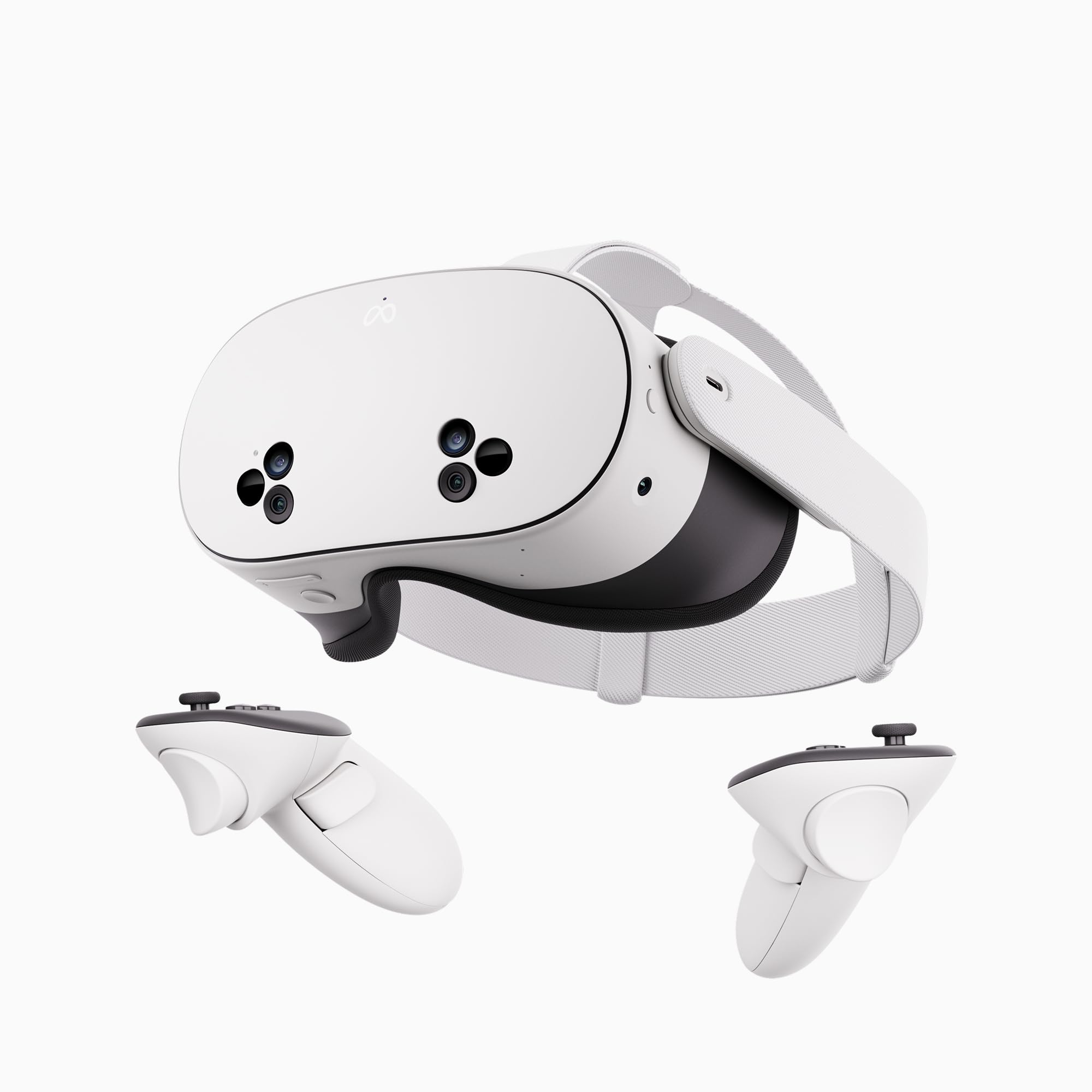
the balance between high-end visuals and a price that does not sting.
The Quest 3S 256GB makes mixed reality a daily habit rather than a special occasion. You blend digital objects into your actual room with the color passthrough cameras, and the 120 Hz refresh rate — versus the 90 Hz on the 128GB model — makes every movement feel fluid and reduces the queasy disconnect some people get in VR. Reviewers report that setup is quick, the visuals are sharp, tracking is accurate, and the controllers feel responsive even during long sessions.
Battery life is listed at roughly 3 hours for the 128GB version, so expect similar here for active gaming. The real win is the 256GB storage, giving you room for dozens of games and apps without constantly uninstalling. It is also completely wireless, so you can spin, duck, and dodge without tripping over a cord.
The only real trade-off is that the strap, while much better than the Quest 2, still puts a bit of weight on the front of your face. Many buyers solve that with a third-party Elite Strap, which is a modest extra cost. For the mix of performance, library size, and price, this is the one most people should buy.
The headset for everyday adventurers: If you want to game, work out, and watch movies in mixed reality without spending premium-tier money, the 256GB Quest 3S delivers the smoothest experience at this price point.
The one realistic catch: The battery will tap out after a couple of heavy gaming sessions, so you will want a charging dock or a power bank for marathon nights.
Reach for this if: You want the best balance of visual quality, game library, and price in a self-contained headset — it is the most versatile pick for gamers and first-time buyers alike.
Look elsewhere if: You need all-day standalone battery life or you want to use face tracking for social VR apps.
2. Meta Quest Pro

The face tracker that brings your avatar to life, if you can stomach the short runtime.
The Quest Pro is built for someone who wants their virtual meetings and social VR interactions to feel genuinely human. Its self-tracking Touch Pro controllers capture every finger motion, and the built-in face and eye tracking translate your real expressions into avatar movements with uncanny accuracy — buyers describe the face tracking as “magical” and far more precise than third-party add-ons on other headsets. The pancake lenses with local dimming and quantum dot tech deliver striking visual clarity. At 5348 Milliamp Hours, the battery has more capacity than the 4324 Milliamp Hours in the Quest 3S 128GB. But real-world use tells a different story than the 8-hour official spec: one buyer measured 4 hours without face tracking and 2 hours with it active. The power-hungry sensors drain it fast. The included charging dock helps, but you will likely want a battery pack for longer sessions.
Build quality feels premium, and the counterbalanced design (battery in the back) distributes weight better than front-heavy headsets like the Quest 3S. If your main goal is expressive social VR, this is the best tool for the job. For general gaming, the Quest 3S offers a sharper 2064 x 2208 resolution versus the Quest Pro’s 1800 x 1920 per eye and more consistent controller tracking for less money.
The face-tracking specialist: If you spend your VR time in VRChat or virtual meetings and want your avatar to mirror your real expressions, nothing else at this price comes close.
The honest friction point: Controller tracking can drift unexpectedly, and the headset gets hot during face-tracking use — plus the short real-world battery means you will need an external pack or a charging dock nearby.
Best for: Social VR users, VRChat enthusiasts, and remote workers who want natural avatar expression in meetings.
skip it if: You just want to game — the Quest 3S gives you better resolution, more consistent controllers, and a larger accessory ecosystem for less money.
3. HTC Vive XR Elite

A sleek, glasses-friendly headset that slips into a bag — if your forehead can handle the squeeze.
The XR Elite is HTC’s answer to the buyer who wants high-quality optics in a compact form. It uses pancake lenses with adjustable diopter dials (so you can set the focus for each eye without wearing glasses underneath), and the display resolution of 1920 x 1920 per eye provides crisp, edge-to-edge clarity. Reviewers consistently praise the optics, calling them “far better than Quest 2” and noting that PC VR gaming via cable link runs flawlessly. The high-resolution XR passthrough lets you see your surroundings in color while you interact with virtual content.
The pain point is comfort. Multiple buyers report that the forehead pressure from the battery cradle becomes painful during extended sessions, and “glasses mode” (where the visor flips up) feels tight for people with larger heads. The battery average life of 2 hours is short — one reviewer measured “under 2 hours” standalone — so you will need the hot-swappable batteries or a power bank to finish a movie or a long game session. The controller tracking can also struggle in low light, and the standalone app store is thin compared to Meta’s library.
If you value portability and optical clarity above all else and you already have a VR-ready PC, the XR Elite is a solid travel companion. For most standalone use, the Quest 3S offers a more comfortable experience and a much larger game library.
The on-the-go XR companion: The adjustable diopters and compact design make this the easiest headset to pack for trips, and PC VR via Virtual Desktop works great.
The ergonomic warning: The forehead pressure is real — buyers who found it uncomfortable needed an aftermarket facial interface, and the 2-hour battery life means you are always watching the clock.
Reach for this if: You wear glasses, travel frequently, and want a headset that connects to your PC for high-fidelity VR without taking up your whole suitcase.
Look elsewhere if: You plan to play standalone games for more than an hour at a time — the short battery and forehead pressure make long sessions a chore.
4. HTC Vive Focus Vision Wired Bundle

The all-in-one that turns into a pro PC VR rig with one cable.
The Vive Focus Vision is built for the buyer who wants both worlds: a standalone headset for casual use and a lossless PC VR experience via DisplayPort mode for hardcore gaming. The 5K resolution — 2448 x 2448 pixels per eye — is the sharpest in this lineup, and the 120-degree field of view is the widest on the list, giving you more peripheral vision and deeper immersion. Built-in eye and hand tracking plus support for face and body trackers make this a compelling choice for VRChat users who want full-body expression. Buyers who use it for PC VR note that “DisplayPort mode enables lossless PCVR” and that the hot-swappable battery extends sessions without downtime.
The catch is software polish. Several owners mention a buggy experience: the streaming kit is underpowered (it needs a 45W source), the DisplayPort connection can be unstable and occasionally reverts to USB causing disconnects, and the software can glitch (one reviewer described “world tilts 45°”). The Fresnel lenses also produce noticeable god rays and visible lens lines, which feels like a step back at this premium price point. The controllers are described as large with inaccurate tracking, and the head strap lacks downward rotation for a snug fit.
For serious PC VR streamers who are willing to tinker with driver settings and tolerate occasional bugs, the Focus Vision delivers class-leading raw specs. For everyone else, the more polished Quest ecosystem or the HTC Vive XR Elite (with its better optics) are safer bets.
The spec-heavy enthusiast’s pick: With the highest per-eye resolution, the widest field of view, and hot-swappable batteries, it checks every box on paper for demanding PC VR users.
The rough edges: Software instability, Fresnel lens artifacts, and finicky DisplayPort connections mean you need patience and a willingness to troubleshoot — this is not plug-and-play.
Best for: PC VR enthusiasts who want lossless DisplayPort visuals, wide FOV, and eye/face tracking for social VR — and have the technical comfort to handle occasional bugs.
pass on it if: You want a polished out-of-the-box experience — the Quest 3S is simpler, more reliable, and costs a fraction of the price.
5. Meta Quest 3S 128GB
The entry point that does not feel cheap — great VR on a budget.
The 128GB Quest 3S is the most affordable way to get into true mixed reality without giving up the core experience. It runs on the same Snapdragon XR2 Gen 2 processor as its bigger sibling, so you get 2x graphical processing power compared to older Quest models, and the dual RGB color cameras deliver full-color passthrough that blends your real and digital worlds convincingly. Buyers consistently call it a “great VR value,” praising the quick setup, sharp visuals, accurate tracking, and responsive controllers. The 3-hour battery average life (powered by a 4324 Milliamp Hours battery) is enough for most gaming sessions, though not for marathon all-day use.
The main trade-off compared to the 256GB version is the 90 Hz display refresh rate instead of 120 Hz. The 90 Hz refresh rate (instead of 120 Hz) means motion is slightly less smooth, and you may notice a bit more blur during fast head turns. The 2064 x 2208 pixel resolution per eye is still sharp enough that text and details are clear, but the 256GB model’s 2880 x 1600 resolution has a higher pixel count for a cleaner image. Storage at 128GB is adequate for a handful of games but fills up fast if you download the big titles like *Beat Saber* or *Half-Life: Alyx*.
For anyone new to VR or anyone on a tighter budget, this headset gives you 90% of the premium experience at a much lower entry cost. The 3-month Meta Horizon+ trial included gives you immediate access to a rotating library of games, so you start playing the moment you unbox it.
The smart entry point: It delivers the same Snapdragon XR2 Gen 2 power, color passthrough, and wireless freedom as the 256GB model at a friendlier price — perfect for first-time VR buyers.
The trade-off you feel: The 90 Hz refresh rate (vs 120 Hz on the 256GB) and smaller storage mean you will notice slightly less smooth motion and will need to manage your game library more carefully.
Reach for this if: You are new to VR and want the best possible experience without overspending — it gives you the full Quest 3S feature set with a small compromise on smoothness and storage.
Look elsewhere if: You already own a Quest 2 and want a noticeable upgrade — the Quest 3S 256GB with 120 Hz and more storage is the clearer step up.
Understanding the Specs
Display Resolution and Refresh Rate
Resolution is measured in pixels per eye (like 2064 x 2208). Higher numbers mean you see less of the screen-door effect — that grid-line filter between pixels that can break immersion. The refresh rate, measured in hertz (Hz), tells you how many times the image updates per second. A 90 Hz display updates 90 times a second and feels smooth to most people; a 120 Hz display updates 120 times a second and is noticeably smoother, which helps prevent motion sickness during fast-paced games. The Quest 3S 256GB runs at 120 Hz, compared to 90 Hz on the 128GB model.
Battery Life and Hot-Swappable Batteries
Battery life is measured in hours of active use, but real-world times vary depending on what you are doing — playing a graphically intense game drains the battery faster than watching a movie. The Meta Quest Pro claims an 8-hour battery average life but only hits that in light use; with face tracking active, it drops to about 2 hours. A hot-swappable battery design (found on the HTC Vive Focus Vision) lets you swap a drained battery for a fresh one without powering down the headset, so you can keep playing indefinitely if you have spare packs.
FAQ
Can I use an AR VR headset without a PC?
What does “mixed reality” mean on an AR VR headset?
How long does the battery last on a typical VR headset?
Are AR VR headsets compatible with prescription glasses?
What is the difference between 90 Hz and 120 Hz in VR?
Can I connect a Quest 3S or Quest Pro to my PC for better graphics?
What is face tracking and why would I want it?
How much storage do I really need on a VR headset?
Is the HTC Vive Focus Vision worth the premium price?
Do AR VR headsets come with games included?
Final Thoughts: The Verdict
For the majority of shoppers, the ar vr headset winner is the Meta Quest 3S 256GB because it delivers the best blend of smooth 120 Hz visuals, a rich mixed reality experience, and a massive game library at a mid-range price. If you want face tracking for expressive social VR, grab the Meta Quest Pro. For the highest-resolution PC VR streaming with a wide 120-degree field of view, the HTC Vive Focus Vision is the one to consider if you are willing to tolerate software bugs.
How We Picked
We do not accept paid placement. Every pick is matched to a real buyer and a real use-case; we do not hands-on test units.
Sources & Methodology
Specifications: manufacturer listings and product documentation. Review insights: verified customer reviews, as of July 2026. Pricing: not shown on this page (it changes often); check the current price via the retailer link.
As an Amazon Associate, Gadgets Feed earns from qualifying purchases. This does not affect which products we feature.
Related Guides
Product prices and availability are accurate as of the date/time indicated and are subject to change. Any price and availability information displayed on Amazon at the time of purchase will apply to the purchase of this product. As an Amazon Associate I earn from qualifying purchases.
CERTAIN CONTENT THAT APPEARS ON THIS SITE COMES FROM AMAZON. THIS CONTENT IS PROVIDED "AS IS" AND IS SUBJECT TO CHANGE OR REMOVAL AT ANY TIME.
Amazon and the Amazon logo are trademarks of Amazon.com, Inc. or its affiliates.