
Our readers keep the lights on and my morning glass full of iced black tea. As an Amazon Associate, I earn from qualifying purchases.
Specs are compiled from manufacturer listings and verified buyer reviews and can change over time — please confirm the key details on the product page before buying.
That dead battery after a weekend away is not bad luck — it is a parasitic draw, a tiny current that slowly sips power from your RV, boat, or classic car all week long. A simple on/off switch placed right at the battery terminal stops that leak cold, so you get a guaranteed start every time you turn the key. The trick is picking the right switch for your voltage, amperage, and mounting situation so you don’t swap a dead battery for a melted switch.
I’m Min — the founder and writer behind Gadgets Feed. This guide is built by comparing the manufacturers’ published specifications and the patterns across verified customer reviews, so you get each pick’s real strengths and trade-offs instead of marketing spin.
Whether you are wiring up a solar-powered trailer, a 48V golf cart, or a marine dual-battery setup, choosing the right battery switch on off means matching the current rating to your load. You also need to pick a form factor that fits your battery post or panel cutout without guesswork.
Quick Picks
- Blue Sea Systems e-Series 9003e — Top Performer
- Malictele Side Post Battery Switch — Best Overall
- AWBLIN Battery Disconnect Switch with Voltmeter — Smart Monitor
- GOGONFLY 12V-48V 275A Master Switch — Weather Guard
- Nilight 1-2-Both-Off Battery Switch — Dual-Battery Boss
- Spurtar Battery Disconnect Switch 200A — Tough Metal Build
- QuickCar Racing Products 55-010 Master Disconnect — Track-Ready
How To Choose The Best Battery Switch On Off
Picking a battery disconnect switch depends on matching three things: how much current your gear pulls, what voltage your system runs, and where you plan to mount the switch. A mismatch on any of those three turns a useful tool into a fire hazard or a part that simply does not fit.
Current Rating — Continuous vs. Peak
The most important number on a battery switch is its continuous amperage rating — the steady load it can carry without overheating. Many switches list a much higher intermittent or cranking rating (like 1000A for a few seconds), but that is for starter motors only. For running a fridge, inverter, or lights hour after hour, look at the continuous DC rating. A switch rated for 200 amps continuous handles a typical camper or small boat easily, while a 275-amp or 350-amp continuous switch is needed if you plan to run a larger inverter or multiple high-draw appliances at once.
Voltage Compatibility
Most switches are labeled for 12V to 48V DC systems, but always check the upper limit. A switch rated for 48V will work on a standard 12V car or a 36V golf cart. If you have a 60V solar bank or an electric vehicle conversion, look for a switch that explicitly includes that range — some premium models now cover 5V to 60V DC. Never run a 12V-only switch on a higher voltage system; the internal contacts may arc or fail.
Mounting and Terminal Style
Switches attach either directly to the battery post (side post or top post) or to a panel or wall via a cutout hole. Direct-mount switches are the simplest install — no extra cables — but they only fit batteries with the correct post type. Panel-mount switches require a hole saw and some wiring but let you place the switch wherever is convenient, like the side of a battery box or a dashboard. Terminal stud size (3/8 inch is standard) matters because your ring terminals must fit without drilling.
Quick Comparison
| Model | Best For | Continuous Amps | Voltage Range | Mount Style | Amazon |
|---|---|---|---|---|---|
| Blue Sea Systems 9003e | High-amp marine/RV builds | 350A | 48V DC | Surface or panel mount | $35.91$59.99Amazon |
| Malictele Side Post | Direct battery-side install | 275A | 12V-48V | Side post direct | $12.88Amazon |
| AWBLIN with Voltmeter | Voltage monitoring on the go | 250A | 5V-60V | Panel mount | $27.99Amazon |
| GOGONFLY 275A | Weather-exposed installs | 275A | 12V-48V | Panel mount | $16.99Amazon |
| Nilight 1-2-Both-Off | Dual-battery management | 200A | 12V-48V | Panel mount | $13.59$15.99Limited time dealAmazon |
| Spurtar 200A | All-metal ruggedness | 200A | 12V-48V | Surface mount | $15.99$16.99Amazon |
| QuickCar Racing 55-010 | Track-day or theft deterrent | 125A | 12V | Panel mount | $44.47Amazon |
In‑Depth Reviews
1. Blue Sea Systems e-Series 9003e
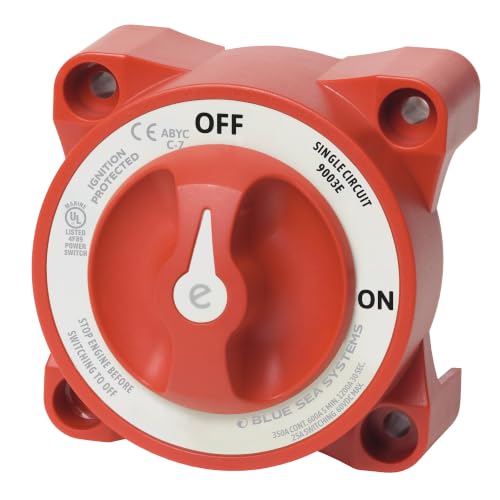
This switch laughs at a 3000W inverter load — it is built for the heaviest marine and RV builds.
You install this when you want to forget it exists. The Blue Sea 9003e delivers 350 amps continuous at 48V DC, which gives it more headroom than any other switch here. It beats the 275A Malictele and the 200A Nilight by a wide margin. Tin-plated copper studs resist corrosion in saltwater environments. The textured knob lets you find Off or On by feel in a dark engine bay. Buyers report using it to disconnect two 230Ah LiFePO4 batteries feeding a 3000W inverter in an overlanding solar setup, and the switch handles it without getting warm.
Installation requires a 3 5/8-inch hole saw for a proper flush mount, which reviewers consistently mention. The switch is compact — its small footprint supports tight spaces — but the studs are standard 3/8 inch, so ring terminals fit without adapters. One reviewer noted it lacks a non-metallic back cover for accidental contact prevention, so adding a boot or mounting it inside a box is wise for exposed installations.
Why it dominates
- 350A continuous — handles the heaviest loads without flinching
- Tin-plated copper studs resist saltwater corrosion
- Textured knob allows blind operation in low light
The install gotcha
- Requires a 3 5/8″ hole saw for flush mount — no standard punch
- No rear insulator cover included
Reach for this: If you are building a serious solar-powered camper, a twin-battery boat, or any setup where you will draw 200+ amps continuously and cannot afford a failure.
Look elsewhere: If you only need a simple on/off for a 12V car battery and do not want to drill a 3 5/8-inch hole — the extra cost and install effort are overkill for that job.
2. Malictele Side Post Battery Switch

Screw this side-post switch directly to your battery — no extra cable or bracket needed.
If you want the simplest possible battery disconnect — one that screws right onto the battery side post — this Malictele is it. It carries 275 amps continuous, which is at 275A versus the 200-amp Nilight switch, making it a better fit for anyone running solar or a high-draw inverter. The removable bolts mean you can take the switch off for maintenance without undoing the whole battery connection. Owners mention using these on 300 Ah lithium-ion batteries in solar setups and note “connectivity is great no power leaks by when they are off.”
The IP67 rating (totally dust-tight and submersible in 1 meter of water for 30 minutes) matters: mounting it on an exposed battery in a Jeep or a boat tray is fine. The side post design is straightforward — you remove your existing battery bolt, slide the switch in, and tighten. One thing to know: the switch is 4.9 x 2.1 x 1.85 inches, so it occupies space right on the battery post. If your battery sits in a tight plastic box, measure clearance first.
Why it is a breeze
- Bolts directly to side post — no extra cables, no drilling
- 275A continuous beats most budget switches by miles
- IP67 rated for wet and dusty locations
What it is not
- Fits side-post batteries only — not for top post or remote panel mounts
- Takes up real estate on the battery; may not fit cramped boxes
Ideal for: Anyone who wants a truly tool-less install — screw it on the battery, turn the rotary knob, and done. Great for RV solar banks, golf carts, and marine start batteries.
skip it if: Your battery has top posts only, or you need to mount the switch away from the battery on a dashboard or wall panel.
3. AWBLIN Battery Disconnect Switch with Voltmeter

A premium nylon shell and a live voltage display — you always know your battery’s health at a glance.
This AWBLIN switch replaces the usual plastic body with a nylon 66 shell that handles heat better and feels denser in hand. The standout feature is the LED digital voltmeter (a live voltage readout) built into the knob: when the switch is on, the screen shows battery voltage in real time. When you flip it off, the display goes dark and draws zero standby current. That built-in meter saves you from digging out a multimeter every time you wonder if your battery is holding charge. Buyers confirm the voltmeter is accurate and does not noticeably drain a golf cart battery on a 54V system.
It covers a wider voltage range than most — 5V to 60V DC — making it suitable for 6V, 12V, 24V, 48V, and even 60V systems. The current rating is 250 amps continuous at 12V, which is plenty for a camper, boat, or trailer. One buyer mentioned the instructions are unclear and you may need to drill your own mounting holes, but the kit includes a rubber gasket and rear cover to protect terminals. The blue LED voltmeter is bright at night but can be hard to read in direct sunlight, so mount it where it is shaded if you plan to check it often.
The live-feed advantage
- Real-time voltage display — no multimeter needed
- Nylon 66 shell resists heat better than standard ABS
- Wide voltage range (5V-60V) fits oddball systems
A couple of quirks
- Blue LED voltmeter is tough to read in bright sunlight
- Mounting instructions are vague; expect to drill your own holes
Grab this if: You want to monitor battery voltage without extra gear — perfect for RVs and solar setups where you check charge levels daily.
Pass on it if: You just need a simple off switch and do not care about voltage readout; the extra cost is not worth it for a basic install.
4. GOGONFLY 12V-48V 275A Master Switch

A fully enclosed ABS housing keeps mud, rain, and corrosion away from the contacts.
If your switch lives in the open — under a truck hood, on a trailer tongue, or bolted to a boat battery box — this GOGONFLY model brings a fully enclosed design that wraps the wiring in plastic. The IP54 rating (protected against splashing water and dust) means you do not have to baby it. The core spec matches the Malictele: 275 amps continuous, 455 amps intermittent for five minutes, and 1250 amps cranking for ten seconds. Clockwise to turn on, counterclockwise to turn off — simple binary operation.
The kit includes four mounting bolts, four 2×3/8-inch copper ring terminals, heat shrink tubing, and a hex wrench, so you have everything for a clean install from the start. Reviewers praise the tactile feel: one ham radio operator uses it on a LiFePO4 backup battery and calls the detent “positive.” A minor downside several buyers mention is that the mounting screws are machine thread, not self-tapping, meaning you need to drill pilot holes and tap them for the screw heads to sit flush. The included hardware package is generous, but plan for a bit of drilling.
Protected build
- Fully enclosed housing blocks dirt and moisture
- 275A continuous — matches the top-tier budget switches
- Generous install kit with ring terminals and heat shrink
Installation friction
- Machine-thread screws need pre-drilled pilot holes
- Housing is bulkier than open-frame switches
Best situated for: Outdoor or engine-bay installs where rain, mud, and road salt are constant threats.
Not great if: You want a super low-profile switch or a direct battery-post mount — this is a panel-mount design that needs a flat surface.
5. Nilight 1-2-Both-Off Battery Switch

A four-position rotary that lets you pick battery A, battery B, both, or cut everything off.
This Nilight is the go-to for anyone running two batteries — a start battery and a house battery on a boat or camper. The rotary knob clicks through four positions: 1 (battery one only), 2 (battery two only), Both (both combined), and Off (everything disconnected). It is rated for 200 amps continuous at 12V DC, 300 amps intermittent, and 1000 amps momentary for engine cranking. The ABS plastic housing has a rear cover that insulates the terminals against accidental short circuits.
Buyers caution that the internal contacts are small. One reviewer posted a photo of the innards and warned: “Probably should NOT run high amps through this thing. Not near their rated 200 amps.” They installed it in a camper to switch low-draw items like a propane fridge, stereo, and USB outlets — about 20 amps total — and it works fine there. The inverter is a definite no-go according to that same reviewer. If your setup draws over 50 amps continuous, look at the Malictele or Blue Sea instead. For managing dual batteries at modest loads, this is the most versatile tool here.
Selector versatility
- Four positions: 1, 2, Both, Off — full dual-battery control
- Rear cover insulates terminals from shorts
- Easy to wire; markings on the case are clear
Know its limits
- Internal contacts are small; do not trust 200A continuous for high-draw gear
- Plastic housing feels less sturdy than metal-body switches
Tailored for: Dual-battery boats, RVs, and trailers where you switch between banks but keep loads under 50 amps.
Do not use if: You plan to run an inverter, winch, or heavy DC load through it — step up to a higher-rated single-circuit switch.
6. Spurtar Battery Disconnect Switch 200A

An all-metal housing and a satisfying click — it feels like a switch that will outlast the vehicle.
The Spurtar stands out from the sea of plastic switches with a silver metal body that resists heat and impact better than ABS. It is rated for 200 amps continuous and 1000 amps intermittent, using a toggle-style action with a clear click sound so you know it is engaged. The kit comes with two 3/8-inch copper lugs, two heat shrinks, and two rubber terminal insulator sleeves that prevent accidental shorting — thoughtful extras that save a trip to the hardware store.
A reviewer upgrading a 2016 trailer from acid to lithium battery mounted the Spurtar on the empty battery box lid. They noted: “I did have to replace the trailer connection as it wouldn’t fit on the bolt.” The switch uses standard 3/8-inch studs, but some larger ring terminals may need a bit of filing. Once connected, it worked perfectly for isolating the lithium bank. The metal body is the main draw here — it simply does not feel flimsy, and in hot climates where plastic degrades, this switch holds up.
Built to last
- Metal body handles heat and abuse better than plastic
- Kit includes copper lugs, heat shrink, and terminal insulators
- Toggle action with a positive click — no half-engaged position
Tight fit
- Some large ring terminals do not fit the studs without modification
- 200A continuous is fine for most, but less headroom than 275A options
Pick this when: You are mounting the switch in a hot engine bay or direct sun where plastic switches crack and fade.
Choose another if: You need over 200 amps continuous or a direct side-post mount — the Spurtar is a surface-mount toggle only.
7. QuickCar Racing Products 55-010 Master Disconnect

A compact race-style switch that takes up almost no space but kills power with total authority.
Do not let the low 125-amp rating fool you — this QuickCar switch is purpose-built for 12V race cars, classic cars, and theft-deterrent installations where every square inch of dash space counts. The body measures just 2.5 inches high by 2.5 inches wide, with a red aluminum on/off panel that makes the switch easy to spot at a glance. The rotary action is simple: turn to connect, turn back to kill everything. Buyers install it on Land Rover Defenders and street cars to isolate the battery when parked for weeks, and report that it shuts power off instantly with a solid feel.
One critical caveat: the included mounting panel is designed for panels up to about 1/4 inch thick. If you mount it in a thick wooden dash or a heavy-gauge metal panel, the switch body may not reach through far enough for the nut to catch. A reviewer on a pontoon boat found the mounting panel barely bigger than the switch body, making it hard to cover a large hole. Measure your panel thickness before buying — this is best for thin fiberglass, plastic, or metal dashes common in race and off-road vehicles.
Compact and clear
- Very small footprint — fits tight dashboards
- Red panel is instantly visible in an emergency
- Super sturdy build; feels like it will last decades
The thin-panel limit
- Mounting panel only suits surfaces up to 1/4″ thick
- 125A max is too low for inverters, winches, or dual-battery house loads
Ideal for: Race cars, weekend toys, and daily drivers where you want a visible, theft-proof kill switch that fits in a small hole.
Not for: Any system running 12V loads over 100 amps or panels thicker than about a quarter-inch — you need the Blue Sea or a larger model for those jobs.
Understanding the Specs
Continuous vs. Intermittent vs. Cranking Amps
The most misleading number on a battery switch is the big one printed on the front. Many switches list an “intermittent” rating of 300-1000 amps, but that is only for a few minutes or seconds at a time. The number that actually matters for running a fridge, lights, or a water pump hour after hour is the continuous rating. A 200A continuous switch handles most RVs and boats fine. If you run a large inverter or an electric winch, go 275A or higher. The cranking rating (often 1000A+) only matters for starting engines — ignore it for accessory loads.
IP Rating — What It Tells You
IP stands for Ingress Protection, a standard for how well a device keeps out dust and water. The first digit is dust protection (6 is fully dust-tight). The second digit is water protection (7 means you can submerge it in 1 meter of water for 30 minutes; 5 means it handles rain but not immersion). For a switch mounted inside a vehicle cab or a dry battery box, IP54 is plenty. For a switch bolted to an exposed battery tray on a boat or off-road rig, IP67 gives real confidence. Do not overpay for waterproofing you do not need — and do not cheap out on it when the switch sits in the weather.
FAQ
Can I use a 12V battery switch on a 24V or 48V system?
How do I know if a switch is side-post compatible?
What size hole saw do I need for a panel-mount battery switch?
Will a battery switch drain my battery when it is in the Off position?
Can I leave a battery switch on all the time?
What is the difference between a 1-2-Both-Off switch and a simple On/Off switch?
Do I need a fuse or circuit breaker in addition to a battery switch?
Can I use a battery switch as a theft deterrent?
How many amps does a typical RV fridge draw through a battery switch?
What does IP67 mean on a battery switch?
Final Thoughts: The Verdict
For most buyers, the battery switch on off winner is the Malictele Side Post Switch because it delivers 275 amps continuous with the simplest possible install — just bolt it to the battery and you are done. If you want voltage monitoring at a glance, grab the AWBLIN with Voltmeter. And for the heaviest builds where 350 amps continuous is the baseline, the standout is the Blue Sea Systems 9003e.
How We Picked
We do not accept paid placement. Every pick is matched to a real buyer and a real use-case; we do not hands-on test units.
Sources & Methodology
Specifications: manufacturer listings and product documentation. Review insights: verified customer reviews, as of July 2026. Pricing: not shown on this page (it changes often); check the current price via the retailer link.
As an Amazon Associate, Gadgets Feed earns from qualifying purchases. This does not affect which products we feature.
Related Guides
Product prices and availability are accurate as of the date/time indicated and are subject to change. Any price and availability information displayed on Amazon at the time of purchase will apply to the purchase of this product. As an Amazon Associate I earn from qualifying purchases.
CERTAIN CONTENT THAT APPEARS ON THIS SITE COMES FROM AMAZON. THIS CONTENT IS PROVIDED "AS IS" AND IS SUBJECT TO CHANGE OR REMOVAL AT ANY TIME.
Amazon and the Amazon logo are trademarks of Amazon.com, Inc. or its affiliates.