
Our readers keep the lights on and my morning glass full of iced black tea. As an Amazon Associate, I earn from qualifying purchases.
Specs are compiled from manufacturer listings and verified buyer reviews and can change over time — please confirm the key details on the product page before buying.
Tap water can carry lead, arsenic, fluoride, and chlorine that you do not want in your glass. Alkaline reverse osmosis system handles both sides: it strips out those contaminants and then adds back minerals so the water tastes clean, not flat. The catch is that many models either deliver pure but lifeless water, or their mineral-boosting stage fades after a few months. Here are the systems that hold up for years, not weeks.
I’m Min — the founder and writer behind Gadgets Feed. This guide is built by comparing the manufacturers’ published specifications and the patterns across verified customer reviews, so you get each pick’s real strengths and trade-offs instead of marketing spin.
You want water that tastes like spring water without the waste or complexity. A truly great alkaline reverse osmosis system needs fast flow, easy maintenance, and a consistent pH boost. These models do all three.
Quick Picks
- NU Aqua 7-Stage (12 Step Filtration) UV & Alkaline Under Sink Reverse Osmosis Water Filter System — Best Overall
- APEC Water RO-PH90, 6-Stage Alkaline Under Sink Reverse Osmosis Water Filter System — Premium Certified
- WINGSOL Reverse Osmosis Water Filter, Mineral Alkaline UV Tankless RO System — Space Saver
- APEC Water ROES-PH75X 6-Stage Alkaline Under Sink Reverse Osmosis Water Filter System — Reliable Value
- Frizzlife PX500-A Under Sink Tankless Reverse Osmosis Water Filtration System — Fast & Sleek
- Home Master TMHP HydroPerfection Reverse Osmosis System, 9-Stage — Deep Purifier
- iSpring RO500AK-BN Reverse Osmosis Water Filter, NSF 58 Certified, 500 GPD Tankless — Certified Tankless
How To Choose The Best Alkaline Reverse Osmosis System
An alkaline RO system adds a final remineralization stage that traditional RO units lack. Without that stage, the water is stripped of everything — including the natural calcium and magnesium that give it taste and body. The trick is finding a system where that mineral boost is consistent, not just a cartridge that runs dry in three months. Here is what to look for.
Flow Rate and Daily Capacity
Daily capacity tells you how much water the system can produce in 24 hours. A 75-gallon-per-day (GPD) unit handles a small family, while a 500 GPD tankless system fills a glass in seconds without waiting. The maximum flow rate (measured in gallons per minute, or GPM) matters when you are filling a large pot or a pitcher — anything below 0.05 GPM feels slow on a busy morning.
Tank vs. Tankless Design
A tank-based system stores purified water in a pressurized bladder, so you have a steady reserve even if the filter is slow. The downside is the tank takes up under-sink space and can breed bacteria over time if not used often. Tankless systems filter on demand and save roughly 70-75% of cabinet space, but they need a power outlet (110-240v) and a pump to push water through the membrane quickly.
Remineralization Quality
Not all alkaline filters are equal. The best use high-purity calcium carbonate (often US-made) to raise pH while adding magnesium and potassium for a balanced mouthfeel. Many buyers report that a cheap alkaline cartridge fades after a month, leaving water that tastes flat again. Look for a system where the alkaline stage is replaceable independently and is a dedicated stage (not a combined filter).
Waste Water Ratio
Traditional RO systems waste 3-4 gallons of water for every gallon they purify. Modern systems with a permeate pump or advanced membranes achieve a 2:1 or 1.5:1 pure-to-drain ratio. The WINGSOL and iSpring models in this guide both claim a 2:1 ratio (every 2 cups of clean water produce only 1 cup of waste), which is a meaningful difference on your water bill over a year.
Certifications and Filter Life
NSF/ANSI Standard 58 covers RO systems for TDS reduction, while Standard 53 covers taste and odor (chlorine, VOCs). Standard 372 confirms the product is lead-free. A system with WQA certification or NSF listing gives you third-party proof that the contaminant reduction claims are real. Filter life cycles vary — carbon prefilters typically need changing every 6 months, RO membranes last 2 years, and alkaline stages often last 6-12 months depending on usage.
Quick Comparison
| Model | Best For | Capacity (GPD) | Flow Rate (GPM) | Filtration Stages | Amazon |
|---|---|---|---|---|---|
| APEC Water ROES-PH75X | Reliable value with extra pre-filters | 75 GPD | 0.05 GPM | 6-Stage | $314.29Amazon |
| NU Aqua 7-Stage UV & Alkaline | High flow with UV sterilization | 100 GPD | 0.07 GPM | 7-Stage (12-Step) | $259.95$297.99Amazon |
| WINGSOL Tankless RO | Space-saving tankless design | 400 GPD | — | 6-Stage + UV | $259.99Amazon |
| APEC Water RO-PH90 | Premium build with US-made filters | 90 GPD | 0.06 GPM | 6-Stage | $332.16$409.99Amazon |
| Frizzlife PX500-A | Tankless 500 GPD with filter alerts | 500 GPD | 0.4 GPM | 3-Stage + Alkaline | $322.99$379.99Limited time dealAmazon |
| Home Master TMHP HydroPerfection | 9-stage deep purification with UV | 2000 gal (annual) | 1 GPM | 9-Stage | $445.55Amazon |
| iSpring RO500AK-BN | NSF 58 certified, 500 GPD tankless | 500 GPD | 0.4 GPM | 3-Stage + Alkaline | $625.06Amazon |
In‑Depth Reviews
1. NU Aqua 7-Stage (12 Step Filtration) UV & Alkaline Under Sink Reverse Osmosis Water Filter System
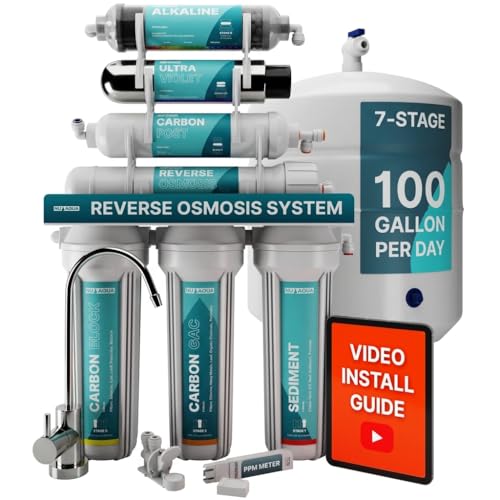
Delivers 100 GPD daily output and still fits in a UV light plus an alkaline stage — at 100 GPD versus the APEC ROES-PH75X at 75 GPD, so you do not wait as long during busy mornings.
This system pours water at 0.07 Gallons Per Minute and produces 100 gallons per day. That is at 100 GPD versus the APEC ROES-PH75X at 75 GPD, so you are less likely to run dry during a busy morning with multiple fills. The 7-stage filtration (which the maker calls 12-step) includes a UV light that kills microorganisms, plus an alkaline remineralization filter that adds calcium back for a smooth, non-flat taste. The tank holds the purified water in a standard bladder, meaning you get steady pressure without needing a power outlet under the sink.
Owners mention that this is the “third NU Aqua system purchased” over 8+ years, citing reliable performance with no leaks and easy installation that takes under an hour thanks to color-coded tubing and quick-connect fittings. One reviewer noted that a cracked intake fitting from shipping and some leaking fittings needed re-taping, but resolved quickly. The system includes a PPM meter and a leak detector as bonuses, and the 120-day home trial with a 3-year warranty gives you room to test it.
Why it leads the list
- 100 GPD flow outpaces competing 75 GPD units, so filling a large pot is noticeably faster.
- UV sterilization adds an extra microbial barrier that standard alkaline-only systems lack.
- Included PPM meter and leak detector remove guesswork from maintenance.
What to watch for
- At 28 pounds it is the heaviest unit here — a tight squeeze under a shallow sink.
- The spigot handle can feel loose from the start, a minor but common complaint.
Best for the long haul: Buyers who want UV confidence, high daily output (100 GPD), and a system backed by a 3-year warranty with a 120-day risk-free trial.
The one catch: The tank takes up cabinet space, so measure your under-sink area before buying.
2. APEC Water RO-PH90, 6-Stage Alkaline Under Sink Reverse Osmosis Water Filter System
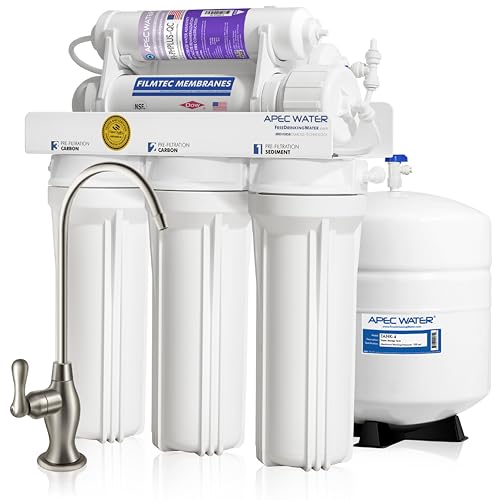
Uses US-made filters and carries a WQA certification — third-party proof that its 99% contaminant reduction claim is real, not marketing.
This 6-stage system delivers 90 GPD with a maximum flow rate of 0.06 Gallons Per Minute, and it holds a 4-gallon tank. The alkaline stage uses high-purity calcium carbonate sourced in the US to raise pH. It is WQA tested and certified to remove up to 99% of impurities including fluoride, arsenic, lead, and VOCs (volatile organic compounds — chemicals that evaporate into the air). The system comes with John Guest quick-connect fittings and a 100% metal, 100% lead-free designer faucet — a step up from plastic-necked alternatives.
One buyer who replaced a 20-year-old Everpure system noted that it produces water faster, filling the 4-gallon tank in under 3 hours at 60 psi. Several reviewers praise the long-lasting filters, with one mentioning the system “pays for itself by not having to buy bottled water.” The company offers lifetime support by certified WQA water specialists, and a 2-year extended warranty is available upon registration. At a flow rate of 0.06 GPM versus the APEC ROES-PH75X at 0.05 GPM, which matters when waiting for a pitcher to fill.
Premium build points
- 100% US-made filter cartridges with high-purity calcium for consistent alkalinity.
- WQA tested and certified for 99% reduction of 1000+ contaminants.
- Metal faucet with lead-free construction feels substantial and resists corrosion.
Watch out for
- At 0.06 GPM the fill rate is moderate — not ideal if you need instant large volumes.
- Some customers note that the Quick Dispense upgrade (3/8″ output) must be ordered separately from APEC and is not compatible with the Amazon kit.
Who it fits: Those who prioritize certified contaminant reduction and US-made components over raw speed.
What to note: Requires a minimum 50 psi water pressure; a booster pump is needed below 40 psi.
3. WINGSOL Reverse Osmosis Water Filter, Mineral Alkaline UV Tankless RO System
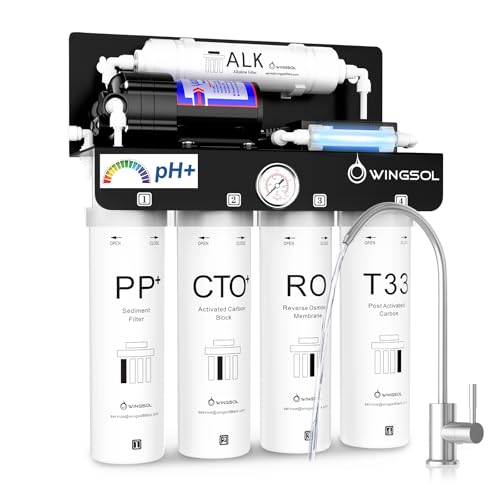
Saves roughly 75% of under-sink space by going tankless, and the visible UV light lets you see sterilization working in real time.
The WINGSOL system is a 6-stage tankless design that delivers 400 GPD with an all-in-one filter cartridge that swaps in 3 seconds. It uses a visible UV light — reviewers point out “WINGSOL RO: Visible UV confirms sterilization” — so you see the sterilizer running every time the system works. The waste ratio is 2:1 pure to drain (for every 1.5 gallons of pure water, only 1 gallon is discarded), which is significantly better than traditional 4:1 waste systems. The unit measures 13.78″L x 6.3″W x 17.52″H, at 13.78″L x 6.3″W x 17.52″H versus the APEC ROES-PH75X at 15.5″L x 5.25″W x 17.5″H, a meaningful difference for cramped cabinets.
Buyers praise the straightforward installation and near-zero TDS output (test readings close to 0 ppm). One buyer mentioned that the plastic valve adapters have poor O-rings that can leak if not replaced with sturdier hardware. The system requires a 110-240v power source for the pump and UV light, so a nearby outlet is mandatory. The filter cartridges (PP+, CTO+, RO, T33, ALK) are sold separately on Amazon with specific ASINs for easy reordering.
On-demand advantages
- No tank means no secondary bacterial growth and 75% more cabinet space.
- Visible UV light provides real-time confirmation that sterilization is active.
- 3-second filter swap is the fastest cartridge change in this guide.
Installation quirks
- Plastic valve adapters may leak — many buyers replace them with brass fittings.
- Requires a power outlet (110-240v), limiting placement to sinks with an accessible plug.
Ideal for tight spaces: Anyone with limited under-sink room who still wants UV protection and fast 400 GPD flow.
Beware: The drain clamp tube must be fully inserted to the marked dot or the system may not seal properly.
4. APEC Water ROES-PH75X 6-Stage Alkaline Under Sink Reverse Osmosis Water Filter System
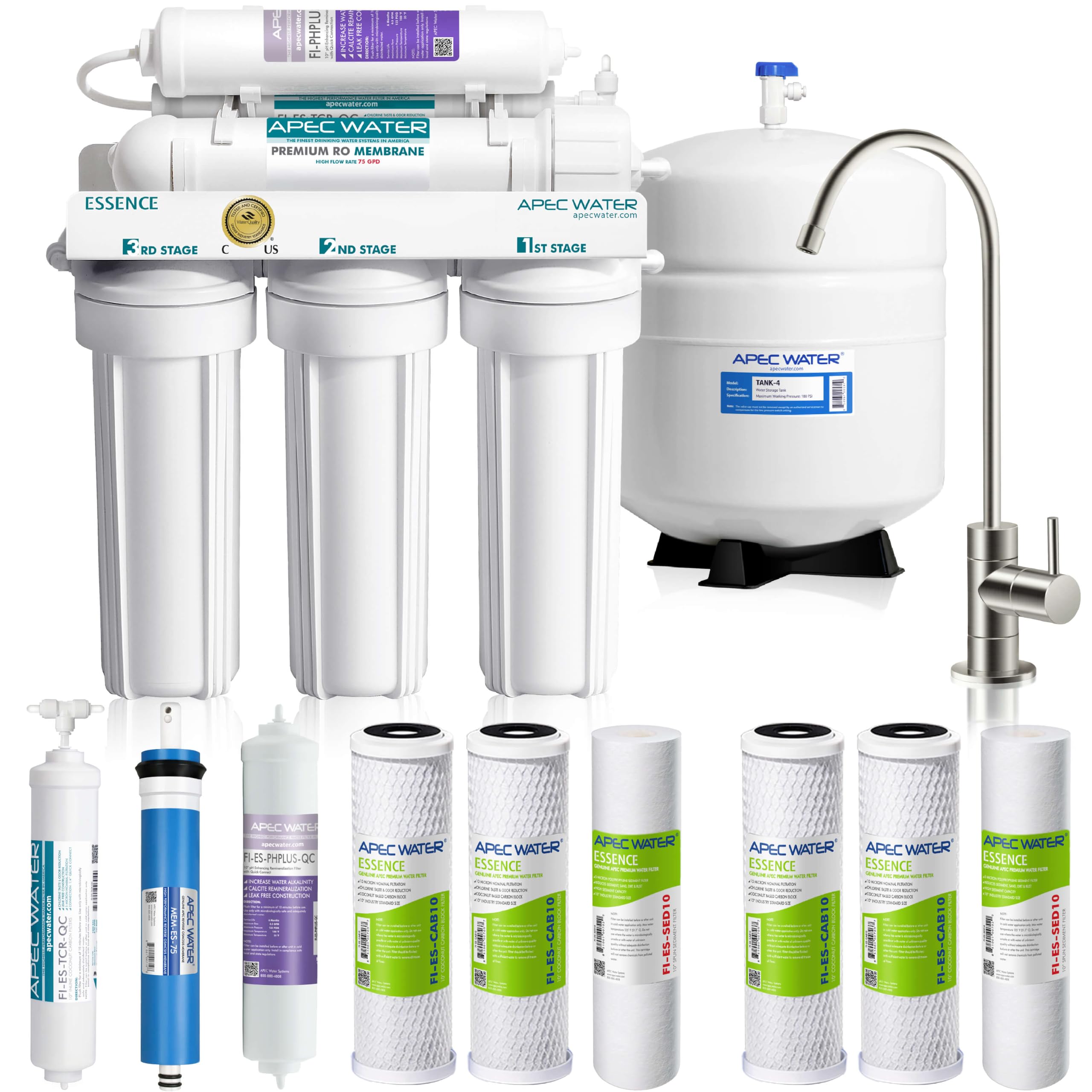
Comes with a free set of extra pre-filters from the start, so your first year’s maintenance costs are essentially zero.
This 6-stage system produces 75 gallons per day with a maximum flow rate of 0.05 Gallons Per Minute. It is WQA certified to remove up to 99% of chlorine, taste, odor, VOCs (volatile organic compounds), fluoride, arsenic, lead, and 1000+ impurities. The value bundle includes an additional set of pre-filters (Stages 1-3) that should be changed every 6 months, effectively giving you a year of pre-filter supply from the start. The system measures 15.5″L x 5.25″W x 17.5″H and weighs 27 pounds — at 27 pounds versus the NU Aqua at 28 pounds.
Shoppers say it “completely transformed our heavily treated municipal tap water” and note that it “replaced a poor Mizudo system.” Several reviews highlight the quick installation (about 1 hour) and thick plastic housings that feel durable. One reviewer advised pre-disassembling all threaded nylon fittings and applying thread tape to prevent leaks — a simple fix that avoids most installation hiccups. The alkaline stage uses premium calcium from a trusted source for consistent pH enhancement.
What stands out
- Extra pre-filter set included means you do not need to buy replacements for the first 6-12 months.
- 20 years of market presence with a reputation for noise-free, dependable operation.
- WQA certified for 99% contaminant reduction, backed by actual test data.
Minor gripes
- At 0.05 GPM, it is the slowest flow rate in this lineup — filling a 64-oz pitcher takes about 8 minutes.
- Nylon fittings lack factory sealant; pre-taping with thread tape is strongly recommended.
Smart pick for budget-minded buyers: You get APEC’s proven build quality and a free set of pre-filters, keeping your first year of maintenance costs near zero.
The catch: The 0.05 GPM flow is noticeably slower than the NU Aqua (0.07 GPM) — fine for casual sipping, less ideal for a busy family.
5. Frizzlife PX500-A Under Sink Tankless Reverse Osmosis Water Filtration System
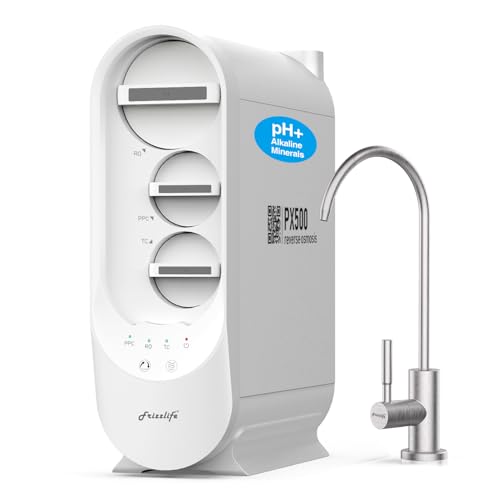
Fills an 8-ounce cup in about 10 seconds thanks to its 500 GPD capacity and 0.4 GPM flow rate — the fastest alongside the iSpring in this guide.
The Frizzlife PX500-A is a tankless RO system that produces 500 gallons per day at a maximum flow rate of 0.4 GPM — fast enough to fill an 8-ounce cup in about 10 seconds. The 3-stage process uses a pre-filter (ASR311), a 0.0001-micron RO membrane (ASR312-500G), and a post alkaline filter (ASR313-A) that remineralizes the water and raises pH above 7.5. The waste ratio is 1.5:1 pure-to-drain (for every 2 cups of pure water, only 1 cup is wasted). That is better than most tank-based systems but not as efficient as the 2:1 ratio claimed by the iSpring RO500AK-BN.
Buyers report the water tastes “crisp” and “bottled-water quality” and appreciate the space-saving design. Several reviews mention that the built-in filter life monitor — which glows blue when good and red when replacement is due — removes the guesswork from maintenance. One owner reported a tapping noise when the faucet is open, and another had a leaky 3-way valve that required a replacement sent by customer service. The system comes with a brushed nickel faucet and all necessary fittings for DIY installation.
Speed and convenience
- 500 GPD and 0.4 GPM flow rate means no waiting — even for large containers.
- Filter life indicators (blue/red) and audible beep remove the guesswork from maintenance.
- Single-twist filter changes take 2 seconds and require no water shutoff.
Noise and water lag
- Some owners mention a noticeable pump noise when the faucet is open.
- Occasional water lag (flow drops then returns) may require a free mini tank from customer service.
For the speed-hungry: If you hate waiting for water to trickle out, the 0.4 GPM flow is the fastest in this guide alongside the iSpring.
Heads-up: The noise level is higher than tank-based units — audible in a quiet kitchen.
6. Home Master TMHP HydroPerfection Reverse Osmosis System, 9-Stage
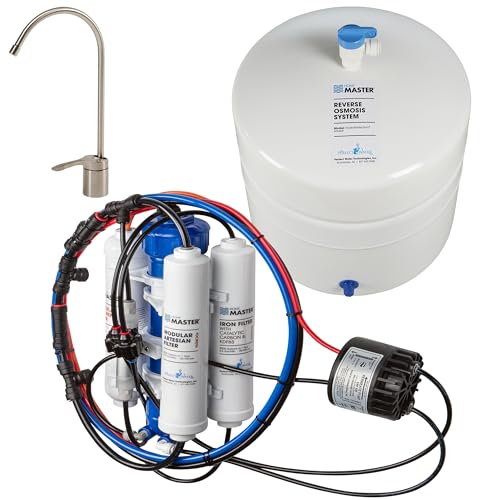
Runs water through nine stages, including a patented two-pass alkaline process and an EPA-registered UV light — the most thorough purification path here.
The Home Master TMHP uses a 9-stage process including a patented 2-pass alkaline remineralization that adds calcium and magnesium twice for what the maker calls “bottled mineral water” taste. It has an EPA-registered UV sterilizer (EPA establishment number 97952AZ1) that kills 99.9% of microbes. The maximum flow rate is 1 GPM — the highest in this guide — and the unit includes a non-electric permeate pump that achieves a 1:1 waste ratio (for every gallon of pure water, only 1 gallon is discarded). It has a 2000-gallon annual capacity and measures 15″L x 5″W x 16″H.
Buyers are nearly unanimous in their praise: one reviewer who has used the system for 3 years notes it still impresses, reducing ppm (parts per million, a measure of total dissolved solids) from 88 to 25 while adding calcium and magnesium. Another says it “greatly improves water taste for coffee, beer, juices, tea.” The annual filter change is straightforward, and the company’s customer service is frequently described as “top-notch.” The system does make a pumping sound when operating — note if your kitchen is open-plan and quiet.
class-leading purification depth
- 9-stage process with 2-pass alkaline adds minerals twice for a fuller taste.
- EPA-registered UV light kills 99.9% of harmful germs.
- 1 GPM flow rate fills a pitcher in under 30 seconds.
Space and sound
- The multi-canister design takes up considerable under-sink space.
- The permeate pump creates an audible hum, which some buyers find distracting.
For the water purist: If you want the most thorough filtration path (2-pass minerals + UV + iron prefilter) and are willing to sacrifice cabinet space, this is the deepest system here.
The trade-off: The annual filter cost is higher than simpler 6-stage units, and the pump noise is real.
7. iSpring RO500AK-BN Reverse Osmosis Water Filter, NSF 58 Certified, 500 GPD Tankless

NSF 58 certification (third-party proof the RO membrane reduces total dissolved solids) and a 2:1 pure-to-drain ratio that with a 2:1 pure-to-drain ratio.
The iSpring RO500AK-BN is a tankless system delivering 500 GPD at a flow rate of 0.4 GPM, filling an 8-ounce cup in about 10 seconds. It is NSF 58 certified for TDS reduction, which means third-party verification that the RO membrane actually reduces total dissolved solids. The filtration uses a 2-in-1 composite sediment and carbon block filter, an advanced RO membrane (removing 99% of 1000+ contaminants including lead, arsenic, fluoride, and asbestos), and a carbon alkaline filter that balances pH and adds beneficial minerals. The waste ratio is an industry-leading 2:1 pure to drain — 2 cups of clean water for every 1 cup of wastewater — and the tankless design saves up to 70% of under-sink space.
Buyers are emphatic about customer service: one reviewer described how Nick at iSpring sent a replacement base unit after 21 months when a pump issue emerged, calling it “real service.” Another buyer did a blind taste test with tap water and iSpring-filtered water; the iSpring water was picked immediately as tasting cleaner. Several reviewers mention that filter changes take about 10 seconds with a quarter-turn twist, and the automatic self-cleaning function runs after 24 hours of inactivity to extend the membrane lifespan. The system includes a brushed nickel faucet, power supply, and all tubing and adapters.
Third-party certified
- NSF 58 certification provides independent verification of TDS reduction — not just a marketing claim.
- 2:1 pure-to-drain ratio is the most water-efficient in this lineup, reducing wastewater from a traditional 4:1 waste ratio to a 2:1 pure-to-drain ratio.
- Tool-free quarter-turn filter changes and automatic self-cleaning minimize maintenance hassle.
Minor inconveniences
- Requires a power outlet (110-240v) for the pump, limiting placement to sinks with an accessible plug.
- The faucet may be slightly narrower than standard 1.5″ sink holes, requiring a faceplate (which iSpring may send free if needed).
Best for the certification-minded: If an NSF 58 stamp and a water-saving 2:1 waste ratio matter to you, this is the safest bet among tankless alkaline systems.
What you give up: The 3-stage design is simpler than 9-stage units — you trade some purification depth for speed, space, and a lower water bill.
Understanding the Specs
Gallons Per Day (GPD) vs. Actual Flow Rate
GPD tells you how much water the membrane can produce in 24 hours under ideal conditions (typically 60 psi, 77°F). A 75 GPD system delivers about 3 gallons per hour — fine for drinking and cooking. The actual flow rate at the faucet is measured in Gallons Per Minute (GPM). A tankless system like the iSpring RO500AK-BN offers 0.4 GPM, while a tank-based 75 GPD system like the APEC ROES-PH75X only manages 0.05 GPM. The difference: about 8 seconds per glass versus 8 minutes per pitcher.
Remineralization and pH Level
Remineralization is a final stage that adds calcium, magnesium, and sometimes potassium back into the water after the RO membrane strips everything out. Without it, RO water can taste flat and acidic (pH around 6.0-6.5). A good alkaline filter raises the pH to 7.5 or higher and restores the minerals that give water body and mouthfeel. Some systems, like the Home Master TMHP, use a 2-pass process for a more pronounced mineral boost, while simpler systems rely on a single calcium carbonate cartridge.
Waste Water Ratio (Pure-to-Drain)
The waste ratio compares how much clean water the system produces versus how much it sends down the drain as reject water. Traditional RO systems often have a 1:3 or 1:4 ratio (1 gallon clean, 3-4 gallons waste). Modern tankless units with permeate pumps achieve 1:1, 1.5:1, or even 2:1. The WINGSOL and iSpring tankless models both claim a 2:1 ratio, meaning you waste 1 gallon for every 2 gallons you keep — a meaningful reduction on a monthly water bill if you use 10-15 gallons of drinking water per day.
NSF/ANSI Certifications
NSF/ANSI Standard 58 specifically covers RO systems for TDS reduction and contaminant removal. Standard 53 covers taste, odor, and chlorine reduction. Standard 42 covers aesthetic effects like chlorine taste and sediment. Standard 372 confirms lead-free materials (≤0.25% lead content in wetted surfaces). WQA (Water Quality Association) certification means the system was independently tested and meets those standards. Fewer than 30% of RO systems sold online carry actual NSF certification, so a system like the iSpring RO500AK-BN (NSF 58) or the APEC RO-PH90 (WQA certified) has an advantage in trustworthiness.
FAQ
Does an alkaline reverse osmosis system actually raise the pH of the water?
What is the difference between a 6-stage and a 9-stage alkaline RO system?
Will a tankless alkaline RO system work with my refrigerator’s ice maker?
How often do you need to replace the alkaline filter cartridge?
Can I install an alkaline RO system myself, or do I need a plumber?
What is the difference between UV and non-UV alkaline RO systems?
Which is better for well water — a tank-based or tankless alkaline RO system?
How much counter or under-sink space does a tankless alkaline RO system save compared to a tank-based system?
Final Thoughts: The Verdict
Across the board, the alkaline reverse osmosis system winner is the NU Aqua 7-Stage UV & Alkaline because it balances a high 100 GPD flow, UV sterilization, a 3-year warranty, and a 120-day home trial — all at a price that beats similarly equipped units. If you want a tankless design with NSF 58 certification and the best waste water ratio (2:1), grab the iSpring RO500AK-BN. And for the deepest 9-stage purification with a patented two-pass alkaline process, the standout is the Home Master TMHP HydroPerfection.
How We Picked
We do not accept paid placement. Every pick is matched to a real buyer and a real use-case; we do not hands-on test units.
Sources & Methodology
Specifications: manufacturer listings and product documentation. Review insights: verified customer reviews, as of July 2026. Pricing: not shown on this page (it changes often); check the current price via the retailer link.
As an Amazon Associate, Gadgets Feed earns from qualifying purchases. This does not affect which products we feature.
Related Guides
Product prices and availability are accurate as of the date/time indicated and are subject to change. Any price and availability information displayed on Amazon at the time of purchase will apply to the purchase of this product. As an Amazon Associate I earn from qualifying purchases.
CERTAIN CONTENT THAT APPEARS ON THIS SITE COMES FROM AMAZON. THIS CONTENT IS PROVIDED "AS IS" AND IS SUBJECT TO CHANGE OR REMOVAL AT ANY TIME.
Amazon and the Amazon logo are trademarks of Amazon.com, Inc. or its affiliates.