
Our readers keep the lights on and my morning glass full of iced black tea. As an Amazon Associate, I earn from qualifying purchases.
Specs are compiled from manufacturer listings and verified buyer reviews and can change over time — please confirm the key details on the product page before buying.
Picking your first filmmaking camera can feel like decoding a secret language. You just want a camera that shoots sharp 4K video, is simple enough to learn on, and leaves you room to grow without forcing an upgrade in six months. The DJI Osmo Pocket 3 is the best pick for most beginners because its built-in gimbal kills shaky footage instantly and it comes with a wireless microphone in the box, so you get two of the hardest parts right from day one. This guide breaks down exactly what to look for in a beginner filmmaking camera, sticking to real specs and honest buyer feedback so you can choose with confidence.
I’m Min — the founder and writer behind Gadgets Feed. This guide is built by comparing the manufacturers’ published specifications and the patterns across verified customer reviews, so you get each pick’s real strengths and trade-offs instead of marketing spin.
To find the right beginner filmmaking camera for you, match specific features like sensor size, stabilization type, and autofocus capability to the kind of videos you actually want to shoot — whether that is vlogs, short films, or YouTube content.
Quick Picks
- DJI Osmo Pocket 3 Vlog Combo — Best Overall
- Canon EOS R50 Mirrorless Camera Kit — Best All-Rounder
- Blackmagic Design Pocket Cinema Camera 4K — Cinema Quality
How To Choose The Best Beginner Filmmaking Camera
Match your first filmmaking camera to the stories you want to tell. The wrong choice forces you to fight the camera instead of focusing on the shot. Here is what to prioritize.
Sensor Size — The Foundation of Image Quality
The sensor is the part of the camera that captures light. A larger sensor generally captures more light, which gives you better video in dim settings and more control over the blurry background look (called depth of field, or how much of the image behind your subject stays out of focus). Entry-level cameras usually feature a 1-inch sensor or an APS-C sensor. The 1-inch sensor, found in the DJI Osmo Pocket 3, is a strong performer packed into a tiny body. The larger APS-C sensor, used in the Canon EOS R50, offers better low-light performance and a more cinematic look. The Blackmagic Pocket Cinema Camera 4K uses a Micro Four Thirds sensor, which is a good middle ground that excels in dynamic range (the ability to keep detail in both bright and dark areas of a shot).
Stabilization — Why Your Shots Look Shaky
Built-in stabilization smooths out walking movements, preventing the shaky footage that marks a beginner. Built-in stabilization smooths out your walking movements. The DJI Osmo Pocket 3 uses a 3-axis mechanical gimbal (three small motors that physically keep the camera level) — reviewers report it keeps footage “smooth even when walking or moving quickly.” The Canon EOS R50 relies on lens-based stabilization (called IS, or Image Stabilization, which means the lens itself shifts to reduce shake) but lacks in-body stabilization, meaning the camera body itself does not correct shake. The Blackmagic Pocket Cinema Camera 4K has no built-in stabilization at all, which is a major consideration for handheld shooting.
Autofocus — Keeping Your Subject Sharp
As a beginner, you want a camera that takes care of focusing so you can focus on framing the shot and telling the story. The Canon EOS R50 has excellent Dual Pixel AF II, a system that reliably tracks faces, eyes, and subjects by using millions of phase-detection pixels on the sensor. The DJI Osmo Pocket 3 has fast auto-focus and ActiveTrack 6.0, a mode that keeps you centered in the frame while you move. The Blackmagic Pocket Cinema Camera 4K, however, is a true cinema camera — it has no continuous auto-focus at all. You focus manually, which is a steeper learning curve. One reviewer noted, “Just a reminder, this is a cinema camera so no continuous auto focus and no in body stabilization.”
Quick Comparison
| Model | Best For | Sensor Size | Stabilization | Max Video | Amazon |
|---|---|---|---|---|---|
| DJI Osmo Pocket 3 | Vloggers & On-the-Go Creators | 1-inch CMOS | 3-Axis Mechanical | 4K / 120fps | $450.00$532.00Amazon |
| Canon EOS R50 Kit | All-Around Beginners & Photo/Video Hybrids | APS-C | Lens-Based (IS) | 4K Oversampled | $849.99Amazon |
| Blackmagic Pocket Cinema Camera 4K | Budding Cinematographers & Narrative Filmmakers | Micro Four Thirds | None | 4K / 60fps | $1,139.00Amazon |
In‑Depth Reviews
1. DJI Osmo Pocket 3 Vlog Combo
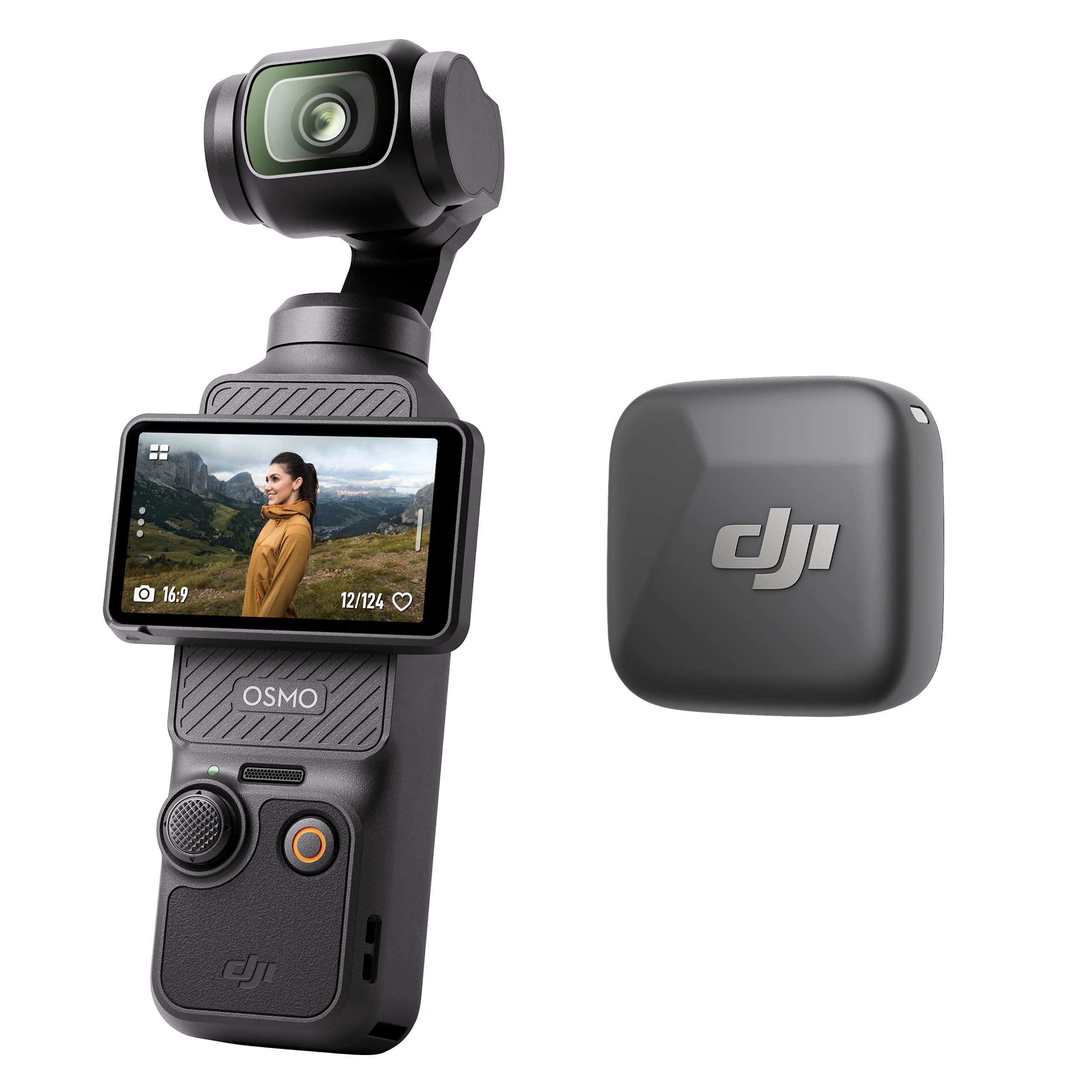
A pocket-sized camera that gives you cinema-smooth footage without a steep learning curve — the Canon R50 and Blackmagic 4K cannot match its built-in gimbal.
The defining feature of the DJI Osmo Pocket 3 is its built-in 3-axis mechanical stabilization. Unlike the Canon EOS R50, which relies on lens-based stabilization that still leaves some shake, this camera physically floats the lens so your walking shots look like they were filmed on a dolly. It pairs this with a 1-inch CMOS sensor (a 1-inch sized chip that converts light into an electronic signal) that records 4K video at up to 120 frames per second (fps), meaning you can slow down action without it getting choppy. According to the specs, the sensor captures “breathtaking night views and sunsets with enhanced clarity,” so low-light scenes should look cleaner than typical pocket cameras.
Buyers consistently highlight how easy it is to get started. One reviewer notes, “The battery is long-lasting and charges relatively quick.” The 2-inch rotatable touchscreen flips between horizontal and vertical shooting, which is a huge time-saver if you post to both YouTube and TikTok. It also comes with a DJI Mic Mini transmitter in the box, so you skip the hassle of buying an external microphone separately — a common beginner oversight that ruins audio. Unlike the Blackmagic camera below, the Pocket 3 has reliable autofocus and subject tracking (ActiveTrack 6.0, a mode that locks onto you and keeps you centered in the frame automatically).
The catch is its fixed lens. You cannot change the lens to get a wider or more zoomed-in shot, and what you see on the 2-inch screen is all the framing control you get. Compared to the Canon R50’s 5-inch screen, the Pocket 3’s display is 2 inches compared to the Canon R50’s 5 inches, which makes critical focusing harder in bright sunlight.
Why It Wins for Beginners
- Built-in 3-axis gimbal gives you pro-level stabilization right away.
- 1-inch sensor and 4K/120fps produce professional-looking video.
- Included wireless Mic Mini fixes the biggest problem (bad audio) before you start.
- Ultra-compact form factor means you will actually carry it with you.
The Real Trade-Off
- Fixed lens means no zoom reach or wide-angle options.
- 2-inch screen is small for framing and reviewing shots.
Reach for this if: your priority is grab-and-go vlogging or content creation where stabilization and simplicity matter more than lens flexibility.
Look elsewhere if: you want to learn manual focus, shoot with different lenses, or need a larger screen for precise framing.
2. Canon EOS R50 Mirrorless Camera Kit
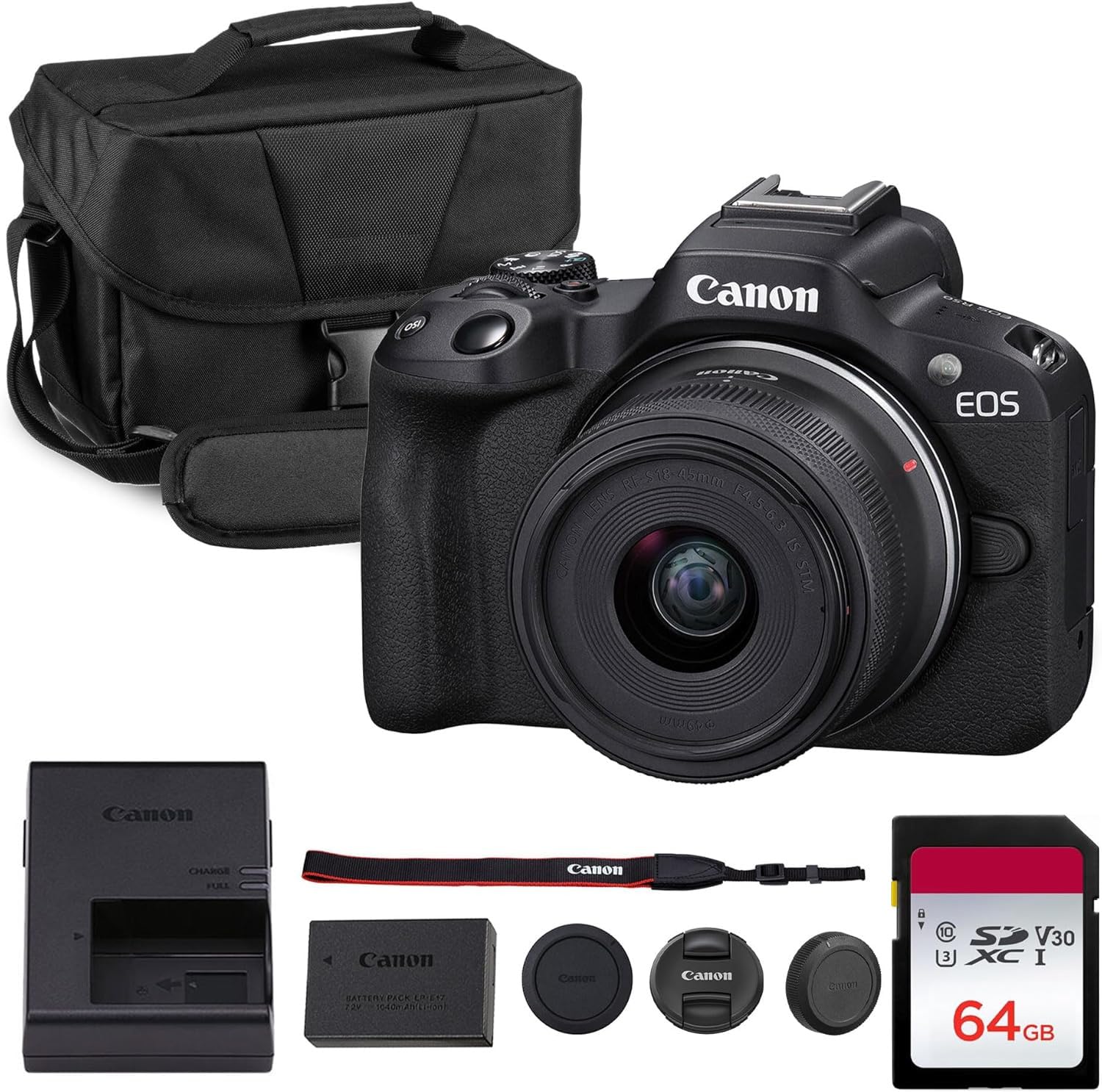
A true system camera that grows with your skills — its larger sensor and interchangeable lenses put it ahead of the DJI Pocket 3 for low-light and cinematic shots.
The Canon EOS R50’s larger APS-C sensor captures far more light than the DJI Pocket 3, delivering a more cinematic look with blurrier backgrounds and significantly better low-light performance. It shoots oversampled 4K video — meaning it uses more pixels than needed from the sensor and squeezes them into 4K for extra sharpness. The kit lens (18-45mm f/4.5-6.3 IS STM) covers wide to standard views, so you can shoot a landscape or a portrait without swapping lenses immediately. More importantly, you can later buy different RF lenses — for example a telephoto for sports or a fast prime lens for dim interiors — which you simply cannot do with the Pocket 3’s fixed lens.
Buyers report that the Dual Pixel CMOS AF II autofocus system (a sensor-based phase-detection system) is outstanding. It tracks faces, eyes, and animals reliably, so you can focus on directing your subject rather than twisting a lens ring — far more user-friendly than the Blackmagic 4K which has no autofocus at all. The vari-angle touchscreen flips out and rotates, making it easy to film yourself or get creative low-angle shots. A buyer sums it up well: “Great for beginners: fast autofocus, good image quality, portable.” That buyer also notes it “Lacks in-body stabilization; buffer fills quickly with continuous shots.” The camera is light at just over a pound with the lens, which makes it comfortable for long shoots.
The main trade-off is stabilization. Unlike the Pocket 3’s mechanical gimbal, the R50 only has lens-based image stabilization (IS, where the lens optics move to counteract shake). For handheld walking shots, you will need to hold it steady or invest in a separate gimbal. This puts its video smoothness behind the DJI, but ahead of the Blackmagic, which has none at all.
Why It Stands Out
- APS-C sensor delivers better low-light performance and cinematic depth of field.
- Interchangeable lens mount lets you upgrade your glass as you improve.
- Dual Pixel AF II autofocus is top-tier for keeping subjects sharp.
- Kit includes a bag and 64GB memory card, so you can start shooting immediately.
Know Before You Buy
- No in-body stabilization means handheld video is shakier than the DJI Pocket 3.
- Continuous shooting buffer fills quickly, so burst photos pause after a short run.
This one is for you if: you want one camera that shoots high-quality photos AND 4K video, with room to grow into different lenses as you improve.
skip it if: pure run-and-gun vlogging with rock-solid stabilization is your main need — the DJI Pocket 3 does that better from the start.
3. Blackmagic Design Pocket Cinema Camera 4K

The gateway to real cinema-grade color and dynamic range — if you are ready to learn manual focus, rigging, and color grading, this camera’s 13 stops of dynamic range outperform both the Canon R50 and the DJI Pocket 3 for image quality.
The Blackmagic Pocket Cinema Camera 4K (BMPCC 4K) is in a different league from the other two picks here. It uses a Micro Four Thirds sensor that shoots native 4096 x 2160 resolution — true DCI 4K, the exact wider standard used in movie theaters, not the slightly narrower 16:9 cropped frame you get on consumer cameras. It delivers 13 stops of dynamic range, meaning it holds detail in bright skies and dark shadows simultaneously, which is the hallmark of cinematic footage and a major step beyond the Canon R50. It records in Blackmagic RAW (a deeply customizable Raw file format) and Apple ProRes (an editing-friendly professional codec), giving you enormous flexibility to adjust colors in editing. It even includes a free DaVinci Resolve Studio activation key — a professional color grading and editing suite that normally costs a few hundred dollars.
This camera demands more from you than either of the other two picks. As one buyer bluntly states, “Just a reminder, this is a cinema camera so no continuous auto focus and no in body stabilization.” You focus every shot by hand. You stabilize every shot with a tripod, monopod, or gimbal. The included battery lasts around 30 minutes, so you will need spare batteries or an external power source. The 5-inch LCD screen is bright and large — 5 inches compared to the DJI Pocket 3’s 2 inches — but it is nearly unusable outdoors on a sunny day, as it is dim at roughly 250 nits. Unlike the Canon R50, there is no flip screen for self-recording.
The reward for that effort is breathtaking footage. Reviewers call it “studio-quality gear” and note that “the full kit cost about the same as a single day’s shoot with a high-end production outfit.” This is not a vlog camera — do not buy it for family gatherings or walking tours. It is a tool for narrative shorts, interviews, music videos, and documentaries where you control the environment and prioritize image quality over convenience.
The Professional Edge
- 13 stops of dynamic range captures detail in highlights and shadows like a film camera.
- Records Blackmagic RAW and ProRes, giving you maximum editing flexibility.
- Includes a DaVinci Resolve Studio license for professional color grading.
- 5-inch LCD eliminates the need for an external monitor.
Hard Truths for Beginners
- No autofocus and no stabilization — you must manually pull focus and rig the camera.
- Battery lasts roughly 30 minutes; you need a serious power plan.
- Screen is unviewable in direct sunlight; no flip screen for self-recording.
- Total build cost with accessories can reach or more.
Go for it if: you are serious about learning the craft of cinematography and are willing to invest time in manual focus, rigging, and color grading.
Pass if: you want to shoot vlogs, need reliable autofocus, or expect to be ready to film in under 60 seconds.
Understanding the Specs
Sensor Size (1-inch vs APS-C vs Micro Four Thirds)
The sensor captures light, and its size directly impacts image quality. A larger sensor generally gives better low-light performance and a more cinematic look with shallow depth of field (blurry backgrounds that separate your subject from the background). The Canon EOS R50 uses an APS-C sensor, which is a step up in size from the 1-inch sensor in the DJI Osmo Pocket 3. The Blackmagic Pocket Cinema Camera 4K uses a Micro Four Thirds sensor, which sits between those two in size but prioritizes dynamic range over low-light noise performance.
Stabilization — Mechanical vs Electronic vs None
Stabilization keeps your video from looking like an earthquake. Mechanical stabilization uses a physical gimbal (the DJI Pocket 3) to float the camera and cancel out movement. It is the gold standard. Electronic stabilization (also called digital stabilization) crops into the video slightly to smooth out wobbles, but it is not as effective. The Canon R50 has lens-based optical stabilization but lacks in-body stabilization, so hybrid shooters often buy an external gimbal. The Blackmagic Pocket 4K has zero stabilization, making it unusable for handheld work without extra gear.
Dynamic Range and Color Depth
Dynamic range is the camera’s ability to hold detail in bright and dark areas of the same shot. More stops of dynamic range mean your footage looks more like what the human eye sees, with fewer blown-out skies or crushed-black shadows. The Blackmagic Pocket 4K offers 13 stops, which is excellent. Color depth, measured in bits, determines how many colors the camera can distinguish. Both the DJI Pocket 3 and the Canon R50 support 10-bit color, which gives you around one billion colors — much smoother gradients than the 16.7 million in 8-bit video.
FAQ
Is a mirrorless camera better than a pocket camera for a beginner filmmaker?
Why does the Blackmagic Pocket Cinema Camera 4K have no autofocus?
Can I use the DJI Osmo Pocket 3 for professional filmmaking?
What does “oversampled 4K” mean on the Canon EOS R50?
Do I need an external microphone for any of these cameras?
Which camera handles low-light shooting the best?
Can I use the Canon EOS R50 for live streaming?
What memory card do I need for the Blackmagic Pocket Cinema Camera 4K?
How important is dynamic range for a beginner filmmaker?
Which of these cameras is best for learning manual exposure?
Final Thoughts: The Verdict
For most people starting out, the best beginner filmmaking camera is the DJI Osmo Pocket 3 because it removes the two biggest barriers to good video — shaky footage and bad audio — with its built-in gimbal and included wireless mic, all in a package small enough to take everywhere. If you want a camera that shoots both stunning photos and 4K video with interchangeable lenses, grab the Canon EOS R50. And if you are ready to commit to learning real cinematography — manual focus, grading, and rigging — the Blackmagic Pocket Cinema Camera 4K delivers image quality that competes with cameras many times its price.
How We Picked
We do not accept paid placement. Every pick is matched to a real buyer and a real use-case; we do not hands-on test units.
Sources & Methodology
Specifications: manufacturer listings and product documentation. Review insights: verified customer reviews, as of July 2026. Pricing: not shown on this page (it changes often); check the current price via the retailer link.
As an Amazon Associate, Gadgets Feed earns from qualifying purchases. This does not affect which products we feature.
Related Guides
Product prices and availability are accurate as of the date/time indicated and are subject to change. Any price and availability information displayed on Amazon at the time of purchase will apply to the purchase of this product. As an Amazon Associate I earn from qualifying purchases.
CERTAIN CONTENT THAT APPEARS ON THIS SITE COMES FROM AMAZON. THIS CONTENT IS PROVIDED "AS IS" AND IS SUBJECT TO CHANGE OR REMOVAL AT ANY TIME.
Amazon and the Amazon logo are trademarks of Amazon.com, Inc. or its affiliates.