
Our readers keep the lights on and my morning glass full of iced black tea. As an Amazon Associate, I earn from qualifying purchases.
Specs are compiled from manufacturer listings and verified buyer reviews and can change over time — please confirm the key details on the product page before buying.
Water in the bilge is the one thing every boat owner dreads. An automatic bilge pump handles this threat silently, turning on when water rises and shutting off once it is clear — without you touching a switch. The real question is which one reliably does that job for years and which one will leave you ankle-deep in trouble mid-season.
I’m Min — the founder and writer behind Gadgets Feed. This guide is built by comparing the manufacturers’ published specifications and the patterns across verified customer reviews, so you get each pick’s real strengths and trade-offs instead of marketing spin.
If you own a boat, a failing bilge pump can sink your day — or worse, your boat. This guide breaks down the automatic bilge pump for boat owners actually rely on, matching real-world feedback to the specs that matter most.
Quick Picks
- SEAFLO 06 Series Automatic Submersible Bilge Pump – 1100 GPH — Best Overall
- SAILFLO 750 GPH Automatic Bilge Pump — Best Value
- OASIS MARINE Automatic Bilge Pump — Pro-Grade Longevity
- SeaSense 800 GPH Automatic Bilge Pump — Compact Fit
- Rule 500 GPH (25SA) Electronic Sensing Bilge Pump — Smart Sensor
- Johnson Pump 05903-00 Cartridge Combo Automatic Submersible — Cartridge Upgrade
How To Choose The Best Automatic Bilge Pump For Boat
Choosing the right pump starts with understanding your boat’s size, the space in the bilge, and how much water you realistically need to move. A pump that fits badly or draws too much power is worse than no pump at all.
Flow Rate: The GPH Number You Can Actually Expect
Manufacturers state the flow rate at zero lift — meaning the pump sitting right at the water line. In a real boat, the pump has to push water up through a hose, often several feet. That head height drops the real output, sometimes by half. Look for a pump with a higher GPH than you think you need; a 750 GPH unit at 4 meters of lift may only move half that at the top of the hose.
Automatic Operation: Float Switch vs. Electronic Sensor
The built-in float switch is the most common automatic trigger. As water rises, the float lifts and the pump kicks on. It is mechanical, simple, and cheap to replace. Electronic sensor pumps, like the Rule 25SA, periodically check for water by running for a fraction of a second — they have no moving float to jam, but they use a tiny bit of power constantly.
Installation and Fit
Check the outlet diameter (most use 3/4″ or 1-1/8″) and the dimensions of the pump base. A pump that is 8 inches long will not fit in a tight corner where a 5.9-inch unit slides in. Also look at the wire leads: 2-foot leads may need an extension, while 30-inch leads give a little more slack.
Quick Comparison
| Model | Best For | Flow Rate (GPH) | Weight | Maximum Lift | Amazon |
|---|---|---|---|---|---|
| SEAFLO 06 Series 1100 GPH | High-volume replacement | 1100 GPH | 1.17 Pounds | 13 Feet | $27.99Amazon |
| SeaSense 800 GPH | Small-footprint install | 800 GPH | 15.2 ounces | — | $33.96Amazon |
| SAILFLO 750 GPH | Wiring flexibility | 750 GPH | 1.1 Pounds | 4 Meters | $44.99Amazon |
| OASIS MARINE 750 GPH | Quiet, durable backup | 750 GPH | 1.3 Pounds | 3.5 Meters | $44.99Amazon |
| Rule 500 GPH (25SA) | Ultra-compact auto sensor | 500 GPH | 0.8 Pounds | 1.75 Feet | $79.64Amazon |
| Johnson Pump 05903-00 | Cartridge-style upgrade | 1000 GPH | 16 ounces | 36 Inches | $90.97Amazon |
In‑Depth Reviews
1. SEAFLO 06 Series Automatic Submersible Bilge Pump – 1100 GPH

The high-volume workhorse that moves water faster than most, backed by a warranty that outlasts the competition.
If you want water gone in a hurry, the SEAFLO delivers 1100 GPH of rated flow through a 5-blade impeller — a noticeable jump over the 750-800 GPH pumps. In practice, that means it clears a flooded bilge before smaller units even finish their first cycle. The pump integrates the float switch right into the housing, so you do not need a separate external float, which simplifies both wiring and troubleshooting. Buyers report it “runs 15 min on garden tractor battery,” which speaks to its efficiency on 12V even during extended operation.
The SEAFLO includes a snap-off strainer base for cleaning and a compact footprint at 5.9 inches long — the SeaSense pump measures 8 inches long. That makes it easier to shoehorn into a tight bilge. The catch, as some owners mention, is that while the outlet is 1-1/8 inches, you will need a 1-inch ID hose, not a 1-1/8 inch one, so double-check your plumbing before buying. The 3A current draw means it is gentle on your battery compared to a 6A max draw, but the initial 6A surge at startup is something your wiring needs to handle.
The real stand-out is the 4-year warranty — by far the longest in this group. Most pumps offer one to two years. SEAFLO puts its money where its mouth is, which should give you confidence that this unit is built to last, not just to move water for a single season. Some owners have reported early failures from small debris jamming the impeller after 60-70 hours, so keep the strainer clean, but otherwise, this is the most reliable high-capacity option in the list.
Why It Stands Out
- 1100 GPH flow rate moves water aggressively
- 4-year warranty is industry-leading
- Compact size fits tight bilge spaces
- Snap-off strainer for quick cleaning
Watch Out For
- Needs 1″ ID hose, not 1-1/8″ (verified by buyers)
- Short 1-meter (3-foot) wire leads may require extension for deep bilges
- Volume drops noticeably at 3-4 feet of head height
Best for skippers who want: the highest flow rate matched with the longest warranty, on a mid-size boat that can use a 1-inch hose. It is the go-to for anyone who has ever waited too long for a smaller pump to clear standing water.
Look elsewhere if: your boat has a 1-1/8 inch hose already installed — you will need an adapter — or if you run in extremely debris-heavy water and do not want to clean a snap-off strainer weekly.
2. SAILFLO 750 GPH Automatic Bilge Pump

The well-rounded 750 GPH unit that gives you both auto and manual control without the premium price tag.
That extra meter of lift matters when your bilge is deeper than average. The three-wire setup lets you run it in automatic mode (brown/white wire) or manual override (brown wire) — flexibility simpler units lack. One buyer used it as a “step-down bilge pump in Sea Ray Sundancer 260” and reported it “works well after 3 months.” Another owner noted the float only triggers when fully submerged, but they fixed that by gluing styrofoam to the float base — a cheap hack that made it activate at 2/3 submerged.
At 1.1 pounds, this pump is lighter than the OASIS MARINE (1.3 pounds) making it easier to handle during installation. The 3/4-inch hose outlet is the standard size for most small boats, so you probably will not need adapters. The construction includes a stainless steel shaft and a waterproof, impact-resistant shell, which helps it survive the corrosive marine environment. It is also noticeably quiet in operation, which is a plus if your bilge is near the cabin.
The trade-off is the 2-year warranty — solid but not exceptional. Some owners have had the float behavior be slightly unpredictable, as with many mechanical float switches. It is not the absolute cheapest option, but for the combination of high lift, auto/manual wiring, and compact size, it represents the best middle-ground value.
Smart Value
- 4-meter maximum lift — highest in this lineup
- Three-wire setup for automatic and manual modes
- Quiet, vibration-free operation
- 2-year replacement warranty
Minor Quirks
- Float may not trigger until fully submerged (buyers have workarounds)
- Some users had to extend the short wire leads
Smart buy for: owners of mid-size boats (18-26 feet) who want a reliable 750 GPH pump with both automatic and manual modes. The high lift gives it an edge in deeper bilges.
Skip it for: saltwater-heavy environments — no splash-proof rating is specified — or if you need a plug-and-play unit that requires zero tweaking from the start.
3. OASIS MARINE Automatic Bilge Pump with Built-in Float Switch 750 GPH

The pump that customers note lasting 7 years — proof of build quality that is hard to find at this level.
Few marine products earn the “industry standard” label from owners, but the OASIS MARINE 750 GPH has done exactly that. One reviewer noted their “first unit lasted 7 years before switch scum” — an impressive lifespan for a submersible pump that runs on 12V in a damp bilge. That longevity comes from a stainless steel motor shaft and a sealed housing designed to resist corrosion and vibration, even in saltwater. At 1.3 pounds, it is slightly heavier than the SAILFLO (1.1 pounds), but that extra mass comes from more sturdy materials, not bulk.
The pump features a compact design at 6 inches long, which fits into tight compartments on small craft like a 14-foot aluminum skiff, as one buyer confirmed. The three-wire configuration (brown, brown/white, black) allows for automatic, manual override, or both modes. The snap-lock strainer base is easy to remove for cleaning without uninstalling the pump, which is handy since debris tends to collect in bilges. One catch some owners hit: the constant and intermittent power wires were swapped on a unit from the factory, requiring brown and brown/white to be reversed for proper auto function. Check yours before buttoning everything up.
While the OASIS is rated for 750 GPH (gallons per hour), some users felt the pump underperforms that number at realistic head heights — a common complaint across most bilge pumps. At its maximum lift of 3.5 meters (about 11.5 feet), it falls short of the SAILFLO’s 4-meter reach. However, for the average small boat (under 24 feet), that difference rarely matters. What does matter is the 2-year spare part availability, and the fact that the pump is a drop-in replacement for many OEM (original equipment manufacturer) units — one owner called it “the exact replacement for my failed pump, just printed a different name on it,” which tells you it meets standard mounting patterns.
Built to Last
- Owner-reported lifespan of 7 years is outstanding
- Stainless steel shaft resists saltwater corrosion
- Snap-lock strainer for tool-free cleaning
- Direct replacement for many factory pumps
Potential Hiccups
- Some units had constant/auto wires swapped at the factory
- 3.5-meter lift is lower than the SAILFLO (4 meters)
- Short 2-foot wire leads may need an extension
Best for owners who value durability: if you are tired of replacing bilge pumps every two years, this is the one that buyers themselves say lasts nearly a decade.
Consider another if: you need the highest possible flow at high head — the SEAFLO at 1100 GPH and 13 feet of lift is a better fit — or if you do not want to verify wire polarity before installation.
4. SeaSense 800 GPH Automatic Bilge Pump
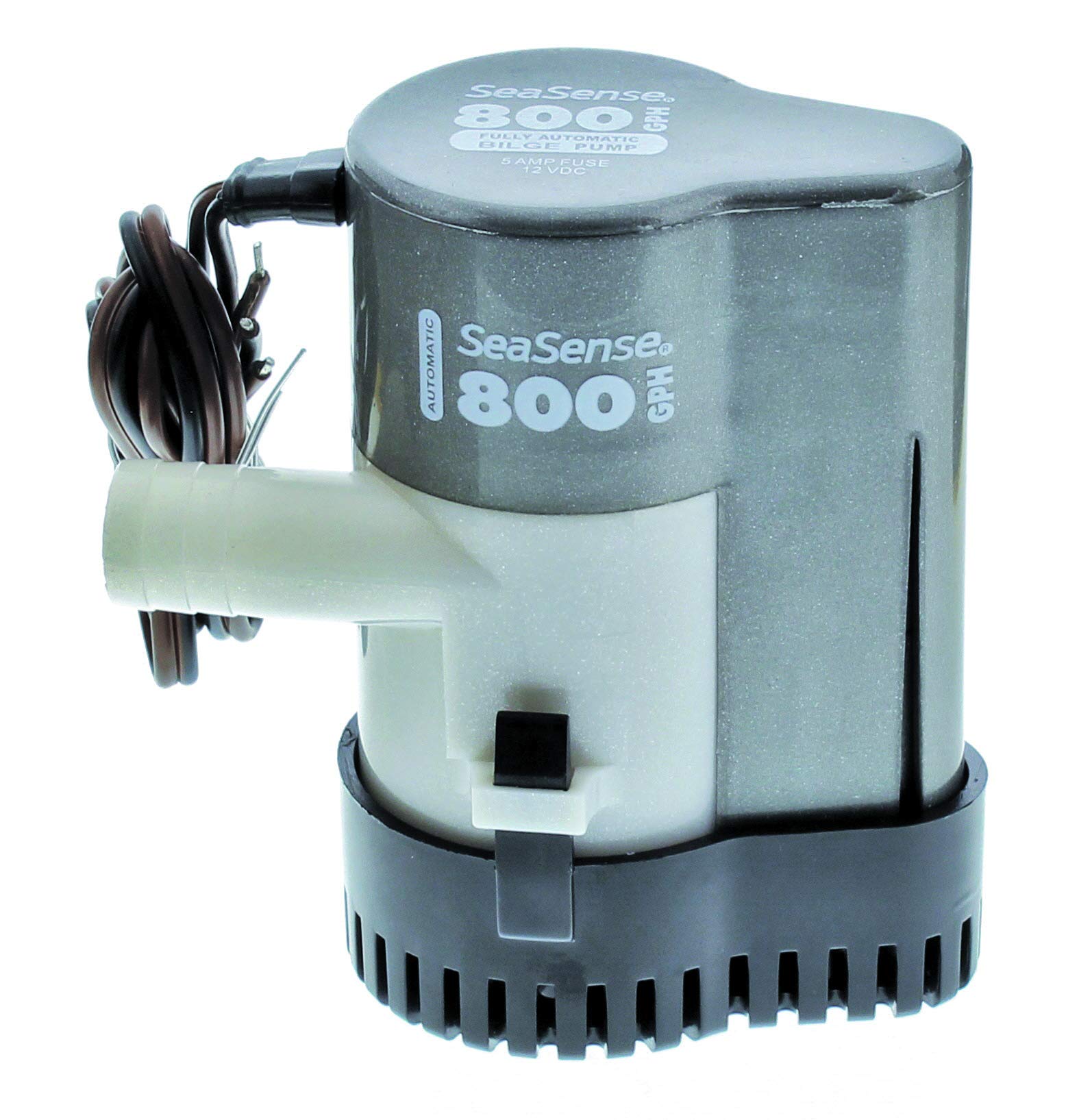
The tiny pump that squeezes into the tightest corners, though its rated flow is optimistic in real-world use.
At 8 inches long, the SeaSense is the second-longest pump here, but its slim profile and lightweight 15.2 ounces make it nimble to install in awkward spots. One owner bought it specifically because “it had a small footprint and fit in next to boat’s drain plug” — the kind of tight space where larger pumps simply will not sit. It is ignition-protected, which is important for installation near fuel vapors, and includes a stainless steel shaft and mounting hardware for corrosion resistance.
However, the real-world GPH is a frequent topic in reviews. One measured it at roughly 200 GPH, while another said it “kicks on at ~4 inches of water, stops at ~1 inch” and called it “not 800 GPH but sufficient for 19 ft boat.” If you are buying this to handle a serious leak, the gap between marketing and actual output could be dangerous. The float switch integrates directly, but the auto trigger is high — it waits until water is about 4 inches deep before turning on, which is late for a primary pump.
On the plus side, the impact-resistant ABS housing is tough, and the 30-inch tinned marine-grade wire leads are longer than most competitors, giving you more flexibility for routing. The first pump one owner had lasted about 5 years in fresh water before the impeller shaft rusted off — so in fresh water, it can be reliable. In salt water, buyers suggest it will not survive as long. It has no strainer; instead, the basket detaches easily, which means debris can bypass the filter and hit the impeller directly.
Space-Saver
- Compact profile fits next to drain plugs and tight bilge corners
- Ignition protected — safe near fuel vapors
- 30-inch tinned wire leads are longer than most
- Stainless steel shaft and mounting hardware
Optimistic GPH
- Real-world flow reported as low as 200 GPH by users
- Auto float triggers late (~4 inches of water)
- No strainer cover — debris hits impeller directly
Ideal for tight spaces: if you have an inch or two of clearance next to a drain plug and need an automatic pump that physically fits, this one will slide in where nothing else will.
Not for primary duty: the low real-world output and late float activation make it a poor choice as your main pump — use it as a backup or on a small boat with minimal water risk.
5. Rule 500 GPH (25SA) Electronic Sensing Bilge Pump

The intelligent pump that checks for water every 2.5 minutes — no float to jam, but a different set of failure modes.
The Rule 25SA takes a different approach from the rest: instead of a mechanical float switch, it uses electronic sensing. Every 2.5 minutes, the pump runs for one second to check if it detects a load (water). If there is no load, it shuts off. This design eliminates the most common failure point — the float switch getting stuck, scummed up, or physically jammed. One buyer confirmed it “runs pump every 2.5 min for 1 sec; shuts off if no load.” It is also very quiet and lightweight at 0.8 pounds, making it the lightest pump in this review.
The catch with electronic sensor pumps is that the shaft seal can fail from vapor in the bilge, leading to corrosion and circuit failure — as multiple reviewers discovered. One noted, “shaft seal fails from vapor, causing corrosion and circuit failure; keep receipt and spare.” Another said the auto float quit working within 11 months. These issues mean the Rule requires a higher level of vigilance and a backup plan. It also requires a third wire for an auto/on/off switch, which adds a step to installation.
At 500 GPH, the flow rate is the lowest in this lineup, but that is intentional — it is meant as a secondary or backup pump, not a primary flood fighter. The maximum lift is only 1.75 feet, so it will not push water up a long hose. The threaded port design eliminates the need for a separate float switch or third wire for basic auto operation, which simplifies initial installation. Just know that the pump has a built-in thermal cut-off for overheating protection, which is a plus for extended periods of dry running.
Smart Tech
- No mechanical float switch to jam or scum up
- Ultra-compact and lightweight (0.8 pounds)
- Built-in thermal cut-off protects against overheating
- Self-checks for water every 2.5 minutes
Tech Vulnerabilities
- Shaft seal failures from vapor have been reported
- Only 1.75 feet of maximum lift
- Low 500 GPH flow rate — backup pump only
- Some units failed within a year
Best as a smart backup: the Rule 25SA is ideal for keeping the bilge dry between main pump cycles, especially if you value the no-float-switch design for fewer mechanical snags.
Do not rely on it alone: the low flow, low lift, and electronic failure risk make it unsuitable as your only pump — pair it with a mechanical float switch pump as primary.
6. Johnson Pump 05903-00 Cartridge Combo Automatic Submersible Bilge Pump – 1000 GPH

The clever cartridge pump that upgrades your existing base — the best 10-minute improvement a boat can get.
The Johnson Pump stands out because of its cartridge design: instead of replacing the entire pump, you swap only the cartridge and float assembly onto your existing base. One owner called it “the best 10-minute boat upgrade you can make” — they just swapped out the cartridge, attached the float to the original base, ran a dedicated positive wire to the battery, and it was done. That is a huge time-saver if your boat already has a Johnson base installed. The pump is rated at 1000 GPH and includes an electro-magnetic float switch that operates automatically, along with a removable check valve to prevent backflow.
The Dura-Port discharge ports are a thoughtful design: both a straight and a 90-degree smooth elbow are included, and they are designed to eliminate stress cracking caused by overtightened hose clamps. That is a real-world issue on older boats where the outlet fitting cracks if you crank the clamp too tight. The pump handles debris reasonably well, too — one user with a bilge “always full of leaves, dirt, etc.” said it “works well even with the trash” and is easy to disassemble to unclog.
The catch is hose compatibility. The pump comes with 5/8-inch or 3/4-inch hose outlets, which may not match your boat’s 1-1/8-inch existing plumbing. One buyer found the pump “much smaller than you think” with outlets incompatible with his boat’s 1-1/8-inch through-hull. At 7 inches tall, it is taller than other pumps, which may not fit a shallow bilge. The flow rate of 1000 GPH is competitive with the SEAFLO, but some owners suspect real-world output is closer to 500-800 GPH. At 16 ounces, it is mid-weight, and the limited 3-year warranty is decent but not exceptional.
Clever Design
- Cartridge system makes upgrading a 10-minute job
- Dura-Port outlets prevent stress cracking from over-tightening
- Includes check valve to prevent backflow
- Works well with debris-heavy bilge water
Fit Issues
- 5/8″ or 3/4″ outlets may not match 1-1/8″ boat plumbing
- Tall design (7.5 inches) needs vertical clearance
- Real-world GPH may be lower than advertised
- 3-year warranty, not the longest offered
Best for Johnson owners: if your boat already has a Johnson pump base, this cartridge upgrade saves you the full re-wiring hassle and gives you automatic operation in minutes.
Not for first-time buyers: if you are starting from scratch with no existing base, a standard full-pump like the SEAFLO or SAILFLO is simpler to fit and comes with a longer warranty.
Understanding the Specs
Flow Rate (GPH)
Gallons Per Hour tells you how much water the pump moves at zero lift — meaning with the pump sitting at the same level as the water. In a real boat, that number drops as you push water up through a hose. A 1100 GPH pump at tip-top shape may only move 600 GPH at 4 feet of lift. This is why you always pick a pump with a higher GPH rating than your theoretical need.
Maximum Lifting Height
This spec, given in feet or meters, tells you how high the pump can push water vertically before it stops moving altogether. A pump with 4 meters of lift can clear a deeper bilge than one with 3.5 meters. If your bilge is shallow (under 2 feet), even a smaller lift pump will work, but for deeper hulls, this number directly affects how fast the water leaves.
Outlet Diameter
The size of the hose connection, usually 3/4 inch, 1 inch, or 1-1/8 inches. This must match your existing hose or through-hull fitting. Many pumps use 3/4-inch outlets for standard small-boat plumbing, while high-volume units like the SEAFLO need a 1-inch hose. If you install a pump with a smaller outlet than your plumbing, you create a bottleneck that reduces flow.
Built-In Float Switch vs. Electronic Sensor
Float switches are simple mechanical triggers: a ball or plastic float rises with water and completes the circuit. They are cheap and easy to replace but can get stuck or scummed over. Electronic sensors, like the one in the Rule 25SA, periodically check for water by running the pump for a second — no moving parts to jam, but the electronics can fail from vapor corrosion.
FAQ
What size automatic bilge pump do I need for my boat?
How often should I test my bilge pump?
Can I use a bilge pump in saltwater?
What is the difference between a bilge pump and a sump pump?
Why does my bilge pump run even when there is no water?
Will a bilge pump drain my boat battery?
Can I install a bilge pump myself?
How long do bilge pump float switches last?
Final Thoughts: The Verdict
For most boat owners, the automatic bilge pump for boat winner is the SEAFLO 06 Series 1100 GPH because it pairs the highest flow rate with a 4-year warranty and compact dimensions — a rare combination that prepares you for real emergencies. If you want maximum lift for a deep bilge, grab the SAILFLO 750 GPH. And for a durable backup that owners say lasts 7 years, the OASIS MARINE 750 GPH is the one to trust.
How We Picked
We do not accept paid placement. Every pick is matched to a real buyer and a real use-case; we do not hands-on test units.
Sources & Methodology
Specifications: manufacturer listings and product documentation. Review insights: verified customer reviews, as of July 2026. Pricing: not shown on this page (it changes often); check the current price via the retailer link.
As an Amazon Associate, Gadgets Feed earns from qualifying purchases. This does not affect which products we feature.
Related Guides
Product prices and availability are accurate as of the date/time indicated and are subject to change. Any price and availability information displayed on Amazon at the time of purchase will apply to the purchase of this product. As an Amazon Associate I earn from qualifying purchases.
CERTAIN CONTENT THAT APPEARS ON THIS SITE COMES FROM AMAZON. THIS CONTENT IS PROVIDED "AS IS" AND IS SUBJECT TO CHANGE OR REMOVAL AT ANY TIME.
Amazon and the Amazon logo are trademarks of Amazon.com, Inc. or its affiliates.