
Our readers keep the lights on and my morning glass full of iced black tea. As an Amazon Associate, I earn from qualifying purchases.
Specs are compiled from manufacturer listings and verified buyer reviews and can change over time — please confirm the key details on the product page before buying.
Buying a 3/8-inch check valve is one of those small decisions that either solves a headache or creates a new one. The job is simple — let water, air, or oil flow one way and stop it from flowing back — but picking the wrong material or pressure rating means leaks, a broken valve, or a busted weekend project.
I’m Min — the founder and writer behind Gadgets Feed. This guide is built by comparing the manufacturers’ published specifications and the patterns across verified customer reviews, so you get each pick’s real strengths and trade-offs instead of marketing spin.
Whether you are plumbing an air compressor, fixing a toilet bidet setup, or stopping backflow in an irrigation line, this breakdown of the best 3/8 check valve options covers what actually matters for the job at hand.
Quick Picks
- ChillWaves 304 Stainless Steel 3/8″ In‑Line Siamese Check — High‑Pressure Beast
- TAISHER 304 Stainless Steel 3/8″ NPT Male to Female Check — Solid All‑Arounder
- Viair 3/8″ Female to 3/8″ Male NPT Check Valve — Air System Specialist
How To Choose The Best 3/8 Check Valve
A check valve might look like a simple brass or steel fitting, but the wrong one can fail under pressure, corrode before you expect it, or block flow because the spring is too stiff. Here are the three specs that separate a five-year valve from a five-day valve.
Pressure Rating (Maximum Working PSI)
This is the big one. Every valve has a maximum pressure it can handle before the seal breaks or the internal parts deform. If you are running 150 PSI on a compressor line, you need a valve rated above that — the higher the headroom, the longer it will last. A 2800 PSI valve will outlive a 600 PSI valve on a high-pressure system.
Material: Stainless Steel vs. Brass
304 stainless steel resists rust and corrosion much better than standard brass, especially in water lines or outdoor setups where moisture is constant. But nickel-plated brass is a solid, cheaper option for dry air systems (like compressors) where corrosion is less of a risk. The trade-off is strength — 304 steel handles higher pressures.
Thread Type: Male vs. Female NPT
National Pipe Taper (NPT) threads seal by wedging into each other as you tighten. A male thread (MNPT) goes into a female port, and a female thread (FNPT) receives a male fitting. Make sure the valve you pick matches your existing hoses or adapters. Some valves are male on both ends (Siamese style), others are male-to-female.
Quick Comparison
| Model | Best For | Max Pressure | Material | Thread Configuration | Amazon |
|---|---|---|---|---|---|
| ChillWaves 304 Stainless Steel | High‑pressure systems & compressors | 2800 PSI | 304 Stainless Steel | 3/8″ Male NPT (both ends) | $16.99Amazon |
| TAISHER 304 Stainless Steel | General fluid & air systems | 600 PSI | 304 Stainless Steel | 3/8″ Male NPT to 3/8″ Female NPT | from $16.99Amazon |
| Viair Nickel Plated Brass | Air compressors & bidet backflow | 250 PSI | Nickel Plated Brass | 3/8″ Female NPT to 3/8″ Male NPT | $22.85$27.24Amazon |
In‑Depth Reviews
1. ChillWaves 304 Stainless Steel 3/8″ In‑Line Siamese Check Valve
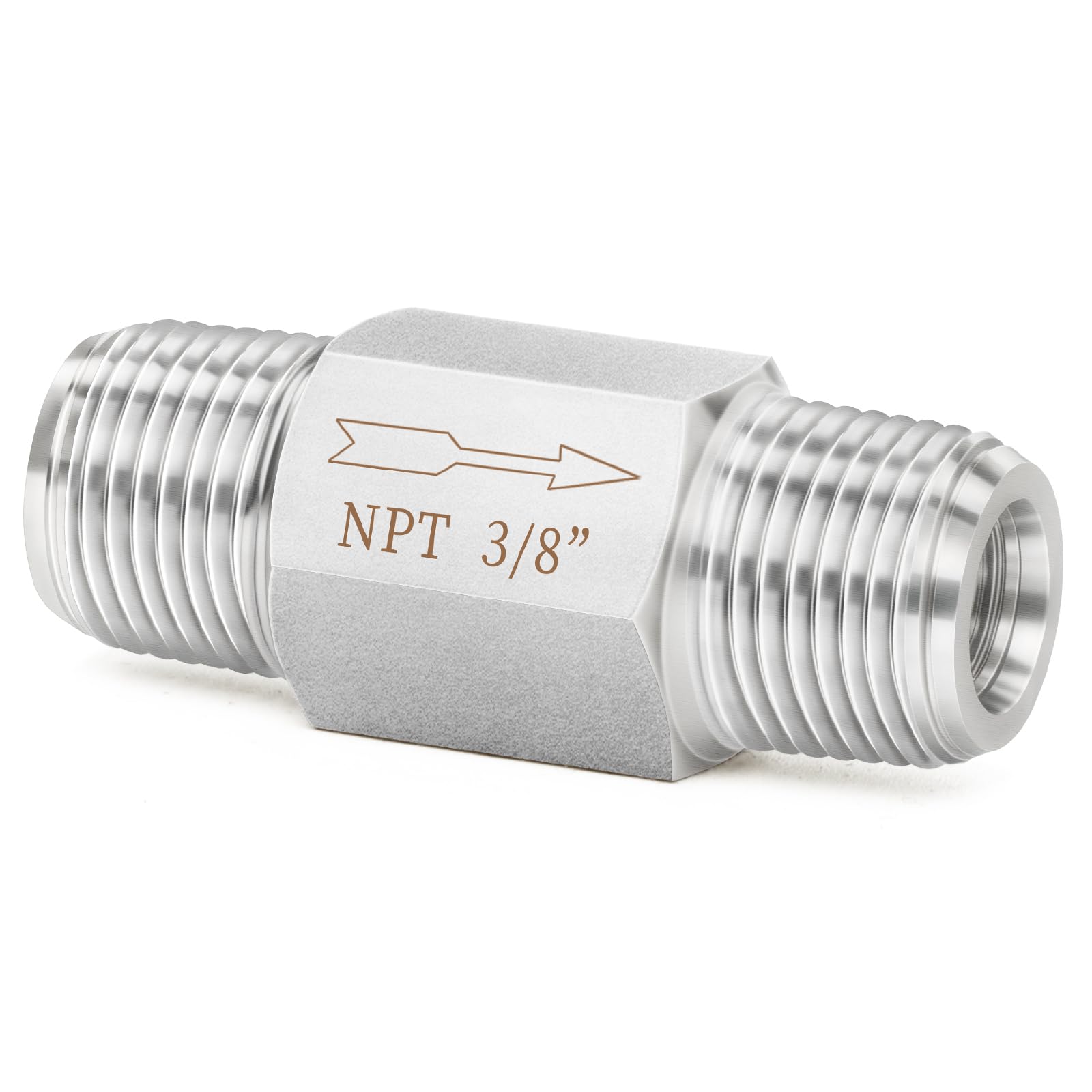
The overbuilt stainless steel valve that handles extreme pressure without flinching.
You need this valve when you are pushing high pressure through a compressor, a water pump, or a pneumatic system. The ChillWaves is built from 304 stainless steel (a tough, rust-resistant steel alloy) and is rated for a massive 2800 PSI — a rating of 2800 PSI versus the TAISHER’s 600 PSI. It only lets fluid flow one way (a “one-way non-return” setup), so the medium — gas, water, or oil — stays moving in the direction you want and cannot sneak backward.
The threads are male NPT (National Pipe Tapered) on both ends, so it is a “Siamese” style, meaning it fits directly between two female fittings. The body is thickened and the inner wall is polished smooth, which helps prevent mineral buildup over time. One reviewer with an air compressor setup noted that it “fixed the problem right away” and had been running fine for over 10,000 miles.
That said, the extreme pressure rating comes with a catch. One buyer reports that theirs “lasted 5 days on a system running 500psi” before a retaining piece broke — a clear reminder that even a 2800 PSI valve can fail if the internal spring or retainer has a defect. It also comes with a 1-year warranty for confidence.
Why It Stands Out
- Rated at 2800 PSI — enough headroom for almost any home or shop high-pressure system
- 304 stainless steel resists corrosion far better than standard brass or nickel-plated fittings
- Polished inner wall resists scaling and keeps flow smooth
The Real Trade‑Off
- One documented failure at 500 PSI suggests quality control can be inconsistent
- Male threads on both ends (Siamese) limit placement — you need two female ports
- Not meant for low-pressure gas below 15 PSI, as one buyer found
Reach for this if: your system runs high-pressure air or water and you want a valve that will not fail early — the 304 steel and 2800 PSI rating give you a real margin of safety.
Look elsewhere if: your setup uses a low-pressure gas line under 15 PSI or you need a male-to-female thread configuration — the Siamese style (male to male) limits its use.
2. TAISHER 304 Stainless Steel 3/8″ NPT Male to Female Check Valve

A well‑built stainless valve with a versatile male‑to‑female design and a comfortable pressure ceiling.
If you need a 3/8 check valve that fits a wider range of connections without adapters, this TAISHER is the pick. It uses a male NPT thread on one end and a female NPT thread on the other, which makes it much easier to drop into existing plumbing — you can thread it directly between a male fitting and a female port without extra parts. The maximum working pressure is 600 PSI, which covers most home and automotive air systems, irrigation lines, and oil circuits comfortably.
The body is 304 stainless steel just like the ChillWaves, so it resists rust and corrosion well, but it also meets ASME B16.34, ASTM, and MSS SP 80 standards (industry specs that verify the valve’s design and material quality). Its temperature range is broad: from -60°F up to 450°F, so it handles hot water or oil without seizing or cracking.
A reviewer who installed it on a Jeep noted it was “the part I needed for my jeep” and had no issues with leaks or seals. Buyers repeatedly call it good quality and effective for simple one-way flow jobs. The catch? Its maximum is 600 PSI; the ChillWaves is 2800 PSI — so if you need headroom over, say, 800 PSI, this is not the valve for that.
The Main Strengths
- Male-to-female design fits more setups without extra adapters
- Rated for -60°F to 450°F temperature extremes
- Meets ASME, ASTM, and MSS SP 80 industry standards
The Limitation
- 600 PSI cap, versus the ChillWaves’ 2800 PSI; not suitable for very high-pressure systems
- No long-term failure data from buyers — fewer high-mileage reviews than the Viair or ChillWaves
Grab this for: a straightforward mid-pressure water or air line where the versatile male-to-female threading saves you from buying two adapters — it just drops in.
skip it if: your system pushes beyond 600 PSI or you need a Siamese (male-to-male) design that goes directly between two female ports — this is male to female only.
3. Viair 3/8″ Female to 3/8″ Male NPT Check Valve, Nickel Plated Brass

The compact brass valve built for clean air systems that need a light cracking pressure.
The Viair is a completely different tool from the two stainless steel valves above. It is made of nickel-plated brass (a corrosion-resistant, smooth-fitting metal alloy, not the stainless steel of the other picks) and designed specifically for atmospheric air only — the maker says explicitly to avoid liquids or other gases. Its maximum operating pressure is 250 PSI, which is fine for most home or Jeep-mounted air compressors but significantly lower than the 600 PSI or 2800 PSI of the stainless models.
The stand-out spec here is the cracking pressure (the tiny amount of force needed to open the valve): just 6 PSI. That means it opens easily even with a small air compressor that does not build instant pressure — unlike the TAISHER or ChillWaves, which might need more back-pressure to crack open. It flows from the female NPT side to the male NPT side, so check your orientation before installing. The recommended torque is 12 to 15 ft-lbs, and Viair says to use thread sealant rather than Teflon tape.
Buyers found creative uses for it. One says it prevents backflow from a toilet bidet into a potable hot water line, “stops cold toilet water from cooling hot water in vanity.” Another mounted it on a Jeep’s on-board air system to keep “pressure is not held against the pistons of the pump.” The main caution: one reviewer flagged that the listing pictures male-to-female but the actual valve is female-to-male, so double-check the port direction before ordering.
The Standout Features
- Low 6 PSI cracking pressure opens easily on small compressors or low-flow systems
- Nickel-plated brass is compact and corrosion-resistant for dry-air environments
- Buyers confirm it works for both compressor air lines and bidet backflow prevention
The Real Catch
- 250 PSI limit is low compared to stainless steel valves; not for high-pressure water or oil lines
- Only for atmospheric air — the manufacturer bans liquids and other gases
- Female-to-male flow direction (not male-to-female) can confuse installation if you follow the listing photo
Best for: a portable air compressor or an on-board vehicle air system where you need a valve that opens easily at low pressure and keeps oil from back-flowing into the intake.
Not the one if: you are working with liquids, hot water, or high-pressure systems over 250 PSI — go with a stainless steel model instead.
Understanding the Specs
Maximum Working Pressure (PSI)
This number tells you how much internal pressure the valve can hold before it breaks, leaks, or its internal spring deforms. “PSI” stands for pounds per square inch — the force applied to every square inch of the valve’s interior. A valve rated at 2800 PSI, like the ChillWaves, has a huge safety margin for standard home tools (which run around 100-150 PSI). A 250 PSI valve like the Viair works for small compressors but will burst if you attach it to a high-pressure pump. Always pick a valve rated above your system’s maximum possible pressure.
Cracking Pressure
This is the minimum amount of pressure needed to push the valve open and let fluid flow. A low cracking pressure — like the Viair’s 6 PSI — means the valve opens easily from a small air compressor or a low-pressure water line. A higher cracking pressure might be needed to keep the valve closed under vibration. If you choose a valve with too high a cracking pressure for a very low-flow system, the valve may never open fully, restricting your flow.
FAQ
Can I use a 3/8 brass check valve for water lines?
What is the difference between male and female NPT threads on a check valve?
How do I know which way the valve flows?
Will a 600 PSI valve work on a 150 PSI air compressor?
What does cracking pressure mean for my application?
Can a 3/8 check valve leak?
Is a stainless steel check valve better than brass?
Why does one reviewer say a 2800 PSI valve failed at 500 PSI?
Can I use a Viair check valve for a water bidet?
What tools do I need to install a 3/8 check valve?
Final Thoughts: The Verdict
For the majority of shoppers, the 3/8 check valve winner is the TAISHER 304 Stainless Steel because it offers the best balance of high-quality 304 stainless construction, a versatile male-to-female thread design, and a 600 PSI rating that covers nearly all home and automotive systems. If you need to handle extreme pressure up to 2800 PSI, grab the ChillWaves. And for a lightweight air-compressor or bidet backflow job with a low 6 PSI cracking pressure, the compact Viair is a solid budget pick.
How We Picked
We do not accept paid placement. Every pick is matched to a real buyer and a real use-case; we do not hands-on test units.
Sources & Methodology
Specifications: manufacturer listings and product documentation. Review insights: verified customer reviews, as of July 2026. Pricing: not shown on this page (it changes often); check the current price via the retailer link.
As an Amazon Associate, Gadgets Feed earns from qualifying purchases. This does not affect which products we feature.
Related Guides
Product prices and availability are accurate as of the date/time indicated and are subject to change. Any price and availability information displayed on Amazon at the time of purchase will apply to the purchase of this product. As an Amazon Associate I earn from qualifying purchases.
CERTAIN CONTENT THAT APPEARS ON THIS SITE COMES FROM AMAZON. THIS CONTENT IS PROVIDED "AS IS" AND IS SUBJECT TO CHANGE OR REMOVAL AT ANY TIME.
Amazon and the Amazon logo are trademarks of Amazon.com, Inc. or its affiliates.