
Our readers keep the lights on and my morning glass full of iced black tea. As an Amazon Associate, I earn from qualifying purchases.
Specs are compiled from manufacturer listings and verified buyer reviews and can change over time — please confirm the key details on the product page before buying.
You want to breathe cleaner air without guessing which specs matter. Most purifiers look similar, but their real performance — cleaning speed and operating cost — varies dramatically. This guide focuses on two key specs: coverage area and filter type. That way, you choose a purifier that matches your specific air quality needs, not just its appearance.
I’m Min — the founder and writer behind Gadgets Feed. This guide is built by comparing the manufacturers’ published specifications and the patterns across verified customer reviews, so you get each pick’s real strengths and trade-offs instead of marketing spin.
Your best choice depends on room size, the pollutants you face, and your tolerance for filter replacement costs. We evaluated seven leading models to find the best fit for each scenario. This breakdown of the best air purifier will help you pick one that actually works for your home.
Quick Picks
- LG PuriCare 360 (AS601HBB0) — Best Overall
- WINIX 5520 — Odor Buster
- AirDoctor AD3500 — Hospital Grade
- Nuwave Forever Smart Air Purifier — Never Replace Filters
- LEVOIT Core 300-P — Smart Value
- DAYETTE AP308 — Pet Owner’s Pick
- GermGuardian AC4825E — Budget Champion
How To Choose The Best Air Purifier
Choosing an air purifier boils down to three factors: room size, target particles, and acceptable noise and maintenance.
Start with the Room Size and CADR
The first spec to check is the Clean Air Delivery Rate (CADR) — a number given in CFM (cubic feet per minute) or m³/h that tells you how fast the unit can filter a specific pollutant like smoke, dust, or pollen. A good rule: the smoke CADR should be at least two-thirds of your room’s square footage. For a 300 square foot living room, you want a smoke CADR of at least 200. Many brands list a maximum coverage area, but that is often at one air change per hour — meaning it takes a full hour to filter all the air once. For better air quality, aim for four to five air changes per hour, which lowers the effective room size the unit can handle.
Filter Technology: HEPA vs. Carbon vs. Everything Else
A True HEPA (High-Efficiency Particulate Air) filter is the real standard: it captures 99.97% of particles as small as 0.1 microns (that is 0.3 millionths of a meter) — think dust, pollen, pet dander, and mold spores. If you have allergies, this is non-negotiable. An activated carbon filter uses charcoal to trap gases and odors, like cooking smells, pet smells, and VOCs (volatile organic compounds from paint or cleaners). Some premium units add an UltraHEPA or H14 HEPA stage for even finer particles, but for most homes True HEPA is plenty. A few models now offer washable or permanent filters, which cuts out the recurring cost of replacements — a big savings over a few years.
Noise, Power, and Maintenance
A purifier that roars like a jet engine on high speed will push you out of the room. Look for a sleep mode around or below 24 dB (decibels) — that is quieter than a whisper, and good for a bedroom. Also check the filter replacement schedule: most units recommend a new HEPA filter every 6 to 12 months, and the cost varies a lot. A cheap purifier with expensive filters can cost more over a few years than a mid-range model with a washable pre-filter. Finally, check the power: most purifiers run on standard 120V household power in the US.
Quick Comparison
| Model | Best For | Coverage (1 Hr) | Weight | CADR (Smoke) | Amazon |
|---|---|---|---|---|---|
| LG PuriCare 360 | Large room, smart features | 2059 ft² | 14.9 lbs | — | $299.99Check Price |
| WINIX 5520 | Odor removal, value | 1882 ft² | 16.5 lbs | — | $179.99Check Price |
| AirDoctor AD3500 | Hospital-grade purification | 2520 ft² | 24 lbs | — | $559.00Check Price |
| Nuwave Forever | Zero filter cost, very large space | 2002 ft² | 21.85 lbs | — | $499.99Check Price |
| LEVOIT Core 300-P | Small room, quiet sleep | 1073 ft² | 7.9 lbs | 143 CFM | $99.00Check Price |
| DAYETTE AP308 | Pet owners, compact design | 3400 ft² | 5 lbs | 300+ m³/h | $107.99$119.99Limited time dealCheck Price |
| GermGuardian AC4825E | Budget-friendly, small room | 743 ft² | 8.55 lbs | — | $80.74$99.99Check Price |
In‑Depth Reviews
1. LG PuriCare 360 (AS601HBB0)
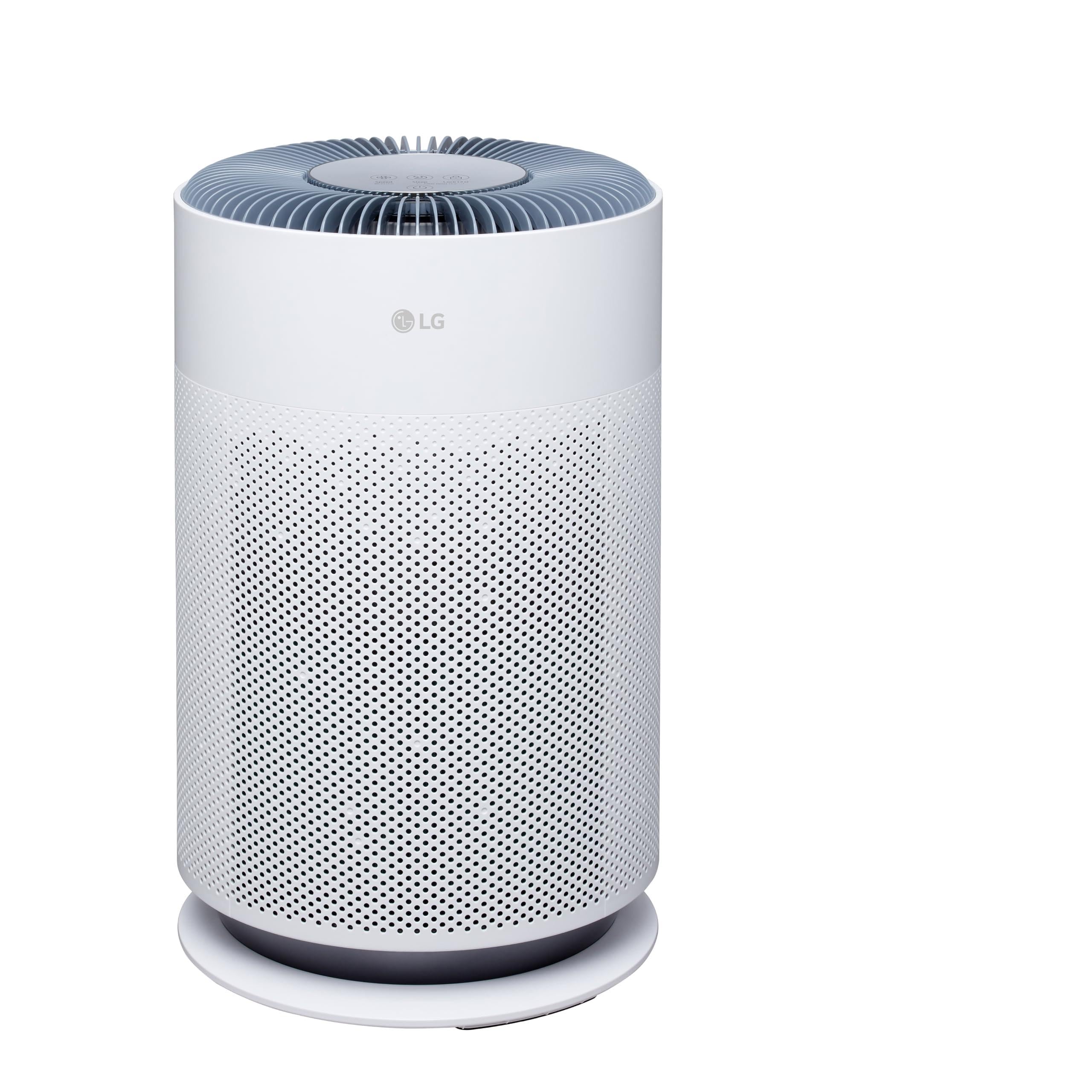
The premium pick that pulls double duty — covering huge spaces discreetly and quietly.
You almost forget it is running. The LG PuriCare 360 delivers whole-home purification for rooms up to 2,059 ft² in one hour, but its cylindrical, 20.1-inch-tall design is so compact and quiet that it blends right into your decor. The core technology here is a NanoFiber True HEPA filter that traps 99.97% of particles down to 0.3 microns, but the real differentiator is the PM 1.0 sensor — it detects particles as small as one micron (one millionth of a meter), giving you a more complete readout of the air quality. Buyers report that it is noticeably “quieter than Windmill, Coway Airmega, Pure” and that it eliminates cooking smells in real time.
The intelligent LED indicator on top shifts from red to green as the air cleans up, and the 360-degree intake makes sure it pulls dirty air from every corner. In terms of raw numbers, it covers 2,059 ft² at one air change per hour, but if you run it at 4.8 air changes per hour that drops to 429 ft² — a great range for open-plan living rooms. It weighs 14.9 pounds and measures 12.4 x 12.4 x 20.1 inches.
Standout quality: The whisper-quiet auto and sleep modes — owners mention it is barely audible from one foot away, making it an easy choice for a nursery or bedroom.
The trade-off: The optional smoke pre-filter is an extra purchase, and the app setup requires some patience to link with Alexa or Google Home.
Reach for this if: You want a near-silent unit that handles both large open spaces and small bedrooms using smart sensors and a polished app.
Look elsewhere if: You do not need smart features and just want a simple dial-and-forget purifier — the setup process may feel unnecessary.
2. WINIX 5520
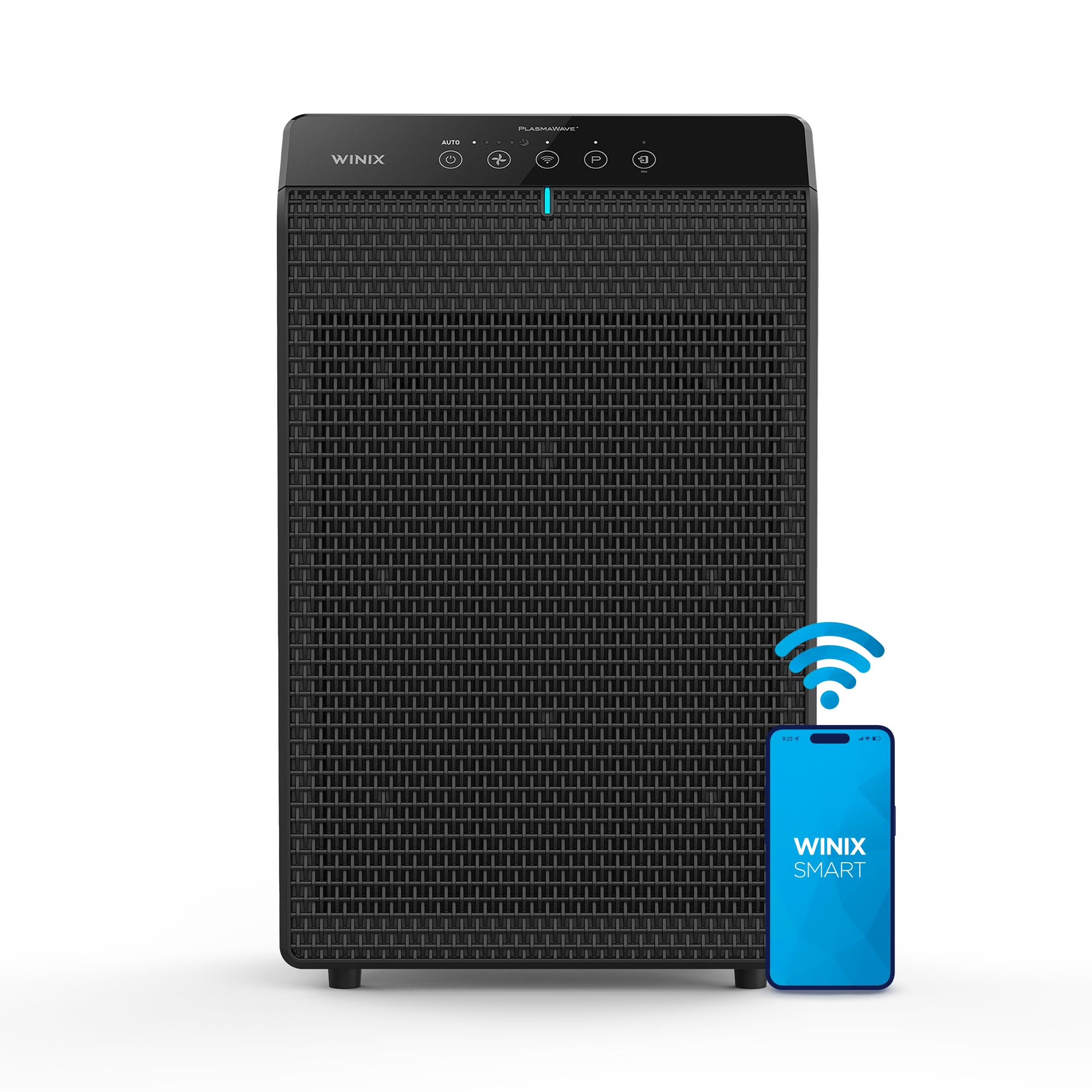
The workhorse with four layers of filtration that actually outlasts its competition.
If you live somewhere with wildfire seasons, this is the one buyers pick. The WINIX 5520 is a 16.5-pound tower that stands 23.6 inches tall and covers an LHAM-verified 392 sq. ft. at four air changes per hour — but it can cycle a room up to 1,882 sq. ft. in one hour. Its real strength is odor control: the Advanced Odor Control Carbon Filter reduces VOCs (volatile organic compounds, the chemicals in smoke and fumes) and smells from cooking and pets, while the Plasmawave ionizer (an electronic cleaner you can turn off) pushes smaller particles to settle. One reviewer wrote that “we only have to deal with wildfire smoke when we venture outside” after running this unit.
Unlike the LG, the WINIX is heavier — it weighs 16.5 pounds compared to the LG’s 14.9 pounds, and its dimensions are 8.3 x 13.6 x 22.7 inches. The washable Fine Mesh Pre-Filter catches large dust and hair before they reach the HEPA, letting the main filter last about 12 months — a big savings versus many brands that recommend changes every 3 months. It runs nearly silent at 23.5 dB (decibels) on its lowest speed, and the auto mode with a real-time air quality indicator (blue/amber/red) is truly set-and-forget.
Advantage over LG: The 4-layer filtration system (washable pre-filter + activated carbon + True HEPA + Plasmawave) and the year-long filter replacement cycle mean lower long-term cost.
The catch: The Alexa integration is reported as “not true Alexa integration” — the app setup is clunky and some buyers skip it entirely, using the unit manually instead.
Best for: Anyone dealing with cooking smells, pet odors, wildfire smoke, or VOCs — the odor control is head and shoulders above similarly priced units.
Not for: Tech lovers who want smooth voice control; if you do not mind pressing a button, this unit is excellent on its own.
3. AirDoctor AD3500
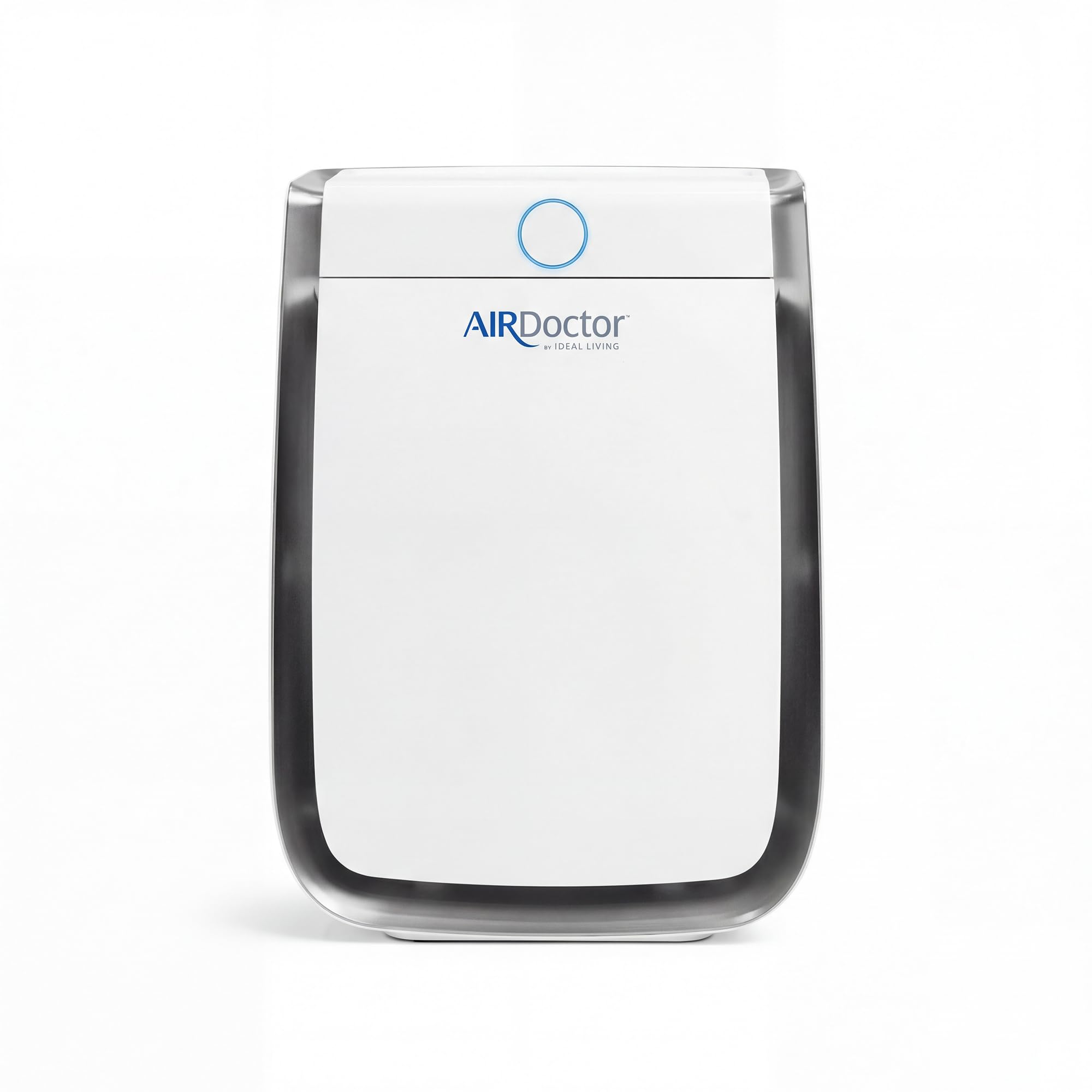
For those who want true medical-grade filtration and do not mind a bigger footprint.
The AirDoctor AD3500 is the heaviest unit in this roundup at 24 pounds, but that weight houses a serious filtration system. It uses UltraHEPA technology to capture 99.99% of airborne particles at 0.003 microns — compared to the standard HEPA’s 0.3 microns. In real terms, it clears a room as large as 2,520 ft² in one hour and can clean a 630 ft² space in just 15 minutes. The three-stage process includes a premium activated carbon filter packed with potassium permanganate (a chemical that traps gases) to handle gases, cooking fumes, and wildfire smoke.
Buyers with severe allergies and asthma are particularly emphatic about this unit. One reviewer wrote: “I have very bad Asthma and COPD… I recommend this above any others.” Another noted that the auto mode “detects cooking/nebulizer treatments” and adjusts fan speed instantly. The Halo display shows color-coded PM2.5 (particulate matter 2.5 microns and smaller) levels in real time. Dimensions are 19.87 x 27.16 x 12.38 inches — it is tall and wide, so plan where it will sit. Replacement filters are pricey (around every 6 months for carbon, annually for UltraHEPA), but the unit is FSA and HSA eligible (you can use tax-free healthcare spending accounts).
Key differentiator: The UltraHEPA filter catches particles down to 0.003 microns, compared to a standard HEPA’s 0.3 microns — making it a top pick for medical-grade needs.
The real downside: Genuine replacement filters are expensive and need to be swapped every 6 to 12 months, which adds a recurring cost that budget-conscious buyers should plan for.
Reach for this if: You or a family member has asthma, COPD, or severe allergies and you want the most thorough filtration available for a large home.
Step away if: You are on a tight budget or want low-maintenance washable filters — the ongoing filter cost may creep up on you.
4. Nuwave Forever Smart Air Purifier

The purifier that promises you will never buy a filter again — and delivers.
The Nuwave Forever is a radically different approach. Instead of disposable paper or fiberglass filters, it uses seven stages of cleanable metal and Bio-Guard filtration media that you simply vacuum or wash with warm water. The result: no recurring filter costs, ever. It handles rooms up to 2,002 ft² in one hour, and Intertek lab certification confirms it captures 100% of particles down to 0.3 microns. It also reduces ozone levels to 1 ppb (parts per billion), which guarantees CARB (California Air Resources Board) compliance — meaning it is safe and does not emit harmful ozone.
Weighing 21.85 pounds and measuring 13 x 14.25 x 22.81 inches, it is one of the larger units here, but buyers praise its performance with heavy pet dander — one owner of four large dogs reported “noticeably cleaner, crisp air” and reduced allergies. The washable filters need about 24 hours to dry after cleaning, so you may want to have a quick-dry plan. The WiFi app allows full control and scheduling, and the adjustable flow panel directs air where you need it.
Standout advantage: The washable, reusable filters eliminate the single biggest recurring cost in air purification — and buyers confirm the performance holds up even after many cycles.
The trade-off: Cleaning the filters takes time and they require a full 24-hour drying period; the unit is also relatively loud on fan levels above 3.
Perfect for: Anyone who hates the subscription-like cost of replacement filters and wants a large-room purifier that pays for itself over time.
Skip if: You want a low-maintenance experience and do not want to plan around a 24-hour filter-drying cycle.
5. LEVOIT Core 300-P

The compact champion that punches way above its weight for smaller rooms.
If you are shopping for a bedroom or an office, the LEVOIT Core 300-P might be your perfect match. At just 7.9 pounds and 8.7 inches wide, it is the lightest and most portable unit here — yet it packs a 56W (watt) high-torque motor delivering a CADR (Clean Air Delivery Rate) of 143 CFM for smoke, 153 CFM for dust, and 167 CFM for pollen. That translates to cleaning a 222 ft² room 4.8 times per hour, or a 1,073 ft² room once per hour. The 3-in-1 filter is HEPA-grade and filters 99.97% of particles from 0.1 to 0.3 microns.
One thing that sets the Core 300-P apart is Sleep Mode, which uses QuietKEAP Technology to drop the noise to a near-silent 24 dB. Customers note it “filters kitchen smells and incense in ~20 min on high” and is barely noticeable on levels 1-2. The touch controls allow a timer (2, 4, 6, or 8 hours) and a display-off function for zero light distraction at night. It is AHAM Verifide (independently tested by the Appliance and Home Appliance Manufacturers group), FCC Certified, ETL Listed, and CARB Compliant.
Why it beats the competition: At 7.9 pounds it is far more portable than the WINIX (16.5 pounds), making it easy to move from bedroom to office as needed, and the 24 dB sleep mode is genuinely silent.
The trade-off: Small footprint means a smaller filter — you will need to swap filters periodically, and the motor is 120V only (not suitable outside the US).
Reach for this if: You need a quiet, effective air purifier for a bedroom, home office, or small apartment where space is tight.
Step away if: You need to cover an entire open-plan home — this unit is best as a single-room solution.
6. DAYETTE AP308
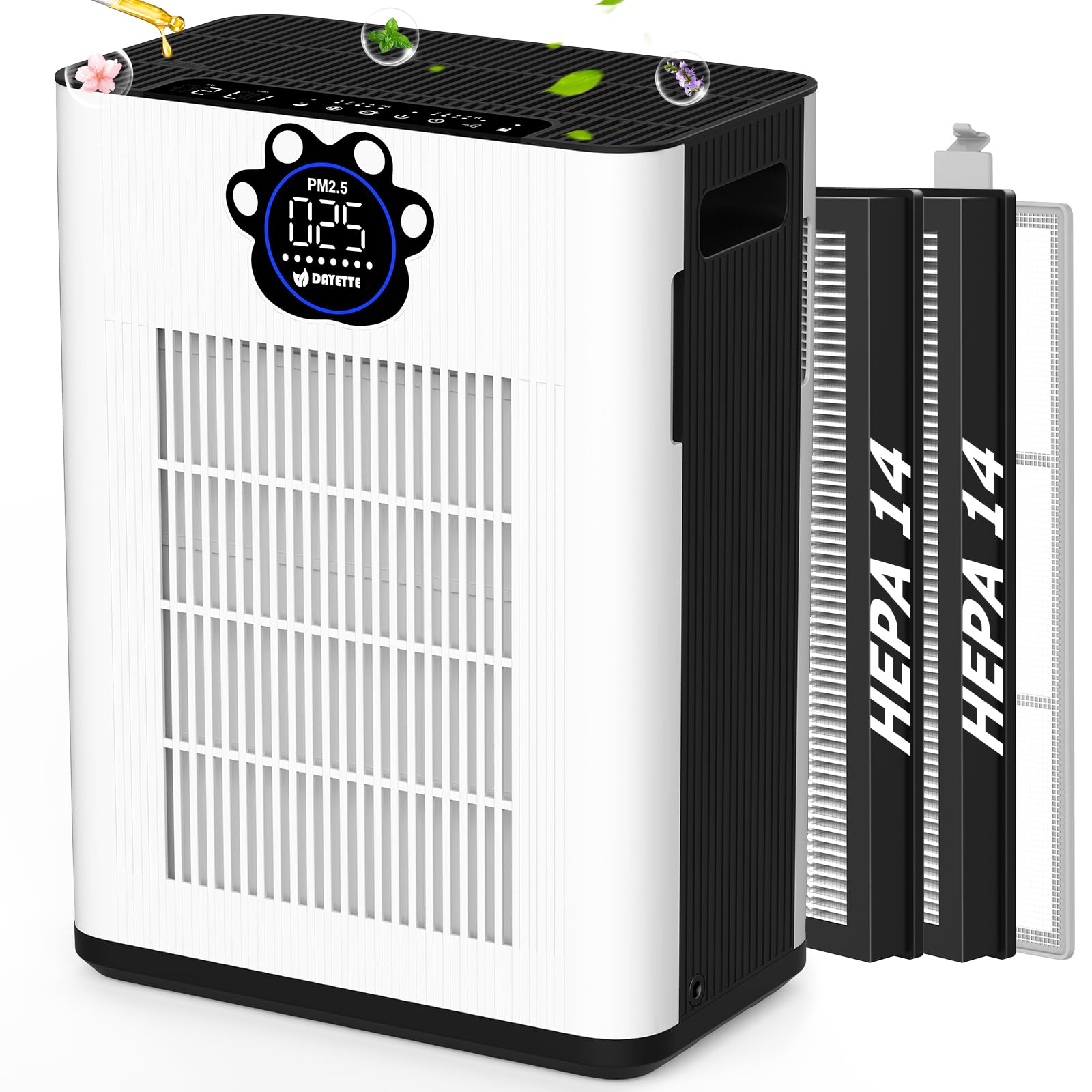
The featherweight that climbs without wheezing — and targets pet smells.
At just 5 pounds and measuring only 5 x 12 x 15 inches, the DAYETTE AP308 is an outlier. It is the lightest unit in this roundup by a huge margin (compare to the WINIX at 16.5 pounds). Yet it claims an enormous maximum coverage of 3,400 ft² in one hour in Pet Mode. The trick is a double-sided air intake with two H14 HEPA filters (the highest residential HEPA rating, filtering 99.995% of particles down to 0.3 microns) that work in parallel to speed up purification. It also packs dual smart sensors (TVOC + PM2.5) — one for total volatile organic compounds and one for fine particulate matter — that adjust fan speed automatically, with a color-coded display showing blue (very good) to red (bad).
Buyers like the “compact, quiet, energy-efficient” design and note that replacement filters are cheap. The Pet Mode is engineered for max fan speed when you need it most, like after a smelly dog walk. The Sleep Mode drops to 22 dB, quieter than a whisper, and an aromatherapy diffuser slot lets you add essential oils for a scent boost. The dual H14 HEPA system includes washable nylon pre-filters for large pet hair, plus activated carbon pellets for odor.
Key spec advantage: At 5 pounds and 5 x 12 x 15 inches, it is dramatically more portable than the WINIX 5520 (16.5 pounds, 15.4 x 8.5 x 23.6 inches) — making it the easiest purifier to move from room to room.
The trade-off: The massive 3,400 ft² coverage claim in Pet Mode is based on one air change per hour; in practice, smaller rooms will see better performance.
Best for: Pet owners who need a lightweight unit they can carry between rooms, with dual sensors and a dedicated pet mode that really ramps up the power.
Not for: Those who want a heavy-duty, permanent fixture — this one feels almost too light to be serious, but the specs make up for it.
7. GermGuardian AC4825E

The tried-and-true tower that proves effective filtration does not have to be expensive.
Few air purifiers have the staying power of the GermGuardian AC4825E, which has been around since 2011 and remains a top seller. This tower stands 22 inches tall and covers a small bedroom of 153 sq. ft. every 12.5 minutes, or a larger space of 743 sq. ft. in one hour. The True HEPA filter captures 99.97% of allergens as small as 0.3 microns, while the optional UV-C light (ultraviolet light that kills germs) helps reduce airborne particles. The activated carbon filter targets scents from cooking and pets.
Reviewers consistently mention it is “easy to use” and that it “eliminated cooking and nail polish smells.” It uses a simple 3-speed dial and a UV button — no apps, no confusion. The washable first filter extends the life of the main HEPA, which one reviewer noted is a “yearly replacement.” At 8.55 pounds, it is relatively light and easy to move. It is CARB Certified, ETL Certified, and Zero Ozone Verified. The trade-off? On high speed it is slightly noisy, but most users agree that speed 1 or 2 is very quiet.
Why it still competes: Simple, effective, and affordable — the UV-C light and washable pre-filter add real value for the price, and the yearly filter replacement schedule is standard.
What to know: It has no air quality sensor or auto mode, so you have to manually adjust the dial speed; also, some buyers find the UV light a minor gimmick.
Reach for this if: You want a no-fuss, budget-friendly purifier for a small bedroom or dorm that still offers True HEPA and UV-C cleaning.
skip it if: You need smart sensors, auto-mode, or a very quiet operation for a nursery — the high speed noise may be too much for a baby’s room.
Understanding the Specs
True HEPA vs. HEPA-type vs. UltraHEPA
A True HEPA filter is independently tested to capture 99.97% of particles as small as 0.3 microns. That is the standard that matters for allergy sufferers. “HEPA-type” filters are thinner, less effective, and often just marketing. UltraHEPA captures down to 0.003 microns — great for medical-grade use, but overkill for most homes. In this list, every unit except possibly some budget options uses genuine True HEPA or better. Always check for the certification; if the box says “True HEPA,” you can trust it.
CADR (Clean Air Delivery Rate)
CADR is a number given in CFM (cubic feet per minute) or m³/h that measures how quickly a purifier cleans smoke, dust, and pollen. A higher CADR means faster cleaning. A good guideline: the smoke CADR should be at least two-thirds of your room’s square footage. For a 200 ft² room, you need a smoke CADR of about 133 CFM. The LEVOIT Core 300-P, for instance, has a smoke CADR of 143 CFM, making it effective for rooms up to roughly 215 ft². The DAYETTE boasts a CADR of 300+ m³/h, which is very high.
FAQ
What size air purifier do I need for my bedroom?
How often do I need to replace the filters?
Can an air purifier help with pet dander and pet smells?
Will an air purifier help with wildfire smoke?
Is it safe to run an air purifier 24/7?
What does AHAM Verifide mean?
Does the UV-C light really kill germs?
Are washable filters as effective as disposable ones?
Final Thoughts: The Verdict
For most people, the best air purifier overall is the LG PuriCare 360 because it combines near-silent operation with a powerful NanoFiber True HEPA filter and smart sensors that cover up to 2,059 ft². If you want advanced odor control and a longer filter life, grab the WINIX 5520. And for someone who hates the thought of buying replacement filters year after year, the standout is the Nuwave Forever — a one-time purchase that keeps cleaning.
How We Picked
We do not accept paid placement. Every pick is matched to a real buyer and a real use-case; we do not hands-on test units.
Sources & Methodology
Specifications: manufacturer listings and product documentation. Review insights: verified customer reviews, as of July 2026. Pricing: not shown on this page (it changes often); check the current price via the retailer link.
As an Amazon Associate, Gadgets Feed earns from qualifying purchases. This does not affect which products we feature.
Related Guides
Product prices and availability are accurate as of the date/time indicated and are subject to change. Any price and availability information displayed on Amazon at the time of purchase will apply to the purchase of this product. As an Amazon Associate I earn from qualifying purchases.
CERTAIN CONTENT THAT APPEARS ON THIS SITE COMES FROM AMAZON. THIS CONTENT IS PROVIDED "AS IS" AND IS SUBJECT TO CHANGE OR REMOVAL AT ANY TIME.
Amazon and the Amazon logo are trademarks of Amazon.com, Inc. or its affiliates.